by Maximillian Alvarez | Jul 2, 2026 | east palestine, Economy, Economy and Inequality, labor, Politics and Movements: US, sacrifice zones, video, Working People
From the explosion of AI data centers to the increasing number of toxic spills, explosions, and industrial disasters happening across the country, corporations and the government are turning the USA into one giant “sacrifice zone.”
Things are going to get worse before they get any better, and nothing is going to change unless residents of different sacrifice zones and poisoned communities, workers and unions on the frontlines of the industries poisoning us, environmental justice groups, community and faith organizations, scientists, journalists, and all others who have a stake in this fight start coming together, working together, and fighting back together. In this special panel discussion, recorded at the 2026 Railroad Workers United convention in Chicago, Illinois, we speak with a panel of guests who are part of a new coalition that is doing just that.
Panelists include: Jeff Kurtz, a retired locomotive engineer, union officer, and Railroad Workers United member who also served as a state representative in the Iowa House of Representatives; Jami Wallace, a resident of East Palestine, Ohio, and founder of the Chemically Impacted Communities Coalition (CICC); Dr. Nicole Fabricant, a professor of anthropology at Towson University and scholar-activist who has been working with chemically impacted communities in South Baltimore, Maryland, for 15 years; Scott Smith, independent testing expert and founder of the Blue Shirt Justice League; and Lesley Pacey, Senior Environmental Officer at the Government Accountability Project.
Additional links/info:
Railroad Workers United website, Facebook page, and X page
Chemically Impacted Communities Coalition (CICC) Facebook page
Blue Shirt Justice League website and Facebook page
Government Accountability Project website, Facebook page, X page, Bluesky page, and Instagram
Coal-Free Curtis Bay Facebook page and Instagram
South Baltimore Community
by Mansa Musa | Jun 30, 2026 | Black Panthers, Politics and Movements: US, Racial Justice, Rattling the Bars, Socialism, video
This year marks the 60th anniversary of the Black Panther Party, founded in Oakland, California, in 1966. On this episode of Rattling the Bars, host Mansa Musa speaks with Dr. Joy James and Dr. K. Kim Holder about the legacy of the Panthers today, and about the important differences and intersections between democratic socialism and the Black Panther model of communalism.
This is Part 1 of a two-part conversation. Subscribe to TRNN and stay tuned for Part 2 next week.
Guests:
Dr. Joy James is Ebenezer Fitch Professor of Humanities at Williams College. She is the author of numerous books, including: In Pursuit of Revolutionary Love; Resisting State Violence; and Shadowboxing: Representations of Black Feminist Politics. Creator of the digital Harriet Tubman Literary Circle at UT Austin, James is also editor of The New Abolitionists: (Neo)Slave Narratives and Contemporary Prison Writings; Imprisoned Intellectuals; Warfare in the American Homeland; The Angela Y. Davis Reader; and co-editor of the Black Feminist Reader.
Dr. K. Kim Holder is an assistant professor of educational foundations and Africana studies at Rowan University. Dr. Holder earned his doctorate from the University of Massachusetts Amherst in Multicultural Education and African American Studies, his masters in Early Childhood Education from Bank Street College of Education, and B.A. in History from Hampshire College.
Credits:
Producer / Videographer / Editor: Cameron Granadino
Transcript
The following is a rushed transcript and may contain errors. It will be updated as soon as possible.Mansa Musa:
This year marks the 60th anniversary of the Black Panther Party founded in Oakland, California in 1966. Today we’ll be discussing the history of the Black Panther Party with two people that are intricately involved with the
by Maximillian Alvarez | Jun 29, 2026 | elections, midterms, Politics and Movements: US, Racial Justice, video, Voting Rights
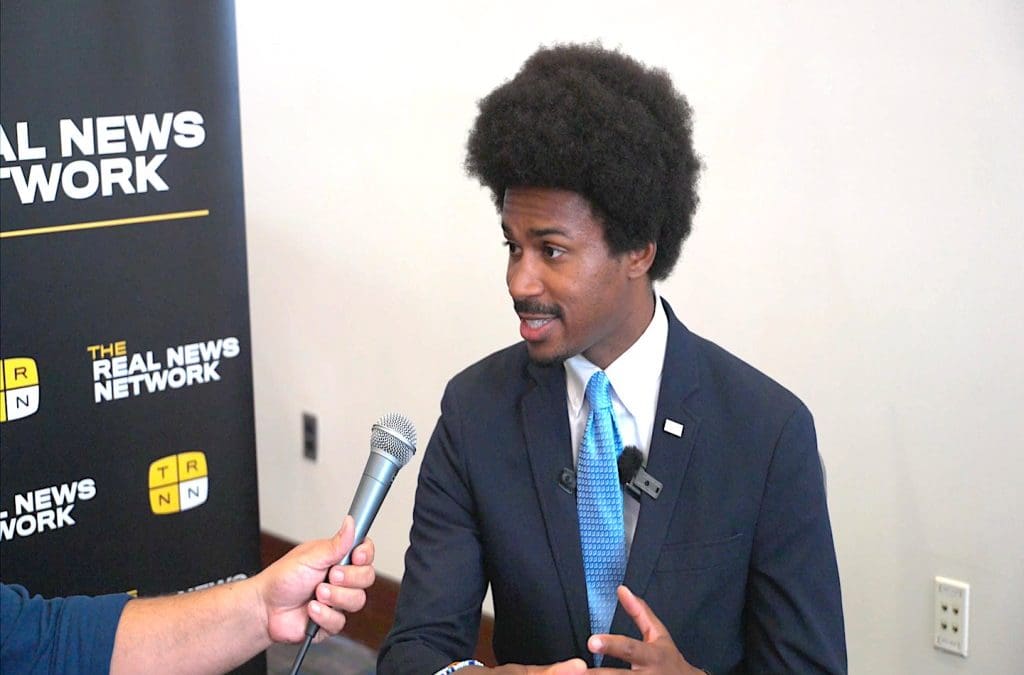
After an April decision by the US Supreme Court gutted the 1965 Voting Rights Act, Tennessee became the first state to redraw its Congressional district maps, resulting in the 9th District—a solidly Democratic seat representing the only majority-Black district in the state—being erased. We speak with Tennessee State Representative Justin Pearson, who has been running to represent Tennessee’s 9th District in the US House of Representatives, about why he is still running despite Republicans’ attempts to rig the electoral process, and what is at stake for Tennessee and the country this midterm election season.
Additional links/info:
Philip Wang, Time, “They gerrymandered away the district he’s campaigning to represent. He’s still running”
Leigh Cuen, The Tennessean, “Photojournalist shares story behind viral TN redistricting photos”
Credits:
Videography: Stephen Janis, Maximillian Alvarez
Post-Production: David Hebden
Transcript
The following is a rushed transcript and may contain errors. It will be updated as soon as possible.
Maximillian Alvarez:
We’re here in Philadelphia at the 2026 Net Roots Conference and I’m sitting with Representative Justin Pearson from the Tennessee House of Representatives who is now running for the US House of Representatives. Representative Pearson, thank you so much for joining us. I know you only have a few minutes and we got so much to talk about, so I kind of want to just throw a couple things at you and let you go, right? I got you. Tennessee was the first state to redistrict its congressional maps after this Supreme Court hearing. So you were at the center of that. What the heck can people do about this attempt to rig the midterm elections and everything moving forward? Second, you are in Memphis, one of
by Mansa Musa | Jun 23, 2026 | baltimore, Media Criticism, Policing, Politics and Movements: US, Prisons and Policing, Rattling the Bars, video
A new, thought-provoking documentary hits theaters this summer. Beyond the Wire, by filmmaker and researcher Dr. S. Rasheem, offers a powerful counternarrative to the popular crime series The Wire. In this exclusive, one-on-one interview between Dr. Rasheem and Rattling the Bars host Mansa Musa, they explore how her background in community organizing compelled her to tell a different story of Baltimore—one focused on the boots-on-the-ground activism that defies the narrative of a hopeless, crime-ridden city in need of over-policing. Premiering this June, Beyond the Wire is already being hailed by critics and organizers alike as an indispensable representation of “The Greatest City in America.”
Credits:
Producer / Videographer / Editor: Cameron Granadino
Transcript
The following is a rushed transcript and may contain errors. It will be updated as soon as possible.
Mansa Musa:
Welcome to this edition of Rattling the Bars. I’m your host, Mansa Musa. A new documentary Beyond the Why, which provides a powerful counter narrative to the popular crime series, The Wire is premiering this month. Today I’m honored and joined by the filmmaker, Dr. S. Rasheen. Welcome to the show, Dr. Rashid.
Dr. S. Rasheem:
Thank you so much for having me. I’m really excited to be here. All
Mansa Musa:
Right tell our audience a little bit about yourself and more importantly, your background and community organizing.
Dr. S. Rasheem:
Yeah. So my background as it relates to this work, how I came to even being able to a point where I’m doing filmmaking, I’ll also share that. So I am a social scientist by socialization and training. So it just means that I largely study people, large populations of people. The people that I particularly focus
by Maximillian Alvarez | Jun 23, 2026 | education, ICE, Israel, Palestine, Politics and Movements: International, Politics and Movements: US, video, Working People
We sit down with Dr. Steven Thrasher to talk about his new book, The Overseer Class; how our police state today evolved from yesterday’s slave plantations; and why Dr. Thrasher has been blacklisted from academia after defending his students at Northwestern University during the Palestine encampment movement in 2024.
Guests:
Steven W. Thrasher, PhD, is the author of The Overseer Class: A Manifesto and the award-winning book The Viral Underclass: The Human Toll When Inequality and Disease Collide, which was a New York Times’s Paperback Row Editors’ Pick, named one of the Best Nonfiction Books of 2022 by Kirkus Reviews, was longlisted for both the PEN/John Kenneth Galbraith Award for Nonfiction and the Carnegie Medal for Excellence in Nonfiction Literature, and won the 2023 POZ Award for Best in Literature. He is also the inaugural Daniel Renberg Chair for Social Justice in Reporting at the Medill School of Journalism and a faculty member of Northwestern University’s Institute of Sexual and Gender Minority Health and Wellbeing. An internationally renowned scholar on race, gender, and infectious disease, Dr. Thrasher’s writing has been published by the Guardian, Atlantic, New York Times, Scientific American, Literary Hub, and in many academic journals.
Credits:
Studio Production / Post-Production: David Hebden
Transcript
The following is a rushed transcript and may contain errors. It will be updated as soon as possible.
Dr. Steven Thrasher:
So I did stand between the students and the cops. I got beat up for it and I survived. It wasn’t that bad at the time and the students had an encampment for five days. But then a few weeks later, Congress called our president to the Hill and Congressman Jim Bank
by Mansa Musa | Jun 17, 2026 | Fascism, history, Politics and Movements: International, Politics and Movements: US, Rattling the Bars, Trump, video
In Part 2 of a conversation between Mansa Musa (former political prisoner and Black Panther) and Alberto Toscano (professor of critical theory and author of Late Fascism), the two discuss how consent and coercion operate within US civil society and abroad. They specifically unpack how Donald Trump’s domestic and foreign platforms animate white nationalism—relying on the explicit promise of state violence against targeted populations.
Guests:
Alberto Toscano is a renowned Italian cultural critic, social theorist, philosopher, translator, and adjunct professor at the Simon Fraser University School of Communication. Toscano is a columnist at In These Times and the (co-)author of numerous books, including: Late Fascism: Race, Capitalism and the Politics of Crisis; and Fanaticism: On the Uses of an Idea.
Credits:
Producer / Videographer / Editor: Cameron Granadino
Transcript
The following rushed transcript may contain errors. It will be updated as soon as possible.
Mansa Musa:
Gramsci wrote about consent and coercion. Talk about the difference when it comes to a targeted population of prisons and policing.
Alberto Toscano:
Yeah. So that relationship between consent and coercion or in Gramsci’s terms also hegemony and domination or consent and force is really crucial. Gramsci was enough of a realist about politics. After all, he was also a very brilliant reader of Machiavelli that he never thought that force or coercion could be eliminated from politics altogether, but he was very interested in looking both at the past and the present to think about the mix of force and coercion, hegemony and consent. That’s also why he was so interested in the question of policing and of how to conceive of the police. And on could argue that the expansion of repression and incarceration is always a