by Mansa Musa | Sep 15, 2026 | Civil Rights, Politics and Movements: US, Prison Industrial Complex, prison reform, Prisons and Policing, Rattling the Bars, video
After running a historic campaign to unseat a criminal court judge for the first time in Nashville, Courtney Teasley created the legal education company emeffen to inform working-class communities about their civil rights. From combating police abuse to supporting vulnerable populations targeted by the criminal justice system, Teasley is a business and legal powerhouse redirecting people toward civic engagement and political-economic acumen. In this heartfelt interview, Mansa Musa and Courtney Teasley discuss grounded community organizing and political education that subverts the carceral system’s goal of turning citizens into captives.
Related links:
Follow Courtney Teasley on Youtube, TikTok, Instagram, website.
Credits:
Production/Post-production: Cameron Granadino
Transcript
The following is a rushed transcript and may contain errors. It will be updated.
Mansa Musa:
Welcome to this edition of Rattling the Bars. I’m your host, Mansa Musa. Today we are joined by Courtney Teasley, who consider herself and identify herself as a legal disruptor and justice strategist. We’ll be discussing her perspective on how she is intervening in the criminal injustice system and her work challenging the prison industrial complex as it exists today. Thank you, Courtney. Welcome to Rattling the Bars.
Courtney Teasley :
Thank you so much for having me. I’m really excited. I’ve heard a lot about this podcast, and so thank you so much for this opportunity to talk to your audience.
Mansa Musa:
Okay. Let’s start by introduce yourself to our audience and tell our audience how you came into this space, but more importantly, what is a legal disruptor and a justice strategist? What’s your identity as how you identify those things? So tell us a little bit about yourself.
Courtney Teasley :
Yes. So my name is Courtney Teasley. I am
by Mansa Musa | Sep 15, 2026 | baltimore, Policing, Politics and Movements: US, Prisons and Policing, Rattling the Bars, video
On August 8th at the Real News Studio, a screening of the new documentary Beyond the Wire—directed by filmmaker Dr. S. Rasheem—was followed by a panel discussion featuring seasoned conflict mediation organizers from the film. The participants explored their grassroots efforts to challenge the corporate media establishment’s heavy emphasis on crime—which drives city policy and the local economy—and redefine Baltimore’s historical present as a city of abolition.
Credits:
Videographer: Cameron Granadino/David Hebden
Editor: Cameron Granadino
Transcript
The following is a rushed transcript and may contain errors. It will be updated.
Speaker 1:
I’m going to be super brief. I largely just want to, again, thank everyone for coming out. I’m the producer of this film, but I’m sure you guys know you can’t do something like this by yourself, right? So I want to also thank the Baltimore Legacy Project Youth Crew who’s outside, who took your. I mean, they’ve just been really on point getting B-roll setting up. Really appreciate them a lot. Also, the folks that you saw in the film, thank you so much for trusting me with your voice, your story. I don’t take that lightly. And when I say you don’t do it by yourself, one of the. Oh, I also want to shout out. She’s not in here, but the narrator is actually here too. She’s part of Baltimore Legacy Project Youth Crew in the front. Her name’s Empress. Yep. But someone who is definitely in the thick of all of this with me is there’s several cinematographers, but there was one person who was the lead cinematographer, more or less the director of photography on this project.
They were also the
by Taya Graham and Stephen Janis | Sep 15, 2026 | Democratic Party, Democrats, Inequality, Inequality Watch, midterms, Politics and Movements: US, video
David Sirota explains how consultants profit from massive television-ad purchases, how billionaire-funded super PACs influence the candidates and policies voters are offered, and how the language of “moderation” and “electability” is used to undermine progressive and populist challengers.We examine the consequences of legalized political corruption: Washington’s silence on America’s healthcare crisis, the widening gulf between voters and their representatives, and the 50-year campaign to transform elections into auctions while concentrating power in the presidency.David Sirota is the founder of the investigative news organization The Lever, a former speechwriter for Bernie Sanders, an Oscar-nominated co-creator of the story for the movie Don’t Look Up, and the producer of the podcast series Master Plan.
Additional links/info:
David Sirota and Jared Jacang Maher’s co-authored book, Master Plan: The Hidden Plot to Legalize Corruption in America
The Lever’s website, Instagram, and podcast series, Master plan
Credits:
Production: Stephen Janis, Taya Graham
Written by: Stephen Janis
Studio Production: Cameron Granadino
Post-Production: Stephen Janis, David Hebden
Transcript
The following is a rushed transcript and may contain errors. It will be updated as soon as possible.
Taya Graham:
Hello, my name is Taya Graham and welcome to the Inequality Watch Report, a show that examines government policy and action through the lens of extreme economic inequality, the existential issue of our time. Today, we’re going to discuss a topic that defines who holds power in America and how they keep it despite growing voter dissatisfaction amid a historic wealth imbalance. It’s a story of money, access, and self-enrichment that is at the root of the bad policies and broken institutions we all struggle with daily. And it’s an issue that transcends the nominal state of play in this country
by Michael Fox | Sep 15, 2026 | brazil, Latin America, Politics and Movements: International, Politics and Movements: US, Trump, video
President Luiz Inácio Lula da Silva launched his campaign for a fourth and final term before thousands of supporters in São Bernardo do Campo, promising to keep fighting poverty and investing in Brazil’s future. His challenger: Senator Flavio Bolsonaro, running in place of his father, former far-right President Jair Bolsonaro, who is under house arrest after being convicted of attempting a coup. US President Donald Trump has backed the Bolsonaros with tariffs, visa revocations, and open pressure — what experts call a new era of US dominance over Latin America.
Michael Fox reports from São Paulo, with voices from Lula’s campaign launch, evangelical Bolsonaro supporters on the streets of São Paulo, and foreign relations professor Igor Fuser.
Credits:
Filmed and edited by Michael Fox
Transcript
The campaigns are underway ahead of Brazil’s October elections
And U.S. President Donald Trump is doing his best to sway the vote…
“Lula, Lula!”
Thousands of supporters of leftist president Luiz Inácio Lula da Silva attended his campaign launch in mid August.
Karen Silva
“We came to support Lula, especially in his last election. And we believe that we are going to win. This is a fact.”
They filled May 1st Stadium in Sao Bernardo do Campo….
A place, where Lula led an iconic metal workers strike and rally in 1979.
They say Lula has changed their lives.
Raimunda Silva Santos
“Yeah, he changed my life. He changed the life of my whole family.”
During his years in office, he promoted education, health and social programs. He helped to lift millions from poverty. They have not forgotten.
Raimunda Silva Santos
“Wow, this is the greatest joy of my life. I’m 76 years old. I’m so happy. Lula is coming to stay. He’s an incredible person. He’s helped
by Ruwaida Amer, Belal Awad, and Leo Erhadt | Sep 15, 2026 | documentary, Gaza, Israel, Palestine, Politics and Movements: International, video
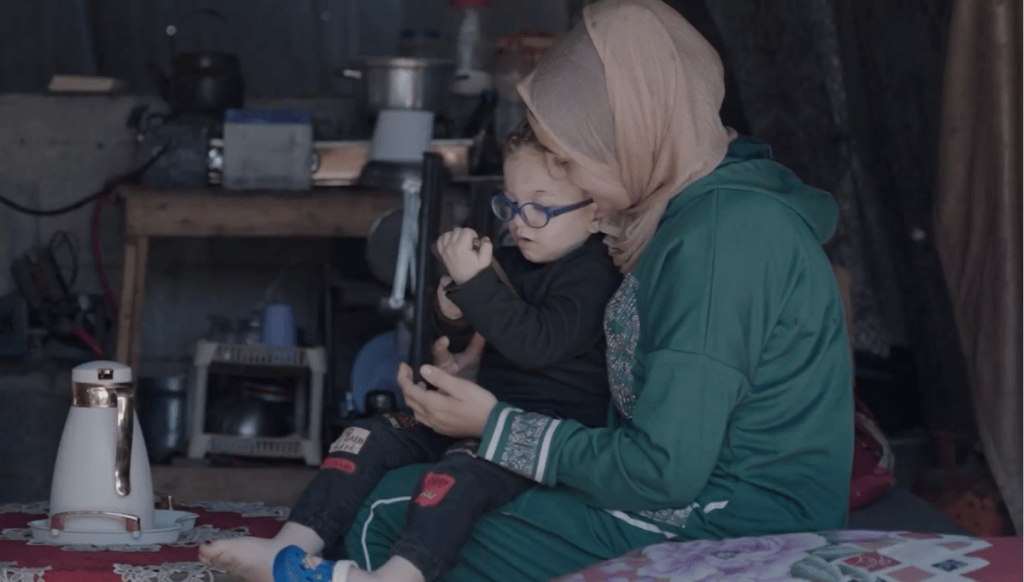
When Israeli forces besieged Al-Shifa Hospital in November 2023, eight premature babies in incubators were evacuated to Egypt under fire. One of them was Joud. His mother, Fatima Dakkeh, spent the next two years and eight months searching for him and fighting to bring him home.
Fatima tells the story of giving birth just months before October 7, losing contact with her son during the first Israeli raid on Al-Shifa, learning a year later that he was alive in Egypt, and a bittersweet reunion with a child who no longer recognized her.
According to the International Rescue Committee, at least 17,000 children in Gaza are unaccompanied or separated from their parents. For many families, there will be no reunion.
Credits:
Producers: Belal Awad, Leo ErhardtVideographers: Ruwaida Amer, Mahmoud Al MashharawiVideo Editor: Leo Erhardt
Transcript
Narrator:
Al-Shifa hospital is the largest medical complex in Gaza. Since October 7, it’s been repeatedly raided, occupied and targeted by Israeli forces. Over the course of the Genocide, hundreds were killed in and around the building and the hospital itself was completely destroyed.
In November 2023, under Israeli fire, 8 premature babies in incubators were hurriedly evacuated to Egypt. Joud was one of those babies.
Fatima Dakkeh:
I gave birth to my son, Joud, in July. Joud needed neonatal care at Al-Shifa Hospital. We placed him in the neonatal unit, but then the war started and Joud was there in the hospital. We couldn’t get in touch with Joud because of the shelling and the war.
Narrator:
Fatima Dakkeh and her son Joud have been unable to have a regular mother-son relationship. Joud was born in Gaza just a few months before October 7th 2023 and so,
by Mansa Musa | Sep 15, 2026 | baltimore, Prisons and Policing, Rattling the Bars, video
Author and community organizer Dominque Conway has transformed a house at the epicenter of the 2015 Baltimore uprising into “Eddie’s Front Porch,” a people’s museum dedicated to preserving the remarkable legacy of her late husband, Eddie Conway. To mark the opening of the museum, this special episode of Rattling the Bars features host Mansa Musa sitting down with Dominque to discuss the project and Eddie’s enduring impact.
The conversation also highlights perspectives from formerly incarcerated organizers who worked alongside Eddie inside Maryland prisons and are now building community power on the ground in West Baltimore. Together, they share powerful stories celebrating the man, the myth, and the legend behind the movement.
Credits:
Production: Maximillian Alvarez
Post-production: Cameron Granadino
Transcript
The following is a rushed transcript and may contain errors. It will be updated.Mansa Musa:
So we are here at Eddie Conway’s front porch, which is, we call it People’s Museum. I’m here with Dominque Conway, the wife of Eddie Conway. Tell our audience what Eddie Conway meant to you or who was Eddie Conway to you?
Dominque Conway:
That’s really, that’s hard to sum up, to be quite honest. Eddie was so many things to me and so many other people, but Eddie was, quite honestly, he was my hero as he was to many other people. He was a Black Panther. He was somebody who also served 44 years in the Maryland prison system and didn’t allow that time to break him. During that time, Eddie worked with hundreds of men in the prison system, many of whom have come out and done their own programming and continued to do really great things in the community. So at