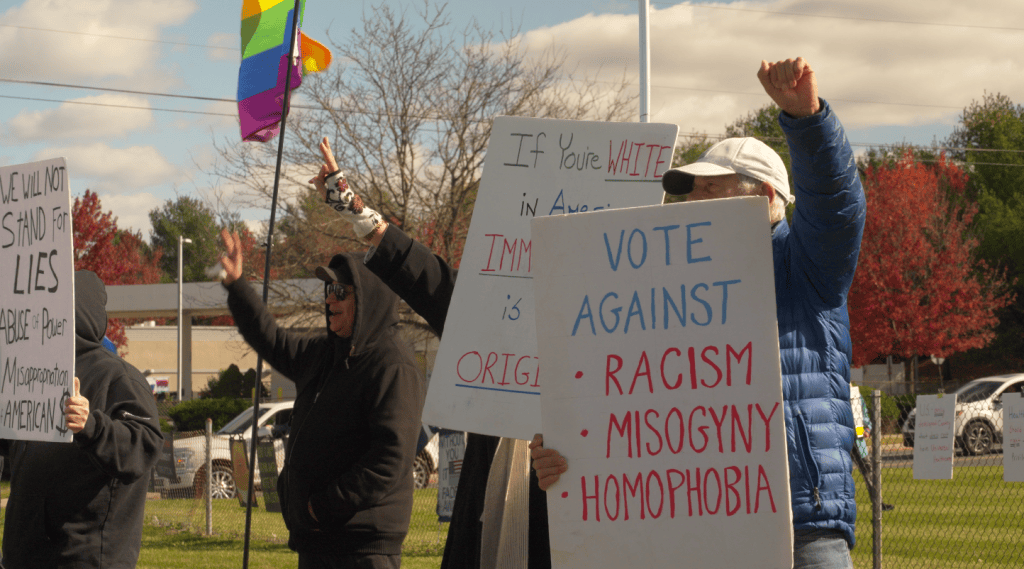
by Taya Graham | Nov 11, 2026 | Article, elections, midterms, Pennsylvania, Politics and Movements: US
In 2018, covering our first midterm election, we followed the ultimately unsuccessful campaign of an electoral upstart named Jess King.
King was a progressive candidate touting ideas like Medicare for All and a higher minimum wage in Pennsylvania’s deep-red 11th District. Her campaign seemed improbable at the time.
Her opponent, conservative Republican Lloyd Smucker, had won his previous race by roughly 10 points. In 2018, the district was gerrymandered to be even more Republican.
Despite the long odds, King made an argument we hadn’t heard before. Even though she was running as a Democrat, her pitch to voters was not exclusively partisan.
“I think what we see is that voters aren’t necessarily on the left-right spectrum as much as they are on a bottom-to-top spectrum,” King told us at a campaign event. “We need to talk more about two political parties that have sold out to special interests.”
Call it the inequality proposition or a power-to-the-people mantra, King made it clear that viewing politics through the prism of party was not only outdated, but destructive.
Ultimately, her pitch fell short. She lost to Smucker.
But the 2026 election may have proved that King was simply ahead of the curve. Alongside historic wins for Democrats, her message re-emerged with new potency among an electorate increasingly angry with the status quo, regardless of party.
“You hear people talking about this top-down message instead of this left-right message,” said Pennsylvania state Representative-elect Ce-Ce Gerlach. Gerlach won with the help of the Working Families Party and the progressive group Lehigh Valley Stands Up.
She said her message of economic populism trumped party politics.
“People are struggling. People don’t want to hear all this rhetoric
by Ryan Johnson | Nov 9, 2026 | elections, Fascism, Israel, midterms, Palestine, Politics and Movements: International, Politics and Movements: US, video
On November 3, Democrats secured a historic landslide victory over the Republican Party, securing 54 Senate seats and over 250 House seats. Five governor’s seats were also flipped, including in historically red states like Texas, Kansas, Iowa, and Georgia.
According to a New York Times estimate, Americans aged 18-29 voted overwhelmingly Democrat during the Midterms. 70% of voters in the 18-29 age group voted for Democratic candidates for the U.S. House of Representatives, a 33-point increase from 2024.
Americans aged 18-29 also came out in droves to support Democratic Senate nominees in 2024, with over 30-point differences in every competitive Senate race, including 44-point increases in Mississippi and North Carolina and a whopping 49-point increase in Texas.
Social Reporter Ryan Johnson sat down with Jason Stanley, the Bissell-Heyd Chair in American Studies in the Munk School of Global Affairs & Public Policy at the University of Toronto and author of Erasing History: How Fascists Rewrite the Past to Control the Future, to talk through the issues that swayed young people to vote for Democrats, the global anti-fascist wave, and a lasting change in American public opinion on Israel.
Related Links:
Jason Stanley at University of Toronto
Jason Stanley on Amazon
Credits:
Production: Ryan Johnson
Post-production: David Hebden
Transcript
The following is a rushed transcript and may contain errors. It will be updated.
Ryan Johnson:
On November 3rd, Democrats secured a historic landslide victory over the Republican Party, securing 54 Senate seats and over 250 House seats. Five governor seats were also flipped, including in historically red states like Texas, Kansas, Iowa, and Georgia. According to a New York Times estimate, Americans aged 18 to 29 voted overwhelmingly Democrat during the midterms. 70% of
by Erin Reed | Nov 7, 2026 | 2026 election, 2026 Elections, 2026 midterms, Anti-trans, Arizona, Ballot Measures, Colorado, elections, LGBTQ Rights, midterms, Missouri, Nebraska, News Analysis, Trans Rights, Vermont, Virginia, Washington, Washington State
On Tuesday night, as election results poured in, it became immediately clear: anti-transgender ads had failed to earn Republicans a victory in the year they relied on them the most. Despite $183 million spent on ads targeting transgender people and any Democratic politician who had ever expressed support for them, even Democrats who openly supported transgender people won in Republican strongholds.
Source
by Amy Goodman | Nov 6, 2026 | 2026 Elections, 2026 midterms, California, Democrats, elections, Gina Hinojosa, Latino voters, midterms, News Analysis, Texas
The midterms saw a landslide of Latinos vote for Democrats. In Texas, California, Kansas and Colorado, Latinos who had voted for Republicans just two years ago voted for Democrats in large numbers, helping secure Democratic control of both the House and the Senate. Latino lawmakers will make up about a fifth of the Democratic majority in the House. And in an historic victory, the two most populous…
Source
by Michael Arria | Nov 6, 2026 | 2026 election, 2026 Elections, 2026 midterms, Abdul El-Sayed, AIPAC, Corporate Media, Democrats, elections, Israel, Mainstream Media, Media, Michigan, midterms, Mike Rogers, News Analysis
In the final televised debate for Michigan’s Senate race, GOP candidate Mike Rogers used his closing remarks to claim that Jewish Democrats were supporting him because they view his Democratic opponent, Dr. Abdul El-Sayed, as “too extreme” on the subject of Israel. “Jewish Democrats who are afraid for their children when their daughters can’t wear their Star of David walking across Michigan’s…
Source
by Elizabeth Weill-Greenberg | Nov 6, 2026 | 2026 Elections, 2026 midterms, Abdul El-Sayed, Angie Nixon, Ashley Moody, CoreCivic, Damon Hininger, elections, FEC, GEO Group, ICE, Immigrants, immigration jails, Ken Paxton, Marsha Blackburn, midterms, Mike Rogers, News, PACs, private prison, Private Prison Companies, private prison industry, Private Prisons, Super PACs, Trump Administration
PACs and executives from three of the leading private prison companies have donated close to $1.2 million to candidates, fundraising committees, and political party committees during this year’s midterm election cycle, according to Federal Election Commission (FEC) records. A GEO Group subsidiary, GEO Reentry Services LLC, donated an additional $4.4 million to MAGA Inc.
Source