by Maximillian Alvarez | Sep 14, 2026 | Economy, Economy and Inequality, labor, Podcast, Working People
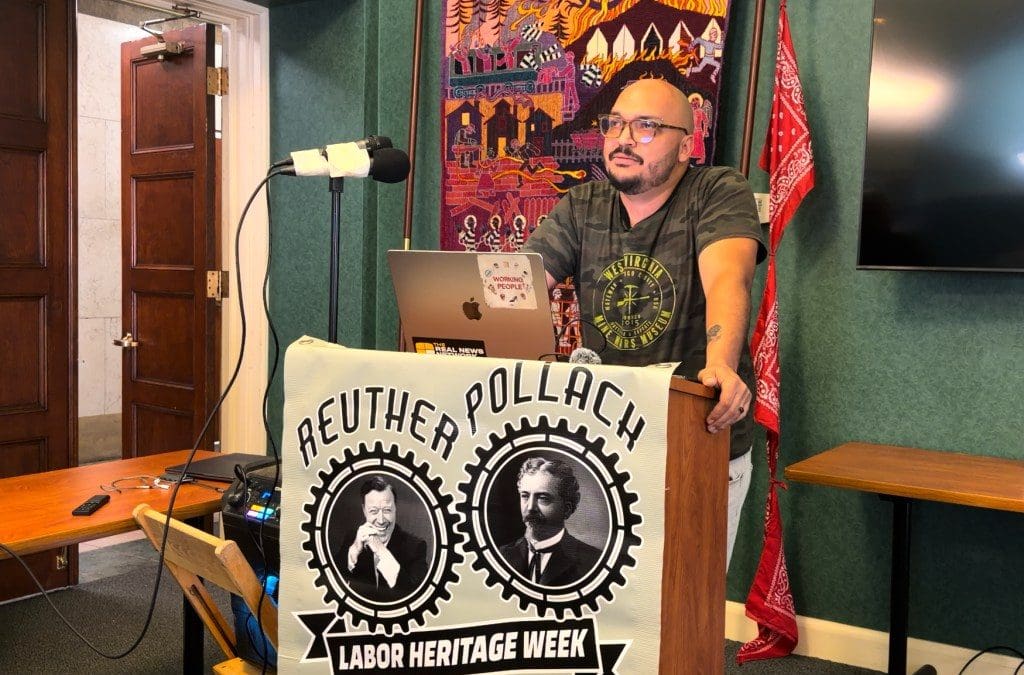
Over the 2026 Labor Day weekend, I had the honor of speaking at the Reuther-Pollack Labor History Symposium in Wheeling, West Virginia, organized by the Wheeling Academy of Law & Science (WALS) Foundation. The symposium takes place in Wheeling every year and adopts a different theme each year; this year, the theme was “The Art of Labor.” I got to represent TRNN and speak alongside a truly incredible lineup of artists and working-class warriors, including: Tabitha Arnold, the great textile artist and tapestry maker; Erik Ruin, printmaker and shadow puppeteer; and Shaun Slifer, a multidisciplinary artist and the Creative Director for the West Virginia Mine Wars Museum.
The text below is a transcript of the talk I gave at this year’s Symposium, which has been lightly edited for clarity and readability. You can also listen to the audio recording of my speech on The Real News Network podcast feed.
https://www.spreaker.com/show/2952221/episodes/feed
Thank you. It is genuinely an honor to be here on these hallowed grounds with all of you in Wheeling, West Virginia. It really, really means a lot to me to be here with all of you.
I also have to say: I really appreciate it when Vince or anyone else tells me that that first-ever Working People interview I recorded with my dad, Jesus Alvarez, meant something to them—because it meant everything to me. It started everything.
I didn’t start out to become a labor journalist or to do the kinds of interviews I do with working people. I didn’t set out to make a life reporting on working-class struggles from working-class areas around the country, on the front lines of a class war
by Alexandra Martinez | Sep 14, 2026 | ALPR, DeFlock, Flock, Mass Surveillance, News, ULTA
A national gender justice organization is escalating a campaign against Ulta Beauty over the cosmetics retailer’s use of automated license-plate reader (ALPR) cameras made by the surveillance company Flock Safety, arguing that it threatens customer privacy and could disproportionately harm women and gender-expansive people. UltraViolet, a women-led gender justice organization…
Source
by Hunter Woodall | Sep 14, 2026 | elections, News
Kansas hasn’t elected a Democrat to the U.S. Senate since 1932. But 50 days out from Election Day, Vice President JD Vance is spending Monday in a suburb of Kansas City campaigning for a Republican incumbent.
“We’re excited to do a fraud task force event in the Kansas City area, and then a campaign [event] with my very dear friend ‘Doc’ Marshall, who’s one of the very best United States senators, and very important that we get him re-elected,” Vance told reporters earlier on Monday.
Sen. Roger Marshall won his seat in 2020 after representing a sprawling House district across western Kansas. Democrats tried to make that race competitive by nominating Barbara Bollier, a state senator who had switched parties after years as a moderate Republican. She lost by 11 points.
Democrats argue that the ground has shifted since. In a midterm cycle that is turning into a referendum on President Donald Trump, they see an opening in a farm-heavy state where his policies carry real political risk.
Their candidate is Adam Hamilton, a United Methodist Church pastor making his first run for office.
“No amount of Washington politicians parachuting in to campaign for Roger Marshall will be able to save the senator from his flailing campaign and disastrous debate,” Glynnis Harvey, a Hamilton spokesperson, said in a statement ahead of Vance’s visit.
Kansas is not a conventional red state. It has voted Republican for president for decades, but the governor’s office changes hands regularly, and the state has a recent history of rewarding pragmatism. After tax cuts under Republican Gov. Sam Brownback pushed Kansas into deep fiscal dilemmas and split the GOP, Democrat Laura Kelly,
by Truthout | Sep 14, 2026 | 32-hour workweek, Artificial Intelligence, Bernie Sanders, Mark Takano, News, Overtime Pay, workers rights
Amid growing concerns about technological advances and stagnant worker pay, Sen. Bernie Sanders (I-Vermont) and Rep. Mark Takano (D-California) introduced a bill earlier this month to reduce the workweek to 32 hours. “The 40-hour workweek was established in law nearly 90 years ago. Since then, cell phones, the internet, and now AI have increased worker productivity, but the profits have been…
Source