by Mike Ludwig | Nov 10, 2026 | 2026 midterms, Ballot Initiatives, Climate Activism, Climate Change, data centers, Democratic Party, News Analysis, Populism, Progressives
The dominant narrative about the Democratic sweep of the midterm elections has focused on President Donald Trump’s brash ineptitude and voters fed up with the costs of living amid reports of corruption emanating from the White House. The climate crisis appeared to take a backseat to concerns about rising energy prices driven by data center build-out and inflation linked to the U.S.
Source
by Julia Conley | Nov 10, 2026 | 2026 midterms, Chris Van Hollen, Chuck Schumer, Democratic Party, IAM, News, Unions
Senate Minority Leader Chuck Schumer’s bid to continue leading the Democratic Party when it takes control of the US Senate in January continued to falter Monday night as a key machinists’ union asked the New York senator to step aside and allow “a new generation to lead Senate Democrats.” In a letter, Brian Bryant, international president of the International Association of Machinists and…
Source

by Adam Johnson | Nov 5, 2026 | Article, Democratic Party, elections, Israel, midterms, Politics and Movements: International, Politics and Movements: US
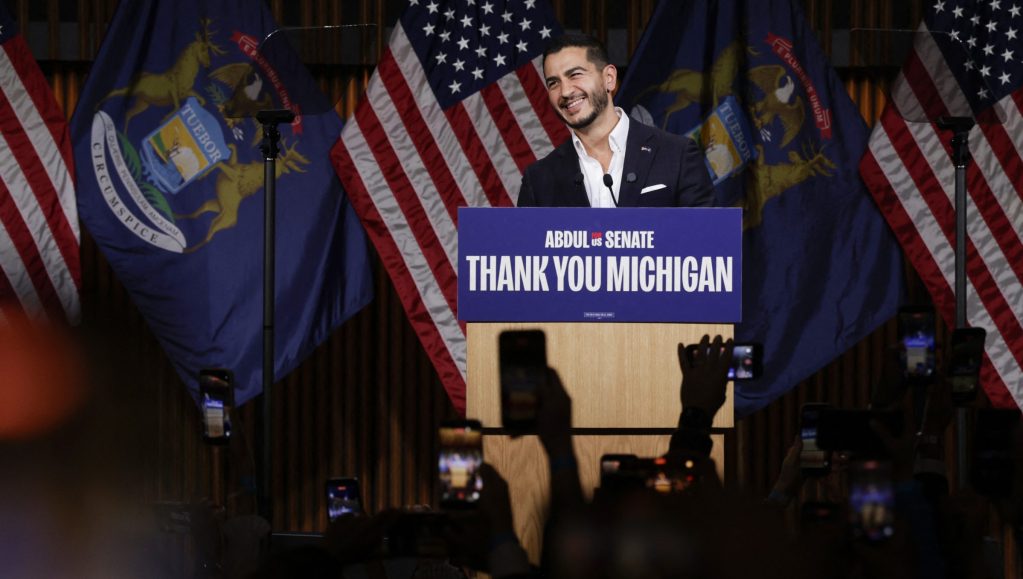
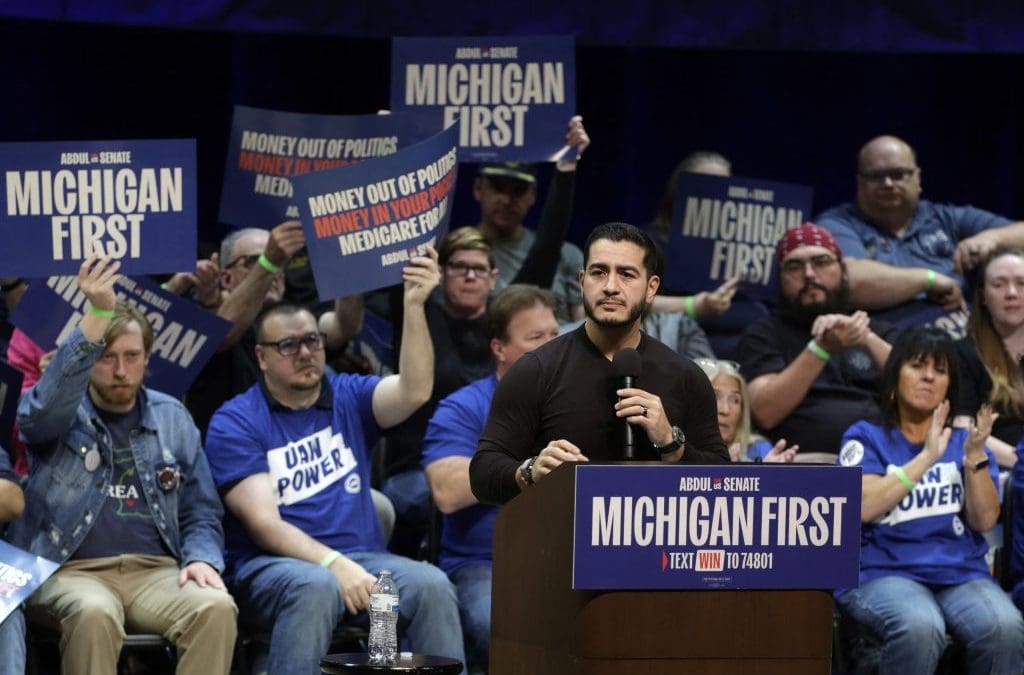
As the tide recedes on the Democrats’ “Blue tsunami” this past Tuesday, before the votes were even tallied, the internecine fight over The Narrative among the US center-left began in earnest. Centrist ideological curators, as is their function, came out strongly to paint the historic drubbing of Republicans as evidence that centrists are more electable than progressives. And progressives, likewise, have made the opposite argument, buoyed by the 7-point swing state victory of progressive and strong Israel critic Abdul El-Sayed in Michigan.
This piece won’t litigate the empirical question as such (though pollster G. Elliot Morris does an excellent job debunking the “centrists overperformed” conventional wisdom), but will highlight instead how many of the “El-Sayed is toxic and can’t win middle America” narratives completely evaporated Tuesday night, and how those pushing them will, of course, never be held to account nor asked to explain why so many outright lies were advanced about the Democratic nominee. El-Sayed won by roughly 340,000 votes despite being subject to nonstop intra-party, intra-liberal attacks emanating from everyone from the president of the most influential liberal think tank in the US, to key Democrats in Congress such as House Speaker Emerita Nancy Pelosi, Jim Clyburn, and Debbie Wasserman Schultz, to influential liberal media outlets The Atlantic magazine and The New York Times, to his largely Republican-funded primary opponent Hayley Stevens, who––unlike the others––at least had the courtesy to break kayfabe and come out in support of Republican Mike Rogers explicitly. Unlike genetic white media darlings Roy Cooper and James Talarico who, the centrist wonk expects insists, Covered The Spread, El-Sayed was subject to one of the most
by Chris Walker | Nov 5, 2026 | Article, Democratic Party, elections, midterms, Politics and Movements: US, Reprint, Voting Rights
This article was originally published by Truthout on Nov. 04, 2026. It is shared here under a Creative Commons (CC BY-NC-ND 4.0) license.
Several statewide and state legislative contests in this week’s midterm elections have resulted in new Democratic Party “trifecta” governments — places where the party is now in control of both houses of the state legislature as well as the governor’s office.
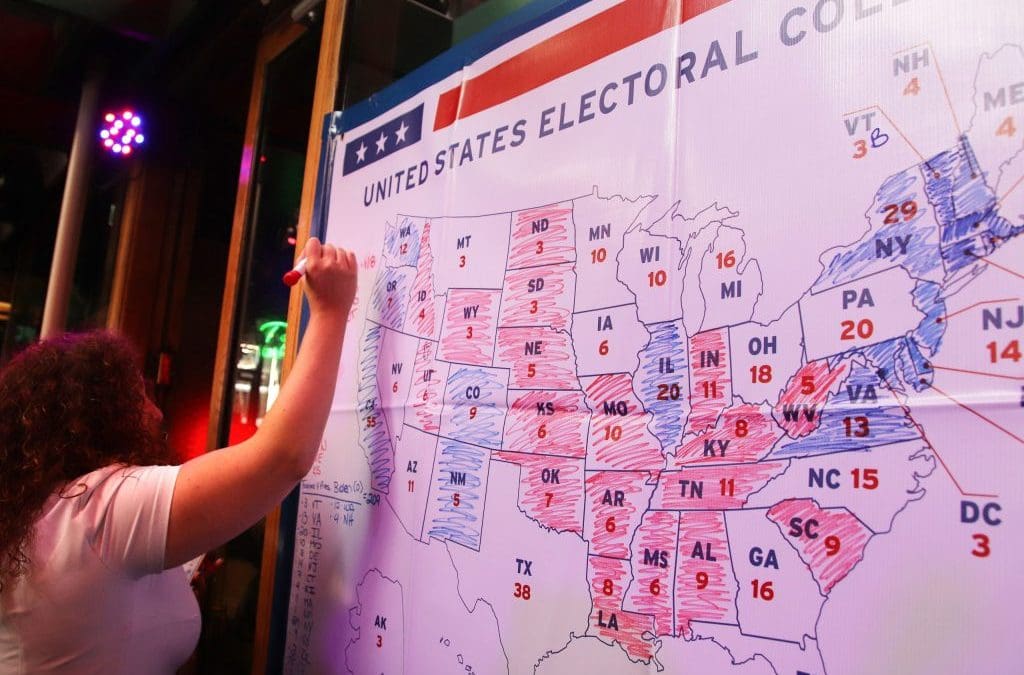
With these new wins, Democrats have the opportunity to do something once considered nearly impossible: implement a popular vote model for electing future presidents of the United States, to replace the archaic and unpopular Electoral College.
Due to the mechanics of the Electoral College, five presidential “winners” in U.S. history have taken office who did not win the approval of most voters, including twice over the past three decades. While a constitutional amendment would be needed to formally abolish the Electoral College — which is unlikely to happen anytime soon, even after this week’s “blue wave” — there is a workaround called the National Popular Vote Interstate Compact, which doesn’t require such an amendment.
Per Article II of the U.S. Constitution, each state is mandated to appoint, “in such manner as the Legislature thereof may direct, a number of electors, equal to the whole number of Senators and Representatives to which the State may be entitled in the Congress.” These electors end up voting for president and vice president.
All states today direct their electors to vote based on their own results in presidential races. If a Democratic candidate wins in California, for example, all 54 of its electors are people chosen to support that candidate in the Electoral College.
But under
by Julia Conley | Nov 3, 2026 | 2026 midterms, AI, Bernie Sanders, Democratic Party, Democrats, News, Progressives, Wealth Tax
As a campaign season in which dozens of progressive candidates endorsed by US Sen. Bernie Sanders prevailed in primaries, the independent Vermont lawmaker urged his supporters across the country to “do all we can to bring out the vote to end Republican control of Congress,” while urging voters to look beyond the goal of reining in President Donald Trump. “If the pundits are correct and…
Source
by Adam Johnson | Nov 2, 2026 | Article, Democratic Party, Media Criticism, midterms, Opinion, Politics and Movements: US
You may have heard that Michigan Democratic Senate nominee Abdul El-Sayed is “having a lot of trouble putting [the Democratic] coalition back together,” or that “Democrats [are] struggling to unite behind El-Sayed,” or that “Democrats are still struggling to unite behind El-Sayed,” or that “El-Sayed faces resistance from some voters who would ordinarily be inclined to support a Democrat,” or that “Democratic divisions could hurt El-Sayed.” It’s a prominent narrative that is driving political discourse in the closing weeks of the tight Michigan Senate race.
There’s only one problem with this narrative: It has zero empirical basis. It’s a total confection of US media and the pro-Israel lobby that isn’t supported by any data whatsoever. Two recent polls, one from Marist and one from RedBox Research, make it clear that El-Sayed’s support among Democratic voters in Michigan is both extremely high (95%) and the exact same percentage as Republican candidate Mike Rogers’ support with Republicans. And a new poll from Mitchell Research CBS complicates the narrative even further, finding that support for El-Sayed among Democrats is, in fact, 3 points higher than Rogers is among Republicans, at 94% versus 91%, respectively.
If El-Sayed and Rogers have the exact same percent of party dissent—or, as is the case in the CBS Detroit poll, Rogers has more—then why are there countless stories highlighting, handwringing, and scandalizing the trivially small dissent for only one of the candidates? Where are the breathless profiles of Republicans refusing to vote for Rogers? Where are the NPR and CNN segments focusing on “Republican divisions”?
There, of course, aren’t any, because this narrative wouldn’t advance an ideological agenda.
The “Michigan Democrats are