by Caitlyn Clark | Sep 14, 2026 | Article, Economy, Economy and Inequality, labor, Politics and Movements: US, Reprint, Unions
This story originally appeared in Labor Notes on Sept. 01, 2026. It is shared here with permission.
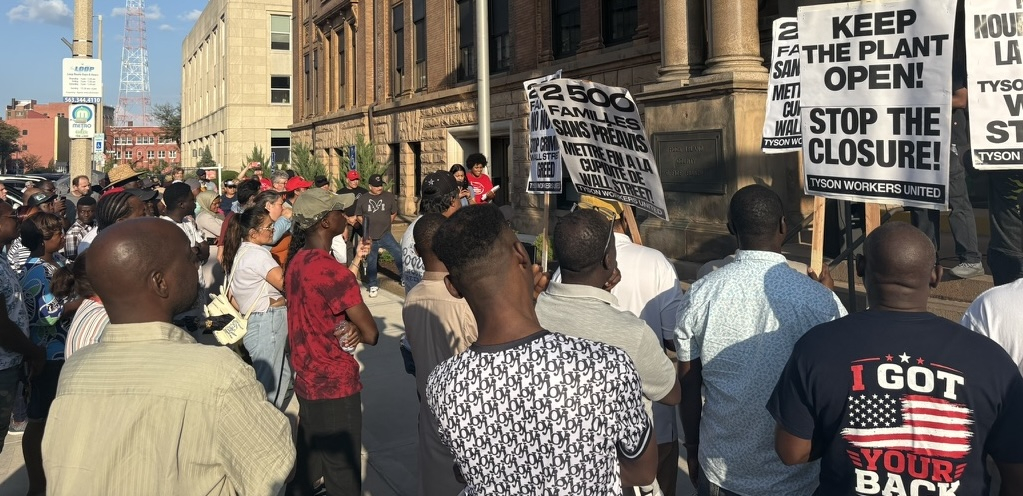
Ouano Tante worked the afternoon shift at the Tyson beef plant in Joslin, Illinois, for five years. But when she and hundreds of her co-workers arrived at work on August 13, they found the plant closed.
They speculated that someone on the morning shift might have gotten injured. Then two mid-level supervisors came outside in tears. Plant supervisors told workers the plant was closing permanently, effective immediately.
Inside, the early-morning shift had just ended when the workers were informed it would be their last. The cafeteria erupted into chaos. Plant supervisors stood guard by the doors, workers said, while everyone received their closure paperwork.
“People were crying, shaking,” Tante said. “When we were leaving the parking lot, there were so many car accidents. People were so upset.”
“They gave no reason, nothing,” said Ahoro Asselissime. “People have no job. No money to pay our bills. For 11 years, I made money for them. And now they’re not doing anything for me.”
DISASTER FOR COMMUNITY
Joslin is home to just 56 residents. But 2,500 workers from Africa, Latin America, and Burma toiled at the meatpacking plant there, butchering cattle for Tyson, one of the world’s largest meatpacking companies. The workers were represented by Food and Commercial Workers (UFCW) Local 1546.
Most of the workers live in the Quad Cities, clustered around the Illinois-Iowa border 160 miles west of Chicago. Everyone there knows someone who works at Tyson, the area’s ninth-largest employer. The closure announcement sent the community into a tailspin.
Tante, originally from Togo, had the job of determining the age of cattle by
by Michael Arria | Aug 3, 2026 | AI, big tech, data centers, education, labor, News, Privatization, Unions, Workers
Artificial intelligence (AI) has permeated our workplaces, where many employers have sought to boost productivity, cut labor costs, and eliminate jobs via the technology. A 2025 Pew Research Center poll found that 1 in 5 workers now use AI in their jobs. Organized labor’s response to the AI has been fraught. Where some see an inevitable shift that simply needs to be regulated and could…
Source
by Natascha Elena Uhlmann | Jul 17, 2026 | 2026 World Cup, ICE, Joan Sebastian Guerrero, labor, Labor Unions, Lorenzo Salgado Araujo, Los Angeles, News, Strikes, Unions, Wages, World Cup
In a World Cup-fueled union win, concessions workers at SoFi Stadium in Los Angeles have won the right to walk off the job, should ICE pose a threat to their safety. The stadium’s 2,000 cooks, bartenders, dishwashers, servers, and attendants had a major piece of leverage this summer: eight scheduled World Cup matches. Their victory came days after a 96 percent vote to authorize a strike.
Source
by Aastha Uprety | Jul 11, 2026 | AIPAC, Claire Valdez, Darializa Avila Chevalier, Democratic Socialists of America, DSA, elections, Israel, labor, Labor Unions, New York, New York City, Op-Ed, Palestine, UAW, Unions, Zohran Mamdani
While the rest of the U.S. left celebrated two major wins in New York’s congressional primaries in June, much of the organized labor movement was left licking its wounds. The combined heft of New York City’s largest labor unions was not enough to best the candidates backed by the Democratic Socialists of America (DSA) and the star power of Mayor Zohran Mamdani. Darializa Avila Chevalier won…
Source
by Natascha Elena Uhlmann | Jun 28, 2026 | Gig Workers, labor, mexico, News, Unions
Chanting, “We are not partners, we are workers,” hundreds of workers across Mexico who provide rides and deliveries through apps held a two-hour work stoppage on May 15 demanding fair rates, an end to unjustified deactivations, and ultimately, a collective labor agreement with app giants like Uber, Didi, and Rappi (two Uber Eats-style delivery platforms). The National App Workers Union (la…
Source
by C.J. Polychroniou | Jun 24, 2026 | anti-capitalism, Democratic Party, Democratic Socialists of America, DSA, elections, far right, Interview, labor, Labor Movements, Labour Party, left politics, Syriza, UK, Unions
The left in western democracies has been pretty much in free fall since the onset of neoliberal globalization. This is quite ironic since resistance to capitalism from civil society has actually grown during the same period. This resistance is also reflected in the U.S. political landscape, where the Democratic Socialists of America are surging in support through grassroots efforts in major urban…
Source