by Mansa Musa | Apr 27, 2026 | Economy and Inequality, history, Inequality, Politics and Movements: US, Racism, Rattling the Bars, video
2026 marks the 250th anniversary of the American Revolutionary War. While the national mythology behind the “America at 250” celebrations focuses on the 18th-century battle between Patriot and Loyalist elites, what does the story of the American Revolution and the founding of the United States look like through the eyes of enslaved people? In this episode of Rattling the Bars, host Mansa Musa speaks with Professor Justene Hill Edwards, author of Unfree Markets: The Slaves’ Economy and the Rise of Capitalism in South Carolina.
Guests:
Justene Hill Edwards is an associate professor of History in the Corcoran Department of History at the University of Virginia. Her research explores the intersection of African American history, the history of slavery, and the history of American capitalism. She is the author of Unfree Markets: The Slaves’ Economy and the Rise of Capitalism in South Carolina and Savings and Trust: The Rise and Betrayal of the Freedman’s Bank.
Credits:
Producer / Videographer / Editor: Cameron Granadino
Transcript
The following is a rushed transcript and may contain errors. A proofread version will be made available as soon as possible.
Mansa Musa:
This year marks the 250th anniversary of the Revolutionary War, a conflict that we typically frame as a struggle between the colonialists and the British. However, we rarely examine the age of revolution from the perspective of the enslaved and the enslaved has a voice in this matter, as we will see. Join us today as the University of Virginia Professor of History, Justine Hill Edwards, an author of Unfree Market: The Slave Economy and the Rise of Capitalism in South Carolina. And Saviors and Trust. Professor, welcome to Rattling the Bars
by Taya Graham and Stephen Janis | Apr 24, 2026 | elections, ICE, Inequality, Inequality Watch, midterms, Politics and Movements: US, Prisons and Policing, video
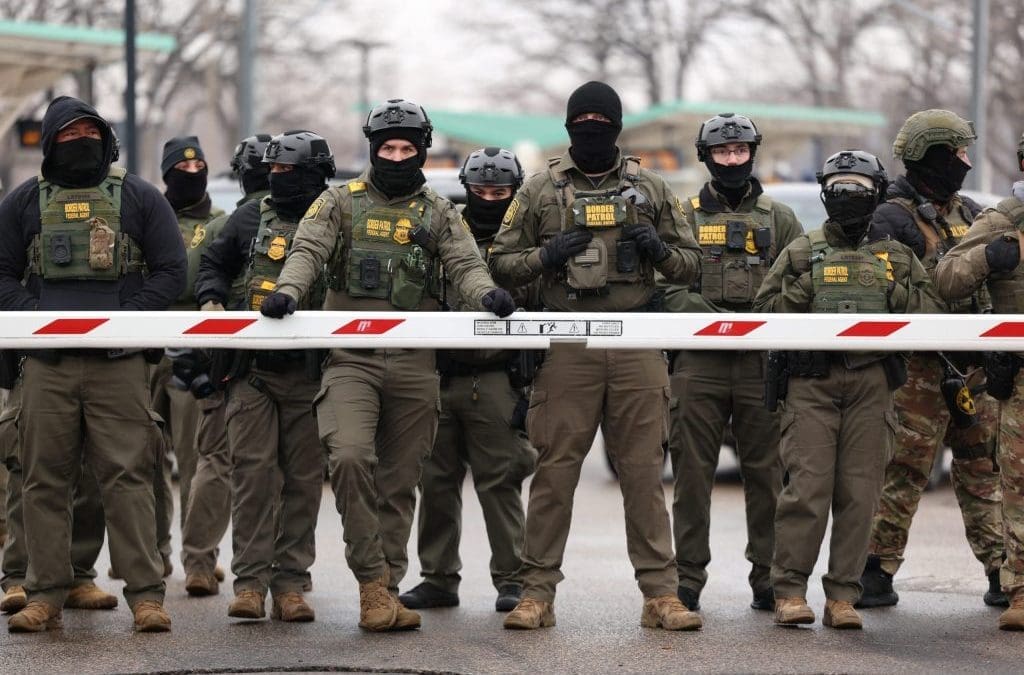
Congress members of the Hispanic Caucus speak out on their concerns on ICE and Border Patrol, with their first question being: why is an additional $70 billion needed after the record breaking $140 billion allocated last year from the Big Beautiful Bill? The budget for ICE has already increased by 400% within the past year, so speculation as to how these new funds would be used now leans towards intimidation and interference at the upcoming midterm elections. Inequality Watch reporters Taya Graham and Stephen Janis break down their most recent interviews from these representatives at the nation’s Capitol in Washington, DC.
Credits:
Written by: Stephen Janis
Produced by: Taya Graham, Stephen Janis
Studio / Post-Production: Cameron Granadino
Trancript
The following is a rushed transcript and may contain errors. A proofread version will be made available as soon as possible.
Taya Graham:
Could new funding slated for ICE be used for a midterm election surprise? We’ll break down what might happen on this episode of our Capitol Hill Inequality Watch video React. Hello, my name is Taya Graham and welcome back to our Capitol Hill React show where we watch comment and analyze developments at the nation’s capital and beyond. It’s a show filtered through the prism of inequality and informed by the intellectual context of analyzing the imperative of raw power and exposing how it corrupts a political power that is supposed to serve we, the people. Now, to start the show, I want to introduce my reporting partner, Stephen Janis. Hello, Stephen. How are you?
Stephen Janis:
Hey, Taya, how are you doing? Good to be back here with you talking about power and politics.
Taya Graham:
Excellent. Well, we appreciate
by Lorah Steichen | Apr 24, 2026 | Article, Economy, Economy and Inequality, labor, Military Industrial Complex, Politics and Movements: US, Reprint, War
This story originally appeared in Jacobin on April 23, 2026. It is shared here with permission.
Amid the United States’ illegal, costly, and broadly unpopular war in Iran, the Trump administration recently asked Congress to approve a record-breaking $1.5 trillion military budget — the largest military spending proposal in US history. The administration claims that record war spending will pay for a “once-in-a-century revival of American industry,” while hawks in Congress argue that the spending spree will “revitalize” the military industrial base by investing in a “skilled, patriotic defense workforce.”
But new research from Transition Security Project suggests that military spending increases are unlikely to translate into broad gains for American workers.
While Pentagon budgets have steadily increased over recent decades, the arms industry has become more consolidated, more automated, and less labor-intensive — upending the idea that the warfare state is an effective economic development strategy for working people, and strengthening the case for a state-led shift toward a civilian industrial base focused on green manufacturing.
Half of the Pentagon budget is funneled to private weapons manufacturers, but higher spending has not produced more jobs. Employment in military industries has fallen significantly since Cold War peaks, from an estimated 3.2 million workers during the 1980s to about 1.1 million in 2020, despite Pentagon budgets growing by roughly 22 percent over the same period. Meanwhile, job quality in the sector has also deteriorated: wages have declined, pensions cut, and unionization collapsed to roughly 10 to 14 percent on average across major military contracting firms, while company revenues from military contracts have grown substantially.
Taken together, these trends challenge a persistent assumption in Washington policymaking that military spending is an effective jobs program for American
by Caitlyn Clark and Lisa Xu | Apr 23, 2026 | Article, Economy, Economy and Inequality, labor, Politics and Movements: US, Reprint, Unions
This story originally appeared in Labor Notes on April 23, 2026. It is shared here with permission.
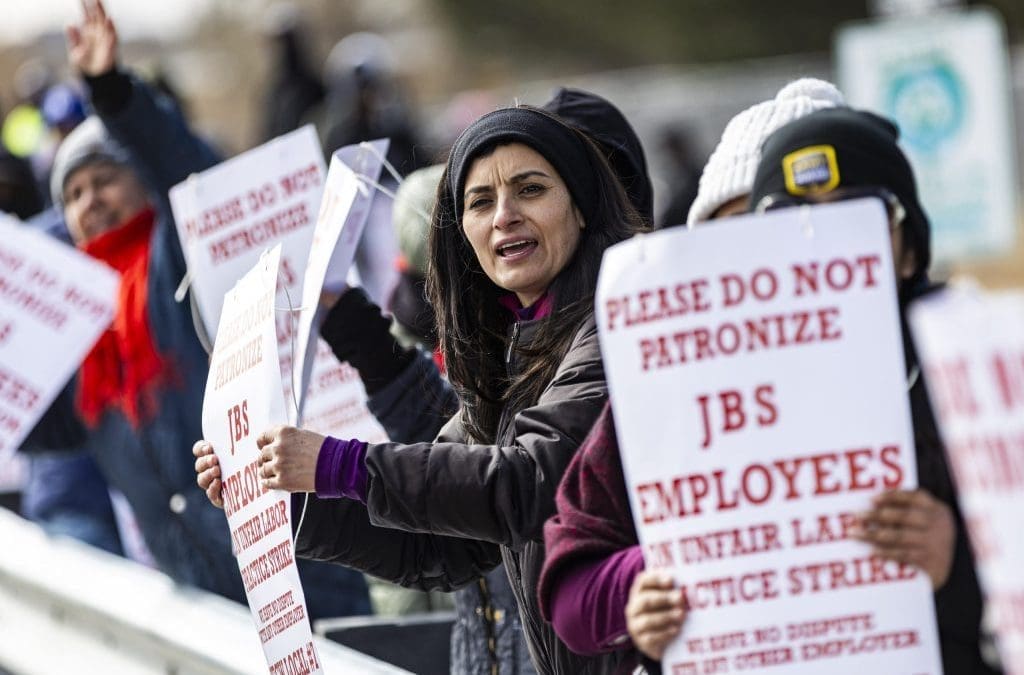
Last month, 3,800 meatpacking workers in UFCW Local 7 in Greeley, Colorado launched the industry’s first major strike in 40 years.
The three-week unfair labor practice strike was the first time workers had ever struck the JBS Greeley beef packing plant, one of the company’s largest. ULP charges against JBS included the illegal termination of a member of the bargaining committee and surveillance and intimidation of workers for participation in union activity.
With 57 languages spoken under one roof, the strike united the plant’s largely immigrant workforce to take on the biggest meatpacking company in the world.
The local had spent nearly a year in negotiations following the contract’s expiration last July. JBS returned to the bargaining table after the strike—and when the dust settled, the company had conceded to almost every demand.
WON PROTECTION
In addition to $1.50 an hour in wage increases over the short two-year agreement, workers won a groundbreaking policy on personal protective equipment, challenging JBS’s previous system of garnishing wages to replace necessary PPE when it was lost, damaged, or stolen. JBS was charging workers up to $1,100 to pay for mesh vests, gloves, arm guards, and knife sharpeners.
“My mesh apron had a hole in it. I had to go two months wearing the same apron,” said Chris Ready, who has worked in the slaughter department at the plant for one year.
“I’ve had my equipment stolen,” Ready said. “I borrowed knives until I had to buy my own… I’ve had to buy two mesh gloves so far, that’s $200. It was annoying, but it
by Maximillian Alvarez | Apr 22, 2026 | Climate Change, Climate Crisis, Podcast, Politics and Movements: International, Politics and Movements: US
Just decades from now, millions of people all over the world will be forced to move because of climate change. In his new book, Shelter from the Storm: How Climate Change Is Creating a New Era of Migration, acclaimed journalist and migration researcher Julian Hattem reports from the front lines of the environmental apocalypse, taking readers on a journey from the South Pacific to the Indian subcontinent, to the Mediterranean. TRNN Editor-in-Chief Maximillian Alvarez speaks with Hattem about his new book and about the massive human displacement that is already being caused by climate change today.
This podcast was recorded on April 4, 2026, at “End Papers: A mini-book fest on capitalism and the climate crisis,”hosted by Red Emma’s Cooperative Bookstore and Coffeehouse in Baltimore, Maryland.
Guests:
Julian Hattem is the editor of Migration Information Source, the online magazine of the Migration Policy Institute, and founder and host of the podcast Changing Climate, Changing Migration. He has been on staff with the Associated Press and The Hill, and written for outlets including the Washington Post, The Guardian, NPR, and The Atlantic. The author of Shelter from the Storm: How Climate Change Is Creating a New Era of Migration (The New Press), he lives in Washington, DC.
Credits:
Audio Post-Production: Alina Nehlich
Transcript
The following is a rushed transcript and may contain errors. A proofread version will be made available as soon as possible.
Maximillian Alvarez:
Welcome back to The Real News Network. I’m Maximillian Alvarez. Just decades from now, millions of people all over the world will be forced to move because of climate change. Entire islands will disappear into the sea. Once in a century, hurricanes will occur
by Jake Johnson | Apr 22, 2026 | Article, elections, midterms, Politics and Movements: US, Reprint
This story originally appeared in Common Dreams on April 22, 2026. It is shared here under a Creative Commons (CC BY-NC-ND 3.0) license.
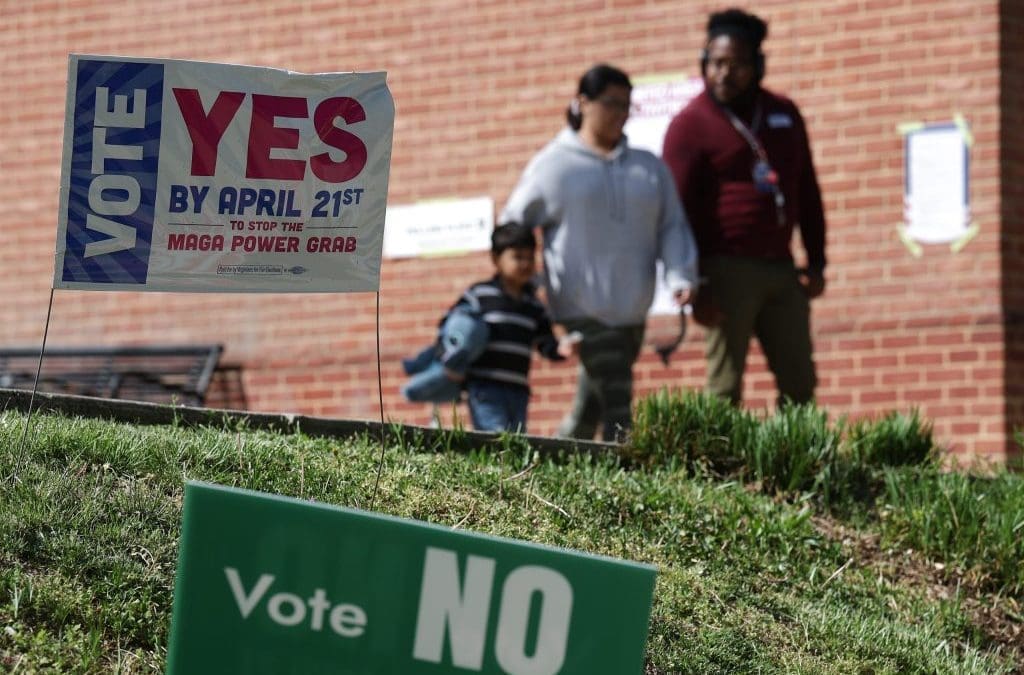
Virginia voters on Tuesday approved a referendum that’s likely to give Democrats four additional seats in the US House of Representatives in the upcoming midterm elections, a key victory in a gerrymandering war launched last year by President Donald Trump and the Republican Party.
“Virginia voters have spoken, and tonight they pushed back against a president who claims he is ‘entitled’ to more Republican seats in Congress,” Virginia Gov. Abigail Spanberger, a Democrat, said following Tuesday’s vote. “As we watched other states go along with those demands without voter input, Virginians refused to let that stand. We responded the right way: at the ballot box.”
The ballot measure, which was approved by a margin of fewer than 100,000 votes, allows the Virginia constitution to be “amended to allow the General Assembly to temporarily adopt new congressional districts to restore fairness in the upcoming elections, while ensuring Virginia’s standard redistricting process resumes for all future redistricting after the 2030 census.”
The new congressional map that Virginia lawmakers approved earlier this year—prior to putting the ballot question before voters—would aggressively redraw the state’s district lines to give Democrats eight safe districts. Two other districts would be competitive but Democratic-leaning, leaving Republicans with just one favorable district. Common Cause Virginia, an advocacy group that does not favor partisan gerrymandering, called the new Virginia maps “a proportionate response” to GOP redistricting in other states, including Texas.
Eric Holder, the former US attorney general and chairman of the National Democratic Redistricting Committee, said in response to Tuesday’s result that “the mere existence of this special election stands in stark contrast to the gerrymanders forced on constituents in Texas, Missouri, and North Carolina