With 350+ dead and 1,300 missing, Nepal carnage seen as climate disaster
This story originally appeared in Common Dreams on Aug. 27, 2026. It is shared here under a Creative Commons (CC BY-NC-ND 3.0) license.
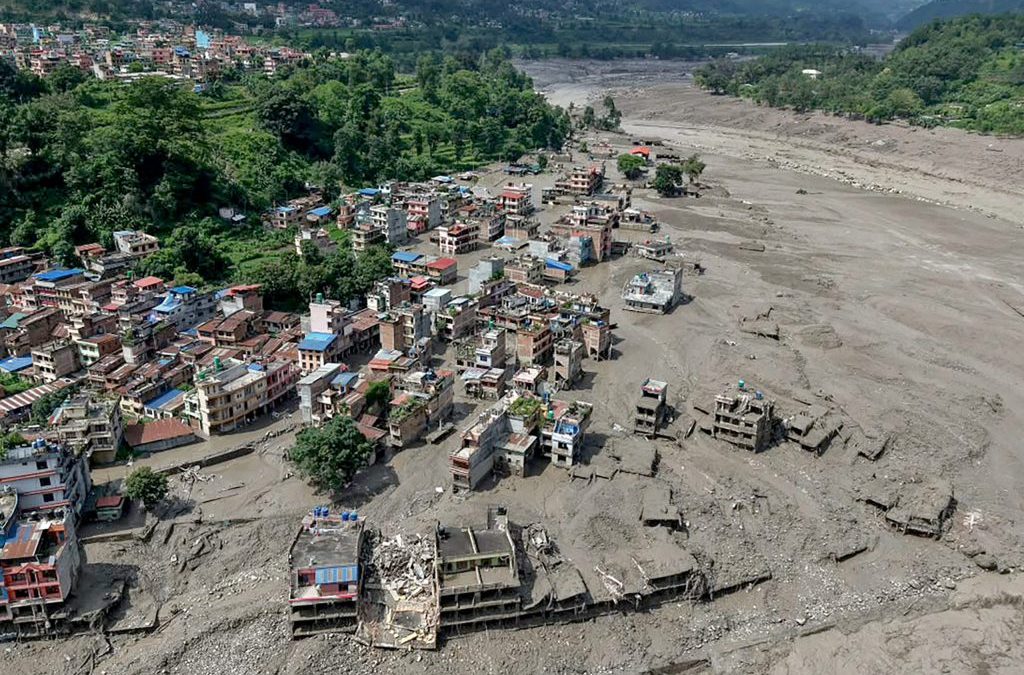
Scientists and climate action campaigners on Thursday pointed to the collapse of a glacier as a likely cause of disastrous flash flooding in Tibet and Nepal’s Rasuwa district, where emergency workers are searching for more than 1,300 missing people after water and mud poured into the Trishuli River valley, crashing through villages where thousands of people live and sweeping away bridges, homes, and miles of roads.
An initial assessment by geologists and glaciologists found that in satellite imagery taken before the flooding, a glacier was seen about 4,000 feet above the valley where at least 353 people were later killed Wednesday by the rushing waters and mudslide.
The glacier appeared about 2 million square feet smaller after the flooding, while the valley was “strewn with ice and mud” and the nearby river was “swollen beyond its banks, submerging the surrounding vegetation beneath murky brown floodwaters.
The scientists said an “ice avalanche”—a massive chunk of ice that fell off a glacier in the mountainous region and into the valley below, was likely at least partially to blame for the flash flooding, but noted that it was too early to rule out other or additional causes.
The satellite imagery appeared to show that “a glacier in the area basically snapped off in a clean break, allowing it to fall just over a vertical kilometer to the valley bottom,” Daniel Shugar, a geologist at the University of Calgary in Canada, told The New York Times. “The bottom looks like a bomb exploded—it’s just deposits from the broken-up glacier.”
The chunk of ice was likely about 2,000 feet wide, Shugar told the