by Jordan Rubin | Nov 10, 2026 | Deadline: Legal Blog, Supreme Court, White House
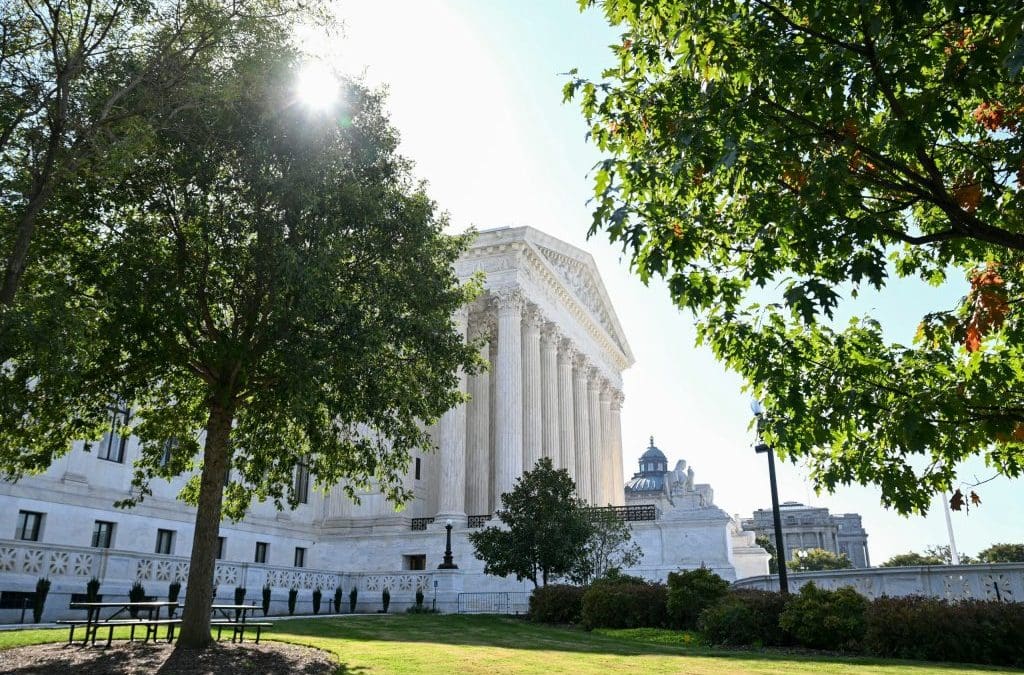
The Supreme Court on Monday cleared the way for a Trump administration wall construction project along the U.S.-Mexico border in Texas, over dissent from Justice Ketanji Brown Jackson.
The high court majority said that a lower court was wrong to halt the project because it likely lacked jurisdiction to block the government action.
The administration sought to waive environmental and conservation laws in order to facilitate construction in a region it called the “Big Bend Sector.” The Homeland Security secretary said the area was “an area of high illegal entry” that required more protection.
That prompted a lawsuit from a river guide, an environmental nonprofit and a nonprofit dedicated to preserving a historic church in Ruidosa, Texas. They argued that the secretary exceeded his authority. A federal district court in West Texas granted a preliminary injunction.
Lifting that injunction while further litigation proceeds, the Supreme Court said, in part, that the government’s interest “outweighs any aesthetic, recreational, and environmental harm alleged” by the plaintiffs.
Unsuccessfully opposing the action the court took on Monday, the plaintiffs said that granting the government’s request “would result in the permanent alteration of an irreplaceable landscape that includes Big Bend National Park, Big Bend Ranch State Park, and nearly 200 miles of the congressionally designated Rio Grande Wild and Scenic River corridor.”
The court’s reasoning came in an unsigned “per curiam” opinion, which is how the justices have been handling some emergency litigation lately instead of simply issuing an unexplained order.
Jackson, a Biden appointee, only noted without explanation that she would have denied the administration’s application.
The post Supreme Court allows border wall construction over Justice Jackson’s dissent appeared first on MS
by Jordan Rubin | Nov 6, 2026 | Criminal Justice, Deadline: Legal Blog, Supreme Court, White House
Ahead of Donald Trump’s return to office in January 2025, a divided Supreme Court declined to halt his criminal sentencing in New York.
Over dissent from four of the court’s six GOP-appointed justices, the five-justice majority let the sentencing proceed for two main reasons: One was that Trump was only being sentenced to an unconditional discharge, which is basically a nonpenalty; the other was that “the alleged evidentiary violations at President-Elect Trump’s state-court trial can be addressed in the ordinary course on appeal.”
Nearly two years later, that “ordinary course” is still unfolding.
On Thursday one of the president’s personal lawyers, Robert Giuffra, was in a Manhattan courtroom to press Trump’s appeal in the so-called hush money case. Those “alleged evidentiary violations” were among the arguments presented to the appellate panel — that is, that some of the evidence used to convict Trump at his spring 2024 trial ran afoul of the presidential immunity ruling the Supreme Court announced that summer.
Trump was convicted of falsifying business records to cover up a hush money scheme in connection with the 2016 presidential race. Although covering up a hush money scheme is not an official act protected by presidential immunity, Trump’s lawyers have cited the immunity ruling’s related prohibition against using evidence of official acts to secure convictions for unofficial conduct. They have pointed to evidence from his first term in office: discussions with White House communications director Hope Hicks, statements on social media, discussion with the attorney general and testimony about White House operations.
Immunity is not the only issue in the appeal. Much of the discussion at Thursday’s hearing focused on Giuffra’s argument that
by Sharon Zhang | Nov 5, 2026 | Department of Justice, Deportations, Donald Trump, Fascism, immigration, Ken Paxton, News, Supreme Court, Texas
The Supreme Court stripped immigration judges of the ability to pause certain deportation proceedings on Tuesday, declining to block a deal slammed as “egregious collusion” between the Justice Department and the state of Texas. The unsigned order on Tuesday halts the practice known as “administrative closure,” which allows judges to pause deportation cases. The practice affects thousands of…
Source
by Brad Reed | Nov 5, 2026 | 2026 election, 2026 Elections, 2026 midterms, Ballot Initiatives, citizens united, corporate campaign spending, Corporations, Dark Money, elections, Hawaii, midterms, money in elections, Money in Politics, Montana, New York, News, Supreme Court
Voters in Montana on Tuesday delivered a major blow to big moneyed interests by overwhelmingly passing a ballot initiative barring corporate cash from political campaigns in the state. With 87% of votes counted as of Wednesday morning, Montana Constitutional Initiative 194 has received support from more than 65% of voters, with just 35% registering opposition.
Source

by Chris Walker | Nov 3, 2026 | Article, health care, Politics and Movements: US, prison reform, Prisons, Prisons and Policing, Reprint, Supreme Court, Trump
This article was originally published by Truthout on Oct. 21, 2026. It is shared here under a Creative Commons (CC BY-NC-ND 4.0) license.
The U.S. Supreme Court has denied an emergency petition from the Trump administration, which sought a stay on a lower court’s injunction on a policy that would have denied gender-affirming care to federally incarcerated transgender people.
That policy was implemented by the Bureau of Prisons (BOP) after President Donald Trump signed an executive order in January 2025 that denied the existence of transgender people. The order also directed federal agencies to take steps that would be consistent with that view, and included specific instructions for the BOP.
“The Attorney General shall ensure that the Bureau of Prisons revises its policies concerning medical care to be consistent with this order, and shall ensure that no Federal funds are expended for any medical procedure, treatment, or drug for the purpose of conforming an inmate’s appearance to that of the opposite sex,” the order reads.
After the BOP conformed to the order, a group of incarcerated trans people who had been receiving gender-affirming care sued the administration. The group is being represented by the American Civil Liberties Union (ACLU), which argued that their Eighth Amendment protections against cruel and unusual punishment were being infringed upon.
A federal judge agreed, and, in August, ordered the policy to be blocked. The Trump administration challenged that finding, but the U.S. Court of Appeals for the District of Columbia Circuit upheld it, prompting Solicitor General John Sauer to submit an emergency appeal to the Supreme Court.
The court has regularly ruled against transgender people, allowing state bans on trans athletes’
by Jordan Rubin | Nov 3, 2026 | Deadline: Legal Blog, elections, Supreme Court
The Supreme Court on Monday denied the Trump administration’s bid to sequester mail ballots from California voters whom the federal government claimed it had “identified as likely noncitizens.”
The rejection came in an unexplained order without any justices noting dissent. That is not unusual for emergency litigation. But a notable aspect of this rejection of the administration is how quickly it came from the full court and without the court even calling for a response from the opposing party first.
The Department of Justice turned to the high court after a divided appellate panel refused to order the Democratic-led state to separate out more than 20,000 ballots and establish a process to verify the citizenship status of those voters before counting them.
The two panel judges in the majority were appointees of Presidents Donald Trump and Joe Biden. They said the state already had a verification process and that the DOJ was trying to subvert the constitutional system for how elections are conducted. The majority also raised concerns about disenfranchising lawful voters while questioning the reliability of the government’s data.
The dissenting panel judge, also a Trump appointee, said the DOJ only sought “modest” relief that “would not cancel any vote but would allow time to verify the eligibility of suspected noncitizens.”
In its Supreme Court application Monday, the DOJ leaned on that dissent from Judge Patrick Bumatay, who has been floated as a potential high court pick if Trump makes another appointment during his second term. Whether he has an opportunity to do so hinges, in part, on the Senate’s composition after the Election Day results are tallied.
The DOJ quoted Bumatay in support