
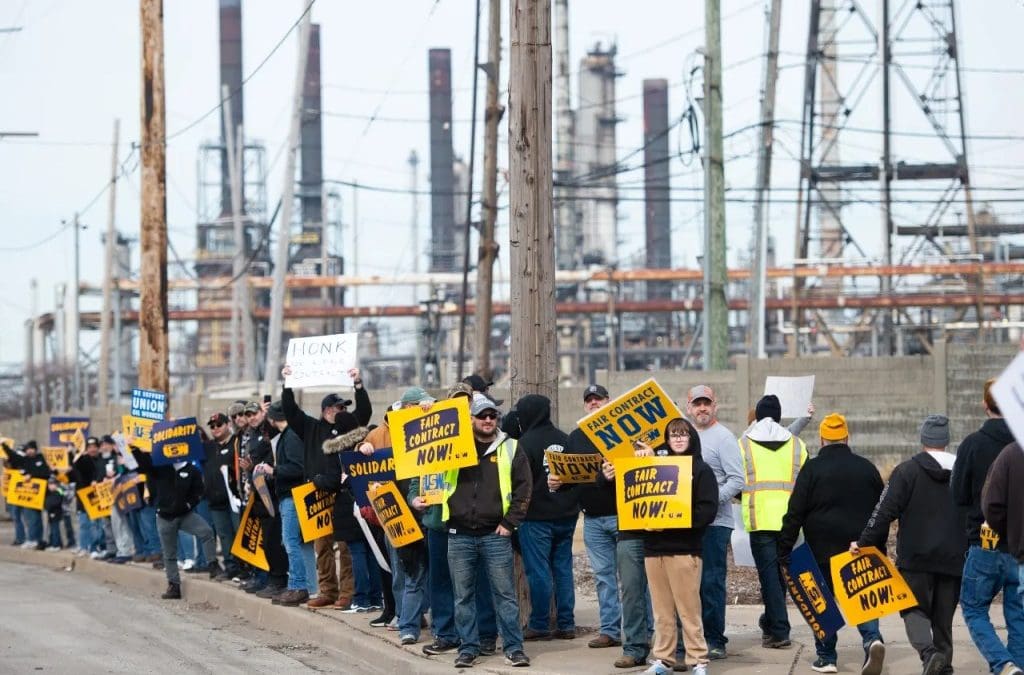
Foreign oil giant BP locks out workers at its last unionized refinery in USA
For the last five months, oil giant British Petroleum (BP) has locked 800 workers out of their jobs at a crude oil refinery in Whiting, Indiana. The facility, located on the southwestern shore of Lake Michigan, is BP’s last unionized oil refinery in the United States. BP says it is pursuing “modernized job structures, training, and upskilling,” but workers and their union—United Steelworkers Local 7-1—say that the company has not bargained in good faith, that its contract proposals pose blatant existential threats to workers’ jobs, pay, and collective bargaining rights, and that the company is illegally trying to crush the union out of existence with the lockout. In this episode of Working People, we speak with three locked out workers at the BP oil refinery in Whiting: Eric Schultz, president of USW Local 7-1; Leno Miller, assistant griever for USW Local 7-1; Tim Powell, a 19-year member of USW Local 7-1, and a volunteer for the lockout assistance committee.
Additional links/info:
USW Local 7-1 Official Lockout Update/Support Page
USW Local 7-1 Facebook page and Instagram
Sarah Lazare, Workday Magazine / The American Prospect, “Locked out refinery workers say BP is trying to ‘starve us,’ crush union”
Maximillian Alvarez, Working People / TRNN, “I survived the rig explosion that caused the Deepwater Horizon oil spill. This is what I saw”
Featured Music:
Jules Taylor, Working People Theme Song
Credits:
Audio Post-Production: Jules Taylor
Transcript
The following is a rushed transcript and may contain errors. It will be updated.
Maximillian Alvarez:
Alright. Welcome everyone to Working People, a podcast about the lives, jobs, dreams, and struggles of the working class today. Working People is a proud member of the Labor Radio Podcast Network and is brought to you in partnership with In These
Republicans Want to Punish Canada for “Exporting” Its Wildfire Smoke Into the US
Republican members of Congress are introducing legislation to impose sanctions on Canada over the fact that the smoke from wildfires has spread to the U.S. — an absurd effort to blame Canadian officials for the spread of the smoke without acknowledging the role of the climate crisis in supercharging the fires. In a statement, Sen. Bernie Moreno’s (R-Ohio) office says he blames Canada and…
Source
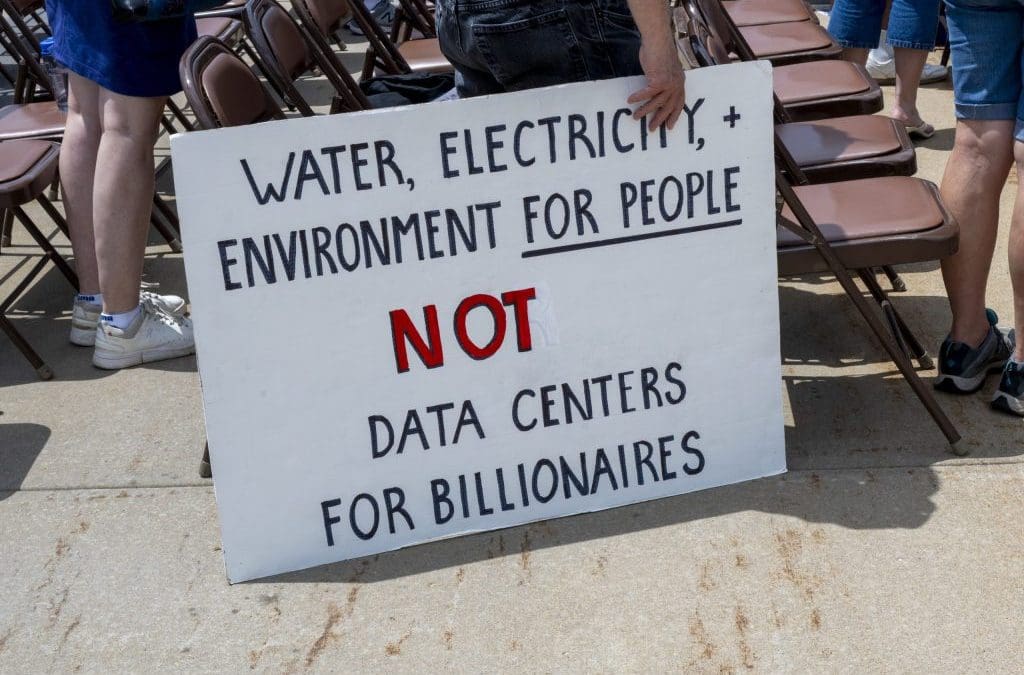
As heat wave spreads across the US, data centers strain electrical grids
This article was originally published by Truthout on July 01, 2026. It is shared here under a Creative Commons (CC BY-NC-ND 4.0) license.
A heat wave is spreading across the U.S. this week that will affect over 250 million people from the Midwest to the East Coast.
Last week, a heat dome covered much of Europe, causing over 1,300 excess deaths. This week, a new heat dome is bringing record-shattering heat to two thirds of the U.S. population, affecting areas that normally do not see such high temperatures.
The heat wave is expected to worsen as the week continues. Heat indexes – or how hot the temperature feels to the body, worsened by high humidity – are expected to reach between 100 and 110 degrees over large parts of the country. On Tuesday, the highest heat index value was 113.6 degrees Fahrenheit in southern Illinois.
Temperatures are expected to peak on Thursday and Friday, with cities like Newark, New Jersey, and Philadelphia, Pennsylvania, expecting actual temperatures of 105 degrees Fahrenheit starting Thursday. Parts of Virginia and North Carolina are expecting four to five consecutive days of 100-degree heat, from Wednesday, July 1 through the July 4 weekend.
Last week, a study from World Weather Attribution found that Europe’s heat wave would have been “virtually impossible” without climate change. Similar findings are expected for this U.S. heat wave.
In France alone, around 1,000 excess deaths were reported during the heat wave last week – hundreds more deaths per day compared with the daily death rate before the heat wave.
Fewer Americans are expected to die from heat in the U.S. than in Europe, largely because the U.S. has far more air conditioning, particularly in homes.
But
2 Weeks of Iran War Released More Carbon Emissions Than 84 Countries Do Yearly
The first two weeks of the U.S. and Israel’s war on Iran released a deluge of carbon emissions equivalent to the combined yearly climate warming pollution output of the lowest 84 emitters in the world, a new analysis finds. Researchers for progressive think tank Climate and Community Institute found that the first 14 days of the assault released over 5 million metric tons of carbon dioxide…
Source

Fisherwoman Diane Wilson is on hunger strike to stop Dow’s pollution of Texas Gulf Coast
Diane Wilson is a fourth-generation fisherwoman and a lifelong resident of Seadrift, Texas. Wilson has become a global folk hero over the course of her epic, decades-long journey from shrimp boat captain and mother of five to social and ecological justice warrior who took on a multibillion dollar corporation polluting the bays along her beloved Texas Gulf Coast. But the fight to save her home from industrial pollution is far from over. On March 2, Wilson began a hunger strike outside the Dow Chemical Company/Union Carbide plant in Seadrift. “I have a tent and am camping out 24 hours, 7 days a week,” Wilson wrote in a letter to Dow CEO Jim Fitterling, “to impress upon Dow/Union Carbide our intense dislike and frustration of decades of plastic pollution being discharged into our bays and waterways.” In this episode of Working People, TRNN Editor-in-Chief Maximillian Alvarez speaks with Wilson as her hunger strike enters its third week.
Guest:
Diane Wilson is a fourth-generation shrimper, boat captain, mother of five, author, and an environmental, peace, and social justice advocate. During the last 30 years, she has launched legislative campaigns, demonstrations, hunger strikes, sunk boats, and even climbed chemical towers in her fight to protect her Gulf Coast bay. She is a co-founder of CODEPINK, the women’s anti-war group based in Washington, DC, and co-founder of the Texas Jail Project, which advocates for inmates’ rights in Texas county jails. Since 2012, Wilson has been executive director and waterkeeper of San Antonio Bay Estuarine Waterkeeper (SABEW) on the Texas Gulf Coast. Wilson is the author of numerous books, including: An Unreasonable Woman: A True Story of