by Mansa Musa | May 13, 2026 | elections, midterms, Politics and Movements: US, Racial Justice, Rattling the Bars, video, Voting Rights
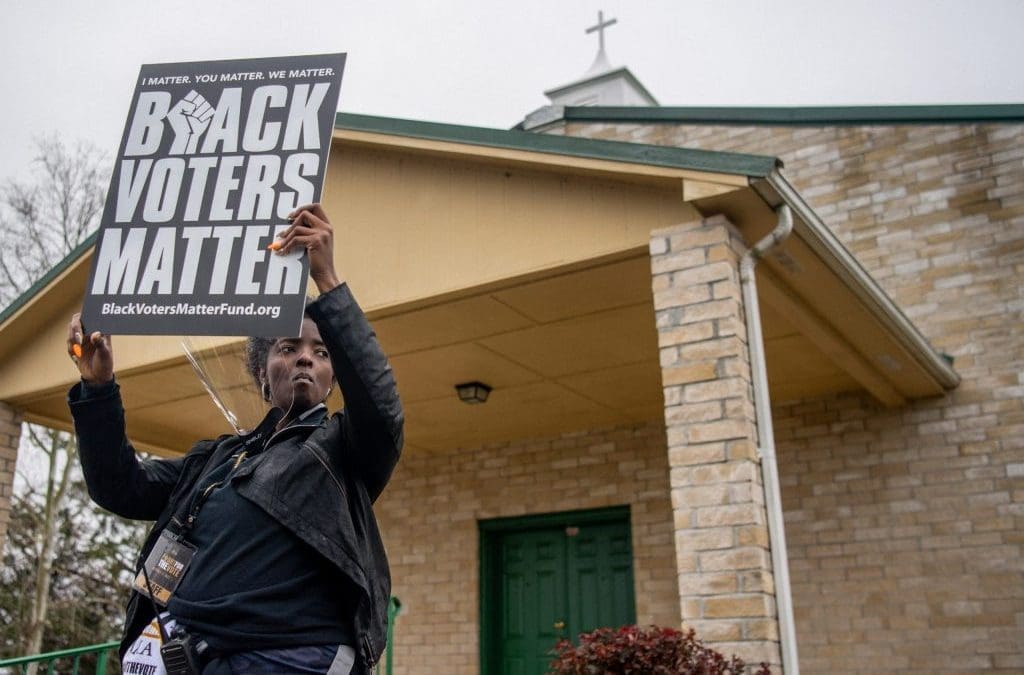
Alabama US Senate candidate Dakarai Larriett joins Mansa Musa on Rattling the Bars to expose the rising tide of voter suppression and the battle for the Democratic ticket. Ahead of the May 19, 2026, primary, Larriett takes aim at opponent Kyle Sweetser—a former three-time Trump voter—calling his sudden party shift disingenuous while vowing to ‘fight like hell’ against racist redistricting in the South.
Credits:
Producer / Videographer / Editor: Cameron Granadino
Editor’s Note: This interview was recorded on May 11, 2026. Following the recording, a US Supreme Court ruling cleared the way for Alabama to implement a new congressional map that effectively dismantles one of the state’s two majority-Black districts.
Transcript
The following is a rushed transcript and may contain errors. A proofread version will be made available as soon as possible.
Mansa Musa:
Welcome to this edition of Rattling the Bars. I’m your host, Mansa Musa. Since the Supreme Court decision in Louisiana versus Cowan, significantly weakening protection under the Voting Rights Act. Several Southern states have redrawn district lines leading to concerns over the delusion of Black political representation. From the Supreme Court decision in Virginia, striking down Democrat drawing maps to Texas Governor Greg Abbott redistricting plans, receiving formal approval, the national landscape is shifting. Today we are following up with the Dakarai Larriett, a candidate for the United States Senate of Alabama to discuss these nationwide shifts and their impact on the midterm and the balance of power in Congress. Dakarai, welcome to Rattling the Bar.
Dakarai Larriett:
Oh, good to be back, man, sir.
Mansa Musa:
So let’s dive into how you see this latest decision coming out of the Supreme Court and how you assessing
by Maximillian Alvarez | May 12, 2026 | education, ICE, immigration, Podcast, Politics and Movements: US, Prisons and Policing, Working People
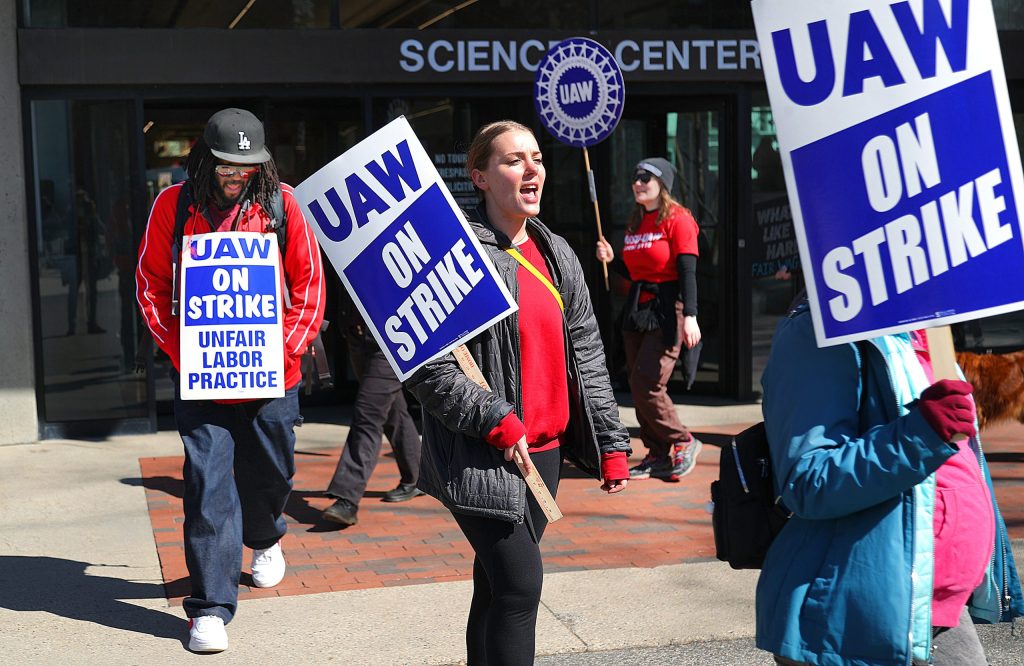
After 14 months of fruitless contract negotiations with the Harvard University administration, over 4,000 workers represented by the Harvard Graduate Students Union (HGSU-UAW Local 5118) walked off the job on an indefinite strike on April 21. According to the union, “Graduate student workers will suspend teaching and research labor until Harvard’s bargaining team takes substantive action in addressing the union’s key issues: pay that keeps pace with the rising cost of living, recourse for harassment and discrimination, support for non-citizen students, protections for academic freedom, and ‘fair share fees’ to equitably distribute the expenses of union representation, among others.” In this episode of Working People, we speak with three striking graduate student workers about the issues at the center of this strike, and about what it’s like to live, work, and strike at the country’s richest university amid political attacks from the federal government, scandals connecting high-ranking Harvard officials to Jeffrey Epstein, and a nationwide cost-of-living crisis.
Panelists include: Sara Speller, a fifth-year PhD student in the Music Department at Harvard and president of the Harvard Graduate Students Union; Zoë Feder, a seventh-year PhD student in the Biological & Biomedical Sciences program at Harvard Medical School and a research assistant in the Microbiology Department; and Jacob Wolf, a third-year PhD student and Teaching Fellow in the Harvard Graduate School of Education.
Additional links/info:
Harvard Graduate Students Union (HGSU-UAW Local 5118) website, Facebook page, X/Twitter page, TikTok, and Instagram
Harvard Graduate Students Union Strike Update/FAQ Zine
Lydialyle Gibson, Harvard Magazine, “Harvard graduate student workers strike”
Noah A. Ferris, The Harvard Crimson, “Grad students rally outside Garber’s home as strike enters third week”
Hugo C. Chiasson & Elise A.
by Jake Johnson | May 11, 2026 | Article, cuba, Iran, Politics and Movements: International, Politics and Movements: US, Reprint, Venezuela, War
This story originally appeared in Common Dreams on May 11, 2026. It is shared here under a Creative Commons (CC BY-NC-ND 3.0) license.
US surveillance and reconnaissance flights off the coast of Cuba have surged in recent months as President Donald Trump has issued increasingly belligerent threats to seize the island nation by force.
CNN reported Sunday that the US Navy and Air Force have conducted more than two dozen surveillance flights—mostly of them near Havana and Santiago de Cuba, the country’s largest cities—since early February, after the Trump administration invaded Venezuela and kidnapped its president. The outlet noted that “similar patterns, in which ramped-up rhetoric by the Trump administration coincided with an uptick in publicly visible surveillance flights, occurred in the lead-up to US military operations in both Venezuela and Iran.”
“The flights are notable not only for their proximity to the coast, which puts them well within range of gathering intelligence, but for the suddenness of their appearance—prior to February, such publicly visible flights were exceedingly rare in this area—and for their timing,” CNN reported.
CNN published its story days after US Secretary of State Marco Rubio announced new sanctions targeting a conglomerate operated by Cuba’s military and a natural resources firm, intensifying the United States’ decades-long economic war against the island nation.
“Our people already know the cruelty behind the actions of the US government and the viciousness with which it is capable of attacking us,” Cuban President Miguel Díaz-Canel said in response to the sanctions. “They understand, just as the rest of the world does, that this is a unilateral aggression against a nation and a population whose sole ambition is to live in peace, masters of their own destiny and free from the pernicious interference of US imperialism.”
In a New York Times op-ed on Monday, US Reps. Pramila
by Brad Reed | May 11, 2026 | AI, Article, Economy, Economy and Inequality, Inequality, Politics and Movements: US, Reprint
This story originally appeared in Common Dreams on May 08, 2026. It is shared here under a Creative Commons (CC BY-NC-ND 3.0) license.
A top state utilities regulator is calling foul on an effort to shift the power cost of out-of-state artificial intelligence data centers onto Maryland residents.
Maryland’s Office of People’s Counsel on Thursday filed a complaint with the Federal Energy Regulatory Commission (FERC) against electric grid operator PJM Interconnection objecting to plans that it said would force residents in the state to pay $1.6 billion in data center-driven transmission costs over the next decade.
The complaint states that the transmission cost allocation methodology PJM is using “broadly socializes” the cost of increased power demands that is being driven by AI data centers.
“That result is unjust and unreasonable and violates the cost causation principles that have long governed transmission cost allocation and that this commission has repeatedly affirmed,” the complaint says. “PJM’s tariff imposes these costs on Maryland electric customers even though Maryland customers do not meaningfully cause nor benefit from those investments.”
The Office of People’s Counsel pointed to the massive number of data centers built in neighboring Virginia as a primary culprit for added strain on the electric grid.
“Amidst national data center growth, Virginia stands as the epicenter,” the complaint says. “Virginia is the largest data center market in the world… As of December 2024, data centers represented 3.6 GW of demand… reflecting, since 2013, a 660% increase in megawatt-hour consumption.”
This explosive growth in energy demand is only expected to intensify over the next several years, the complaint continues, noting that “PJM projects 32 GW of peak load growth across its territory by 2030, of which approximately 30 GW
by Taya Graham and Stephen Janis | May 8, 2026 | Article, Economy and Inequality, Inequality, Inequality Watch, Opinion, Politics and Movements: US, Prisons and Policing
The press conference for Epstein survivors we covered earlier this year felt claustrophobic.
It was the afternoon before President Donald Trump’s State of the Union address in February. The women who had suffered at the hands of the world’s most infamous predator were crammed into a small meeting room in the Cannon House Office Building in Washington, DC.
They had gathered to demand acknowledgement that evening from both Congress and the President. The venue was so tiny, there was barely room for the survivors to gather around the podium.
The assemblage stood in stark contrast to what we found in the emails we had been poring over after the Justice Department released an often-opaque database of documents gathered during several investigations of the historic sex predator.
Based on what we’ve read, Epstein and his associates inhabited a world of material and social abundance. They weren’t constrained or forced to plead for anything. Their lives were full of easily obtained wealth, which afforded plenty of space to commit crimes.
This contrast reveals what this scandal is ultimately about: not just one man’s crimes, but the unimaginable inequality that made asking for tens of millions of dollars as easy as writing a poorly worded email. In fact, all Epstein had to do to enrich himself was to ask.
Consider what Epstein sent to media mogul Mortimer Zuckerman in July of 2014:
I’m happy to hear from you, happy to see your stock at the 120 level. an increase in over 100
million in new net worth in only a few months. (how long did it take for the first 100?) I
assume, by your email, that as I predicted, you have
by Jake Johnson | May 8, 2026 | Article, elections, midterms, Politics and Movements: US, Racial Justice, Reprint, Voting Rights
This story originally appeared in Common Dreams on May 07, 2026. It is shared here under a Creative Commons (CC BY-NC-ND 3.0) license.
Republicans in the Tennessee House of Representatives voted during a special session on Thursday to adopt a new congressional map that would carve up the state’s lone majority-Black district, a move that came amid raucous protests from angry residents and Democratic lawmakers.
The special session was called by GOP Gov. Bill Lee at the behest of President Donald Trump, whose aggressive gerrymandering push across the country was supercharged by the US Supreme Court’s decision last week gutting the 1965 Voting Rights Act’s protections against racial discrimination. One Tennessee Republican—state Rep. Todd Warner (R-92)—walked into the House chamber for Thursday’s vote wearing a Trump 2024 flag as a cape.
The Tennessee House approved the new congressional map, which would likely draw the only Democrat in Tennessee’s US congressional delegation out of his seat, by a party-line vote of 64 to 25. Following the vote, The Tennessean reported that “Democrats linked arms and walked out of the room. Seconds later, the chamber adjourned.”
Shouts of rage flooded the Tennessee House chamber after the map passed, and protesters booed and jeered Republican lawmakers as they exited.
⚡️ WATCH — JUST NOW — 99% white Tennessee House Republicans pass a racist 9-0 map stripping majority Black Memphis of congressional representation pic.twitter.com/OYwTWZK2i1— The Tennessee Holler (@TheTNHoller) May 7, 2026
House passage of the map came after lawmakers voted to repeal a 1972 ban on mid-decade redistricting after limited debate, clearing the way for approval of the new district lines, which are expected to draw US Rep. Steve Cohen (D-Tenn.)—the only Democrat in Tennessee’s congressional delegation—out of his seat.
The Tennessee Senate is expected to approve