by Michael Fox | Nov 9, 2026 | brazil, Podcast, Politics and Movements: International, Politics and Movements: US, Trump, Under the Shadow, Under the Shadow Season 2
On Sunday, October 25, Brazilian President Luiz Inacio Lula da Silva defeated far-right Senator Flavio Bolsonaro by a margin of three and a half points, and almost 4.5 million votes. It was roughly twice the margin of the 2022 election, when Lula defeated Flavio’s father, Jair Bolsonaro.
It was the first time in Brazilian history that a candidate lost the first round of voting and won the second. And it was also one of the first defeats of a far-right Trump ally in several years.
As we’ve examined throughout this season of the podcast, Trump’s Donroe Doctrine has overshadowed the region since he came back into power early last year. He’s invaded Venezuela, tightened the screws on Cuba, and twisted arms to get his friends elected in countries up and down the Americas. But in Brazil, he couldn’t. And it’s not because Trump and his Silicon Valley buddies didn’t try.
It’s because Lula supporters organized en masse. Students, workers, teachers, retirees, and everyone in between. And they hit the streets to flip the vote, despite the odds.
They rallied with weeks of around-the-clock campaigning, marches, and protests. They pamphleted and fliered. They talked to their neighbors and their relatives. Online, Lula supporters responded with creative campaigns to confuse the algorithms that aggressively pushed content promoting Bolsonaro.
As many in the crowds told me again and again in recent weeks, this election was a decision that would define the fate of Brazil’s democracy. This wasn’t a vote between two candidates in a democratic system, where one wins and the other accepts their loss. It was a decision between democracy and dictatorship. Or democracy and something else.
And democracy won.
We began this
by Plínio Teodoro | Nov 7, 2026 | Article, paraguay, Politics and Movements: International, Politics and Movements: US, Prisons and Policing, Reprint, Trump
This story originally appeared in Panamerican Dispatch on Nov. 07, 2026, and is shared here with permission.
Former Paraguayan President Santiago Peña was moved from house arrest to a military unit within the Armed Forces overnight on Friday, October 6. The relocation followed an incident in which protesters surrounded his residence in Asunción, demanding his incarceration in a formal prison facility, which led to clashes with the police.
Peña was removed from office hours earlier, after the Senate voted unanimously to impeach him. The impeachment stemmed from his alleged involvement in the collapse of Ueno Bank, an institution that blocked access to funds for approximately 40% of the Paraguayan population.
The case bears similarities to the financial scandal in Brazil involving Daniel Vorcaro’s Banco Master, which implicated former presidential candidate Flávio Bolsonaro, a significant portion of the Bolsonaro movement and the political right in Brazil.
According to the Argentine digital news outlet Infobae, the military organized Peña’s extraction from his home in the La Piedad neighborhood of Asunción, using three pickup trucks for the transfer. The operation took place shortly before midnight, after escalating tensions near his residence made it untenable for the former president to remain there.
Footage captured by the Paraguayan newspaper ABC Color shows individuals throwing eggs and shouting insults at the vehicle transporting Peña as the convoy departed. The same outlet reported that Paraguayan intelligence identified the infiltration of agitators within the crowd, individuals who had previously been participating in a protest in the city center and allegedly moved to the residence with the intent of inciting violence.
🔴 AHORA | Trasladan a Santiago Peña al Regimiento Escolta.En medio de momentos de
by Jessica Corbett | Nov 6, 2026 | Article, California, Politics and Movements: US, Prison Industrial Complex, prison reform, Prisons and Policing, Reprint
by Adam Johnson | Nov 5, 2026 | Article, Democratic Party, elections, Israel, midterms, Politics and Movements: International, Politics and Movements: US
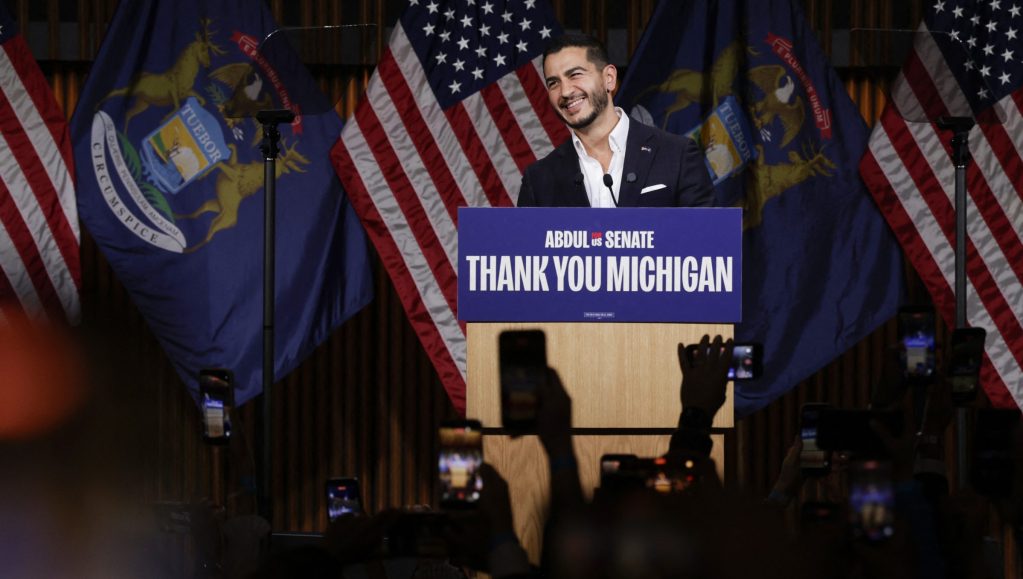
As the tide recedes on the Democrats’ “Blue tsunami” this past Tuesday, before the votes were even tallied, the internecine fight over The Narrative among the US center-left began in earnest. Centrist ideological curators, as is their function, came out strongly to paint the historic drubbing of Republicans as evidence that centrists are more electable than progressives. And progressives, likewise, have made the opposite argument, buoyed by the 7-point swing state victory of progressive and strong Israel critic Abdul El-Sayed in Michigan.
This piece won’t litigate the empirical question as such (though pollster G. Elliot Morris does an excellent job debunking the “centrists overperformed” conventional wisdom), but will highlight instead how many of the “El-Sayed is toxic and can’t win middle America” narratives completely evaporated Tuesday night, and how those pushing them will, of course, never be held to account nor asked to explain why so many outright lies were advanced about the Democratic nominee. El-Sayed won by roughly 340,000 votes despite being subject to nonstop intra-party, intra-liberal attacks emanating from everyone from the president of the most influential liberal think tank in the US, to key Democrats in Congress such as House Speaker Emerita Nancy Pelosi, Jim Clyburn, and Debbie Wasserman Schultz, to influential liberal media outlets The Atlantic magazine and The New York Times, to his largely Republican-funded primary opponent Hayley Stevens, who––unlike the others––at least had the courtesy to break kayfabe and come out in support of Republican Mike Rogers explicitly. Unlike genetic white media darlings Roy Cooper and James Talarico who, the centrist wonk expects insists, Covered The Spread, El-Sayed was subject to one of the most
by Ryan Johnson | Nov 5, 2026 | Fascism, Politics and Movements: US, Prisons and Policing, terrorism, Trump, video
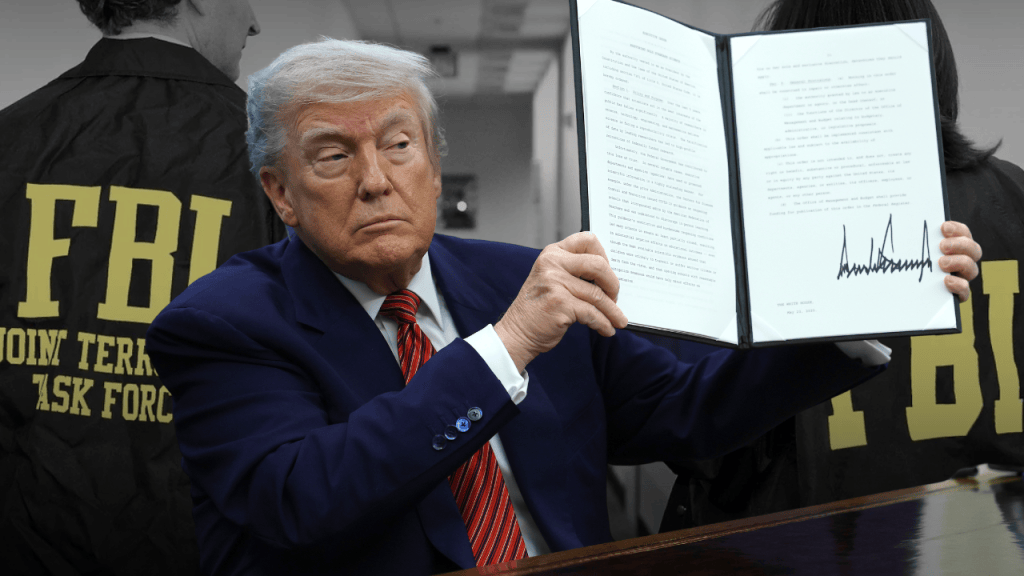
In September 2025, President Donald Trump signed the National Security Presidential Memorandum 7, a classified document that directs powerful federal agencies to counter “Domestic Terrorism,”, a loosely defined term with no specific federal criminal charge. Still, the Trump Administration has taken steps to use it as a pretext for targeting and punishing people and organizations who are standing for marginalized communities.
This summer, nine protesters were convicted on terrorism charges with sentences ranging from 30 to 70 years for a noise demonstration occurring on July 4th, 2025, outside the Prairieland ICE facility in Texas that resulted in the shooting of a federal officer.
The charges include a 50-year sentence for protester Autumn Hill, who said she left before the officer was injured, and a 30-year sentence for Daniel Rolando Sanchez-Estrada, who was not even present at the site of the shooting and was convicted of conspiracy to conceal documents for moving a box of magazines and pamphlets of “Anti-fascist literature.” Benjamin Song, the shooter, also received 100 years in prison.
Credits:
Reported and Produced by Ryan Johnson
Filmed by Vanessa Donovan
Edited by Evan Stice
Transcript
A transcript will provided when ready
by Chris Walker | Nov 5, 2026 | Article, Democratic Party, elections, midterms, Politics and Movements: US, Reprint, Voting Rights
This article was originally published by Truthout on Nov. 04, 2026. It is shared here under a Creative Commons (CC BY-NC-ND 4.0) license.
Several statewide and state legislative contests in this week’s midterm elections have resulted in new Democratic Party “trifecta” governments — places where the party is now in control of both houses of the state legislature as well as the governor’s office.
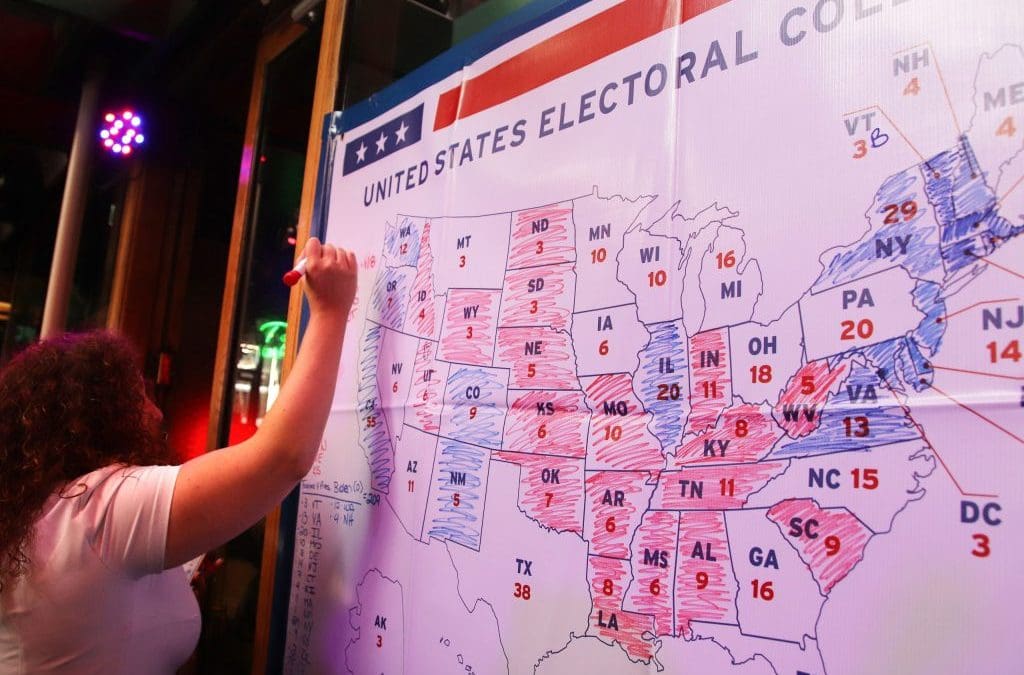
With these new wins, Democrats have the opportunity to do something once considered nearly impossible: implement a popular vote model for electing future presidents of the United States, to replace the archaic and unpopular Electoral College.
Due to the mechanics of the Electoral College, five presidential “winners” in U.S. history have taken office who did not win the approval of most voters, including twice over the past three decades. While a constitutional amendment would be needed to formally abolish the Electoral College — which is unlikely to happen anytime soon, even after this week’s “blue wave” — there is a workaround called the National Popular Vote Interstate Compact, which doesn’t require such an amendment.
Per Article II of the U.S. Constitution, each state is mandated to appoint, “in such manner as the Legislature thereof may direct, a number of electors, equal to the whole number of Senators and Representatives to which the State may be entitled in the Congress.” These electors end up voting for president and vice president.
All states today direct their electors to vote based on their own results in presidential races. If a Democratic candidate wins in California, for example, all 54 of its electors are people chosen to support that candidate in the Electoral College.
But under