by Lorah Steichen | Apr 24, 2026 | Article, Economy, Economy and Inequality, labor, Military Industrial Complex, Politics and Movements: US, Reprint, War
This story originally appeared in Jacobin on April 23, 2026. It is shared here with permission.
Amid the United States’ illegal, costly, and broadly unpopular war in Iran, the Trump administration recently asked Congress to approve a record-breaking $1.5 trillion military budget — the largest military spending proposal in US history. The administration claims that record war spending will pay for a “once-in-a-century revival of American industry,” while hawks in Congress argue that the spending spree will “revitalize” the military industrial base by investing in a “skilled, patriotic defense workforce.”
But new research from Transition Security Project suggests that military spending increases are unlikely to translate into broad gains for American workers.
While Pentagon budgets have steadily increased over recent decades, the arms industry has become more consolidated, more automated, and less labor-intensive — upending the idea that the warfare state is an effective economic development strategy for working people, and strengthening the case for a state-led shift toward a civilian industrial base focused on green manufacturing.
Half of the Pentagon budget is funneled to private weapons manufacturers, but higher spending has not produced more jobs. Employment in military industries has fallen significantly since Cold War peaks, from an estimated 3.2 million workers during the 1980s to about 1.1 million in 2020, despite Pentagon budgets growing by roughly 22 percent over the same period. Meanwhile, job quality in the sector has also deteriorated: wages have declined, pensions cut, and unionization collapsed to roughly 10 to 14 percent on average across major military contracting firms, while company revenues from military contracts have grown substantially.
Taken together, these trends challenge a persistent assumption in Washington policymaking that military spending is an effective jobs program for American
by Caitlyn Clark and Lisa Xu | Apr 23, 2026 | Article, Economy, Economy and Inequality, labor, Politics and Movements: US, Reprint, Unions
This story originally appeared in Labor Notes on April 23, 2026. It is shared here with permission.
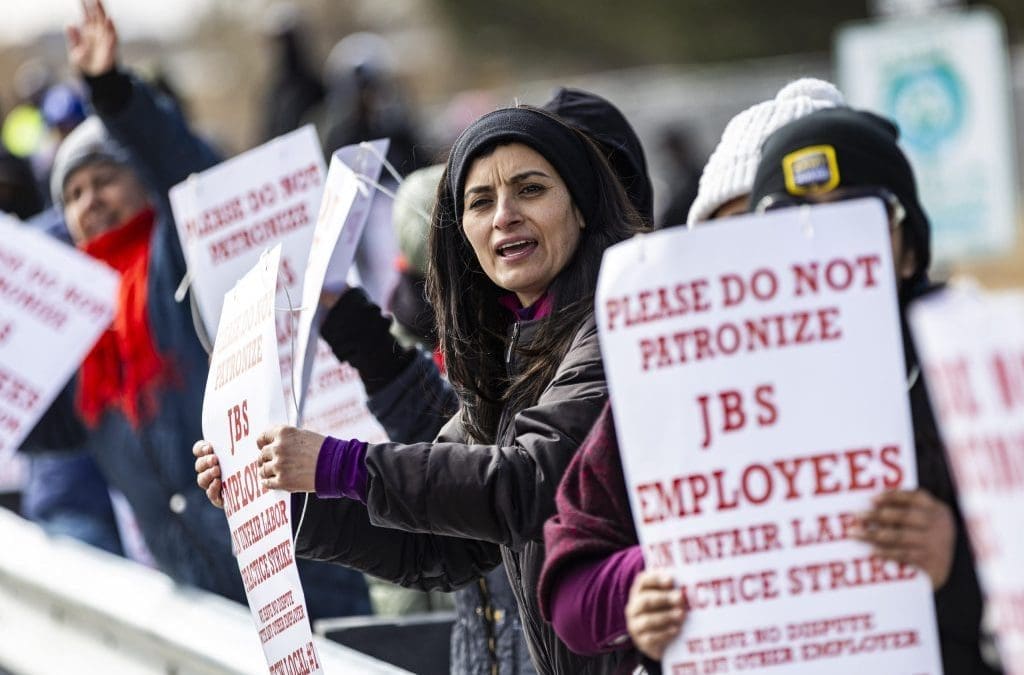
Last month, 3,800 meatpacking workers in UFCW Local 7 in Greeley, Colorado launched the industry’s first major strike in 40 years.
The three-week unfair labor practice strike was the first time workers had ever struck the JBS Greeley beef packing plant, one of the company’s largest. ULP charges against JBS included the illegal termination of a member of the bargaining committee and surveillance and intimidation of workers for participation in union activity.
With 57 languages spoken under one roof, the strike united the plant’s largely immigrant workforce to take on the biggest meatpacking company in the world.
The local had spent nearly a year in negotiations following the contract’s expiration last July. JBS returned to the bargaining table after the strike—and when the dust settled, the company had conceded to almost every demand.
WON PROTECTION
In addition to $1.50 an hour in wage increases over the short two-year agreement, workers won a groundbreaking policy on personal protective equipment, challenging JBS’s previous system of garnishing wages to replace necessary PPE when it was lost, damaged, or stolen. JBS was charging workers up to $1,100 to pay for mesh vests, gloves, arm guards, and knife sharpeners.
“My mesh apron had a hole in it. I had to go two months wearing the same apron,” said Chris Ready, who has worked in the slaughter department at the plant for one year.
“I’ve had my equipment stolen,” Ready said. “I borrowed knives until I had to buy my own… I’ve had to buy two mesh gloves so far, that’s $200. It was annoying, but it
by Derek Seidman | Apr 20, 2026 | AI, Article, Economy, Economy and Inequality, Politics and Movements: US, Reprint
This article was originally published by Truthout on April 19, 2026. It is shared here under a Creative Commons (CC BY-NC-ND 4.0) license.
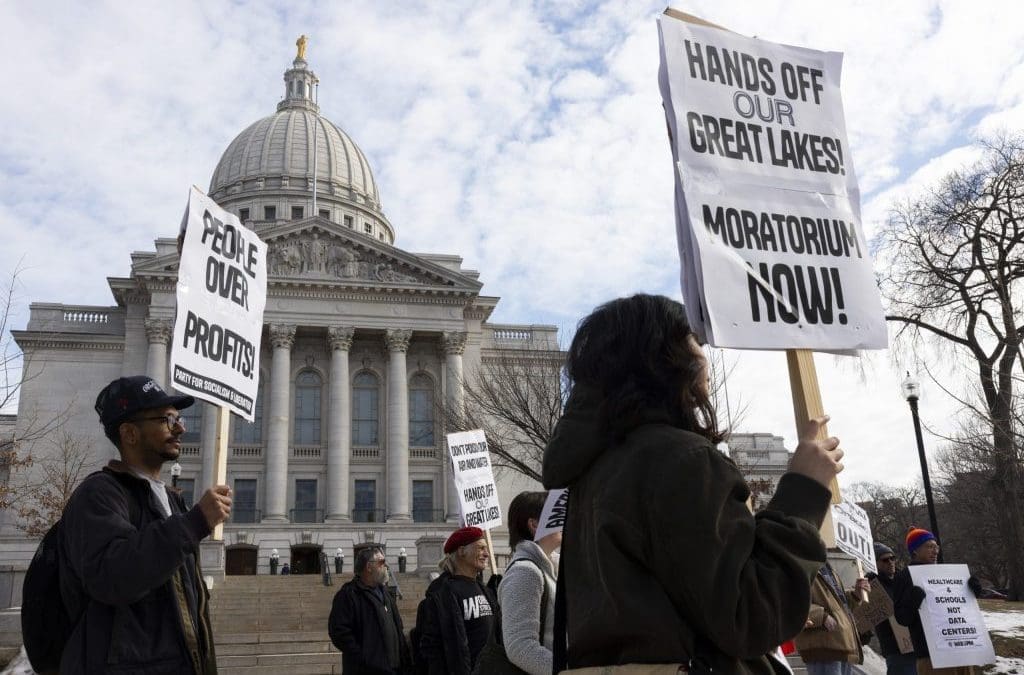
The prolific construction of massive data centers that house the physical computing power for artificial intelligence (AI) is galvanizing resistance in localities across the United States. Communities are fighting back against the billionaire tech and financial power behind these projects and their numerous harms, from their noise and pollution to their hyperconsumption of water and electricity.
Truthout has been covering the corporate interests behind the data center boom and local resistance to data centers. In this roundtable, we brought together representatives from three campaigns across the U.S. to share their experiences and lessons from taking on data centers and AI infrastructure in their areas.
KeShaun Pearson is the leader of Memphis Community Against Pollution (MCAP), based in Memphis, Tennessee, which is focused on fighting for environmental and climate justice in the predominantly Black community of southwest Memphis that’s most impacted by the concentrated pollution from nearby toxic release facilities. MCAP is currently campaigning against Elon Musk’s polluting xAI Colossus supercomputer. Tricia Boehlke is an organizer with No Data Center in DeForest, which recently succeeded in halting a proposed data center that was pushed by a private equity-owned company in a small town outside of Madison, Wisconsin. Lee Ziesche organizes with the Tucson Democratic Socialists of America and the No Desert Data Center Coalition, which has been taking on Project Blue, a huge data center proposed in the Tucson, Arizona, area. The campaign against Project Blue won a victory when Amazon recently pulled out of the project, but its developers are again trying to advance it.
This roundtable has been lightly edited for length and clarity.
Derek
by Taya Graham and Stephen Janis | Apr 17, 2026 | AI, Economy and Inequality, Inequality, Inequality Watch, Politics and Movements: US, video
Welcome to Inequality Watch React, where we don’t just talk about inequality, we go straight to the source.
This week, we take you inside the National Press Club, where we spoke with Congressman Ro Khanna about the future of the Democratic Party, economic patriotism, and the growing divide between the powerful and everyone else.
From why Democrats struggle to win, to the unanswered questions surrounding the Epstein files, to whether Silicon Valley is creating a new class of untouchable elites, we break it all down.
Because this isn’t just about politics. It’s about power, and who it protects.
And the big question: can we protect ourselves from its excess and its consequences? Independent journalists Taya Graham and Stephen Janis head down to Capitol Hill to ask these questions. And if you have a question you want us to ask, please leave it in the comments!
Credits:
Written by: Stephen Janis
Produced by: Taya Graham, Stephen Janis
Studio / Post-Production: Cameron Granadino
Transcript
The following is a rushed transcript and may contain errors. A proofread version will be made available as soon as possible.
Taya Graham:
Hello, my name is Taya Graham and welcome to our Inequality Watch React, the show where we discuss not just how this country is ruled by billionaires, but how and why. Reporting that seeks to hold the American aristocracy accountable for the destructive effect unimaginable wealth has had on our politics and on our lives. Now, unlike other YouTubers, we go right to the source to report back to you on America’s historic wealth imbalance, namely our nation’s capital, Washington DC. That’s where my reporting partner and I, hello, Steven.
Stephen Janis:
Hey, how you doing, Taya?
Taya Graham:
We often
by Brett Wilkins | Apr 17, 2026 | Article, Economy, Economy and Inequality, Iran, Oil, Politics and Movements: International, Politics and Movements: US, Reprint, Trump, War
by Maximillian Alvarez | Apr 15, 2026 | Economy and Inequality, Inequality, Podcast, Politics and Movements: US, Working People
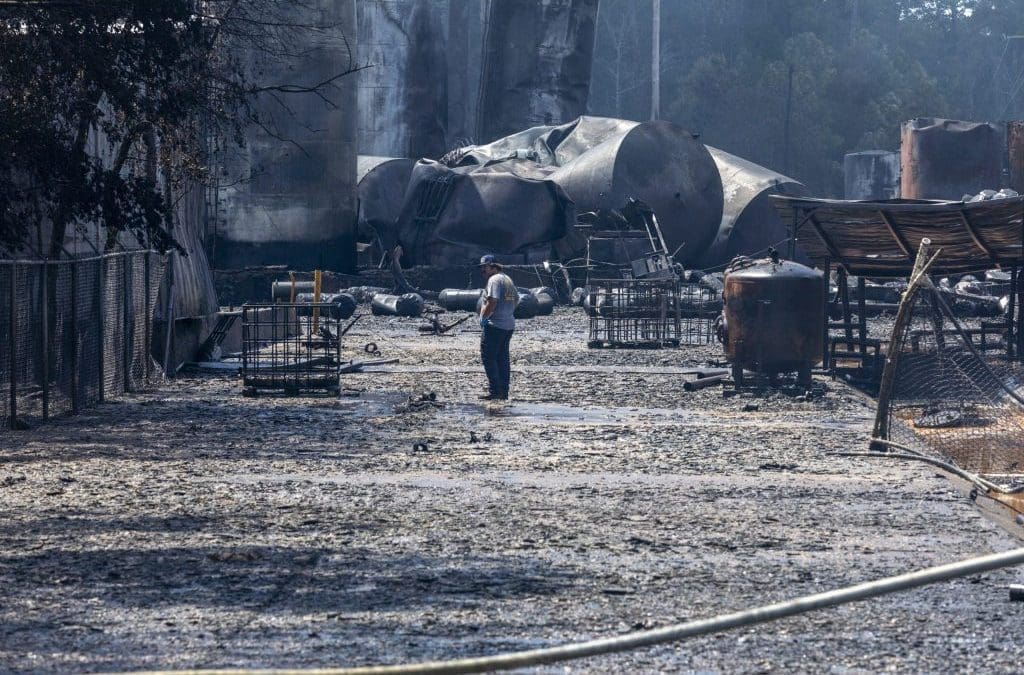
On Aug. 22, 2025, the small-town lives of residents living near the Smitty’s Supply facility in Roseland, Louisiana, changed forever when an explosion occurred at the automotive lubricant plant. The explosion and ensuing fire, which burned for days, triggered evacuations across the area, blanketing homes and businesses with smoke, soot, and oily residue, while spilling petroleum products from the plant into area waterways, including several adjacent ponds and the Tangipahoa River. While the Environmental Protection Agency claims that the area is safe, according to the agency’s own chemical monitoring, residents say they’ve been left behind and kept in the dark as they develop negative health symptoms and their homes remain covered in toxic substances. In this episode, we speak with Arlene Bankston, a farmer and resident of Roseland, and Allie Ponvelle, who lives one town over in Amite, about the slow-moving nightmare they’ve been living in ever since the massive explosion and chemical fire at Smitty’s Supply.
Additional links/info:
Alene Bankston’s Facebook page
Allie Ponvelle’s Facebook page
Petition to Close Roseland Montessori School Due to Toxic Contamination
Chemically Impacted Communities Coalition (CICC) website
Wesley Muller, Louisiana Illuminator, “Smitty’s Supply neighbors still wary of fire fallout despite assurances from Landry, EPA”
Whitney Miller, WWL Louisiana, “What was in the air and water after the Smitty’s Supply fire? Testing under new scrutiny”
”Maximillian Alvarez, The Real News Network, “America’s toxic future looks like East Palestine, Ohio, today”
Featured Music:
Jules Taylor, Working People Theme Song
Credits:
Audio Post-Production: Jules Taylor
Transcript
The following is a rushed transcript and may contain errors. A proofread version will be made available as soon as possible.
Maximillian Alvarez:
All right. Welcome everyone to Working People, a podcast about the lives, jobs, dreams,