by Leigh Goodmark | Dec 4, 2025 | Abolition, Criminalization, Feminism, Op-Ed, Pennsylvania, prison reform, Prisons, sex trafficking, Violence
Pennsylvania State Sen. Amanda Capalletti recently announced her intention to propose legislation that would allow people convicted of crimes related to resisting their own abuse to ask for shorter sentences. The legislation also enables those already serving long sentences for crimes substantially related to their experiences of violence to seek resentencing. The law is meant to offer hope…
Source

by Mansa Musa | Dec 1, 2025 | Economy, Economy and Inequality, labor, Podcast, prison reform, Prisons and Policing, Rattling the Bars
In this episode of Rattling the Bars, host Mansa Musa speaks with Miami-based organizer Katherine Passley about how prison labor, temp agencies, and the 13th Amendment have created a system that traps formerly incarcerated people in unending cycles of cheap, hyper-exploited work. Passley, co-executive director of Beyond the Bars, also talks with Musa about how her organization is fighting to win free jail phone calls, erase millions of dollars in fines and fees for systems-impacted people, and build powerful bridges between the prison abolition movement and the labor movement in Florida.
Guest:
Katherine Passley is co-executive director of Beyond the Bars, a worker center in South Florida building the social and economic power of workers with criminal records and their families. Passley was named the 2025 Labor Organizer of the Year by In These Times magazine.
Additional links/info:
Kim Kelly, In These Times, “Building bridges and erasing jail debt: Katherine Passley“
Mansa Musa, The Real News Network, “America is built on prison labor. When will the labor movement defend prisoners?“
Credits:
Producer / Videographer / Post-Production: Cameron Granadino
Transcript
The following is a rushed transcript and may contain errors. A proofread version will be made available as soon as possible.
Mansa Musa:
My name is Mansa Musa. I’m a former political prisoner, member of the Black Panther Party. And prior to being released from prison, I served 48 years. Now I’m the host of rallying the bars on the Real News Network when we think of labor and labor movement in this country. More importantly, when we think of the quote from Marxist, when Marx say, workers of the world Unite. Was Marx talking about only workers of a certain ethnic group? Was Marx talking about all
by Mansa Musa | Nov 24, 2025 | Politics and Movements: US, prison reform, Prisons and Policing, Rattling the Bars, video, Wisconsin
Wisconsin’s much-touted prison overhaul plan promises to close crumbling facilities like Green Bay Correctional Institution, but people locked up inside these facilities may have to wait years for relief they desperately need now. In this episode of Rattling the Bars, formerly incarcerated organizer Sean Wilson joins host Mansa Musa to discuss whether Wisconsin’s bipartisan prison plan will deliver real transformation to a broken justice system, or if it simply amounts to a construction project that leaves that system intact.
Guest:
Sean Wilson is the senior director of organizing and partnerships at Dream.Org. In his role, he is responsible for overseeing capacity building, leadership development programs, and grassroots partnerships. Over the past two and a half years, Sean has led the team in building one of the most transformational training programs in the nation — the Dream Justice Cohort — as part of the justice program. Sean was born and raised in Milwaukee, Wisconsin, and has organized at the state and local level around policy change related to youth justice, voting rights, police reform, and criminal justice.
Additional links/info:
Sean Wilson, Wisconsin Examiner, “I lived inside Green Bay Correctional. Wisconsin can’t wait another four years”
Credits:Producer / Videographer / Post-Production: Cameron Granadino
Transcript
The following is a rushed transcript and may contain errors. An updated version will be made available as soon as possible.
Mansa Musa:Welcome to this edition of Rattling the Bars. I’m your host, Mansa Musa. October the 28th. Wisconsin State legislators on both sides of the aisle voted in favor of a sweeping proposal by governor of Wisconsin, Tony Evers, to overhaul the state correctional facilities in this overhaul package. In theory, the governor want to
by Mansa Musa | Nov 17, 2025 | Politics and Movements: US, Prison Industrial Complex, prison reform, Prisons and Policing, Rattling the Bars, video
The Alabama prison system functions like a modern-day plantation: overcrowded, understaffed prisons like Bullock Correctional Facility run on forced labor, violence, and deliberate neglect. In this episode of Rattling the Bars, host Mansa Musa speaks with journalist Matthew Vernon Whalan about his book Bullock: Chronicles of Deprivation and Despair in an American Prison, and about the systematic corruption and inhumane horrors endured daily by incarcerated people in Alabama.
Guest:
Matthew Vernon Whalan is a writer and oral historian living in New England. He is the author of the book Bullock: Chronicles of Deprivation and Despair in an American Prison, and his work has appeared in Counterpunch Magazine, Alabama Political Reporter, Scheer Post, Jacobin, Eunoia Review, New York Journal of Books, The Brattleboro Reformer, and elsewhere. He runs the publication Hard Times Reviewer.
Credits:
Producer / Videographer / Post-Production: Cameron Granadino
Transcript
The following is a rushed transcript and may contain errors. A proofread version will be made available as soon as possible.
Mansa Musa:
Welcome to this edition of Rattling Bars. I’m your host, Mansa Musa. In this country, we have the right to life, liberty, and the pursuit of happiness according to the Constitution. But in this country also, we have legalized slavery under the 13th Amendment. To understand what legalized slavery is, institutionalized slavery is, all you have to do is look to Alabama and the Alabama prison system. The prison industrial complex in Alabama is one of the most notorious systems in this country, I would even venture to say in the world. Join me today is Matthew Whalan. Matthew wrote a book called Bullock: Chronicles of Deprivation and Despair in an American Prison. Thank you for joining us today, Matthew.
Matthew Whalan:
Thank you for having me.
Mansa Musa:
Alright,
by Mansa Musa | Nov 3, 2025 | Politics and Movements: US, Prison Industrial Complex, prison reform, Prisons and Policing, Rattling the Bars, video
From chronic overcrowding and inmate deaths to systematic abuse and lawbreaking by corrections officers, prison conditions in the state of Alabama have reached a crisis point. And yet, state leaders continue to push an “Alabama solution” that involves building more mega-prisons and expanding qualified immunity for officers. In this episode of Rattling the Bars, host Mansa Musa speaks with Dakarai Larriett, a Democratic candidate for US Senate in Alabama, about about the true cost of Alabama’s carceral crisis and his vision for an alternative vision of criminal justice.
Guest:
Dakarai Larriett is a community leader, entrepreneur, and Democratic candidate for US Senate in Alabama
Credits:
Producer / Videographer / Post-Production: Cameron Granadino
Transcript
The following is a rushed transcript and may contain errors. A proofread version will be made available as soon as possible.
Mansa Musa:
Welcome to this edition of Rattling the Bars. I’m your host Mansa Musa. We’ve been hitting hard on covering what’s going on down in Sweet Home, Alabama. We’ve been intentional about giving people a voice or turn the volume up on their voice about what they should be done in Alabama. What is the Alabama solution? This term came out of a documentary where prison system in Alabama was being highlighted, and when they confronted the governor with some of the realities of the abuse that was taking place in the Alabama prison system in general, and the fact that the United States Attorney General had issued a mandate that the conditions in Alabama were so horrendous that they had to do something about it, the governor respond was this is not a Justice Department solution. This is not the Justice Department responsible correcting.
by D Watkins | Oct 30, 2025 | Article, baltimore, Prison Industrial Complex, prison reform, Prisons and Policing, Reprint, The Cultural Front
This story originally appeared in Baltimore Beat on Oct. 28, 2025. It is shared here with permission.
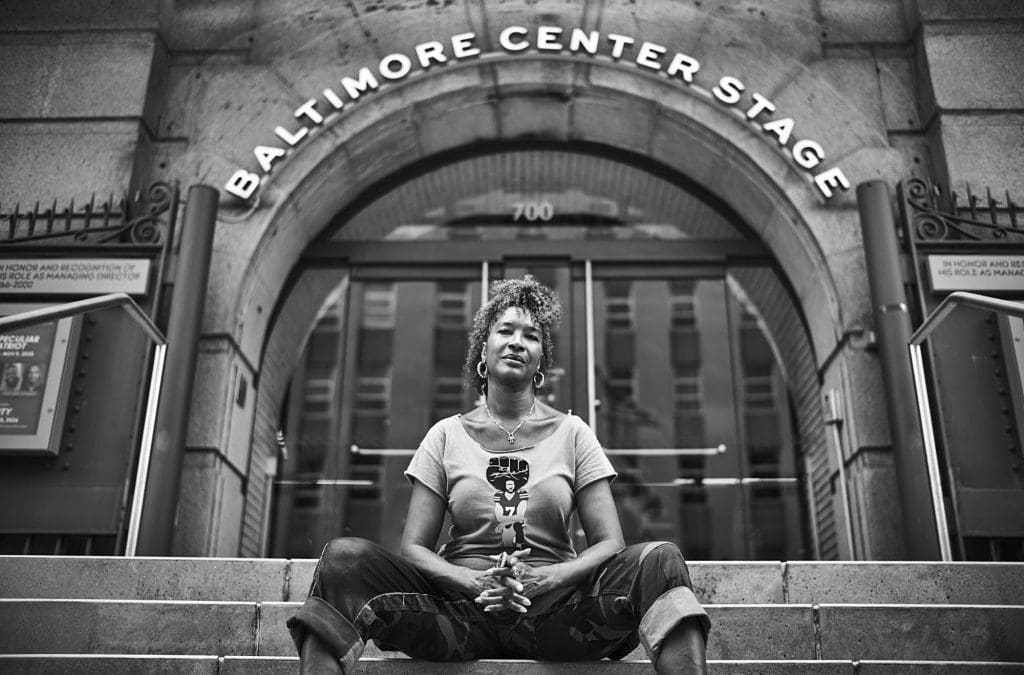
Poet, actor, and playwright Liza Jessie Peterson is bringing her one-woman play “The Peculiar Patriot” to Baltimore Center Stage. The Philly native believes it’s the right place and the right time for this story.
“There’s an energy here that just feels familiar, like home,” Peterson said. “I love bringing this piece here because I know that it’s a Black Mecca. The play speaks to our people in a real way. I’m excited to see how Baltimore is going to receive it.”
“The Peculiar Patriot” taps into the deep humanity that exists within the confines of mass incarceration. In it, Peterson portrays Betsy Laquanda Ross, who regularly visits her incarcerated best friend Joanne. The play takes place over a series of wild conversations between the women. Ross keeps her friend updated about what’s happening in the neighborhood, her own life, and in the outside world. The play is inspired by the 20 years Peterson spent working with teens at New York’s notorious Rikers Island.
Liza Jessie Peterson Credit: Devin Allen.
At Rikers, Peterson served as a poetry and GED teacher, program counselor, and re-entry specialist. Her time at Rikers not only taught her about the evils of the prison industrial complex, and the great capacity all people have for change — but it served as a creative catalyst. Out of it came a memoir, “All Day,” which Peterson published in 2017. She also wrote monologues that later evolved into this play.Peterson originally intended to debut the play off-Broadway, but like many Black artists who dare to aim mirrors at