by Maximillian Alvarez | Jul 24, 2026 | Democratic Party, Democrats, elections, midterms, Politics and Movements: US, video
The outcome of Michigan’s Senate race will have major implications for the balance of power in Washington, DC, and for the future of the Democratic Party itself. With primaries taking place on August 4, all eyes are on the battle between progressive candidate Dr. Abdul El-Sayed and establishment candidate Haley Stephens to see who will represent Democrats in the general election. TRNN Editor-in-Chief Maximillian Alvarez sits down with El-Sayed to talk about his campaign, the civil war within the Democratic party, and about fighting corporate oligarchy and MAGA fascism at the same time.
Credits:
Videography: Maximillian Alvarez
Post-Production: Maximillian Alvarez, David Hebden
Transcript
The following is a rushed transcript and may contain errors. It will be updated.
Speaker 1:
Michigan is shaping up to be one of the most closely watched Senate races of this entire cycle.
Speaker 2:
Democrats will choose between Congresswoman Haley Stevens and former director of the Department of Health, Human and Veterans Services, Wayne County, Dr. Abdul El-Sayed.
Dr. Abdul El-Sayed:
We pay more for the stuff we got to buy, get paid less for the work that we do and watch as our tax dollars get misappropriated abroad to drop bombs on other people’s kids instead of to invest in our own kids and their schools and their healthcare.
Speaker 4:
We’re done. Business as usual politics is over.
Dr. Abdul El-Sayed:
Most people don’t walk around thinking, where do I stand on the left right spectrum? Most people walk around thinking, how am I going to afford my groceries? How am I going to pay for my rent? Can I ever afford a home? What am I going to do if I get sick? The majority of Democrats
by Sharon Zhang | Jul 23, 2026 | Article, Israel, Military Industrial Complex, Politics and Movements: International, Politics and Movements: US, Reprint
This article was originally published by Truthout on July 22, 2026. It is shared here under a Creative Commons (CC BY-NC-ND 4.0) license.
Rep. Alexandria Ocasio-Cortez (D-New York) issued a stark warning this week about a congressional measure that would merge the U.S. and Israel’s military technology industrial complexes, saying that it represents an “existential threat” to U.S. democracy.
The provision — called the “U.S.-Israel Defense Technology Cooperation Initiative,” or Section 219 — is included in the 2027 National Defense Authorization Act (NDAA), which passed the House in a 216 to 212 vote on Wednesday. Six Democrats broke from the party to vote “yes,” and seven Republicans voted “no.” The bill is still stalled in the Senate, however, after Democrats voted against its advancement last week.
The NDAA “includes a provision to merge parts of our military with the [Israeli military],” Ocasio-Cortez said in a post on social media on Tuesday. “This [provision] is an existential threat to American sovereignty and democracy. Every member of Congress must vote NO.”
The provision, if included in the final bill, would entrench Israel’s enmeshment with the U.S. military, mandating cooperation with regard to technology and intelligence with Israeli forces even when the U.S. gets little in return. Israeli Prime Minister Benjamin Netanyahu has advocated for the measure as public scrutiny over the U.S.’s monetary military aid to Israel has increased amid Israel’s genocide in Gaza.
Some lawmakers in Congress have waged a bipartisan effort for Section 219 to be stripped from the NDAA. Representatives Ro Khanna (D-California) and Thomas Massie (R-Kentucky) have introduced an amendment to the bill to remove Section 219.
However, these efforts have been quashed by pro-Israel lawmakers, who
by Michael Fox | Jul 23, 2026 | Civil Rights Movement, free speech, history, Podcast, Politics and Movements: US, The Battle for Free Speech
“Existence is struggle,” says Marc Steiner. “It always has been, and always will be.”
In this podcast series, we’ve looked at the attacks on free speech rights today in the United States. We looked at the history and how movements and organizations have stood up for and exercised free speech in their work. We looked at how social media, AI, and disinformation are undermining our free speech, and at how people are responding in the United States and abroad.
In the final episode of this series, we’re focusing on what free speech means within the context of the life of one person who has been through it all — co-host Marc Steiner. He turned 80 earlier this year.
In this episode, Michael Fox sits down with Marc to discuss all of these incredible layers of his life, from fighting civil rights and community organizing to underground newspapers, street theater, education, and journalism. What do they all mean for him, how do they all add up to nearly seven decades standing up and fighting for free speech, and how they fit into the battle for free speech today?
“You have to step back and really listen to what people are saying so you can bring out their truth so others can wrestle with it,” says Marc. “And if they need confronting in their process, you confront it and push back. Which is why when I think about what we do, how important it is — We have a critical role to play in bringing understanding to the world. The truth lives in every corner. And you have to listen. No one has a hold on it.”
In our conversation, Marc says right now the battle for free speech is more important than ever.
“I think we’re politically facing the most
by Maximillian Alvarez, Dave Zirin, and Jules Boykoff | Jul 22, 2026 | edge of sports, Edge of Sports TV, Fascism, Opinion, Podcast, Politics and Movements: International, Politics and Movements: US, Sports, The Cultural Front
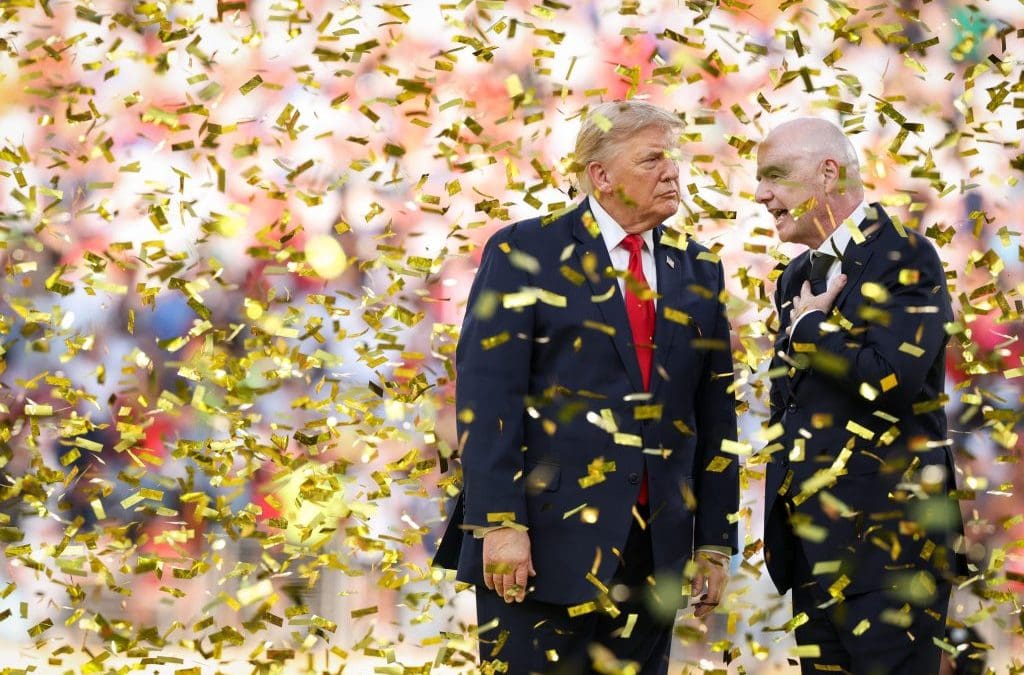
For many around the US and around the world, the World Cup was a welcome distraction from the dismal state of the world and the daily overwhelm of relentless war, corruption, fascism, and disaster. But the games were also an uncomfortable reminder that, no matter how much we love sports and want them to be an escape from politics and the pain of living in a broken society, there is no way to truly escape those things, and the manufactured illusion that sports are an escape from political reality is just that: an illusion.
At a live event hosted on July 16, 2026, at Chilo’s bar in New York City, TRNN Editor-in-Chief Maximillian Alvarez spoke with legendary sportswriters Dave Zirin and Jules Boykoff about what it means to love sports in an age of authoritarians.
Additional links/info:
Chilo’s bar website and Instagram
Jules Boykoff, OR Books, Red Card: The 2026 World Cup, Sportswashing, and the FIFA Greed Machine
Dave Zirin, Penguin Randomhouse, The People’s Historian: The Outsized Life of Howard Zinn
Credits:
Audio Post-Production: Alina Nehlich
Transcript
The following is a rushed transcript and may contain errors. It will be updated.
Maximillian Alvarez:
Welcome back to the Real News Network. I’m Maximillian Alvarez. The 2026 World Cup is now officially over after Spain defeated Argentina in the final match on Sunday. And for many of us around the US and around the world, the World Cup was a very welcome distraction from the ambient awfulness and doom and the daily delugion overwhelm of relentless war, corruption, fascism and disaster. But the games were also an uncomfortable reminder that no matter how much we love sports and the global spectacle of the
by Taya Graham and Stephen Janis | Jul 22, 2026 | Article, Economy and Inequality, health care, Inequality, Inequality Watch, Politics and Movements: US, Prisons and Policing, Trump
A few weeks ago, we argued the Trump administration was seeking to invent new ways to punish Americans. The idea was that the authoritarian impulses of the MAGA-run government will need to dial up the cruelty in order to sow chaos and pave the way for a broader assault on democracy.
Well, this week a rule was issued by Medicare and Medicaid services that shows just how proficient the Trump administration is at inflicting pain. And the consequences for poor, seriously ill Americans could be devastating.
Before we explain the rule, it’s worth contemplating the often destructive role healthcare — both the lack of it and exorbitant costs associated with it — play in the lives of working-class Americans.
Poll after poll shows that working people rank anxiety over healthcare costs at the top of the list of high-priority concerns. Unpaid medical bills are the most likely cause of personal bankruptcy in the US. Unlike any other wealthy nation on earth, when Americans lose their jobs, they often lose access to a doctor as well.
The US healthcare system is already inherently extractive — making it even more prohibitively expensive means more people will suffer with diseases that can be cured and die from afflictions that would otherwise be treatable. All of this makes the working class vulnerable and likewise incapable of asserting their right to be healthy.
And that’s where the new rule comes in.
The government agency that administers Medicaid has created a new criterion, ‘medically frail,’ which must be met to qualify for the program without working — even if you only have weeks to live. It didn’t exist prior to the passage
by Sharon Zhang | Jul 21, 2026 | Article, cuba, Politics and Movements: International, Politics and Movements: US, Reprint, Trump