by Keith Reed | Oct 3, 2026 | Congress, Opinion, Politics, Sports
The Protect College Sports Act, sponsored by Sen. Ted Cruz, R-Texas, and passed by the Senate this week, is ostensibly an effort to bring common-sense reform to an NCAA that, in pursuit of the almighty dollar, has abandoned all pretense of developing college athletes academically and personally. It’s hard to pinpoint when the cries to fix college sports got so loud, but one especially hears it everywhere NCAA Division I football teams compete on Saturdays.
But no matter how it looks on its face, the bill is a deeply flawed attempt at reforming college sports “because its framework confers consequential legal and economic benefits on institutions that already exercise enormous power,” NAACP President Derrick Johnson wrote to Senate leaders in August. Johnson argued that the bill could be catastrophic for Black student-athletes, who make up the majority of FBS football and Division I men’s basketball rosters and have already suffered decades of economic harm under the NCAA’s former rules.
It’s hard to pinpoint when the cries to fix college sports got so loud, but one especially hears it everywhere NCAA Division I football teams compete on Saturdays.
Among other things, the Congressional Research Service’s summary of Cruz’s bill notes that it would require agents representing college athletes to register with at least one state and caps their compensation for negotiating Name, Image, and Likeness deals at 5% of a contract’s value. It bans the NCAA and its member institutions from limiting what student-athletes can make from such deals and establishes a reporting requirement for any deal worth more than $600.The bill would also bar colleges and NIL collectives from paying athletes in ways
by Sharon Zhang | Sep 29, 2026 | Gaza, Genocide, Israel, News, NFL, Professional Athletes, Sports
An NFL official reportedly threatened to remove Houston Texans linebacker Azeez Al-Shaair from his game earlier this month unless he removed his memorial for an 8-year-old Palestinian girl killed by Israel in Gaza. During the Texans’s week two game against the Cincinnati Bengals on September 20, Al-Shaair wrote the name of Wafaa Akila on his eye black, which refers to the strip or paint…
Source
by Sydney Carruth | Sep 29, 2026 | culture, News, Sports
The Senate on Monday voted to pass the Protect College Sports Act, marking a milestone in the joint effort between Congress and the NCAA to address chaos and uncertainty in the industry with new federal regulations on athlete payments, transfers and eligibility requirements. In a closely watched 77-22 vote, the Senate approved the legislation along wide bipartisan margins. It’s now headed to the House for debate.
The act aims to impose some order on college athletics in what supporters of the bill have called an “era of chaos” defined by record-high athlete payments, nearly unrestricted transfers between schools and a patchwork of lawsuits over athlete eligibility. The bill would create a national set of rules to govern name, image and likeness payments to college athletes and would designate the NCAA as the primary enforcer of those new standards. Texas Sen. Ted Cruz, the Republican sponsor of the PCSA, and Washington Sen. Maria Cantwell, the Democratic sponsor, have pitched the legislation as a means of securing federal protections for student athletes, reining in runaway spending on athletic programs and athletes and an attempt to even the playing field between major athletic conferences and their less-wealthy counterparts.
“We’re not going to let the most powerful and richest conferences dictate to the rest of America what’s going to happen to 500,000 athletes,” Cantwell said following a June hearing on the bill.
The new bill would allow schools to establish caps on how much they can pay athletes and would limit players’ eligibility to five years, beginning the year they turn 19 or the year they graduate from high school, thereby preventing athletes from competing in collegiate

by Ja'han Jones | Sep 17, 2026 | Congress, Opinion, Sports
It’s hard to get a broad majority in the Senate to agree on much of anything these days — except, apparently, sticking it to college athletes.
Dozens of Democrats effectively sided with President Donald Trump, Sen. Ted Cruz, R-Texas, and powerful lobbyists in voting Tuesday to move forward with a bill that stands to police college sports, largely by limiting athletes’ ability to make money and collectively bargain for important changes they desire. The Senate voted 74-24 to advance the Protect College Sports Act toward a final vote.
I’ve written about the bill before — and the numerous gripes that critics have with it. Basically, the legislation is co-sponsored by Cruz and Sen. Maria Cantwell, D-Wash., who have contended that college athletics, particularly sports that don’t generate much revenue, are at risk under the current rules, known as NIL, which authorize players to make money off their names, images and likenesses.
Trump — who has openly stated his desire to return college sports to the exploitative system that was in place before NIL — is a staunch supporter of the bill.
Meanwhile, the bill has been decried by labor associations, such as the AFL-CIO; social organizations like the NAACP; and Athletes.org, a players association for college athletes.
Among the bill’s heavily criticized provisions are parts that would afford antitrust protections to the NCAA, potentially undermine athletes’ ability to collectively bargain for improved conditions and institute caps on some player compensation. The bill has been backed by various college athletic conferences, powerful broadcast companies and numerous coaches — who don’t stand to see their earnings suppressed.
And as NBC News reported, “advocates for athletes have pointed to
by Kavitha A. Davidson | Sep 16, 2026 | Opinion, Sports
Saturday night, after the Texas Longhorns stormed back to score 21 unanswered fourth-quarter points to beat the top-ranked Ohio State Buckeyes, 24-23, ESPN’s Holly Rowe attempted to get a standard postgame interview with Texas head coach Steve Sarkisian on the field. But instead of speaking with her, Sarkisian yelled into the mic, flashed the “hook ‘em horns” sign and stormed off, leaving Rowe looking understandably perplexed and frustrated.
Sarkisian snubbing Rowe, who is universally respected in the industry, was enough by itself to spark a conversation about disrespect toward women sports journalists. But then came an artificial intelligence-generated video of Sarkisian not snubbing Rowe but slapping her so hard she hit the ground. At Monday’s media availability, when Texas quarterback Arch Manning was asked if he had seen any of the AI edits, he responded excitedly: “That’s a good one. Of him slapping Holly Rowe? That’s hilarious.”
At Monday’s media availability, when Texas quarterback Arch Manning was asked if he had seen any of the AI edits, he responded excitedly: “That’s a good one. Of him slapping Holly Rowe? That’s hilarious.”
The room, mostly full of men reporters and football admins, appeared to laugh along with Manning. Fans and commentators responded almost immediately with understandable anger that a star quarterback and a group of ostensibly professional men thought the image of a woman being slapped simply for doing her job was, to use Manning’s word, “hilarious.” On Tuesday, Manning issued an apology on Instagram.
“In my press conference yesterday, I made an insensitive comment about an AI video,” he wrote. “There is nothing funny about it. It’s easy to say I didn’t mean it,
by Patrick Sauer | Sep 16, 2026 | Article, NFL, Politics and Movements: US, Reprint, Sports, The Cultural Front
This story originally appeared in Truthdig on Sep. 15, 2026, and is shared with permission.
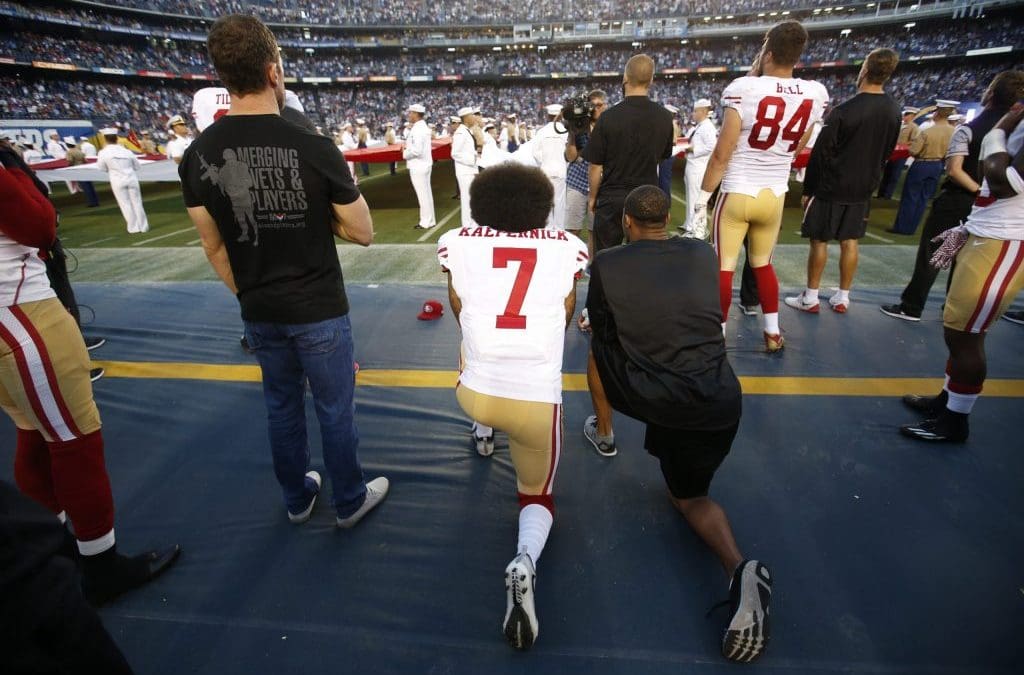
During the national anthem of the first three 2016 NFL preseason games, San Francisco 49ers quarterback Colin Kaepernick sat down on his team’s bench between two Gatorade coolers. Few noticed, and nobody made mention of the gesture until a Black reporter for NFL Network named Steve Wyche asked him about it following the third exhibition tilt, a home game against the Green Bay Packers. Wyche’s interview with Kaepernick put the quiet protest on newsfeeds across the country. Then, shortly after police shot and killed Alton Sterling and Philando Castile within a 48-hour period — Kaepernick and a teammate, safety Eric Reid, went a step further before the final preseason game on Sept. 1. Instead of sitting on the bench during the anthem, they took a knee. The rest is civil rights and sports history.
The story of Kaepernick’s life before and after that fateful stand is the subject of his new memoir, “The Perilous Fight,” co-written with Pulitzer Prize-winning journalist and author Nick Chiles. Kaepernick’s journey from a shy adoptee of color to white parents uninterested in exploring his Black experience, to a boldfaced protest icon is a singular American story, whose hinge moment came at the cusp of the Trump era. The book, which comes out tomorrow, will be available at most places where books are sold — but not Target. Kaepernick is boycotting the retailer over the company’s anti-diversity, equity and inclusion initiatives. I spoke with the author in late August. Our conversation has been edited for length and clarity.
Truthdig: Beginning where the book begins, have you thought about what it means to be a public face for adopted children?
Colin Kaepernick: It’s interesting,