by Belal Awad, Leo Erhadt and Mahmoud Al Mashharawi | Nov 18, 2025 | Gaza, Israel, October 7: One Year Later, Palestine, Politics and Movements: International, Politics and Movements: US, video
Since October 2023, at least 34 hospitals in Gaza have been damaged or destroyed by Israel. In that same time, as the humanitarian need for urgent medical care in the Gaza Strip dramatically increased, Israeli forces detained at least 405 Palestinian healthcare workers, according to NGO Healthcare Workers Watch. In this on-the-ground report, TRNN takes you inside one of Gaza’s last functioning hospitals.
Editor’s note: This report was filmed at Al Shifa Hospital in June 2025, before it was destroyed.
Credits:
Producers: Belal Awad, Leo Erhardt
Videographers: Ruwaida Amer, Mahmoud Al Mashharawi
Video Editor: Leo Erhardt
Transcript
Dr. Moataz Harara – HEAD OF EMERGENCY ROOM AT AL-SHIFA HOSPITAL:
Hospitals have become targets for the Israeli occupation and the Israeli army. Many hospitals have been destroyed. They have been taken out of service and burned. Doctors, nurses, and medical teams have been kidnapped from hospital premises. It’s become difficult at times to convince some medical staff to remain in the hospital. They tell you: “Maybe the Israelis will come at night and kidnap me like they did my colleague?”
Narrator:
The abduction – or worse – of Gaza’s medical workers is a documented reality. According to NGO Healthcare Workers Watch: Since October 2023, Israeli forces have detained at least 405 Palestinian healthcare workers, including 28 specialist doctors – among them surgeons, pediatricians, and ICU specialists. Twenty staff were kidnapped from hospitals during military raids; while others were detained while evacuating. Two senior physicians reportedly died in detention from torture, their bodies are still being held by Israeli authorities.
Dr. Moataz Harara – HEAD OF EMERGENCY ROOM AT AL-SHIFA HOSPITAL:
All resources, capabilities, and supplies have been exhausted. Before, to treat one patient, the
by Jessica Corbett | Nov 12, 2025 | Article, Israel, Palestine, Politics and Movements: International, Prisons and Policing, Reprint
This story originally appeared in Common Dreams on Nov. 11, 2025. It is shared here under a Creative Commons (CC BY-NC-ND 3.0) license.
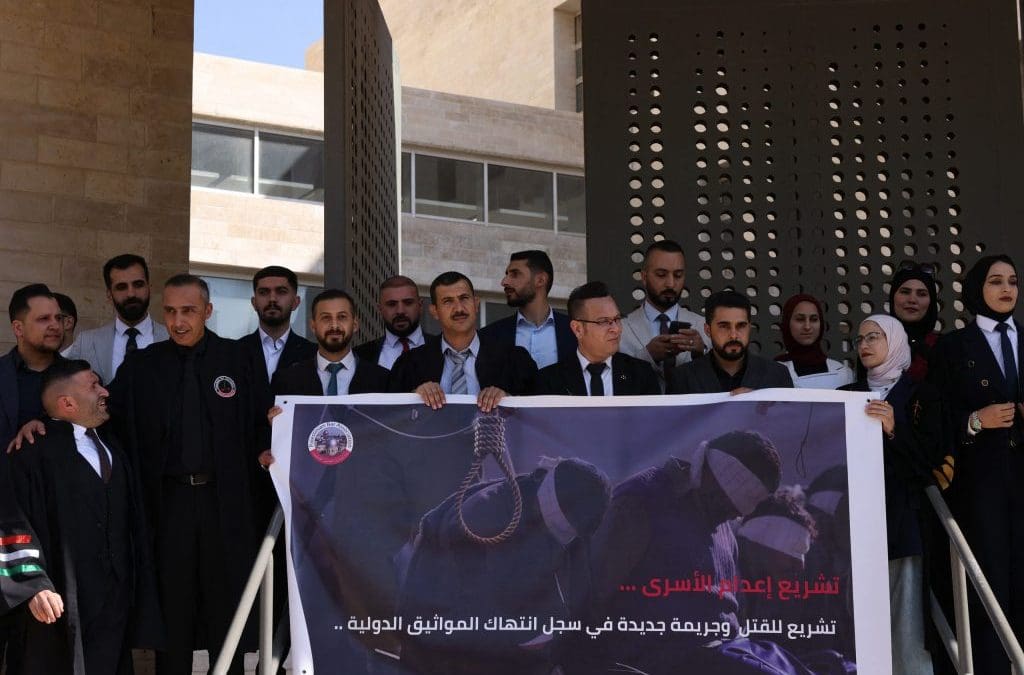
As Israel continues its “silent genocide” in the Gaza Strip one month into a supposed ceasefire with Hamas and Israeli settler attacks on Palestinians in the illegally occupied West Bank hit a record high, Amnesty International on Tuesday ripped the advancement of a death penalty bill championed by far-right National Security Minister Itamar Ben-Gvir.
Israel’s 120-member Knesset “on Monday evening voted 39-16 in favor of the first reading of a controversial government-backed bill sponsored by Otzma Yehudit MK Limor Son Har-Melech,” the Times of Israel reported. “Two other death penalty bills, sponsored by Likud MK Nissim Vaturi and Yisrael Beytenu MK Oded Forer, also passed their first readings 36-15 and 37-14.”
Son Har-Melech’s bill—which must pass two more readings to become law—would require courts to impose the death penalty on “a person who caused the death of an Israeli citizen deliberately or through indifference, from a motive of racism or hostility against a population, and with the aim of harming the state of Israel and the national revival of the Jewish people in its land.”
Both Hamas—which Israel considers a terrorist organization—and the Palestine Liberation Organization slammed the bill, with Palestinian National Council Speaker Rawhi Fattouh calling it “a political, legal, and humanitarian crime,” according to Reuters.
Amnesty International’s senior director for research, advocacy, policy, and campaigns, Erika Guevara Rosas, said in a statement that “there is no sugarcoating this; a majority of 39 Israeli Knesset members approved in a first reading a bill that effectively mandates courts to impose the death penalty exclusively against Palestinians.”
Amnesty opposes the death penalty under all circumstances and tracks such killings annually. The international human rights group has also forcefully spoken out against Israeli abuse of Palestinians, including the genocide in
by Michael Fox | Nov 4, 2025 | Peru, Podcast, Politics and Movements: International, Stories of Resistance
In the late 1700s, Indigenous peoples in the Spanish colonies of the Andes were forced to work for the Spanish. They tilled the land, worked in the textile mills and the mines. Those that didn’t faced heavy taxes. But in early November 1780, Indigenous Incan leader Tupac Amaru II led an uprising against the Spanish that he hoped would end it all.
It was the largest revolt against colonial Spain. Thousands would join the months-long rebellion. It would inspire uprisings elsewhere across the continent, and independence leaders. South America would gain its freedom from Spain just 40 years later.
BIG NEWS! This podcast has won Gold in this year’s Signal Awards for best history podcast! It’s a huge honor. Thank you so much to everyone who voted and supported.
And please consider signing up for the Stories of Resistance podcast feed on Spotify, Apple Podcasts, Spreaker, or wherever you listen. And please take a moment to rate and review the podcast. A little help goes a long way.
The Real News’s legendary host Marc Steiner has also been in the running for best episode host. And he also won a Gold Signal Award. We are so excited. You can listen and subscribe to the Marc Steiner Show here on Spotify or Apple Podcasts.
Please consider supporting this podcast and Michael Fox’s reporting on his Patreon account: patreon.com/mfox. There you can also see exclusive pictures, video, and interviews.
Written and produced by Michael Fox.
Transcript
In the main square of Yanaoca, Peru, people dance. It’s carnival season. Yanaoca is a small town in the highlands of Peru. Population 1,500 people. But it is best known for rebellion.
See, just
by Maximillian Alvarez | Oct 31, 2025 | Gaza, Israel, October 7: One Year Later, Palestine, Podcast, Politics and Movements: International, Politics and Movements: US, Working People
In September, before the current ceasefire deal was announced, we spoke with two Palestinians in Gaza—Mohamed Abu Tawila (a former English teacher) and his nephew Abdul Rahman (a would-be college student)—about surviving 700 days of genocidal destruction at the hands of Israel’s military and with the full backing of the United States. In this critical follow-up episode, we speak once again with Mohamed Abu Tawila from Gaza to get an on-the-ground account of life for Palestinians after the shaky implementation of the ceasefire began on Oct. 10.
Additional links/info:
Mohamed’s Instagram account
Living Water Mutual Aid in Gaza Chuffed fundraiser page and Instagram account
GoFundMe campaign to support Mohamed’s water delivery operation and his family
Maximillian Alvarez, Working People / The Real News Network, “‘Hearts are crying and bodies are bleeding’: Gazans describe their daily struggle to survive”
Tareq S. Hajjaj, Mondoweiss, “Israel’s repeated ceasefire violations are part of its strategy to keep waging war on Gaza”
DropSite News, “Israel kills over 100 Palestinians in overnight bombardment of Gaza; thousands killed in Sudan’s El-Fasher”
Featured Music:
Jules Taylor, Working People Theme Song
Credits:
Audio Post-Production: Alina Nehlich
Transcript
The following is a rushed transcript and may contain errors. A proofread version will be made available as soon as possible.
Maximillian Alvarez:
Alright. Welcome everyone to Working People, a podcast about the lives, jobs, dreams, and struggles of the working class today. Working People is a proud member of the Labor Radio Podcast Network and is brought to you in partnership within these Times Magazine and the Real News Network. This show is produced by Jules Taylor and made possible by the support of listeners like you. My name is Maximilian Alvarez and we’ve got a short but extremely important episode for you
by Sharon Zhang | Oct 31, 2025 | Article, Economy and Inequality, Politics and Movements: International, Reprint, Sudan
by Ruwaida Amer, Mahmoud Al Mashharawi, Belal Awad and Leo Erhadt | Oct 24, 2025 | Gaza, Israel, Palestine, Politics and Movements: International, video
Ahead of a ground invasion that officials threatened would be a “mighty hurricane,” Israel ordered the entire population of Gaza City—over one million people—to evacuate. For those in Gaza City, many of whom have already been displaced multiple times, this order presents a deadly choice: flee into the unknown yet again, or stay and face the advancing Israeli army. “We already experienced displacement,” Ziad Ayyad, a refugee in Gaza City, says. “We can’t do it again. We’re staying here. Whatever happens, happens. Even if they crush us under their tanks.” In August 2025, TRNN asked Palestinians if they plan to evacuate or stay as Israel attempts to completely depopulate Gaza City. This is what they told us.
Producers: Belal Awad, Leo ErhardtVideographers: Ruwaida Amer, Mahmoud Al MashharawiVideo Editor: Leo Erhardt
Transcript
Ziad Ayyad:
Look at me. Nothing in the entire world compares to what’s happening to us.Saleh Abd Al Dayim:
Neither people, nor trees, nor rocks—nothing has escaped this brutal war.Abed Abed Al Dayim:
You wake up to bombing and go to sleep to bombing.
Basel Radi’ Al Masri:
It’s clear they have not destroyed the resistance in Gaza at all. They have only destroyed the people.
Narrator:
Israel has ordered the entire population of Gaza City—over one million people—to evacuate. The orders come ahead of a ground invasion that Israeli officials have described as a ‘mighty hurricane.’ For those in Gaza city, many of whom have already been displaced multiple times, this order presents a deadly choice: flee into the unknown yet again, or stay and face the advancing Israeli army.
Ziad Ayyad:
We moved from one place to another: from Nuseirat to Deir al-Balah, then from Deir to Gaza City.