Why US veterans are sailing to Gaza with the Global Sumud Flotilla

Why US veterans are sailing to Gaza with the Global Sumud Flotilla

The Global Sumud Flotilla sets sail from Barcelona towards Gaza, in Barcelona, Spain, on August 31, 2025. Hundreds gather at Moll de la Fusta to bid farewell to the flotilla, with dozens of boats and thousands of supporters wearing kufiyas (Palestinian scarves) and waving flags. Photo by Lorena Sopena/NurPhoto via Getty Images

After multiple voyages by the Gaza Freedom Flotilla have been prevented from reaching Gaza’s shores by Israel’s military, a massive fleet of freedom flotillas are currently sailing towards Gaza to deliver life-saving humanitarian aid to Palestinians in the midst of genocide. The Global Sumud Flotilla “brings together a diverse coalition of international participants, including those involved in previous land and sea efforts like the Maghreb Sumud Flotilla, Freedom Flotilla Coalition, and Global Movement to Gaza.” Including over 50 vessels, delegations from at least 44 countries, and activists, organizers, and people of conscience from around the world, the Global Sumud Flotilla is the largest maritime mission in history to break Israel’s blockade of the Gaza Strip. TRNN Editor-in-Chief Maximillian Alvarez speaks with Zue Jernstedt and Zuleyka Morales Rivera, two US military veterans and members of About Face: Veterans Against the War, who are sailing with the Global Sumud Flotilla.

Additional links/info:

Credits:

  • Studio Production: Cameron Granadino
  • Post-Production: David Hebden
Transcript

The following is a rushed transcript and may contain errors. A proofread version will be made available as soon as possible.

Maximillian Alvarez:

After multiple voyages by the Gaza, freedom Flotilla have been prevented from reaching Gaza shores by Israel’s military, a massive fleet of freedom. Flotillas are currently sailing towards Gaza as we speak their mission to break Israel’s blockade and deliver lifesaving humanitarian aid to Palestinians in the midst of a genocide. This is the largest maritime mission in history to break Israel’s blockade of the Gaza Strip. The Global Saud Flotilla includes small and large vessels, delegations from 45 countries, and activists organiz and people of conscience from around the world. From Greta Thunberg to Man Mandela Nelson Mandela’s grandson. And we are recording on Monday, September 8th. The Global Saud Flotilla is currently docked at the Port of Tice and will be departing on Wednesday en route to Gaza. And joining us on The Real News today from uni are two American military veterans and members of the group about face veterans against the war who are sailing with the global Saud Flotilla. Zue Jernstedt is a US Army veteran, and Zuleyka Morales Rivera is a US Marine veteran and they join us now. Thank you both so much for joining us on the Real News Network. I really appreciate it.

Zuleyka Morales Rivera:

Thank you for having us.

Maximillian Alvarez:

Well, firstly, we’ve been seeing a lot of the videos and photos of this massive fleet of flotillas sailing towards Gaza, but I wanted to ask you both if you could tell us what it actually looks and feels like to be there right now, who is taking part in this? Just give our viewers an on the ground view of this historic effort.

Zue Jernstedt:

Yeah, well, it’s actually pretty crazy because we’re in these very tiny sailboats. This is a humanitarian mission. This is not a military mission. So we’re on these very tiny sailboats with people from all over the world who are just regular people sailing across a giant sea. So when we’re in these boats, it’s actually, we feel quite small and we’re just all stuffed in these tiny boats. And then we’ll look across the vast sea and just see all these little sailboats dotted around us, all flying Palestinian flags. So it feels so surreal to be on a giant ocean with all these tiny little boats bobbing around all with Palestinian flags. And it feels like we’re very separate almost at times. And then we can see the solidarity online and the people in Gaza who are talking about waiting for us, the actions back home of people saying they’re with us, and we realize how big it actually is from being seasick alone in our boat too, being connected with everyone around the world.

Zuleyka Morales Rivera:

Yeah, it feels very surreal. I think it’s one of those moments where you don’t realize just how big it is until months have passed and it finally sinks in and you’re like, wow, I can’t believe that this is actually happening or this actually is happening.

Maximillian Alvarez:

And I guess just on that note, what was the reception like in uni when you guys got there?

Zue Jernstedt:

Well, actually we got here a bit later than everyone else. When the first boats came in, the streets were so crowded that people couldn’t get through, and there was just parties and dancing and singing, and yeah, it was completely crushed with people supporting. We didn’t get until very, very late last night. So by that time, everyone was sleeping and we were just happy to get to the hotel.

Zuleyka Morales Rivera:

Even as we were sailing in maybe six hours out from actually arriving in Tunis, there’s a boat of civilians that came up to our boat and just started screaming Free Palestine. Free Palestine, and stopped by each boat and just kept saying, thank you, free Palestine. So the solidarity that we feel in this movement is pretty incredible.

Maximillian Alvarez:

Wow. Yeah. What does that feel like?

Zuleyka Morales Rivera:

It’s unlike anything that we’ve ever experienced before because it’s on such a large scale globally, 44 countries that are sailing to Gaza. To be part of that is something that I’ve never felt before.

Maximillian Alvarez:

Yeah, I can only imagine. And I wanted to ask as individual American military veterans and as a group representing about face against the War, because there’s a contingent of you sailing towards Gaza now, I wanted to ask if you could tell us more about why you all decided to join the global Saud Flotilla?

Zue Jernstedt:

Yeah, so actually most of the people on the boat are about face members. Most of us are also veteran for peace members. We’re all pretty much all anti-imperialist activists because we believe that the struggle in Palestine is interconnected with anti imperialism. But I joined personally because my Palestinian American friend who I met in the West Bank last year while doing protective presence, asked me if I knew any boat people, any captains or anything, and I said no. And then they said, Hey, there’s a veterans boat. And I said, sign me up here. Absolutely. I want to be a part of this. And then sent the information to other people. And about face

Zuleyka Morales Rivera:

Mine is somewhat similar. I actually took part in the march to Gaza that took place in June and we weren’t able to get very far. But it really opened my eyes to the layers of systemic oppression that is not only against the Palestinian people, but against a lot of the global south and the people of the world. And so I had a comrade that was also in the March to Gaza that called me and asked me, they’re doing another Flotilla and it’s going to be dozens of boats. Would you like to go? And immediately I said, of course we have to make it to Gaga.

Maximillian Alvarez:

Is there anything about your identities as veterans, as people who took the oaths that you took and have gone through, what you’ve gone through? Is there anything about being a veteran of the US military that made you feel even more compelled to speak out about this?

Zue Jernstedt:

Yeah, absolutely. I’m someone who served in Afghanistan in 2009, and I feel like it’s my duty now to stand up against imperialism because I was a foot soldier of imperialism. I spread pain and violence through the world, upholding this American ideal and resource stealing. So I feel like I also now have to stand against it now that I see what’s going on, now that I have privilege in America for being a veteran, that it’s very important for us to say, Hey, no, we see what’s happening. We won’t take part anymore. We can change the narrative. We don’t have to follow orders. We don’t have to be these people. We don’t have to march to their tune. We are the people, we have the power.

Zuleyka Morales Rivera:

For me, I joined the Marine Corps straight out of Puerto Rico. I was born in Puerto Rico, the oldest colony in the world, and I wasn’t aware of the oppression and the second class citizen that we had. And as I opened my eyes when I got out of the military, I realized these systems are designed to be put against us and we have to do something. So it’s intertwined in our everyday lives and just had to do something about it.

Maximillian Alvarez:

Well, I spoke to Chris Smalls when he was on board the Last Freedom Flotilla, and we had that conversation about a day or so before the Flotilla was captured, and Chris himself was separated, beaten, and detained by Israeli forces. And Chris knew that he was putting his safety and possibly even his life at risk for this cause. And I know that everyone on this mission is fully aware of those risks as well. But I wanted to ask, what are you expecting the response from Israel to be like, we’ve never seen a fleet like this before, but we’ve seen how Israel has responded to individual missions before. So how are y’all prepared for the different range of outcomes here, including the possibility of violence and hostility from the Israeli military?

Zue Jernstedt:

Well, I just want to start with the violence and hostility from the Israeli military will be nothing compared to what the people of Gaza and the people in the West Bank face every day. So for us, it’s not, yeah, it means so much that they’re going through this that does not worry us. It’s nothing compared to what they’ve been facing for the last 700 days and since 1948 and before. So that isn’t our main concern. Our main concern is what are they going to do? Because they do not follow humanitarian law. They do not follow the Geneva Convention. They do not follow the ICC. They do not follow the IHL. So we are completely unsure. They’re a rogue state. They’re a complete wild card. So we are making all these scenarios up of what we could do in each way, but we really cannot say because they do not follow the laws and they’re inhumane and they are committing a genocide against the Palestinian people.

Zuleyka Morales Rivera:

And based off what we’ve witnessed and the slaughter that’s been going on in Gaza for over 700 days, we can honestly expect anything from them because that’s just how they are. Nobody sets limits on them. So we go over scenarios on a regular basis. Daily we have meetings, we talk about what if this happens or what if this happens or what would you do if you see this happen to another person? How do we remain calm? How do we deal with situations like that, which we most likely aren’t really prepared for, but we’re preparing as much as we can.

Maximillian Alvarez:

Just the very fact of this fleet existing. It really is a testament to the age old organizing principle that there is strength in numbers, and we’re even hearing about ways that others who are not on those ships are preparing to aid your effort, including the Italian dock workers who are saying that they will shut down the ports if you all are harmed. So it sounds like, and please do tell us if there’s more in that vein that folks should know about, but it does sound like the strength in numbers principle is being applied in its full force here from the amount of ships sailing towards Gaza to the amount of support around the world to protect those ships.

Zue Jernstedt:

Yeah, absolutely. The people are waking up and we are aware of American imperialism now. We are aware of billionaires controlling resources, and the people are waking up to say no more. This is multinational. We are coming together to say, it doesn’t matter how much money you have, you don’t have the numbers that we have. And the people of the world stand for humanity. The people of the world stand for Palestine. The people of the world stand for Congo. The people of the world stand for Sudan. The people of the world stand for Puerto Rico. We’re not going to take it laying down anymore, and we are all going to join up. And everyone can do their little part. You don’t have to be on a flotilla. You can do things in your everyday life that will subvert what they’re doing and show them that they don’t have the power of us over us and we can make changes.

Zuleyka Morales Rivera:

And I think that’s the difference with this movement is that it’s so big. Maybe we don’t realize it because we’re on a small ship, but it’s so big that I feel like this time people actually can feel like they can be in solidarity with us, even if it’s just sharing or sharing the voices in Gaza or sharing a post or speaking about it with their families or joining the discourse, or even the smallest little bit of effort that is put towards standing in solidarity with the people of Gaza and the Palestinian people all around the world is very different than the movements in the past.

Maximillian Alvarez:

Well, and on that note, I mean that hits very deeply, and I just wanted to make my own appeal to anyone watching this that please share the dozens of documentary reports that we’ve been publishing from Gaza itself, from the West Bank, our reporter in Gaza, ruida Amer, a brilliant documentary filmmaker, is starving, her family is dying. We are talking to her every day. I beg you, if you’ve been watching those documentaries, just know that the person behind them is dying like everyone else in Gaza. And that is where this urgency to do something is coming from. On my podcast Working People last week, which we published here in The Real News, I interviewed two Palestinians in Gaza talking about the horrific circumstances that they are living through and trying to survive in. This is as real as it gets. That is why this massive fleet is sailing towards Gaza this week. And so I wanted to end on that note because I know I have to let you both go. You’ve got a long week ahead of you. But while I still have you, I wanted to ask if you had any final messages about what you all and the rest of the Flotilla Coalition are advising people to do to help, and if you had any final messages to the world that you want to share here before we let you go?

Zue Jernstedt:

Oh, yes, absolutely. I mean, the biggest thing is what you were just saying of Center the Voices and Gaza Center, the voices on the West Bank, sure, we have this Flotilla, it’s a big media thing, but where’s the media for Gaza? Where’s the media for the West Bank? Those are the people who are going through it, are suffering under it. Those are the people you need to be listening to. One thing I would like to say is 26,000 people tried to get on the Flotilla and we didn’t have the room, but there’s other organizations that you can work with in solidarity with the Palestinian people. I was in the West Bank with ISM, the International Solidarity Movement. They need people in the West Bank. They’re undergoing right now some horrific, horrific ethnic cleansing, where they’re destroying the olive trees. They’re shooting people. They need observers from around the world to be there to keep them from doing these crimes without having anyone international to intervene. Like, please, please, there’s more ways of solidarity than just the flotilla.

Zuleyka Morales Rivera:

And I think it’s just important to realize that in our thousands, in our millions, we’re all Palestinians. And I really mean that We can’t look away from the suffering of Palestinian children. We can’t look away from the suffering of Gaza that has been going on for so long. It is one fight. It’s one fight, and it’s a fight of the whole world. And the more of us that there are, the better.

Original

‘We are all DC’: Massive protests rock US capital in defiance of Trump

‘We are all DC’: Massive protests rock US capital in defiance of Trump

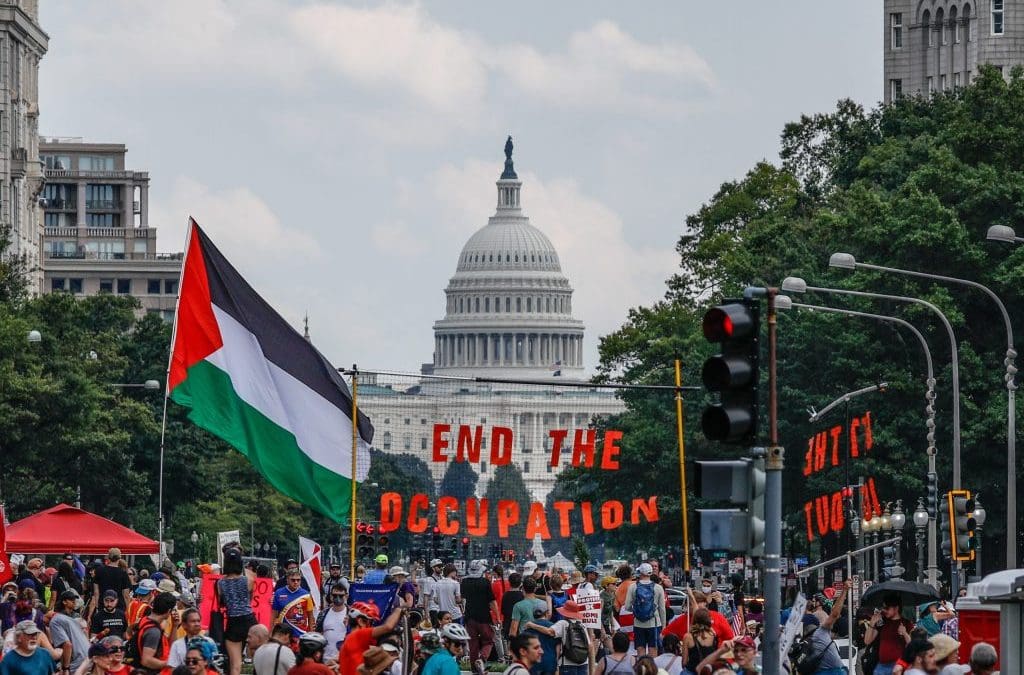
Protesters gathered in the nation's capital on September 6, 2025, to raise their voices against the federal government's efforts to increase control over the city's police department. The demonstration, titled

On Saturday, Sept. 6, thousands of local residents, out-of-state supporters, union members, and concerned citizens of all stripes marched through the nation’s capital to protest President Trump’s militarized federal occupation of Washington, DC. The “We are all DC” march was one of the largest protests—if not the largest—to take place in the US capital since the beginning of the second Trump administration. Reporting from Malcolm X Park for TRNN, Rattling the Bars host Mansa Musa and Edge of Sports TV host Dave Zirin give an on-the-ground account of the size, makeup, and significance of Saturday’s protest.

Credits:

  • Producer / Videographer / Post-Production: Cameron Granadino
Transcript

The following is a rushed transcript and may contain errors. A proofread version will be made available as soon as possible.

Mansa Musa:

I am here at Malcolm X Park in Washington, DC with Dave Zirin. Today we are looking at the birth of a mass movement around anti-imperialism, antifascism, anti-capitalism. Talk about what you see today, Dave.

Dave Zirin:

I’m so impressed right now. This is a demonstration to free DC and what we’re seeing out here is that it unites people of across all sorts of ways. You’ve got people here from all backgrounds, you’ve got people here of all ages. Multi-generational protests in this town are actually quite rare. And to see all of this is incredible. Also, incredible union delegations, which I have not seen yet at these demonstrations. That’s a big deal. Also a big deal. They’re masses of buses of here from Baltimore. There are masses of buses of here from New Jersey. There’s a whole Unite here union team from Jersey, like dozens and dozens of people. And what this says to me is that people are not looking at DC as a DC issue. That’s right. Or one, they’re just offering solidarity with us. People are seeing we could be next and DC will either be the first or the last city under Trump’s military occupation.

And we play a role in that by defending DC. So it’s amazing. I mean, this is huge. Right? And look, we can go into demos of dozens of people, 50 people, a hundred people to free dc and this is just over the top. Amazing. And can I just say one last thing? Come on. It is a tribute to the people of Washington DC and the resistance that they have already built because that’s the pole of attraction that’s brought so many people here today. If there was no resistance, if the vibe from DC was nobody cares that we’re now being militarized or we support that we are being militarized. No one would come here to support us. So the fact that we have created a pole of attraction on this is just incredible.

Mansa Musa:

And the fact they got it in Malcolm X Park. But talk about, you mentioned earlier, multi-generational, but talk about the international characteristics of this particular march because they start out saying, they start out saying it’s about free dc right? But then it turned into free people. NS turned to more or less getting around the issues of Palestine, getting around the issues of the immigration law, getting around the issue. What he getting ready to do in Venezuela. Talk about the international characteristics of this movement.

Dave Zirin:

Well, the international aspect of this demonstration and the international aspect of this moment are very real because what is happening overseas is boomeranging onto us back home. Authoritarianism, soldiers, children dying without repercussion, no investigations of things. Decades ago there would’ve been congressional oversight and demonstrations of, look, I’m not naive about how things used to be. I know there’s always been so much rotten in this system, but people have to recognize that it’s been turned up 15 to 20 notches under Trump. We’re talking about the militarization of our cities, and it’s international for a couple of reasons. Let’s start with Latin America. This is a crowd of people who understands that people are fleeing to come to this country. And we used to have a system in this country called asylum. And instead of people being treated as like, give me your tie, your poor, your huddled masses. People are being treated not just like criminals, but people who deserve to be tortured, people who deserve to be sent to South Sudan. How does a family from El Salvador that is starving, coming to this country know a damn lick about South Sudan, know a damn lick about a prison camp in Libya. How are they ever supposed to get home? These are people being disappeared by an international prison system. And that’s one aspect of this international development. It’s solidarity with the people of Latin America and saying, immigrants are welcome here. Another aspect of the internationalism that we’re seeing is a lot of Palestinian flags and banners.

Mansa Musa:

That’s right.

Dave Zirin:

I haven’t heard something yet from the front of the stage about it. And that’s fine if people want to keep a broader united message because on the ground, it’s flags in keffiyehs here. And I think we have to understand that there’s an anti-colonial solidarity. That’s right. That’s very real. And another aspect is that the Palestinian struggle and the movement against the massacres of children taking place in Gaza, the famine and Gaza, that is what animates the young generation to want to hit the streets, to risk arrest, to risk losing their college financial aid. And that is represented here today. That is why the Democratic party can’t even go to a college to campaign anymore because they’re so pro-Israel. And no student anywhere is going to have that even down south, even in the old Jim Crow. I mean, even at the state schools, people are protesting and they can’t have that.

Original

‘We want DC to be free!’ Voices from the ‘We are all DC’ march

‘We want DC to be free!’ Voices from the ‘We are all DC’ march

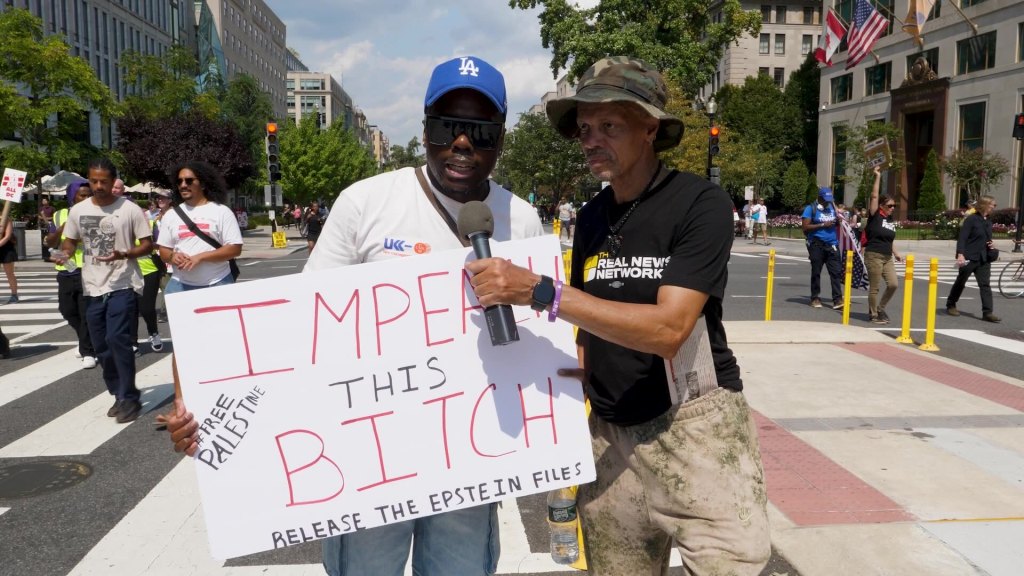
TRNN's Mansa Musa (right) speaks with an unnamed protestor and

The “We are all DC” march on Saturday, Sept. 6, was one of the largest protests—if not the largest—to take place in the US capital since the beginning of the second Trump administration. Thousands of local residents, out-of-state supporters, union members, and others marched through the streets of Washington, DC, to demand an end to President Trump’s militarized federal occupation of DC. But the march also brought together a cross-section of concerned citizens protesting the Trump administration’s attacks on immigrants, US support for Israel’s genocide in Gaza, and more. Reporting on the ground for TRNN, Rattling the Bars host Mansa Musa speaks with a range of organizers and attendees at Saturday’s march.

Additional links/info:

Credits:

  • Producer / Videographer / Post-Production: Cameron Granadino
Transcript

The following is a rushed transcript and may contain errors. A proofread version will be made available as soon as possible.

Mansa Musa:

We at Meridian Park, also known as Malcolm X Park, where we are recovering the rally from free dc, a coalition group of all organizations in the District of Columbia that’s coming together to call for the freedom of dc. What do freedom of DC mean? It means they saying that in the federal occupation, but it means more than that. It means statehood, it means the right to self-determination. As you can see, a lot of people have come out here today to be a part of this process. What you going to see today is a textbook and organizing 1 0 1. What do you think about this movement today?

Alfonso:

Well, I think it’s very popular. There’s a lot of people, it’s across generations, across all walks of life. So I’m really hopeful.

Mansa Musa:

Right. And in terms of the connection between the DC federal occupation and what we seeing going on in Occupy Palestine, is it a connection?

Alfonso:

Well, I guess there is a connection, but it’s much worse and much more serious what’s going on in Gaza.

Mansa Musa:

And I agree 100%. Right, it’s more serious. But do you think that in terms of your presence here and the fact that I walked around, I see a lot of Palestinian flags. I see a lot of, I get out of Gaza free Palestine, so it’s obviously international, it’s obviously international connection. People are looking at from respect that none of us are free until

Alfonso:

All of us are free. Absolutely. I think we have a lot of things to protest against. So I think it’s a good moment to gather and ask for all of those things. Right.

Lydia Walther-Rodriguez:

We’re here today with over a hundred CASA members, over a dozen organizations with one simple ask to stop the militarized occupation in DC

Mansa Musa:

They using the law to say that if you are committed a crime and you are an immigrant, then they hold you to the outcome of your crime to determine whether or not they’re going to deport you. But they rounding people up saying that under the pretense they commit the crime. What do you think? Really the story is behind why they rounded?

Lydia Walther-Rodriguez:

We are seeing a time that is unprecedented to us, but a time that has repeated itself over and over again under this administration. We have seen the constitutional crisis of the injustice of this president not respecting due process. We saw it in Quin Ab Garcia’s case, and we continue to see it every time they detain our immigrant communities here in DC and Baltimore, all across the country, folks are being detained and targeted and there there’s a PR machine saying they’re criminals. But the reality is that they see black and brown people and they have already targeted us as criminals and are taking away our due process. It’s happening to, it’s happening to immigrants, it’s happening to black Baltimoreans, and it’s going to happen to all of us if we don’t put a stop to this right now.

Mansa Musa:

And I like that. I like that articulation because I want you to unpack this right here. Alright. As you said, they rounding up people under the prescience of being criminals. Do you think that the fact that they’re using their lack of citizenship status to ignore their rights as human beings,

Lydia Walther-Rodriguez:

We know there’s no dignity and there hasn’t been dignity in this country for people of color, for black Americans, for immigrants, for anybody who does not meet the white supremacist agenda, they’re just trying to use the laws that were created against us. But we have the Constitution that clearly states that we have due process and in violation of due process is where we will resist, we will fight back and we will not allow these normalized racial biases to continue to silence the voices of the struggle. And for everybody who can hear my voice, it’s going to happen in you two if you don’t rise up and stand up.

Mansa Musa:

That’s right. And we remember in time in history was called Dr. Scott decision and Dred Scott, the Supreme Court, said that Dred Scott did not have no rights that the United States was bound to respect because he was considered one third of a human being and looked like they resurrected the Dred Scott decision in terms of rounding up people, not just Latin Americans, Latinos, Hispanic, anybody that can fit the narrative. You got the last word on this

Lydia Walther-Rodriguez:

Dred Scott decision never left us. Our people have continued to suffer as black, indigenous, Latina queer. And now this system is showing its face. Are you listening? Are you seeing it because we’re seeing it through every single kidnap that’s happening every single day in the streets of DC and countrywide? This is not a phenomenon that started here, but the US occupation intervention has been piloted in Central and South America. And it has shown to us that imperialism continues and its tactics will continue on in this country too.

Susan:

There have been people we’ve talked to, there’s a whole bus from Unite here, it’s come from Philadelphia, people from New Jersey, Vermont, Florida. So I think people understand the threat. This means not just for people in DC and for the country, and I guess particularly from Pennsylvania, people from DC every election go out and canvas and do things we don’t have people to vote for. So I kind of feel like it’s paying back and appreciative of that.

Sarah:

There’s 60 of us here from Vermont because we want DC to be free. This invasion is terrible.

Mansa Musa:

Why do y’all feel like y’all had to come down here though?

Sarah:

Because if Trump does it here, he’s going to do it in the next city, in the next city, in the next city. And this is not a dictatorship. And just because most of the people in DC voted against him, he’s now pissed and he’s taking it out on them. That is not right. This is not a dictatorship. This is a country where we all vote. And if he doesn’t, people don’t like what he’s doing, they’ll vote him out and bye-bye Mr. Trump. We’re here to support the people in dc

Gelly:

We have basically changed our rhythm from focusing on climate change legislation and getting elected officials in that are for a green New deal. And we’ve shifted completely to trying to combat the administration and the oligarchy and occupation that’s happening because we can’t get anything done with them in office.

Mansa Musa:

So you think it’s a connection between climate change, immigration and free dc?

Gelly:

Absolutely. And there’s a connection between climate change and the oligarchy that’s happening right now in our government.

Mansa Musa:

Okay. So what you think about the demonstration today?

Gelly:

I think the demonstration today is beautiful. I see a lot of people out here focused on different things. We’ve got immigrants, we’ve got climate people, just everyday Americans who want to be free and don’t want to have an occupation in our streets.

Mansa Musa:

This definitely is a people’s movement?

Gelly:

Absolutely. Yeah. This is for the people, by the people.

Mansa Musa:

It’s all about the revolution…

Joe:

This is Bernie Sanders’ group, our revolution group. And why are y’all here? Well, we’re here because the country’s been taken over by a group of fascists.

Mansa Musa:

This is Malcolm X Park. At one point in time you had African Liberation Day. They rally around. They rally around here. But more importantly, the most salient demonstration and rallying point was the war in Vietnam. And it all started with small groups. And then every day

Joe:

I was in all of them

Mansa Musa:

Nationally, you see nationwide, worldwide. So you got defund genocide, free Palestine.

Lisa:

Well, I think our giving military aid to Israel is just perpetrating these attacks on Gaza and giving them the means to commit genocide and cause this starvation, this hunger problem over there. And what’s really upsetting is people are trying to get the aid we’re sending and they’re getting shot down. And I find that quite upsetting. It’s an atrocity,

Joe:

It’s a major war crime and genocide. The whole world knows it. But the good thing, except for Trump and his administration,

Jane:

A members of Congress including a lot of Democrats in Congress who won’t vote to cut off the aid.

Mansa Musa:

Why is occupation a crime?

Pomelo:

Oh, occupation is just a violation of everybody’s dignity and justice. It’s an complete abuse of power. Everything that’s happening in Palestine is going to be happening in the states and DC is the test case for what’s going to happen across the country. So it’s all intersectional. It’s being tested on Palestine. The technologies they’ve been used on Palestine ICE are now using here on DC and people are across the street. So we’re just got to protest it all.

Mansa Musa:

What do you think about today’s demonstration?

Pomelo:

It’s fantastic. I mean, obviously people have to be protesting every day in their lives, not just in one protest that we get to go on a Saturday. Everybody can do actions all day every day. But it’s amazing to be in masses of people and know that you’re not alone.

Mike:

Human rights belong to everybody. When people start taking people off the street claiming they’re illegal, they’re not only hurting that person, they’re hurting the family that they provide for, which can be a large family in the community as a whole. Even if they’re not legal citizens of the United States, they still pay taxes. They still belong here. We are the melting pot of America. Isn’t that correct? We have a statue in New York Harbor that is meant for exactly that.

Mansa Musa:

Most people just won’t be treated as human beings.

Mike:

That’s correct. Why can’t everybody just be treated like human beings? There’s a lot of people out there that are intimidated of large groups of people or people they don’t know or understand instead of loving them.

Mansa Musa:

Why are you here today?

Yuri:

Well, I’m an immigrant and I don’t feel like we are being treated fairly. We are here to work, to be part of America and support the American dream, and that way that we’re being treated is just unfair. So I’m here to protest.

Mansa Musa:

Bottom line. You here to do the same thing his father did, came here to find a place to live and get living conditions and you’re no different. You’re not an immigrant. You’re a human being.

Yuri:

Thank you. I appreciate that.

Mansa Musa:

Yeah. Talk about your sign.

“Freedom Fighter”:

My sign indicates today that our president can go into the White House, he could exercise his writer free speech. I’m doing the same. I’m keeping it in plain text English. Let’s impeach this bitch. What’s happening in our world is not okay. What’s happening in Palestine is not okay. And we as a people have come together today to stand for justice, for unity and to take back our streets. I think that this is what DC is. It is collective unity. It’s love, it’s peace, and it’s coming together on the streets and letting our voices be heard. So this is what this represents and this is beautiful.

Mansa Musa:

And talk about what you think the takeaway going to be today. For most people,

“Freedom Fighter”:

The takeaway for most people today is going to say, listen, we are here. We’re loud. We’re in color. We’re letting our voices be heard. And enough is enough, right? We’re in the streets. We love dc, this is our home. And we won’t let it just go willingly and teach this bitch.

Medea Benjamin:

I think this one is great because it brings together so many key issues. You have the issue of ice, get ice out of our city. You have groups like Casa representing immigrants and the signs saying immigrants are welcome here. Then you have the issue of the militarization of our city, which is wrapped around the whole issue of free DC and statehood for dc. And then we have the issue of Palestine. That occupation is a crime from DC to Palestine. So it’s all connected. It’s a large march. It’s very militant and I think it’s great.

Mansa Musa:

And I dub this as organized in 1 0 1 because we seen initially the call was for free dc, but then it takes on the international and national character. How do you think This’s going to play out in the long run?

Medea Benjamin:

Well, I think in the long run, the only way to deal with any of these issues, whether it’s ice or the oppression of DC by the Trump administration or Palestine, is united front. And this is an example of United Front. It’s got to get much bigger and we’ve got to really strengthen all of those connections. But this is a great example.

Mansa Musa:

This remind me of the war in Vietnam. When we had the marches against the war in Vietnam, it started out microscopic, but then it got to a point where it became international, where every Saturday, every Sunday, every day throughout the week, you see masses demonstration. So this is characteristic of that. Do you not agree?

Medea Benjamin:

Absolutely. And I think that’s the way we have to do, it’s great to be marching on a Saturday, but we really need to be out in the streets on a Monday, Tuesday, Wednesday, Thursday, Friday when we say no business as usual. So I’m looking forward to that because until now there’s been small groupings of these individual issues. For example, I’m in Congress all the time and you see the free DC people in Congress, you see us, the Palestine people, you see the immigrant rights people, but they’re not together. So if we joined up during the week as well as on the weekend, I think there’s so much power in that.

Ryan Harvey:

Well, I think it’s important for folks. We came down, we had five buses come down from Baltimore, organize that with in partnership with unions and grassroots groups. I saw a busload of folks from Vermont. I think it’s really important for folks to take some national action right now and stand up because DC’s a test case. DC’s the city where he’s testing out how far he can push it. And I think Trump’s making real authoritarian moves right now. And I think it’s really important for people to be out here, not just for us and for the people in our cities, but also for members of the National Guard and members of the US military. They need to be asking themselves if they’re not already serious questions right now about what they’re doing, what they’re being asked to do, what their rights are, and do they have the willingness to stand on the right side of this.

Mansa Musa:

And we was down here, one of the marches that they had, and it was about 60 people today. It looked like we estimating more close to 3000. But in terms of the coalition building, what’d you think about that?

Ryan Harvey:

I mean, I would say this looks to me like it’s at least 10,000. I mean, how far we’re stretching the White House right now, but no, look, I mean we’ve been building coalitions I would say in a pretty unprecedented way for the last couple of years. And I think what’s been happening, especially with the unity now between some of the labor unions and grassroots organizations, especially black led grassroots organizations in DC, I think is critical. I think the labor movement needs to be pushed in a better direction in terms of how they show up on the streets. And I think that a lot of folks need to be reaching out to the unions and working with the unions and organizing unions as well. So I think there’s a gap that we’ve been suffering from, I would say, since McCarthy in this country. And I think we’re starting to undo some of that. And I think it’s really good to see.

Mansa Musa:

And this remind me of the war in Vietnam, how to protest, start with the war in Vietnam. And it always ended up in DC where people come together in hundreds of thousands to protest. And I think this is the star that would you agree?

Ryan Harvey:

Absolutely. And Vietnam was a common enemy. I think there’s a misconception about the sixties that it was all about Vietnam. You go to a Vietnam War protest, there’s the black power movement, there’s the Puerto Rican Liberation Movement, the gay liberation movement, leftists, socialists, et cetera. The feminist movement. We’re in a moment like that and folks need to understand. And I think we are understanding that when you have these common struggles, that’s where a lot of problems get solved. That’s where a lot of forms of bigotry disappear when you confront that this person is fighting just like I am for something better for themselves and for the world.

Johnny Silvercloud:

It looks pretty amazing, man. It was like a whole lot more folks than I thought.

Mansa Musa:

Yeah. Have you been at the previous ones?

Johnny Silvercloud:

Yeah, a few of them. I was bit injured, so I couldn’t be in the ones early August. But I make my way to be out here. Now you’re talking to Johnny Silver Cloud, the premier photographer, videographer of Washington DC as far as street journalism goes.

Mansa Musa:

But talk about this movement and talk about the characteristics of it. Have you been noticing that they got people from all over the country?

Johnny Silvercloud:

Oh yeah. Especially as a military veteran, a lot of folks center around where we’re camped out at. We’ll find numerous folks coming from Mississippi, Georgia, California, Vermont, Maine. It’s pretty amazing. There’s probably a couple of days that I’ve missed. I don’t have overhead sight of every day, but these summer come out, there’s, there’s folks that are native to dc, native of the DMV. There’s a difference. And also folks from across the United States. It’s pretty amazing. Alright, one more thing. Alright. So we as Washington dc, especially US military veterans, we are not against the National Guard. We’re not against the troops, we’re against their presence. We are against their usage. Their usage. Because we’re not mad at the pieces on the chess board. We’re mad at the hand on the pieces.

Mansa Musa:

Okay. You mad at the people that’s moving the pieces?

Johnny Silvercloud:

Exactly.

Craig Williams:

I’m Craig Williams. I do a jazz program on Thursday mornings. Morning brew, classic jazz edition.

Mansa Musa:

Yeah, I listen to Morning Brew.

Craig Williams:

Oh good, good. And I’m also here in the streets representing the justice side of our radio station.

Mansa Musa:

What you think about this day’s demonstration?

Craig Williams:

I think it’s great that we finally have a really big event and turnout from everywhere.

Mansa Musa:

Look, when you look up we way down, we are in the middle of it and they way down the road. Talk about being alternative radio and attack on media. How is WPFW fighting back?

Craig Williams:

So we have not had corporation for funding, public broadcasting for over a decade. So they can’t take money away from us that they haven’t been given us. On the other hand, our Pacifica network was specifically mentioned in Project 2025 and the FCC is watching. So we have to be careful about everything we do, everything we say, everything we play, and it isn’t fun.

Mansa Musa:

Is freedom of speech under attack?

Craig Williams:

Absolutely. Absolutely.

Mansa Musa:

Why you wearing that at this time?

Unnamed Protestor 1:

Because it’s about solidarity. It’s about all the people who are experiencing hate and oppression banding together and not being divided.

Mansa Musa:

And you got to say a reminder, this is not normal. Why is this not normal?

Unnamed Protestor 1:

We do not need the National Guard in our streets. Our streets are safe. I feel more unsafe from the National Guard than I do from the people of dc.

Mansa Musa:

And what do you think about today’s demonstration, the turnout?

Unnamed Protestor 1:

I’m really happy about it because the last demonstration I went to was much smaller and I think that everybody should be in the streets. Everybody, when one person civil rights are taken away, all of our civil rights are at risk.

Thomas:

It’s a great turnout. Multicultural religious organizations in the forefront. And many people who are native and live in DC are here as well as people from around the region.

Mansa Musa:

Right. I noticed that it’s a cross section of people representation, the unions transgender, L-B-G-T-Q, the Palestinians. But talk about free DC because I see you have free dc. Talk about what it means when you say free dc.

Thomas:

If you notice the term free DC is more than taxation without representation is more than home rule. It’s actually the deliberation of people exercising their own right to liberty. So free DC means a lot. Those people who made our home, it means that we get to run our lives, we get to run our government. It’s not run from the outside even by a person like Trump.

Mansa Musa:

And I’m glad you qualify that. I was thinking the same thing when you say free DC and then you put the limitation on it, statehood that don’t mean that you free right now we got home rule. And do you think home rule represent freedom?

Thomas:

No. Home rule examples of what’s going on right now. Home rule show you that it’s not freedom. It’s so many exemptions and so many rights that can be taken away simply by the presidential authority.

Mansa Musa:

Talk about if you have a view on they saying the mayor capitulated to Trump going with the occupation. Talk about that, if you got a view.

Thomas:

The mayor plays within the lines. She’s not a rebellious person. She plays within the rules that are given to her. So she’s trying to make the best that she can. But the mayor, I thought was a friend of mine, but I can see her days coming to an end.

Mansa Musa:

Yeah, I think so too because right now most citizens in the District of Columbia don’t like this occupation. Just the other day, they locked out kids from Union Station. They didn’t let ’em at a certain time when the curfew kicked in, they said that they could not go use the subway in public transportation, the National Guard. And then the mayor turned around and say that we are happy that these people are here.

Keya Chatterjee:

We’re out here also in front of the Wilson building. So I want to say something also to Mayor Bowser. Mayor Bowser, your constituents call on you to stop cooperating with this administration. Do not make their work easier or convenient. We do not welcome indefinite coordination. Do we welcome that? No. And the vast majority of our constituents do not want this. Local leaders oppose what is happening right now. And we need you not to enable it.

Erin McCleary:

Mariel Bowser. Yeah, we need some leadership right now. We don’t need conciliatory, appeasement. It gets us nowhere. First rule against fascism is Yeah, don’t bend the knee.

Mansa Musa:

Don’t bend.

Erin McCleary:

Don’t bend.

Mansa Musa:

I thought she was for statehood. I thought she was for a home rule. I thought all her actions she say is in defense of these things.

Erin McCleary:

I mean, actions speak louder than words. And she talks to Pam Bundy every day. I am disappointed. I’m let down. I’m afraid.

Mansa Musa:

Oh, is it more or is it more like Pam Bundy? Tell her what to do every day.

Erin McCleary:

I mean, either way. Does she have to be an earpiece for Pam Bundy?

Mansa Musa:

No.

Erin McCleary:

Come on.

Mansa Musa:

What you think about today’s demonstration?

Erin McCleary:

Huge turnout. Very inspiring. We’re united. We’re united.

Mansa Musa:

She’s coming about there.

Erin McCleary:

She’s going to what?

Mansa Musa:

Bows. She’s coming about

Erin McCleary:

There. Oh, for

Mansa Musa:

Sure.

Erin McCleary:

She’s done. She’s done.

Mansa Musa:

She’s done.

Erin McCleary:

She’s done. Bye-bye. Bowser.

Mansa Musa:

Talk about the orange man. Why you got the orange man?

Maisy:

I wanted to bring some fun to the march because we are so fed up. We’re so filled with anger. So now it’s kind of like nice to put a little fun in it.

Mansa Musa:

And fun is definitely, this is like you got good trouble and you got good fun.

Maisy:

Yep. Good trouble.

Keya Chatterjee:

So fascists like this president lose their power. When people like us start using our power, we’re going to use our power as workers and we’re going to use our power as community members. So we need to use every single tool we have to make this administration’s attacks on us. Difficult and costly every day. Everywhere. And that is how we will win.

Mansa Musa:

Talk about what you see today, Paul.

Paul Coates:

I see people. I see people and I’m energized by ’em. I’m energized by the young folks. I’m energized by the older folks who are out here like me, but very, very energized by people and from all different veins. All right. Different interests are united here. Beautiful.

Mansa Musa:

And we just talked to a woman from Vermont and she say, and we got people from Vermont. We got people representing the Palestinians. We got people representing in apartheid DC and we got people talking about don’t occupy Baltimore. So it’s a cross section throughout the world.

Should the unions be more proactive?

Steven:

The unions should be much more active. Trump’s taken away bargaining rights from a million people and every union should be out and some unions are, but a bunch of unions have somehow convinced themselves that they’ll sort of sit this out and be okay and they’re wrong. Everybody needs to be out.

Mansa Musa:

Yeah, because come for one ain’t going to come for everybody.

Steven:

That’s exactly right. But what is good is UNITE HERE, SEIU 32BJ, a bunch of unions are here today, but it’s unions who should be on the front lines in fighting fascism.

Mansa Musa:

And Paul, what about the representation of black people? You think more black people should be represented? I mean, we don’t turn out, we’re not turning out. And the one that’s most threatened

Paul Coates:

In this city, I don’t know about most threatening this city, but I know when black folks are ready to turn out, they’ll turn out. Right now, I’m very happy to see white folks out here and so many white folks out here. It actually makes me feel good and it enlivens me. I don’t think we have to worry about black folks coming out. I don’t. Folks are ready to jump in the street. They’ll jump in the street and unfortunately they may come out with a little different, a little different. So I’m glad to see it going. It’s going okay.

Sue Blair:

We’re union workers. We stick up for rights, workers’ rights. We are based out of Atlantic City, but unite here is all over the country. Local 54 is very powerful. Our president, Donna DiCaprio, she’s awesome. She likes to stick up for workers’ rights. And when this all went down, we have about 150 TPS workers in Atlantic City and we came down here to March. They’re trying to take away their temporary protective status. So we came down here to march and do the rally.

Mansa Musa:

How important do you think it is for the union to be represented in marches like this?

Sue Blair:

Very important. It’s very important for workers’ rights. We stick up for all workers’ rights, but being that my mom was never a citizen and to stick up for the dreamers and they have their children here and for them to be deported and it’s just horrible. They have rights. They’ve been paying taxes for decades now, and now they’re trying to make them leave the country. It’s just not right.

Mansa Musa:

We’re in the midst of a march in DC Freedom. We marched from Malcolm X Park to down to Freedom Square. But what you see behind me is where they barricaded the front of the White House. This was one of the major tour attraction, and now they got petitions up where you can’t walk through that section no more. Just last week you could. Today you can’t. Here today, gone tomorrow.

Keya Chatterjee:

This is not just about the next election. Their end game is to silence, dissent and prevent a transfer of power. Why do we have Democrats voting for that? They’re bullying you and you are being bullied into attacking dc. So some of the people who have the most tools right now are members of Congress and we need Congress to do their part. And this president’s racist and white nationalist occupation of dc, right? They have the power to do that. We need this Congress to get ice out of DC and get the entire federal Gestapo outside of dc. We heard from our black youth today what that is doing. Do we want them out?

Juliette Bethea:

All I have to say is we must resist this. And today is encouraging to see folks out who aren’t going to deal with this. So we just have to resist. Are you a native Washington? Well, I’ve lived here since 1967. I wasn’t born here, but I’ve payed a lot of taxes

Mansa Musa:

You’re a Washingtonian. You remember the Civil Rights Act? You remember summer jobs, all that stuff. Right. So what you think about the state of DC right now? What’s going on with the state of DC right now?

Juliette Bethea:

Well, it’s really distressing. It’s an outrage because I was here when we were fighting for home rule, and even when we were fighting for representation on the school board and then mayor and then, so to see the pendulums would go, this far is really distressing and I have no other option but to resist it in many ways.

Mansa Musa:

And this is a good indication of the people’s attitude about what they feel. I didn’t participate in a number of rallies, but this is the largest and the most You think about that, the cross-sectional aspect of this.

Juliette Bethea:

Well, we have people from all over the country. I’ve been talking with people from Chicago, from Atlantic City, from New York. So people realize what this means and the ramifications of this. It’s not just about controlling dc, it’s this march towards authoritarian, which we have to resist.

Mansa Musa:

As you can see, we’re wrapping up our day of rally and demonstration for freedom. They say free dc. But as we talk to people, they say it’s bigger than that. It’s bigger than free in dc. It’s about people’s right to humanity and to be treated as human beings. We had a cross section of people here today. We had unions, we had the Palestinian representatives, we had people come all the way from Guam. We had people come from every city, major city in the United States, Chicago, New York, Philadelphia, Atlanta Union representatives, and more importantly, we had grassroots elements come here around organizing to eternity as they see it today from the Trump administration. So it is not about free dc, it’s about freedom. Our right to have freedom. Stay tuned.

Original

4 Reasons why Trump is afraid of Zohran Mamdani

4 Reasons why Trump is afraid of Zohran Mamdani

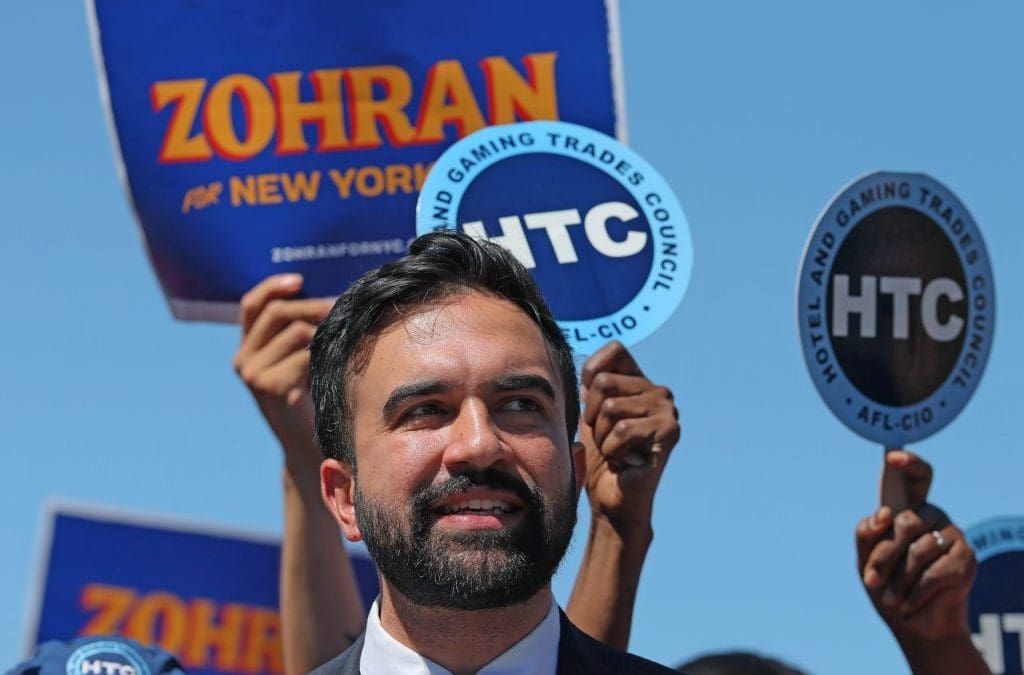
New York City Mayoral Candidate Zohran Mamdani speaks during a rally at Lou Gehrig Plaza on September 02, 2025 in the South Bronx in New York City. Photo by Michael M. Santiago/Getty Images

Donald Trump is putting his thumb on the scale of the New York mayoral race. Reports suggest he’s floated an ambassadorship to current Mayor Eric Adams and even had back-channel conversations with former Governor Andrew Cuomo, who’s now eyeing an independent run.

Credits:

  • Written by: Stephen Janis
  • Studio: David Hebden
  • Post-Production: Stephen Janis
Transcript

The following is a rushed transcript and may contain errors. A proofread version will be made available as soon as possible.

Taya Graham:

Okay. I have one simple question for you. Could it be that Donald Trump, president of the United States might be afraid of Zoman Mond, a New York State assemblyman and mayor candidate? Well, we will answer that question on this. Our latest installment of the Inequality Report react, and we’ve got a video you won’t want to miss. Okay. It has been a whirlwind since Rah Ami was the surprise, Victor of the New York mayoral primary. The self-described Democratic socialist beat, the establishment favorite former New York governor, Andrew Cuomo. But of course, since then it has been knives out for manami. The mainstream media, democratic elites and nervous real estate billionaires have been targeting him from every single angle, including with propaganda millions in super PAC donations and personal attacks on a man who did nothing more than win an election while the Democratic party sinks deeper into the abyss. Imagine that. But now since none of the attacks have worked, the most unlikely of political alliances has recently emerged. And Steven, you’re not going to believe it,

Stephen Janis :

Tell you when I heard it, I didn’t believe it. I know you’re going to say it, but I still don’t freaking believe it, to be honest with you. It was shocking.

Taya Graham:

I know. It shocked me too. I mean, all he did was win, which is honestly quite unusual for Democrats these

Stephen Janis :

Days at this point. Absolutely.

Taya Graham:

But instead of embracing his success, the pushback from Democrats has gone even further and has become even more bizarre. Democrats seem so upset the mond of one, they’ve taken the idea that politics creates strange bedfellows and turned it into a king size bed of crazy. Okay, you ready for this?

Stephen Janis :

Yeah, I’m ready.

Taya Graham:

Okay. According to reporting by the New York Times and Politico, Donald Trump is weighing in on whether to insert himself into the upcoming November, New York mayoral election, specifically to beat ami. But what’s really shocking is who he called to form the alliance to beat the upstart candidate. Wait for it. None other than Andrew Cuomo himself. That’s right. The New York Times reported that Trump and Cuomo talked on the phone about strategies to beat Mond in the fall, although Cuomo actually denies that this call happened. But still, Cuomo is your typical corporate Democrat who appears to be okay with working with Trump, provided he wins. And just to put an exclamation point on the fact that Manami is living rent free in Trump’s head and why this potential alliance is possible at all, let’s take a look at the clip where he talks about manami in not so glowing terms. Stephen, let’s watch and then we come back. Let’s talk about what he’s really saying.

Donald Trump:

Total lunatic. I don’t know what she’s on. She’s all jumping up and down. I’ve never seen anything like it talking about supporting the communist mayor. And he’s not a socialist. He’s a communist. Okay. This is not a socialist mayor. This is a communist. If you look at any of his policies and go back six months, you don’t have to go back further than that. So they want to put a communist in New York. Now, the good news is we have a lot of power over that because we’re the ones with the money. We send the money, we don’t send the money. It’s up to the house. A lot of power in the White House.

Taya Graham:

That was intense.

Stephen Janis :

Yeah, that was very, very intense. That was like, wow, he seems really upset.

Taya Graham:

So before we get into why Trump might possibly be scared of Manami, why don’t you help me break this video down?

Stephen Janis :

Well, I think what’s interesting about it is they talk about the Trump derangement syndrome, and this is like Momani or derangement syndrome. I mean to call him a communist. What? I’m sorry. Free public transit is communist. I’m sorry. Having affordable housing is communist. I mean, he’s going to extremes. Usually he just calls him left wing nut jobs or right left wing radicals. Now he’s using the C word. Right?

Taya Graham:

Right. He really did bring out the C word. The C word. Like you said, I’ve heard him say left wing lunatics or left wing nut jobs, but communist is actually a new one. What’s going on here, Steven? Why does he seem to be almost desperate to make sure Mond doesn’t win?

Stephen Janis :

I think Ami, and we’ll talk about this really specifically hits on some points and breaks from the democratic neoliberal incrementalists elitist playbook that hires consultants at billions of dollars but doesn’t connect with the people. I think he hits on that and I think Trump realizes that, and that’s why he’s scared

Taya Graham:

Steven. That is the perfect place to drill down into the four reasons Donald Trump might possibly be scared of. Zorah Mond. Okay. Number one, he is not a neoliberal corporatist, typical incrementalist Democrat. Steven, talk to me about it.

Stephen Janis :

Okay. Tell, there’s one word I’m going to use here to describe why this is an important concept to understand of why Trump years won the healthcare. Healthcare.

Taya Graham:

Yes.

Stephen Janis :

Okay. So we watched this 1.5 billion fiasco where the Democrats lost to Trump, and one thing they did not do was ever mention healthcare, one of the most important issues to the American people and an issue that they won on in 2018. A month after that election, you have this tragic murder of the United Healthcare, Brian Thompson. And then the public comes out and all they’re talking about is how much they hate the healthcare system in this country. And Democrats didn’t talk about it, I think because a lot of their money comes from healthcare companies. So they were boxed in. The one thing where they could have beaten Trump or at least made a difference or a difference in the court of public opinion was healthcare. And they didn’t even touch it. And that’s why these corporate centers candidates fail consistently.

Taya Graham:

Okay. I really like where you’re going here because I think you’re pointing out something that just does not get enough discussion. I remember when we talked to Professor Richard Wolf about the economic history of this country. One of the things he pointed out that really stuck with me was that during the Cold War, the reason the tax code and unionization and other working class policies persisted in the fifties and sixties and even partially into the seventies, was because the elites of this country were fighting with the Soviet Union. He told us they felt like they had to provide a better life for the broad majority of people in order to win the ideological battle that democracy and capitalism were better than communism. But he then told us that at the end of the Cold War, equality unionization and the other things that made working class life better just vanished. And the elites started hoarding wealth. That’s when we get into the nineties neoliberalism and what we call the age of the corporate Democrat. And of course the topic of our show wealth inequality and political division. But history aside, Steven, why does Mond not being a corporatist make Trump afraid of Mond?

Stephen Janis :

Well, you talk about the kind of shift and the Democrats in that same period of time that Wolf was talking about were aligned with the working class because they were trying to lift up the working class and create a large middle class. And then the nineties they got corporatized totally. They got taken over by political money and they became less and less able to align their interests with the working class interests. I mean, working class people want real change to their lives. They don’t want more tax breaks for corporations or more tax breaks for people in power. They want something that’s going to materially change their life. And Manami was promising that. And he’s breaking from that past or that tradition of the nineties that started with the corporatist incrementalist Democrats. And that’s why it scares Trump because he knows that democratic playbook is a failure.

It’s a failure for the working class and the working class, high school educated voters that Democrats just can’t connect to anymore. Trump knows that the most dangerous thing is for the Democrats who abandon that playbook and look, tell we have big structural problems, not incremental problems, not problems you can address around the edges, like our disastrous healthcare system like the unaffordable housing. They are big problems. It takes bold ideas, not just saying, Hey, we’re going to pass a little legislation and move it incrementally forward. It takes bold, progressive thinking. And Trump knows, as long as the Democrats stick to the playbook where they don’t address the broad structural problems, he knows he’s good and he knows the Republican party is good, they can just point to failure. And that’s what happens when you try to approach these huge structural issues with incrementalism. It

Taya Graham:

Doesn’t work. Absolutely. And to be perfectly honest, our constituents, our fellow voters, they don’t trust it anymore. They want change and they want it now. Okay, and now let’s go to number two. The second reason that Trump might be scared of Mond, he’s not a kandis. Now, Steven, on a previous show we showed a CNN anchor giving Mond’s opponent, Andrew Cuomo, the opportunity to spout propaganda and to try to discredit his opponent. Lemme just play a really short clip of this before we talk about it.

Kasie Hunt:

Do you think your opponent, would a Mayor Momani help or hurt the morale of the NYPD?

Andrew Cuomo :

Well, look, if you look at his prior statements, I think it would definitely hurt. Literally, he has said he was part of this defund the police movement. He has said that the police are a threat to public safety, that they are racists, that he would dismantle the police department.

Taya Graham:

Okay. Now I get Kagan that is a good card to play against Soran, but why do you think it concerns that Mond is not doubling down on policing? I mean, Trump is using the National Guard to allegedly fight crime in blue cities that he has categorized as hell holes. And just as a little side note, we both went to interview the National Guard in DC with I would say minimal results. But the point is Trump is trotting out the old playbook that Democrats are soft on crime. But why does Mondavi’s promise to use social programs and community intervention programs scare him?

Stephen Janis :

Well, the thing is that what we have learned in blue cities and reporters who have covered this closely is that policing doesn’t work. I mean, policing might be one part or one component of trying to fight crime, but if you don’t double down on social programs, which is what a lot of cities have done that have been successful, you’re not going to lower crimes. So what Trump actually does is he exploits this idea, this lack of vision in the Democratic party. Because really, truthfully, as you not taan, you’re going to talk about the Democrats really tripled down on policing in Baltimore until they didn’t. And it’s an important thing because Trump has ’em there. They pick the wrong policy and then he throws it back in their face. If Manami says, Hey, I’m going to invest in social programs to reduce crime, he’s got a more winning formula. And it also cancels out the whole idea that you’re either for or against police.

Taya Graham:

Steven, I’m so glad you mentioned Baltimore because I have personally lived through all the different strategies they’ve tried with the Baltimore City Police Department. And just for the record, we have had historic drops in crime while our police department has also had historic drops in staffing. I mean, there’s some estimates that say our department is short between 500 to a thousand officers, which is literally a third of the force. Strangely enough, crime has dropped precipitously. But to your point, the Democrats have wrongly back policing. I mean, it’s just so ironic. I mean, here in Baltimore we had zero tolerance policing that led to a hundred thousand people arrested every year for nearly a decade and crime. And in particular, the homicide rate didn’t go down until they stopped doing that. So honestly, the Democrats look bad both ways. And so as long as they keep on trying to out police Trump, I think they’re going to look pretty bad.

Stephen Janis :

So it’s pretty

Taya Graham:

Smart from Adam not to fall into that trap.

Stephen Janis :

Yeah, well, that’s the thing. It is a trap. It is a trap because you have two sort of visions, right? What can the Democrats say in opposition of Trump’s idea of putting National Guard, bringing in all sorts of law enforcement? They can’t say anything because they’ve embraced the same sort of tactics with unconstitutional and authoritarian policing that we wrote about in democratic cities. But if you come with a different playbook and you say, you know what? Policing is fine, but really what’s important is improving people’s lives, having social programs, having a community-based approach to violence, then you have a different vision. And that’s the problem. Trump’s vision. Trump’s idea is to exploit the Democrats for picking the wrong policy and he could just double down on it doesn’t matter. But if you have a different vision, a contrast, which is what Manami has in his campaign, then you can fight it out.

Then you have something to say. If you don’t have that contrast, you just end up looking feeble and weak. And let me say this too, as you pointed out, the idea that Democrats picked policing to solve complex social problems, hurt this city, hurt the people of the city, as Professor Lester Spencer said from Johns Hopkins University, we wrote about this, it basically minimized the efficacy of the most progressive parts of this country. So really the are going to be the Democrats were like 15 years ago. Oh my God, we have to look like we’re tough on crime. We have to embrace policing. But what scares Trump is that if Moham says, you know what? I don’t even think policing is the answer to this question, then you have a different vision and a competing vision that people can pick from. And Trump does not want that.

Taya Graham:

Okay. Reason number three. Okay, Steven, I think number three is kind of interesting and intriguing, and we’re going to call it the Medicare fallacy.

Stephen Janis :

Why

Taya Graham:

Don’t you explain what that is and why that might scare Trump about Mond

Stephen Janis :

Teya? It’s a really simple idea. The Medicare fallacy is a way of proving that neoliberalism doesn’t work. And by doing so, it shows that the underlying assumptions in neoliberalism that the market is always the best solution is wrong. So if you look at private healthcare versus Medicare, private healthcare spends between 2012 and 20% on overhead. Medicare spends 2%. So think about that. What’s more efficient? The market-based solution that plays 12 to 20%, or Medicare, which is 2%. So everyone’s always saying, when bomb with the grocery stores, you can’t do that. Government can’t do anything. Well, well, the Medicare fallacy shows that, yeah, government can do something really well deliver healthcare efficiently to millions and millions of elderly Americans. And so what Manami is trying to say here and why that scares Trump is like, no, Medicare is more efficient, so security is more efficient. We’re not going to give our 4 0 1 Ks over to private equity. He’s going to interrupt the whole idea that government should be profitable, or the only way government can solve problems is by monetizing them. And I think that’s why we call it the Medicare fallacy. You just look at Medicare and it’s much more efficient, much more cost effective,

Taya Graham:

And

Stephen Janis :

Benefits more people. So I think by him embracing some of these ideas that aren’t exactly Medicare, but ancillary to that is something that Trump fears because if Democrats start making government work, that’s really going to be a problem for the Republicans.

Taya Graham:

Steven, I think you touched on something so important there, because fundamentally the message that we’re getting from the Republican party is that government can’t do anything right? Which is sort of ironic that that would be coming from people who are in government, but I’ve seen government get things right and I’ve seen them get them right effectively. I get water, I get electricity, I have roads I can drive on. I have a public library I can go to. I get mail. There are things the government can do, and it doesn’t necessarily have to be a for-profit, which I think explains why it might be worthy to consider whether or not AMI should have the city investing into a grocery store. It’s

Stephen Janis :

A good

Taya Graham:

Question. Just the idea people have just been vicious about it, saying it’s impossible.

Stephen Janis :

Yeah, no, I mean, this is one of the ideas he’s been attacked on the most is his idea that you can’t run a grocery store. But I think it’s oversimplification. I think what he’s trying to say is we have a complex social problem. People can’t afford to live. How are we going to attack it? Maybe we’ll try a grocery store, maybe it won’t work, but maybe in the process we’ll learn something about how government can work. And the other thing too is that the Democrats always put themselves in defending bad institutions. Instead of saying, we can reform this. A lot of institutions have been corrupted by this idea, a lot of government institutions by the idea that they should serve profit and they should be neoliberal and market-based solutions that make business money but don’t serve the people. If the Democrats would turn around and say, you know what? The main metric we have in governance is how well it serves the people, and we’re going to reform any institution that doesn’t meet that goal, then they’re in better shape right now. They just look like they’re defending waste, fraud and abuse and whatever they say. And that’s because they have embraced neoliberalism and as you were saying, public private partnerships and things like that.

Taya Graham:

Reason number four, okay. Now the fourth reason that I see Trump might be afraid of ami. I mean, it almost sounds silly when I say it, but it actually might be one of the most important. Okay, here it goes. People like him. I know it sounds strange, but the truth is he is charismatic. People connect to him, and he seems authentic to him, at least based on our reporting. And I actually have firsthand experience with this because I’ve covered, actually you were there with me.

Stephen Janis :

I was there,

Taya Graham:

The Republican National Convention. And when I was there, I literally, literally saw people crying when Trump would appear. I mean, it kind of felt like a religious gathering. But when Chuck Schumer goes up to the podium, if people are crying, it’s probably from disappointment because he is one of the key members of the Democratic leadership that has refused to fight back against Republicans during the government funding showdown earlier this year. But I know from talking to people that, except for Bernie Sanders or a OC, and now ami, the ability to connect with the voters is often underestimated and an undervalued skill by Democrats. I mean, let’s think about it. They spent 1.5 billion,

Stephen Janis :

Billion

Taya Graham:

With a B last November, and they lost. And now they’re paying consultants again, the same ones to figure out how to talk to voters. And this is something that Madami seems to naturally understand given his win. But why don’t they get it, Steven? I mean, Dems, okay, let me talk like the kids Dems don’t seem to value the Riz. No,

Stephen Janis :

No, they don’t. They don’t really get that. It’s really funny because I was at the same Republican convention you’re at, as you mentioned, and I was just amazed at how people were connected to Trump in that audience. They felt like it was visceral. They had some deep bond with this man, which I’m a reporter so I can’t express my opinion, but was somewhat mystifying to me given some of the things he had said, and they were just completely enthralled. But every time the Democrats have a candidate that emerges that can have the same sort of connection with their side of the voters or even voters beyond their side, they tend to attack him because I think in a lot of ways it attacks the underlying political economy of the Democrats, which is a consultant class who can take a mediocre sort of play by the rules.

Remember we talked about this, get in line Democrats, which we had the get in line Democratic party where no candidate can jump the line like Trump did for the Republicans. They have to get in line. So they take the assembly line of neoliberal Democrats and say, I’ll make you popular. Just don’t say these words. I’ll make you popular as you point out before, I’ll spend $20 million. We’ll do focus groups with young men and we’ll tell you what to say. I mean, of course they’re going to come out and be bland and not be interesting and not be authentic. And of course they’re going to get outmatched because they’re so circumspect, because there’s been so much money trying to turn them into automatons that when Trump says something crazy, they don’t even know how to respond because there’s no there. And I think the candidates that capture people’s imagination have something other than political consciousness. They have some understanding of what people are really going through some way to connect and be empathetic and not sound totally superficial. So the Democrats just reject them because the entire business economy of being a Democrat is sort of bound in this idea of having you get in line the next candidate, the next one we formulated, rather than someone like Manami, it comes out nowhere and wins it, and then no, look, they’re apoplectic. So I think that’s part of it.

Taya Graham:

What’s even funnier, and maybe it’s sad, not funny, but I’m sure you’ve heard about this democratic think tank called Third Way that put out a list of words Democrats are not supposed to use. Can I give you an example?

Stephen Janis :

Yeah. Okay.

Taya Graham:

It’s kind of like seminar speak, organizer jargon, therapy speak words like safe space triggered, words like that. So when they have to have a conversation like that, they’re having some difficulties.

Stephen Janis :

They have a really perverse od deak, wait, did I say that

Taya Graham:

Right? Yeah. Siro deak

Stephen Janis :

Kind of thing going on here where they’re paying people millions of dollars to tell them what to come out of their mouth because they don’t know what to say. But that’s such, to me, such a bad sort of omen for Democrats as politicians. If a politician doesn’t innately know how to respond to a situation, if a politician doesn’t know what to say in a moment or how to connect with a person who could be a skeptical voter or a person, they’re not immediately aligned with, there’s no amount of money you can spend to cover that up. There’s no amount of training or no amount of lists of words that is going to make a Democrat an effective communicator. It’s innate, it’s natural, but it also comes from people jumping the line. Let’s remember that Obama jumped the freaking fucking line he was not supposed to run. Right? He’s a senator. They’re all like, he’s only been a senator for two years. He jumped the line. He won because he understood he was a political talent, and they’ve got to look for talent, not just people who check a box. And that’s what it sounds like. It sounds like the consulting class. Check a couple of boxes. They need talent.

Taya Graham:

Okay. Steven, I think this really speaks to what you were talking about, about those focus groups, because Democrats are limiting candidates controlling their words while Trump says whatever comes to mind, regardless of how offensive some folks might find it. I mean, how is that supposed to work? I mean, just imagine a candidate trying to be natural and trying to connect to people while being worried about saying a particular set of words. Meanwhile, president Trump can shoot from the hip and say literally everything. And it’s not because the rules are different, it’s because he knows his audience and he connects with them. And there are a lot of people who just don’t like that and don’t like him, and they’re going to get angry with me for even mentioning it. But a candidate has to have a way with connecting with people. Absolutely. It’s so important. I mean, people may not want to accept that Trump has a way of connecting with his base, but you can’t deny it. So a candidate has to have a way of connecting that has nothing to do with focus groups or consultants or paid advertising. And the fact that Mond came out of nowhere says something about the importance of charisma. And there is not a focus group or list or consultant that can conjure that if a candidate doesn’t intrinsically have

Stephen Janis :

It. So true. So

Taya Graham:

True. I’m sure Republicans are laughing as Democrats twist and turn and try to address their historic unpopularity with consultants rather than embracing a candidate. People actually like

Stephen Janis :

That is so Taya. No, but that is exactly what I was trying to say, that you said so much better than I

Taya Graham:

Do. Oh, no,

Stephen Janis :

You are so right. Thank you for saying that. I just hope they listen to you, but I don’t know if they will.

Taya Graham:

I don’t know mean there are a lot of young folks, and I’ve heard this from them, they feel like it’s a gerontocracy.

Stephen Janis :

Oh my God. Yeah. And I think Ali is an expression of that, what, 32, 31 years old. He is a very young man. And I think the average age in the Senate, the medium age is like 64.

Taya Graham:

I wouldn’t be surprised if it was higher, but I’ll take your word for it.

Stephen Janis :

It was something like that. I was real. I was just, was astounded. It’s like an assisted living facility. But it is. And I mean, come on, the Democrats have to get younger. Look, I’m an old man, but I want to see a viable two party system in here. And if they don’t recover in some way, the Republicans are going to rule this country for a very long time.

Taya Graham:

And that doesn’t lead to a healthy democracy having only one party rule.

Stephen Janis :

Right? Right. So we’ll see if the Democrats will actually listen to what Te Graham said today, which I think should be the Bible going forward, but we’ll just have to see because I don’t know if it’s going to

Taya Graham:

Happen. Well, we are available as consultants to write you up our own playbook. No you’re not. I’m just teasing. Okay, Steven, we reviewed the four reasons Trump might be afraid of Mond. And the question is now will the Democrats agree to embrace him?

My

Name is Taya Graham. This is my colleague Steven. Janis, we’re your inequality watchdog and we’re reporting for you.

Original

‘THIS IS WAR’: Will Charlie Kirk’s assassination unleash a wave of political retribution?

‘THIS IS WAR’: Will Charlie Kirk’s assassination unleash a wave of political retribution?

A memorial ceremony held in front of the Brandenburg Gate for U.S. conservative political activist Charlie Kirk, who was killed in an assassination, in Berlin, Germany, on September 11, 2025. Photo by Ilkin Eskipehlivan /Anadolu via Getty Images.

The assassination of Charlie Kirk, a close ally of President Donald Trump, conservative political activist, and founder of Turning Point USA, has sent shockwaves throughout the entire country. As of Thursday, Sept. 11, Kirk’s killer is still at large. Authorities still do not know who the shooter is and what their motivations were, but that hasn’t stopped the formation of a thunderous chorus of powerful people across the right and far-right spectrum calling for retribution, from President Trump and Elon Musk to far-right influencers like Chaya Raichik and Laura Loomer. What will the societal fallout be from this high-profile assassination? Will the public murder of Kirk unleash a new wave of political repression? What possibilities should people be prepared for? In this urgent panel discussion, TRNN Editor-in-Chief Maximillian Alvarez poses these questions to three experts on far-right politics: Shane Burley, Natasha Lennard, and Jared Holt.

Guests:

Additional resources:

Credits: 

  • Studio Production: David Hebden
Transcript

Maximillian Alvarez:  On Wednesday, Sept. 10, Charlie Kirk was assassinated while speaking to a large crowd at an outdoor event on the campus of Utah Valley University. Kirk was a close ally of President Donald Trump, a far-right influencer, conservative political activist, and founder of Turning Point USA, a nonprofit that advocates for conservative politics on high school, college, and university campuses, which also created the professor watch list, a site that has been used for years to surveil, doxx, and harass academics the group accuses of being politically biased. Horrifying videos of Kirk being shot in the neck and the crowd racing away in panic immediately flooded the internet and mainstream media. Kirk was pronounced dead shortly afterwards, leaving behind his wife, Erika, and their two children.

Now, we are recording this on the afternoon of Sept. 11, and as of right now, Kirk’s killer is still at large. Authorities posted images earlier today of a person of interest, and asked the public for help in identifying the individual. Law enforcement officials also said that the weapon used has been recovered and described as a high powered bolt-action rifle.

Kirk had become one of the most prominent voices of the MAGA movement. His assassination has sent shockwaves throughout the entire country. But the reaction to Kirk’s death on the right, from President Trump to Elon Musk, to far-right influencers like Chaya Raichik and Laura Loomer, suggests that we are sailing into very troubled waters in this country.

“The left is the party of murder,” Musk said on X Wednesday. “The Left are terrorists,” Loomer posted. In all caps, Raichik posted on X, “THIS IS WAR.”

And on Wednesday night, president Trump made a public address from the Oval Office. Here’s some of what he said:

President Donald Trump [recording]:  This is a dark moment for America. It’s long past time for all Americans and the media to confront the fact that violence and murder are the tragic consequence of demonizing those with whom you disagree day after day, year after year, in the most hateful and despicable way possible.

For years, those on the radical left have compared wonderful Americans like Charlie to Nazis and the world’s worst mass murderers and criminals. This kind of rhetoric is directly responsible for the terrorism that we’re seeing in our country today, and it must stop right now.

My administration will find each and every one of those who contributed to this atrocity and to other political violence, including the organizations that fund it and support it, as well as those who go after our judges, law enforcement officials, and everyone else who brings order to our country.

Maximillian Alvarez:  Again, we still have no idea who the shooter is and what their motivations were, but that hasn’t stopped the formation of a thunderous chorus of powerful people across the right and far-right spectrum calling for retribution.

And that is what we are going to focus on in today’s segment. And to help us break this all down, I am very grateful to be joined on The Real News today by three guests: Shane Burley is a journalist, organizer, and filmmaker based in Portland, Oregon. He’s the author, co-author, and editor of numerous books, including Safety through Solidarity: A Radical Guide to Fighting Antisemitism, and Fascism Today: What It Is and How to End It.

Natasha Lennard is a columnist for The Intercept and the author of the book Being Numerous: Essays on Non-Fascist Life. She’s the associate director of the Creative Publishing and Critical Journalism graduate program at the New School for Social Research in New York.

And Jared Holt is the co-host of the podcast Posting Through It. He is a journalist and research analyst who has covered political extremism and hate movements in the United States for nearly a decade.

Thank you all so much for joining me on The Real News today. It is a very dark day in the country, but I’m truly grateful to have you all and to shine the light of your brilliant insights onto this moment when our audience desperately needs it.

There is, frankly, a frightening amount of misinformation and conjecture flying around right now. So, I wanted to use this first section to break down who Charlie Kirk was and what we definitively know and what we do not know about his assassination yesterday. So, Shane, why don’t we start with you, and then, Natasha, we’ll go to you.

Shane Burley:  Thanks so much for having me. So, I think, thinking about it this morning, it’s really hard to imagine, certainly, a second Trump term, but even, to a degree, a first Trump term without Charlie Kirk. He really helped to redevelop what a young, youthful, really far-right Republican Party could look like at a time when young people were not actually getting involved in these campus organizations. He created one that really brought people in and then pushed them further and further right.

So, as he matched Trump’s rhetoric and what became the MAGA movement, he was really able to bridge that and build a movement that just wouldn’t have happened before. So, the idea if we’re talking about a young GOP base or young right-wing men in particular, that really wouldn’t have happened without Charlie Kirk.

And he moved the Overton window quite a bit. The way that he talked about politics is something you would’ve found in the fringes of the right maybe five or 10 years before, and he helped mainstream it. He helped bring it onto Fox News, helped bring it into Newsmax and other places, and really helped establish that that is going to be the way that the right talks about politics. Just [inaudible] close to openly racial politics, openly transphobic politics, and certainly anti-immigrant politics.

Natasha Lennard:  Absolutely. Just following on from Shane, for those viewers and listeners who had never heard of Charlie Kirk for some reason before today, they could look at the news cycle, from right-wing news to liberal mainstream news, and get the sense that this was some generous, open-hearted man invested in young people getting together and organizing and developing spaces for robust debate and discourse and speech.

Notably, The New York Times‘ Ezra Klein lauded Kirk for his approach to politics as if he were mainly invested in the project of debate. What Charlie Kirk did was, largely, go from campus to campus and beyond and motivate young white men, and somewhat young white women, but particularly young white men, into the revanchist politics of the right today. Very much openly Christian nationalist, and antitrans to the extreme, anti-immigrant, and racist, and did a lot of work to normalize those positions as a center for the political right. So it’s no time to be whitewashing the political project to which he was reliably devoted.

He did make much of this “debate me” shtick with 19-year-olds he would meet when he would go on college campus tours. But this was essentially a 31-year-old man condescending to 19-year-olds, whilst, in fact, committing himself reliably to everything that is so troubling about Trump’s authoritarian second term.

And what that does, indeed, is not open up debate. This is not about opening up debate. It’s about making the very people who are allowed to be in the body politic of this country at all smaller, whiter, more patriarchal, meaner, and yes, less inclusive. So yeah, just really agreeing with Shane there.

Maximillian Alvarez:  Jared, I want to bring you in here too. Anything else you want to add about who Charlie Kirk was and what we know and don’t know about his assassination on Wednesday?

Jared Holt:  Yeah, I’ll start. I think Shane and Natasha covered the brunt of Charlie Kirk, but a couple other things I want to add in here. I feel like another thing that these obituaries and mainstream media have omitted about Charlie Kirk is the fact that he was a central leading figure in efforts to overturn the results of a democratic election in 2020. He is not a patriot. His career was built on contempt for this country and most of the people in it, particularly minorities and our immigrant communities.

Another thing to know about Charlie Kirk is that the reason anybody knows who Charlie Kirk is, is because when he was younger, fresh out of high school and looking to get into conservative politics, he managed to charm the right-wing mega-donor class. So much of early Turning Point USA and early Charlie Kirk lore, I guess, if you will, was a dark money project. This was not somebody who was authentically popular. Eventually, he did catch on and attain sincere popularity with conservative audiences, but he kind of faked it till he made it.

And I feel like that’s important to note. He has been portrayed in so many of these obituaries as this sort of sincere, genuine freedom fighter kind of guy, and maybe people disagreed with him, but you have to respect him, that sort of thing. But this is a professional operation. He is a provocateur, is how I saw him, not as somebody who was interested in a good-faith debate, but somebody who was willing to poke the bear and push things to the extremes, all with the goal of embarrassing people or stirring up audiences against various outgroups and targets of the conservative movement.

Maximillian Alvarez:  Well, I think that that’s an area of Kirk’s legacy that all four of us have dealt with at one point or another. When I was a graduate student at the University of Michigan, this was when Turning Point USA was really becoming a political force on campuses, and the professor watch list was something that we were all aware of. I knew many people who ended up on it and some who got disciplined by their universities just for being accused of what TPUSA was accusing them of without any real investigation. This was not something that any of us who genuinely championed robust, intellectual, good-faith debate saw as that. Because if you ran into any TPUSA folks on campus, that’s not what they were looking for. They were looking to oust you as some radical Marxist who was indoctrinating their students and needed to be doxxed and harassed into silence.

So it came as a shock to many of us who knew Kirk that way and TPUSA that way to be confronted with so many people saying that he was a champion of good-faith debate. And that does not go into the realm of speaking ill of the dead or pretending that we can’t be honest about the situation that we’re in right now.

I have so many folks who are conservative in my family, in my friend circles, people I’ve reported on in sacrifice zones around the country who are genuinely heartbroken about this, and my heart is broken for them. It’s broken for this country. It’s broken for the same reasons that I think a lot of us are feeling like this desperate desire to return to a place where we can talk to each other in terms that aren’t so black and white and so violent, but we can’t in this country, and Charlie Kirk had a big hand in creating that political surround that we find ourselves in where we can’t really cross the aisle and talk to each other across our political differences. If we don’t reckon with that legacy, we’re not going to get to the place so many of us want to get to.

And that is not the place where we are currently going in this country, and I want to focus us on where we are headed after this world-shaking political assassination. Again, there is still a lot that we do not know about Kirk’s assassination, and the suspect is still, as of this recording, at large. However, it is quite clear that the MAGA faithful and far-right influencers are responding as if they know for certain what happened, who’s at fault, and what must be done in response.

And so with the time that we have left, I want to focus specifically on how the right is responding to this and the dark political possibilities that are quickly approaching on the immediate horizons.

So, Shane, let’s start and go back to you.

Shane Burley:  I think one of the first things to bring up here is that, just as if there wasn’t a young MAGA movement without Charlie Kirk, there also wouldn’t have been the big wave of campus repressions that saw in ’23 and 2024 without the foundations laid by the professor watch list and the logic that was presented of the campus as this dangerous place that was attacking free speech and required someone to come in with an illiberal voice to balance things out.

And I actually think that’s going to actually have consequences on campus. Remember where he was killed, it’s in the place that was his war zone and where he said was dangerous. And so, I think that will just ramp up what he started 10 years ago. So, I think that’s going to continue.

One thing that people have to remember is that Charlie Kirk did have enemies to the right. This is actually a big part of his story. Starting in 2019, the Groyper movement, Nick Fuentes, really made their name by going to Turning Point events and demanding that Charlie Kirk answer for Zionism in Israel, and whether or not he’s being paid by Jews, or different framings.

And that has actually been a really consistent piece of the American far right’s story about Charlie Kirk. It’s actually in a lot of ways where neo-Nazis and certain people in the very far right distinguish themselves from the mainline far right that Charlie Kirk represented. Until the end he maintained a pro-Israel stance, even though he started to flirt with a lot more of the Israel-critical crowd. So, it’s possible that there’s someone to the right.

There’s also the fact that Charlie Kirk constantly changes positions to match those in power. So he would take a populist tone one day, he’d switch it when Trump switched. He’d be pro-exposing Epstein one day and then try and dissuade people from looking at it another day. He’d be about voter integrity one day and then would deny ballot integrity another, free speech one day and not the other. So it’s really actually hard to say who he betrayed here.

But nonetheless, it’s about a narrative and about justification for repression. And so when I hear something like this, the first thing I hear is that the right is going to use this to justify really serious repression against social movements, against activist groups. Of course, they always understand political movements on the left as having to be controlled from above, to have a vertical alliance. So, they assume that any kind of activist, anyone talking about racism, something like that, they must somehow be involved and so they’re going to have to use equal force. At a time when national officers, when National Guard troops are being sent into cities, this is going to be another pretext for it.

And so, I’m concerned about not just what’s going to happen on campus, but how this will be used to actually target and use group cases or justify really serious investigations into activists of all sorts.

Maximillian Alvarez:  Let’s not forget that the federal occupation of Washington, DC, was effectively a response to a DOGE staffer, AKA Big Balls, getting beat up in DC. So, we’ve got some precedent here.

Natasha, please hop in.

Natasha Lennard:  Yes, I think we heard Trump’s own statement, saying this is a dark moment for America, and I think true, but for, of course, entirely the opposite reason. But the rhetoric that Trump himself is using, already saying he wants to go after rhetoric — He used the word “rhetoric.” He, of course, used the word “terrorism.” He talked about contributing to this crime.

And again, it is worth reiterating many, many times, at the time of speaking, we have no idea who this shooter is, absolutely no idea at all. But immediately in unison, Trump and his acolytes jumped to blame the radical left. And by the radical left, they quite literally mean anyone from leftist mutual aid kitchen to Bill Gates.

So it is a really open season, but obviously, the concern is the way in which activist communities can and will be targeted as a point, not of aberration from what we’ve seen before, but escalation in terms of, as you’ve all been saying, repression on campus.

We saw one of the responses worth noting last night, Christopher Rufo from the Manhattan Institute, the man behind turning critical race theory into a boogeyman who, along with Kirk and others, is responsible for so many of the censorious attacks on higher education and scholarly speech that we see today, he quite openly and explicitly called for a return of J. Edgar Hoover’s FBI-style attacks on the left. So we are talking COINTELPRO, assassinations, and dissimulation and targeting, the worst sort of McCarthyism, the eras that had been condemned as really dark times in American history are being openly called into revival now, in the name, we are told by our centrist leaders, of a man who supposedly adored free speech.

So I think one thing I want to end with is that this isn’t a moment for our leaders, progressive or self-identifying progressive leaders, to forego their duty of ensuring that the most vulnerable in these moments are protected from the very world that Kirk and his ilk want to see called into being, which, again, is a whiter, crueler, less inclusive world.

Jared Holt:  What I will add here, again, like the previous question, Shane and Natasha, two brilliant people took a lot of words out of my mouth, but something I want to note is I’ve been tracking the far right for a decade now, and I cannot tell you how many times I have heard figures associated with these movements talking about retribution and civil war and retaliation. Violent rhetoric is a feature of these movements, and it was part of a problem — A lot of these obituaries are presenting Charlie Kirk as a victim of political division and violent rhetoric, and I think he was a major contributor to the problem. And like you said, I’m not trying to speak ill of the dead, but I do want to speak honestly about it. That has to be acknowledged and understood if we’re talking about him.

What’s different this time about this surge of violent rhetoric is that the people promoting it have institutional power. They have a vice grip over the federal government and can act on it in a way that they didn’t beforehand. And they are pursuing this agenda anyway, whether it is sending military to liberal-coded cities, including my home of Chicago, although it’s not clear if they’re going to go ahead with that after getting some pushback. We saw the incident where they exploded a speedboat that they claim was full of Venezuelan drug traffickers, is the official story. No due process, no way to check this claim because everyone’s dead, and it’s illegal.

And they just keep pushing the limits. They keep making clear they don’t really care about the courts or the traditional thresholds of institutional power that would normally be there to check it. The Republican Party at large is not interested in reigning things back right now. And for the last several years, right-wing media has been — Well, really the last decade, but especially the last few years — Right-wing media has been really harping on these narratives that there is some kind of imminent violent threat radiating from the “radical left,” which can be defined, as Natasha said, as loosely or as specifically as possible, depending which one of these guys you ask.

This event, to me, all things considered, almost feels like the climax of that narrative arc. They’ve been hyping this up. They’ve been really stretching themselves thin to villainize all kinds of random people, especially transgender people, trying to portray them as some kind of violent, murderous threat to conservatives that have to be acted on. And here you have an extremely high profile, extremely gruesome, awful event that happened to one of the movement’s figureheads, and to somebody who spent a lot of time and effort promoting those exact narratives.

So what comes next? I’m not sure. It seems this administration has made up its mind about who is to blame for what happened to Charlie Kirk. Even though, as we’re recording this, we know that Charlie Kirk was shot and killed. We have an idea about how it happened, where the gunman was, what weapon was used. We have a photo of a suspect that they’re asking for help tracking down.

And then we have a conflicting report, some internal chatter that says that messages associated with transgender and anarchist ideologies, whatever that means, that could mean anything if you don’t specify, were found on bullet casings. That was conflicted. A senior law enforcement official told The New York Times this morning that that conflicts with other reports and is not confirmed and people should not be running with that.

Trump’s remarks, so many influencers’ remarks have decided that this “radical left” is responsible for this shooting. And, I don’t know, if they arrested a white supremacist, and it turned out he was the — Because, as Shane pointed out, there’s plenty of people to the right of Charlie Kirk that hate his guts. It’s not outside entirely the realm of possibility at this point that we’re recording that it’s possible, I guess, I don’t know. But even if they arrested somebody like that, I don’t know if it would stop this trajectory that they’re on.

And I think what’s most alarming — And I’ll end this here — Is what Trump said, basically blaming not anybody specifically or any specific group or whatever, but saying that Charlie Kirk died because people called him a supremacist, a Nazi specifically is what Trump said. That’s First Amendment-protected speech. That is not violent speech, that is not a threat, that is a criticism — a very extreme criticism of somebody, but a criticism of somebody.

If this administration tries to act in a way where people who criticize the supremacist elements of its agenda, the supremacist ideology and rhetoric of its top proponents, that can get us in a very dark place very quick. We’re already in a dark place, but if you flip your history books back to the ’60s and 70s in this country in terms of left-wing movements or social progressive movements, things can get a lot darker from here.

Maximillian Alvarez:  My dearly departed comrade and colleague Eddie Conway was locked up for 44 years and framed by COINTELPRO. He was a Baltimore Black Panther. Those are the casualties. He’s one of so, so many of that dark period.

I want to end on a rapid fire one more round around the table, because you all have studied the right, the far right, from the activist level to the donor level for years. You are authorities. You have seen this stuff up close. And as you all said, we don’t know where things are going to go, but we do know that the far right elements that you have been studying are now mainstream in the Republican Party, that that party has a stranglehold on the levers of power in our government from all three branches, that the media ecology that we’re in has shifted dramatically, and tech platforms are owned by people who are also part of the MAGA coalition, and algorithms are driven towards that type of ideology.

So I wanted to ask if we could glean from your years of research and studying the right and far right, if you could talk to folks watching this and listening to this right now who are afraid, who are anxious, who are angry, who don’t know what is going to happen next, what lessons could you offer on how to navigate this moment? What is not going to work if what we don’t want is more violence and death and civil war? Do you have any final thoughts that you want to leave folks with about where we could be headed in this country and how to carry ourselves so that we don’t end up in the darkest of possible outcomes?

Shane Burley:  I can kick us off on this optimistic note. The first thing I want to say is that what really struck me when I heard the news, my immediate response was that this is going to be bad for a lot of people. This is going to be a justification to raid people’s homes, to comb through people’s social media, to try and pass legislation to target people.

Historically, when something like this happens, a lot of what people are scared of is vigilante groups coming out. And I think that that is still a viable threat, whether this is formal groups like the Proud Boys or less formalized groups, particularly at big public events. And I think, obviously, being well coordinated and having safety plans and addressing that, I think that’s really important because those are still a threat.

But what’s different in 2025 is that I just don’t think that Proud Boys or a small neo-Nazi group is the primary threat. I think that the far right has much, much bigger militias than that, and they have ICE deputization, or they’re border patrol, or they’re coming in as the National Guard, and that’s a much different question. If people spent the last 10 years asking, how do we keep ourselves safe from the far right? I don’t think that those answers really dealt with the National Guard, with bolstered police forces, with militarized federal officers.

And so I think the questions and the answers are just going to be different now, because what’s possible is different now. What the courts can stop is much smaller. What’s available within the GOP to create friction is less.

And so it is hard to answer that question. I think what you ultimately get back to is that you deal with some of these, as productive as you can, as a crisis situation. What gets through people through those things? Being connected with their communities, being bonded with organizations, with their neighbors, knowing what people have, having other people know what you need. Basically, having strong relationships that allow you to coordinate for those things.

And then if we’re talking about the threat of political violence, the answer to that is mass movements that have the power to actually change things. The reality is that shooting Charlie Kirk will not stop the politics of Turning Point USA. But millions of people organizing, putting pressure on institutions, going to the streets, those things actually can stop that. They can actually shift the tide entirely.

And so, ultimately, that kind of movement is the same answer as what keeps us safe in this situation: It’s getting together with other people, it’s talking about it. It’s envisioning a different future, and trying to coordinate together as a mass of people. And ultimately, that’s exactly what Charlie Kirk was not doing. He was not trying to make a mass democratic movement that represented everyone. He was trying to create an elitist, top-down government that privileged only certain kinds of people. So I think the answer to this crisis is to build exactly what Charlie Kirk wanted to destroy.

Natasha Lennard:  Yeah, I just completely agree. I would also say, especially for maybe some of our younger listeners and viewers, the government does not have a sense of humor. Please don’t be stupid online. So I think just being aware of what you’re putting out there, just very practically, not a time for stupid jokes. Because, yes, indeed, the problem is not just state-sanctioned vigilante violence.

And I think we definitely have to also have noted that, in the last 30 years, by far the majority of politically motivated attacks, or at least how they’re understood and studied in terms of data, by far,they have been committed by the far right and cis men. So whatever narratives are going to be spread to the country, which also Kirk himself was invested in dissimulation campaigns about, that remains true. So, that sort of vigilante is state-sanctioned at this point, vigilante violence has been a constant threat. But right now it is, I think, the state itself and its mechanisms of oppression, as we have seen in this country before, being reweaponized, revived with this ability to weaponize a justification wherever they can find it, we will continue to see.

And so for that reason, Shane’s suggestions are all the more important because they were the very thing that we have needed in response and will continue to need in response to authoritarian escalations anyway, which is community protection of the most vulnerable, not presuming that we’ll be saved by the courts or the Democratic center.

Jared Holt:  Yeah, I will echo what Shane said. I don’t know what to tell anybody to do, and I don’t know that it’s really my place to be handing out advice, but I do think there is merit in hard times with making your world a little smaller. And by that I don’t mean tuning out. I mean investing your energy in the things around you. You could write a letter to your congressperson, or you could go show up at a local government meeting and be one of the three people that showed up that day, which means you’ve got a whole lot of influence right now. You’ve got a pretty big voice, and it’s on issues that might affect your neighborhood.

And also organizing with other like-minded people locally, alternative media is great. Sharing that with people, getting more honest and unfiltered perspectives to people that really convey the truth about this situation at a time where a lot of media is glossing over it or seeming to walk around with their hands over their eyes and fingers in their ears pretending that the house is not on fire, if you will.

But the other thing I also want to say, again, to echo a point Shane made, Turning Point USA is not stopped. The far right is not stopped because somebody killed Charlie Kirk. It shouldn’t have happened. That sort of thing should not happen. We should not celebrate that, as some people online have. And like Natasha said, the police, the government, they don’t really have a sense of humor. So people might’ve been joking around or poking some fun or whatever, but it is just not a good idea. And it’s also just kind of gross, in my opinion.

I do the work I do and have done for the last decade because I feel personally driven because I want to live in a world that is more accepting, that is safer, and that can produce sincere and needed change to make sure that everybody can enjoy a good life, the freedoms and joys that a good life can contain.

A vision towards a positive future like that I do not think can include violence. A future where everybody is safe and happy and secure and can live their life to the fullest is not one where people are getting assassinated in broad daylight over political attitudes — And I’m no fan of Charlie Kirk, I think that has been evident here, but that is not the future. That is not the way forward.

I think the future is building strength through solidarity and actually organizing and supporting each other through this hard time, and identifying those little points of friction, those little small acts of refusal we can all do, because authoritarianism requires collaboration and complacency. And I think even if it doesn’t feel like much on the individual level, keeping our guards up and saying no and making our voices known is worth something.

Original

Trump’s incarceration nation: ‘Alligator Alcatraz’ is just the beginning

Trump’s incarceration nation: ‘Alligator Alcatraz’ is just the beginning

US President President Donald Trump tours a migrant detention center, dubbed

The 11th Circuit Court of Appeals has halted the imminent closure of the infamous “Alligator Alcatraz” detention camp in Florida; now, the future of the facility, and the people incarcerated within it, remains in limbo. “But no matter the future of Alligator Alcatraz, the Trump administration is turning it into a model for expanding detention capacity across the country,” Shannon Heffernan and Beth Schwartzapfel report at The Marshall Project. “Similar large-scale facilities, opened in collaboration with state governments, are already in the works. These projects mark the first time that states have gotten this involved in large-scale immigration detention.” In this episode of Rattling the Bars, host Mansa Musa speaks with Heffernan about how the Trump administration, in collaboration with state governments, is expanding the US system of mass incarceration to unprecedented levels.

Guest:

  • Shannon Heffernan  is a staff writer at The Marshall Project whose work focuses on prisons and jails across the US, as well as sexual and gender-based violence, immigration and mental health, and how arts and culture shape (and are shaped by) crime and punishment.

Additional links/info:

Credits:

  • Producer / Videographer / Post-Production: Cameron Granadino
Transcript

The following is a rushed transcript and may contain errors. A proofread version will be made available as soon as possible.

Mansa Musa:

Welcome to this edition of Rattling the Bars. I’m your host, Mansa Musa. Today we’re talking about detention centers, zombie prisons, and alligator Alcatraz. Joining me today is Shannon Heffernan, an award-winning reporter and fiction writer whose works focused on prisons and jails across the United States. Her recent reporting include two major pieces. The next alligator Alcatraz could be in your state, which looks at the controversial ICE Detention Project in Florida and zombie prisons about how ICE is bringing shuttered facilities back to life. Shannon, welcome to Rallying the Bars.

Shannon Heffernan:

Thank you so much for having me. I’m happy to be here.

Mansa Musa:

Let’s start with the next alligator. Alcatraz could be in your state. Okay. So construction on Alligator Alcatraz was stopped because a lawsuit was filed saying it had a environmental detriment, and so it was stopped. Based on that, walk us through how that came about and what’s going on with that now.

Shannon Heffernan:

Sure. So a couple of groups, some environmental groups as well as some indigenous tribes. Our a indigenous tribe bought a lawsuit against Alligator Alcatraz because of environmental concerns. They essentially said, this is a federal facility, it should follow federal laws, and it’s not done the proper environmental review. Originally, a court did halt that. However, very recently an appeals court has lifted the halt on alligator Alcatraz, so it moves forward. All of this is going to continue to play out in courts. We don’t know where it will land for alligator Alcatraz, but I do believe that this all has implications beyond what’s happening in Florida for states across the country. And no matter what happens at Alligator Alcatraz, I think it gives us some insight into the strategies that the federal government wants to use to increase immigration detention across the United States.

Mansa Musa:

In terms of the conditions in alligator Alcaraz, I recall reading some things where one is beyond the environmental aspect of it, the impact it has on environment, but the impact it has on human, human beings, people that’s being detained in there. And I seen a picture of how it’s designed and the way it’s designed is designed like with multiple bunks and cages and tents. In your report and in your gathering your information, what can you say about the conditions of alligator ture?

Shannon Heffernan:

Yeah, there’s been some pretty big complaints about the human conditions there. You’ve had people complaining about food not being edible. You’ve had people complain about their access to legal representation. You’ve also had people complaining about how difficult it is to even find if somebody is incarcerated at alligator Alcatraz. They weren’t showing up in the federal system. They also weren’t showing up in the state system. So it was hard to locate folks. It became this kind of black hole. The federal government has denied some of those claims in terms of how bad the living conditions are, but there have been multiple reports from people who are incarcerated there as well as civil rights lawyers representing their case,

Mansa Musa:

Talk about the law that gives them the right to detain people, and if you can juxtapose that against what is actually taking place now.

Shannon Heffernan:

Yeah, so I think this is a really important point that I heard from legal scholars I’ve been speaking to about immigration detention. Technically, immigration detention is not supposed to be punishment. It is different in that way from what you see in the criminal system, at least in terms of the law. That said, you see these places not only having troubling conditions like you’ve mentioned, but being given these names that raise the specter of them being frightening places. Alligator Alcatraz, you now see that they want to send people to Angola, a place that has a long history of problems and lots of associations with abusive treatment or the so-called speedway slammer in Indiana. So I think that it seems to be clear that officials are really raising the spectra of these places, being places you don’t want to go, that would be punitive. So I do think there’s that gap between what you hear legal scholars saying immigration detention should be, and then actually how it plays out and what it does.

Mansa Musa:

And you mentioned speedway slammer, and then the fact that AIN going is known for its plantation style facilities, but more importantly, we had the opportunity to talk to some people relative to crop dusting and when they come around and crop dust, whether or not it has an effect on going into the cell blocks. And so in terms of your investigation, how do you see that playing out? Because you mentioned earlier that this what we see now taking place in alligator Alcatraz is ominous a whisk to come down the pipe in terms. Talk about that.

Shannon Heffernan:

So I mean, I think that there’s a couple of things to consider. I mean, I think generally there’s the issue of detention increasing across the United States and what that means for conditions. But specifically what I meant when I talked about that is there’s a strategy that the federal government is now using to specifically get state governments involved in alligator Alcatraz. As I said, this is a state run facility. You see what’s happening in Indiana, in Nebraska with the so-called corn husker clink with Angola and Louisiana, that there are these collaborations with states to do that. And so why would that matter? Why would that matter? Right. Well, when it’s fuzzy who’s in control, a lot of the experts I spoke to about this says that makes accountability much harder. It sets up conditions that are really ripe for abuse, and we already know that there have been problems with conditions and immigration detentions for a long time, and I think what folks are arguing is this just creates a really fertile ground for that to happen even more and an even more extreme way. The collaboration with states, I think also could potentially free up resources for the federal government to do this even more other places. You’ve had the DHS secretary, Christie Noam saying that this strategy of working with states is actually becoming her preferred method instead of working with private prisons. And why is that? Because she says she thinks it’s cheaper, she thinks it’s more efficient. Instead of having to sign long-term contracts, she can sign these shorter term contracts.

She didn’t say this now, but this is me, at least she hasn’t said it that I’m aware of. It also would give her access to a workforce that might not otherwise be available because it comes from the state or buildings that might not otherwise be available because their own bar state. So if the United States government really wants to up the number of people who they’re detaining and then eventually deporting, which they’ve said that is their goal, collaborating with states on this level is something that can help them do that. I think it’s really important to note that this is unprecedented. Local governments have played a role and immigration detention in the past. For example, local jails rent out their beds to ice, but you haven’t really seen it on this scale. We’re talking about massive, massive facilities that are supposedly under the state’s control, although I think that there’s some complications and nuance there about how much they’re under the state versus the federal control.

So this is something we’ve not really seen at this scale before in the United States and is definitely worth paying attention to. I also think it speaks to a larger idea that I think we really need to be wrestling with and thinking about, which is how our country’s history of mass incarceration is actually deeply tied to what you see happening with immigration right now. These facilities are available and built because the United States has a long history of incarcerating large numbers of people. When you saw criminal justice reforms in the last decade, some of those facilities began to be shut down, either because places were shrinking, their prison population changes to parole or sentencing, or because the facilities were simply deemed too terrible, too harsh of places to put humans into. But after those facilities closed, the buildings weren’t destroyed and now you’re seeing them reanimate it for use by immigration detention.

And I think that’s really important to notice because in the same way that they’re being moved from the criminal system to the immigration system right now, once this system is built, once the system is fortified, you can see it being deployed against other populations. Once the infrastructure is there, there are financial incentives to keep them going. So when we see immigration detention getting bigger and bigger, I think there’s a question of like, well, what does that mean for the next decade in the United States? I think it’s something, it’s going to be a legacy that is likely to continue beyond just this present moment.

Mansa Musa:

Do immigrants people that’s locked up under the Immigration Nationalization Act, do they have constitutional rights? Do they have the protection under the eighth amendment, the cruel, unused upon the 14th due process, 14th amendment due process? Do they have these rights of once they’re locked up, do they have the same rights that United States citizen had or are they just put detained and then when they determine where they’re going to send ’em, they pack ’em up and fly ’em to wherever state or country they want to take ’em to?

Shannon Heffernan:

So there are standards that are supposed to be met in these detention centers. I think the question is, regardless of what the standards are, if you don’t have oversight, then it doesn’t matter. If you don’t have enforcement, then it doesn’t matter. And we’ve seen a real decimation of the systems that have historically provided oversight in these facilities. If you can’t prove what’s happening inside, it becomes really difficult to hold those systems accountable. And in addition to some of the groups that were supposed to watch dog detention centers shrinking or ending, you also have lawyers less able to access their clients in these facilities, which means the word is getting out less about what’s happening there. So I think it’s a real challenge and it’ll become an increasing challenge to make sure that what’s happening inside these detention centers is meeting basic humanitarian standards.

Mansa Musa:

And I think that based on everything that’s being done, and I did 48 years in prison before I got out, and I did, and I served time in some antiquated elaborated involvements, but I’m looking at what’s going on here. These ain’t no detention. These are basically concentration camps. They’re holding them, pinning, sending them somewhere else, but they’re holding them under the most inhumane conditions known to man at this time. But let’s talk about how the next article you wrote was Zombie Prison. I want to shift there, and you made very astute observation on this. What we’re seeing now is how their practice is in terms of how they establish this prison industrial complex, the infrastructure, how they mapping it out in terms of finding places, putting people, finding places, putting people, finding places, putting people, talk about the zombie prison, how ice detention is raising troubled facilities from the dead.

Shannon Heffernan:

Yeah, so we’ve seen a number of facilities that used to be prisons and got closed down reopening now as ice detention centers. And I think that’s important because in some cases these facilities closed for a reason. Either the infrastructure is in poor shape or the staff there were treating people poorly, for example. And now I think the real question is how are they going to ensure that’s not repeated for immigrants? I also think that that really illustrates the question of detention’s not supposed to be punishment.

Then why are places that were prisons able to handle these populations? Why are they equipped? Why are the places that we’re going to send these folks? As you know from your understanding of prisons, a lot of these facilities are in fairly remote locations. They’re hard to get medical care too. They’re hard to get translators to, they’re hard to get legal help to. So just by the geographic location, you’re already setting up a real challenge in terms of people getting what they need. I want to go back to something you said before, which is you were talking about the poor conditions in these places before they deport people. I think there’s a real connection between the conditions and deportations themselves. We’ve spoken to immigrants who are inside some of these facilities who want to stay in the United States and who may even have credible legal paths to staying in the United States, but they’re choosing to leave.

They’re choosing deportation over those legal battles because they are so disturbed by the conditions that they’re experiencing that they want to leave and they want to get out. So the conditions have, in the same way that you have people talk about people confessing to crimes that they maybe do not commit because they want to get out of jail, right? Because bail’s not available to them. The conditions are so terrible. I would say this is sort of analogous to that. People who may have credible claims to stay in the United States choosing to leave anyways because the conditions are so abysmal that they don’t feel like they can stay there safely.

Mansa Musa:

Talk about where we stand in terms of advocacy, what we have to do or what people need to do, what people need to understand about fighting back. Because I think Angela Davis say, if they come for me in the morning, they’ll come for you night. So the coming is coming. It’s just a matter of how they change the narrative on how they identify why a person or class of people fit up under the statute to say that you are a danger to the security of the United States, therefore you can be detained as an illegal immigrant even though you are a United States. Talk about the pushback, how we fight back or how to fight back.

Shannon Heffernan:

As you alluded to the so-called big, beautiful Bill gave a huge infusion of cash into immigration detention and deportation. So I suspect we’re going to continue to see efforts to grow this machinery from the federal government. I think one big challenge that advocates and activists are up against is historically under other administrations, immigration, detention and deportation was also a problem. This has gone across both parties. It’s not just unique to the Trump administration, but one thing that I think was really different is some other administrations would be shamed into action when there were reports of bad humanitarian treatment. They didn’t want that to be what it appeared to be on the outside. They wanted to appear friendly and nice. So if activists or advocates or the media showed bad conditions, there would be some thought that that would result in an action because they didn’t want to be perceived that way. But I think we’re under an administration now where that specter of it being terrible, that specter of it being cruel is something that they’re less afraid of. I mean, you have them naming these facilities, things like alligator, Raz,

Which have a connotation of the conditions themselves being poor. So if you’ve relied on a strategy in the past that if you expose harm, if you expose things being terrible, that’s going to result in action, I think that’s a strategy that you’re going to see work a little differently now under the current administration, and it’s going to require different ways of operating for activists and advocates. I think another challenge is just moving at a really, really quick speed. How quickly the administration has been able to get these places up and running is really quite astounding. Now, I say all that with those challenges. I do think it’s also important to note that this has gotten a lot of attention. You have seen a lot of activists and advocates being motivated towards action. So people are in motion across the United States resisting this and showing

Mansa Musa:

Up. And I think another problem that we are confronted with as we moved in opposition, you hit on it the speed at which they’re doing it, but in every regard in terms of the amount of money they put into it and the countries that they looking at putting money into these countries, telling them like El Salvador was the test case and say, I’m going to give you money to house these prisons. I’m going to give you money. And came out and said, yeah, I’m with this. Whatever you want to send, however you want to send. Now they talking about going to different African countries or other third world countries to pay them to take people. Talk about going forward, how do we look at it from the legal landscape? Because right now, as it stands right now, it seems, and I raised this earlier, it seems like the courts don’t have jurisdiction over the treatment aspect of it that’s being litigated. It is cruel and unusual punishment. It’s inhumane. So is it a United Nation thing or is what? Talk about that. This is mind boggling. I know our audience would probably saying the same thing if this was done to United States prisoners, at some point in time the court going to intervene because we got constitutional rights to be treated a certain way. But when it comes to a person that’s they done dub illegal immigrant, a non-citizen to that non citizenship mean I can treat you like inhuman and with impunity.

Shannon Heffernan:

So there are legal challenges that have been brought and will play out in the courts, and I suspect that will continue. I think one of the things you really have to think about when you’re talking about these legal challenges is the law is created by humans and the law is enforced by people in power. And what the law means is decided by courts, and as you’ve seen some of these cases work their way up, you will see the courts siding with where their political affiliations are. I mean, courts aren’t supposed to do that, but there’s a range in what judges can decide. So we know what the Supreme Court looks like right now as these cases reached that the question is regardless of how the law has been interpreted in the past, what is the law itself capable of doing right now? In the same way that I talked about the specter of cruelty being a little bit differently, I also think the specter of what the law will and won’t do is something that’s really in flux right now under the current administration. So I think that’s something that definitely is worth paying attention to.

Mansa Musa:

And as we close out, tell our audience how they can stay on top of your reporting because it’s definitely impactful in terms of really focusing on the issues and informing people about what is the real news versus fake news. So talk, how can our audience stay intact?

Shannon Heffernan:

Sure. So you can read my work@themarshallproject.org. I’m also on Blue Sky, and we would love to hear from all of you about what you’re seeing on the ground and what kinds of recording you think we need to continue to do. We are especially interested in looking at ways that the criminal justice system overlaps with the immigration system because we think that’s going to be really key going forward.

Mansa Musa:

Alright, thank you. And as you said earlier, I just want to close on this point. So we ask that as you look at this information that Shannon put out, we ask that you follow her lead in terms of letting them know some of the things that are going on with your views on these things, what you witnessing.

But more importantly, we ask that you take a critical look at what’s going on in this country because it’s not a matter of what I like someone or don’t like someone, it’s a matter of whether or not a person should be treated as a human being. This is about treating people as human beings. It’s not about treating people as animals because they’re not United States citizens. This is about treating people as human beings, what the Statue of Liberty says, the Statue of Liberty right now would be taking the mass off and running down the water. As you see what’s going on in this country, we ask that you continue to support the real news and rally the bar. We ask that you look at this information, give your views on it, critique it, and let us know what you think. And we’ll definitely echo your voice because we don’t give you a voice. We just turn the volume up on your voice.

Original