by Caitlyn Clark | Sep 14, 2026 | Article, Economy, Economy and Inequality, labor, Politics and Movements: US, Reprint, Unions
This story originally appeared in Labor Notes on Sept. 01, 2026. It is shared here with permission.
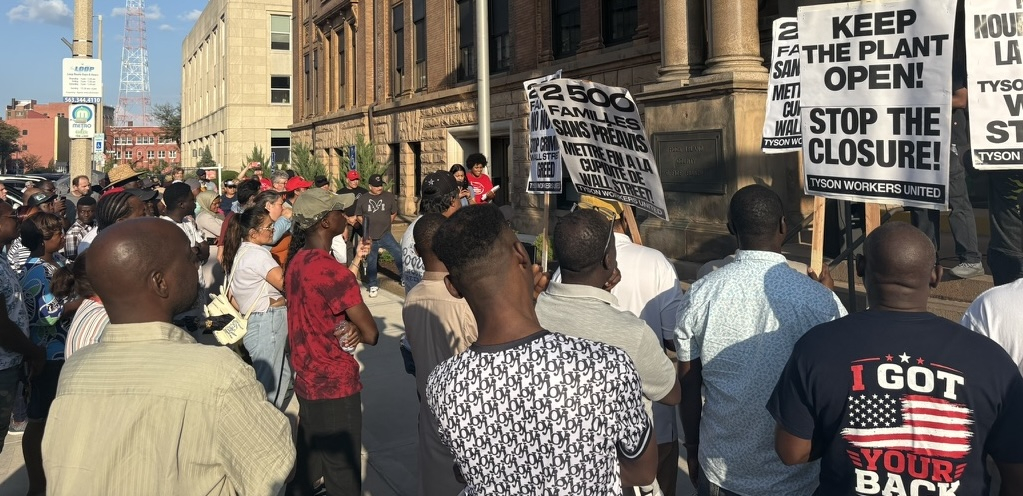
Ouano Tante worked the afternoon shift at the Tyson beef plant in Joslin, Illinois, for five years. But when she and hundreds of her co-workers arrived at work on August 13, they found the plant closed.
They speculated that someone on the morning shift might have gotten injured. Then two mid-level supervisors came outside in tears. Plant supervisors told workers the plant was closing permanently, effective immediately.
Inside, the early-morning shift had just ended when the workers were informed it would be their last. The cafeteria erupted into chaos. Plant supervisors stood guard by the doors, workers said, while everyone received their closure paperwork.
“People were crying, shaking,” Tante said. “When we were leaving the parking lot, there were so many car accidents. People were so upset.”
“They gave no reason, nothing,” said Ahoro Asselissime. “People have no job. No money to pay our bills. For 11 years, I made money for them. And now they’re not doing anything for me.”
DISASTER FOR COMMUNITY
Joslin is home to just 56 residents. But 2,500 workers from Africa, Latin America, and Burma toiled at the meatpacking plant there, butchering cattle for Tyson, one of the world’s largest meatpacking companies. The workers were represented by Food and Commercial Workers (UFCW) Local 1546.
Most of the workers live in the Quad Cities, clustered around the Illinois-Iowa border 160 miles west of Chicago. Everyone there knows someone who works at Tyson, the area’s ninth-largest employer. The closure announcement sent the community into a tailspin.
Tante, originally from Togo, had the job of determining the age of cattle by
by Sharon Zhang | Sep 14, 2026 | Article, Gaza, Israel, Palestine, Politics and Movements: International, Politics and Movements: US, Reprint, Uncategorized
This article was originally published by Truthout on Sept. 03, 2026. It is shared here under a Creative Commons (CC BY-NC-ND 4.0) license.
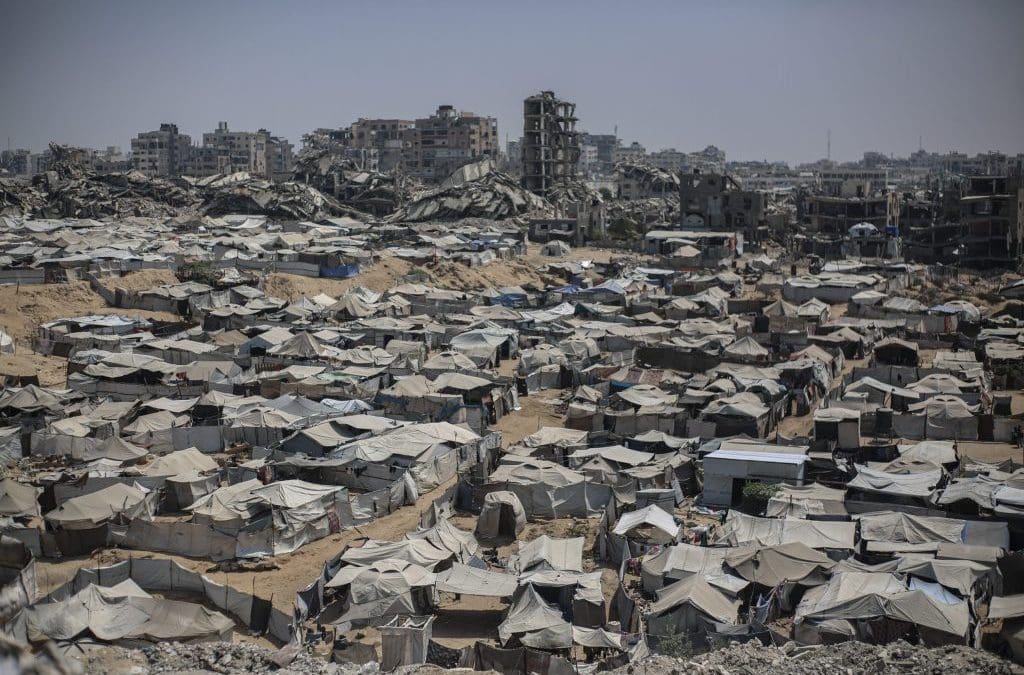
Israeli Defense Minister Israel Katz admitted this week that Israel’s goal for Gaza is the mass expulsion of Palestinians from Gaza in “every way possible,” despite denying allegations of ethnic cleansing for years.
“There is no real solution for Gaza in the end without this migration,” Katz said at a conference hosted by Israeli outlet Yedioth Ahronoth on Wednesday, per a translation by France 24. Israel “is organized and prepared to get them out — by sea, by air, by every way possible.”
This plan would amount to ethnic cleansing, something that Palestinians and human rights advocates have long said Israel is carrying out in Gaza and the occupied West Bank. In a report earlier this year, the UN Human Rights Office warned that Israel was carrying out policies consistent with ethnic cleansing between 2024 and 2025, including famine, destruction of civilian infrastructure, and overall imposing conditions “incompatible with [Palestinians’] continued existence in Gaza as a group.”
Katz said that Israel is “seeking Trump’s support” for the idea because no country will take in Palestinians without the approval of the U.S.
The White House has not commented on the plan. When Donald Trump took office last year, he proposed a plan for forced displacement of the entire population of Gaza, dubiously framing it as “voluntary.”
The administration’s stance has since evolved, however. In July, Trump’s “Board of Peace” announced a plan that would still implement colonial control over Gaza, but that would transition power over the Strip to a Palestinian board and demand Israel withdraw its troops from the Strip.
In a rare
by Stephen Prager | Sep 14, 2026 | Article, Climate, Climate Change, Climate Crisis, Economy and Inequality, EPA, Reprint, Trump
by Michael Arria | Sep 14, 2026 | Article, Iran, Iraq, Politics and Movements: International, Politics and Movements: US, Reprint, terrorism
This story originally appeared in Mondoweiss on Sep. 11, 2026. It is shared here with permission.
This week marks the 25th anniversary of the 9/11 attacks.
The United States has experienced much political and social upheaval since then, but the subsequent “War on Terror” paved the way for our current moment, and there are booming echoes of the era all around us.
Once again, the United States is waging a disastrous war in the Middle East with no discernible end in sight. Islamophobic rallies targeting NYC Mayor Zohran Mamdani conjure up memories of the “Ground Zero Mosque” controversy. The government designates activist and advocacy organizations as terrorists. The Guantánamo Bay detention camp remains open. In fact, a legal immigrant was just sent there.
CBS reveals that the Taliban seized roughly $7 billion worth of American-purchased military hardware after the United States officially lost that war 5 years ago.
“Taliban fighters patrol in armored vehicles once supplied to Afghan forces, wearing American tactical gear and carrying American weapons,” reads the report. “CBS News saw one Humvee in the Afghan capital still adorned with a faded Green Bay Packers decal — a remnant from its past operators.”
The small number of Americans who opposed that war were either dismissed or attacked. So too were those who warned that the Bush administration’s overreach would result in disaster.
“The civil libertarians were mostly ignored, and as one new threat followed another — Iraq, ISIS, ‘lone wolves’ — the president’s reach continued to grow. Across the Bush and Obama administrations, the commander in chief was given, or simply took, new powers to prosecute, shut down and seize the assets of alleged terrorist groups and their supporters,” writes Radley
by Sara Awad | Aug 14, 2026 | Article, Gaza, Israel, Palestine, Politics and Movements: International, Reprint
by Paul Messersmith-Glavin | Aug 13, 2026 | Article, Economy and Inequality, Fascism, labor, Minneapolis, Politics and Movements: US, Prisons and Policing, Reprint
This article was originally published by Truthout on Aug. 12, 2026. It is shared here under a Creative Commons (CC BY-NC-ND 4.0) license.
The U.S. government is attempting to use conspiracy charges to imprison organizers, just as it did in its war against the Black Panther Party, New Left, and other 1960s and ‘70s radicals through its counterintelligence program, COINTELPRO. Through this method, the Trump regime shares the goal of the Nixon administration of disrupting and attempting to destroy domestic opposition to its authoritarian agenda.
Two weeks after the September 2025 murder of right-wing activist Charlie Kirk, Donald Trump issued the National Security Presidential Memorandum 7 (NSPM-7), entitled “Countering Domestic Terrorism and Organized Political Violence.” The memorandum created a category of “domestic terrorist” that, while lacking legal authority, broadly includes anyone who believes in things deemed as constituting “anti-Americanism, anti-capitalism, and anti-Christianity; support for the overthrow of the United States Government; extremism on migration, race, and gender; and hostility towards those who hold traditional American views on family, religion, and morality.” NSPM-7 openly calls for “investigative” tactics designed to “disrupt” and “dismantle” political movements and organizations.
Following the recent use of conspiracy charges to successfully convict people in both the Prairieland case in Texas and the Spokane 3 case in Washington, 15 community members in the Twin Cities were indicted on June 16 for resisting the Trump administration’s December 2025 immigration crackdown dubbed “Operation Metro Surge.” According to the indictment, all defendants are identified as “members and associates of … Direct Action Minnesota (‘DAMN’),” which helped organize Minnesota’s resistance. That organization is now defunct in light of the arrests and revelations about government infiltration.
The primary charge against