by Maximillian Alvarez | May 12, 2026 | education, ICE, immigration, Podcast, Politics and Movements: US, Prisons and Policing, Working People
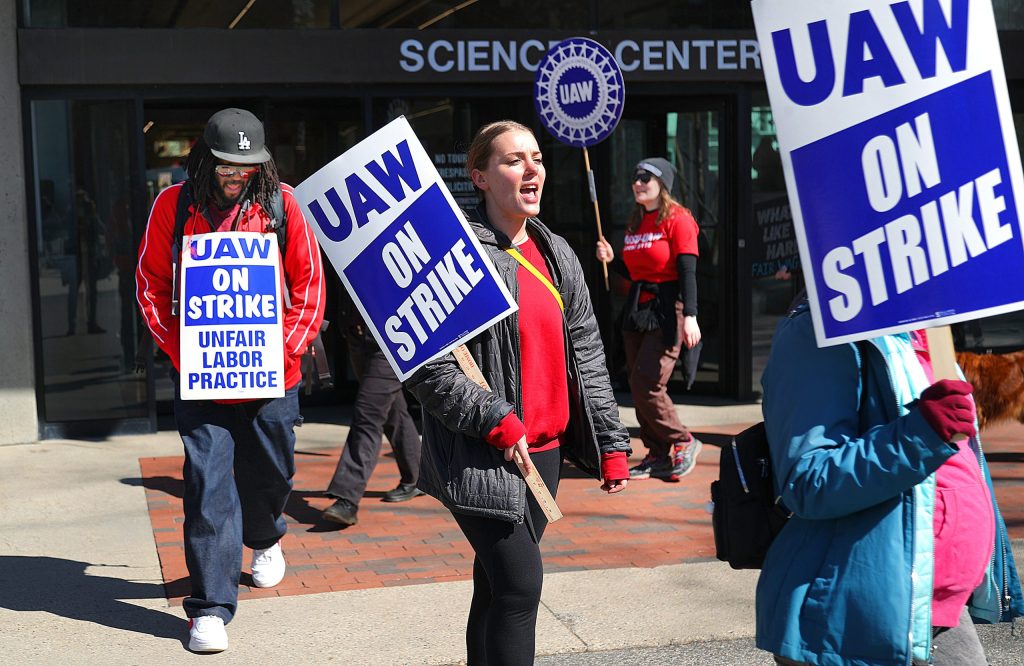
After 14 months of fruitless contract negotiations with the Harvard University administration, over 4,000 workers represented by the Harvard Graduate Students Union (HGSU-UAW Local 5118) walked off the job on an indefinite strike on April 21. According to the union, “Graduate student workers will suspend teaching and research labor until Harvard’s bargaining team takes substantive action in addressing the union’s key issues: pay that keeps pace with the rising cost of living, recourse for harassment and discrimination, support for non-citizen students, protections for academic freedom, and ‘fair share fees’ to equitably distribute the expenses of union representation, among others.” In this episode of Working People, we speak with three striking graduate student workers about the issues at the center of this strike, and about what it’s like to live, work, and strike at the country’s richest university amid political attacks from the federal government, scandals connecting high-ranking Harvard officials to Jeffrey Epstein, and a nationwide cost-of-living crisis.
Panelists include: Sara Speller, a fifth-year PhD student in the Music Department at Harvard and president of the Harvard Graduate Students Union; Zoë Feder, a seventh-year PhD student in the Biological & Biomedical Sciences program at Harvard Medical School and a research assistant in the Microbiology Department; and Jacob Wolf, a third-year PhD student and Teaching Fellow in the Harvard Graduate School of Education.
Additional links/info:
Harvard Graduate Students Union (HGSU-UAW Local 5118) website, Facebook page, X/Twitter page, TikTok, and Instagram
Harvard Graduate Students Union Strike Update/FAQ Zine
Lydialyle Gibson, Harvard Magazine, “Harvard graduate student workers strike”
Noah A. Ferris, The Harvard Crimson, “Grad students rally outside Garber’s home as strike enters third week”
Hugo C. Chiasson & Elise A.
by Taya Graham and Stephen Janis | May 8, 2026 | Article, Economy and Inequality, Inequality, Inequality Watch, Opinion, Politics and Movements: US, Prisons and Policing
The press conference for Epstein survivors we covered earlier this year felt claustrophobic.
It was the afternoon before President Donald Trump’s State of the Union address in February. The women who had suffered at the hands of the world’s most infamous predator were crammed into a small meeting room in the Cannon House Office Building in Washington, DC.
They had gathered to demand acknowledgement that evening from both Congress and the President. The venue was so tiny, there was barely room for the survivors to gather around the podium.
The assemblage stood in stark contrast to what we found in the emails we had been poring over after the Justice Department released an often-opaque database of documents gathered during several investigations of the historic sex predator.
Based on what we’ve read, Epstein and his associates inhabited a world of material and social abundance. They weren’t constrained or forced to plead for anything. Their lives were full of easily obtained wealth, which afforded plenty of space to commit crimes.
This contrast reveals what this scandal is ultimately about: not just one man’s crimes, but the unimaginable inequality that made asking for tens of millions of dollars as easy as writing a poorly worded email. In fact, all Epstein had to do to enrich himself was to ask.
Consider what Epstein sent to media mogul Mortimer Zuckerman in July of 2014:
I’m happy to hear from you, happy to see your stock at the 120 level. an increase in over 100
million in new net worth in only a few months. (how long did it take for the first 100?) I
assume, by your email, that as I predicted, you have
by Taya Graham and Stephen Janis | May 4, 2026 | Police Accountability Report, Politics and Movements: US, Prisons and Policing, video
In this episode of the Police Accountability Report we speak with Ismael Rincon, aka Corners News, of Texas, who often encounters Customs and Border Patrol while driving to pick up clients for ride share. Federal agents have now taken to stopping cars and engaging in traffic enforcement, and in his case prolonging a stop to introduce K-9 even though it was established that the driver was an American citizen. Federal agents stopping American citizens shouldn’t be a problem if they have nothing to hide, right? Unfortunately, history has taught us that allowing governmental agents more and more access to your private property, your person, and your time leads to the erosion of civil rights and often more disastrous consequences for the individual. Join us for the conversation, live chat, and discussion in the comment section on where Americans should draw the line between privacy and constitutional rights and the current imperative of law enforcement.
Credits:
Written by: Stephen Janis Produced by: Stephen Janis, Taya Graham
Transcript
The following is a rushed transcript and may contain errors. A proofread version will be made available as soon as possible.
Taya Graham:
Hello, my name is Taya Graham and welcome to the Police Accountability Report. As I always make clear, this show has a single purpose holding the politically powerful institution of policing accountable. And to do so, we don’t just focus on the bad behavior of individual cops. Instead, we examine the system that makes bad policing possible. And today, we will achieve that goal by showing you this video of Border Patrol agents illegally detaining popular Cop Watcher Coroners News. A questionable example of law enforcement overreach
by October Krausch | Apr 30, 2026 | Article, immigration, Politics and Movements: US, prison reform, Prisons and Policing, Reprint
by Marianne Dhenin | Apr 27, 2026 | Article, ICE, immigration, Politics and Movements: US, Prisons and Policing, Reprint
This article was originally published by Truthout on April 26, 2026. It is shared here under a Creative Commons (CC BY-NC-ND 4.0) license.
Grassroots coalitions in a growing number of states are working to pass legislation to cut municipal or state ties to Immigration and Customs Enforcement (ICE). The efforts are gaining momentum as the Trump administration’s mass deportation agenda throws long-standing problems with the nation’s immigration regime into sharp relief.
“We see a tremendous upswelling of this type of legislation being proposed in different states across the country,” Rebecca Sheff, a staff attorney at the American Civil Liberties Union of New Mexico, told Truthout. “I think it speaks to the moment that it’s really a time to make the most of the political willingness to take bold action in light of how aggressive ICE has become.”
Sheff helped draft New Mexico’s Immigrant Safety Act, which Gov. Michelle Lujan Grisham signed into law in February. The law prohibits state and local governments from entering into agreements to detain individuals for civil immigration violations, stops the use of public land for immigration detention, and bans agreements that turn local law enforcement into immigration agents. It will come into force in May.
Comparable laws to curb civil immigration detention are already on the books in at least half a dozen other states, including New Jersey, California, Washington, Illinois, Colorado, and Maryland. Many have been passed under the banner “Dignity, Not Detention,” following a national campaign launched in 2010 by the Detention Watch Network and hundreds of supporting organizations nationwide. California was the first to pass its Dignity, Not Detention legislation seven years later. New Mexico’s is the most recent.
Elsewhere, organizers are still hard at work on similar bills. Tania Mattos, executive director
by Julia Conley | Apr 27, 2026 | Article, government surveillance, Politics and Movements: US, Prisons and Policing, Reprint