by Michael Fox | Oct 19, 2025 | chile, Podcast, Politics and Movements: International, Prisons and Policing, Stories of Resistance, The Cultural Front
On October 18, 2019, protests erupted in Santiago, Chile, over a hike in the cost of public transportation. But the demonstrations quickly grew into more than that. Those in the streets demanded change—real change. They demanded more rights. They demanded a new Constitution.
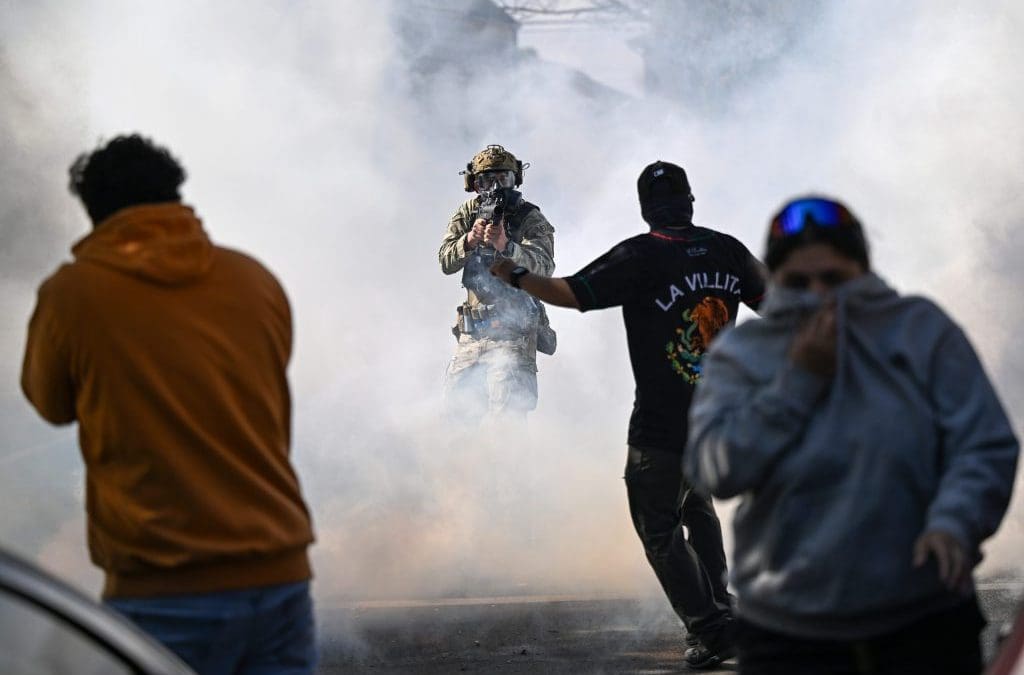
Police cracked down with impunity. Videos went viral of riot police beating people in the streets. Chemical water guns. Shooting rubber bullets at point blank range. The number of the dead and wounded skyrocketed.
Throughout the protests, which would ripple on for almost 6 months, Chilean state security forces would cause more than 400 eye injuries to protesters in the streets. Many people would never see out of those eyes again. But some of them also found each other… and began to sew their lives back together, with music.
BIG NEWS! This podcast has won Gold in this year’s Signal Awards for best history podcast! It’s a huge honor. Thank you so much to everyone who voted and supported.
And please consider signing up for the Stories of Resistance podcast feed on Spotify, Apple Podcasts, Spreaker, or wherever you listen.
And please take a moment to rate and review the podcast. A little help goes a long way.
The Real News’s legendary host Marc Steiner was in the running for best episode host, and he also won a Gold Signal Award. You can listen and subscribe to The Marc Steiner Show here on Spotify or Apple Podcasts
Please consider supporting this podcast and Michael Fox’s reporting on his Patreon account: patreon.com/mfox. There you can also see exclusive pictures, video, and interviews.
Written and produced by Michael Fox.
Resources:
Here is the YouTube channel for Hasta La Victoria
Hasta La Victoria’s Instagram Page
Camilo Galvez Bugueño Instagram page
Michael Fox’s story for The World on
by Mike Ludwig | Oct 16, 2025 | Article, ICE, Politics and Movements: US, Prisons and Policing, Reprint, Trump
This story was originally published on Truthout on Oct. 15, 2025. It is shared here under a Creative Commons (CC BY-NC-ND 4.0) license.
Wearing a high-visibility vest that said “Press,” award-winning journalist Mario Guevara was arrested in June by local law enforcement while livestreaming a “No Kings” protest against President Donald Trump in Georgia. While the charges against him were eventually dropped, Guevara was handed over to Immigrations and Customs Enforcement (ICE) despite being authorized to live and work in the United States. The Trump administration railroaded Guevara through the courts until October 3, when they deported him to El Salvador, a country he fled 20 years ago in fear for his life.
The targeting of Guevara has been widely regarded as an attack on press freedom — and a punishment for dissent. It’s also likely top of mind for some as people across the country prepare for the next round of “No Kings” protests this week. Experts say that the recent string of moves from the Trump administration is meant to criminalize political opposition and further put activists on edge — but they also urge people to stay engaged. Trump’s claims about a surge in anti-fascist political violence are false, and people across the country are developing clever ways to resist, even as the president attempts to sow mayhem in cities led by Democrats.
“Coupled with a legal concern about the very troubling expansion of an authoritarian state, it’s never going to be my legal advice to let an authoritarian do an authoritarianism,” Matthew Kellegrew, an attorney with the Civil Liberties Defense Center, told Truthout. “You can look out your window and see what Trump is saying
by Julia Conley | Oct 15, 2025 | Article, Chicago, ICE, Politics and Movements: US, Prisons and Policing, Reprint, Tech
This story originally appeared in Common Dreams on Oct. 15, 2025. It is shared here under a Creative Commons (CC BY-NC-ND 3.0) license.
Chicago residents in recent weeks have found numerous ways to resist the Trump administration’s deployment of hundreds of federal agents in its increasingly violent “Operation Midway Blitz” anti-immigration campaign—with thousands of people marching to demand armed officers leave the city, some physically intervening in arrests, and community members volunteering to patrol their neighborhoods to warn the public when agents are nearby.
But the alliance between Big Tech and the Trump administration on Tuesday interfered with efforts by more than 80,000 Chicagoland residents to show solidarity with immigrants and people of color, as Facebook suspended a community group where people have been tipping off their neighbors when they see US Immigration and Customs Enforcement (ICE) and other federal agents in public areas.
Days after far-right activist and conspiracy theorist Laura Loomer, who has gained considerable influence in the White House despite holding no formal government position, spoke out against a group called ICE Sighting-Chicagoland, Facebook parent company Meta suspended the group to stop its 84,000 members from sharing information about impending ICE raids and enforcement actions.
Loomer wrote on the social media platform X on Sunday that “Big Tech executives” such as Meta CEO Mark Zuckerberg should “use this as an opportunity to be in compliance and to support President [Donald] Trump’s immigration policies, but they aren’t.”
She said the presence of the community group was evidence of Zuckerberg’s “leftist subversion of Trump and his policies.”
Two days later, US Attorney General Pam Bondi announced that action had been taken to stop Chicago area residents from discussing the deployment of federal agents.
“Today, following outreach from the [Department of
by Shane Burley | Oct 14, 2025 | Article, ICE, Politics and Movements: US, Portland, Prisons and Policing
The crowds amassing on Portland’s South Waterfront on Sunday, Sept. 28, outside the city’s ICE processing facility, featured activists from nearly every community in the city, including volunteers handing out water and food from a mutual aid table and healthcare professionals nearby to offer onsite first-aid treatment. A cloud of tension sat over the metro region as residents waited to see exactly what President Trump’s latest pronouncement would mean.
Just one day earlier, Trump took to social media to loudly declare that he was “directing Secretary of War, Pete Hegseth, to provide all necessary Troops to protect War ravaged Portland, and any of our ICE Facilities under siege from attack by Antifa, and other domestic terrorists.” Perhaps most chillingly, Trump added that “I am also authorizing Full Force, if necessary.”
While it has remained unclear if troops would ultimately touch down in Portland, 200 National Guard troops were authorized by Hegseth into federal Title 10 service on Sept. 28.
The notion that Portland is “War ravaged” came as news to people who actually live there.
The notion that Portland is “War ravaged” came as news to people who actually live there. As residents have repeatedly pointed out, Portland is far from the war zone Fox News, Trump, and the MAGA right claim it to be. The city is not facing destructive mass demonstrations; rather, there has been a small, ongoing, largely nonviolent demonstration happening outside of the local Immigration and Customs Enforcement (ICE) facility south of downtown.
This was the 113th day of protests at this location. A permanent protest encampment was established here shortly after high-profile immigration raids and confrontations began dominating news coverage
by Mansa Musa, Taya Graham and Stephen Janis | Oct 13, 2025 | Economy and Inequality, ICE, police accountability, Politics and Movements: US, Prisons and Policing, Racial Justice, Trump, video
President Trump repeatedly promised that his mass deportation efforts would target “the worst of the worst” criminals, yet the government’s own data reveals that immigrants with no criminal record are the largest group in US immigration detention today. How can the Trump administration justify its deployment of federal agents, and even the military, to US cities based on the factually disprovable fictions that American cities are crime-ridden “war zones” overrun with criminal “illegal aliens”? To answer that, one must study the long-established precedent in the USA of overpolicing poor communities of color that are painted as inherently violent, chaotic, and crime-ridden. In this episode of Rattling the Bars, host Mansa Musa speaks with TRNN reporters Stephen Janis and Taya Graham about what the history of policing in America can teach us about Trump’s authoritarian deployment of law enforcement agencies today.
Credits:
Producer / Videographer / Post-Production: Cameron Granadino
Transcript
The following is a rushed transcript and may contain errors. A proofread version will be made available as soon as possible.
Mansa Musa:
Welcome to this edition of Rattling the Bars. I’m your host Mansa Musa. The Watts Riots, sometimes referred to as Watts Rebellion or Watts Uprising, took place in Watts neighborhood and surrounding areas of Los Angeles from August 11th and 16th from 1965. The rise was motivated by anger at racist and abusive practices of Los Angeles Police, as well as his grievances over unemployment discrimination and residential segregation of property. The backdrop of it was that they arrested our individual that they claimed didn’t pass the drunk driving test. Out of that grew a conversation about police kicking a pregnant woman. At any rate,
by Kori Skillman | Oct 9, 2025 | Article, baltimore, ICE, immigration, Politics and Movements: US, Prisons and Policing, Racial Justice, Reprint
This story originally appeared in Baltimore Beat on Oct. 07, 2025. It is shared here with permission.
Highlandtown sidewalks tell a much different story today than they did a year ago. Shops that once bustled with conversation sit emptier; families who once roamed the streets have now retreated. The day-to-day has become filled with fear under President Donald Trump’s mass deportation push, sending shockwaves through the largely Spanish-speaking neighborhood.
Both noncitizen, long-time U.S. residents L and E (whose full names Baltimore Beat is not using for their safety) are family members who are two sides of the same coin: L was already forced to leave the country; E feels imprisoned in his fear. Every glance from strangers, every passing security officer a reminder of the attention their brown skin draws.
Their parallel lives reflect a community sentiment, where daily rhythms are interrupted by immigration enforcement vans and streets become more desolate with every deportation.
Lucia Islas, a case manager at the Southeast CDC, works with a client at their office in East Baltimore on September 30. Credit: J. M. Giordano.
While L’s fight ended when she was forced to leave the country, E’s continues toward an unknown. L has walked her final moments in the United States, holding the hands of her two young children, and E could not walk beside her. In this moment in history, to get too close would be a risk to his own freedom. His life the last seven months has been characterized by living in the shadows. His heart is still heavy that he could not comfort his loved one in the way he wanted to.
L, 32, came to the