Sanitizing MLK’s legacy begins by forgetting his life outside the South

Sanitizing MLK’s legacy begins by forgetting his life outside the South

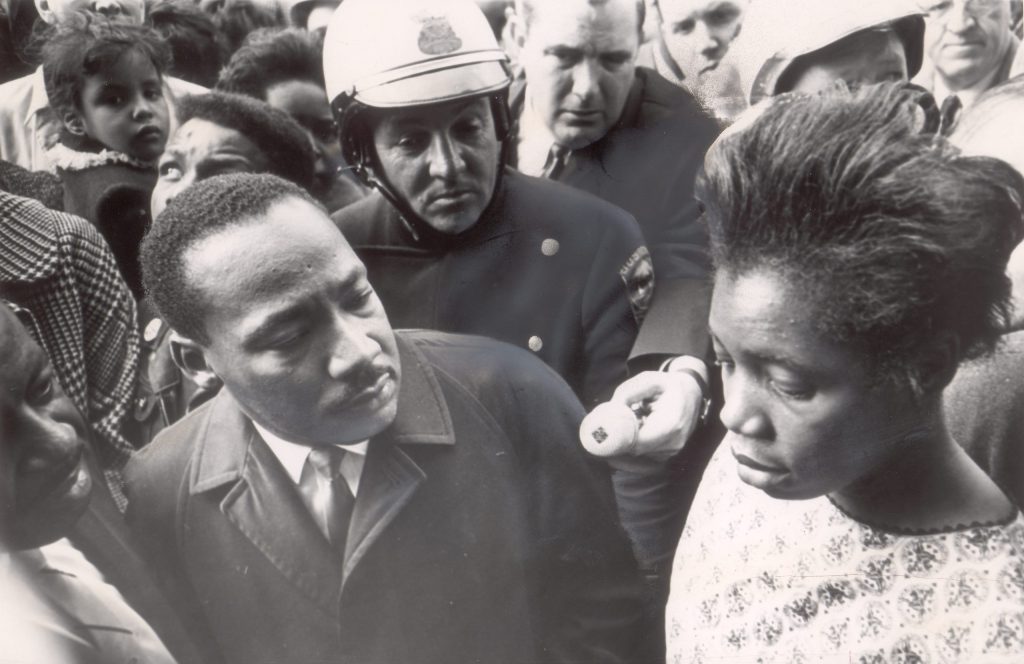
BOSTON - APRIL 22: Martin Luther King, Jr. hears complaints from Roxbury residents. Here, Mrs. Jennings, a resident of Howard Avenue, complained of cockroaches. Dr. King led a march through the city to protest segregated housing conditions and racially imbalanced schools, and spoke at Boston Common and the State House during his visit. Photo by Paul Connell/The Boston Globe via Getty Images

In our mythological retelling of the Civil Rights movement, Martin Luther King, Jr. vanquished the racist apartheid system of Jim Crow in the American South. However, in her groundbreaking new book, historian Jeanne Theoharis argues that King’s time in Boston, New York, Los Angeles, and Chicago—outside Dixie—was at the heart of his campaign for racial justice. As the book description lays out, “King of the North follows King as he crisscrosses the country from the Northeast to the West Coast, challenging school segregation, police brutality, housing segregation, and job discrimination. For these efforts, he was relentlessly attacked by white liberals, the media, and the federal government.” In this episode of The Marc Steiner Show, Marc speaks with Professor Theoharis about the MLK Americans have deliberately forgotten, and what this recovered history tells us about how to fight against injustice today.

Guest:

  • Jeanne Theoharis  is Distinguished Professor of Political Science at Brooklyn College of City University of New York. She is the author of the New York Times bestselling The Rebellious Life of Mrs. Rosa Parks and winner of the 2014 NAACP Image Award for Outstanding Literary Work Biography/Autobiography and the Letitia Woods Brown Award from the Association of Black Women Historians. Her book has been adapted into a documentary of the same name, executive produced by Soledad O’Brien for Peacock where Theoharis served as a consulting producer. Her book A More Beautiful and Terrible History: The Uses and Misuses of Civil Rights History won the 2018 Brooklyn Public Library Literary Prize in Nonfiction and was named one of the best Black history books of 2018 by Black Perspectives. Theoharis’s writing has appeared in the New York Times, the Washington Post, MSNBC, The Nation, Slate, The Atlantic, and many more. She is also the author of King of the North (The New Press) and lives in Brooklyn.

Additional resources:

Credits:

  • Producer: Rosette Sewali
  • Studio Production: David Hebden
  • Audio Post-Production: Stephen Frank
Transcript

The following is a rushed transcript and may contain errors. A proofread version will be made available as soon as possible.

Marc Steiner:

Welcome to the Marc Steiner Show here in The Real News. I’m Marc Steiner. It’s great to have you all with us. My guest today is Jean Theo Harris. She’s one of the most important and leading chronicler of the Civil Rights Movement and black power movements in our country. Our most recent book is King of the North, Martin Luther King’s Life of Struggle Outside the South. Dr. Theo Harris is a distinguished professor of political science and history at Brooklyn College and Cooney graduate school in New York, an author or co-author of 13 books and numerous articles on civil rights and black power movements and the Contemporary Politics of Race in America. And I also have to mention her amazing New York Times bestselling biography, the rebellious life of Mrs. Rosa Parks. There’s so much more to say, but if we kept up, we’d never talk to her. We’re about to have a conversation with author filmmaker Acts professor Jean Theo Harris. And so Jean, welcome. Good to have you with us. It’s been a long time. I’m glad you’re back here.

Jeanne Theoharis :

I’m glad to be back.

Marc Steiner:

So as always, we’re pumping on all cylinders. It must be something genetic in the family, but it’s great. So let me talk about the most recent book that we just mentioned about your idea of the sanitized Martin Luther King, what that means and well, let’s just start there.

Jeanne Theoharis :

I think part of the ways that we’ve sanitized King is that we’ve ized him. We’ve trapped him in the South. We’ve trapped non-violence in terms of lunch counter sit-ins and bus boycotts.

We have made him into some sort of respectability politics, kind of scolding minister, and all of these are deeply narrow and deeply inaccurate to who he was. So I think the first thing we want to remember is that Martin Luther King grows up in Atlanta, but he spends his formative coming of age years in grad school, but first in Pennsylvania at Crosier Seminary and then at Boston University getting his PhD, as does Coretta Scott. She goes to Antioch College for college, and then she goes to the New England Conservatory of Music. So fundamentally, both kings have experienced both that segregation is not a southern problem, but a national cancer. And they’ve also experienced the limits of northern liberalism at home, and they will never not know that. And so we often start the story of King in Montgomery, which is where he has his first pastorship and the Montgomery Bus boycott. But he comes into that experience with those lessons learned in Pennsylvania and Boston. Just to give you an example, when he moves to Boston, he tries to rent a place and no one will rent to him because he’s black. To give you another example, Coretta Scott goes to Antioch College in Ohio, probably the most liberal college in the nation.

Marc Steiner:

Absolutely.

Jeanne Theoharis :

Her and her sister are the first black students to go there in decades. She majors in music and elementary ed, and then all education majors, she asked Student Teach, but Antioch is located in Yellow Springs, Ohio, and Yellow Springs School Board says, no, we’re not having any black people. Student teach here. And Antioch goes along with them and she’s dumbfounded and her and her classmates are protesting the Korean War and they’re protesting all sorts of issues, and she tries to get those classmates to protest with her this policy and no one will. So she goes to the president of Antioch alone and basically protests and what they want her to do is to go student teach in a black town called Xenia, and she says, no, I am not paying for that. This is not American democracy. And I could go on with other stories. The point is that both of them have had these experiences that are going to forever shape how they see what the racial landscape of the United States is, not just the deep South and where they see the struggle is, which is again, coast to coast.

Marc Steiner:

Yeah, it’s interesting what you said is really important. People don’t realize that in that period, much of the north or the middle of the north, Ohio, Pennsylvania, where I grew up here in Baltimore, Maryland was segregated, separated

Jeanne Theoharis :

For sure.

Marc Steiner:

It wasn’t just Mississippi and Alabama.

Jeanne Theoharis :

Nope.

Marc Steiner:

And people do not realize that.

Jeanne Theoharis :

And the state or everyone from the mayor to the board of Ed to the governor is playing a role in that. It’s not just accidental or episodic segregation in New York, it’s the Board of Ed zoning schools so that some schools are almost all black and some schools are almost all white. And when those schools get overcrowded, whether it’s in New York or Chicago or la, do you know what those board of Eds do? They don’t rezone to move those black students into white schools. They go to double session days, they add trailer classrooms, they get deeply overcrowded. So I think another myth of the time is that somehow it was state sponsored in the South and more episodic or accidental or the result of personal prejudice, not sort of state action. And that’s also not

Marc Steiner:

True. Right, right. The personal prejudice. No, it’s not racism, just personal prejudice. Right. Well, I could digress into this and stay here for a long time, but let me answer this question. As someone who’s been in the media for a while and also been through the Civil Rights Movement, one of the things I think people do not get or even understand is the hostility in the way the media portrayed King and went after him, including great liberal institutions like the New York Times and more to talk a bit about that part of the world.

Jeanne Theoharis :

Yeah, I mean, I think that point is really important, and I think there’s been a tendency because the national media came to cover the Southern movement, and again, I’m talking about the Birmingham with sort of rigor and clarity that we then not scrutinized how they’re covering King, how they’re covering injustice closer to home in many ways. Part of the story I’m telling in King of the North required getting underneath a set of media narratives. The first was that segregation was sort of state sponsored in the South and not in the north. The second was that therefore the real problem of racism was in the South. The third then was southern black people were good and went for nonviolence and northern black people. And this set of media narratives, flattered, we could say northern sensibilities, and it produced wildly different coverage. If we look at how, for instance, the New York Times is covering Birmingham in 1963 versus how they cover as we were just talking about the New York City School boycott sort of the next year

And how they cover King and the kinds of criticisms that King is making of New York segregation or la. And so they tend to do a couple of things. One, for as long as they can, they minimize it. They call it alleged segregation. And they constantly use words like that in headlines. Activists alleged king alleges in ways that they don’t in the South, they tend to, as we talked about just using the New York City School boycott example, paint activists as reckless and unreasonable as hurting their own cause. In ways when we’re talking about activism, whether it’s in New York or Chicago or la and I should say when I’m using the word north, I’m using it the way King is using it and the way activists at the time are using it, and it basically means any place that thinks it’s not the South. So we’re talking the Northeast,

The Midwest, the West, and they obviously are very different in a lot of ways, but they also all take pride in, oh, we’re not the South. We don’t have that kind of racism. We’re open and tolerant. And so one of the things that I for the book is I looked at hundreds of articles from the LA Times, from the Chicago Tribune, from the Washington Post and from the New York Times to look at how they covered movements closer to home versus movements like the movement in Birmingham or what happens in Selma around voting rights versus what happens in Chicago versus what happens in la. And there was incredible discrepancy. Also, I should say the related to the myth about sort of southern black people go for non-violence and northern black people. So then the extension of that becomes after that you don’t have very much coverage of northern movements before the uprisings that happened in Harlem in 1964 and Watts, then the media discovers the problem in the north,

But in doing so, also paints northern black people as not going for nonviolence. Even though in LA in New York, there are years of movements basically calling out these issues. And that one of the things King will say over and over, I mean he will say about Watts, if you had listened, there would not have been a Watts. We have King stands with all these movements in LA in 62 and 63 and 64 against police brutality against school and housing segregation there. And then lo and behold, the LA Times is so surprised, how could we have this uprising? And King is basically calling the city to account. And it’s interesting. Then we have the mayor of LA who months earlier had given key to the city being like, you should never have come. You’re terrible when he’s talking about what needs to be happening in la. If the mayor could just stand next to King and be like, you’re great. You got a Nobel Prize, don’t talk about here. Then it’s like, we’re going to give you the key to the city. You’re always welcome. Except no, now you’re not welcome at all. And I’m being a little sassy, but that’s,

Marc Steiner:

That’s fine.

Jeanne Theoharis :

That’s the way that, so in many ways, we often talk about, and scholars like me talk about the ways that the king holiday is misused and king is stripped, but in fact, people are misusing king when he’s alive. They want to take pictures with him, but the minute he opens his mouth about their own problems, then they’re like, oh, be quiet. And the media helps to cement that narrative.

Marc Steiner:

I was thinking about what you just said a little bit ago and what you wrote about as well, about Coretta King.

Jeanne Theoharis :

Yeah,

Marc Steiner:

Because I think before we dive into other parts, I really think it’s important for people to understand who she really was

Jeanne Theoharis :

Absolutely.

Marc Steiner:

And how she was the radical not king, and how she dragged King into the radical world. I mean, let’s celebrate her for just a second.

Jeanne Theoharis :

As we were just talking about, she goes to Antioch College, gets politically involved at Antioch College, including with the Progressive Party. And people may remember the Progressive Party is a third party that gets started and they’re running a third party candidate, Henry Wallace for president in 1948, domestically on a kind of anti segregation platform, but also a kind of anti cold war. The progressive Party is bringing kind of a double challenge.

Marc Steiner:

This is 1948, as you said, it’s really important.

Jeanne Theoharis :

1948.

Marc Steiner:

48, right, right.

Jeanne Theoharis :

And she is supporting Henry Wallace for President 1948, and she is one of about 150 black people who go to the Progressive Party convention in Philadelphia. It is through her progressive party activism and work that she meets Bayard Rustin and Paul Robeson.

So I would like to say this very clearly, Coretta Scott King meets Paul Robeson meets Bayard Rustin long before Martin Luther King does, and long before she meets Martin Luther King. So she goes to Antioch and then she goes to New England Conservatory of Music for vocal education. And through a friend she meets Martin Luther King. And at first she’s very, she’s not sure she even is interested in a date. Most of the ministers she knows, and this is her words, are kind of about suits and sanctimony. They don’t have the kind of vision of Christian social responsibility. I mean, make no mistake, Coretta Scott King is a deep Christian, but for her, Christianity is how you live your life and the ways you practice that in the world. But she agrees to a date. And Martin Luther King, who is again getting his PhD at BU is smitten after that first date.

Right? He’s never met someone like her. They talk about racism and capitalism on their first date. Right? Good first date is at the end of the day, he says, you have everything I want in wife. Right? You’re beautiful, you’re smart, you’re thoughtful. And she’s like, you don’t even know me. So one of the things is that she is going to expand and kind of take many of the things that he is thinking and feeling and help those to grow. Many people talk about King going to be you, and that the influence that Howard Thurman absolutely has on king’s kind of growing, we might call liberation,

Marc Steiner:

Who’s a great radical black philosopher, if you will. Right, exactly.

Jeanne Theoharis :

He studies, and this is one of King’s mentors at BU and helps King find a kind of liberation theology, a black liberation theology, black social gospel, because we want to remember that King growing up didn’t think he wanted to be a minister because he found his father’s ministry both too emotional and too otherworldly, too materialistic, not in this world. And it is through his mentors at Morehouse and also his mentors at Crosier and bu. And again, Howard Thurman plays a big role in this that he begins to see this possibility for a ministry grounded in social justice. But another person who makes that vision a reality is Coretta Scott because she is living this kind of grounded Christianity that he also is wanting they date for a while. It takes her a while to decide on him. She’s worried that he’s marrying a minister, will make her small.

Her friends are worried. What if he doesn’t amount to anything? But she’s very impressed by his vision, by the ways that he has this drive to have this kind of socially committed ministry. And so ultimately she agrees to marry him. And just to give you a sense, they get married in June of 1953. She refuses to wear white. She does not wear a long dress. She wears a T length light blue dress in 1953 where this is not 1963, this is not 1973. This is not 1993. And she makes her very imposing father-in-law take obey out of the vows because she says it makes her feel like an indentured servant. This is Martin Luther King’s beloved, and I think seeing kind of the fullness of her politics and her spirit, and this is who Dr. King sort of Marys, I think also speaks to maybe different or bigger sense of who Martin Luther King is too.

Marc Steiner:

Yeah. I think that as you’re write about, I mean that Martin Luther King credits Coretta Scott King with making him the radical that he is, that changing his worldview

Jeanne Theoharis :

Because of the progressive party, the triple evils that we associate with kings last year, right. Racism, poverty, militarism,

Those she comes in with and she has that global vision and very much, one of the issues she really focuses on in the late fifties and early sixties is kind of global peace and anti-colonialism. She will be active in the anti-nuclear movement in the United States in 1962. She will go to Geneva with Women’s Strike for Peace to a 17 member Decir men conference trying to get the United States and the Soviet Union to sign a nuclear test ban treaty. And then when he gets the Nobel Prize in 1964, she really sees this as a broadened responsibility for him and for her to the world. And she begins to push him to come out against US involvement in Vietnam. And from 1965 on, she is publicly out against the war in Vietnam. She’s the only woman who speaks at a big rally at one of the big first rallies at Madison Square Garden in 1965. A reporter asks Dr. King afterwards sort of remarking on this, did you educate her? And he says, no, she educated me. So I mean, Reta Scott King is really, as both of them would say, the family leader around issues of kind of global peace. So in many ways, he leads on some issues, she leads on some issues, but I think we want to see that as a political partnership.

Marc Steiner:

So I want to talk a bit about as we bring this into the century we’re in today, that there’s been an effort of powerful effort to sanitize Martin Luther King to fit into this. I have a dream speech and that’s it. And to Deradicalize King to not make him a confrontational leader that he was.

Jeanne Theoharis :

Yeah.

Marc Steiner:

Talk a bit about that in terms of your analysis of how that happened, why that happened, and how we have pushed against that.

Jeanne Theoharis :

So I think all sorts of people misuse King Republicans as well as Democrats. And I think for our purposes today, I think we want to focus on the ways that liberals and moderates misuse him.

Because I think it’s sometimes easier to see, oh, when the FBI tweets out on Martin Luther King Day, were remembering Martin Luther King. There’s sort of something so absurd about it that we can just recognize that. But I think one of the things we’ve seen over and over from the beginning of Black Lives Matter more than a decade ago around the pro-Palestine demonstrations around anti-ice demonstrations that Dr. King tends to get rolled out to tell young activists, you’re not doing it the right way. You need to be less angry. You need to be less confrontational. You need to wear a suit. And I think that really misses both who Dr. King was and what a kind of politics of disruption he and many in the movement with him pursued and the kinds of criticisms they got for it. I think now we look back and whether we’re looking at the Montgomery Bus Boycott or whether we’re looking at the New York City School boycott in 1964, which was the biggest civil rights protest of the era happens in New York City,

And we assume, oh, we would’ve been with that. And in fact, many, many people, the national NAACP for instance, does not support the Montgomery Bus boycott, does not support that economic tactic at the time. They do support the legal case, but not the boycott. If we take the New York City School boycott the New York Times, who had been praising and reporting very seriously on King’s work in Birmingham, and we will see this with the Washington Post, we will see this with the LA Times. We will see this with the Chicago Tribune when the work gets closer to home, as King would say, as long as I was safe from them in the South, many of these national news outlets sort of covered the emerging Southern movement with rigor, with substance. They didn’t take public officials words verbatim. And then you get to New York, you get to Chicago, and that’s very different. So these are troublemakers, this is reckless. The New York Times, we’ll call the New York City School boycott, unreasonable, reckless, violent, in part because it’s disruptive in part because it’s meant to cost the city and state money. And so I think part of Southern King is also constraining what we see his non-violence to be about.

So we pacify it. Non-violence was about school boycotts. It was about rent strikes, it was about tenant unions and welfare unions. It was about disrupting the comforts of injustice because one of the key things that we can see him saying from Montgomery till the end of his life is that injustice is comfortable to too many people. The status quo works. And so in order to change that, you have to disrupt that and make people uncomfortable. Similar to what, again, black Lives Matter, the pro Palestine demonstrations, the anti-ice demonstrations, the notion that you have to disrupt. But I think we’ve taken that sense of disrupting injustice out of how we understand Dr. King. I think we’ve pitted him against young people. Some of my favorite stuff in the book is in Chicago. So in the mid sixties, king in the SELC join a huge movement in Chicago and help to expand that movement.

But that movement has been organizing for years to take on housing segregation, to take on the conditions in Chicago slums to take on economic inequality and job discrimination, to take on city negligence and public services, all these, and one of the things that King does in 1966 is he spends hundreds of hours working with gang members and sees in them real leadership potential, real organizing potential. And this is not just like pull your pants up, kind of talk. This is serious long conversations about how to take on the political economy of Chicago. And these gang members, these gang leaders who worked with King talked about, they didn’t agree on everything, but as the head of the Vice, Lord said, you couldn’t help but fall in love with him. But that’s not an image we have of King spending hours and hours with gang members and developing their leadership in the movements in Chicago, again, around unequal housing and unequal jobs.

Marc Steiner:

It was a period that people actually need to know more about. We come back and do a longer piece on that alone just as a lesson. I mean, it’s when that was happening, I was allied with the Young Patriots, which was the white gang of Appalachian whites, and they were in this Rainbow coalition. People don’t even realize how powerful that was at that moment. And so I say that now to think about what all of this teaches us about and how it talks to us about where we are today with Palestine, the struggle that’s going on in Palestine with this kind of neo right takeover of the United States and what King did to confront and others to end segregation and to fight against racism and to open America up. How do those things talk to us about this moment that we face right now?

Jeanne Theoharis :

I mean, I think some of the lessons that I draw both from Dr. King and Credit Scott King and also from Rosa Parks, is the ways that we’ve somehow made the Civil Rights movement seem obvious when in fact, part of the genius of people like Rosa Parks, like the Kings is their ability to move without having a clear sign that it’s going to do anything. I think we often get trapped today in trying to figure out what will be effective. And obviously those conversations are important, but I think we miss that part of what the Civil Rights Movement teaches us. Part of what looking at Dr. King’s life teaches us is that you try a bunch of things, you’re going at it a bunch of ways and you lose a lot, and that you can’t kind of measure what you’re going to do on some sort of sureness or some sort of calculation that it will work. Because in some sense, part of what, and I’m going to use Rosa Parks here, the summer before Rosa Parks makes her bus stand, she goes to Highlander Folk School. Highlander is an adult organizer training school in Tennessee at the time,

Marc Steiner:

Multiracial radical school

Jeanne Theoharis :

Multiracial radical. It really lifts her spirits. She goes to a two week workshop around implementing school desegregation in 1955, and yet on the last day, they do the go wrong. What are you going to do when you get home? And she says, there’s never going to be a mass movement in Montgomery. And so I’m going to keep working with the young people. And people like Rosa Parks, people like Dr. King we’re very worried about, could you ever get people to unite? Could you ever get a mass movement given the level of fear, given the level of reprisals, given the kind of class divisions. And yet when the Women’s Political Council decides to call for a boycott that day, the kings, they get up at 5:00 AM they’re hoping it’s going to work, and then they see the buses and it has, and that changes what’s Im imaginable. And so that one day boycott, and no one wants to speak at that mass meeting that night, none of the ministers, and Edie Nixon, who’s a longtime organizer, basically is trying to shame the ministers and being like, you guys are all cowards. And Dr. King’s like, I’m not a coward. And so basically, he volunteers to speak at the mass meeting that nobody wants to speak at because nobody, and it’s that night, that first night that the community feeling the power of that first day decides to change that one day boycott into an indefinite boycott.

So in many ways, I think that the second lesson here, besides what you don’t know, what’s going to work, is that being in motion expands what’s possible. So that night it’s like, okay, we’re going to do this indefinitely. Then six weeks in the King’s House gets bombed. Coretta and their baby two month old baby Yolanda are home. And Coretta thankfully gets them both out safely. But guess what? Both their dads show up that night and they’re like, oh no, you’re not being in this house with a baby having this happen. All of us can imagine this, right? Both dads. And she’s like, we’re not going anywhere. I’m not leaving. They want them all to leave, and if Martin’s going to be too stubborn, then Cor and the baby have to leave because we can’t have the baby under these conditions. And she’s like, no. And so that decision will then change the scope of the movement again, because in some ways what that bomb was intended to do was to try a different tactic to sort of unsettle or shorten the movement. And she was like, no, we’re not going anywhere. And I think the third thing is that they’re scared. And I think we forget this.

I think there’s a way, particularly with King, where it just seems like he’s built from different material. And in some ways, most of us don’t have those eloquent abilities to kind of draw the metaphors that he can. But he’s terrified that first night when he goes to speak, he’s shaking. He may have had a panic attack. I mean, he was terrified. They’re terrified. And I think the third thing to learn from them is part of what they are able to do is to be scared and to move. Anyways. So I think that’s the third thing is that sometimes the way that the civil rights movement appears in movies is like you’re scared, but then you have some sort of revelation and then you’re not scared. And that’s not true.

Marc Steiner:

No.

Jeanne Theoharis :

And so learning how to both acknowledge the fear and to move with the fear, I think is another lesson for us today, because it’s not going to not be scary, and they’re not going to not be costs.

Marc Steiner:

And what you’re saying is absolutely correct. I mean, in those days, I was terrified every second of every moment of every day we were in the Civil Rights movement that I could be killed, tortured. We were all terrified. But you didn’t stop,

Jeanne Theoharis :

Right.

Marc Steiner:

So what does that say about we are facing, I think in this country at this moment, we’re on a precipice and a very dangerous place. Everything that people think about America could be turned upside down. You’ve seen the repression across the country, immigrants being rounded up, people trying to defend immigrants being rounded up, and it is beyond that. So you’re seeing this massive push. So I’m wondering from your perspective as historian, as an activist as well, what those moments that you study write about, share with us, say to us now about what we face, what the Palestinians face, what black people face in America, what Americans face with this right wing growth, that’s a reaction to everything we fought for and changed. So what does it say to us now? What does it say to you?

Jeanne Theoharis :

I think one of the other things it says to me is that courage begets courage. So if we take the snapshot of Rosa Parks on the bus or we take a snapshot of King deciding, okay, I will speak at that mass meeting tonight, even though no one wants to, then it’s terrifying, then you’re alone. But I think what we then see the next day is, okay, nobody stands up on the bus with Rosa Parks, but that Monday she’s terrified that they’ve called this boycott for that Monday and nobody’s going to do it. And then they do. One of I think, the greatest gifts and getting to sort of spend many years studying Dr. King, that I think perhaps his greatest gift is that his courage made people feel their own courage.

It wasn’t just that he was incredibly eloquent. It was that in his actions, people found their own actions. So I think one of the other lessons that I take is the ways that stepping forward both opens up possibilities, but also that other people, and maybe it’s not as many as we would want at first, but that I think it also provides a path for other people to step forward too. And so even if it feels, oh, our numbers are so small, I think the perspective of history is that our heroes keep stepping forward and then the numbers get bigger. And so I think that’s one lesson I take. I think another lesson I take is the ways that they’re learning and listening. And I think that’s not often a word we think about with Dr. King. We’re so used to seeing him on the podium. But so many people talk about Dr. King being a good listener.

And I think that’s another skill for this moment is sitting there is hearing what people need so that then we can craft a way forward together and to kind of keep expanding how in some ways, if we look at the ways, if we’re thinking about Chicago and the Poor People’s Campaign, this kind of bringing in more people and bringing in more people. And one of the things that the Kings do very well is from the bus boycott on, they’re meeting people around the country who are doing the work, and then they keep bringing them in. And so some of those gang members I was talking about, when King goes down to Mississippi to take part in the Meredith march, he brings some of those gang members with him. He brings some of the Puerto Rican organizers in New York that he’d been working with down there too. So then we get to the Poor People’s campaign and there’s people from all around the country. So I think that sense of listening and of expanding,

Marc Steiner:

I know we have to close out here. I wonder for you and your thinking and yourself and what your books say if there is hope in that, in terms of confronting what we face today, whether it’s Palestine Israel, or whether it’s the repression taking place in the cities throughout America right now, rounding up immigrants, I mean the right wing push.

Jeanne Theoharis :

So I think it’s both gives me kind of soberness and hope. When you look at the history of the civil rights movement, you look at kind of how these movements in the North are treated and Dr. King is treated in the north. I think it’s a reminder that our activism is not necessarily going to be praised in the moment. And I think that’s another myth. This notion that you shine a light on injustice. This is George Bush’s take on Rosa Parks. She shined a light on injustice and then injustice was changed. That would be nice. That’s not how it really works. And so I think remembering that the kinds of criticisms that we get, that we’re being unreasonable, that we’re being troublemakers, the ways that it feels lonely, we stand on many shoulders who have felt that same way and who have had those very same criticisms. Even though now today, all those people are like, “Oh yeah, I would’ve been with King…”

Marc Steiner:

Right.

Jeanne Theoharis :

So I think that’s sobering. I think what’s hopeful is the ways one of King’s other, in my opinion, greatest gifts is his ability. I was talking about this kind of expanding, but that one of the things that he does is when faced with pressure, he doubles down. And I think that’s a lesson for us too, because I think sometimes it’s so dispiriting. It’s like, this isn’t working. We don’t have the numbers. And then I think taking that lesson that instead of shrinking or getting smaller, we go deeper and we go harder, and that we stand on shoulders like Dr. King’s when we do so. Because I think going back to where we started this conversation, I think one of the worst things about the ways that King is sanitized and lobbed at activists today is that those shoulders are taken from us.

When I was doing the research on Rosa Parks, I came upon some of her notes, speech notes during the boycott, and she’s talking about how she’s reading about Mary McLeod Bethune and she’s reading about Sojourner Truth that our heroes also needed to stand on shoulders, right? There was tremendous kind of sustenance to learning that people had gone before them. And so to me, one of the real dangers in the way that King is kind of turned into this respectability politics, just be nice and wear a suit kind of guy, is that it takes him from us and from this generation of activists when again, as you’re saying, we need him more than ever. We need this. Which is not to say we’re going to do it exactly the same way, but again, many of the lessons, tenant unions, rent strikes, blocking traffic, all these things are techniques that King and friends are using.

Marc Steiner:

It’s always a pleasure to talk to you, and I really will link to all the work you’ve been doing to people get this new book about King of the North and really kind of dive into it. Maybe we’ll have another conversation about that specifically someday soon. And I want to thank you so much for taking the time for all of our listeners here at The Real News and being part of the program today.

Jeanne Theoharis :

Thank you so much for having me.

Marc Steiner:

Once again, I want to thank Dr. Jean Theo Harris for joining us today, and we’ll be looking to her work here on this site. And thanks to David Hebdon for running the program today, audio editor Stephen Frank for working his magic rosette, so for producing the Mark Steiner show and putting up with me and the tireless Keller of our Making it All Work behind the scenes. And everyone here at Real News will making this show possible. So please let me know what you thought about, what you heard today, what you’d like us to cover. Just write to me at ss@therealnews.com and I’ll get right back to you. Once again, thank you Jean o’ Harris for joining us today. So for the crew here through Real News, I’m Marc Steiner. Stay involved. Keep listening, and take care.

Original

Nearly 100 (and counting) dead as Israel launches large-scale ground invasion of Gaza City

Nearly 100 (and counting) dead as Israel launches large-scale ground invasion of Gaza City

11-year-old Palestinian Marah Haddad, who is trapped under rubble after an Israeli strike targeted a residential area in Sheva Square, is rescued by civil defense teams after nearly 10 hours of efforts and transferred to the Baptist Hospital for treatment on September 16, 2025, in Gaza City, Gaza. Photo by Khames Alrefi/Anadolu via Getty Images
Common Dreams Logo

This story originally appeared in Common Dreams on Sept. 16, 2025 . It is shared here under a Creative Commons (CC BY-NC-ND 3.0) license.

The Jewish-led rights group IfNotNow was among those condemning Israel’s ground invasion of Gaza  City on Tuesday, warning  that the Israel  Defense Forces have left more than 1 million people in the northern city and its surrounding towns with an “impossible choice”: “flee once more without anywhere safe to go or face indiscriminate bombs and bullets from Israeli forces.”

At least 91 people  in Gaza City were killed by the latter on Tuesday as two divisions of the IDF launch ground attacks across the city, with a third expected to join them in the coming days.

Israeli forces have ordered people in the city to leave for the so-called “humanitarian zone” of al-Mawasi in the south, but the area has also been bombarded repeatedly—including an attack  two weeks ago, when eight children as young as 3 years old were killed while lining up for water, according to the United Nations Children’s Fund (UNICEF).

The Israeli government last month approved  the takeover of Gaza City, with the aim of taking control of all of Gaza and ethnically cleansing the entire exclave, and since then about 150,000 people have been forced  to flee south while the IDF has stepped up  aerial and artillery attacks, destroying whole neighborhoods.

At Al Jazeera on Tuesday, Tareq Abu Azzoum described  “relentless bombardment from military operations that are leaving the landscape completely uninhabitable” in Gaza City.

“The Israeli military has deployed different military tactics to force people to leave Gaza City to the south—most notably excessive firepower, seen in the deliberate destruction of high-rise buildings,” said Abu Azzoum.

“It is inhumane to expect nearly half a million children battered and traumatized by over 700 days of unrelenting conflict to flee one hellscape to end up in another.”

Israeli human rights groups including the Association for Civil Rights in Israel and Physicians for Human Rights called on  officials to lift the mass evacuation order and said it constitutes ethnic cleansing and forced displacement.

Tess Ingram, a spokesperson for UNICEF, said  the mass displacement of families is a “deadly threat for the most vulnerable.”

“It is inhumane to expect nearly half a million children battered and traumatized by over 700 days of unrelenting conflict to flee one hellscape to end up in another,” she said, adding that the IDF’s escalation in Gaza City forced nutrition centers in the city to shut down this week, “cutting off children from a third of the remaining treatment sites that can save their lives.”

Abu Azzoum described  “tragically consistent” scenes of Palestinians—almost 70,000 in the past few days—loading whatever belongings they have left into vehicles and donkey carts to flee their homes:

Many people said in the initial days of the ground operation that they would not leave Gaza City. But, right now, Israel is burning the ground. They’re destroying every kind of civilian infrastructure and have cut off aid deliveries to the city, all for one clear purpose—to relocate them into the southern part of Gaza.

Some people are unable to afford the cost of transportation. We see exhausted faces, mothers carrying their babies, elderly people on foot.

What is so devastating to see is the vulnerability of children who have lost their parents and found themselves on the move again. They’re struggling to find any patch of land where they can stay in the absence of their parents and are completely reliant on strangers to survive.

At IfNotNow, executive director Morriah Kaplan called  the ground assault on Gaza City “a chillul hashem, a desecration of God’s name.”

“With just days until Rosh Hashanah, we watch in horror as the Israeli military bombs and invades Gaza City, putting the lives of hundreds of thousands of Palestinians in mortal danger,” said Kaplan, adding that the invasion “spells almost certain death for the remaining hostages” who were kidnapped by Hamas from Israel on October 7, 2023.

“The Israeli government’s willingness to sacrifice their own citizens to continue its campaign of destruction is devastatingly clear,” said Kaplan. “It is critical that we say loudly and unequivocally: This invasion won’t make a single Jew anywhere in the world safer.”

She called on international funders of the Israeli military—including the largest, the United States—to take immediate action to stop Israel’s assault on Gaza, which a United Nations commission said  Tuesday is a genocide.

“The only way to halt this devastation,” said Kaplan, “is to end the flow of weapons that Israel relies on to fuel its genocide.”

Original

The real reason Donald Trump can’t escape the Epstein scandal

The real reason Donald Trump can’t escape the Epstein scandal

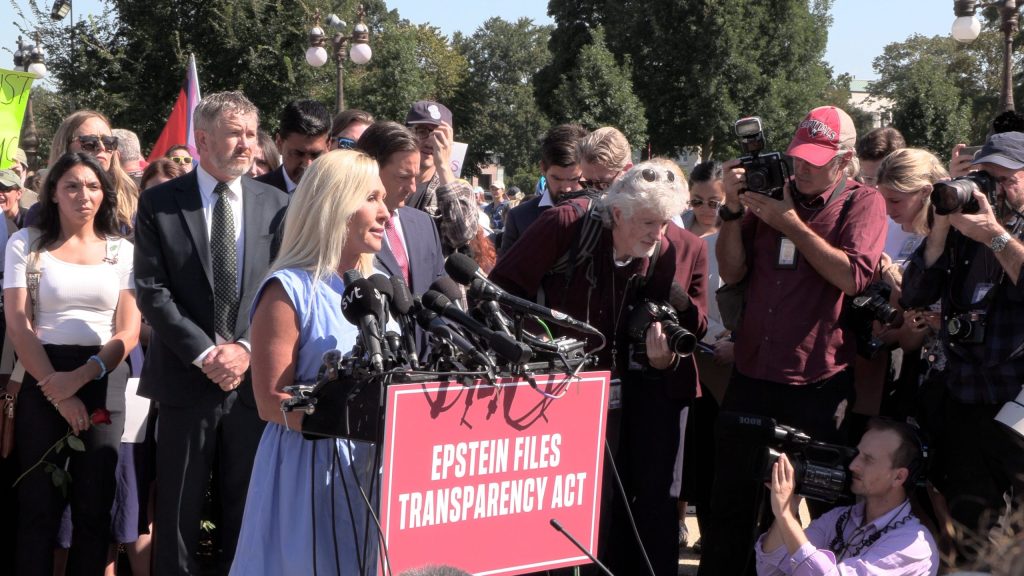
Marjorie Taylor Greene speaks at a press conference, held on Sept. 3, 2025, by Congressmen Ro Khanna and Thomas Massie, to hear statements from Epstein survivors. Photo by Stephen Janis.

Last week on Capitol Hill, a press conference unfolded unlike any other. Victims of sexual abuse by the wealthy and powerful stepped forward to share their stories—some for the first time. Their voices cut through the usual political noise, revealing decades of manipulation and violation by Jeffrey Epstein.

The event drew a crowd of chanting protesters and reporters, but amid the chaos, one fact stood out: the Epstein scandal continues to grow, and Donald Trump’s attempts to silence it are failing.

That became clear when Marjorie Taylor Greene, a staunch Trump loyalist, unexpectedly appeared to support a discharge petition that seeks to force the House to subpoena the Justice Department for all files related to Epstein’s crimes. Greene’s attendance wasn’t announced beforehand, but her presence signals to Trump’s detractors that there are limits to his control over his MAGA supporters.

Trump has tried to suppress the scandal. The Justice Department re-released already public documents to conservative influencers, drawing ridicule. The administration sought access to grand jury transcripts from Epstein’s 2019 indictment—a request a judge denied, as expected. And Trump dismissed the entire controversy as “a Democratic hoax.”

Unlike many elites who have bowed to Trump’s authoritarianism, these survivors are holding him accountable.

But victims disagree . “This is not a hoax, and it’s not going away,” said Epstein survivor Marina Lacerda.

Trump’s struggles reveal the limits of his usual tactics. His strategy—harnessing the anger caused by inequality to deflect blame—has faltered here. To understand why, we must look beyond Epstein as a predator to examine the system that protected him.

Documents recently released from Epstein’s estate expose the extent of his aristocratic immunity. In a 2008 plea deal, prosecutors agreed not to charge his alleged co-conspirators and gave Epstein a list of victims who had come forward—a list that victims describe as a “hit list,” provided by law enforcement.

Compare this leniency to Jean Roussel Eloi , a man convicted of internet solicitation of a minor in the same jurisdiction received 30 years in federal prison. Epstein, after pleading to state charges of procuring a person under 18 for prostitution and solicitation of prostitution, served just 13 months in a private wing of a minimum-security jail, working in his upscale office during the day—and allegedly receiving female visitors.

This deference to wealth echoes the broader inequalities that helped propel Trump’s rise. For nearly a decade, Trump has exploited economic anxiety by casting opponents and institutions as characters in his own reality show. Like on The Apprentice, he “fires” his targets, blaming them for a rigged economy.

This inequality theater taps into real grievances: medical debt drives 60% of personal bankruptcies; middle-class wages have stagnated; and since 1975, $89 trillion has shifted from lower earners to the top 1%.

Ironically, Trump has wielded the very inequalities he helped deepen. America’s failures in healthcare, housing, and justice have created a frustrated electorate eager to blame someone. Trump has redirected that anger away from himself—until now.

The Epstein scandal has flipped the script. Salacious photos, videos, and even a birthday card allegedly sent by Trump to Epstein have placed Trump on the wrong side of the story. The victims are now directing the narrative.

That’s why their stories matter. Their painful testimonies expose the consequences of inequality upheld by Trump, Epstein, and other billionaires. Unlike many elites who have bowed to Trump’s authoritarianism, these survivors are holding him accountable.

The question remains: who will speak out next?

Original

‘We’ve got four public prisons and one private prison closed’: CA abolitionist coalition takes on the prison-industrial complex

‘We’ve got four public prisons and one private prison closed’: CA abolitionist coalition takes on the prison-industrial complex

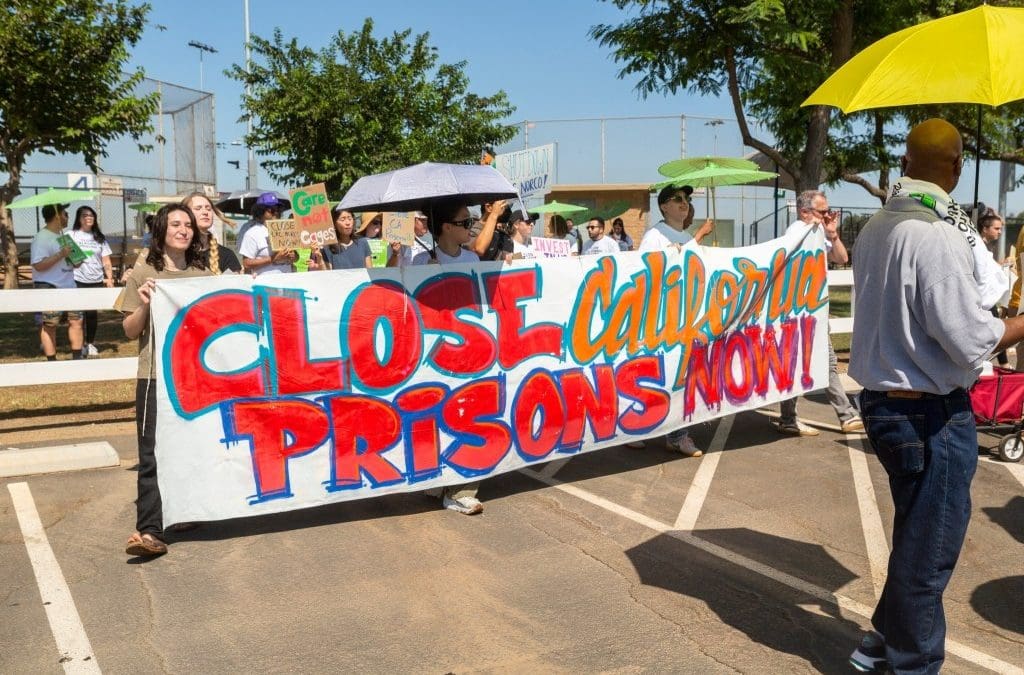
After years of pressure from community members and a coalition of over 80 organizations, the California Department of Corrections and Rehabilitation has announced plans to close the infamous California Rehabilitation Center in Norco, CA, by the fall of 2026. But organizers say this is just the beginning—they are fighting to close more prisons in California and prevent the government from re-opening shuttered facilities for immigrant detention. In this episode of Rattling the Bars, host Mansa Musa speaks with Woods Ervin of the grassroots organization Critical Resistance about California’s prison system and the growing abolitionist movement working to dismantle it.

Guest:

  • Woods Ervin is the National Co-Director of Campaigns and Projects at Critical Resistance, a national grassroots organization seeking to build an international movement to end the prison-industrial complex.

Additional links/info:

Credits:
Producer / Videographer / Post-Production: Cameron Granadino

Transcript

The following is a rushed transcript and may contain errors. A proofread version will be made available as soon as possible.

Mansa Musa:

Welcome to this edition of Rattling the Bars. I’m your host, Mansa Musa. Today we are discussing California’s prison system and the abolition movement working to dismantle it. Joining me today is Woods Ervin. She’s the National Co-Director for Campaigns and Projects at Critical Resistance, an organization founded in the mid 1990s with the mission of ending the use of prisons and police. Woods, thank you so much for joining me today.

Woods Ervin:

Thank you so much for having me today, Mansa. I appreciate it.

Mansa Musa:

Recently the California Department of Correction and Rehabilitation announced that the California Rehabilitation Center or CRC in Norco will close in the fall of 2026. Now, CIC is known for the most inhumane conditions as it relate to road infested unsafe drinking water, severe overcrowding, stifling heat and violence at the hands of the staff. Can you walk us through how this came about and were there any unlikely alliances that emerged in the fight to close prisons that people might learn from when building coalitions?

Woods Ervin:

Thank you so much. So that’s a really great question. So just to take us back a little bit to 2020, Critical Resistance joined a campaign, a coalition that was leading a campaign to close 10 prisons by 2025, feeling ambitious, it was 20. And the coalition is actually in an alliance. The California is United for Responsible Budget.

And at the time around 2020, we heard from the legislative analyst office, which is a bipartisan research office within the California state infrastructure that at the very least five prisons could close without impacting the imprison population. Just with all of the work that we’ve been doing to get people out of prison over the last decade, the population had gotten to that point. So we launched this campaign and had moved a few prisons towards closure, but we were focusing on the person who had the decision making power ultimately, which was Governor Newsom. And he was just making choices around whatever prison he saw fit to close, I think in relationship to or talking to CDCR, but not necessarily to us. And so even though we knew that Gut Newsom does have the final say in whether or not our prison closes, we also thought that everyday people should also get a say in how dollars are spent.

So we decided to engage in a site fight just to sort of test our power, our ability to be able to name a prison and then have that prison get shut down. So when we first started the campaign, it was based in what we called the People’s Plan for Prison Closure, which was a research project that Curb did back in 2019 or 2028 where they interviewed hundreds of imprison people across the state. What were the prisons that were most toxic? And given everything you listed initially, clearly CRC Norco was one of the prisons at the top of that list. So we pulled 10 prisons and we were just like between people inside wanting the prison to close. And we had heard that there were pushes from the city council and the mayor to close the prison as well. And we thought that might be good conditions for trying out focusing on CRC Norco to get it to close.

So we did the sort of, I think some of the usual things around grassroots organizing where we, and agitated our base of supporters to send the governor letters for closure or advocating for closure. We did also engage in mobilizations to CRC Norco as direct action and also we organized with interfaith movements. So a bunch of churches from across the state that would mobilize to Norco, they did a pilgrimage of the direct action as well to show their opposition to Norco support for people inside and the desire for it to close. But we didn’t want to stop there. We did some organizing outside of the prison, which looked like what we call parking lot outreach days. So with the goal of organizing the families of people

Mansa Musa:

And not to cut you off and that was onsite at the institutions. When you say pa, alright, go ahead. That’s

Woods Ervin:

Every weekend when folks would visit their family members inside we would have a table with food and water and iceman outside. And so the goal was to one, just generally support family members of people who were in CRC Norco and then also to let them know about the campaign to encourage them to join if they were interested in doing so. And we were hoping to also then set the groundwork so that if we did win the closure of CRC Norco, then we would be prepared to mobilize with family members on that. Right,

Mansa Musa:

Right. And you just described organizing 1 0 1 in terms of going where the people are because as you said, y’all got this strategy to close it. But now we looking at conditions that shifted in this country in the interim of what you just said, the mentality has shifted. Now we have the raise on people, rounding people up, ice rate rounding people up because they’re now United States citizens. So we see that. How are y’all looking at alright, the close of these prisons and not allowing them to become a repurposed for federal detention and ice? Is that a part of y’all plan? Because Governor Gavin Newsome signed AB 1 37 to prevent ICE from acquiring closed facilities. Has this legislation been effective in stopping the federal government from taking over sites like FCI, Dublin and Chaco Walla Valley State Prison?

Woods Ervin:

Right on. So we’re definitely excited to have been able to push for AB 1 37 to get passed and that to include some of the language that would allow for prisons that we get closed to not be able to be sold to the federal government. Just like you were saying, 2020 when we started the campaign, it was a different moment when we knew in the fall of last year when Trump got elected and was spouting all the anti-immigrant rhetoric that we needed to get ahead of the issue with prisons being converted to detention centers. So the legislation AB 1 37 currently says that the state has to name a building as excess to fall into the status of not being sold. And while that is one step forward, that does then bring about a lot of challenges in terms of it’s implemented, right? So what the prisons you were speaking to Chuck Wall Valley State Prison is not currently named as excess. So we’re organizing our base to send letters to the governor to move it into that category. But we’re also thinking about this next legislative cycle. How do we figure out ways to either strengthen the legislation via amendment or if there are ways administratively to figure out some supporting the interpretation of the legislation to a little bit one more automatic, it shouldn’t be that we have to fight for every prison that we get closed to then get named as excess so that we don’t have to worry about it getting sold.

And two, so that it’s just broader. So it covers as many of the facilities that get closed as possible. Unfortunately with a case of something like FCI Dublin, which was a federal facility, so it was already federally owned. So AB 1 37 doesn’t cover it, right? Federal property. So there’s no need to exchange hands in terms of ownership,

Mansa Musa:

But there’s always the question, when a prison closed, does it actually mean the conservation, are people being released or are they simply being transferred to another jail or prison? And in that regard, we are looking at the impact of the closure. Talk about the impact of closure when y’all made y’all analysis, how y’all tracking that?

Woods Ervin:

Yes, I can definitely speak to that. So how we’re approaching this is rooted in the answer to your first question because some of our grassroots organizing was not just with people on the outside, it was also on people with people on the inside,

Mansa Musa:

Right?

Woods Ervin:

Okay. We organized with people on the inside about if we were successful in getting Norco name for closure, what would they want to see? How would they want us to approach it? And so really at the top of their desire was for us to move for releases and not transfers. So already a lot of us just wanted to get clarity on we want what’s the highest bar, but then if we don’t have the juice or the capacity to get CR to get our prison system to release everybody what then? And so even though we’ve been continuing to push for releases, not transfers, we’re also realistic about where is there some room beyond that? So what we’ve been trying to do is then also to have, if they are going to be transferring people to try and mitigate the harm as much as possible. So what we’ve looked at is we’ve been trying to push for our process for our prison system to assess eligibility for release and create reentry plans, push for autonomy and choice in the transfer process.

So we know that especially when thinking about programs like programming for folks inside, we’re trying to, there’s a penal code 2030 3.7 in California that should allow for people in prison to choose to be able to continue programming at their next facility. But that will require that the facility that they move to have that program program, right? So we’re pushing for in accordance with law people should be moved to a prison, continue to program and also other things like people should have adequate prep time and in planning and advance the transfer and clearly everything else maintain adequate levels of medical assistant food stocks and space to avoid overcrowding. And so those are some of the things that we are pushing for as part of our ultimate goals release is not

Mansa Musa:

Transferred.

Woods Ervin:

If they’re not going to fully comply with that, we have other demands in addition to that.

Mansa Musa:

I like the strategy because it’s interconnected. You close the prison and you create a transitory environment, then that means that okay, I go from maximum security to medium security to minimum security to pre-release if that’s a system that exists in California. But ultimately I don’t stay in one secure environment. My behavior is now allow me to be able to progress through the system. Whereas though before I’m just, I need a plantation, I need numbers. One of the numbers that need to be on the plantation versus ain’t no more plantations. So we close them. That mean we got to do something with the people and I like that strategy. So that’s all power to the people in that regard. Another factor here is that we had did a story on North Carolina and we found in our study, in our investigation that a lot of prisons in environments where if you got fires, floods when it rains and they don’t have a contingency plan for preparation to move people into a safer environment or close the prison and then have the people move to a more secure environment or process them out. Can you speak to that?

Woods Ervin:

That’s exactly right. I think we saw this back in I think 20 21, 20 22 during the fires, the fire, right? Exactly. In Susanville and we were pushing a closed California correctional center at the time. And at the time, just like CIC Norco, California Correctional Center did not have an emergency plan even though the fire was heading directly towards them. And so we literally had to intervene because family members were calling us and they didn’t know what was going to happen to their loved ones. So because the prison system didn’t have an emergency plan, a contingency plan for that, we were like not only do we need to manage the outside advocates, we have managed this situation when CDCI has all this money to do that, but then also this prison needs to close immediately. Right? Right,

Mansa Musa:

Exactly.

Woods Ervin:

That was a blatant and clear example of the inability for them to keep people inside safe.

Mansa Musa:

It’s only because of the advocacy of families and people much like y’all cells that bring this to national attention. That makes it an issue that has to be dealt with in a more humane manner. Fine. Let’s touch on the broad economic picture. California is basically facing a deficit now. I was looking at how much money in the 20 24, 20 25 fiscal year. They estimated 18.1 billion for that fiscal year. Alright. Talk about perhaps repurposing the facilities. Will it help strengthen the state economy, especially given the outgoing hostility from the Trump administration? So we find ourselves in a situation where you close in prison. Okay. How was this closing and repurposing those facility help strengthen the state’s economy? What’s the economic impact?

Woods Ervin:

I love that question. I let you ask the question. So essentially there are a couple of things. So there is the fact that there’ll be less wasteful spending. So prior to the closure of CRC Norco, California spent 250 million on repairs as we said earlier is in terrible condition. So 250 million on repairing CRC Norco that in a way that wasn’t effective given the state of the prison,

Mansa Musa:

Right? Right, exactly.

Woods Ervin:

We want to stop our prison system, our state from pouring the state’s resources into these dilapidated prisons that need to be closed and have our folks released. So that’s like baseline, right? So also as a result of this continuing trend downward of the population, so the population reductions that have been happening inside of prison, the legislative analyst office shows that California is in a position to close five more prisons and that would save 1.5 billion annual, yeah,

Mansa Musa:

1.5 billion

Woods Ervin:

Foreseeable future. And that can be put towards the deficit, but if as it currently stands, but it can also support some of the gaps in Medi-Cal food services

And other programs, housing exactly. That are being slashed in this moment. There’s also this really interesting opportunity. So as I was saying earlier, the prison system CDCI has no plan whether it be for emergencies or for the prison closure. So what did we do? We came up with a plan and we were like, here’s an example of what we could be doing with as part of prison closures. So we are pushing for the state to not only close prisons permanently and not reopen or sell them, but then to try and transform the conditions of the prison. So that could be tear it down, use it for something else

Like detoxify the land, give it back to the local communities, right? Give it back to put it into a program for reparations or back to this communities we’ve been working with. So that’s one example of what we could do. We’ve been working with an organization called Designing Justice, designing Spaces that does redesigns for prison facilities that could be turned into lots of other things that are generative for the local economy. And clearly from the funds that gets saved from the prison being closed that would’ve gone to that prison, could go back into the general fund at the state level, but then be set aside for the county to make decisions about their local economy and youth. Norco is a particular case. That county is relatively wealthy and conservative, so they actually don’t need the money to do what they want to do with the prison after it shuts down. So what we’re advocating for in that instance is, or instances like these and in general is that the money that would go to that, there’s money that could go to counties, but there’s also the money that should go to the counties. So there’s the counties that the prison is located in, but then there’s counties where the majority of imprison people come from like LA County and there should be more resources going to where the people who are locked up the most come from,

Mansa Musa:

You can divide that like you say, it is equity, economic equity because you can divide that money up in two places where it can be served the most in terms of advancement of humanity. And that’s a good strategy to counter what the Trump administration is doing. They throwing a lot of money to the states and it’s not being regulated. I’ll give you 1.9 billion or I’ll give you like 1.5 million and you just do this right here for me. And whatever happens in terms of being regulated, if you knock somebody’s brains out, if you put people in thumb locks, it don’t really matter to me as long as you contain that population that I wanted to put in that space for closing first, we want to thank you for coming to the real news and rallying the bars. Tell us about going forward, what you want our listeners and our viewers to be on the lookout for coming out with the critical resistance space.

Woods Ervin:

Yeah, I mean, thanks again so much for having me. And the fight continues. We’ve got four public prisons and one private prison closed. As I said earlier, we’re still going to keep trying to make sure that those prisons that we close don’t get turned into something we don’t want them to get turned into that the money goes where it needs to go. And then we still have five to six additional prisons that we want to get named for closure. And according to legislative analyst office, even though there’s been, as you were saying, the landscape has shifted and there’s more of a sort of tough on crime approach that is gaining popularity in moment, there is still room to close many more prisons in California and just given the amount of people that we’ve been able to get out and that we could potentially still get out and so we’re going to, are going to keep fighting. It would be amazing if we got the 10 prisons, the rest of the name this year. But I definitely think that even if they don’t get named this year, we’re going to fight until we reach our goal.

Mansa Musa:

And I want to close with the immortal words of Bob Marley, get up, stand up. Stand up for your rights. Get up. Stand up. Don’t give up the fight. And I see from what I’m seeing in California, George Jackson say, when the doors open, the real dragon will come out. Well the real dragon is out in the form of critical resistance in the form of curb. The real dragon has come out and make no mistake about y’all are actually showing the nation, when we say abolition, what that look like in terms of the full colony of it. Not just shutting the prison doors but ensuring that the people that’s in prison have a transition. The states and the counties. Well, the counties where the prisons, I have an opportunity to transition from relying on slave labor to looking at expanding your imagination, imagining some other than making money off of people’s sweat and browe.

Woods Ervin:

Thank you so much Mansa for having me. Thank you for being those very big kind words.

Original

EXCLUSIVE: Federal whistleblowers expose how Trump’s HUD is abandoning vulnerable Americans

EXCLUSIVE: Federal whistleblowers expose how Trump’s HUD is abandoning vulnerable Americans

Federal whistleblowers are going public with an emergency message from within the Department of Housing and Urban Development (HUD). According to their formal complaint, under President Trump’s administration, “HUD leadership has already violated the law” and taken actions that “will result in legal violations, gross mismanagement, gross waste of funds, and present a specific danger to public health and safety.” The complaints were filed by four attorneys and staff workers at HUD’S Office of General Counsel and Office of Fair Housing and Equal Opportunity. In their first on-air appearance since going public with their allegations, TRNN Editor-in-Chief Maximillian Alvarez speaks with attorneys and federal employees Paul Osadebe and Palmer Heenan about their whistleblower complaints and the “chaos” at Trump’s HUD.

Guests:

  • Paul Osadebe is an attorney working in the federal government, a shop steward for the American Federation of Government Employees (AFGE) – Local 476, and a member of the Federal Unionists Network. Osadebe is one of the four employees within the Department of Housing and Urban Development who have filed formal whistleblower complaints through the office of Senator Elizabeth Warren (D – Massachusetts).
  • Palmer Heenan is an attorney working in the federal government, a rank-and-file member of AFGE – Local 476, and a member of the Federal Unionists Network. Heenan is one of the four employees within the Department of Housing and Urban Development who have filed formal whistleblower complaints through the office of Senator Elizabeth Warren (D – Massachusetts).

Additional resources:

Credits
Studio Production / Post-Production: David Hebden

Transcript

Maximillian Alvarez:  Whistleblowers working in the federal government are going public with an emergency alarm message from within the Department of Housing and Urban Development. According to their formal whistleblower complaint — Which they have already filed with Sen. Elizabeth Warren from Massachusetts, who herself will be formally notifying HUD Inspector General Brian D. Harrison and requesting the contained charges be thoroughly investigated.

“HUD leadership has already violated the law and taken actions that will result in legal violations, gross mismanagement, gross waste of funds, and present a specific danger to public health and safety.” The complaints were filed by four attorneys and staff workers at HUD’s Office of General Counsel and Office of Fair Housing and Equal Opportunity.

In their first on-air appearance, we are speaking with two of those four whistleblowers here on The Real News now. They are speaking with us on their own behalf, not on behalf of HUD or any office therein.

Welcome to you both. Thank you so much for being here and for speaking with us. Please, let’s start by introducing yourselves, and give our audience a short summary of the allegations that you have presented to Sen. Warren.

Paul Osadebe:  Sure. So I’m Paul Osadebe. I’m a trial attorney in the Department of Housing and Urban Development Office of General Counsel, Fair Housing, and I’m also a steward with AFGE Local 476, and an organizer with the Federal Unionists Network.

To put it simply, we work on housing. We make sure that people have safe and affordable and equal housing in this country, that everyone has the chance to achieve the American dream and have a roof over their head. And that’s what we came to HUD to work on.

But every avenue that we have to do that crucial work is being dismantled piece by piece from political interference, and going as far as to remove complaints that have already been investigated and where we’ve already found that someone discriminated against an American, or removing settlements.

We’re talking about political interference when it comes to gag orders, restricting our ability to talk with complainants or other parts of HUD or other federal agencies. We’re talking about restricting our ability to make sure that federal funding is spent without facilitating discrimination or allowing discrimination to happen.

Every way that someone could come to us and get help for free and see that someone is speaking with the voice of the American people and with the government, all of that is being dismantled.

And we knew that as that was happening, we couldn’t just stay silent and allow that to happen. And we knew that by coming forward there was going to be some risk to us, of course, but people fought and marched and bled and died for these rights that we enforce. That’s our job. And as part of that job, we took an oath to the American people to defend the Constitution, to defend them.

And in that moment I think that required us to organize, to talk with each other as coworkers, as union members, and to say, this is wrong. The law has to be enforced. People need equal access to housing, period, and it’s our job to make sure that they get it.

And what that meant in this moment was going public to tell the American people, to tell Congress and the inspector general what is being broken under Secretary Scott Turner’s watch. And we had to do it. There was no other choice.

Palmer Heenan:  Thanks, Paul, and thanks, Max, for having us. We really appreciate it. My name is Palmer Heenan. I’m also a trial attorney in the Office of General Counsel, Fair Housing Enforcement. Also, I’m a member of the AFGE 476 union as well.

Paul mentioned that when we came to the federal government, we took oath, and that is absolutely true. And part of that oath was to ensure that the law is faithfully executed. That is particularly true in our office. We are one of the only federal agencies that is charged and, in fact, required by Congress to investigate and prosecute discrimination across the country. Our investigators wear badges, they are law enforcement agencies. That is what Congress has charged them with. And that is the oath that we took when we decided to take these positions.

And the frank fact of the matter is that right now discrimination is not being prosecuted. Fair housing laws are not being enforced. And what that means is that every American is less able to secure safe and stable housing. And that’s why we decided to go public because our mission — And not just our mission, but the oath that we swore was to make that happen for our fellow Americans, and that’s not what we’re being allowed. And so we felt that we had no choice but to go public despite, as Paul said, possible risk to ourselves.

Maximillian Alvarez:  It’s a real shame that our history is forgotten so quickly. And folks may be hearing this wondering, well, what’s the point of civil rights law enforcement at HUD? And I’m here sitting in Baltimore, the home of redlining, where racial segregation in housing was perfected and exported around the rest of the country. So if you’ve forgotten that part of our history, you should really pick up a book and educate yourself.

Let’s take a quick step back and make sure that people watching have the necessary inside context that they need to understand the weight, scope, and impact of what we’re talking about here. Can you tell us more about the jobs that you do, the day-to-day work that those jobs entail, and the functions of the offices within HUD that you work at?

Paul Osadebe:  Sure. So, like I said before, what we do is enforce fair housing. We make sure that everyone has the backing of the government so that when someone discriminates against them or restricts housing, the government is there to say, that’s wrong and you have to stop.

So, we do that in a bunch of different ways. We prosecute complaints; we investigate complaints; we help people settle complaints without going through the entire litigation process; we help write regulations; we advise Congress on when they pass a law that might implicate civil rights, we tell them what effect that’s going to have; and when the federal government parcels out money to build housing or rebuild housing after a natural disaster, we make sure that that’s done in compliance with all civil rights requirements; and when the government itself provides housing through vouchers or public housing, we make sure that those housing providers are not discriminating, they’re not restricting people and kicking them out of housing, or they’re not building housing so inaccessible that parts of the population can’t even use that housing. That’s what we do.

And every element that I just talked about is something that we are now being restricted from doing. And that’s a real tragedy for the American people because there is no private sector version of a lot of the things that we do. There’s no law firm or nonprofit that can speak with the power of the government and has the resources and authority that we have.

So, when people lose that, they’re losing something fundamental to the American dream, to the economy, to their lives. And it has a real, concrete impact. It’s not just abstract. It impacts not just your housing, your employment, your healthcare, your education, your physical safety, everything is tied back to that. And that’s why it’s so important that we’re allowed to do what we do. And sadly, right now we’re not.

Palmer Heenan:  Paul’s absolutely right. Year in, year out, decade in, decade out, through Republican administrations and Democratic administrations, no matter who was in charge, people saw the importance, until now, of enforcing these fair housing laws.

And when we talk about fair housing law enforcement, I think people have an abstract notion of what that means. So, I just want to take a second to talk about the kinds of cases that our office investigates because Paul said it: This doesn’t just affect housing, but this whole set of other concerns. Stable housing, safe housing is one of the strongest correlates with childhood health outcomes in existence. It affects the whole kit and caboodle.

The cases we investigate are things like lending discrimination, where a lender might just decide, well, that area, there are too many people who are Black, and so we’re going to charge more to get a mortgage in that area. And that means that if you want to live in that area, that’s an extra $100, $200, $500 out of your pocketbook. Those are cases that we investigate that we’re not investigating now.

Cases where a power plant or a garbage company decides we’re going to put our garbage dump or our power plant in the backyards of those people over there because they’re disfavored, they’re a member of a protected class, whatever it is. Those are cases where HUD was able to come in and say, hey, no, no, no. Folks don’t want a power plant or a garbage dump in their backyard. You gotta put that elsewhere. Those are cases that we’re not investigating.

Cases where a mom and her three kids are looking for a place to live, and a landlord says, I don’t want kids here. I just don’t want kids here. That’s a case that we investigated, and now we’re not investigating them. So even if that mom is able to find housing — Which is not guaranteed — And her and her three kids might be out on the street, the housing they’re going to find is not going to be as good.

We investigate cases that involve housing providers that just don’t want to build accessible housing. So, the disabled veteran who was injured and maybe doesn’t have use of their legs anymore because of an injury they suffered serving our country, they literally can’t get in the door of that housing. Those are cases that we’re not able to investigate.

And finally, we investigate cases where federal funds themselves are being used. Cases where a county, a city, or an entity might decide they want to use federal dollars to discriminate. And part of our job was to prevent that kind of discrimination, that kind of fraud, that kind of waste, and that kind of abuse. We’re not able to investigate those cases anymore.

That’s what this means for people. It’s not just this idea of civil rights, it’s literally your day-to-day life because housing is your day-to-day life. Where you live is at the center of practically everything.

Maximillian Alvarez:  You mentioned, Paul, earlier that y’all are part of the Federal Unionists Network. And we’ve been interviewing federal workers and agencies across the board over these recent months. And the overwhelming response that we’re getting from folks is it’s chaos. And from people working at the VA, healthcare workers who are having more work piled onto fewer people, to people in the National Park Service having to do the same, to people at the CFPB, being fired en masse, and the NLRB being effectively rendered unfunctional.

So, I wanted to, continuing with that coverage, ask if you, as workers for the federal government, if you could give us an inside view of what you, your coworkers, and your clients have been experiencing at the Department of Housing and Urban Development over the past year. What does this look like for you all on the day-to-day basis? How has your work changed with the transition from the Biden administration to the new Trump administration? Walk us through that timeline and the course of events that led you to file this whistleblower complaint and go public with it.

Paul Osadebe:  It’s been, from day one, an attack from the top through everything that could possibly be used to help people, that was set up to help people, that’s what it’s been. So, from the beginning, there [have] been attacks on probationary employees. There’s been an atmosphere that’s so toxic that people felt the need to leave through the deferred resignation program — And then they did another one because they wanted to cut staffing and harm the ability of the agency to actually help people.

There’s been restrictions on our ability to talk to the public, to help complainants, to give legal advice. We’re lawyers that can’t give legal advice. That makes no sense.

Everything that you could imagine that could be done to slow down certain types of work, especially civil rights work, to disparage, to cause fear, to cause chaos, to have people so scared of what management might do that they’re censoring themselves.

That’s the environment that’s been created, and that does not save anybody any money. That does not improve safety or efficiency for anyone. It only causes harm to you out there who need someone to enforce their rights and to be concerned about everyday Americans and not just landlords and developers and people who can bend the government to their whim. We’re the ones who are here to serve the ordinary person who doesn’t have all that backing and all that money.

And because of that, that’s exactly why we’ve seen the attacks that you just talked about. And that’s exactly why we’ve had to come together in this moment. As much as we’ve been under attack and as much as our work has been restricted, we’ve recommitted to the importance of that work. And we’ve recommitted to each other, we’ve recommitted to our agency, and because of the intensity of the attacks towards us, the level of solidarity among us has increased dramatically.

And that’s what could make a public collective whistleblowing action like this possible. Because we saw that if we didn’t do something, if we were not the ones to speak out, we knew that things would be destroyed in silence and there wouldn’t be anyone to sound the alarm. And we knew that we couldn’t wait for someone else to do it, it had to be the people who were actually responsible for people’s safety and health, which is us — Federal workers, federal union members. It’s us who’s responsible.

And so that’s why we’ve come forward in this way through coming together collectively, thinking collectively, moving collectively, finding all potential connections we have to the community and the people that we serve, building power in that way. That’s what it’s going to take to get things under control. And that’s what we’re doing.

Palmer Heenan:  And just to add on to that, and Paul put it perfectly, that collective action has been necessary because when we came to HUD, we came in order to help people, in order to fulfill this mission that Congress charged us and our office with decades and decades ago.

And the frank fact of the matter is that with the changes to our day-to-day, in a normal day, we might call a complainant, work on a case, interact with a respondent in a case and say, hey, these are the other cases that we’ve tried that look like this. If we move forward, this is the possible end result. Maybe don’t discriminate. Those are all things that we haven’t been able to do. And slowly but surely, every avenue that a person who’s been discriminated against [has] has just been closed off in terms of getting any kind of resources to get assistance.

And again, the Fair Housing Act requires HUD to investigate and prosecute these complaints when a member of the public brings forward a complaint. It’s not optional. There’s a lot of federal agencies where they have some discretion in their ability to investigate and bring these cases. We don’t, and we need the people and we need the resources to be able to fulfill that mission. And we’ve had to come together collectively because we’ve been systematically deprived of those resources and those people to do this critical mission.

Maximillian Alvarez:  I want to dig into some of the specific actions that have led to this result. And y’all mentioned one earlier that I didn’t want listeners to just pass by. You mentioned both here and in the whistleblower complaints a top-down gag order that has been implemented there. Could you say a little more about that and what that alleged gag order entails?

Palmer Heenan:  Sure. So, we are lawyers. When the Office of Fair Housing and Equal Opportunity decides that there’s reasonable cause to believe that discrimination has occurred, our office is the one who prosecutes that complaint. So, they do a neutral investigation with our assistance. We provide them legal advice, we are their lawyers. And then, we are, essentially, the prosecutors of these cases where they’ve completed the investigation. We file them, we litigate them.

And as part of that, we, of course, talk to complainants, the person who’s been discriminated against. We talk to the respondents, essentially the defendant in those lawsuits. And we try to either help conciliate the case or do the things that lawyers need to do to actually bring the case to trial and bring it to a resolution to get some justice for somebody who’s experienced terrible discrimination.

All of those things involve talking to people, whether it’s talking to the person who’s discriminated against, the person who FHEO has determined there’s reasonable cause to believe has engaged in discrimination, or just the court or other federal agencies who we might need to interact with in order to get some information.

We’re not able to do any of those things. Those are all things that, in the past, we’ve been able to do because they were necessary to do the work. We’re not able to do any of those things now, and we haven’t [been] for going on seven months since, essentially, the first days of the administration.

That makes it almost impossible to adequately prosecute these cases. And these are cases that affect real people’s lives. These are people who have been put in physical danger, who have been called terrible racial epithets, who are unhoused because of discriminatory acts that their landlord might’ve undertaken, who can’t get a mortgage because they were charged more than somebody with a different background or a different skin color. These are people who deserve justice. And whether or not they deserve it, by statute, the federal government is required to give them justice. That’s what the Fair Housing Act requires. And we’re not able to do that if we’re told you can’t talk to anybody. We’re the ones prosecuting the cases, and yet we can’t talk to anyone at all.

Paul Osadebe:  And of course, it’s not everyone that has those restrictions. Other parts of the office can talk freely. For example, the parts of the office that defend the agency’s actions or that defend personnel actions, those parts of the agency can talk freely. It’s the parts that help people, the parts that help your average American out there, those are the parts that are restricted.

And that’s really sad because it drastically limits the effectiveness of the government when it comes to enforcing people’s rights. And we were given these responsibilities for a reason. This system was set up for a reason because it was known from the beginning that without the government’s expertise and without the government’s authority, landlords, banks, developers, states, and cities will discriminate freely.

And you need someone who has that experience and the ability to speak with that voice to actually make sure that people’s rights are protected. That’s what we are supposed to be doing. That’s [why] I’m doing this, to be allowed to do again. And this is the only way that I saw to be able to do that.

Maximillian Alvarez:  Let’s talk specifically about the Violence Against Women Act, or VAWA, the role that HUD has played, traditionally, in protecting survivors of domestic abuse, sexual assault, and human trafficking, and the charges made in your whistleblower complaint that these top-down administrative changes will, and I quote, “place survivors in greater danger of suffering additional trauma, physical violence, and even death.”

Paul Osadebe:  Yes. This is what has me truly angry and sad for people out there because they need help urgently, urgently. We are talking about cases where people are on the street and the only housing available for miles is government-provided housing that HUD provides. We fund the housing, we build the housing. The only way that someone will have a roof above their head and for their kids is if they are allowed in the housing, but for some reason, a landlord does not want to allow someone with a history of domestic violence, or they have a partner or a spouse or stalker that is abusing them and the landlord doesn’t want to allow them in.

We are the only ones who enforce the law and stop that from happening. The only ones. The attorneys in this office, including me, I am on the Violence Against Women Act team. I am one of the people who actually protects women.

This administration has issued executive orders and made a lot of pretty statements about defending women, and yet they take away the team that actually defends women, that makes sure that people are physically safe. That’s what our job is supposed to be, and we’re not being allowed to do it.

And that means that people who need emergency transfers to get out of a dangerous situation, physical danger, people who are unhoused, people with kids who need a safe place to stay, that is what we’re supposed to help with. And we’re being stopped from doing that.

The team that is supposed to investigate those cases, that was trained to have the ability to actually talk to people in a trauma-informed way, to be able to put people at ease, to get all the information that they need, to analyze it, to know what they’re even looking at, because this stuff is not intuitive. You need specialized training to understand all the dynamics of abuse, of public housing, of vouchers, all of this. You need specialized training. That entire team has been destroyed under this administration. It was just made, and they destroyed it. That is not protecting women. And someone has to say something about that. That’s what I’m doing right now.

Maximillian Alvarez:  Well, and another bombshell allegation in your whistleblower complaint states that HUD leadership has actually intercepted and rescinded referrals to the Department of Justice concerning at least 115 “major investigations and cases concerning alleged housing discrimination and segregation, including some where the agency already found civil rights violations.”

So, can you guys break this down for us? Because this seems even more egregious than just the internal gag order that we were just talking about.

Palmer Heenan:  Absolutely. I have worked on a number of cases where the referral of the charge has been rescinded or, in some cases, the case itself has been dismissed. One case in particular involved a large HOA in Texas that HUD found had engaged in systemic racial discrimination.

And I spoke to many of the complainants involved in the investigation. It was actually more than 50 separate cases involving more than 150 people that were impacted. And many of them experienced horrific racial discrimination. They were harassed, called racial epithets. Some of them told us that they were physically threatened, all with the idea of driving them out from this community. And FHEO found reasonable cause to believe that discrimination had occurred after a years-long, thorough investigation.

Our office, as we are required to do by the Fair Housing Act, charged the case, we filed our charge of discrimination, essentially HUD’s version of a lawsuit, and DOJ became involved as part of the Fair Housing Act — Some cases do what’s called electing, where they proceed in federal court through the Department of Justice. And once the case was over at the Department of Justice, we were told that the case, the referral of the case, had been rescinded, and that was it.

And for months and months and months, the case has now just sat, or nothing has been done with it. And those folks who represent survivors of domestic violence, who represent people who experienced horrific discrimination, we had veterans, as I said, survivors of domestic violence, all of whom experienced this horrific treatment, have not been able to get justice through the process that was mandated by statute for we at HUD to engage in.

So, that’s just one example of the many cases where the referrals of the charges have been withdrawn, where the cases themselves have been dismissed, where, essentially, political interference has led to outcomes that contravene, that contradict what it is we’re supposed to be doing under the Fair Housing Act.

Maximillian Alvarez:  This is going to sound like a really naive question: Why? Why do that in a case that seems this transparently awful and egregious, what the hell’s the point of the DOJ or others getting involved and just dropping that?

Palmer Heenan:  Look, I can’t tell you what’s in a person’s heart. I do know that, at his confirmation hearing, Secretary Turner was asked whether he would enforce the Fair Housing laws, and he said yes. If we take him at his word, then things have gone off the rails because the fact is that we are not able to enforce the Fair Housing laws because we have been subject to systematic efforts to prevent us from doing so.

And that’s why we’re going public and why we’re going public now. People deserve justice. And like I said, even if they don’t deserve justice, the statute requires that we get it for them. And right now, we simply can’t.

Maximillian Alvarez:  So what happens now? What can be done, both with this whistleblower complaint and beyond?

Paul Osadebe:  So, that’s a question that people ask a lot in times like these when a lot of people feel hopeless, shocked, they’re not sure what they can actually do to contribute to anything changing. And it’s not easy to answer those questions, but I do know the solution does lie in solidarity and all the people who feel that something has gone wrong and that they want to get involved and do something, now is the time to do it. And you do that through joining your union, making your union better, and finding out ways to build the type of power that can actually hold people to account.

So if you’re a federal worker, for example, a lot of us are facing similar attacks all across the government, and they’re wondering, what can I do in this moment? If you come together with your coworkers and plan and decide that you are committed to your agency and your oath and you use all the resources that you collectively have, your connections, your ability to think, organize, and care, I believe that we all have the power to change what needs to be changed right now.

And that’s what led me to get involved in this in the first place. I wouldn’t be doing it if I believed it had no hope of changing. And even if it didn’t, it’s the right thing to do. Someone has to tell people what’s going on, and I believe that’s all of our roles. That’s what the Constitution calls us to do right now. It’s what our oath calls us to do.

And we don’t have to do it alone. You can do it with your coworkers, and you can join together with all the groups that need your services, that benefit from your services if you’re a federal worker. And if you’re outside the federal government, if you are just a citizen out there that’s concerned, you can join together with federal workers, you can join together with groups that really need the services that the federal government provides. If you’re a veteran, join with veterans groups and workers that actually provide veterans care. If you care about the environment, join with EPA workers and join with environmental groups.

Together, I believe we have more than enough power, but we have to get past the fear right now. We have to get past being paralyzed, demoralized, and apathetic. And I think if we come together in this moment and really move forward on that basis, I think people will feel a lot more sense of power. Despite the fear that I do feel in this moment, I feel a lot better knowing that I am doing the right thing, that I didn’t wait for someone else to tell me what to do.

We just have to all move together in this moment. And I think when people do that, they will feel a sense of power, a sense of agency, and a sense that they can actually solve problems — And not just solve problems, build something better for the future. It’s going to be up to us.

Maximillian Alvarez:  Well, I think Paul really hit on this final question already, but I wanted to give you both the chance to, if you have any final messages that you wanted to share with the American public, with other federal workers, as Paul was just addressing, anything you want to say about why they need to care about this, what they can do to fight back, and what will happen if they don’t?

Paul Osadebe:  I think it’s really important because, in this moment, so many things are happening. There’s a flood of information and a flood of attacks, and it disorients people, and people feel like they can’t really do anything to respond. But the number of people who feel that way, if every one of them was to actually join together with the others who felt that way and just do one thing about something that you care about, I think that we could really turn the tide on a lot of the attacks that are happening right now.

And whether that looks like rallies, whether that looks like union organizing, whether that looks like calling your member of Congress, whether that looks like joining a civil rights group and trying to raise the pressure and the voice of what’s happening right now, I think any of those steps are better than doing nothing. I think as many of those as you can combine, that’s what you should be doing right now.

And you can join us in the Federal Unionists Network and workers in the federal government in general. I think you’ll be seeing more people doing similar things to what we’re doing right now.

It’s not always going to look the same. It’s not going to look the same for federal workers as it does for people who are not in the federal government. But there are people that you can hold accountable, and there are people that you can join with. That’s what you should do.

Palmer Heenan:  And just to add to that, there are so many critical services that the government provides, things that affect your day-to-day life. And my concern is that, as we erode and erode and erode the ability to do that, to fulfill our basic, statutory responsibilities, that that becomes an excuse to make things worse and worse and worse, and it becomes almost a self-fulfilling prophecy.

So, like Paul said, we have to stand together. We have to do what we can where we can, even if it’s just one small thing to make sure that when people are discriminated against, they get justice. That we are able to provide the basic services that we promise in our Constitution and in the laws that Congress has passed and have been on the books for years and decades.

So, like Paul said, please just do something, anything, even if it’s a small thing.

Original