‘THIS IS WAR’: Will Charlie Kirk’s assassination unleash a wave of political retribution?

‘THIS IS WAR’: Will Charlie Kirk’s assassination unleash a wave of political retribution?

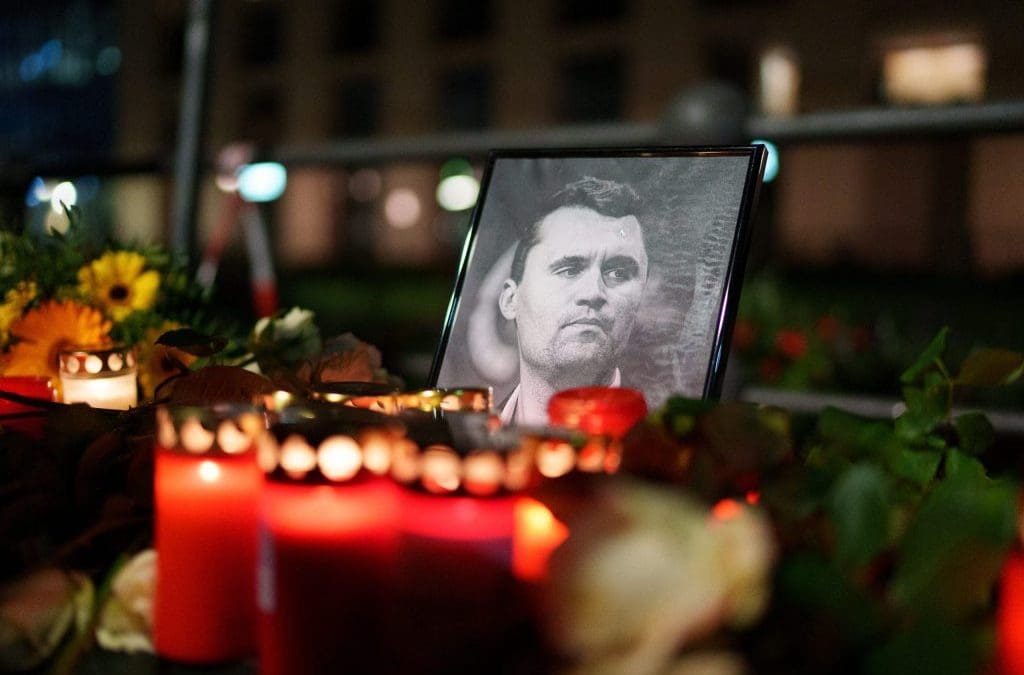
A memorial ceremony held in front of the Brandenburg Gate for U.S. conservative political activist Charlie Kirk, who was killed in an assassination, in Berlin, Germany, on September 11, 2025. Photo by Ilkin Eskipehlivan /Anadolu via Getty Images.

The assassination of Charlie Kirk, a close ally of President Donald Trump, conservative political activist, and founder of Turning Point USA, has sent shockwaves throughout the entire country. As of Thursday, Sept. 11, Kirk’s killer is still at large. Authorities still do not know who the shooter is and what their motivations were, but that hasn’t stopped the formation of a thunderous chorus of powerful people across the right and far-right spectrum calling for retribution, from President Trump and Elon Musk to far-right influencers like Chaya Raichik and Laura Loomer. What will the societal fallout be from this high-profile assassination? Will the public murder of Kirk unleash a new wave of political repression? What possibilities should people be prepared for? In this urgent panel discussion, TRNN Editor-in-Chief Maximillian Alvarez poses these questions to three experts on far-right politics: Shane Burley, Natasha Lennard, and Jared Holt.

Guests:

Additional resources:

Credits: 

  • Studio Production: David Hebden
Transcript

Maximillian Alvarez:  On Wednesday, Sept. 10, Charlie Kirk was assassinated while speaking to a large crowd at an outdoor event on the campus of Utah Valley University. Kirk was a close ally of President Donald Trump, a far-right influencer, conservative political activist, and founder of Turning Point USA, a nonprofit that advocates for conservative politics on high school, college, and university campuses, which also created the professor watch list, a site that has been used for years to surveil, doxx, and harass academics the group accuses of being politically biased. Horrifying videos of Kirk being shot in the neck and the crowd racing away in panic immediately flooded the internet and mainstream media. Kirk was pronounced dead shortly afterwards, leaving behind his wife, Erika, and their two children.

Now, we are recording this on the afternoon of Sept. 11, and as of right now, Kirk’s killer is still at large. Authorities posted images earlier today of a person of interest, and asked the public for help in identifying the individual. Law enforcement officials also said that the weapon used has been recovered and described as a high powered bolt-action rifle.

Kirk had become one of the most prominent voices of the MAGA movement. His assassination has sent shockwaves throughout the entire country. But the reaction to Kirk’s death on the right, from President Trump to Elon Musk, to far-right influencers like Chaya Raichik and Laura Loomer, suggests that we are sailing into very troubled waters in this country.

“The left is the party of murder,” Musk said on X Wednesday. “The Left are terrorists,” Loomer posted. In all caps, Raichik posted on X, “THIS IS WAR.”

And on Wednesday night, president Trump made a public address from the Oval Office. Here’s some of what he said:

President Donald Trump [recording]:  This is a dark moment for America. It’s long past time for all Americans and the media to confront the fact that violence and murder are the tragic consequence of demonizing those with whom you disagree day after day, year after year, in the most hateful and despicable way possible.

For years, those on the radical left have compared wonderful Americans like Charlie to Nazis and the world’s worst mass murderers and criminals. This kind of rhetoric is directly responsible for the terrorism that we’re seeing in our country today, and it must stop right now.

My administration will find each and every one of those who contributed to this atrocity and to other political violence, including the organizations that fund it and support it, as well as those who go after our judges, law enforcement officials, and everyone else who brings order to our country.

Maximillian Alvarez:  Again, we still have no idea who the shooter is and what their motivations were, but that hasn’t stopped the formation of a thunderous chorus of powerful people across the right and far-right spectrum calling for retribution.

And that is what we are going to focus on in today’s segment. And to help us break this all down, I am very grateful to be joined on The Real News today by three guests: Shane Burley is a journalist, organizer, and filmmaker based in Portland, Oregon. He’s the author, co-author, and editor of numerous books, including Safety through Solidarity: A Radical Guide to Fighting Antisemitism, and Fascism Today: What It Is and How to End It.

Natasha Lennard is a columnist for The Intercept and the author of the book Being Numerous: Essays on Non-Fascist Life. She’s the associate director of the Creative Publishing and Critical Journalism graduate program at the New School for Social Research in New York.

And Jared Holt is the co-host of the podcast Posting Through It. He is a journalist and research analyst who has covered political extremism and hate movements in the United States for nearly a decade.

Thank you all so much for joining me on The Real News today. It is a very dark day in the country, but I’m truly grateful to have you all and to shine the light of your brilliant insights onto this moment when our audience desperately needs it.

There is, frankly, a frightening amount of misinformation and conjecture flying around right now. So, I wanted to use this first section to break down who Charlie Kirk was and what we definitively know and what we do not know about his assassination yesterday. So, Shane, why don’t we start with you, and then, Natasha, we’ll go to you.

Shane Burley:  Thanks so much for having me. So, I think, thinking about it this morning, it’s really hard to imagine, certainly, a second Trump term, but even, to a degree, a first Trump term without Charlie Kirk. He really helped to redevelop what a young, youthful, really far-right Republican Party could look like at a time when young people were not actually getting involved in these campus organizations. He created one that really brought people in and then pushed them further and further right.

So, as he matched Trump’s rhetoric and what became the MAGA movement, he was really able to bridge that and build a movement that just wouldn’t have happened before. So, the idea if we’re talking about a young GOP base or young right-wing men in particular, that really wouldn’t have happened without Charlie Kirk.

And he moved the Overton window quite a bit. The way that he talked about politics is something you would’ve found in the fringes of the right maybe five or 10 years before, and he helped mainstream it. He helped bring it onto Fox News, helped bring it into Newsmax and other places, and really helped establish that that is going to be the way that the right talks about politics. Just [inaudible] close to openly racial politics, openly transphobic politics, and certainly anti-immigrant politics.

Natasha Lennard:  Absolutely. Just following on from Shane, for those viewers and listeners who had never heard of Charlie Kirk for some reason before today, they could look at the news cycle, from right-wing news to liberal mainstream news, and get the sense that this was some generous, open-hearted man invested in young people getting together and organizing and developing spaces for robust debate and discourse and speech.

Notably, The New York Times‘ Ezra Klein lauded Kirk for his approach to politics as if he were mainly invested in the project of debate. What Charlie Kirk did was, largely, go from campus to campus and beyond and motivate young white men, and somewhat young white women, but particularly young white men, into the revanchist politics of the right today. Very much openly Christian nationalist, and antitrans to the extreme, anti-immigrant, and racist, and did a lot of work to normalize those positions as a center for the political right. So it’s no time to be whitewashing the political project to which he was reliably devoted.

He did make much of this “debate me” shtick with 19-year-olds he would meet when he would go on college campus tours. But this was essentially a 31-year-old man condescending to 19-year-olds, whilst, in fact, committing himself reliably to everything that is so troubling about Trump’s authoritarian second term.

And what that does, indeed, is not open up debate. This is not about opening up debate. It’s about making the very people who are allowed to be in the body politic of this country at all smaller, whiter, more patriarchal, meaner, and yes, less inclusive. So yeah, just really agreeing with Shane there.

Maximillian Alvarez:  Jared, I want to bring you in here too. Anything else you want to add about who Charlie Kirk was and what we know and don’t know about his assassination on Wednesday?

Jared Holt:  Yeah, I’ll start. I think Shane and Natasha covered the brunt of Charlie Kirk, but a couple other things I want to add in here. I feel like another thing that these obituaries and mainstream media have omitted about Charlie Kirk is the fact that he was a central leading figure in efforts to overturn the results of a democratic election in 2020. He is not a patriot. His career was built on contempt for this country and most of the people in it, particularly minorities and our immigrant communities.

Another thing to know about Charlie Kirk is that the reason anybody knows who Charlie Kirk is, is because when he was younger, fresh out of high school and looking to get into conservative politics, he managed to charm the right-wing mega-donor class. So much of early Turning Point USA and early Charlie Kirk lore, I guess, if you will, was a dark money project. This was not somebody who was authentically popular. Eventually, he did catch on and attain sincere popularity with conservative audiences, but he kind of faked it till he made it.

And I feel like that’s important to note. He has been portrayed in so many of these obituaries as this sort of sincere, genuine freedom fighter kind of guy, and maybe people disagreed with him, but you have to respect him, that sort of thing. But this is a professional operation. He is a provocateur, is how I saw him, not as somebody who was interested in a good-faith debate, but somebody who was willing to poke the bear and push things to the extremes, all with the goal of embarrassing people or stirring up audiences against various outgroups and targets of the conservative movement.

Maximillian Alvarez:  Well, I think that that’s an area of Kirk’s legacy that all four of us have dealt with at one point or another. When I was a graduate student at the University of Michigan, this was when Turning Point USA was really becoming a political force on campuses, and the professor watch list was something that we were all aware of. I knew many people who ended up on it and some who got disciplined by their universities just for being accused of what TPUSA was accusing them of without any real investigation. This was not something that any of us who genuinely championed robust, intellectual, good-faith debate saw as that. Because if you ran into any TPUSA folks on campus, that’s not what they were looking for. They were looking to oust you as some radical Marxist who was indoctrinating their students and needed to be doxxed and harassed into silence.

So it came as a shock to many of us who knew Kirk that way and TPUSA that way to be confronted with so many people saying that he was a champion of good-faith debate. And that does not go into the realm of speaking ill of the dead or pretending that we can’t be honest about the situation that we’re in right now.

I have so many folks who are conservative in my family, in my friend circles, people I’ve reported on in sacrifice zones around the country who are genuinely heartbroken about this, and my heart is broken for them. It’s broken for this country. It’s broken for the same reasons that I think a lot of us are feeling like this desperate desire to return to a place where we can talk to each other in terms that aren’t so black and white and so violent, but we can’t in this country, and Charlie Kirk had a big hand in creating that political surround that we find ourselves in where we can’t really cross the aisle and talk to each other across our political differences. If we don’t reckon with that legacy, we’re not going to get to the place so many of us want to get to.

And that is not the place where we are currently going in this country, and I want to focus us on where we are headed after this world-shaking political assassination. Again, there is still a lot that we do not know about Kirk’s assassination, and the suspect is still, as of this recording, at large. However, it is quite clear that the MAGA faithful and far-right influencers are responding as if they know for certain what happened, who’s at fault, and what must be done in response.

And so with the time that we have left, I want to focus specifically on how the right is responding to this and the dark political possibilities that are quickly approaching on the immediate horizons.

So, Shane, let’s start and go back to you.

Shane Burley:  I think one of the first things to bring up here is that, just as if there wasn’t a young MAGA movement without Charlie Kirk, there also wouldn’t have been the big wave of campus repressions that saw in ’23 and 2024 without the foundations laid by the professor watch list and the logic that was presented of the campus as this dangerous place that was attacking free speech and required someone to come in with an illiberal voice to balance things out.

And I actually think that’s going to actually have consequences on campus. Remember where he was killed, it’s in the place that was his war zone and where he said was dangerous. And so, I think that will just ramp up what he started 10 years ago. So, I think that’s going to continue.

One thing that people have to remember is that Charlie Kirk did have enemies to the right. This is actually a big part of his story. Starting in 2019, the Groyper movement, Nick Fuentes, really made their name by going to Turning Point events and demanding that Charlie Kirk answer for Zionism in Israel, and whether or not he’s being paid by Jews, or different framings.

And that has actually been a really consistent piece of the American far right’s story about Charlie Kirk. It’s actually in a lot of ways where neo-Nazis and certain people in the very far right distinguish themselves from the mainline far right that Charlie Kirk represented. Until the end he maintained a pro-Israel stance, even though he started to flirt with a lot more of the Israel-critical crowd. So, it’s possible that there’s someone to the right.

There’s also the fact that Charlie Kirk constantly changes positions to match those in power. So he would take a populist tone one day, he’d switch it when Trump switched. He’d be pro-exposing Epstein one day and then try and dissuade people from looking at it another day. He’d be about voter integrity one day and then would deny ballot integrity another, free speech one day and not the other. So it’s really actually hard to say who he betrayed here.

But nonetheless, it’s about a narrative and about justification for repression. And so when I hear something like this, the first thing I hear is that the right is going to use this to justify really serious repression against social movements, against activist groups. Of course, they always understand political movements on the left as having to be controlled from above, to have a vertical alliance. So, they assume that any kind of activist, anyone talking about racism, something like that, they must somehow be involved and so they’re going to have to use equal force. At a time when national officers, when National Guard troops are being sent into cities, this is going to be another pretext for it.

And so, I’m concerned about not just what’s going to happen on campus, but how this will be used to actually target and use group cases or justify really serious investigations into activists of all sorts.

Maximillian Alvarez:  Let’s not forget that the federal occupation of Washington, DC, was effectively a response to a DOGE staffer, AKA Big Balls, getting beat up in DC. So, we’ve got some precedent here.

Natasha, please hop in.

Natasha Lennard:  Yes, I think we heard Trump’s own statement, saying this is a dark moment for America, and I think true, but for, of course, entirely the opposite reason. But the rhetoric that Trump himself is using, already saying he wants to go after rhetoric — He used the word “rhetoric.” He, of course, used the word “terrorism.” He talked about contributing to this crime.

And again, it is worth reiterating many, many times, at the time of speaking, we have no idea who this shooter is, absolutely no idea at all. But immediately in unison, Trump and his acolytes jumped to blame the radical left. And by the radical left, they quite literally mean anyone from leftist mutual aid kitchen to Bill Gates.

So it is a really open season, but obviously, the concern is the way in which activist communities can and will be targeted as a point, not of aberration from what we’ve seen before, but escalation in terms of, as you’ve all been saying, repression on campus.

We saw one of the responses worth noting last night, Christopher Rufo from the Manhattan Institute, the man behind turning critical race theory into a boogeyman who, along with Kirk and others, is responsible for so many of the censorious attacks on higher education and scholarly speech that we see today, he quite openly and explicitly called for a return of J. Edgar Hoover’s FBI-style attacks on the left. So we are talking COINTELPRO, assassinations, and dissimulation and targeting, the worst sort of McCarthyism, the eras that had been condemned as really dark times in American history are being openly called into revival now, in the name, we are told by our centrist leaders, of a man who supposedly adored free speech.

So I think one thing I want to end with is that this isn’t a moment for our leaders, progressive or self-identifying progressive leaders, to forego their duty of ensuring that the most vulnerable in these moments are protected from the very world that Kirk and his ilk want to see called into being, which, again, is a whiter, crueler, less inclusive world.

Jared Holt:  What I will add here, again, like the previous question, Shane and Natasha, two brilliant people took a lot of words out of my mouth, but something I want to note is I’ve been tracking the far right for a decade now, and I cannot tell you how many times I have heard figures associated with these movements talking about retribution and civil war and retaliation. Violent rhetoric is a feature of these movements, and it was part of a problem — A lot of these obituaries are presenting Charlie Kirk as a victim of political division and violent rhetoric, and I think he was a major contributor to the problem. And like you said, I’m not trying to speak ill of the dead, but I do want to speak honestly about it. That has to be acknowledged and understood if we’re talking about him.

What’s different this time about this surge of violent rhetoric is that the people promoting it have institutional power. They have a vice grip over the federal government and can act on it in a way that they didn’t beforehand. And they are pursuing this agenda anyway, whether it is sending military to liberal-coded cities, including my home of Chicago, although it’s not clear if they’re going to go ahead with that after getting some pushback. We saw the incident where they exploded a speedboat that they claim was full of Venezuelan drug traffickers, is the official story. No due process, no way to check this claim because everyone’s dead, and it’s illegal.

And they just keep pushing the limits. They keep making clear they don’t really care about the courts or the traditional thresholds of institutional power that would normally be there to check it. The Republican Party at large is not interested in reigning things back right now. And for the last several years, right-wing media has been — Well, really the last decade, but especially the last few years — Right-wing media has been really harping on these narratives that there is some kind of imminent violent threat radiating from the “radical left,” which can be defined, as Natasha said, as loosely or as specifically as possible, depending which one of these guys you ask.

This event, to me, all things considered, almost feels like the climax of that narrative arc. They’ve been hyping this up. They’ve been really stretching themselves thin to villainize all kinds of random people, especially transgender people, trying to portray them as some kind of violent, murderous threat to conservatives that have to be acted on. And here you have an extremely high profile, extremely gruesome, awful event that happened to one of the movement’s figureheads, and to somebody who spent a lot of time and effort promoting those exact narratives.

So what comes next? I’m not sure. It seems this administration has made up its mind about who is to blame for what happened to Charlie Kirk. Even though, as we’re recording this, we know that Charlie Kirk was shot and killed. We have an idea about how it happened, where the gunman was, what weapon was used. We have a photo of a suspect that they’re asking for help tracking down.

And then we have a conflicting report, some internal chatter that says that messages associated with transgender and anarchist ideologies, whatever that means, that could mean anything if you don’t specify, were found on bullet casings. That was conflicted. A senior law enforcement official told The New York Times this morning that that conflicts with other reports and is not confirmed and people should not be running with that.

Trump’s remarks, so many influencers’ remarks have decided that this “radical left” is responsible for this shooting. And, I don’t know, if they arrested a white supremacist, and it turned out he was the — Because, as Shane pointed out, there’s plenty of people to the right of Charlie Kirk that hate his guts. It’s not outside entirely the realm of possibility at this point that we’re recording that it’s possible, I guess, I don’t know. But even if they arrested somebody like that, I don’t know if it would stop this trajectory that they’re on.

And I think what’s most alarming — And I’ll end this here — Is what Trump said, basically blaming not anybody specifically or any specific group or whatever, but saying that Charlie Kirk died because people called him a supremacist, a Nazi specifically is what Trump said. That’s First Amendment-protected speech. That is not violent speech, that is not a threat, that is a criticism — a very extreme criticism of somebody, but a criticism of somebody.

If this administration tries to act in a way where people who criticize the supremacist elements of its agenda, the supremacist ideology and rhetoric of its top proponents, that can get us in a very dark place very quick. We’re already in a dark place, but if you flip your history books back to the ’60s and 70s in this country in terms of left-wing movements or social progressive movements, things can get a lot darker from here.

Maximillian Alvarez:  My dearly departed comrade and colleague Eddie Conway was locked up for 44 years and framed by COINTELPRO. He was a Baltimore Black Panther. Those are the casualties. He’s one of so, so many of that dark period.

I want to end on a rapid fire one more round around the table, because you all have studied the right, the far right, from the activist level to the donor level for years. You are authorities. You have seen this stuff up close. And as you all said, we don’t know where things are going to go, but we do know that the far right elements that you have been studying are now mainstream in the Republican Party, that that party has a stranglehold on the levers of power in our government from all three branches, that the media ecology that we’re in has shifted dramatically, and tech platforms are owned by people who are also part of the MAGA coalition, and algorithms are driven towards that type of ideology.

So I wanted to ask if we could glean from your years of research and studying the right and far right, if you could talk to folks watching this and listening to this right now who are afraid, who are anxious, who are angry, who don’t know what is going to happen next, what lessons could you offer on how to navigate this moment? What is not going to work if what we don’t want is more violence and death and civil war? Do you have any final thoughts that you want to leave folks with about where we could be headed in this country and how to carry ourselves so that we don’t end up in the darkest of possible outcomes?

Shane Burley:  I can kick us off on this optimistic note. The first thing I want to say is that what really struck me when I heard the news, my immediate response was that this is going to be bad for a lot of people. This is going to be a justification to raid people’s homes, to comb through people’s social media, to try and pass legislation to target people.

Historically, when something like this happens, a lot of what people are scared of is vigilante groups coming out. And I think that that is still a viable threat, whether this is formal groups like the Proud Boys or less formalized groups, particularly at big public events. And I think, obviously, being well coordinated and having safety plans and addressing that, I think that’s really important because those are still a threat.

But what’s different in 2025 is that I just don’t think that Proud Boys or a small neo-Nazi group is the primary threat. I think that the far right has much, much bigger militias than that, and they have ICE deputization, or they’re border patrol, or they’re coming in as the National Guard, and that’s a much different question. If people spent the last 10 years asking, how do we keep ourselves safe from the far right? I don’t think that those answers really dealt with the National Guard, with bolstered police forces, with militarized federal officers.

And so I think the questions and the answers are just going to be different now, because what’s possible is different now. What the courts can stop is much smaller. What’s available within the GOP to create friction is less.

And so it is hard to answer that question. I think what you ultimately get back to is that you deal with some of these, as productive as you can, as a crisis situation. What gets through people through those things? Being connected with their communities, being bonded with organizations, with their neighbors, knowing what people have, having other people know what you need. Basically, having strong relationships that allow you to coordinate for those things.

And then if we’re talking about the threat of political violence, the answer to that is mass movements that have the power to actually change things. The reality is that shooting Charlie Kirk will not stop the politics of Turning Point USA. But millions of people organizing, putting pressure on institutions, going to the streets, those things actually can stop that. They can actually shift the tide entirely.

And so, ultimately, that kind of movement is the same answer as what keeps us safe in this situation: It’s getting together with other people, it’s talking about it. It’s envisioning a different future, and trying to coordinate together as a mass of people. And ultimately, that’s exactly what Charlie Kirk was not doing. He was not trying to make a mass democratic movement that represented everyone. He was trying to create an elitist, top-down government that privileged only certain kinds of people. So I think the answer to this crisis is to build exactly what Charlie Kirk wanted to destroy.

Natasha Lennard:  Yeah, I just completely agree. I would also say, especially for maybe some of our younger listeners and viewers, the government does not have a sense of humor. Please don’t be stupid online. So I think just being aware of what you’re putting out there, just very practically, not a time for stupid jokes. Because, yes, indeed, the problem is not just state-sanctioned vigilante violence.

And I think we definitely have to also have noted that, in the last 30 years, by far the majority of politically motivated attacks, or at least how they’re understood and studied in terms of data, by far,they have been committed by the far right and cis men. So whatever narratives are going to be spread to the country, which also Kirk himself was invested in dissimulation campaigns about, that remains true. So, that sort of vigilante is state-sanctioned at this point, vigilante violence has been a constant threat. But right now it is, I think, the state itself and its mechanisms of oppression, as we have seen in this country before, being reweaponized, revived with this ability to weaponize a justification wherever they can find it, we will continue to see.

And so for that reason, Shane’s suggestions are all the more important because they were the very thing that we have needed in response and will continue to need in response to authoritarian escalations anyway, which is community protection of the most vulnerable, not presuming that we’ll be saved by the courts or the Democratic center.

Jared Holt:  Yeah, I will echo what Shane said. I don’t know what to tell anybody to do, and I don’t know that it’s really my place to be handing out advice, but I do think there is merit in hard times with making your world a little smaller. And by that I don’t mean tuning out. I mean investing your energy in the things around you. You could write a letter to your congressperson, or you could go show up at a local government meeting and be one of the three people that showed up that day, which means you’ve got a whole lot of influence right now. You’ve got a pretty big voice, and it’s on issues that might affect your neighborhood.

And also organizing with other like-minded people locally, alternative media is great. Sharing that with people, getting more honest and unfiltered perspectives to people that really convey the truth about this situation at a time where a lot of media is glossing over it or seeming to walk around with their hands over their eyes and fingers in their ears pretending that the house is not on fire, if you will.

But the other thing I also want to say, again, to echo a point Shane made, Turning Point USA is not stopped. The far right is not stopped because somebody killed Charlie Kirk. It shouldn’t have happened. That sort of thing should not happen. We should not celebrate that, as some people online have. And like Natasha said, the police, the government, they don’t really have a sense of humor. So people might’ve been joking around or poking some fun or whatever, but it is just not a good idea. And it’s also just kind of gross, in my opinion.

I do the work I do and have done for the last decade because I feel personally driven because I want to live in a world that is more accepting, that is safer, and that can produce sincere and needed change to make sure that everybody can enjoy a good life, the freedoms and joys that a good life can contain.

A vision towards a positive future like that I do not think can include violence. A future where everybody is safe and happy and secure and can live their life to the fullest is not one where people are getting assassinated in broad daylight over political attitudes — And I’m no fan of Charlie Kirk, I think that has been evident here, but that is not the future. That is not the way forward.

I think the future is building strength through solidarity and actually organizing and supporting each other through this hard time, and identifying those little points of friction, those little small acts of refusal we can all do, because authoritarianism requires collaboration and complacency. And I think even if it doesn’t feel like much on the individual level, keeping our guards up and saying no and making our voices known is worth something.

Original

‘Great day’ for Brazil as coup plotter Bolsonaro convicted, sentenced to 27 years

‘Great day’ for Brazil as coup plotter Bolsonaro convicted, sentenced to 27 years

Former Brazilian President Jair Bolsonaro speaks to members of the media in Belo Horizonte, Minas Gerais state, Brazil, on June 30, 2023. Photo by DOUGLAS MAGNO/AFP via Getty Images
Common Dreams Logo

This story originally appeared in Common Dreams on Sep. 11, 2025 . It is shared here under a  Creative Commons (CC BY-NC-ND 3.0) license.

Former Brazilian President Jair Bolsonaro  was sentenced to over 27 years behind bars Thursday after four of five Supreme Court justices on a panel voted to convict the far-right leader and seven associates of plotting a military coup and assassination of current President Luiz Inácio Lula da Silva and other officials.

“This criminal case is almost a meeting between Brazil and its past, its present, and its future,” said Justice Cármen Lúcia Antunes Rocha, on Thursday cast the third and decisive vote to convict the former president and seven co-plotters, referring in part to the two decades of US-backed  military dictatorship, during which Bolsonaro served as an army paratrooper.

Lúcia joined Justices Flávio Dino, Cristiano Zanin, and Alexandre de Moraes—who, along with Lula and Brazilian Vice President Geraldo Alckmin were targeted for assassination by the plotters—in voting to convict the defendants of attempting to subvert Lula’s victory  in the 2022 presidential election.

The defendants—who in addition to Bolsonaro include army generals and former Defense Ministers Walter Braga Netto and Paulo Sérgio Nogueira de Oliveira; former Institutional Security Minister Augusto Heleno Ribiero; admiral and former Navy Commander Almir Garnier Santos; former Justice Minister Anderson Torres; and former presidential adviser Márcio Mirando—were found guilty of crimes including attempting a coup, involvement in an armed criminal organization, attempting the violent abolition of democratic rule of law, and aggravated damage of the state’s assets.

Lt. Col. Mauro Cid, a former Bolsonaro aide who turned state’s witness, was sentenced  Thursday to two years of confinement under open conditions, the most lenient form of carceral punishment in the Brazilian justice system.

“The government wanted to remain in power by simply ignoring democracy—and that is what constitutes a coup d’état,” Moraes said ahead of his vote on Tuesday. “The leader of the criminal group made it clear—publicly and in his own words—that he would never accept defeat at the ballot, a democratic loss in the elections, and that he would never abide by the will of the people.”

Bolsonaro was sentenced to 27 years, 3 months in prison, with penalties for the other convicted defendants still uncertain as of Thursday evening. Bolsonaro, who is 70 years old, denies any wrongdoing. He is currently under house arrest and could remain there until after exhausting the appeals process. He is already banned  from running for any office until 2030 due to his abuse of power related to baseless claims of electoral fraud.

Justice Luiz Fux voted Thursday to absolve Bolsonaro, asserting that there was “absolutely no proof” that the former president took part in or was even aware of the coup and assassination plot.

However, Lúcia argued that there was copious evidence indicating that Bolsonaro and his accomplices acted “with the purpose of eroding democracy and institutions.”

“They acted to hijack the soul of the republic,” she said. “The case files show a coordinated criminal enterprise by the defendants, who adopted the methods of a digital militia to attack the judiciary, the electoral system, and the electronic voting machines.”

The landmark verdict came amid acute political polarization in Latin America’s biggest democracy and threats from the office of US President Donald Trump  to unleash American “military might” in defense of the “Trump of the Tropics,” as Bolsonaro is often called. The Trump administration has already slapped 50% tariffs  on Brazilian imports and has sanctioned  Moraes.

US Secretary of State Marco Rubio responded to Thursday’s developments by vowing on social media that “the United States will respond accordingly to this witch hunt.”

Like Trump in 2020, Bolsonaro made many baseless allegations that his loss in the 2022 election was due to fraud, fueling lies and conspiracy theories that led to the January 8, 2023 mob attacks  on government buildings. Around 1,500 Bolsonaro supporters were arrested  in the days following the storming of Congress and the presidential offices.

While many right-wing Brazilians were outraged by the convictions, leftist lawmakers and others applauded what Lula’s Workers’ Party (PT) called  “a historic moment for Brazil.”

Brazilian Secretary of Institutional Affairs Gleisi Hoffmann (PT) said  on social media, “The conviction of Jair Bolsonaro and his accomplices by the Federal Supreme Court expresses the vigor of democracy and national sovereignty.”

“They were convicted in due legal process, based on compelling evidence of the crimes they committed,” she continued. “It is a historic, unprecedented decision so that they may never again dare to attack the rule of law and the will of the people expressed at the ballot box.”

“It is also the proud response of Brazil’s judiciary to the economic sanctions and absurd coercion of the Donald Trump government, in conspiracy with the traitors to the homeland in the service of Bolsonaro,” Hoffmann added. “Today… Brazil told the world that crimes against democracy are intolerable. And they are unforgivable.”

Federal Deputy Talíria Petrone (Socialism and Liberty-Rio de Janeiro) called  Thursday “the greatest day ever,” while former colleague Jean Wyllys also hailed  this “great day.”

Erika Hilton, a Socialism and Liberty federal deputy representing São Paulo, taunted Bolsonaro with the prospect of a lengthy stay at a notorious maximum security penitentiary.

Federal Deputy Benedita da Silva (PT-Rio de Janeiro) said  on social media that “democratic Brazil is proud and celebrating the firm decision” of the high court, “whose members suffered countless threats, including death threats, from the conspirators against the democratic rule of law.”

Referring to the United States, da Silva praised the justices, who “did not bow to the threats to our sovereignty from the greatest external power.”“Now we have to defeat the amnesty coup of the convicted plotters that they are still trying to pass,” she added, a reference to efforts by the right-wing Congress to pass clemency legislation for Bolsonaro. “No amnesty!”

Original

The US never stopped treating Mexico like an imperial colony

The US never stopped treating Mexico like an imperial colony

People hold a peaceful protest to oppose the ongoing U.S. Immigration and Customs Enforcement (ICE) raids and arrests in the cities of Pasadena and Altadena on June 21, 2025 in Pasadena, California. Photo by David McNew/Getty Images

From military invasions, occupations, and annexations of Mexican territories in the 19th century to the post-NAFTA capture of Mexican industries, resources, and labor markets by American companies and investors, US-Mexico relations have always been defined by American imperial domination. “Mexico’s economy has been economically dominated and incorporated as a kind of subsidiary or an extension of the US economy,” labor activist and scholar Justin Akers Chacón says, and that relationship of domination “determines the politics of Mexico” to this day. In this episode of Solidarity Without Exception, co-host Blanca Missé speaks with Chacón about the colonial roots of US–Mexico relations, how that relationship has evolved over the past two centuries, and how it continues to shape the politics, economics, and immigration policies of each country today.

Guests:

Credits:

  • Pre-Production: Blanca Missé
  • Audio Post-Production: Alina Nehlich
Transcript

The following is a rushed transcript and may contain errors. A proofread version will be made available as soon as possible.

Blanca Missé:

Welcome to Solidarity Without Exception, a podcast series about working people’s struggles for national self-determination in the 21st century and what connects them and us. This podcast is produced by the Real News Network in partnership with the Ukraine Solidarity Network, and I am Blanc mise. We are releasing this episode on Mexico as Trump threatened again to impose new tariffs on imports from Mexico while continuing his massive ice terror raid and detention and deportation plan, ICE has arrested more than a hundred thousand people suspected of violating immigration law. Since Trump took office in January, 2025 to the first week of June, the figure amounts to an average of 750 arrests per day, double of the average of the past decade. Many of the immigrants arrested are sent to countries where they have no roots or relation, and some have even been sent to the Kott facilities in El Salvador known for the violation of human rights.

The vast majority of them have no criminal record. More significantly, the number of immigrants in detention center keeps growing, now exceeds more than 50,000, and we know that new detention centers are being built, other prisons are being reopened to housed, arrested immigrants, and these centers are all privately managed and owned by big corporations such as the GEO Group. These are workers who come to the US looking for a better life and to ensure the key sectors of the economy like agriculture, hotel and restaurant industries. In our podcast today, our guest is going to delve into the structural causes of immigration and analyze what is behind the current Trump policies toward Mexico and also towards immigrants. And more importantly, he’s going to offer an alternative view to that of the mainstream media on immigration who will hear a working class perspective and the case for a different immigration policy, one that respects human rights, workers’ rights and is in sync with the needs of working people in the US and Mexico.

Our guest today is Justine er Chacon. He’s an activist, a labor unionist and educator who lives in San Diego Tijuana border. He’s also a professor of Chicano Chicano studies at San Diego City College, and he’s the author of No One Is Illegal with Mike Davis, radicals in the Barrio. And more recently, the border crossed us the case for opening the US Mexico border. Justin, welcome to our podcast Solidarity With Without exception. We’re really delighted to have you on to talk about the neo-colonial relation that maybe the US has with Mexico and what’s happening with the Trump administration right now.

Justin Akers Chacón :

Thanks for inviting me. I’m glad to be here.

Blanca Missé:

Yeah. I would like to start our discussion today maybe by recapping a little bit what is in the history of the relation between the US and Mexico. You’ve said that we need to think of this relation not as a merely economic or diplomatic relation, but more strictly to start with its colonial origins and reading your work and the work of many other activism scholars. This history is pretty important to understand what’s happening today, right, with Trump in power and even what’s been happening in the last year. So could you unpack a little bit what it means to say that the US has a colonial relation with Mexico? What are the key things we need to have in mind to understand this?

Justin Akers Chacón :

Yeah, so that’s an important question. It also requires a little bit of a historical analysis because there are different ways in which the US has imposed a colonial relationship on Mexico, of course, beginning with military invasion and occupation and annexation of Mexican territories in the 19th century. But we see that that historically had been followed by a project of significant capital export into Mexico in the second half of the 19th century, to an extent that which Mexico’s economy was largely under the domination of foreign capital, primarily the US by the time of the advent of the Mexican revolution, the first decade of the 20th century. So that phase of economic colonialism played a direct role in the factors that contributed to the Mexican revolution. And so in the period of and after the revolution, we see much of the social and political content of the revolution being one in which there was an attempt to reclaim Mexico’s economy, its wealth, it’s oil, it’s all of the natural resources that had fallen under the domination and control of foreign capitalists to reclaim those for the Mexican people so that the character of that revolution was one and reaction to the extent of which US economic colonization had been established.

And I think there was an effort in the period, especially after World War II for Mexico to try to develop its capitalist system independently of US direct foreign control. And I think that experiment was short-lived and ultimately gave way to a process in which the United States began to once again accelerate its capital export. And ultimately, by the end of the 20th century, reaching a scale in which many different sectors, key sectors of Mexico’s economy were again largely under foreign capitals controlled by US capitals, not exclusively, but in terms of the dominance of that relationship. And so in concluding in terms of the colonial relationship, I characterize drawing from theoretical formulations by Lenin and others. Subsequently, we can recognize that the scale in which Mexico’s economy has been economically dominated and incorporated as a kind of subsidiary or an extension of the US economy has reached a scale on which that determines the politics of Mexico.

And it frames how the political parties operate in relationship to that. And so while I would say it’s not a direct in sort of military or direct sort of colonial relationship in which there’s no autonomy for the Mexican state and capitalist class, I would say that there’s such a scale of control that’s exerted through that system in which very, very much narrows the range of political possibilities in terms of how the current composition of the Mexican state and how it operates and the ruling class for different reasons. One in which is that the current Mexican state under the regime of AMLO and now Scheinbaum, the Morena government has tried to navigate some degree of emphasizing national capitalist development while not also not disrupting or in any way challenging and even expanding relationships with US capitalism. And that also reflects the way in which the Mexican capitalist class has developed, especially over the last several decades in kind of integration and subordination in US capital. And so these kind of partnerships sort of lock in how I would say the Mexican capitalist class sort of sees itself in a relationship between the Mexican state and the US government and US capitalist class, but navigating between these boundaries, but still allowing for the perpetuation and even strengthening of those imperialist relationships, which I can talk about more as well.

Blanca Missé:

So basically since the 19th century, the US has been not only being an obstacle for the economic development of Mexico, and you mentioned how it was both the trigger and the stop of the Mexican revolution, but it has become more and more a dominant power, which has imposed also its political ruling in an indirect way, right? So we were saying it’s not like the old colonies, but

Justin Akers Chacón :

There’s

Blanca Missé:

A new form of imperialist domination that still allows little wiggle room for Mexico to develop. And I think one, maybe the most recent episode that we’ve heard about is what happened with nafta, right? With the free trade agreement. And could you maybe summarize, I mean, I know it’s difficult to do it quickly, but I mean there’s a lot, even these discussions today about immigration, we go back to NAFTA and what happened to the Mexican agricultural system and everything. So even if we were to understand today, the most recent flux of migration across the border, I think this particular package of policies that the US imposed on Mexico are important to have in mind. So can you explain a little bit how NAFTA altered this imperialist neo-colonial relation?

Justin Akers Chacón :

So nafta, the North American Free Trade Agreement really was a plan developed in the United States to essentially compel Mexico to open its economy, to unfettered unlimited US capital. And this has to be understood in the context of the effort to try to reestablish some degree of control over of the economy and the period of after the Mexican revolution in which a lot of safeguards and restrictions were built around foreign intervention into the economy and restrictions on foreign investment restrictions on all forms of capital export. So that’s a reflection of what the revolution was able to accomplish. But it also was limited, right? Because these series of protections were essentially predicated on the idea that Mexico could develop itself into a first world country based on its natural resources, protecting those natural resources and developing its own capitalist economy and inserting itself into the global economy in ways in which it could leverage its economic power.

But this didn’t work, and there’s multiple reasons why it didn’t work, but the failure of that model enabled the US to lend more money to help finance that model, but then Mexico getting further into debt and then essentially reaching an economic crisis in which it couldn’t repay that debt. This was over the period of the 1980s and ultimately the US using that debt leverage to compel Mexico, and there were definitely people in the Mexican ruling class willing to go along with this, but to compel the Mexican state to rewrite its constitution, to remove practically all of the protectionist elements of its constitution, all of its national developmentalist policies and laws and things like that. So there was a gutting of Mexico’s political infrastructure to allow for massive capital export back into Mexico. So Mexico today is still in the culmination of opening up to such an extent that it’s now the most open economy in the world. It has the most free trade agreements. It essentially has, it’s now the opposite of what it once was. So by doing that, the United States then opened up a massive market for capital export. It now had access to buying up and consuming large sectors of the economy of land. It now had access to buying out production, reshaping it to now be in line with the supply chains needed for US production. But it now had access to a hundred million workers

Where unionization had been in decline in Mexico. And through this process of the restructuring associated with nafta, the Mexicans government and US capital partner to smash and break down the remaining sort of sectors of unionization in Mexico, making, contributing it to having one of the lowest rates of unionization in the world, authentic unionization. So this created a massive boon for the US economy because now there could be large scale capital export production shifted nearshoring the terminology and taking advantage mostly of the vast quantities of Mexican labor that could be degraded and paid less for the same type of work north of the border. And then creating a whole regime of free trade rules that basically favor capital being, having the complete right of mobility, but then also creating a trade regime that favors the ability to repatriate profits on a large scale with basically little or no actual taxation.

It’s really a very pro capitalist regime that allows for significant amounts of wealth to be made out of this process. And so there’s this facilitated wealth transfer on a massive scale nafta, and then its new iteration in the United States, Mexico, Canada agreement. And over this period of time, we see the byproduct of that massive wealth transfer out of Mexico reflected in the way in which large sections of the population of Mexico are going to be economically displaced. And ultimately it’s going to restructure the country internally in terms of people migrating to the cities, but also people from the cities migrating to other parts of the country or to the United States or to Canada. So this begins a massive displacement process that also impacts politics in this country because it’s created the conditions in which migration can be also criminalized at the same time, while these sort of neo or semi colonial relationships are being expanded and pushing more people to have to relocate within the North American economy.

Blanca Missé:

So basically with nafta, it was open field for the US to extract natural resources, get cheap labor, and also impose its products and its production, which led, as you said, a massive displacement from the countryside to the cities and from the cities to abroad. And that’s also the root of the migration, what has been framed as a migration crisis. And we’ll talk about that a little bit later. But before we go into migration, which is one of the hot topics today, I would like your opinion, your take on what is new with this Trump presidency because if we take this macro analysis, we see that this colonial relation, imperious relation of domination, capital extraction has been going on for more than a century and a half,

But there’s still also a sense that this particular administration is aggressive, more aggressive. So is it more aggressive or how is it different? How should we understand the kind of relation Trump wants to impose? And also because one of the paradoxes, right, is that Trump says that he does not believe in free trade. He wants to go back to tariffs. So it could be a little bit confusing in the sense that it is kind of shifting 180 degrees, the most vilified policy, which was the free trade policy and putting in place a protectionist policy, which in theory will protect everybody, Mexicans and the US and workers. So how to make sense of this new administration. Is there continuity? Is rupture, is it worse? Is it bad in a different way?

Justin Akers Chacón :

Yeah, I think the answer is all of those things. But yeah, I think one way of understanding Trump is it is an acceleration of processes that were already at play, but it’s also something qualitatively different in terms of the scale, the extreme measures being taken, for instance, in terms of repressing immigrants or the waging of tariff wars, things like that. But I think one way of understanding the specific context in which Trumpism has an opportunity to manifest and represent a way of advancing the interest of the US capitalist class is recognizing what’s happening globally, what’s happening internationally. There’s a lot of significant changes taking place in the global imperialist system where the US is being challenged economically, especially by China on a global scale, on a regional and global scale in terms of the competition to have access to natural resource and markets. And all that comes with wanting to expand your global economic and political reach.

The US is also facing its own crises economically in terms of its ability to maintain the dominance that it once had in terms of its existing relationships. So an imperialist crisis, the United States losing its economic dominance. And the way that this is also playing out militarily where the United States is now, essentially it’s in full war mode supporting the arming, the genocide and Israel and its campaign of war and terror against the Arab world. It’s fully invested in the conflict in Ukraine, and essentially it’s maintaining its rivalries with Russia and wanting to contain Russian power. So these are all indicators and reflective of the sort of imperialist crisis and the buildup towards war with China. It’s almost like a daily discussion now in terms of the chessboard maneuvering between United States and China, but also militarily. So these factors I think help explain why a Trump can emerge.

I don’t think it’s by chance, I think it’s a political shift in which the United States is trying to exercise more hard power, but also use its economic heft to restructure and extract more from political, I mean from all relationships it has even with what would be considered former allies or making what would be sacred relationships between these capital countries now making them all contingent on what the United States can take from them. So I think this reflects that interim perilous crisis. I think it reflects a deepening capitalist crisis. And the US ruling class I think is also going through some changes in terms of we’re seeing the rise new sectors of capital that are far more politically geared towards war and more backing in terms of the restructuring of US society. And its emphasis on as much as possible reasserting its dominance that it’s losing. So I think these make the situation more volatile and it makes the circumstances more open to what we’re seeing today, which is the far right asserting itself behind Trump, and essentially seeing Trumpism as a way to advance their project to get their power back.

And I think the other element of it is that the US also at its root, at its base is a white supremacist. The ruling class politics always reproduce and regurgitate white supremacist, white nationalist politics. And so that’s brought into the mix through the front door of Trump’s White House. And we see how that also factors in terms of how it intersects with imperialism. And so when we sort of pull these things together, we can see that there’s these deeper structural crises internationally within an imperialist in the capitalist system. And we also see that there’s not solutions to these problems that can be manifest in ways that resolve the crisis only intensify them. And so the way in which Trump has weaponized immigration policy to a point where we now have a kind of gestapo that ice is an expanding gestapo of a political police, but it’s also a racial, and it also has all these other characteristics in terms of who it’s going after.

At least now we have a situation where Trump is now sort of creating an international gulag system, shipping people that are being kidnapped, detained, disappeared into a sort of international system of detention centers. I mean, this is all qualitatively different, but it represents I think, the scale of the crisis and how there’s no solutions. And so it basically draws from this idea of more criminalization, more victimization and in terms of how Trump is trying to develop this political project in a way also that it sort of can somehow respond to the crisis inside the United States, but it’s not, it’s actually exacerbating the crisis. It’s creating a much more volatile and contradictory kind of circumstance, which is where we find ourselves today.

Blanca Missé:

Yeah, thank you for your answer. I think you did show that even if it seems in the surface that this is the opposite of the previous, it is a deepening, an escalation, a worsening of this economic domination now with, as you said, with military means, but also going back to this racist white supremacist core right in the United States and mobilizing people to even in this moment of despair of the US losing its dominance to kind of assert its domination at home and abroad with more violence. I would like now to talk a little bit about one of the topics you are the most known as a public in intellectual as an activist, written two books or three about it, which is this migration, right? The media, the news, every day they talk about the border crisis, immigration crisis, and we’re being inundated with people we don’t know where to put these people.

And you’ve over and over you, you’ve unpacked and criticized this framework and try to go to the roots of the economic and political domination underneath. And as you said before, that this attack on immigrants is not solving the crisis the US is in. But as a socialist or a social activist, what is the frame through which you articulate the question of migration in the United States and what will be an alternative framing to think through these problems? I think everybody’s trying to figure out how do we think of migration in different terms that help us solve the problems we need to fix because white workers, US workers are pit against foreign workers and everybody seems we’re fighting for the same piece of cake. And so there’s an even electoral of Trump, right? There is a social and political anxiety brewing in the country because of the lack of economic development and in the us. So what is the analysis you have to offer for working people in the US to think of this moment and also in general, what is needed to address the question of migration?

Justin Akers Chacón :

I think one of the things that I’ve tried to emphasize in my writing research and activism in terms of understanding migration is how it’s interconnected with the sort of operations of the global imperialist system and also within the framework of capitalism. And what I would characterize as a kind of political crisis, one significant political crisis within the capitalist system is its capacity to address the question of displacement and migration except to further criminalize it, right? Even though it’s a process that’s directly related to how capitalism operates. And so when I say it’s an imperialist crisis, we can look at how there’s increasing waves of global displacement and migration through war, through military invasion, through occupation, through funding regimes that are declaring war on people within their own territorial boundaries or people that are occupying or colonized. So there’s that aspect. There’s also, within capitalism, there’s a way of understanding how when we look at the world today, we see higher rates of inequality in terms of how capitalist systems are allocating resources.

So from the United States further south, we see that the way capitalism has operated is it’s created. There’s more of a polarization where more wealth is going to the top in societies and or more wealth is being exported through economic relationships of imperialism. The point being is that the way in which capital operates internationally and domestically is that it contributes to disrupting ways in which people historically have maintained their standard of living or had opportunities to have work to sustain their needs, or it’s created regimes in which there’s more extraction and exploitation of people so that more profits can be made domestically and repatriated internationally. And so it creates greater amounts of inequality within societies. And ultimately these factors working together push people to have to relocate. They have to find ways in which they can acquire the resources they need to survive. And so under capitalism and imperialism, we can see that if wealth is being extracted from the countryside and people who made their way of living through farming or through some kind of agricultural or rural productive capacity, if that land is privatized or sold off or bought out by companies that produce for export, but they want to maximize the profits that they make, so they’re going to pay people, they’re going to displace people, but then also pay them as little of a wage as possible.

You create a situation in which communities that can once be sustained now are disrupted and people have to sort of follow now where the job opportunities are, so you follow the money. So wealth is flowing. In this case, it would be flowing in different directions internally and internationally. So basically at the very basic level, capitalism to create more wealth for some and exploit others more, it has to create circumstances in which there’s disruptions of people’s ability to sustain themselves. So migration has been increasing each year, both internal and external migration has been increasing each year in relationship to how the global capitalist and domestic capitalist systems are working in terms of their allocation of resources. As more and more people are displaced, they have to go elsewhere to find work. This is why we have hundreds of millions of people now living and working outside of the cities or the countries that they’re from.

But there’s also a second side of this. Well, there’s many sides, but a second side of this is that migration performs another important function, which is the necessary labor, especially because people are following where the money outflows are going, where the wealth outflows are going. So if that’s building the economies where that wealth is controlled, then that means there’s the potential for more jobs to be created in that area. Then it’s further complicated by the fact that inside a domestic economy, so we have migrants coming from different phases of migration from different parts of the Americas, but we have people coming from Mexico who are performing necessary labor and inside of our economy, but at the same time, there’s underdevelopment of working classes here. There’s inequality already in the class structure. So capitalists have learned and perfected, and this operates through the state, their state, they’ve learned and perfected the means to criminalize migration while depending on it and while profiting from it.

But the criminalization is necessary for two reasons. One is because racialized, so migration is racialized. And so that there can be the blaming of migrants for especially racialized migrants, for taking the opportunities or somehow benefiting at the expense of US-born workers who are oppressed and exploited. So there’s the racialization of it. And then to keep those racial and national divisions because you have to, that’s part of the process is there can’t be class unity between different sectors of workers. That’s been a factor in US labor history in which the ruling class has always maintained divisions or worked overtime to maintain these divisions. But the second side of the criminalization of migrant labor is that it itself makes the labor more exploitable. And so you can increase the rate of exploitation by denying basic rights to people once they are inside the economy. And that’s essentially how it works.

So we have a large population of undocumented people, but that’s been created, that’s been curated in the sense that it’s grown as part of this project of having a larger and more diffuse sector of the working class, not have basic democratic rights, not even in contemporary period, not even have the right of mobility, the right to be in public without the threat of being arrested or detained. And so this is a structured process, and I wouldn’t say that it was a grand design, but I would say that it’s developed in this way because it’s demonstrated its capacity to serve the capitalist class most beneficial. So I say that it’s not bad policy, it’s the way capital, it’s the way in which us capitalism in this case, and I would say internationally capitalist class around the world, have followed and applied this method in their own ways, but to extract more from migrants to weaponize and politicize migration as ways of keeping groups of workers divided based on these divisions.

So it’s become in and of itself a beneficial means for extracting more wealth from labor overall, but also the only means of by politicizing it and weaponizing it as a policy like Trump has done, and so many other far right and anti-immigrant political parties and movements are doing. It’s basically trying to present a solution to a crisis that people are experiencing in terms of inequality and underdevelopment, all of the things that go along with that. But it’s doing it making it worse. It’s doing it by creating the conditions in which things are going to get worse for all workers in terms of the criminalization policies themselves.

Blanca Missé:

So I mean, I think you laid out very clearly how migration and the way migration is both presented as a problem as a crisis and encouraged and maintained and nurtured is a symptom or a manifestation of capitalism and helps the goals of capitalism, creates inequality, creates displacement, provides necessary labor that can be offshore and and the criminalization of migration is absolutely necessary for migrant workers to play this role in the economy. Now, I would like to tackle one of the questions you’ve been raising, specifically the title of your last book, the Case for Opening the US Mexico border is a pretty radical position to say, well, the real solution would be to open the border. And this is something we also hear in the demonstrations of immigrant rights activists, at least in California, we didn’t cross the border, the border cross up open the borders, no borders.

That’s something that goes, we’ve also seen the slogans of No Eyes, no detention, but we also have seen these slogans that question the idea that we should have borders and police borders. But no, if I were to say this to my colleagues in my union and say, well, the solution is to open the border, it will raise a big discussion among the coworkers. What does it mean we’re going to get invaded? We cannot accept everybody in the country. So what is meant by this case of opening the US Mexico border? What is the point you and many others in the social movement are trying to make to address the migration crisis?

Justin Akers Chacón :

I think one way of starting to think about what it means to call for an open border is to understand that it’s not really made clear to us how the border actually functions. We get the idea that the border is a sort of space where armed agents are basically keeping people out or they’re creating some kind of divide between the two countries. The reality is that the border is really a type of political fiction, but it does have a very specific function, political fiction, meaning our economies are the United States and Mexico, for instance. There’s so much integration that much of Mexico’s economy now works as part of the assembly line to the US economy. And so one way we can look at this as like Mexico has the fifth largest auto industry in the world, how many people know that? But the majority of that auto industry is US and international auto producers who basically move capital in.

But the United States moves so much automotive productive capacity into Mexico to take advantage of the lower labor costs and the less unionization and to the higher profitability that Mexico’s car industry, in many ways is the US’ car industry operating through Mexico. And last year, the US automakers exported 1.6 million cars from Mexico production lines to the US and they were sold, and this is one of the most profitable arrangements, but there’s different in which this operates. So when Trump says something like, oh, we’re going to put 30% tariffs on goods coming from Mexico, the US media will never tell you that part of the discourse and part of the conflict behind this is that those tariffs are going to largely hit US capitalists operating through in different sort of investment regimes in Mexico. But my point being is that if we look at the United States and Mexico in terms of capital and money, there’s no border.

And so you start to deconstruct, well, what does the border actually do? What does the concept of the enforced border actually do? It keeps out, while it regulates the movement of workers and the movement of poor and dispossessed people, that’s really what it does. I mean, if you look at, I live in San Diego and San Diego, Tijuana is a metropolitan complex. There’s a couple million people in San Diego, a couple million people in Tijuana, and you have this border wall between it, but there’s almost a billion dollars of goods crossing each day on trucks and trains, and there’s 30 to 50,000 people crossing the border. The US Mexico border is the most crossed border in the world, right? Hundreds of millions of crossings each year. So my point being is like, well, where do we get to that? What level of control then actually exists?

So the level of control is now reducible to the regulation of labor markets in the United States, and that connects back to the point in which we can see that this process of creating a larger and larger non-citizen sector of the economy that doesn’t have basic labor rights is actually strategy tied to profitability. So what would it mean to open a border? Well, people are already moving across that border in legal or without authorization. So opening a border would mean basically opening the border to the movement of workers and essentially giving, essentially allowing for some process for people to not have to be undocumented and to basically have direct access, freedom of movement, freedom, the right to work and things like that. So in all practicality, it wouldn’t be radically different than what it is today except for that one fact that by having a border regime and which laws flow from the criminalization of unauthorized migration, but it’s a migration that is essential to the functioning of the US economy, right? Then you’re essentially creating the means by which you can have more and more people placed within the economy who don’t have basic rights. And that becomes in and of itself a profitable scheme. But yeah, the other of it is if we didn’t have a border, wages would go up on both sides of the border.

We would have the possibility to form unions that would extend across borders because the biggest capitalist exploiters in the United States are also the biggest capitalist exploiters in Mexico, and there’s so many supply chains and assembly lines and distribution, cross-border distribution networks where I live in San Diego in the last five years, last several years, they built Amazon built two Amazon fulfillment, massive Amazon fulfillment centers, one in very south San Diego, close to the border, and then one on the Mexican side of the border. And it’s very fascinating because it really does exemplify how the border actually works under capitalism. And so the two fulfillment centers have their modern and industrial technological facilities. The one two miles south of the one on the southern side of the Mexican border, the workers get paid about one to $3 an hour, whereas the workers on this side of the border get paid 18 to $21 an hour.

The thing is, but the thing is that, and then the workers who work on the US side are mostly from Tijuana. They’re allowed to cross the border to work, and they work in the US side facility. The facility moves goods between the two facilities freely because they built the facilities close to a border crossing point, and it’s a commercial crossing point, which means it’s set up to allow goods, these big semi-truck and things to move more freely. It’s called the Otai Mesa crossing. So they built on both sides of that so they can move their goods between, but serve two different markets, pay the workers the lease possible. And it’s also interesting is before this expansion of this commercial crossing point, before it happened, Amazon actually paid a lot of money to the Democratic Party in San Diego because the Democrats are dominant here to support the expansion of that commercial port.

So years before they built the facilities, they were already lobbying and they got the city to agree to pay a large percentage of that expansion. So basically capital is driving, it’s using the border, all of these benefits. And so if you didn’t have that border, those Amazon workers would be able to create a union. They would be able to demand equal pay for equal work. So that’s the way that borders function at its base, is to regulate and divide and keep undocumented workers in a state and to create the illusion that we’re two different economies and that we’re competing with each other.

Blanca Missé:

I mean, I think now I could make the case to my coworkers in the sense that what you have explained is because capital, no borders, and the fact that capital has no borders, but labor has borders, has created this huge sense of inequality, displacement, that it’s almost a matter of reparations to say if capital has no borders, the bare minimum thing would be that labor should have no borders either, right? Because the amount of wealth that has already been created and ammas and appropriated and sucked out of Mexico and sought out of working people in the US and Mexico makes that the bare minimum theme would be, well, we could continue working for you, but at least can we just abolish the most egregious form of discrimination you have imposed on us. Without any consent and any discussion, I would like to maybe finish our interview today by talking about how the immigrant community in San Diego has reacted to the last round of raid and attacks on immigrant communities and the forms of solidarity and resistance across the border.

Because we try always in the podcast not only to give explanations and analytical arguments, but also for folks who listen to us to understand how we can fight back, get organized, what are examples of struggles we can connect with to understand that this is not like lu doom, right? That there is a little bit of hope because we have seen tremendous mobilizations in LA and also in Tijuana, in all of these cities in San Diego. So can you tell us a little bit what has happened in response to the raid and also what are the kinds of struggles you’ve seen that we should learn about, that we should model, that we should replicate and popularize to fight back against this form of domination?

Justin Akers Chacón :

Yeah. Well, I think one aspect of this is that there’s been a significant shift in the US population as a whole in the working class against the state attack on immigrants. And so that’s one of the first things I would say is that even before the uprising in LA against the massive deployment of ice and military and the rebellion that provoked beautiful rebellion before that, there was a situation on a much smaller scale in San Diego where ICE went into a very gentrified, predominantly middle class, white, middle class neighborhood, and attacked this chain of Italian restaurants, one of a chain of Italian restaurants. And it was fascinating because people came out of all of the, they came out of the stores, they came out of the restaurants, and it was people who even a few years ago, you wouldn’t see being in solidarity with immigrants or if they were, it was just a passive solidarity.

But you see people coming out and standing in front of the ice vehicles, you see people in the face of these agents with rifles and they’re yelling. And it did represent a kind of turning point in the way in which a larger segment of US society, and I would say especially in the working class, but beyond that in terms of seeing the attack on immigrants through especially through these means as something that’s not in their interest, something that’s harmful or will negatively impact. So I think there has consistently been a recognition that migrant, undocumented workers are an essential part of our community and part of the economy. There’s these kind of basic understandings of that. But I think politically, this is the first time since the big uprisings of immigrant workers in 2007. This is the first time we’re seeing a kind of broader segment of society moving into active resistance against ice and against the state.

I think it’s very significant because it does also begin to reflect how the ideological glue of capitalism is not as strong as it once was, and the economic crisis, sort of economic crises are expressing themselves now in the political crises. And so that’s significant, and we can learn from that. I think the uprising in LA is significant in the sense that it, once again shows, in this case, I would characterize as the Mexican, Chicano, Latino working class sectors. In this case, the spontaneous, not as organized, but that’s been the characteristic of rebellions in this country for some time. But a sort of uprising that shows the potential and the will to now not go quietly in the face of repression, but to resist. And so I think part of that reflects the experience in which people have been terrorized by ice, and the criminalization has persisted through several administrations, and the material conditions are getting worse because many of the migrant peoples that are being victimized are people who’ve been in the country for some time, they’ve been working and they’ve experienced living in the society for some time. Part of it reflects kind of yata attitude,

But also part of it reflects some of the memory, I think, of the struggles previously and also the role that on a small socialists and pro-immigrant activist organizers have been building sort of networks to do different things in terms of defending the community. So in LA and San Diego, for instance, while in LA, it’s more developed in terms of the infrastructure of resistance, organizing, resistance to ice. They have patrols, they have emergency response networks, there’s social media networks now where people will be called to an area to respond to an ICE presence, things like that. We’ve seen other segments of communities align with and support immigrant defense. And so there is an infrastructure here in San Diego where there’s several groups now that are organizing patrols, rapid response networks sort of pop-up protests. Also, there’s efforts to try to get organized labor to take a more active role in defending workers from ice attacks.

So there’s things happening, and this infrastructure needs to be built because we especially see that is what’s on offer now coming through the federal government is the dramatic expansion of ice, right? Billions more further declaration of war in our communities. We also see this is in conjunction with the building of cop cities around the United States. So this is again what I mean when I say that there’s no solutions in terms of widening inequality, declining material conditions, and there’s no solutions except for more authoritarian, more authoritarianism and more repression. So I think that’s what this is. Essentially what our tasks are today is building these kind of networks of solidarity, and especially trying to connect them to the larger class struggles and the larger needs for the working class. But factoring in that defensive immigrant communities is going to be essential and building on that to advocate for more labor, solidarity, collective action in the workplace to defend or demand on behalf of what the working class needs. So these are all factors in motion right now, I think under Trump.

Blanca Missé:

This was our episode on Mexico of solidarity without exception with our guest, Justin Chacon, who explained how the struggle for self-determination of Mexico is intrinsically linked to the defense of immigrant rights here in the US and also to the struggle of other peoples against debt mechanism and neoliberal policies. As we saw in our episode on Puerto Rico and also our episode and Ukraine and other episodes, I hope his analysis and his case for open borders made you rethink how immigration is usually presented. And as always, stay tuned for our next episode of Solidarity Without exception.

Original

Trump announces he will send National Guard to occupy Memphis

Trump announces he will send National Guard to occupy Memphis

US President Donald Trump looks on during a ceremony presenting the Presidential Medal of Freedom to wrestler Dan Gable in the Oval Office of the White House in Washington, DC on December 7, 2020. Photo by SAUL LOEB/AFP via Getty Images

This story was originally published on Truthout on Sept. 12, 2025. It is shared here under a  Creative Commons (CC BY-NC-ND 4.0) license.

President Donald Trump announced during an appearance  on “Fox & Friends” that he is planning to send military troops to Memphis, Tennessee.

During his appearance on September 12, Trump said his administration would deploy the National Guard “and anybody else we need” to the Tennessee city. Trump did not provide a timeline for the deployment.

“By the way, we’ll bring in the military too if we need it,” he added.

Trump said Memphis is “deeply troubled.”

“We’re going to fix that, just like we did in Washington,” he said.

The Memphis Shelby Crime Commission  shows that crime in Memphis, including violent crime, has decreased  since last year. Violent crime from January to June is down more than 17 percent this year compared with the same period in 2024.

Earlier this month, Trump flooded Washington, D.C.  with federal agents and National Guard troops under the pretense of cracking down on crime, despite record-low crime rates. In June, he sent National Guard troops, as well as the Marines, to Los Angeles to suppress protests  against his immigration policies.

A federal judge recently ruled that Trump’s deployment of troops  to LA was illegal. Earlier this month, D.C.’s attorney general sued the Trump administration , alleging that its deployment of troops in the city was unconstitutional and violated federal law .

For weeks Trump has threatened to send troops to Chicago, but a conversation with a businessman, who he did not name, changed his mind, Trump said on “Fox & Friends.”

“I said, ‘So what do you think? Where should we go next as a city?’” Trump said in his retelling of the story. “‘Because we’re going to 1, 2, 3, and then we’ll do a few at a time. We’re going to straighten out the crime in the city.’”

The man replied, “Sir, Memphis would be good.”

Trump did not disclose the man’s name, but said he was on the Board of FedEx, which has its headquarters in Memphis, and was the head of the railroad company Union Pacific. The Guardian reported  that Union Pacific CEO Jim Vena was on the board of FedEx until 2023, and that none of the railroad company’s leaders currently sit on the FedEx board.

Memphis is one of the largest majority-Black cities  in the country. Like Los Angeles, Chicago, and Washington, D.C., Memphis is run by a Democratic Black mayor.

The governors of Illinois and California, both Democrats, pushed back against Trump’s incursions, but Tennessee Republican Gov. Bill Lee has welcomed the news.

“For months, I have been in constant communication with the Trump Administration to develop a multi-phased, strategic plan to combat crime in Memphis, leveraging the full extent of both federal and state resources,” Lee said in a statement  released on September 12.

“The next phase will include a comprehensive mission with the Tennessee National Guard, Federal Bureau of Investigation, Tennessee Highway Patrol, Memphis Police Department, and other law enforcement agencies, and we are working closely with the Trump Administration to determine the most effective role for each of these agencies to best serve Memphians,” he continued.

Lee said he has authorized an “additional Tennessee Highway Patrol surge in Shelby County, and THP continues to work closely with the Memphis Police Department through the Bluff City Task Force.”

Local leaders, however, were not as enthusiastic about Trump’s plans.

Memphis Mayor Paul Young (D) said in a statement  that he had been informed earlier in the week that the president and governor were “considering deploying the National Guard and other resources to Memphis.”

“What we need most are financial resources for intervention and prevention, additional patrol officers, and case support to strengthen MPD’s investigations,” he continued, adding that Memphis is “making measurable progress in bringing down crime.”

Shelby County Mayor Lee Harris (D), who is Black, said that Trump’s plan to send troops into Memphis is “anti-democratic.” The county mayor is the chief elected official  in Shelby County; Memphis is the county seat .

“The President’s announcement that troops will occupy Tennessee communities is disappointing, anti-democratic, and violates American norms and possibly US laws,” he posted on Facebook  on September 12. “In the short term, the President’s incursion will likely cause confusion and fear in many of our communities, particularly the most vulnerable ones.”

He continued: “Let’s be clear: the President sending troops to Tennessee will interfere and have a chilling effect on Tennesseans’ ability to exercise critical freedoms, such as the freedom to protest and the liberty to travel. We will do everything in our power to prevent this incursion into Tennessee and to protect the rights, safety, and dignity of every resident in our communities.”

Original

Trump’s incarceration nation: ‘Alligator Alcatraz’ is just the beginning

Trump’s incarceration nation: ‘Alligator Alcatraz’ is just the beginning

US President President Donald Trump tours a migrant detention center, dubbed

The 11th Circuit Court of Appeals has halted the imminent closure of the infamous “Alligator Alcatraz” detention camp in Florida; now, the future of the facility, and the people incarcerated within it, remains in limbo. “But no matter the future of Alligator Alcatraz, the Trump administration is turning it into a model for expanding detention capacity across the country,” Shannon Heffernan and Beth Schwartzapfel report at The Marshall Project. “Similar large-scale facilities, opened in collaboration with state governments, are already in the works. These projects mark the first time that states have gotten this involved in large-scale immigration detention.” In this episode of Rattling the Bars, host Mansa Musa speaks with Heffernan about how the Trump administration, in collaboration with state governments, is expanding the US system of mass incarceration to unprecedented levels.

Guest:

  • Shannon Heffernan  is a staff writer at The Marshall Project whose work focuses on prisons and jails across the US, as well as sexual and gender-based violence, immigration and mental health, and how arts and culture shape (and are shaped by) crime and punishment.

Additional links/info:

Credits:

  • Producer / Videographer / Post-Production: Cameron Granadino
Transcript

The following is a rushed transcript and may contain errors. A proofread version will be made available as soon as possible.

Mansa Musa:

Welcome to this edition of Rattling the Bars. I’m your host, Mansa Musa. Today we’re talking about detention centers, zombie prisons, and alligator Alcatraz. Joining me today is Shannon Heffernan, an award-winning reporter and fiction writer whose works focused on prisons and jails across the United States. Her recent reporting include two major pieces. The next alligator Alcatraz could be in your state, which looks at the controversial ICE Detention Project in Florida and zombie prisons about how ICE is bringing shuttered facilities back to life. Shannon, welcome to Rallying the Bars.

Shannon Heffernan:

Thank you so much for having me. I’m happy to be here.

Mansa Musa:

Let’s start with the next alligator. Alcatraz could be in your state. Okay. So construction on Alligator Alcatraz was stopped because a lawsuit was filed saying it had a environmental detriment, and so it was stopped. Based on that, walk us through how that came about and what’s going on with that now.

Shannon Heffernan:

Sure. So a couple of groups, some environmental groups as well as some indigenous tribes. Our a indigenous tribe bought a lawsuit against Alligator Alcatraz because of environmental concerns. They essentially said, this is a federal facility, it should follow federal laws, and it’s not done the proper environmental review. Originally, a court did halt that. However, very recently an appeals court has lifted the halt on alligator Alcatraz, so it moves forward. All of this is going to continue to play out in courts. We don’t know where it will land for alligator Alcatraz, but I do believe that this all has implications beyond what’s happening in Florida for states across the country. And no matter what happens at Alligator Alcatraz, I think it gives us some insight into the strategies that the federal government wants to use to increase immigration detention across the United States.

Mansa Musa:

In terms of the conditions in alligator Alcaraz, I recall reading some things where one is beyond the environmental aspect of it, the impact it has on environment, but the impact it has on human, human beings, people that’s being detained in there. And I seen a picture of how it’s designed and the way it’s designed is designed like with multiple bunks and cages and tents. In your report and in your gathering your information, what can you say about the conditions of alligator ture?

Shannon Heffernan:

Yeah, there’s been some pretty big complaints about the human conditions there. You’ve had people complaining about food not being edible. You’ve had people complain about their access to legal representation. You’ve also had people complaining about how difficult it is to even find if somebody is incarcerated at alligator Alcatraz. They weren’t showing up in the federal system. They also weren’t showing up in the state system. So it was hard to locate folks. It became this kind of black hole. The federal government has denied some of those claims in terms of how bad the living conditions are, but there have been multiple reports from people who are incarcerated there as well as civil rights lawyers representing their case,

Mansa Musa:

Talk about the law that gives them the right to detain people, and if you can juxtapose that against what is actually taking place now.

Shannon Heffernan:

Yeah, so I think this is a really important point that I heard from legal scholars I’ve been speaking to about immigration detention. Technically, immigration detention is not supposed to be punishment. It is different in that way from what you see in the criminal system, at least in terms of the law. That said, you see these places not only having troubling conditions like you’ve mentioned, but being given these names that raise the specter of them being frightening places. Alligator Alcatraz, you now see that they want to send people to Angola, a place that has a long history of problems and lots of associations with abusive treatment or the so-called speedway slammer in Indiana. So I think that it seems to be clear that officials are really raising the spectra of these places, being places you don’t want to go, that would be punitive. So I do think there’s that gap between what you hear legal scholars saying immigration detention should be, and then actually how it plays out and what it does.

Mansa Musa:

And you mentioned speedway slammer, and then the fact that AIN going is known for its plantation style facilities, but more importantly, we had the opportunity to talk to some people relative to crop dusting and when they come around and crop dust, whether or not it has an effect on going into the cell blocks. And so in terms of your investigation, how do you see that playing out? Because you mentioned earlier that this what we see now taking place in alligator Alcatraz is ominous a whisk to come down the pipe in terms. Talk about that.

Shannon Heffernan:

So I mean, I think that there’s a couple of things to consider. I mean, I think generally there’s the issue of detention increasing across the United States and what that means for conditions. But specifically what I meant when I talked about that is there’s a strategy that the federal government is now using to specifically get state governments involved in alligator Alcatraz. As I said, this is a state run facility. You see what’s happening in Indiana, in Nebraska with the so-called corn husker clink with Angola and Louisiana, that there are these collaborations with states to do that. And so why would that matter? Why would that matter? Right. Well, when it’s fuzzy who’s in control, a lot of the experts I spoke to about this says that makes accountability much harder. It sets up conditions that are really ripe for abuse, and we already know that there have been problems with conditions and immigration detentions for a long time, and I think what folks are arguing is this just creates a really fertile ground for that to happen even more and an even more extreme way. The collaboration with states, I think also could potentially free up resources for the federal government to do this even more other places. You’ve had the DHS secretary, Christie Noam saying that this strategy of working with states is actually becoming her preferred method instead of working with private prisons. And why is that? Because she says she thinks it’s cheaper, she thinks it’s more efficient. Instead of having to sign long-term contracts, she can sign these shorter term contracts.

She didn’t say this now, but this is me, at least she hasn’t said it that I’m aware of. It also would give her access to a workforce that might not otherwise be available because it comes from the state or buildings that might not otherwise be available because their own bar state. So if the United States government really wants to up the number of people who they’re detaining and then eventually deporting, which they’ve said that is their goal, collaborating with states on this level is something that can help them do that. I think it’s really important to note that this is unprecedented. Local governments have played a role and immigration detention in the past. For example, local jails rent out their beds to ice, but you haven’t really seen it on this scale. We’re talking about massive, massive facilities that are supposedly under the state’s control, although I think that there’s some complications and nuance there about how much they’re under the state versus the federal control.

So this is something we’ve not really seen at this scale before in the United States and is definitely worth paying attention to. I also think it speaks to a larger idea that I think we really need to be wrestling with and thinking about, which is how our country’s history of mass incarceration is actually deeply tied to what you see happening with immigration right now. These facilities are available and built because the United States has a long history of incarcerating large numbers of people. When you saw criminal justice reforms in the last decade, some of those facilities began to be shut down, either because places were shrinking, their prison population changes to parole or sentencing, or because the facilities were simply deemed too terrible, too harsh of places to put humans into. But after those facilities closed, the buildings weren’t destroyed and now you’re seeing them reanimate it for use by immigration detention.

And I think that’s really important to notice because in the same way that they’re being moved from the criminal system to the immigration system right now, once this system is built, once the system is fortified, you can see it being deployed against other populations. Once the infrastructure is there, there are financial incentives to keep them going. So when we see immigration detention getting bigger and bigger, I think there’s a question of like, well, what does that mean for the next decade in the United States? I think it’s something, it’s going to be a legacy that is likely to continue beyond just this present moment.

Mansa Musa:

Do immigrants people that’s locked up under the Immigration Nationalization Act, do they have constitutional rights? Do they have the protection under the eighth amendment, the cruel, unused upon the 14th due process, 14th amendment due process? Do they have these rights of once they’re locked up, do they have the same rights that United States citizen had or are they just put detained and then when they determine where they’re going to send ’em, they pack ’em up and fly ’em to wherever state or country they want to take ’em to?

Shannon Heffernan:

So there are standards that are supposed to be met in these detention centers. I think the question is, regardless of what the standards are, if you don’t have oversight, then it doesn’t matter. If you don’t have enforcement, then it doesn’t matter. And we’ve seen a real decimation of the systems that have historically provided oversight in these facilities. If you can’t prove what’s happening inside, it becomes really difficult to hold those systems accountable. And in addition to some of the groups that were supposed to watch dog detention centers shrinking or ending, you also have lawyers less able to access their clients in these facilities, which means the word is getting out less about what’s happening there. So I think it’s a real challenge and it’ll become an increasing challenge to make sure that what’s happening inside these detention centers is meeting basic humanitarian standards.

Mansa Musa:

And I think that based on everything that’s being done, and I did 48 years in prison before I got out, and I did, and I served time in some antiquated elaborated involvements, but I’m looking at what’s going on here. These ain’t no detention. These are basically concentration camps. They’re holding them, pinning, sending them somewhere else, but they’re holding them under the most inhumane conditions known to man at this time. But let’s talk about how the next article you wrote was Zombie Prison. I want to shift there, and you made very astute observation on this. What we’re seeing now is how their practice is in terms of how they establish this prison industrial complex, the infrastructure, how they mapping it out in terms of finding places, putting people, finding places, putting people, finding places, putting people, talk about the zombie prison, how ice detention is raising troubled facilities from the dead.

Shannon Heffernan:

Yeah, so we’ve seen a number of facilities that used to be prisons and got closed down reopening now as ice detention centers. And I think that’s important because in some cases these facilities closed for a reason. Either the infrastructure is in poor shape or the staff there were treating people poorly, for example. And now I think the real question is how are they going to ensure that’s not repeated for immigrants? I also think that that really illustrates the question of detention’s not supposed to be punishment.

Then why are places that were prisons able to handle these populations? Why are they equipped? Why are the places that we’re going to send these folks? As you know from your understanding of prisons, a lot of these facilities are in fairly remote locations. They’re hard to get medical care too. They’re hard to get translators to, they’re hard to get legal help to. So just by the geographic location, you’re already setting up a real challenge in terms of people getting what they need. I want to go back to something you said before, which is you were talking about the poor conditions in these places before they deport people. I think there’s a real connection between the conditions and deportations themselves. We’ve spoken to immigrants who are inside some of these facilities who want to stay in the United States and who may even have credible legal paths to staying in the United States, but they’re choosing to leave.

They’re choosing deportation over those legal battles because they are so disturbed by the conditions that they’re experiencing that they want to leave and they want to get out. So the conditions have, in the same way that you have people talk about people confessing to crimes that they maybe do not commit because they want to get out of jail, right? Because bail’s not available to them. The conditions are so terrible. I would say this is sort of analogous to that. People who may have credible claims to stay in the United States choosing to leave anyways because the conditions are so abysmal that they don’t feel like they can stay there safely.

Mansa Musa:

Talk about where we stand in terms of advocacy, what we have to do or what people need to do, what people need to understand about fighting back. Because I think Angela Davis say, if they come for me in the morning, they’ll come for you night. So the coming is coming. It’s just a matter of how they change the narrative on how they identify why a person or class of people fit up under the statute to say that you are a danger to the security of the United States, therefore you can be detained as an illegal immigrant even though you are a United States. Talk about the pushback, how we fight back or how to fight back.

Shannon Heffernan:

As you alluded to the so-called big, beautiful Bill gave a huge infusion of cash into immigration detention and deportation. So I suspect we’re going to continue to see efforts to grow this machinery from the federal government. I think one big challenge that advocates and activists are up against is historically under other administrations, immigration, detention and deportation was also a problem. This has gone across both parties. It’s not just unique to the Trump administration, but one thing that I think was really different is some other administrations would be shamed into action when there were reports of bad humanitarian treatment. They didn’t want that to be what it appeared to be on the outside. They wanted to appear friendly and nice. So if activists or advocates or the media showed bad conditions, there would be some thought that that would result in an action because they didn’t want to be perceived that way. But I think we’re under an administration now where that specter of it being terrible, that specter of it being cruel is something that they’re less afraid of. I mean, you have them naming these facilities, things like alligator, Raz,

Which have a connotation of the conditions themselves being poor. So if you’ve relied on a strategy in the past that if you expose harm, if you expose things being terrible, that’s going to result in action, I think that’s a strategy that you’re going to see work a little differently now under the current administration, and it’s going to require different ways of operating for activists and advocates. I think another challenge is just moving at a really, really quick speed. How quickly the administration has been able to get these places up and running is really quite astounding. Now, I say all that with those challenges. I do think it’s also important to note that this has gotten a lot of attention. You have seen a lot of activists and advocates being motivated towards action. So people are in motion across the United States resisting this and showing

Mansa Musa:

Up. And I think another problem that we are confronted with as we moved in opposition, you hit on it the speed at which they’re doing it, but in every regard in terms of the amount of money they put into it and the countries that they looking at putting money into these countries, telling them like El Salvador was the test case and say, I’m going to give you money to house these prisons. I’m going to give you money. And came out and said, yeah, I’m with this. Whatever you want to send, however you want to send. Now they talking about going to different African countries or other third world countries to pay them to take people. Talk about going forward, how do we look at it from the legal landscape? Because right now, as it stands right now, it seems, and I raised this earlier, it seems like the courts don’t have jurisdiction over the treatment aspect of it that’s being litigated. It is cruel and unusual punishment. It’s inhumane. So is it a United Nation thing or is what? Talk about that. This is mind boggling. I know our audience would probably saying the same thing if this was done to United States prisoners, at some point in time the court going to intervene because we got constitutional rights to be treated a certain way. But when it comes to a person that’s they done dub illegal immigrant, a non-citizen to that non citizenship mean I can treat you like inhuman and with impunity.

Shannon Heffernan:

So there are legal challenges that have been brought and will play out in the courts, and I suspect that will continue. I think one of the things you really have to think about when you’re talking about these legal challenges is the law is created by humans and the law is enforced by people in power. And what the law means is decided by courts, and as you’ve seen some of these cases work their way up, you will see the courts siding with where their political affiliations are. I mean, courts aren’t supposed to do that, but there’s a range in what judges can decide. So we know what the Supreme Court looks like right now as these cases reached that the question is regardless of how the law has been interpreted in the past, what is the law itself capable of doing right now? In the same way that I talked about the specter of cruelty being a little bit differently, I also think the specter of what the law will and won’t do is something that’s really in flux right now under the current administration. So I think that’s something that definitely is worth paying attention to.

Mansa Musa:

And as we close out, tell our audience how they can stay on top of your reporting because it’s definitely impactful in terms of really focusing on the issues and informing people about what is the real news versus fake news. So talk, how can our audience stay intact?

Shannon Heffernan:

Sure. So you can read my work@themarshallproject.org. I’m also on Blue Sky, and we would love to hear from all of you about what you’re seeing on the ground and what kinds of recording you think we need to continue to do. We are especially interested in looking at ways that the criminal justice system overlaps with the immigration system because we think that’s going to be really key going forward.

Mansa Musa:

Alright, thank you. And as you said earlier, I just want to close on this point. So we ask that as you look at this information that Shannon put out, we ask that you follow her lead in terms of letting them know some of the things that are going on with your views on these things, what you witnessing.

But more importantly, we ask that you take a critical look at what’s going on in this country because it’s not a matter of what I like someone or don’t like someone, it’s a matter of whether or not a person should be treated as a human being. This is about treating people as human beings. It’s not about treating people as animals because they’re not United States citizens. This is about treating people as human beings, what the Statue of Liberty says, the Statue of Liberty right now would be taking the mass off and running down the water. As you see what’s going on in this country, we ask that you continue to support the real news and rally the bar. We ask that you look at this information, give your views on it, critique it, and let us know what you think. And we’ll definitely echo your voice because we don’t give you a voice. We just turn the volume up on your voice.

Original

White House working to criminalize left-wing dissent as ‘domestic terror’ in wake of Kirk murder

White House working to criminalize left-wing dissent as ‘domestic terror’ in wake of Kirk murder

Political advisor Stephen Miller speaks at a rally for ormer US President and Republican presidential candidate Donald Trump at the Suburban Collection Showplace in Novi, Michigan, October 26, 2024. Photo by DREW ANGERER/AFP via Getty Images
Common Dreams Logo

This story originally appeared in Common Dreams on Sept. 15, 2025 . It is shared here under a Creative Commons (CC BY-NC-ND 3.0) license.

Senior Trump administration officials on Monday made fresh threats to crack down on a nonexistent left-wing “domestic terror movement” following last week’s assassination of Charlie Kirk—a move that critics called an attempt to exploit the far-right firebrand’s murder to advance an authoritarian agenda targeting nonviolent opposition.

Even as investigators work to determine the motive of Kirk’s killer, members of Trump’s inner circle and supporters have amplified an unfounded narrative of a coordinated leftist movement targeting conservatives.

According to  The New York Times:

On Monday, two senior administration officials, who spoke anonymously to describe the internal planning, said that Cabinet secretaries and federal department heads were working to identify organizations that funded or supported violence against conservatives. The goal, they said, was to categorize left-wing activity that led to violence as domestic terrorism, an escalation that critics said could lay the groundwork for crushing anti-conservative dissent more broadly.

Appearing on the latest episode of “The Charlie Kirk  Show” podcast—which was guest hosted  by US Vice President JD Vance—White House Deputy Chief of Staff Stephen Miller said that “we are going to use every resource we have at the Department of Justice, Homeland Security, and throughout this government to identify, disrupt, dismantle, and destroy these networks and make America safe again for the American people.”

“It will happen, and we will do it in Charlie’s name,” Miller vowed.

Vance said during the podcast that he wanted to explore “all of the ways that we’re trying to figure out how to prevent this festering violence that you see on the far left from becoming even more and more mainstream.”

“You have the crazies on the far left who are saying, ‘Oh, Stephen Miller and JD Vance, they’re going to go after constitutionally protected speech,‘” the vice president said. “We’re going to go after the network that foments, facilitates, and engages in violence.”

Vance, who like Trump and numerous supporters claim to champion free speech, also took aim at “people who are celebrating” Kirk’s killing.

Another unnamed administration official told  the Times Monday that government agencies would be investigating people, including those accused of vandalizing Tesla electric vehicles and dealerships and allegedly assaulting federal immigration agents, in an effort to implicate US leftists in political violence.

Vance and Miller’s threats ignored right-wing violence—which statistically outpaces  left-wing attacks—including the recent assassinations of Democratic Minnesota House Speaker Melissa Hortman and her husband Mark Hortman, who were murdered  in June by a right-wing masked gunman disguised as a police officer.

Investigative reporter Jason Paladino reported  last week that the US Department of Justice apparently removed an academic study previously published  on the National Institute for Justice’s online library showing that “since 1990, far-right extremists have committed far more ideologically motivated homicides than far-left or radical Islamist extremists, including 227 events that took more than 520 lives” versus “42 ideologically motivated attacks that took 78 lives” committed by “far-left extremists.”

“Militant, nationalistic, white supremacist violent extremism has increased in the United States. In fact, the number of far-right attacks continues to outpace all other types of terrorism and domestic violent extremism.”The Trump DOJ scrubbed this study from their website.

— Mehdi Hasan (@mehdirhasan.bsky.social) 2025-09-13T01:43:34.653Z

Responding to Miller’s remarks, New Republic staff writer Greg Sargent noted  on social media that “Stephen Miller was directly involved in one of the largest acts of organized domestic political violence the United States has seen in modern times, the January 6 [2021] insurrection.”

Congresswoman Diana DeGette (D-Colo.) weighed in Monday on Miller’s attempt to exploit Kirk’s murder, writing  on the social media site Bluesky that “it’s never acceptable to kill someone for their political beliefs. But the Trump [administration] exploiting the shooting of Charlie Kirk to follow their authoritarian instincts and crack down on the left is incredibly disturbing.”

“We must end any form of political violence—and reject those who try to exploit it,” she added.

Democratic California Gov. Gavin Newsom noted  Monday on social media that Miller “has already publicly labeled the Democratic Party as a terrorist organization.”

“This isn’t about crime and safety,” Newsom added. “It’s about dismantling our democratic institutions. We cannot allow acts of political violence to be weaponized and used to threaten tens of millions of Americans.”

The progressive Working Families Party (WFP) said  Monday on social media that “JD Vance and Stephen Miller want to use the horrifying murder of Charlie Kirk to target and dismantle pro-democracy groups.”

“Their comments call to mind some of the darkest periods in US history,” WFP continued. “They’re dividing people based on what box we ticked on our voter registration.”

Vance and Miller “want to stoke fear and resentment to justify their un-American crackdowns on free speech, mass abductions of working people, and military takeovers of our cities,” WFP added. “This isn’t going to fly. We’ve survived crises like this before as a country, and we can choose to live in a place where our political freedoms are protected, where we settle disagreements with words not weapons, and where no one has to fear losing a loved one to gun violence.”

Original