by Joseph Zeballos-Roig | Sep 23, 2026 | Congress, Economy, Opinion
Republicans have long ridiculed Jimmy Carter as a feckless figure who did little to help a limping economy and was outsmarted by foreign adversaries like Iran. President Donald Trump once used the occasion of Carter’s 100th birthday, in October 2024, to declare him a success — at least compared with Joe Biden.
Now, with few options at their disposal to tackle the record-high diesel prices battering farmers and truck drivers, and with just six weeks to go until the midterms, growing pockets of the Republican Party are reaching into the Carter playbook.
In the past three days, the concept of a diesel export ban caught fire among Republican lawmakers. Sen. Chuck Grassley of Iowa spearheaded the GOP jailbreak when he endorsed the proposal on Saturday, saying in an X post that “high diesel prices ARE KILLING FARMERS INCOME.”
Republicans are falling back on a Carter-era idea that only deepened rock bottom for farmers.
Now a stampede of Iowa Republicans is rushing to back the proposal, as diesel scaled to a record high of $6.53 per gallon nationwide. It’s more than double the price from a year ago, thanks in large part to the Iran war and, to a lesser extent, the war in Ukraine. Republicans are demanding immediate action.
“Iowa farmers are filling combines this week at the highest diesel price this state has ever seen, while oil companies ship record amounts of American diesel overseas,” Rep. Mariannette Miller-Meeks said, calling companies to “sell American diesel to Americans first.” The three-term congresswoman’s re-election race has been rated as a toss-up by Inside Elections, a nonpartisan publication.
Rep. Ashley Hinson, who is campaigning to replace retiring Sen.
by Sharon Zhang | Sep 22, 2026 | Article, Economy, Media Criticism, Politics and Movements: US, Reprint, The Cultural Front
This article was originally published by Truthout on Sept. 21, 2026. It is shared here under a Creative Commons (CC BY-NC-ND 4.0) license.
A coalition of Democratic states and Paramount reached a settlement in a lawsuit against its proposed $111 billion merger with Warner Bros. Discovery on Monday, paving the way for one of the largest media mergers in history — and a massive consolidation of power over a huge swath of the entertainment and news industries under the conservative billionaire Ellison family.
The antitrust lawsuit was the last major obstacle for the deal, which has already been blessed by the Trump administration. Attorneys general from 12 states had sued to block the merger, which leading California Attorney General Rob Bonta had called “unlawful,” amid a flurry of antitrust concerns from prominent Hollywood figures and press freedom groups. The Writers Guild of America’s (WGA) lawsuit against the merger was also settled on Monday, with the union saying that its members could not afford to continue the legal battle on their own.
The merger will grant widespread power to a company that would effectively control CNN; CBS News; and, in all, roughly 30 percent of wide-release theatrical film distribution and basic cable channel licensing. It amounts to roughly 20 percent of Americans’ television watching time — all conglomerated under the leadership of Paramount Skydance CEO David Ellison. David Ellison is a major ally to Trump and son of Oracle CEO Larry Ellison, who has personally donated millions to Israel’s military; Paramount had once dubiously suggested that opposition to the merger was a result of antisemitism.
David Ellison, who thanked California Gov. Gavin Newsom (D) in his statement celebrating the deal, has said that the merger is expected to go through in two weeks. Pro-Israel David Zaslav, the president of Warner Brothers
by Steve Benen | Sep 17, 2026 | Congress, Economy, elections, Maddowblog
During the Bush/Cheney administration’s war in Iraq, Defense Secretary Donald Rumsfeld had a bad habit. When anyone would point to areas in Iraq that were on fire as the disastrous war continued to unfold, the Pentagon chief would effectively argue, “You’re focused on the bad news. But what about the Iraqi communities that aren’t on fire?”
Two decades later, as Americans struggle with an affordability crisis and inflation that has gotten worse, Republicans have adopted a similar posture. Pressed on increased consumer costs, GOP officials tend to argue, “You’re focused on the bad news. But what about the items that aren’t more expensive?”
Take House Majority Whip Tom Emmer, for example.
Emmer says Republicans need to talk more about grocery prices that aren’t expensive: “Eggs are at pre-pandemic prices. Ah, beef is at, ah, less than $2 a pound for ground beef … I think we have a lot to run on.”— Aaron Rupar (@atrupar.com) 2026-09-16T11:59:03.186Z
The Minnesota Republican appeared on Fox Business this week and was asked about voters who believe their grocery bills are still too high. Pressed on his message, Emmer replied, “We still have work to do — there’s no question. But eggs are at pre-pandemic prices. Beef is at less than $2 a pound for ground beef.”
Even if we put aside the flaws in this Rumsfeldian pitch, it’s hard not to wonder when, exactly, Emmer last visited a grocery store.
Eggs, for example, are not at pre-pandemic prices. It’s not a matter of opinion: The Trump administration’s own data shows that egg prices spiked last year and still have not returned to where they were.
As for ground beef, the idea
by Steve Benen | Sep 16, 2026 | Economy, Maddowblog, White House
The Federal Reserve raised interest rates by a quarter of a point Wednesday, marking the first such increase in three years. The move came in the face of discouraging data on inflation and consumer prices that forced the hand of Fed Chairman Kevin Warsh just four months after President Donald Trump appointed him.
The developments were not a foregone conclusion. On the one hand, the economic data suggested that inflation was proving stubborn, making higher interest rates a necessity. In fact, MS NOW highlighted a Duke University survey, published earlier this week, which found a nearly unanimous consensus among former Fed officials that a rate hike was necessary.
On the other hand, Trump and his White House team — who were responsible for choosing Warsh in the first place — have launched a heavy-handed lobbying campaign to try to convince the Fed chairman to leave the status quo intact despite economic conditions.
If Warsh failed to act, he risked doing lasting harm to global investors’ confidence in the Fed and injecting new turmoil into the bond market. If Warsh raised rates seven weeks before the midterm elections, he risked political backlash from the White House.
On Wednesday afternoon, the Fed chairman made the call the president desperately didn’t want him to make.
How and whether Trump will respond remains an open question. Two weeks ago, the president went so far as to threaten to curtail all trade with a wide swath of U.S. partners unless the Fed agreed to slash interest rates, and earlier this week, during a trip to Ireland, he reiterated the same point.
Soon after, Kevin Hassett, the director of the National Economic
by Maximillian Alvarez | Sep 16, 2026 | AI, Economy, health care, labor, Podcast, Politics and Movements: US, Unions, Working People
https://www.spreaker.com/show/2952221/episodes/feed
On August 27, registered nurses, patients, and community allies rallied and stopped traffic in cities around the US to demand that hospitals and elected officials cut all ties with artificial intelligence giant Palantir. In this episode of Working People, we speak with a panel of registered nurses—Kelli Brennan (Portland, Maine), Lee Barker (Kansas City, Missouri), and Kiera Arbour (Chicago, Illinois)—about National Nurses United’s “Purge Palantir!” campaign, and about the disturbing creep of Big Tech and Big Brother into a US healthcare system that is already in crisis.
Additional links/info:
National Nurses Organizing Committee/National Nurses United website, Facebook page, Twitter/X page, and Instagram
National Nurses United: “Nurses hold nationwide civil disobedience actions to demand ‘Palantir Out!’”
Sheera Frenkel & Aaron Krolik, The New York Times, “Trump Taps Palantir to Compile Data on Americans”
Aisha Down & Robert Booth, The Guardian, “Palantir manifesto described as ‘ramblings of a supervillain’ amid UK contract fears”
Featured Music:
Jules Taylor, Working People Theme Song
Credits:
Audio Post-Production: Jules Taylor
Transcript
The following is a rushed transcript and may contain errors. It will be updated.
Maximillian Alvarez:
Alright. Welcome everyone to Working People, a podcast about the lives, jobs, dreams, and struggles of the working class today. My name is Maximillian Alvarez, and today we are speaking with union nurses who are speaking out against big tech and big brother, sneaking more of their tentacles into our healthcare system and into our lives. They and their union, National Nurses United, participated in a National Day of Action on August 27th, which brought together hundreds of registered nurses, patients, and community allies in cities around the country to demand that hospitals and elected officials cut all ties with artificial intelligence
by Brad Reed | Sep 15, 2026 | Article, Canada, Economy, Economy and Inequality, Politics and Movements: International, Politics and Movements: US, Reprint, Trump
This story originally appeared in Common Dreams on Aug. 24, 2026. It is shared here under a Creative Commons (CC BY-NC-ND 3.0) license.
Politicians from Canada’s two biggest political parties vowed on Monday to hit back hard against US President Donald Trump’s trade war against their country.
Trade negotiations between the two countries collapsed last week after Trump reportedly sought to restrict Canada from striking trade deals with other nations, while also pressuring the country to scrap requirements aimed at preserving the use of the French language.
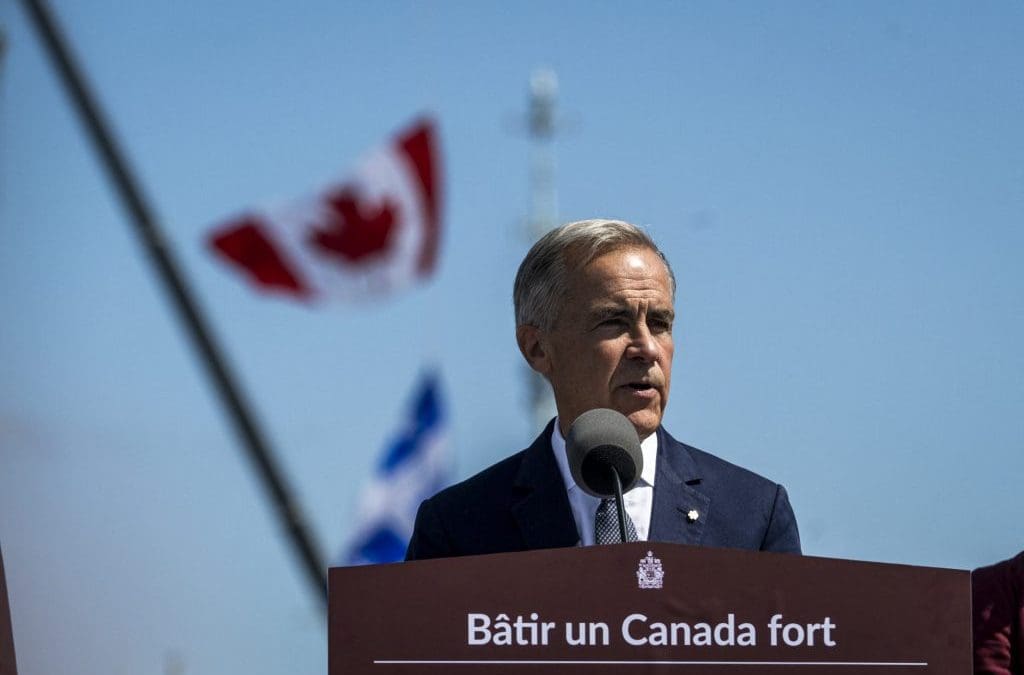
Speaking to reporters on Monday, Canadian Prime Minister Mark Carney warned that Trump’s aggression would come back to hurt US workers.
“It’s not a surprise that the US would take some form of reprisal to our response to their unjustified tariffs,” said Carney, a member of the center-left Liberal Party. “But what message does that send to the workers in Michigan and Ohio and Kentucky and Alabama who rely on Canadian demand? We’re their largest customer for automobiles, more than the European Union, Japan, Korea.”
Mark Carney: “It’s not a surprise that the US would take some form of reprisal to our response to their unjustified tariffs, which was on top of other unjustified tariffs. But what message does that send to the workers in Michigan and Ohio and Kentucky and Alabama who rely on… pic.twitter.com/2o5rbEmQAo— Aaron Rupar (@atrupar) August 24, 2026
Carney also said there was an “attitude at the negotiating table” from US officials that “Canada is a subsidiary of the United States,” which is “not something we’re going to accept.”
Ontario Premier Doug Ford, a member of the rival center-right Progressive Conservative Party, delivered a more strident rebuke to Trump, vowing that Canada’s response would deliver a hit to