by Jaclynn Ashly | Jun 29, 2026 | Article, Climate Crisis, Environment, Politics and Movements: International
Max hears the plane before anyone else.
A low hum threads through the morning air above the Sweetwaters Chimpanzee Sanctuary in Kenya’s central highlands. As it grows louder — a small propeller drifting in from Mount Kenya — Max is already moving.
He snatches a dry branch, paces the electric fence, and begins shouting — ah-ah-ah — his cries rising into a scream at the sky. He swings his arm and sends the stick flying upward. His hair bristles along his spine.
“It’s because of the plane,” says Stephen Mukundi, the sanctuary’s head caregiver. “He is remembering Burundi during the civil war.”
An view of Sweetwaters Chimpanzee Sanctuary, set on the southeastern edge of the 360-square-kilometer Ol Pejeta Conservancy in Laikipia County — the only refuge of its kind in Kenya. Photo by Jaclynn Ashly.
A caregiver hands food through the fence at Sweetwaters. The sanctuary’s caregivers live on-site around the clock, learning each chimpanzee’s temperament so closely that they decide every evening who can safely sleep beside whom. Photo by Jaclynn Ashly.
Stephen Mukundi, the sanctuary’s head caregiver, walks the perimeter of the enclosure. He arrived at Ol Pejeta in 1996 and has known most of the chimpanzees here since they were infants — a second family, he says, that he has watched go from trauma to becoming chimpanzees again. Photo by Jaclynn Ashly.
Max was born in Burundi in 1988. Captured as an infant — his mother presumed killed — he spent his early years with a French film crew before being confiscated in 1990 at around two years old, and transferred to the Jane Goodall Institute’s rescue center in Bujumbura.
When the Burundian civil war
by Noella Williams | Jun 29, 2026 | Article, Florida, LGBTQ, Politics and Movements: US, Pride, Reprint, The Cultural Front
This story originally appeared in The Progressive Magazine on June 18, 2026. It is shared here with permission.
Florida has a magic that only Floridians truly understand. The mix of whimsy, bravery, and devotion you find here is unique, as is the land itself: lush acres of forest and marshy wetlands, puppy like creatures found in springs and slow-moving rivers, beaches of white sand, and off-the-beaten-path trails.
It’s tough to be from here—we’re plagued with hurricane season, mocked with GIFs like Bugs Bunny sawing from the rest of the country, and absurd “Florida man” jokes reflecting the tired 2010s-era cliché that our state is a den of drug-addled chaos and bizarre misadventure. If you mention Florida in conversation, you’re often met with a disgusted or concerning gaze.
The state has also long served as the country’s playground—or, as scholar Julio Capó Jr. describes it in his history of queer Miami culture, a “fairyland” that lures in tourists with the promise of a quick getaway surrounded by Disney animatronics and dreamy beaches. It may be unrecognizable to visitors from outside of the state, but Florida has always been a little queer, even beyond the periphery of the gay club scene in Miami.
In the past several years, however, Florida has become increasingly known for being hostile to queer people. Republican Governor Ron DeSantis—whose term began in 2019, less than three years after the June 2016 mass shooting at Orlando’s Pulse nightclub that killed forty-nine people—is fixated on decimating Florida’s queer population and crushing the morale of our indomitable spirit. In 2021, DeSantis signed into law a provision that redefined a public demonstration of more than three people who “commit a breach of
by Michael Fox | Jun 26, 2026 | Article, Economy and Inequality, Opinion, Politics and Movements: International, Politics and Movements: US, Trump, Venezuela
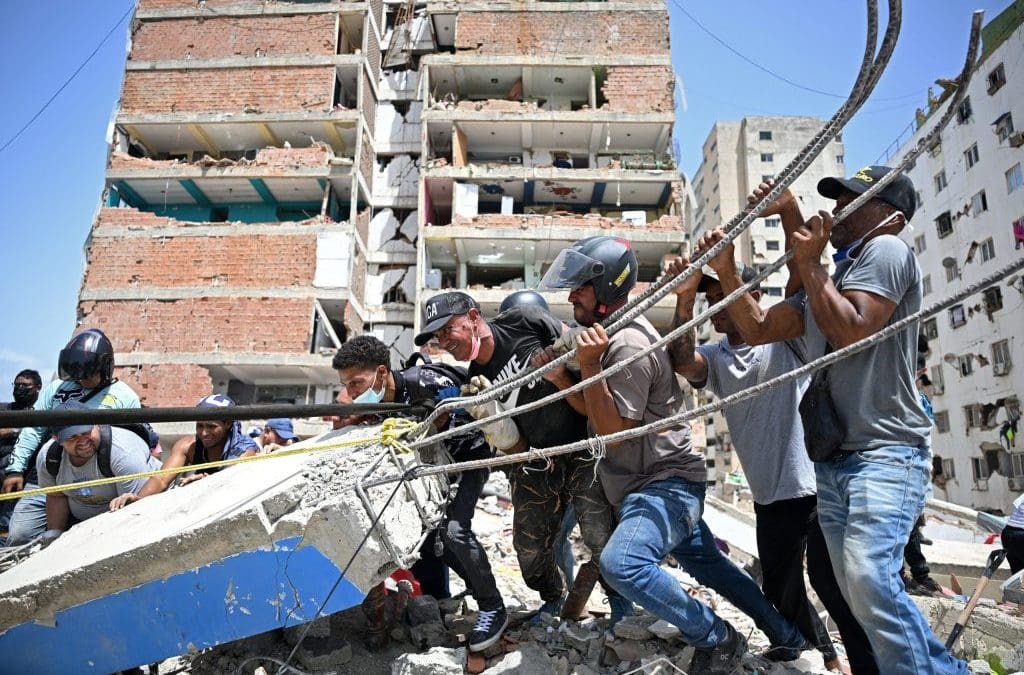
The images are harrowing: whole neighborhood blocks in rubble. Buildings collapsed. Rescue workers climbing over mountains of concrete debris fighting to find the survivors, working through the night.
A country already in crisis and shock after the Jan. 3 US invasion has been hit with another catastrophe.
A pair of back-to-back earthquakes hit Venezuela at 6:04PM local time on Wednesday, June 24. The first registered 7.2. The second struck just 38 seconds later. It was a magnitude of 7.5.
The epicenter of the quake was roughly 100 miles west of Caracas, Venezuela’s capital, but was felt as far away as Colombia and Manaus, Brazil. Reports say it was the largest earthquake to hit the country in more than a century.
Videos taken during the earthquakes show buildings rocking, the concourse of the country’s main airport shaking and crumbling as people run. The airport is now closed.
As of Friday afternoon, the death toll had risen to 920 people, with more than 3,300 people injured. Reports say the death count could rise to anywhere between 10,000 and 100,000 people.
More than 200 aftershocks have rumbled through Caracas. Many people slept outside in the streets Wednesday night for fear of the aftershocks and the structural integrity of their buildings.
The country is in a state of emergency.
La Guaira, the coastal city just north of Caracas where Venezuela’s main airport is located, has been devastated. It has been declared a “disaster zone” because of the number of buildings knocked to the ground.
#Venezuela | La Guaira suffered huge damage after a series of strong earthquakes on June 24.Aerial images taken on June 25 reveal a high level of destruction in many
by Adam Johnson | Jun 26, 2026 | Article, elections, Israel, Media Criticism, Opinion, Palestine, Politics and Movements: US
It’s simply taken for granted in US legacy media that “left-wing/progressive” electeds are driven by rigid ideology while centrists are motivated by cold, calculated, and semi-scientific concern with How To Defeat Republicans. This is a premise basically no one in our media challenges. It is asserted as pure dogma that “centrist” or “moderate” Democrats are only “centrist” or “moderate” because they are forced to be by electoral realities, and thus every position they advance is not the end result of donor pressure or class interest, but a good-faith, totally organic demand from purple-area voters they must channel if they want to “take back Congress.”
Never is this dynamic more evident in media coverage than after the left-wing flank of the party has the kind of electoral success they saw this past Tuesday, when self-identified Democratic Socialist candidates scored major victories in New York City and state office. Immediately, before the votes were even counted, corporate media rushed to take the predictable angle, “Does electing far left-ideologues undermine Democrats’ ability to win in November,” because it’s simply taken for granted that left-wing policy perspectives are mutually exclusive with “electability.”
Leading the charge was, as always, the New York Times. “Democrats find themselves squeezed by competing forces,” the paper lamented. “The party’s leaders in Washington are pushing for moderate candidates who they hope will be competitive in states and areas that have been inhospitable to Democrats in recent years. But primary voters in New York and other recent contests are moving in the opposite direction, increasingly turning to progressives and even socialists who excite the base.”
It’s simply taken for granted that left-wing policy perspectives
by Brad Reed | Jun 25, 2026 | Article, elections, midterms, Politics and Movements: US, Reprint, Voting Rights
This story originally appeared in Common Dreams on June 25, 2026. It is shared here under a Creative Commons (CC BY-NC-ND 3.0) license.
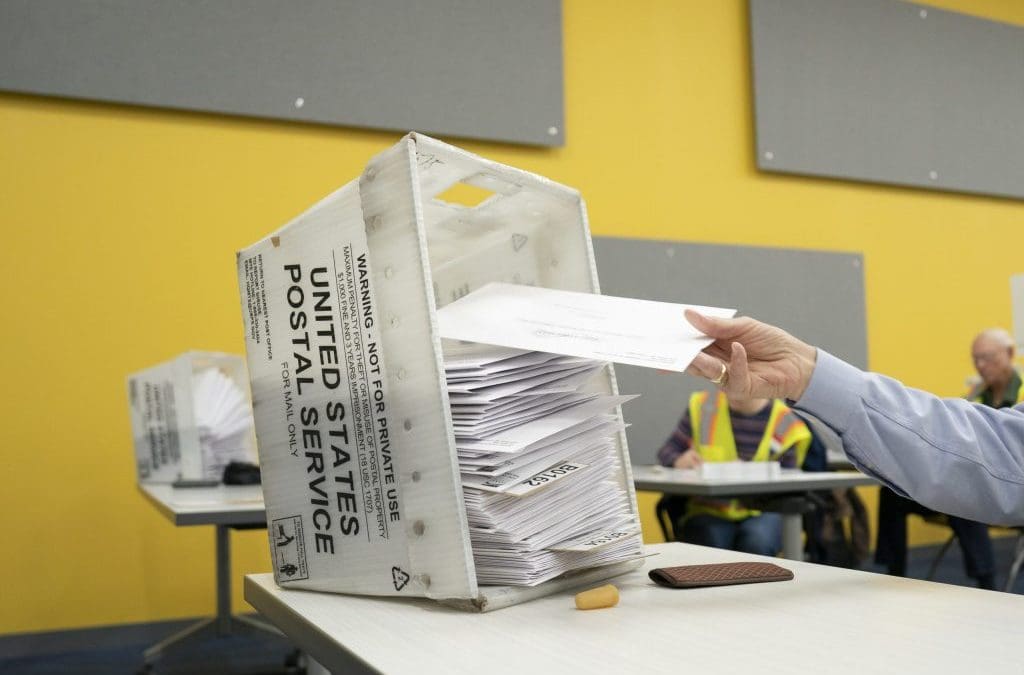
Postmaster General David Steiner drew the ire of Democratic senators and voting rights advocates on Wednesday when he said that the US Postal Service would not deliver mail-in ballots in states that do not hand their voter files to the Trump administration.
During a Senate Homeland Security Committee hearing, Sen. Gary Peters (D-Mich.), the panels ranking member, asked Steiner if USPS would deliver ballots in a state whose government had refused the Trump administration’s request for access to its absentee voter list.
“Under our proposed regulation, no,” Steiner replied. “We would tell the state that we need the manifest.”
Peters responded by accusing USPS of creating a rule that “coerces” states into handing their voter files to the federal government even though they are under no legal obligation to do so.
“You’re making a decision that people cannot vote by mail,” Peters said. “That’s unacceptable.”
PETERS: Yes or no, if a state refuses to turn their absentee voter list to the federal government, will the Postal Service still mail their ballots under this proposed rule?POSTMASTER GENERAL STEINER: No.PETERS: So the proposed rule basically coerces states to hand over their… pic.twitter.com/5bnJb5Atnr— Aaron Rupar (@atrupar) June 24, 2026
Sen. Richard Blumenthal (D-Conn.) also sparred with Steiner during the hearing, informing the postmaster general that USPS had absolutely no role to play in determining how states conduct their elections.
“You run the Postal Service, you deliver the mail,” Blumenthal said. “You don’t review ballots or registration. Nobody said you should… This proposed rule is bogus.”
Blumenthal demanded Steiner commit to deliver all mail-in ballots to voters
by Shireen Akram-Boshar | Jun 24, 2026 | Article, ICE, Politics and Movements: US, Prisons and Policing, Reprint
This article was originally published by Truthout on June 23, 2026. It is shared here under a Creative Commons (CC BY-NC-ND 4.0) license.
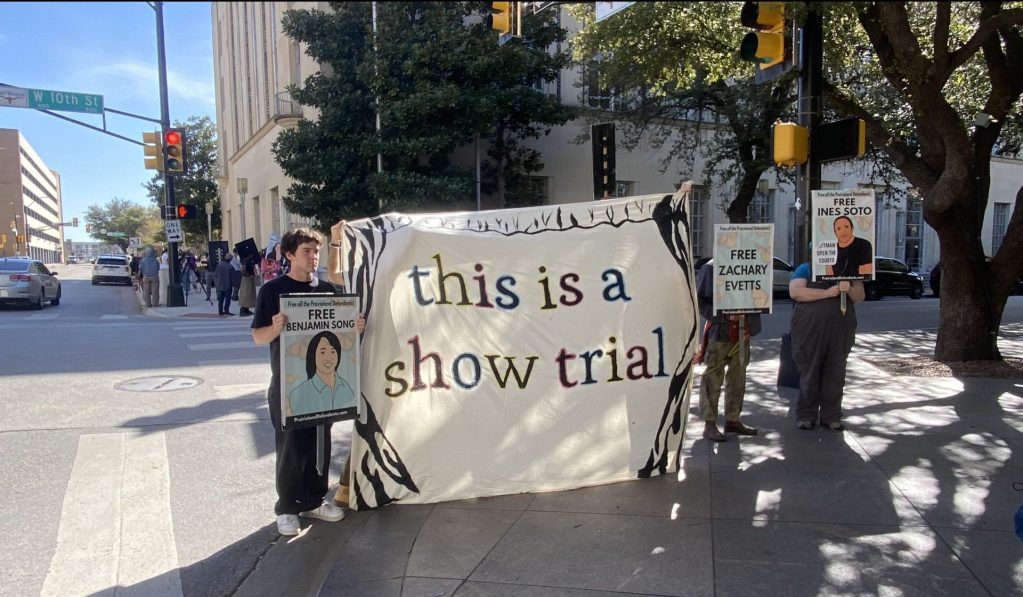
On Tuesday, eight Texas anti-ICE protesters convicted on trumped-up terrorism charges earlier this year received decades-long sentences ranging from 30 to 100 years.
Five of the defendants received 50-year sentences after being convicted of rioting and “providing material support to terrorists.” One received a 30-year sentence, and another a 70-year sentence. And Benjamin Song, convicted of attempted murder of an officer in addition to rioting and “providing material support to terrorists,” was sentenced to 100 years in prison.
The eight protesters were convicted based on a July 4, 2025 protest at the Prairieland Detention Center in Alvarado, Texas, where the activists used fireworks and noise-making to protest the immigrant jail and Trump’s anti-immigrant detentions. Police arrived at the scene, and later claimed that one of the protesters opened fire on an officer, who also shot at protesters. The next day, the FBI began raiding homes, and arresting and detaining protesters.
One of the defendants, sentenced to 30 years in prison, was not even present at the July 4 protest.
These sentences are far longer than any of the prison sentences given to January 6 rioters, the longest of which was 22 years for a member of the Proud Boys, a far right, neo-fascist militant group that embraces white nationalism, Islamophobia, and misogyny. The 22-year sentence was commuted to time served after President Donald Trump pardoned the Proud Boys member, along with some 1,500 other January 6 rioters.
But the Prairieland defendants, on the other hand, have been smeared by prosecutors as part of an “antifa