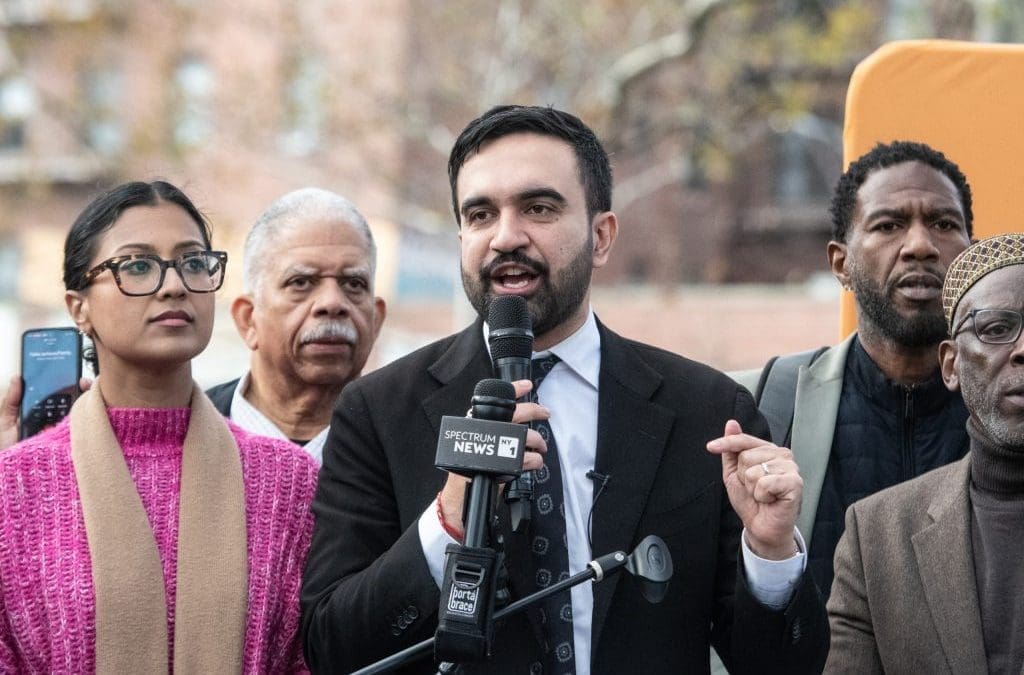
by Taya Graham and Stephen Janis | Nov 5, 2025 | elections, Inequality Watch, New York, Politics and Movements: US, Socialism, video
The mainstream media said voters wouldn’t go for him and they said “socialism won’t sell.” But on the streets of New York, people were done listening to conventional wisdom. All throughout Manhattan and from East Harlem to Queens, voters told us the same thing: they’re tired of the old guard, the empty promises, and a system that serves the wealthy instead of the working class.
Credits:
Pre-Production: Taya Graham/Stephen Janis
Post-Production: Cameron Granadino
Transcript
The following is a rushed transcript and may contain errors. A proofread version will be made available as soon as possible.
Taya Graham:
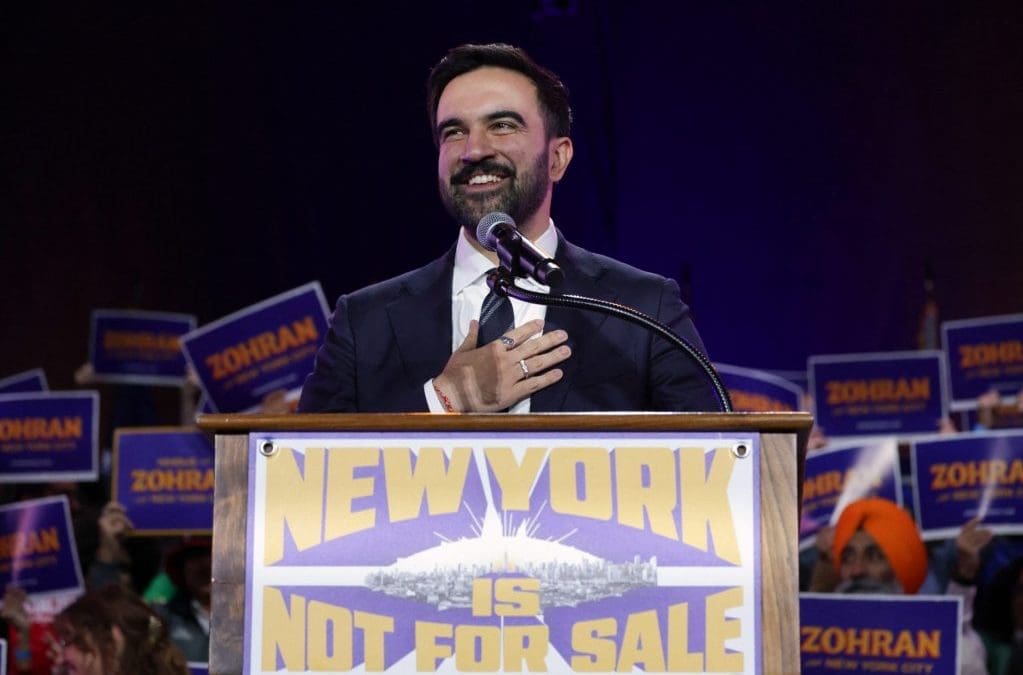
After an election where the mainstream media seemed more concerned about the idea of socialism than the issues confronting New Yorkers Democratic socialist candidate, Zohran Mamdani had a decisive victory and will be the next mayor of New York. We spent the day traveling throughout Manhattan during this record turnout talking to voters who said, this election is about one thing change. Stephen, this has been such an exciting race. What are some of your takeaways from today? Well, I think
Stephen Janis:
What it is is a big miss for the mainstream media. And the reason I say is because they were making this sort of a nationalized race that only it was about socialism and somehow Mondavi was going to be some big eyesore for the Democratic party. But what we saw here was an enthusiasm for change that was much more important than any sort of isms that could be applied to it.
Speaker 3:
Feeling excited about New York City having some new ideas standing up to Donald Trump.
Taya Graham:
Now, is there a particular candidate you feel represents
Speaker 3:
New ideas?
by Maximillian Alvarez | Nov 4, 2025 | Economy and Inequality, elections, labor, New York, Politics and Movements: US, video
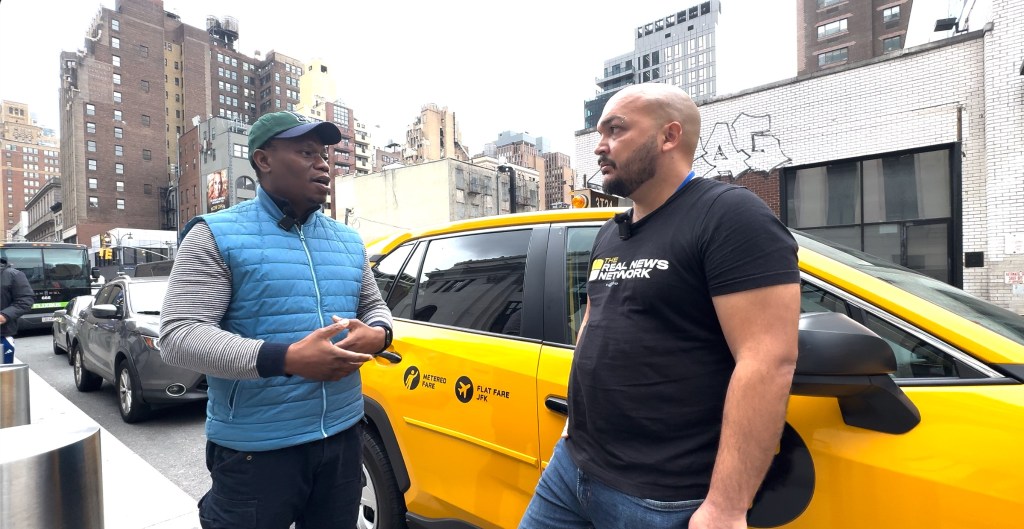
In 2021, when New York City taxi drivers were dying by suicide and others were going on hunger strike, begging City Hall for relief from the debt trap that had set them up for failure and financial ruin, a young NY Assemblyperson named Zohran Mamdani stood with them. Now, taxi drivers are standing with Mamdani in his bid to become the next mayor of New York City. Reporting on the ground in New York, TRNN Editor-in-Chief Maximillian Alvarez speaks with Yellow Cab driver-owner and NY Taxi Workers Alliance member Mouhamadou Aliyu about the ongoing struggle for justice for NY taxi drivers—and what Mamdani’s campaign means to them.
Additional links/info:
Zohran Mamdani campaign ad featuring Mouhamadou
Maximillian Alvarez, The Real News Network, “Cheated, desperate, financially ruined NYC taxi drivers go on hunger strike”
NY Taxi Workers Alliance website, TikTok, and Facebook page
Luis Feliz Leon, In These Times, “Zohran Mamdani on the night shift for mayor”
Credits:
Videographer: Maximillian Alvarez
Post-Production: Cameron Granadino
Transcript
The following is a rushed transcript and may contain errors. A proofread version will be made available as soon as possible.
Mouhamadou Aliyu:
Hello, my name is Mouhamadou Aliyu, a New York City taxi driver and a member of New York Taxi Worker Alliance. We’re so desperate we still going on a hunger strike.
Maximillian Alvarez:
So Mouhamadou, the last time that you and I spoke, it was 2021, you were on a hunger strike at the end of your rope fighting for relief from the city that had entrapped you and so many taxi drivers into this massive amount of debt to get the medallions that you need to drive a taxi cab in the city. And then the
by Taya Graham and Stephen Janis | Nov 3, 2025 | elections, Inequality Watch, New York, Politics and Movements: US, video
Taya Graham and Stephen Janis speak with voters in Harlem just 24 hours before the NYC mayoral election about what issues are important to them, what they think of the frontrunner candidate Zohran Mamdani, what they think of his opponent, former Governor Andrew Cuomo, and what they want the mayor to do for them.
Credits:
Pre-Production: Taya Graham/Stephen Janis
Post-Production: Cameron Granadino
Transcript
The following is a rushed transcript and may contain errors. A proofread version will be made available as soon as possible.
Taya Graham:
This is Taya Graham and Stephen Janis in Harlem, New York. It’s just 24 hours before the final vote for the New York Mayor’s race. So we came to this bustling neighborhood to ask voters what issues were important to them, what they thought of the front runner, Zohran Mamdani, what they thought of his opponent, former governor Andrew Cuomo, and what they wanted the mayor to do for them. But let’s take a listen to the voters themselves. Mamdani is the front runner against former Governor Cuomo. Which one do you hope becomes Mayor of New York?
James B Cray:
Mayor Mamdani.
Taya Graham:
Wow. And now why do you choose Mamdani?
James B Cray:
Well, Mamdani speaking about a lot of things that really address the people such as housing, the transportation issues. I think he’s more at the forefront of what a lot of young people want to hear about. We’ve had FOMO and Bloombergs and the cycle just keeps on going on without a lot of our issues being addressed.
Taya Graham:
What do you think about the leading candidates?
“Vincent”:
It’s time for a change and time for new blood.
Taya Graham:
Wow. I’m impressed to hear that.
by Taya Graham and Stephen Janis | Oct 29, 2025 | Economy, Economy and Inequality, health care, Inequality, Inequality Watch, Politics and Movements: US, video
As the government shutdown stretches into its fourth week, Republicans are managing the crisis as if democratic accountability no longer applies—stalling Congress, ducking public scrutiny, and holding lifesaving ACA tax credits and SNAP benefits hostage for partisan gain. The result is immediate and unequal harm: millions risk losing healthcare while one-man rule, dark money, and gerrymandered advantage erode what little democracy we have left. Reporters Taya Graham and Stephen Janis break it all down in this installment of the Inequality Watch.
Credits:
Studio / Post-Production: David Hebden
Written by: Stephen Janis
Transcript
The following is a rushed transcript and may contain errors. A proofread version will be made available as soon as possible.
Taya Graham:
Hello, my name is Taya Graham and welcome to our Inequality Watch Reaction Report, the show where we break down how money and wealth control and warp our government and the way we live today. Along with my reporting partner Stephen Janis. Hello, Stephen.
Stephen Janis:
Hey Taya. How are you? Doing
Taya Graham:
Well. Today we’re going to break down a very troubling aspect of the current government shutdown, namely that Republicans are managing it like the end of democracy is near. And this is not just about voting or the electoral system in general, which is constantly under assault, but rather how a lack of democratic accountability can affect the actions in even the psychology of a party and how it uses and even abuses power. Now Stephen, before we dig into this, and this might sound like an odd question, but why do we care about democracy?
Stephen Janis:
Well, the thing is that so far in the history of civilization, the only system
by Mansa Musa | Oct 27, 2025 | Arkansas, Economy and Inequality, Prison Industrial Complex, Prisons and Policing, Rattling the Bars, video
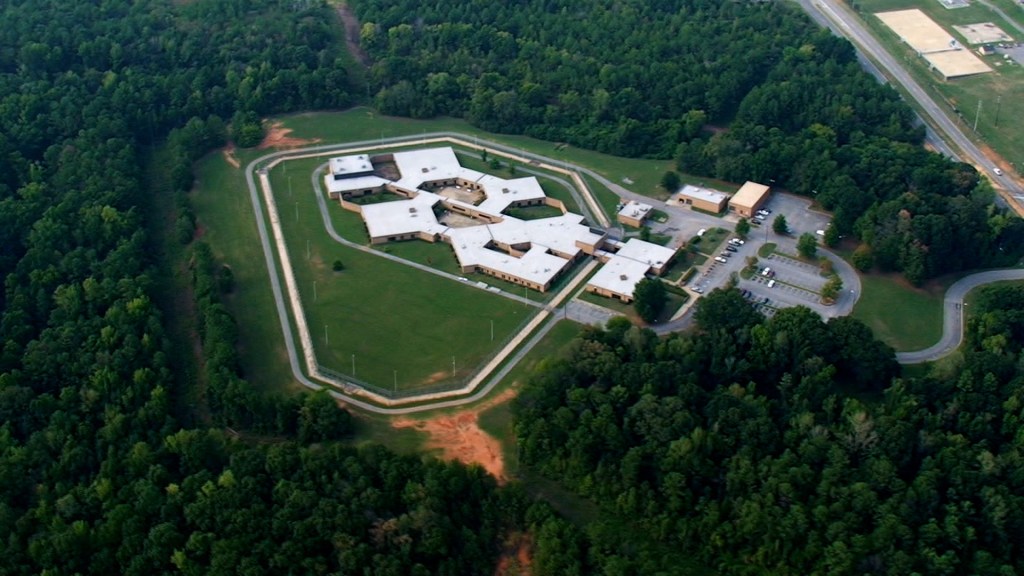
Prisons have frequently been presented as a “solution” to the economic woes and employment needs of rural communities around the US—but that doesn’t mean residents of these communities want them there. In Franklin County, Arkansas, for instance, residents are banding together in opposition to the state’s plans to build a mega-prison in their area. In this episode of Rattling the Bars, host Mansa Musa speaks with Lauren Gill, a staff reporter from Bolts magazine, and Natalie Cadena, executive director of the Arkansas-based rural advocacy nonprofit Gravel & Grit, about the fight in Franklin County and rural America’s changing relationship to the prison-industrial complex.
Guests:
Lauren Gill is a staff writer at Bolts. She previously worked as a reporter for The Appeal, Newsweek, and the Brooklyn Paper. Her reporting on the criminal legal system has also appeared in ProPublica, Rolling Stone, The Intercept, Slate, The Nation, and The Marshall Project, among others.
Natalie Cadena is a seasoned education professional and writer with over 13 years in public education and 15 years of experience in professional writing. She is also the executive director of Gravel & Grit, a 501(c)(4) nonprofit dedicated to transparency, accountability, and rural advocacy in the state of Arkansas.
Additional links/info:
Gravel & Grit website and Instagram
Lauren Gill, Bolts, “The prison next door”
Caroline McCoy, Oxford American, “Arkansas’s faulty plan to build a mega prison”
Credits:
Producer / Videographer / Post-Production: Cameron Granadino
Transcript
The following is a rushed transcript and may contain errors. A proofread version will be made available as soon as possible.
Mansa Musa:
Welcome to this edition of Rattling the Bars. I’m your host, Mansa Musa.
When we think about prisons and we think about prisons in rural America, the first thing most people think is that the rural community wants the prison, it’s the number one source of the economy for the prison. I even had this thought all the time, I even repeated that, that yeah, in rural America, prison’snumber one industry — And in most cases it is. But I also thought that the people in these communities wanted these prisons, that they were like, yeah, we want this, this is recession proof. As long as we got people locked up, we got jobs.
But this is not the case.
Today we’re talking about a new proposed mega prison in Arkansas, a project that has drawn widespread local opposition, even in one of the state’s most conservative areas. Reporter Lauren Gill writes about it in her recent Bolts magazine article, “The Prison Next Door.” She details how the plan for a massive new correctional facility has shaken the small rural community of Franklin County.
To give you a sense of the scale, Franklin County has about 2,600 residents; The proposed prison would house 3,000 people. That’s more prisoners than locals.
Joining me today are Lauren Gill, who wrote the article, and Natalie Cadena, the executive director ofGravel and Grit, a local organization leading the fight to stop this project.
Lauren and Natalie, welcome to Rattling the Bars.
Natalie Cadena:
Thank you for having me.
Lauren Gill:
Thanks so much.
Mansa Musa:
Alright, so let’s start with why the opposition, OK? Give our audience a sense of why the residents inFranklin County is in opposition to this.
Lauren Gill:
Yeah, so I think this is a story about so many different things. So, first of all, you have the state ofArkansas that went to great lengths to hide this prison project that they wanted to bring to Franklin County. And this went on for years where they were searching secretly for land in the northwestern part of the state. And then finally, in July of 2024, they find this land in Franklin County. And state staff aresending emails about it. Some people are saying, oh, this isn’t land that will be viable because of just, it’sso hard to access. And you have state staff who are sending emails like, oh, should we come up with acode name for the project? So, that really gives an indication of the lengths that they were going throughto keep this hidden from the people of Franklin County until it was finally announced on Halloween in 2024.
So, it’s a story about how people are worried about their resources, they’re worried about their way of life,but they’re also worried about how the state is spending taxpayer money and what they say is veryirresponsibly because when the project was first announced, everybody knew that Sarah HuckabeeSanders wanted to build a new prison because that was something tough on crime, was something that shereally campaigned for during her election campaign. And she, shortly after going to office, she passes thisact called the Protect Arkansas Act, which virtually ensures that there’s going to be more need for aprison, another prison by limiting parole and making sure people are behind bars for longer. So yeah, shewas going to build this prison and it was supposed to be 470 million at the outset. And I think the numberis changing as the state is struggling to find just basic resources like water to supply the site.
And right now, I think they’re talking at over a billion dollars. So it’s just really ballooned. And I thinkthere are just so many different reasons that have just emerged throughout this whole entire process thatpeople in Franklin County are noticing and they’re thinking about more. And one of them as well is what Iwas really struck by when I was down there is I’m talking to people and 75% of the county had voted forSarah Huckabee Sanders. And I have people who are telling me, I never really thought aboutincarceration before. I never thought about prisons. And they said, well, once this prison was beingbrought to our community, I did some research and I’m finding out more about how incarceration worksin Arkansas, but I’m really starting to question just the way that the state locks so many people up.
Mansa Musa:
I was reading the article and it talked about the abolition of parole and it talked about some of the crimesthat would deny you parole. And some of the crimes is like don’t even murder, not giving people parole.But like you say, to your point, they need the body. So you change the laws to ensure that you’re going tohave body. Natalie, tell us about your organization, gravel and GR and how it formed, and what are someof the organizing efforts you all have been leading to stop this particular mega prison from being built?
Natalie Cadena:
Well, thank you again for having me on. So Gravel and Grit officially formed in February of 2025, but themembers of the group have been involved since day one. The announcement was made on Halloween andon November 7th, the local community in Charleston had called the Town Hall and they were justdemanding answers from the governor. It was announced on local radio out of the blue like Here, we’redoing you a favor, here’s a mega prison and you’re going to like it. So immediately there was a responseand there was a group of people that formed an official board called the Franklin County and River ValleyAssociation, and they are still active in this process. But as we went on throughout learning about how toaddress this issue in a way that’s going to get attention and really stand out because it’s hard to getattention of your legislature if you’re not allowed.
So they had a legal angle they wanted to pursue. In that part of it, we felt like fundraising was probablygoing to be something we would need to do. So we established a nonprofit, and that’s gravel and griditself is intended to be an advocate for rural communities going forward, not just with prisons, but thereare other communities in Arkansas, especially in the Delta region, but there are other communities inArkansas that need a voice and they’re not being heard by their government either, and they have a lot ofdifferent issues affecting them. So we want to carry this on to that eventually. But for the time being,we’re singularly focused. We are a non-partisan group because as Lauren pointed out, Franklin County is75% Republican and they all voted for Sarah Huckabee Sanders.
Our group has established and agreed that we all have different beliefs on incarceration and just how toaddress public safety in general. So that’s not what we’re going to argue about. We’re going to argue rightnow, we’re going to focus on the practicality of this location, the complete disregard for local input. Evenour legislators, they didn’t know. Our conservative legislators had no idea. Our county judges, our jps,nobody was told. So we want to focus on that transparency piece and giving us a voice in what’shappening in our own community as well as the taxpayer impact. Because we project that once this is allsaid and done, given the infrastructure needs and all of the extra requirements, that this will be upwards of$1.5 billion. So that’s not good for any Arkansas taxpayer. And just imagine how much you could do forrecidivism with that amount of money addressing pretrial services or just drug treatment and reentryprograms and that sort of thing.
So that’s where we are right now. We work through the legislature mostly. We work with our senators andrepresentatives in educating them just to say, Hey, this is how much it’s going to cost taxpayers. It doesn’thave to be this way. There are other solutions. There are other locations that are way more practical. Andthen most recently you bring in the federal argument because now it’s being considered as an ice detentionfacility. That’s a whole nother level of argument that we have to address. So just in, we just got togetherand decided, Hey, these are the steps we need to take. We had great advice from some other grassrootsorganizations that help people organize in Arkansas. And then we have some really, really good supportfrom our legislators that are working with us, the ones that are supportive of us.
Mansa Musa:
Unpack this for me because build this coalition that y’all got is a coalition of under any other givencircumstance, wouldn’t have nothing to do with each other. You got the sheriff, you got the farmers, yougot the churches, you got people that have a diverse way of thinking when it comes to social issues. Whatis it about this particular issue that y’all are able to get this coalition, and how are y’all able to maintain thecoalition? It is in fact the coalition that’s generating the opposition to the building of this mega
Natalie Cadena:
Well, I think we knew from the very beginning that this wasn’t political and it doesn’t need to be political.So we need to establish right away that we’re going to take help from anybody that’s going to give us helpin getting our voice out there. And of course, one of the first people to step up was Dr. Chris Jones, and hehad run for governor of Arkansas against Sarah Huckabee and lost, and now he’s running for Senatoragainst Tom Cotton. He was considered, I think, in the running for the Democratic Party chair of thenational delegation. So he’s an incredible man. He stepped up and said, Hey, what can I do? Just nothinghe could do really other than just help us get our message out. But he came in and spoke to us along withour conservative legislators, which was I think what the community needed to see.
They needed to see Democrat, Chris Jones standing next to Republican, Gary Stubblefield to know that,Hey, this is not an issue that needs to divide us. We’ve got a lot more in common. And I think this is, we’refinding out this is true on a lot of issues, but people had just checked out politics or they had just checkedout of government. They just think it runs itself. They vote once every four years and they’re done. So Ithink for us, it was just establishing that this is not going to be political. It’s not going to be Republican orDemocrat. It’s not going to be about any of that. This is about what’s right for local communities in ruralArkansas. And so we just kind of stay with that message and it brings people together no matter wherethey’re from.
Mansa Musa:
And Lauren, talk about how the land was purchased and was it any transparency associated with it? Andif it wasn’t, no transparency associated with it. How did your investigation unpack that?
Lauren Gill:
Yeah, so this story was honestly a reporter’s dream because the coalition had gone ahead and asked forpublic records, hundreds of pages of public records tracing how the state went about buying the land forthe prison, and then any conversations afterwards. And as they continued to procure various contracts andthings related to the prison sites. So yeah, I was given hundreds of pages of emails showing how the statehad 25,000 sites that met the criteria for what they were looking for, which was like 60 miles away fromother A DOC prisons had flat land and some available infrastructure as well as access to workforce. Soobviously those are all very vague things that they were looking for, but eventually the state narrows it to6,000. They visit 14, and then they find Franklin County through, it was listed on a rural land website inJuly, 2024, and an intern finds it, sends it to the person who is supposed to be in charge of finding theland, and then they kind of go from there by the end of the month, they’re in contract for the land, butdon’t announce it obviously until Halloween.
And then would later say at the town hall meeting that, well, we didn’t want to announce it because wewere afraid that there would be a bidding war for it, which raises a lot of questions since they’re already incontract for it. But yeah, that’s how they went about getting the land, which is 815 acres. When I wasdown there, I just kept hearing from people. They didn’t understand how there was going to be a 3000 bedprison built there because people would try to build fence posts or put in basic infrastructure, and it wouldtake them forever to just nail through the sandstone. That was all over Mill Creek Mountain, which is thearea that the prison’s being built in the surrounding area. So yeah, there’s a power line that runs throughthe property, but other than that, it’s extremely rural. You get to it by a very narrow two lane road. Andyeah, it’s just super rural. So it was definitely raising a lot of questions for me about how they plan tosupport not only the prisoners and staff, but family who are visiting other people who would be needed tosupport this prison in Franklin County.
Mansa Musa:
And Natalie, what’s the status of it now? What’s the current status of the prison plan and who’s still reallypushing for it, or is everybody opposed to it and where it staying at right now? As far as the prison plan?
Natalie