by Mansa Musa | Jul 27, 2026 | prison reform, Prisons and Policing, Rattling the Bars, Trump, video, Washington
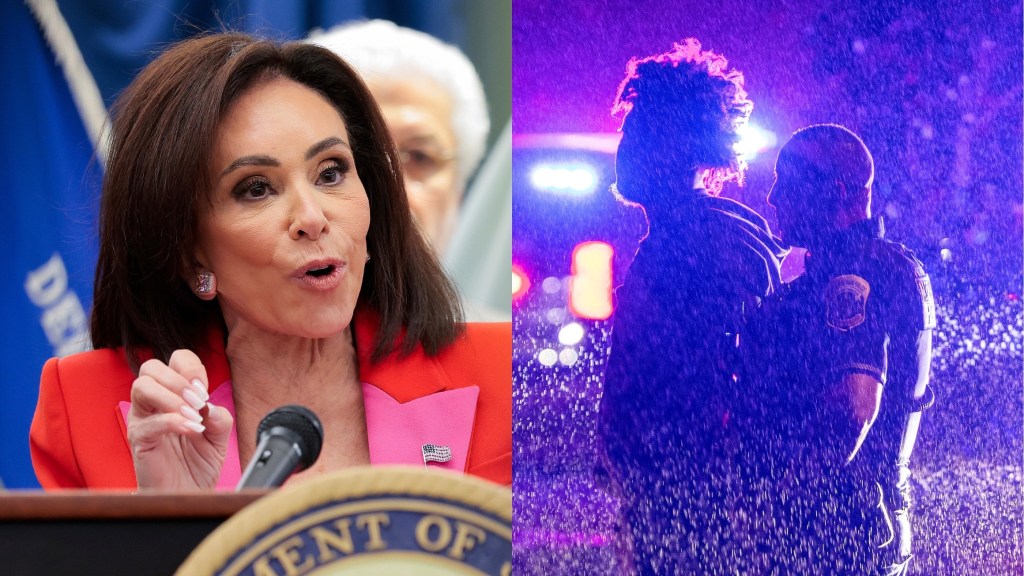
Republicans in Congress are attempting to push policies in the District of Columbia that would charge 14-year-olds as adults, increase mandatory minimum sentences, repeal the Second Look Act, and re-institute cash bail, which was banned in 1992. In this week’s episode of Rattling the Bars, host Mansa Musa reports from U Street and sits down with Bethany Young and Darby Hickey from the DC Justice Lab to discuss how the GOP is using Washington, DC, as a laboratory to wage a national crusade against decades of criminal justice reforms.
This is part one of a two-part series. Subscribe to TRNN and stay tuned for Part 2 next week.
Additional links/info:
DC Justice Lab website, Facebook page, X page, and Instagram
Sarah Staudt, Prison Policy Initiative, “Bad Omens: Reform rollbacks in Washington D.C. are a warning sign for state-level advocates”
Credits:
Producer / Videographer / Editor: Cameron Granadino
Transcript
The following is a rushed transcript and may contain errors. It will be updated.
Mansa Musa: Welcome to this edition of Rattling the Bars. We’re here in the historical part of the District of Columbia, U Street, 14th and U, 13th and U, 11th and U, 12th and U, all historic. Lincoln Theater and Benz Chillibo. We’re here today to talk to two representatives from DC Justice Lab about current legislation that Congress is attempting to pass to minimize the DC City Council’s ability to pass laws to govern this District of Columbia. Stay tuned for this interview. The District of Columbia has become the testing ground for Congress in terms of reforming so-called reform of laws that the city council has passed. So let’s talk about cash bill, what’s going
by Taya Graham and Stephen Janis | Jul 22, 2026 | Article, Economy and Inequality, health care, Inequality, Inequality Watch, Politics and Movements: US, Prisons and Policing, Trump
A few weeks ago, we argued the Trump administration was seeking to invent new ways to punish Americans. The idea was that the authoritarian impulses of the MAGA-run government will need to dial up the cruelty in order to sow chaos and pave the way for a broader assault on democracy.
Well, this week a rule was issued by Medicare and Medicaid services that shows just how proficient the Trump administration is at inflicting pain. And the consequences for poor, seriously ill Americans could be devastating.
Before we explain the rule, it’s worth contemplating the often destructive role healthcare — both the lack of it and exorbitant costs associated with it — play in the lives of working-class Americans.
Poll after poll shows that working people rank anxiety over healthcare costs at the top of the list of high-priority concerns. Unpaid medical bills are the most likely cause of personal bankruptcy in the US. Unlike any other wealthy nation on earth, when Americans lose their jobs, they often lose access to a doctor as well.
The US healthcare system is already inherently extractive — making it even more prohibitively expensive means more people will suffer with diseases that can be cured and die from afflictions that would otherwise be treatable. All of this makes the working class vulnerable and likewise incapable of asserting their right to be healthy.
And that’s where the new rule comes in.
The government agency that administers Medicaid has created a new criterion, ‘medically frail,’ which must be met to qualify for the program without working — even if you only have weeks to live. It didn’t exist prior to the passage
by Stephen Prager | Jul 7, 2026 | Article, Economy and Inequality, Oil, Politics and Movements: International, Politics and Movements: US, Reprint, Trump, Venezuela
This story originally appeared in Common Dreams on July 06, 2026. It is shared here under a Creative Commons (CC BY-NC-ND 3.0) license.
The Trump administration has seized at least $8 billion worth of Venezuela’s oil wealth since it overthrew President Nicolás Maduro in January, according to the New York Times.
Now, as Venezuela struggles to cope with a catastrophic pair of earthquakes late last month that killed at least 3,300 people and left tens of thousands more injured and homeless, and 41,000-50,000 people are reported missing, the US is providing just $300 million in humanitarian aid, a small fraction of the money it purloined.
The Associated Press reported on Monday that international rescue teams have begun to pull out as hopes of finding missing loved ones alive dwindle each day after the disaster.
🇻🇪 Update: The death toll has risen to 3,342, with 16,740 people injured, the country’s Communication and Information Ministry said Sunday. https://t.co/HQfKAMomRZ— Drop Site (@DropSiteNews) July 6, 2026
Shortly after deposing Maduro, US President Donald Trump declared that the US “took over Venezuela… and the oil is flowing.”
Economist Francisco Rodriguez has found that during the first quarter of 2026, after Trump overthrew Maduro and the US began expropriating Venezuelan oil, the country experienced the lowest rate of economic growth since 2021, even as oil exports rose.
As Roxanna Vigil, a former senior sanctions policy adviser at the US Treasury Department’s Office of Foreign Assets Control, explained in an article for the Council on Foreign Relations last month, “almost 100 million barrels of oil worth an estimated $8 billion have flowed through a process marked by no transparency and minimal oversight.”
“While the Trump administration has repeatedly framed this control as benefiting both countries, it has not publicly disclosed how much Venezuelan oil it