by Mansa Musa | Jun 9, 2026 | history, Political Prisoners, Politics and Movements: International, Prison Industrial Complex, Rattling the Bars, video
Imprisoned by fascist dictator Benito Mussolini in 1926, the prison writings of Italian Marxist theorist Antonio Gramsci remain essential 100 years later for understanding how fascism, policing, and incarceration function to suppress political dissent and preserve unequal systems of power. In this episode of Rattling the Bars, former Black Panther and political prisoner Mansa Musa speaks with renowned scholar Alberto Toscano about the importance and terrifying relevance of Gramsci today.
Guests:
Alberto Toscano is a renowned Italian cultural critic, social theorist, philosopher, translator, and adjunct professor at the Simon Fraser University School of Communication. Toscano is a columnist at In These Times and the (co-)author of numerous books, including: Late Fascism: Race, Capitalism and the Politics of Crisis; and Fanaticism: On the Uses of an Idea.
Credits:
Producer / Videographer / Editor: Cameron Granadino
Transcript
The following rushed transcript may contain errors. It will be updated as soon as possible.
Mansa Musa:
Welcome to this edition of Rattling the Bars. I’m your host, Mansa Musa. Today, this is just a political conversation that we’ll be having about fascism, but more importantly, talking about the works of Antonio Gramsci. Joining me today is Alberto Toscano. Welcome to Rattling the Bars Alberto.
Alberto Toscano:
Thanks for having me.
Mansa Musa:
First, explain to our audience who Antonio Gramsci was.
Alberto Toscano:
So Gramsci is best known as former secretary of the Italian Communist Party and one of the most significant Marxist and communist theorists of the 20th century. And most of his theorizing, such as we know today, was done in prison in a series of no books, his prison notebooks that were published after his death and after the end of World War II. It’s
by Sasha Abramsky | Jun 5, 2026 | Africa, Article, Politics and Movements: International, Politics and Movements: US, Reprint, Trump
This article was originally published by Truthout on June 04, 2026. It is shared here under a Creative Commons (CC BY-NC-ND 4.0) license.
In 2018, when the Democratic Republic of the Congo (DRC) experienced a severe Ebola outbreak, more than 30 experts from the Centers for Disease Control and Prevention (CDC), close to 20 disaster-response specialists from the U.S. Agency for International Development (USAID), and 120 additional USAID staff were on the ground attempting to manage the outbreak, according to estimates from Friends of USAID, an advocacy organization mainly made up of ex-USAID staffers. With that level of staffing in 2018, by and large, they succeeded in limiting the extent to which the disease spread.
This year, as a particularly virulent strain of the Ebola virus — the Bundibugyo strain, against which there is no approved vaccine and for which there are no medicinal cures — runs rampant in the Democratic Republic of the Congo, Friends of USAID estimate there is only one CDC staffer on the ground there, along with five additional State Department personnel. There are of course no USAID workers present, since the Trump administration dismantled USAID during the purges led by the so-called “Department of Government Efficiency” (DOGE) in 2025, summarily firing local health care contractors around the world, including in countries with extreme poverty rates such as the Democratic Republic of the Congo.
In addition, since Donald Trump signed an executive order pulling the U.S. out of the World Health Organization in early 2025 — a pullout that was completed in January of this year — CDC experts are no longer allowed to communicate with World Health Organization personnel. And despite
by Brett Wilkins | Jun 4, 2026 | Article, Iran, Politics and Movements: International, Politics and Movements: US, Reprint, War
This story originally appeared in Common Dreams on June 03, 2026. It is shared here under a Creative Commons (CC BY-NC-ND 3.0) license.
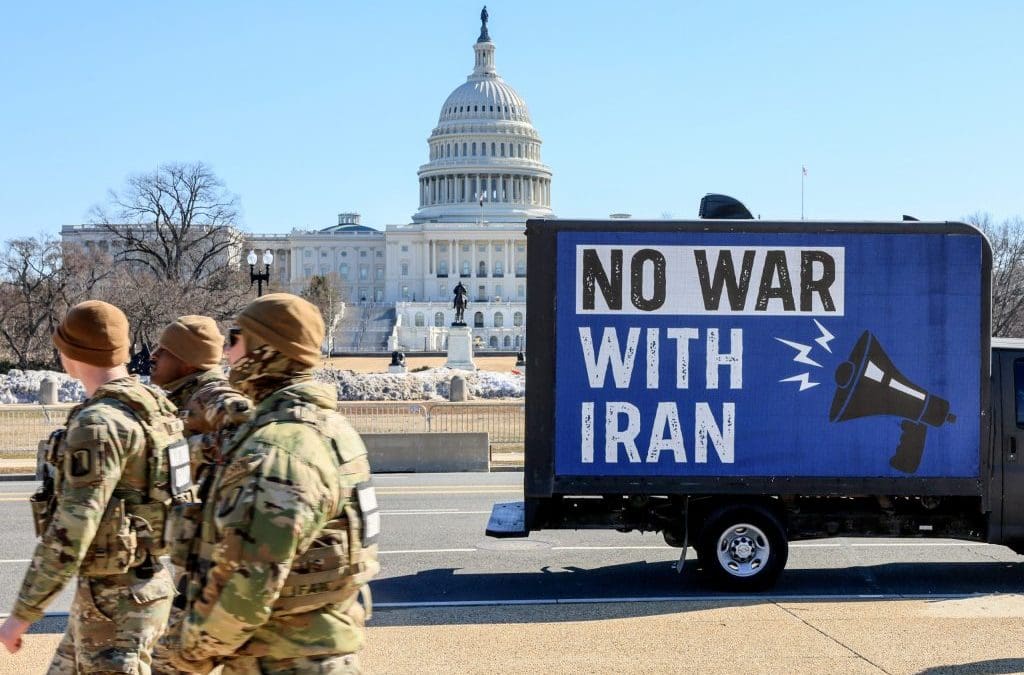
Raucous applause erupted in the House of Representatives on Wednesday after US lawmakers passed a war powers resolution aimed at ending Donald Trump’s illegal war of choice against Iran—although skeptics cautioned that the measure will likely have little impact on the actions of a president who has habitually shown utter contempt for the rule of law.
House lawmakers voted 215-208, with 7 legislators not voting, in favor of H.Con.Res.86, introduced in April by Rep. Gregory Meeks (D-NY) and cosponsored by Reps. James Himes (D-Conn.), Adam Smith (D-Wash.), Gabe Amo (D-RI), Maggie Goodlander (D-NH), and Thomas Massie (R-Ky.).
Every Democrat present voted for the resolution, while three Republicans—Reps. Tom Barrett (Mich.), Warren Davidson (Ohio), and Brian Fitzpatrick (Pa.)—broke ranks with their GOP colleagues and joined Massie in voting to approve the measure, which directs Trump to “remove United States armed forces from hostilities with Iran.”
Cheers in the House as the war powers resolution passes pic.twitter.com/nRL3eGm0Zr— Acyn (@Acyn) June 3, 2026
“We are trapped in a war that won’t end because an incompetent president launched it thinking of only his own ego while failing to prepare for the consequences,” Meeks, the ranking member on the House Foreign Affairs Committee, said during floor debate ahead of Wednesday’s vote. “Diplomacy is the only exit from this, not more bombing, not more bluster.”
The War Powers Resolution of 1973—also known as the War Powers Act—requires the president to notify Congress within 48 hours of committing troops to military action and limiting such action to 60 days, with a 30-day withdrawal period, unless lawmakers declare war or issue an
by Julia Conley | Jun 3, 2026 | Article, cuba, Politics and Movements: International, Politics and Movements: US, Reprint, Trump
This story originally appeared in Common Dreams on June 03, 2026. It is shared here under a Creative Commons (CC BY-NC-ND 3.0) license.
A trio of United Nations rights experts on Tuesday demanded that the US government “cease all threats” against Cuba and accused President Donald Trump of furthering a “disturbing trend of lawlessness” with preparations to attack the island nation; a indictment of its former president; and a protracted oil blockade that has left Cubans facing blackouts and a breakdown of their lauded healthcare system.
“Efforts to change the constitutional order of a sovereign state through threats and coercion echo colonial-era practices,” said George Katrougalos, independent expert on the promotion of a democratic international order; Zaina Jallad, special rapporteur on unilateral coercive measures; and Ben Saul, special rapporteur on counterterrorism and human rights.
The experts pointed to Trump’s declaration of what’s become known as the Donroe Doctrine, “asserting US predominance over the Western Hemisphere” through military might, and his repeated comments regarding the possibility of taking over Cuba, whose communist government, Trump has said, has turned the country into a “failing nation.”
“Statements by the US president regarding the ‘honor of taking Cuba’ reflect a deeply concerning strategy of coercion against a sovereign state,” said the experts. “This assertion is not mere rhetoric, but part of a broader strategy involving the long-standing embargo on Cuba, its listing as a state-sponsor of terrorism, the recent fuel blockade, and the imposition of coercive measures on third parties.”
Experts @profbensaul, @gkatr and Zeina Jallad express concern regarding US escalating threats, coercive measures & judicial weaponisation against #Cuba. “Efforts to change the constitutional order of a sovereign State through threats and coercion echo colonial-era practices.” pic.twitter.com/9feklXLRuQ— United Nations Geneva (@UNGeneva) June 3, 2026
In January, Trump issued an executive order centered around
by Richard D. Wolff | Jun 1, 2026 | Article, Europe, Politics and Movements: International, Politics and Movements: US, Reprint, Russia
This story originally appeared in Professor Richard Wolff’s Substack on May 21, 2026. It is shared here with permission.
By the end of World War 2 in Europe, that continent’s extremely violent self-destruction had killed tens of millions and wrecked many economies. Its politically dominant employer classes had driven their national governments to a clash that had produced those results. By 1945 the war’s outcome had proved far worse than many in those classes had imagined or wanted before the war. Europeans had struggled after 1917/1918 to overcome their self-destruction in World War 1. In the short span between the end of the First and the beginning of the Second World War, Europe destabilized itself via its reparations program, Germany’s staggering inflation, and then global capitalism’s worst ever collapse in 1929. The consequences of those destabilizations ramified across Europe and undermined the League of Nations effort to prevent a second world war.
In 1945, for most Europeans, the greatest urgency attached to recovery from the war. For Europe’s employing classes, more urgent still were defenses against certain immediate threats. Russia’s army had been crucial to defeating the Nazis and to forging Russia’s post-war alliances with Eastern Europe. The mass of the USSR’s military forces, potentially supplemented by those of its new Eastern European allies, struck western Europe’s employer classes as existential threats. After 1945, western Europe’s employer classes smoothly and quickly refocused their hatred from a dead Hitler to the living Stalin and to their nations’ communist parties allied to Stalin.
Western Europe’s employer classes were threatened domestically by communist and socialist political parties whose militants had often led underground anti-fascist or anti-Nazi
by Maximillian Alvarez | Jun 1, 2026 | Climate Change, Climate Crisis, Military Industrial Complex, Politics and Movements: International, Politics and Movements: US, The Empire Files, video, War
We sit down for an hour-long discussion with legendary independent journalist and filmmaker Abby Martin to discuss her new blockbuster documentary, Earth’s Greatest Enemy, and the existential threat that US empire in general—and the US military specifically—poses to humanity and to our planet.
Editor’s Note: This conversation was recorded on Jan. 29, 2026, before the beginning of the illegal US-Israeli War in Iran.
Guests:
Abby Martin is an Izzy-Award-winning independent journalist, filmmaker, and host of The Empire Files. She is the director of the 2019 documentary Gaza Fights for Freedom and the 2026 documentary Earth’s Greatest Enemy.
Additional links/info:
Watch Earth’s Greatest Enemy on The Empire Files YouTube channel.
Credits:
Studio Production / Post-Production: David Hebden
Transcript
The following is a rushed transcript and may contain errors. A proofread version will be made available as soon as possible.
Maximillian Alvarez:
We’re here in the Real News Network studio in downtown Baltimore and I could not be more excited to have legendary independent journalist and filmmaker, the one and only Abby Martin here with me in person. Now, some of you may not know this, but Abby is actually a Real News alumnus. And Sister Abby, I know it’s been a minute since you’ve been back here in your old stomping grounds, but I just wanted to start by saying on behalf of the entire team here, welcome back to Baltimore. Congratulations on all the incredible essential work that you’ve done and we are all just so proud of you and so honored to be in this struggle for truth with you.
Abby Martin:
Oh my gosh. Well, the feeling’s more than mutual, Max. I mean, just being here back in the studio just