Not just in the United States, but around the world, authoritarianism is rising and people’s faith in the concept of “democracy” is collapsing. “In the absence of clarity from its defenders and amid the failures of our putatively democratic institutions,” Osita Nwanevu writes in his new book, The Right of the People, “democracy has become a specious and suspicious platitude, equally useful to marketers and would-be dictators—a hollow idea for a hollow, unserious time.” How did we get here? And what will it take to revive working people’s faith in democracy, not just as a philosophical ideal, but as a real, practiced force that will improve their lives? In this podcast, recorded at
in Baltimore on August 12, 2025, TRNN Editor-in-Chief Maximillian Alvarez and Chris Lehmann, DC Bureau Chief for The Nation, speak with Nwanevu about his new book and the fight to reclaim democracy in an age of rising authoritarianism.
Transcript
The following is a rushed transcript and may contain errors. A proofread version will be made available as soon as possible.
John Duda:
My name is John Duda. I’m one of the worker owners here at Red Emma’s. We are a 20 plus year old radical worker owned bookstore, restaurant, social center, and we’re excited to see you all in the dog days of August and the waning days of the American Republic. We are tonight joined by a wonderful panel chief. Among them is AED Nueva, who is here to launch this amazing book, which I’ve been looking forward to for a long time. I think really grateful to be launching this book. It’s kind of a nerve wracking book because part of it is a catalog of everything that’s wrong with the system that sometimes we call democracy, but as he shows, really isn’t, I got to admit, it woke me up in a fit at one in the morning. So if I seem a little incoherent, it’s because this book caused me to lose sleep.
But as I finished it this morning in my sleep deprived days, it actually, there was something relaxing about it because once you accept that we’ve actually never really had a democracy in America and that it’s going to take generations to build it, it actually, given what we’re seeing today, given all of the shit, all of the backsliding, we know that we’re not losing something that we were actually had, we’re being set back in a struggle that’s a lot longer and has always been a lot longer than just the machinations of the current fascist regime. But to help us work through this today, we also have some amazing panelists with us. We have another good friend of the cooperative here, max Alvarez, editor-in-chief of the Real News Network. And then for the first time we have Chris Lehmann, who is a, I want to say legendary editor, a fantastic run at the head of the Bathler, an incredible generational run at the head of the New Republic, and now the bureau chief for DC for the nation. So excited to have these folks here tonight to talk to us about democracy or lack thereof. Please join me in giving them all a warm welcome.
Chris Lehmann:
Well, thank you all for coming out again in a hot August night or late afternoon. As John said, I’m Chris Lehmann and both Max and I will be enjoying the great opportunity to engage with Oida on these really urgent questions raised in his book, which are not, as John alluded to by any means, sort of academic or theoretical for us at this moment. I drove up from the newly anointed garrison state of Washington to be here today. And that experience just covering Trump’s surreal and fascist racist press conference yesterday was a good sort of distillation of a lot of what O CDA argues in this book, which is to say there is this kind of capital R resistance narrative about the Trump moment being a moment of profound backsliding where we have betrayed our faith and trust with the democratic ideal. In reality, it’s been an accelerationist moment.
It’s harnessing all of the very potent and not even dormant, but latent, I guess you could say, anti-democratic energies in the American political system. And so the challenge going forward in wrestling with this moment is that we are the sort of inheritors of an oligarchic system that uses a very loose rhetoric of democracy, largely to defend status quo arrangements. And to sort of get to the bottom of this morass, you actually need to return to certain basic first principles of what happens to one person, one vote when again, in places like Washington, there is no congressional representation. There is no ability to pass laws or a budget without congressional interference. What does it mean to say that Trump is an existential threat to democracy when the US is exporting a genocidal war in Israel? None of this actually works out at a basic level of logic. And the great virtue of O’S book is he began sort of unpacking the mythology we’ve used to avoid talking about substantive democracy in this moment. So with that all in view, I will toss over to Max.
Maximillian Alvarez:
Well, I just want to say before we get real deep into Osita’s incredible book, what an honor it is for Oita and I to be sitting with Chris who, without whom, I don’t know, I won’t speak for Osita. I mean, I’m sure he would’ve found a way, but I would not be where I am without Chris. And that is true of many of us that you read and see in left and independent media like both as the leader of a news network. Again, it’s never lost on me that I wouldn’t be here had Chris not believed in me in my writing 10 years ago. And also when I look for role models, I have very few, and you may not know it, but as far as like guys who have stuck by their principles and been chewed up, turned out, spit out, and somehow kept coming back and leading different newsrooms to improve, this is the guy that has managed to make a career the right way. So let’s give it up for Chris.
Chris Lehmann:
I think we should all also have a moment of silence for Max because anyone in the position of adopting me as a role model isn’t desperate straight. But thank you.
Maximillian Alvarez:
It was very, and Chris in ota, I just could not be proud of you brother for getting this book out. And I know it was a real slog, but it feels like it’s coming at the right moment when we need it most. And I really appreciate you for that. And like Chris was saying, we were all watching what’s going on in dc. I mean Donald Trump is Federalizing DC police calling in the National Guard. I was just back home reporting in Southern California where he did the same. And I came into reading ADA’s book with one of my favorite book titles from Sister Astor Taylor, another shout out, another Baffler contributor. She has one of the best book titles of all time that’s always swimming around in my head. Democracy may not exist but will miss it when it’s gone. So I’m coming into reading o’s book with that in my head and my head’s on fire with everything in o’s book.
And then I’m watching what’s unfolding over the last 24 hours. And I know we don’t live in a functional democracy in the way that any of us were taught to believe it, but I know when I’m seeing these images that I’m watching the death of something. And so I wanted that to sort of be the springboard for us to talk about and introduce your book Oda, what can your book, what does it give us and people like us who are feeling that same way to help understand what we’re seeing and help know to do what to do next. And let’s use that as a springboard for a larger introduction to what the book is.
Osita Nwanevu:
Sure thing. Thank you for that introduction. You’ve been a real supporter of me throughout the entire process of writing this, and I could not be more grateful, Chris. I could be here for the next hour talking about how grateful I am to you for hiring me at the New Republic. But everything that Max said was absolutely correct. You’ve been truly a real model. If that means bad things for me in the future, I don’t care. It is a fact. It’s true. And I’ll always be grateful. And while we’re doing Thanks Red Emmas, I’ve been really proud to be a part of this community for some years now. It’s not just a great gathering place and a point of community for Baltimore, but it is a place that instantiates every single day, the democratic values that I talk about in this book and inspiration to cooperatives in the city and around the country. And I would not have imagined starting this tour anywhere else but right here. So thank you for that as well.
What I think we’re staring down with the Trump administration, I think is fascism. You can continue to debate that point academically if you’d like to, but when I see people being whisked off the street and put into unmarked vans for expressing opinion, that’s really calling of all I need to know personally. And when you talk about something dying, what is the thing that we’re all kind of feeling? What is the collapse we’re all trying to interpret? I think that what’s collapsed is our kind of faith in the system broadly understood. These institutions that I think all of us are taught, or most of us are taught in school, were designed to prevent the rise of somebody like Donald Trump have not only failed to do that, but as I argue in this book actually helped him come to power the Democratic Party, which I think people might’ve hoped would be an effective bulwark against the radical right against Trump’s fascist movement.
I think its messaging has failed. I think its political approach and strategy has failed. I think even us on the left as much as energy and as much sweat as we’ve put into organizing the last 10, 15 years especially, we’re still a lot of work cut out for us in terms of building a true left majority in this country. And I think the people are kind of taking in all of that and wondering what the next steps are, where do we go from here from this point of collapse? And my book is a humble effort at constructing something that I think might be useful vision moving forward, which is taking democracy seriously, not just as a by word, not just as a cliche, but as a really, really deep system of ideals that I think has animated a lot of people on the left for a long time.
But that conception democracy has not been that prevailing understanding of democracy within mainstream politics. And I’m trying to, I think, bring people who are concerned about Donald Trump concerned about this moment, concerned about authoritarianism into a more ambitious and frankly more radical understanding of what democracy can and should mean for us and to get to a truly democratic America. I think that we have to take a critical look at our existing structures, existing systems, not just in our politics, but within our economy. And that’s what the book in a nutshell is fundamentally about and trying to do.
Chris Lehmann:
Yeah, and actually to put in a plug for my current home publication, the nation is running an excerpt from O’S book about economic democracy that goes live Thursday. So if you want, I mean you should obviously buy it here tonight, but you can send the link to your friends and that I think might be a good place to start the project of engaging with what a democracy worth preserving looks like in this country. And you talk about the first order failure, and I felt this all during the Kamala campaign in 2024, where it was a central theme of the campaign that Donald Trump is an urgent threat to democracy. We have to protect our democracy. And at the same time, there were genuine economic ills and inflation wasn’t under control. And the Trump campaign was able to cynically exploit that and cynically do these absurd gimmicks like suspending taxes on tips, suspending interest payments on auto loans, and Trump even dressed up like a McDonald’s worker to sort of drive home this idea that we are the party of the working class, the forgotten Americans.
And of course, when fast forward, whatever it is, 10 months, and the CBO report just came out on the combined effect of both the quote, big beautiful bill and Trump’s tariffs, and literally every decile of the American income spectrum is going to be paying more. So we don’t have to at Red Ams of all places. We don’t have to belabor this point except to say how is it that the Democrats in particular have become so flatfooted on what had historically been they were the party of workers, and how is it that the Republicans have found it so easy in the broader conditions that we all work and pay our bills under to present themselves effectively as that?
Osita Nwanevu:
Yeah, I mean, as I say in the introduction of the book, which is written after the election, a publisher did not like that they wanted an introduction well before, but there in the introduction of the book, I think that people in this last election felt that they’re being asked to make this binary choice. On the one hand, you can vote to save and protect democracy, which is this kind of that your civics teacher told you was important in sixth grade or something, or you can vote on the basis of your own economic self-interest. You’re paying too much for your groceries, you’re paying too much in your rent, you dunno how you’re going to pay your mortgage, et cetera, et cetera, et cetera. I think people saw themselves as having to make this choice between this ideal that Donald Trump was violating and their own material interest, which they, I think mistakenly believed many voters mistakenly believed that Donald Trump would be able to improve their material law. And that is not a way, first of all, that’s, it’s not a very compelling way to sell a democracy.
If it’s justice, abstraction, justice kind of academic thing that has no connection with your own lived material situation, you’re going to lose that fight to people making other kinds of appeals unless you can sell democracy. And I think truthfully argue for democracy as something can actually materially empower us and improve our standing in the economy, Democrats did not do this. And I don’t think it can be a surprise that for many of the critical constituencies that they needed to win in this election, people chose differently. The Gallup did a poll earlier last year where they found, I think 70 something percent of the American people, 74% it might’ve been, who were dissatisfied with the way American democracy was functioning. That’s not an environment where you want to come in as the people representing the status quo, representing the defense of institutions. You have to speak to that institutional cynicism.
And most Americans are not taking political science classes and they don’t know what senate mal apportionment is and all that, but they do, I think correctly feel that Washington is not set up to work democratically in their interests. They do know even if they don’t have the numbers, that the wealthy corporations get their way more often than not in Washington dc. And so I think people saw that and they saw this kind of defensive our democracy instead of themselves, well, hell, this democracy of ours has never really worked for me. And as a matter of fact, to the extent that you’re telling me that Donald Trump is going to disrupt and destroy those institutions, I might want that to happen. I might vote for him for that reason. And so I think a way to talk about democracy that is more compelling and I think more robust and full is one where you say to people, there’s something about democracy in the system of ideals that actually empowers you materially.
It’s not just about the right to vote. As important as that is, it’s not just about denying or rejecting efforts to overturn the election in 2020. It’s important as that was, but it is a system, it’s a set of ideas, a set of values that will actually improve your own material situation, material standing and ability to live the life that you want. And that’s a conception I’m kind of arguing for in this book, but I think that that can only come if you take a step back, go back to the drawing board and think kind of ambitiously and from first principles, but what democracy even means to begin with. For me, the definition that I came to after reading many dusty and dry books that I don’t know that you should read yourself work for you in a lot of political science or whatever definition I’ve come to that feels most simple to me is democracy is a system in which the govern, the people who are themselves subject to government are the ones who are doing the governing.
It’s not a system that lets some higher authority, arbitrary king or sort of rulers rule over you. You yourself have the power to govern or in Lincoln’s construction government of buy. And for the people, I think there are a lot of technical reasons I get into why that system is better than other alternatives ruled by the few in some guys or another, whether that’s a monarchy and oligarchy. But the thing that I think is increasingly compelling to me is a justification for democracy is this almost spiritual intuition that we, each and every one of us are entitled to a measure of control over the conditions that shape our lives that in this brief time we’re around, it is wrong for us to live as victims of arbitrary circumstance. It is wrong for us to live under in enthrall to hierarchies of people who happen to be born while you’re in more powerful than that.
So there’s something about that and spending our time dominated in that way that is unjust. And so democracy offers us a means to exercise some agency in the time that we have to exercise agency. And if you think about democracy at that level, it becomes very, very clear and obvious, at least to me. And I think a lot of political scientists who aren’t even leftists actually, that’s not just a system of ideals that tells you that you deserve the right to vote and go to the ballot box every couple of years, but that’s a system that says something about what you’re entitled to in the economy and at work
We spend about a third of our lives at work. The decisions that are made at the top of corporations we work for often affect us more directly, intimately and immediately than decisions made in Washington DC or City Hall. And we have very little democratic agency in the economy and at work at all. How can it be the case that somebody who works at Amazon, and I think this is true, this should be true, can go to the polls every two to four years and vote on the basis of what they think are foreign policy should be with respect to Russia or Iran, but has no place in their life where they get to say, this is how I think Amazon should be run as a worker who’s actually at that business generating that business, making what they do possible except for voting within a political system that is also dominated by their bosses at Amazon. That is a democratic problem, a democratic question, and you only come to understand that as a democratic problem if you take a sufficiently ambitious and first principles grounded view of what democracy is about in the first place.
Maximillian Alvarez:
I want to hover real quick on the relationship between democracy and material abundance or having one’s materials needs met, right? Because when you were saying that, a light kind of went on for me and it struck me that the 2024 election was in a way, a sort of bizarro reflection of the post nine 11 moment. And I’ll explain what I mean. Chris and OTA know this, and if anyone’s listened to my show, they know this, but I grew up deeply conservative in that era. I was in high school when nine 11 happened, and I didn’t know shit about shit, but I was with the majority of Americans fully on board, my family and I with this notion that we were going to go spread democracy around the rest of the world that we were going, we were invading Iraq, we were invading Afghanistan somehow in the name of democracy.
Again, not really knowing what democracy meant like Osda is showing, but having the gall to support such an effort because at that time we were middle class and it felt like the economy was doing okay for a lot of us. And when we talked about living in a democracy, let alone having the right to go out and spread democracy and invade other countries to do so again, something felt right there, not because I knew that the system was working, but because as a subject of that system, it felt like the bargain was still being kept and then all of that was effectively broken with the crash, the recession, and it’s just kept breaking ever since. And I think more and more of us have found ourselves falling into that meat grinder over the years, and then fast forward to 2024 where we’re making kind of the same sort of appeals from the Democratic party that we got to defend democracy, the faith bottomed out, and I was like, well, I don’t live in one because I, everything sucks and everything’s worse for my family. And so I think that that is kind of one of the ways that the false connection to democracy maintains when a relative degree of material wealth is available to people, and when that craters, the absence of democracy, real democracy becomes all the more apparent. And so I wanted to ask, what are the kind of tangible examples that people can grasp onto and that you examine in this book where we actually are practicing more democratic control over the conditions of our lives?
Osita Nwanevu:
Well, I think we’re sitting in one place like that. As I said at the beginning, I mean, worker cooperatives are, I think the fullest instantiation of economic democracy, places where workers themselves are running the business, own the business, manage the business, and are making democratic decisions about how things should be run. It’s a small sector in the United States right now, but I think it is a model for the kinds economy that we might aspire to have someday. So you come to places like Redx and you can see that this is not just a kind of pipe dream. This is not just a kind of abstract theory. The businesses can work like this in span. They have this company called the Mongan Corporation System of cooperatives that is actually very, very serious. They manufacture industrial products. There was a profile that Nick Romeo of the New Yorker did a couple of years ago about the business where they said, look, when you look at the kind of patents that they’ve been able to do and the kind of things that they built, it’s very possible that items sitting within a couple of feet of you right now was manufactured by the Mon Dragon Corporation in Spain, the system of cooperatives.
I think that that matters. I think there’s ways you can talk about this economic stuff that makes it seem like it’s so far away and so distant and so impossible to reach for it. I don’t think that has to be true. I think that having visions for the economy are important, and there are all kinds of other economic policies that I talk about in this book too, that have some elements that we’re already kind of seeing at work in the United States today. So I’ve been doing some reporting on worker standards boards, for instance, these panels in different industries around the country, cities and states have set these up where worker representatives and representatives from a particular sector, particular industry and state representatives come together to make decisions on basic working agreements. People see this as a step towards sectoral bargaining, which is common in Europe, a system where instead of firm by firm by firm or workplace by workplace, you need organizing.
You have these agreements that govern an entire sector of workers, and it’s not so hard to get people covered when it comes to their basic wages and working conditions. You’re not doing this kind of whack-a-mole approach to labor organizing. I think that in Europe you have kind of intersecting model of labor power where you have those traditional unions, you have sectoral bargaining, you have co determination, which always also talk about in the book where workers are representative on corporate boards and can vote in corporate decisions at that level. You have ideas like Bernie Sanders offered in 2020 for inclusive ownership funds. This is what John was talking about. They did this polling at the Democracy Collaborative, I believe it was years ago, where Americans were asked, what if we had a policy where companies of a certain size were required to give over, let’s say 20% of their shares to a fund that would be owned and controlled by workers that would pay them out dividends and that would give them voting rights.
In my recollection, and John probably remembers this even better than I do, American supported this idea up to 50% ownership of the company. Why is that? I think that people didn’t understand that proposal as this kind of crazy radical leftist thing. They said, hell, I work for this company. I do what I make it. What does possible. I’m entitled to something more than just my pay. I have a voice that ought to be heard in the basic decisions that are being made here. So I think all of these things are part of an economic agenda that is democratic and it feels, I think, novel in the American context, and it might be exciting to people who want to hear new ideas about addressing our economic situation addressing economic inequality. I think these are also ideas that would build democratic power in a way that would help us in our politics. Let’s say you’re not a leftist like I am, but you’re somebody who’s really, really concerned about tribalism or polarization and isolation. All these things you hear about in the Atlantic Magazine.
One great way to build community amongst people to get them to talk across difference are structures for labor power, whether that’s a union or some other kind of formal organization at work that brings you together with your fellow workers to hash out disagreements, make compromises, make arguments, practice these political skills that ideally we’d be doing more to practice than just trialing ’em out every two to four years in an election. If that was something you were doing on a regular basis, I think that would down to the benefit of our political cohesion as a society. So yeah, I mean, I think that all of these things intersect and interact as a democratic agenda, and it’s a fully conception of democracy again than what we’re used to hearing from our politicians, and I think that makes it rather exciting.
Chris Lehmann:
Yeah, absolutely. Though, naturally the question arises, you’ve sort of sketched out what should be on paper, a very simple program, right? There is tremendous polled support for workplace democracy. There’s tremendous suspicion of corporate oligarchy. There’s this, as we’ve been talking about, a deep drive to challenge the system and the status quo. And so why isn’t this translating into a mass left politics and more specifically, inevitably, I have to ask, why is Democratic party so utterly fucking clueless about
Osita Nwanevu:
This? Yeah, I mean, we could be here all night trying to delve into that question. I don’t know that I have the skills. I’m not a psychiatrist. I don’t know what exactly is going on there. I think there’s a confluence of different things. I think money matters, the fact that they’re being paid by corporations to avoid some of this agenda and some of this talk. I think complacency matters, chair cracy matters. There’s all kinds of cascading influences.
Chris Lehmann:
Not to interrupt, but I think there’s also a credibility problem when you have repeated elections where you say, look, there’s an existential crisis facing our democracy. And as we’ve seen in the last six months of the second Trump administration, Democrats have ruled over on Trump’s appointees. They voted for the Lake and Riley Act, the atrocious demagogic immigration bill. They voted to support the genius Act, which is like, that is the opposite of a small democratic political economy agenda if you’re enabling crypto Barrs and de regulating
Osita Nwanevu:
Banks. That’s, but to go to the other parts of my book, I think that there are also structural things we can point to here. So it matters, I think, for the contours of our politics that a resident of Wyoming has about 67 times representation of residents of California in the United States Senate.
Chris Lehmann:
But Liz Cheney supported Kamala. I’m kidding.
Osita Nwanevu:
Well, this is important to
Chris Lehmann:
Point out
Osita Nwanevu:
Liz Cheney. I believe that she, in all sincerity is offended by Donald Trump attempt to overturn the 2020 election probably genuinely offended by the January 6th attacks. Does Liz Cheney believe that a resident of Los Angeles should have as much power in our political system as one of our constituents in Wyoming? No, she doesn’t believe that. No, there’s not a single person who probably
Chris Lehmann:
Couldn’t afford to
Osita Nwanevu:
Who believes that,
But you welcome her into your political coalition out of an insufficiently serious understanding of what democracy means. It should mean more than just opposing people stealing elections. It’s like a very minimal kind of baseline thing. That’s fine. I think that’s great. But I think another minimal hurdle you should meet is believing in political equality that no matter who you are, no matter what the color of your skin is, no matter where you happen to live, you come into our political system, into the political process in equal standing with other people in your polity. That’s a baseline, I think, ground level democratic principle. And once you take that seriously as simple and as common sensical as it sounds, our existing political system is totally untenable in very basic ways. You talk about Washington dc, Washington DC is a city of about 700,000 people. More people, in fact, in Wyoming is an entire state that does not have full voting representation in Congress. They have a single non-voting delegate, Eleanor Holmes Norton, who cannot vote in the final passage of legislation that matters. You don’t even have to read this book to understand that that’s a democratic problem in 1978, I think more Americans should know this, that Congress actually passed in a bipartisan basis a constitutional amendment that would’ve given DC to senators
And the requisite number of representatives bipartisan Strom Thurmond voted for this, right? If you’re opposed to DC having full representation in Congress, you are to the right of Strom Thurmond’s on this question. It went to the states failed in the States as a constitutional amendment. Why? Because I think people understood
Speaker 5:
Benefit, right?
Osita Nwanevu:
I think that there was a racial question, a racial issue, should we have a majority black city empowered federally in this way? Republicans increasingly outside of Washington, were being pulled to the right, and I think opposed statehood or opposed, this was not statehood, but opposed fully voting rights for DC on that basis. And that’s where the movement for statehood emerges in the 1980s. This is a basic problem there. 4 million Americans for whom this is true, Puerto Rico has most of them. I say in this book that we should offer the Puerto Ricans a choice. Do you want independence or do you want to join this wheezing, jalopy known as the United States. And so it worked towards who carry better system. I think that should be left up to them, but the status quo is not tenable. And I think in very basic democratic ways,
Maximillian Alvarez:
I mean this is a basic ass point, but I think it really should be said that it can’t be underestimated how much damage to the concept of democracy. It has done that one of our two parties calls themselves the Democrats
And they suck so much. And that association with the word, with the name, with the people, with the process, it accrues over time. And that was true when I was a conservative. That was true when I was a lefty nut job over and over again. My disappointment with the democratic party tends to correlate with my lack of faith. That democracy as such is working. And I hear that from a lot of the folks that I talk to, and I think o’s really pushing us to take seriously how we use that term. And I think we should even broaden that to other terms on the left. One that I think about a lot is the leftist knee jerk, good faith tendency to champion community when so few of us actually know what that word means or feel. Any real genuine sense of community. I’ll be honest, I don’t have a big community. My family lives in California. I work all the time. I know people through work. I don’t have a big community. And so
Chris Lehmann:
He has cats.
Maximillian Alvarez:
Yeah, I got cats, my wife and I, we got our cats. But that’s all to say that when I hear people say community to me without it resonating in any sort of meaningful deep way, it cheapens the term to the point where I stopped caring so much about it. And we should care about what community we shouldn’t cheapen it. And same thing with democracy. We don’t give up on it because the term has been so laden with all this crap. But if we’re going to defend it, we need to be really clear about what it means and how it can help improve our lives and save our world from going to total shit. So more democracy equals better outcomes for working people. Let’s take unions as an example. Walk us through Oce a how unions are one of the few institutions, but not the only, where that makes more sense for people.
Osita Nwanevu:
Yeah, I mean, the unions are a straightforward instantiation of economic democracy. They’re formed either by literal election or by majority consensus. And on that basis, they organized the behalf of workers and give them the voice they would not otherwise have in their workplace. And that gave workers in a time when unions were more powerful in this country. In the fifties, there were about a third of the workforce was unionized that were down into workers material benefit. I think it’s been estimated that about a quarter of the decline in inequality between the 1930s and the 1960s is attributable to union membership. Some of the rise, a good proportion of the rise in the equality since unions have declines since the 1970s is attributable to the decline of unions. So it really mattered to deliver people better wages, better working conditions, but also made them, again, agents in their own life.
You don’t have to just take whatever boss tells you. You have an institution, you have advocates that work on your behalf. You can come together with your fellow workers and organize and do something together. That’s a level of agency that really matters. In Washington DC, they were representatives of working class people. Right now we have a lobbying scene in DC that’s obviously dominated by major corporations and business interests. Unions. Were one of the few institutions that would go to Washington and really fight for legislation on the benefit of working class people, instrumental in putting together the new deal and the great society agendas in their absence. That power is eroded, and I think we see the consequences all over our politics and all over our economy. So these worlds are intertwined. And when I started writing this book, I started writing this book in 2021.
I was getting into these economic arguments and I was like, you know what? This makes sense to me, but I’m not sure it’s clear enough to people that these conversations had to be had in tandem. And I wish there was a way to sort of more easily and simply convey that fast forward to this year where literally the wealthiest human being on earth, because he donated $260 million to Donald Trump’s campaign is awarded with a position in government where he fires thousands of federal workers, ends programs, restructure the executive branch to his liking because he just has the money. I could not have constructed a caricature. I know
Chris Lehmann:
Right
Osita Nwanevu:
Of our political situation with respect to economic inequality than what Elon Musk did and we’ll continue to do in policy. I mean, he was going over, I think it was in Wisconsin, this election where he was literally offering people million dollar checks if they could prove that they voted in this state. You can’t make this. It was almost too convenient. For me, this matters. We’re heading into a world where we’re going to have the first in our society, the ancients, whether it was Greece or Rome, these people took seriously the risks that concentrations of wealth would pose to political institutions in a way that we don’t. I think we’re operating this fantasy land where you can make as much money as you want and create as much economic power as you want, and political system will just keep chugging along in a way that makes sense. It’s not how it’s worked. When I was up the New Yorker briefly, I covered the Amazon HQ two process where cities were offering tax incentives and to rename themselves and do this and that in the hopes of getting the city to choose them as their headquarters processes that were shielded, blocked away from the public. People didn’t know what was going through these incentive packages. I think we can expect more and more of our politics even below level of Washington DC to look like that.
Again, these are basic democratic questions that I don’t think we could ignore. I don’t think we can sort of shun to the side. I think very well-meaning people who are political reformers will talk a lot about Citizens United campaign finance reform, lobbying reform. But you’ll read these books and they’ll be all they say about the economy as though if we just pass the right laws,
Chris Lehmann:
Right
Osita Nwanevu:
We will fully insulate our system from the influence of the wealthy. Well, one of the reasons why we can’t pass those laws is because the wealthy influence the system to prevent us from passing ’em.
But the impact of economic inequality is so much more diffuse than people handing each other checks for their campaigns. People who serve as politicians to a large extent are millionaires in this country. They send their children to the same schools as the corporate leaders. They are interacting in the same social circles. Meanwhile, those of us who try to make independent decisions as voters are getting our information from a corporate media that is profit driven depends on advertising for major corporations that influences coverage in all kinds of ways. There’s this paper that was done a couple of years ago on economic coverage, economic reporting that found, well, the metrics that we use to convey to people how well the economy is doing. Things like the Dow Jones Industrial Average, GDP numbers, I’ll tell you a macro story about what the United States is doing economically, how it’s doing economically, but those metrics often don’t have a direct relationship to how ordinary people are feeling. There are figures like corporate earnings, those numbers, they make sense as indicators for wealthy people, and that skews our perception of how the economy is actually functioning. So in all of these kinds of ways, inequality and concentrations of wealth, consciousness of power affect our politics in ways that you can’t just legislate away or you can’t just do away with overturning students to united. You have to really deal with inequality on its own terms as an economic question. And that’s what I think part of the economic portions of this book are trying to get us to think through.
Chris Lehmann:
One question that occurred to me as I was reading the book and occurs to me more broadly as I deal with the insanity of our public life is, and you don’t address this directly, but I’m just curious what you might think. I often find myself in a very, I don’t know, furtive and guilty way feeling almost nostalgic for the Cold War, not in the way that Max was describing of yeah, America first, blah, blah, blah, but it exerted a lot of discipline on these same elites. The idea that there was a serious ideological rival for global hegemony meant that maybe we did have to do something about racism just if only for appearance’s sake, and maybe we do have to make sure that union or that workers have job security and pensions. And so part of me thinks that absent that sort of disciplinary function, the ID of the American right has run wild. And I don’t think it’s a coincidence that the America first part of the Trump movement is so prominent because it is a rejection of that Cold War order through and through. Anyway, I just wanted to get your
Osita Nwanevu:
Yeah, I mean I do think about this a good deal. It’s not really in the book, but when it comes to things like the Trump tariff policies and our entire orientation towards China, I think that people are trying to reconstruct a Cold War arrangement, substitute the Soviet Union for the Chinese now, and it’s leading to a lot of, I think economic delusion. Again, the thing that made, whether it was a union, whether it was a job at a steel mill or an auto plant good back in the day, they sort of romanticized times of old was not the fact that there was something magical about working the steel plant that makes that a good job…
Chris Lehmann:
A union
Osita Nwanevu:
Unions. You had labor unions that fought for better wages, working conditions that extracted those from employers. This idea that if you, in our battle for world dominance with China hike up tariffs enough, a Ford plant is going to start sprouting up in somebody’s backyard with ready to, it is insane. It’s insane. So I think you’re right in the sense that on issues like racial inequality for instance, there was a drive to show up the Soviets by dealing with racial segregation, and that might’ve been useful to a certain extent, but I also think people don’t need to be told. There are also a lot of negative aspects that competition, and I think that that’s kind of replicating itself now with the ways that we talk about China. It feels to me like we are engaging with that battle and that sort of fight for global supremacy in a way that is intended to sideline the issue of labor justice and labor equality.
Chris Lehmann:
Yeah, I think that’s key.
Osita Nwanevu:
It’s the chinese’s fault that we have bad jobs now and you need to bring the steel plants back. It can’t be the case. You can just organize service workers. That’s not a thing. You need people making cars because that is automatically a good job. Nevermind the fact in the places we have people making cars in this country now today in the South. Those are not good paying jobs. People are losing their arms and legs. They have very few labor rights.
Chris Lehmann:
They’re a right to work state.
Osita Nwanevu:
Exactly. So again, how do we talk about this in a way that resonates with a broad swath of the American electorate and this broad swath even within the Democratic party? I think one way to sort of reductively capture the project of this book is that I’m trying to look at the person who I think is rightfully outraged by the authoritarianism of Donald Trump and the authoritarianism of this moment and all that he’s done, that it’s bad and say to them, well, if you care about authoritarianism as you should, there is this other whole sphere of our lives where we are functionally living with authoritarian structures and living with less power than we ought to. And that is the economy.
And if you are passionate as you should be about protecting democratic values, instantiating making good on the promise of American democracy, that is an obligation. That means you should also take seriously how little power workers now have in our economy. And if you repair that, you’ll actually do a whole lot, not just to improve their material lives, but to prevent the continuing drive authoritarianism on the right. I think that these projects have to be united. It is an effort to get somebody who watches M-S-N-B-C to care about labor rights. I think that’s the most protective framing of this project possible. We’re working on it. We’re working on it. We’ll see if it happens. But I think that democracy is a very powerful idea in this way. Even if you’re not somebody who self-consciously considers themselves on the left, people have good feelings about the concept of democracy. They want to feel that they are working for democracy towards democracy, at least on the democratic party side. If we can sort of pull people in that way to our economic project and economic values, I dunno, I think it’s worth a shot.
Maximillian Alvarez:
I think you’re right, man. And I wanted to sort of maybe transition us by way of getting us to the q and a portion. We really want to hear what you guys think. I was wondering if we could sort of end on that note of how important it is to see democracy as something that we all do and not just a thing we all have, and that’s supposed to do things in our name. And trying to think of where people can practice that doing and in so doing, become more hungry for more democracy because they see the benefits of a system where their democratic input improves the functioning of their lives. And so of course, everywhere I go, I’m telling people, join a union. Start a union. If your union sucks democratically, retake that union and make it better. Right? I mean because not just because I believe that every worker deserves a union and should have a union and that bosses should not have the authoritarian dictatorial power over our lives that they do in this country.
But because when I see and hear stories from working people who have had that experience, the small democratic experience of making something happen as a group, not always getting your way, but being satisfied with majoritarian consensus because it’s the best for all. And it’s not the end all be all, but there’s a process for improving things like having a say, having one’s voice heard, feeling like one’s voice deserves to be heard in the first place. When I see working people who have never experienced that before in or outside of the workplace, and they get a taste of it, they become a different version of themselves and they become a more powerful version of themselves. We all need to become those more powerful versions of ourselves if we’re going to start going on the offensive and reclaiming the terrains of life that have been democratized, exploited, and taken over by the rich. I wanted to ask, where else can people practice that in the smallest of ways, even in their own damn apartment buildings, but where and how can people get that taste for real democracy and build on that momentum?
Osita Nwanevu:
Well, I mean, I think red Emma’s people know that these spaces as well, I think you’re right to mention apartments, people doing tenant organizing, interact with people in these ways, bring people together in similar ways. There are other kinds of organizing you can do, whether it’s mutual aid, whatever, but it’s that same basic feeling. How do we give people agency that they don’t presently feel that they have? And again, if democracy has experienced this way is not just this thing that somebody’s telling you about on tv. It’s not just this kind of abstraction about voting in a system you don’t really believe in, but it is the way that you got your last raise. It’s the way that you addressed a working condition that sucked something at worked that was bothering you. I think that you become more committed to it as a system of ideals.
And I think that actually makes you more prepared to say, this person in our politics who’s an authoritarian, that’s a system of values that I don’t like. I can see the impact of that on my life in my own personal life, the way having a structure function that way. And I’ve seen by contrast what democracy can do in a very real material way because it’s embodied my economic wellbeing. And so I’m prepared to reject even political authoritarianism on those grounds rounds. So anywhere people can work to bring folks who are disempowered together in realization of their own agency to change things that is practicing democracy and the more concrete way. One of the things I point out in the book is, look, this is a long-term project, especially at the federal level of very gradual generational reform. I think we should abolish the Senate. Is that going to happen tomorrow in the next 10 years?
No, it’s like 2100 maybe. I dunno. But at the state and local level, your access to reforms is actually much, much greater. State constitutions are much easier to amend. In fact, people have input all kinds of policy items, progressive policy items within state constitutions, on education, on environmental policy. I think that can be one place where you actually build up labor rights. You have to deal with the preemption of federal labor law and how the interacts with state law. I’m not going to bore you, but there are things we can do, I think even within government, the state and local level to try to build up worker of power and to democratize our existing state and local political institutions as well. So that’s something else to try. But yeah, anywhere where you are actively working to bring people together to change their conditions and telling them that they don’t have to accept the way things are, they don’t have to accept being under the thumb of some boss or some higher up person that doesn’t respect them. Anytime you’re telling them to challenge that system, you’re participating in a very meaningful way in democracy.
Chris Lehmann:
I think we should probably open the floor to other questions.
Maximillian Alvarez:
Well, let’s give it up Osita real quick. Everybody. Okay. Now we’ll open up for questions.
Audience Member 1:
Thank you. I was struck by what you said earlier about sectoral organizing, and I had a two-part question. One, do you think there are structural issues the way our system is set up with the federal and state level to doing that in this country slash the size of the country? I’m curious if there are other countries of this size in the world that do sectoral organizing and if that size of the country limits the possibilities or makes it more difficult to implement. But the other side of that question too is do you see AI as a threat to all of these things that you’re discussing today? And how do we combat that?
Osita Nwanevu:
Yeah, we could be here for another two hours on ai. I have a lot of very heated thoughts about all that’s happening. I don’t know. I don’t even know if I want to get into it. I do see it as a threat to labor rights and the agency of workers. We’re seeing workers already replaced by these being replaced by these systems as somebody who believes that writing and art are creative labor. The fact that we have these systems built upon the stolen work of writers, illustrators, photographers, artists of all kinds without any compensation that matters as a labor issue to me. And it’s striking that nobody in politics, nobody in Washington really seems to take that seriously. But even beyond that, we’re already dealing with AI’s impact on the workforce. And actually we’ve had a couple of interesting conversations with some people about whether AI specifically might be a way to kind of test out sectoral bargaining.
If we can create agreements within workers of a particular sector, clerical workers, for instance, in a given city or state where you’re bringing together companies, you’re bringing together workers, bringing together representatives from government to hash out basic guidelines on how AI should be used. That can be kind of proof of concept for how sectoral bargaining might work in future. So I think they’re actually intersecting conversations. But as far as sectoral bargaining broadly considered is concerned. It’s more common in Europe. We’re a very large country that makes everything kind of difficult and hard. But you could have regional sectoral agreements. All companies in a given industry within this part of the country have a sectoral master agreement so on makes it maybe a little bit more manageable to run and to govern. But I think that the existing NLRB framework for labor organizing just does not work.
We should pass the PRO Act. We should make it easier to reform. Traditional unions, obviously in all kinds of ways people talk about all the time, but the process of going HoCo from firm to firm workplace by workplace is going to be so difficult. It’s just difficult to imagine getting up to a reasonable amount of unionization through that process. You need something larger. One way to bring workers all together and by the thousands across lots of workplaces together under the same agreements. And that’s what the promise of sectoral bargaining is. We have these panels that I talked about that are examples of how this could work out. We have a fast food council in California. I did some reporting on Colorado’s standards board for direct care workers industries that are particularly hard to organize traditional unions within, or especially promising for sectoral bargaining. So I think we should look to that, but I also think we should be even more ambitious than the Europeans in certain respects in thinking about how they could be democratically structured. What if you could vote for your worker representatives on the board? There’s an electoral process where you choose people you think are going to be the best people to represent your fellow workers on the sectoral panel if there’s a kind of sectoral Congress or something like that. I think that’s actually an exciting democratic way of making them even more ambitious than they are in current proposals. And I think that’s worth exploring.
Maximillian Alvarez:
Yes. And I want to just throw two quick examples out there for the non-labor folks. So on the sectoral bargaining, why should we consider it, right? Because the system we got now, like Osita said, we ain’t winning. We keep losing. Union density keeps going down. And even the unions that we do have are so vastly outmatched by the sectoral collaboration of the ruling class that we’re fighting against. The railroads are a perfect example. I mean, the corporate consolidation and Wall Street ification of the railroads has been happening for decades to the point where over the past 40 years, we went from over 30 different rail companies to four that own it’s a cartel. They don’t compete with each other. And now Union Pacific and Norfolk Southern are about to merge again and they’re going to be three. And these companies that operate as a cartel are going up against in bargaining like 13 different rail craft unions, which is insane because you got rail workers at all different points of the industry, but they’re bargaining in their own little different sector and sides of the rail industry.
And of course you see the value of that because the needs of someone who’s working in the rail yard fixing broken trains are different from someone who’s going out to fix track or someone in the dispatch office or someone who’s driving those trains, of course. But again, the unions, the less unified that they are and the more scattered and the less just manpower like numbers that they have, the less power that they’re going to have to contend with these fucking companies. So that’s just one example among many in which even with the unions that we’ve got, we are so far outmatched to the monsters that we’re facing that we got to be thinking big. And one other way to think big that like OTA said, goes beyond the NLRB model of organizing is thinking of ways that you can harness the power of communities to act like unions.
And they don’t have to just be labor unions. I mean, step up, Louisiana is doing this with dollar stores like the one across the fucking street. They get dollar store workers, customers like church members in the neighborhood who all start showing up to protest the fact that there are only two workers in those horribly understaffed and stores. So you get stakeholders to show up for each other and build a collective voice focused at a singular problem. Another really great example of this is the Immokalee Coalition of farm workers in Florida who don’t have sectoral bargaining, but what they have done is use people, power workers and their supporters to put pressure on companies like Wendy’s and grocery stores to voluntarily sign labor community standards. And they say, if you don’t abide by these standards and treat your workers according to these standards, we’re going to boycott your ass. Right? I mean, so there are ways that we can harness sectoral leverage without needing the long-term process of formalization, but we’re not going to get there unless we practice democracy every step of the way.
John Duda:
I’m going to go over there.
Audience Member 2:
Hi. Thank you so much for this fantastic talk. I had a quick question. I am 100% on board with this idea of strengthening political democracy. I’m also 100% on board with the idea of building and strengthening economic democracy. I’m not yet convinced of the connective tissue between the two. And I guess my question is in the places where we have, where the people have the strongest political representation, don’t you talk about Wyoming having 60 to one political representation over people in California. They’re the most hostile there to these ideas of labor rights. These are right to work states, et cetera. And then on the flip side, if you look at the places where some of the places where we have the strongest economic democracy unions, especially a lot of our public sector unions, we saw recently some political backsliding toward Trump and authoritarianism. So why do we think that strengthening one or the other will benefit the opposite? Why wouldn’t they just continue to undermine the other? Why is there a relationship?
Osita Nwanevu:
Well, they’re going to undermine the other if people don’t perceive the connection themselves. I mean, I think that people in Wyoming are not well-served by living in the right to work environment, labor environment as well-represented as they are in our politics. If they use that representation to vote for politicians that abrogate labor rights, they’re going to suffer. They’re going to suffer economically. I dunno that they’re, from my perspective, just because they’re well represented, it doesn’t mean that they’re acting democratically in their own interests. And you have to make the argument to them that these things are connected. And I think that they are, again, we have a political system that is dominated in very, very obvious ways by major corporations. The wealthy, you don’t get the just outcomes and sensible outcomes when it comes to policymaking. We want, unless we deal with that problem. Political scientists have been very troubled by this for a long time.
Students as united, et cetera, et cetera, et cetera, they are connected. Again, when unions were stronger, they were one of the few institutions that you would had in Washington DC that were not trade associations, that were not lobbyists for major corporations that were there to represent people who would otherwise not be well represented institutionally within the system. I think that we have suffered with the decline of unions in that respect, as ordinary, as ordinary workers. There have been a study that I talk about in the book where even the words that are used on the floor of Congress to describe the economic situation and the concerns that people talk about in their floor speeches, there’s been a meaningful shift in that given the decline in labor power in the United States, people are talking less and less about worker rights, minimum wage and so on, and talking more and more about narrow issues of direct appeal to major corporations and corporate shareholders. So these worlds are linked and intertwined. Voters might not perceive that, and if they don’t perceive that they’re going to maybe vote for their own democratic representation as people in Wyoming or a small state at the expense of their own economic empowerment or vice versa. I mean, unions traditional. You can talk all day probably about the problems with traditional unions and teamsters and et cetera, et cetera, et cetera.
Maximillian Alvarez:
But I’ll give my answer off the air. I want to make sure people can ask Osita their questions.
Osita Nwanevu:
But yeah, by no means true that just because you’re in a union, you believe in a progressive economic or social gender, an agenda that ought to be as economic progressive as it could be. But I do think that they’re a good starting place. I think that you’re better off or we are better off with unions as a potential place where you can build that politics than we are without ’em. And I think that history shows that, but that’s not going to mean that every trade union is going to have the right positions or agree with me on everything, if that makes sense.
Chris Lehmann:
Yeah. I think,
Maximillian Alvarez:
Oh, please, Chris, go.
Chris Lehmann:
Oh, no, I was just going to, just feeding back. Sorry. I was going to note that for instance, patco, the Air Traffic Controllers Union that was famously broken in 1982 by Reagan endorsed Reagan.
So that’s a sort of capsule portrait of what I think Sean Duffy could be court in or his membership is already suffering. And I think the other sort of relevant data point goes back to the Democrats, and we are in many ways living through the consequences of the Democrats embrace of free trade. In the nineties, when the Clinton administration made a very deliberate calculation to embrace nafta, to embrace the WTO and the savvy Beltway wisdom at that time was, what are workers going to do? Vote Republican? And they do. And now 30 odd years later, we have the answer. So I think this is not just again, to beat up on the Democrats, which I’m always happy to do, but to point out that there are real consequences when you divorce yourself from a core constituency like that. And the political consequences in this case were protracted. It took a good long time and it took the 2008 calamity, I think, to really surface it. But this is why I’m basically seconding oida that unions imperfect as they are, they’re often corrupt, they’re often self-dealing. They exist, and they are a voice that potentially that carries more democratic potential than big pharma or big oil or big maga.
Maximillian Alvarez:
Yeah, God damnit, you could make a real argument that in fact, the continual collapse of our democracy or what remained of it has coincided with the collapse of organized workers having more of a say in their lives, Allah unions. And with that, as unions have declined for the past 40 years, inequality has skyrocketed, right? I mean, Reed Hamilton Nolan’s book for a deeper dive on that. But that doesn’t mean, like you said, unions are perfect. It just means without those where else do you have the ability to tell a boss that, no, you got to pay me more. No, you can’t force me to work in those shitty conditions. And in fact, when unions were at their strongest, they were at the tip of the spear of social issues. When the Cuyahoga River was catching fire every year, the UAW was leading the charge against the companies that were polluting that river.
But then when you started getting globalization, the eighties, the neoliberal turn, when auto companies had a much bigger threat to make to say, we’re going to close this plant and go to the south, or we’re going to go across to Mexico, suddenly unions stop talking about social issues, and they only focus on their healthcare and their pay and benefits. So it’s been a long process and unions have contributed to their own decline. And the one thing that I would say that really makes the argument for OCE a’s book is that the most energy that I’m finding from labor right now is coming from people who believe in the principle that more democracy equals better outcomes. The UAW, their old leadership has been sitting in prison because they were so goddamn corrupt, and the union members led a democratic uprising to elect a new progressive slate and get President Sean feign in there who led the standup strike at the big three before. At the same time, the UAW workers rebelled against their previous international union leadership when they were 10,000 workers were on strike at John Deere, and the union leadership was saying, Hey, you guys should accept this shitty contract. They voted it down twice and stayed on strike and got a much better contract
Chris Lehmann:
I’m from the hometown of John Deere. So represent,
Maximillian Alvarez:
Just like we’re saying with the Democrats in democracy, there are so many people who have their handprints on the enshittification of the institutions that we actually need to save ourselves right now. So we can’t rely on those shitty people to lead those institutions. We got to take ’em over. We got to have a democratic, rebellious overtaking of the organs, institutions, and mechanisms of power building that have just eroded in front of our eyes over the last few decades. That’s whether it’s unions or something else, we got to be the ones to really inject it with that rank and file democratic input and accountability to make them into something that can actually fight
Osita Nwanevu:
To make a technical nerd point. Again, the Europeans have kind of figured a lot of this stuff out. I hate, I feel like very few Americans are persuaded by the idea that we should be Sweden. And so I hesitate
To argue on that basis. But look, in Europe, you have a whole labor infrastructure. You have traditional unions, you have works councils, you have co determination, you have sectoral bargaining. They all kind of intersect with each other and give workers different kinds of powers at different levels of organization, whether the results of that, they have better social mobility than we do. Workers have paid leave as crazy as that, that it’s required. I mean, it’s a different environment, and I think we told ourselves so often in this country that the way that things are, as far as the labor economy is concerned, are the way things have to be. If we want economic growth, we want people to innovate and so on. I just don’t think that that is true. I think we’re falling behind some of our peers with very different labor arrangements, and I think that’s all the more reason why we should again, build a real understanding that there needs to be a democratic reform to our economy that builds up worker power in different kinds of ways, both traditional unions and other forms of organization. If you want to read about this more in depth, Sharon Block at Harvard University has had this project called the Clean Slate for Worker Power. That’s like a full kind of platform that I drew upon substantially for this book, and it talked about how these different aspects of labor economy can intersect in a better system.
Chris Lehmann:
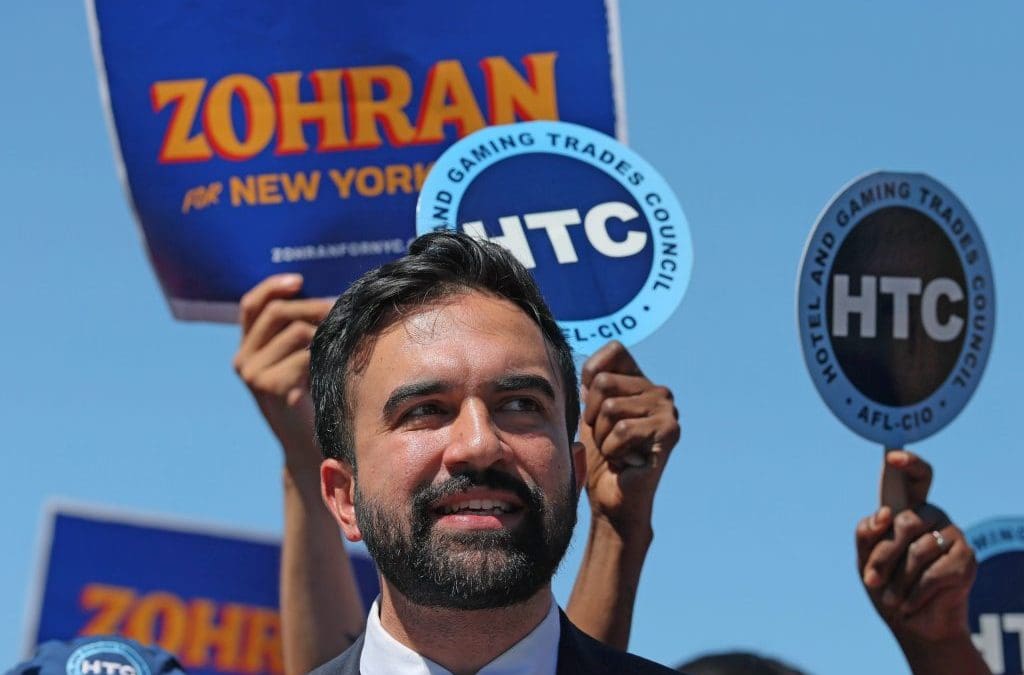
I also just feel like we should note that in the Momani campaign in New York right now, we are sort of seeing a proof of concept underway for the argument of your book, broadening the idea of democracy to include core economic relations and reintroducing, however, I don’t know how it’s going to work, but worker power sort of at the foundation of the Democratic Party in New York, which that’s a big ask because that is the city most dominated by wealth in this country. So I think it bears watching. I’m cautiously optimistic. I mean, I actually think a socialist is going to win in New York, which is, it feels weird to say those words out loud.
John Duda:
Anyone? So I had a question, actually, we’ll go back over there. I wanted to ask a question about roughly American exceptionalism in your book, and I’ll ask it three ways. I’ll try and keep it really schematic. Sure.
So first, there’s a lot of dysfunction in American democracy, but we see that dysfunction mirrored in a lot of other liberal democracies. We see the same weakening center. We see the same kind of tentative surges towards a left populism, and then we see the same sort of really scary rise of authoritarianism, whether it’s Bicon or Erdogan or a F day. There are things happening that are similar even in systems that are very different procedurally from the dysfunction that you really track very well in this book. That’s the first schematic. Second schematic is over the same time period that we’ve seen the neoliberal decay stagnation of the US roughly from the mid seventies, we’ve seen a place make tremendous strides for ordinary working people. China, in just in sheer material terms for hundreds and hundreds of millions of people. That has very, you could say a lot about China, but one thing you probably can’t say about China is that it’s oriented and focused around democracy.
The third thing is carbon democracy globally. The question of democracy in the 21st century, to me, seems to be something that would actually transcend the boundaries of the nation state, right? That if we actually had a democratic world order that was addressing the problem in front of us, it would be one in which we had actual democratic power that could strain our actions here in the United States in our planet, wrecking mode of imperial existence. So those are kind of three angles towards this, and I know it’s a big vague question, but I’m just kind of curious. If we are talking about a multi-generational process of rebuilding democracy, why should we stop at a democracy that ends at the American border?
Osita Nwanevu:
I don’t know that we should. I do think that the project of global democracy, if you believe in that project, is going to be hard to accomplish if the United States remains a kind of authoritarian fascist state. Things don’t go well here if things don’t go well here. I think it’s hard for any kind of liberation to succeed across the globe. And so you kind of have to improve this situation somewhat. That’s just what I happen to believe as far as the reality. And you’re right, I pointed out that we’ve seen the rise of authoritarianism in all kinds of countries, including countries in Europe with better political systems, better labor environment than I describe.
All of the reasons that have contributed to that are not just structural reasons. There are things like tech. They’re fueling the rise of authoritarians abroad. But even in comparing our situation to, let’s say France, for instance, Marine Lapin did not launch an attack on the French legislature that happened here. The kinds of violence that we see amongst Republican politicians. I think that Daniel, what’s his name? Steven Tyranny of the Minority, this book by Steven Ziot and Daniel Levitsky from a couple of years ago. They point out that even to the extent that we see far right parties rising all over the world right now, the Republican Party as is distinctively violent character that we’ve seen play out under Donald Trump. And so I think things are worse here, and I think things are worse partially as a function of the unique aspects of our political system.
What was your second point? The second point before carbon democracy, China. China, I make a point of saying early in this book that the case for democracy is not just a matter of looking at GDP statistics, right? If that’s the case, then the fact, as you say, that China, which is an authoritarian country, it’s not democratic country, has done well by metrics of economic growth that undermines your argument. You have to appeal to things that are deeper and more elemental. I think that the reasons why we should care about democracy have something to do with, again, this almost spiritual commitment that I think people on the left should have to the dignity and value of every person. And I think that’s one reason why we should care about labor rights. I think we would be better if people in China had more labor rights than they do now.
So yeah, I am not here saying that the only way that you get to economic growth is through a democratic system. I think people at the Economist make that argument all the time, but I don’t think it happens to be true. I think that we repeal their democracy for other reasons, and if we instantiate democracy more fully, I think we come to a better society than the Chinese have at present, even as many strides as they’ve made in improving people’s economic standing. But go back to, I think the third thing was the carbon democracy question, which is the global democracy question of how do we deal with the fact that to create a more just world, we need to impose limits of some kind on the American economic system, given how destructive it’s should we move towards global democracy? Again, I think that’s a noble worthy goal, but I think there are things that we can do in this country to improve the situation.
We don’t have to wait for world government in order to prove our law and prove our standing. I think that we can do a lot within the context of the American politics and should to pull us in the right direction in the interest, maybe someday some broad horizon, a hundred years for 200 years, however long it’s going to be. It’s creating a democracy that transcends borders. I don’t think that we’re there yet. I don’t think that we’re especially close. And I think one of the reason why we’re not especially close is that the United States remains as the most powerful country in the world, richest country in the world, still deeply, deeply inequitable in ways that the international communities had to confront, and that we have a responsibility to try to fix the interest of all mankind.
John Duda:
Cool. I’m going to go back here
Jaisal Noor:
So I have more of a statement than a question. Just kidding. I’m just kidding. Just kidding. So there’s an opportunity right now in terms of talking to our neighbors and organizing Police force has been federalized. We’re talking about Baltimore next and my neighborhood. There’s already been 200 people that have signed up as part of an ice alert network. People have been going to door to door, and obviously this is all sort of motivated from Trump to this response is motivated by fear, but people are now thinking about what they can do to sort of build something different, just on a very basic level, talking to neighbors that might not have paid attention before or not felt they could have done anything. Take part in the democratic space as you were talking about. So yeah, so how do we have these conversations? What do we need to prove or what’s the case we need to make to expand that? Not in defensive way, but I’ve been thinking a third of people in Baltimore go hungry any given night, there’s very basic material conditions that are not being met. So how do we actually fight for something deeper and realer than
Osita Nwanevu:
How do you make that struggle resonate with more people, I guess is what
Jaisal Noor:
You’re saying? That’s the question.
Osita Nwanevu:
Yeah. I have been in the last couple of months to, I think one of the big anti-Trump protests. It was not a no King’s protest. It was on no King’s Day, but for whatever reason, they decided not to do an in dc. I think it was because there was this parade that was happening on that particular day. And so I went to a protest that was run by refused fascism because it was the only game in town. You had this incredible mix of baba Vian people and normy libs that I don’t think you normally see. But it was striking to me that as people came up to talk about why they were there, you still have people come up and say, with all the sincerity in their heart, I am here because Donald Trump is violating the US Constitution. I swore oath to defend the constitution, defend the existing political order. Donald Trump is aggregating it, and I think that we should oppose him on that basis, people who I think meant really well.
But this book is about thinking about democracy again in a way that is much broader and more ambitious and deeper than that. It’s about getting people to think about democracy as a kind of elemental first order commitment. I really wish people go into those protests and said, I’m here because Donald Trump is violating our rights as human beings to democratic agency. And I think it’s only when you get people to thinking in that register away from the political norms they’ve grown up with, that you then plug them into these other sites of struggle on the basis of human rights and basic human entitlements that has to change. And that’s why it’s so important for me to talk about democracy in that kind of language, not purely as a kind of project of institutional reform, but something that shapes our existence as human beings. I think if you get people talking about democracy in that way, you do get people who are trouble by Donald Trump to go in and participate in mutual aid projects, to do other kinds of organizing, to protect people from ice more readily, because they understand this is not just a restorative project to bring back old political norms, but building a new country and building a new world that will require us to forge new alliances and take special care and paid special attention to people who’ve been struggling in our society for a long time before Donald Trump was even a political figure.
So that’s a long-winded way of saying that. I think that the way you get more people involved in those struggles is to speak about democracy in a way that pulls them out of the modalities of ordinary politics, if that makes sense.