by Ashley Smith | Apr 9, 2026 | Authoritarianism, Capitalism, ceasefire, China, Displacement, Donald Trump, economic crisis, Economy, Energy, Finance, Food Security, Fossil Fuels, Global Financial Crisis, Global South, India, Interview, Iran, iran war, Israel, Lebanon, Middle East, Palestine, Russia, Strait of Hormuz, War, war in Iran
On February 28, the U.S. and Israel expanded their joint genocidal war on Gaza onto Iran as well as Lebanon. After weeks of assassinations and bombing, President Donald Trump agreed to a ceasefire on April 7. This war of aggression by the U.S. and Israel is part of a continued attempt to wipe out any and all opposition to their dominance over the Middle East and its strategic energy reserves.
Source

by Maximillian Alvarez | Apr 8, 2026 | Economy, Economy and Inequality, health care, labor, Podcast, Politics and Movements: US, Unions, Working People
Nearly a year after workers voted to authorize a strike, non-union city and commercially contracted security officers in Baltimore, MD, will walk off the job on April 9 in an Unfair Labor Practice strike against their employer, Abacus Corporation. In their yearslong effort to unionize and secure more job security, better pay, accessible healthcare, and safer working conditions, workers at Abacus have reported rampant union busting and violations of their labor rights. In this episode, we speak with Laura Dixon, a veteran security officer and Abacus employee, and Jaimie Contreras, executive vice president of the Service Employees International Union, Local 32BJ.
Additional links/info:
SEIU Local 32BJ website, Facebook page, and Instagram
Katherine Wilson, Baltimore Sun, “Baltimore contract security officers at city properties prepare to strike”
Featured Music:
Jules Taylor, Working People Theme Song
Credits:
Audio Post-Production: Jules Taylor
Transcript
The following is a rushed transcript and may contain errors. A proofread version will be made available as soon as possible.
Maximillian Alvarez:
All right. Welcome everyone to Working People, a podcast about the lives, jobs, dreams, and struggles of the working class today. Working People is a proud member of the Labor Radio Podcast Network and is brought to you in partnership with In These Times Magazine and the Real News Network. This show is produced by Jules Taylor and made possible by the support of listeners like you. My name is Maximillian Alvarez, and today we are going back to the picket line. We’ve got another strike update episode for you guys, and this time we’re talking about a strike that’s happening right here in our hometown of Baltimore. As stated in a press release from the Service Employees International
by Marianne Dhenin | Apr 7, 2026 | Article, Economy, Economy and Inequality, Politics and Movements: US, Reprint
This article was originally published by Truthout on April 06, 2026. It is shared here under a Creative Commons (CC BY-NC-ND 4.0) license.
When Elon Musk’s “Department of Government Efficiency” (DOGE) was running roughshod over the Social Security Administration (SSA) last year, experts warned it could spell disaster for disabled, ill, and aging Americans who depend on its programs. A March 2026 report by the Disability Rights Education and Defense Fund (DREDF) and the American Association of People with Disabilities (AAPD) offers insights into just how dire the situation has become.
“It seems that applications are taking longer and being denied more often and running into more errors in the process,” Matthew Borus, a professor at Binghamton University and one of the report’s authors, told Truthout.
The new report is based on interviews with more than 50 benefits specialists working at dozens of organizations nationwide that, together, assist about 8,000 claimants each year in obtaining and maintaining Supplemental Security Income (SSI) or Social Security Disability Insurance (SSDI). Those programs provide financial assistance to about 13.5 million older Americans and those with disabilities.
The programs have long been criticized for their inadequacy and steep barriers to access. Now, things are getting worse. “It just feels like you’re banging your head against the wall,” Brenna, who is using a pseudonym for fear of retaliation against her organization or clients, told Truthout.
Brenna works as an attorney at a medical-legal partnership in Washington, D.C., an organization comparable to those interviewed for the DREDF and AAPD report. She helps vulnerable patients apply for SSI/SSDI.
“It seems that applications are taking longer and being denied more often and running into more errors in the process.”
“It becomes difficult to trust even what advice you can give
by Jake Johnson | Apr 3, 2026 | Article, Economy, Economy and Inequality, Military, Military Industrial Complex, Politics and Movements: US, Reprint
This story originally appeared in Common Dreams on April 03, 2026. It is shared here under a Creative Commons (CC BY-NC-ND 3.0) license.
President Donald Trump’s White House released a budget proposal on Friday that pairs an unprecedented, debt-exploding $1.5 trillion in military spending with tens of billions of dollars in cuts to domestic agencies and education, healthcare, climate, and housing programs.
Trump’s budget request for fiscal year 2027, which must be approved by Congress, includes $73 billion in total cuts to nondefense spending while boosting military outlays by 42%—or nearly $500 billion—compared to current levels.
Programs cut or eliminated in the proposed budget—under the guise of slashing “woke programs” and “ending the Green New Scam”—include the Environmental Protection Agency’s Environmental Justice program, Community Services Block Grants, electric vehicle charging subsidies, renewable energy initiatives at the Interior Department, the Agency for Healthcare Research and Quality, and Pathways to Removing Obstacles to Housing.
The budget proposal also calls for cuts to the already-depleted Internal Revenue Service, without offering specific figures.
One budget expert noted that, if enacted, the White House’s requested cuts would bring nondefense discretionary spending to “its lowest level in the modern era.”
Rep. Greg Casar (D-Texas), chairman of the Congressional Progressive Caucus, wrote in response to Trump’s request that “to pay for his endless wars, he wants the biggest increase to military spending in 70 years.”
“How does he pay for it? Cuts to ‘education, health, housing, and more,’” Casar added. “Hell no.”
Robert Weissman, co-president of Public Citizen, said in a statement that “the Trump-Vought budget proposal is a moral obscenity,” referring to Russell Vought, director of the White House Office of Management and Budget.
“The $500 billion annual increase in proposed Pentagon spending—if it were instead deployed humanely—would be enough to solve or meaningfully address the nation’s great problems, from healthcare to daycare,
by Steve Benen | Apr 3, 2026 | Economy, Maddowblog, News, Politics
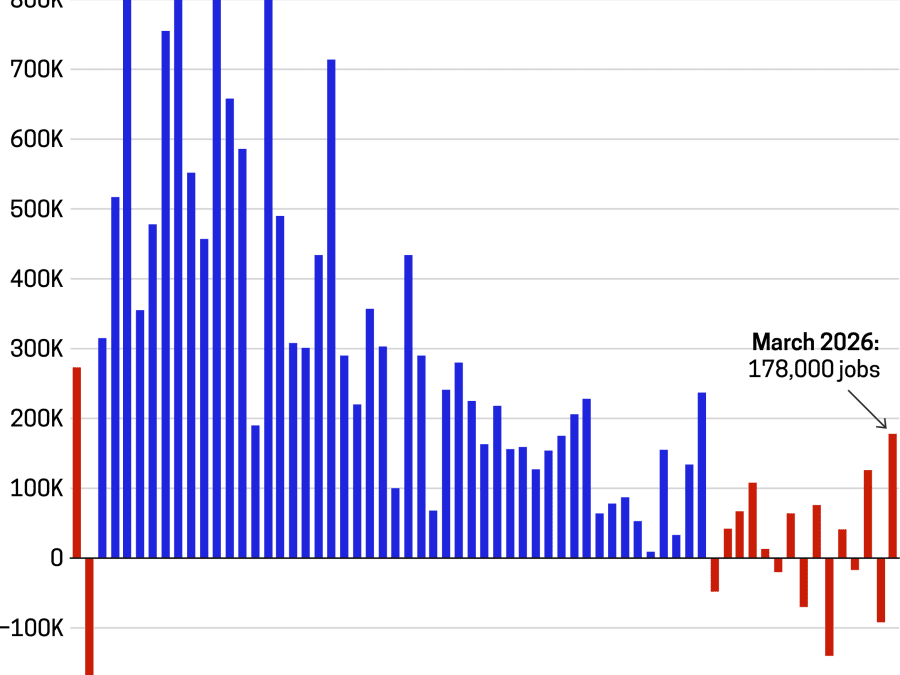
Expectations heading into this week showed projections of about 59,000 new jobs being created in the United States in March. As it turns out, according to the new report from the Bureau of Labor Statistics, the totals exceeded those expectations. CNBC reported:
Nonfarm payrolls rose a seasonally adjusted 178,000 during the month, a reversal from the 133,000 decline in February and better than the Dow Jones consensus estimate for 59,000, the Bureau of Labor Statistics reported Friday. February’s number was revised down by 41,000 while January was revised up by 34,000 to 160,000, putting the three-month average around 68,000.
With job creation higher, the unemployment rate edged lower to 4.3%.
It’s worth emphasizing for context that a major nursing strike in California and Hawaii depressed payrolls in February by tens of thousands of jobs, and now that those labor disputes have been resolved, those now count as new jobs in March. Still, 178,000 is a good overall number.
Indeed, though the data will be revised in the coming months, the preliminary totals suggest that March showed the best job growth of Trump’s second term, though the 178,000 jobs falls short of the 237,000 jobs created in December 2024 — the last full month of Joe Biden’s term.
All told, the U.S. economy has added 321,000 jobs over Donald Trump’s 15-month second term. Over the previous 15 months, the economy added roughly 1.9 million jobs.
While March’s totals are certainly a step in the right direction, the overall picture still reflects a stunning reversal, which the Republican administration has made no credible effort to explain or justify.
To contextualize the data, I put together this chart to show
by Julia Conley | Apr 2, 2026 | Article, Economy, Economy and Inequality, health care, Iran, Politics and Movements: International, Politics and Movements: US, Reprint, War
This story originally appeared in Common Dreams on April 02, 2026. It is shared here under a Creative Commons (CC BY-NC-ND 3.0) license.
Two days after Secretary of State Marco Rubio unironically advised Iran to spend its public funds “helping the people of Iran” instead of on weapons, President Donald Trump announced that the US government has “to take care of one thing: military protection” and isn’t able to provide people in the US with necessities like healthcare and childcare.
“Oh wow, he actually admitted it,” said US Rap. Yassamin Ansari (D-Ariz.) in response.
At an Easter lunch at the White House Wednesday, the president said that “the United States can’t take care of daycare” and demanded that states fully fund childcare programs.
“We’re fighting wars. We can’t take care of daycare. You gotta let a state take care of daycare, and they should pay for it too,” said Trump. “It’s not possible for us to take care of daycare, Medicaid, Medicare, all these individual things.”
Trump: We can’t take care of daycare. We’re a big country. We’re fighting wars. It’s not possible for us to take care of daycare, Medicaid, Medicare, all these things. pic.twitter.com/vLGpp7KJnm— FactPost (@factpostnews) April 1, 2026
The wars the president has waged and threatened to wage since taking office last year include his invasion of Venezuela in January and the abduction of President Nicolás Maduro; the killing of more than 160 people in boat bombings in the Caribbean Sea and eastern Pacific Ocean; an oil blockade on Cuba that’s left tens of thousands of people waiting for surgeries and unable to access essential medications, with Trump threatening to take over the country by force; and the current US-Israeli war on Iran.
The conflicts that Trump said Americans must sacrifice federal funding for public programs in order to continue are opposed by a majority of Americans, according to polls. All have been called violations