by Taya Graham and Stephen Janis | Nov 26, 2025 | Economy and Inequality, Epstein, Inequality Watch, Politics and Movements: US, video
Investigative reporters Taya Graham and Stephen Janis go to Capitol Hill to speak with Representatives Ro Khanna and Thomas Massie, who co-sponsored the Epstein Transparency Act. Many of the women who survived Epstein’s abuse and human trafficking ring share their experiences and their determination to receive justice. Now that the bill has passed both Houses, the Department of Justice is obligated to share with the public thousands of previously secret documents, emails, and photos. Although many critics are concerned that redactions will make these documents ineffectual in exposing the predators and predator protectors, there is still hope that these women will finally be able to reveal the corruption that has survived multiple presidential administrations. We discuss four reasons why the Epstein files may be the beginning of the end for the unchecked power of these elites, or “Epstein class.” With Congress compelling the DOJ to reveal Epstein’s secret files, the protective wall around America’s most powerful men is finally beginning to crumble. This moment could be the first genuine challenge to the impunity enjoyed by the country’s wealthiest predators.
Produced by Stephen Janis and Taya GrahamWritten by Stephen JanisPost-Production by Stephen Janis
Transcript
The following is a rushed transcript and may contain errors. A proofread version will be made available as soon as possible.
Taya Graham:
Have the wealthy elites who have turned this country into an inequality playground finally met their match with the Epstein scandal. Well, we’re going to break down why the fallout from Epstein is turning the tables on the oligarchy and how the stain of being a predator or a predator protector might not be easy to get rid of
by Taya Graham, Stephen Janis and Maximillian Alvarez | Nov 24, 2025 | Economy and Inequality, Epstein, Inequality Watch, Politics and Movements: US, video
President Donald Trump signed a bill last Wednesday directing the Department of Justice to release more files from the investigations into the infamous sex offender, sex trafficker, and international political power broker Jeffrey Epstein. Will the public finally see the full release of the Epstein Files? Or will the Trump administration withhold and redact the information it does not want people to see? TRNN Editor-in-Chief Maximillian Alvarez and Inequality Watch reporters Taya Graham and Stephen Janis report back from a truly wild week in Washington, DC, and answer your questions about one of the biggest political scandals in US history.
Credits:Studio Production / Post-Production: David Hebden
Transcript
The following is a rushed transcript and may contain errors. It will be updated as soon as possible.
Maximillian Alvarez:After refusing to release the Epstein files and claiming the entire massive scandal was a hoax crafted by Democrats, President Donald Trump has apparently changed course in the face of a full-on revolt from his MAGA base, as well as intensifying pressure from Democrats, and even members of his own party. On Wednesday, Trump signed a bill directing the Justice Department to release more files from the investigation into the infamous sex offender, sex trafficker, and international political power broker Jeffrey Epstein.So, will we finally see the full release of the Epstein files? Will the public get the full transparency that we’ve been promised or the selective transparency? And what will the political fallout be? The Department of Justice has 30 days to release the documents, but it’s frankly unclear what the department will release and how much. The bill calls for the Attorney General to make unclassified
by Lara Witt, Prism and Maya Schenwar, Truthout | Nov 20, 2025 | Article, Economy and Inequality, Politics and Movements: US, Reprint, The Cultural Front
This story was originally published on Truthout on Nov. 19, 2025. It is shared here under a Creative Commons (CC BY-NC-ND 4.0) license.
On Nov. 3, Condé Nast announced that it was folding Teen Vogue into Vogue, thus laying off most of Teen Vogue’s staff. Most devastatingly, the layoffs primarily affected their Black, brown, trans, and queer workers and the publication’s entire political desk, which had provided readers with rigorous and accurate reporting on systems of oppression, the policies they took shape as, and the progressive and left movements pushing back against them, thanks to a small team of dedicated editors and reporters. Teen Vogue was an outlier in the Vogue-sphere and a rarity in mainstream media. The racial and gender diversity of Teen Vogue’s workers reached beyond representational politics; it was also present in how they covered the news. It pushed as close as you could get to movement journalism within the mainstream sphere, right up to the boundary where advertisers might get nervous.
Teen Vogue is a major loss for many young (and adult!) readers. But this is just the latest in corporate and mainstream media consolidations and closures for the sake of maximizing profits. The 1996 Telecommunications Act ushered in an era of deregulation and paved the way for mergers and acquisitions. Because of those consolidations, the large majority of for-profit news media are now owned by just six conglomerates. What we are witnessing today, however, can and should more accurately be described as media capitulating to President Donald Trump’s racist and authoritarian agenda or at the very least, newsroom leaders finding an opportunity to stop pretending that they
by Maximillian Alvarez | Nov 20, 2025 | Economy, Economy and Inequality, labor, Podcast, Politics and Movements: US, Unions, Working People
Making ends meet in today’s economy is difficult enough, but with so many societal crises affecting working people’s lives on and off the shop floor—from mass layoffs to untenable costs of living, from an authoritarian federal government to AI and the climate crisis—it can feel all but impossible. What does it mean to have a union job, to be a union member, and to be part of the labor movement in these overwhelming times? What role do unions and other labor organizations have to play, not just in the fight for economic justice, but in the fight for democracy, civil rights, the rule of law, and a livable planet? We posed these questions to a range of emerging labor leaders from different unions and worker centers enrolled in the 2025-26 Minnesota Union Leadership Program (MULP). Here’s what they told us…
Additional links/info:
Minnesota Union Leadership Program website
Workday Magazine website
Maximillian Alvarez, Working People / The Real News Network, “What good is a union in Hell?”
Featured Music:
Jules Taylor, Working People Theme Song
Credits:Audio Post-Production: Alina Nehlich
Transcript
The following is a rushed transcript and may contain errors. A proofread version will be made available as soon as possible.
Maximillian Alvarez:
Alight. Welcome everyone to Working People, a podcast about the lives, jobs, dreams, and struggles of the working class today. Working People is a proud member of the Labor Radio Podcast Network and is brought to you in partnership within these Times Magazine and the Real News Network. This show is produced by Jules Taylor and made possible by the support of listeners like you. My name is Maximillian Alvarez and I am very excited to share today’s episode with y’all because believe me as
by Maximillian Alvarez | Nov 19, 2025 | brazil, climate action, Climate Change, Climate Crisis, Economy and Inequality, Politics and Movements: International, Politics and Movements: US, video
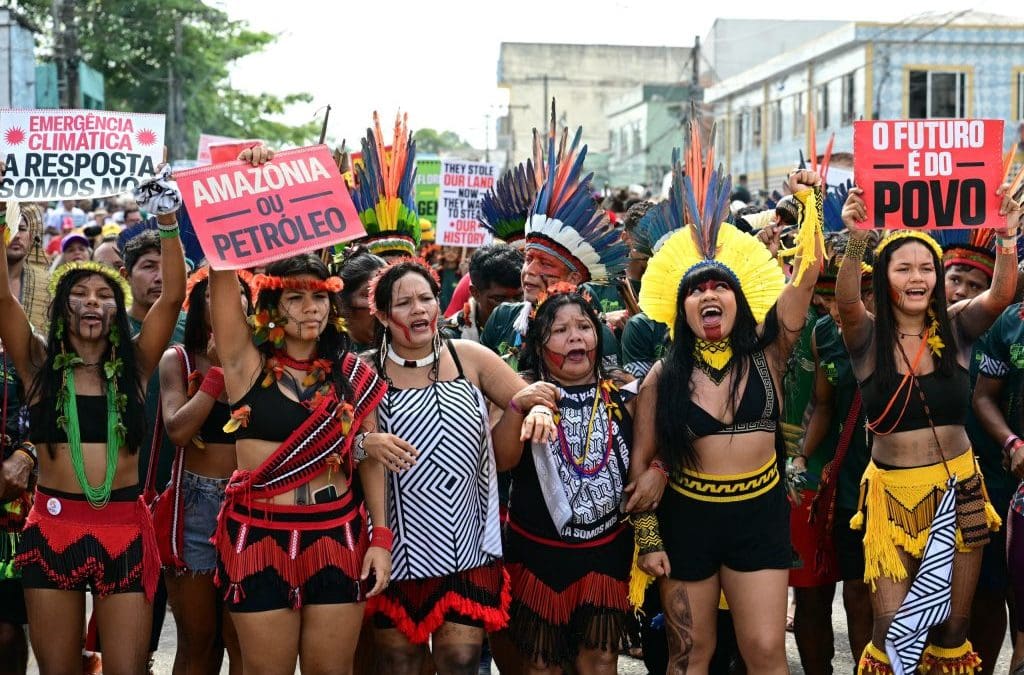
The 2025 United Nations Climate Change Conference, more commonly known as COP30, began on Nov. 10 in Belém, Brazil, on the edge of the Amazon rainforest. This year’s COP conference has more fossil fuel lobbyists in attendance than any previous conference, but it has also drawn the biggest delegation of Indigenous peoples from around the world—each group representing competing visions for addressing the climate crisis. TRNN Editor-in-Chief Maximillian Alvarez speaks with Dharna Noor, fossil fuels and climate reporter at Guardian US, about what actions are and are not being taken at COP30, and what the results of this year’s climate summit will mean for humanity’s future on a rapidly heating Earth.
Additional links/info:
Dharna Noor, Guardian US, “‘Without our expertise, mistakes get made’: The Cop30 campaign to give workers a voice”
Dharna Noor & Jonathan Watts, Guardian US, “Thousands hit streets of Belém to call for action during crucial Cop30 summit”
Credits:
Studio Production / Post-Production: David Hebden
Transcript
The following is a rushed transcript and may contain errors. A proofread version will be made available as soon as possible.
Maximillian Alvarez:
As the Philippines reel from historic typhoons. As Caribbean countries like Jamaica, Haiti, and Cuba rush to recover from a historic hurricane as Iran scrambles amid a historic drought that as people’s water taps running dry, the weary eyes of a battered world turned to Belém, Brazil, where the 30th UN Climate Summit is currently taking place. The 2025 United Nations Climate Change Conference, more commonly known as COP30, began on November 10th and will conclude on November 21st. Our guest today just returned to Baltimore from COP30 in Brazil and is here to give us a breakdown of
by Maximillian Alvarez | Nov 14, 2025 | Economy, Economy and Inequality, labor, Politics and Movements: US, Unions, video, Working People
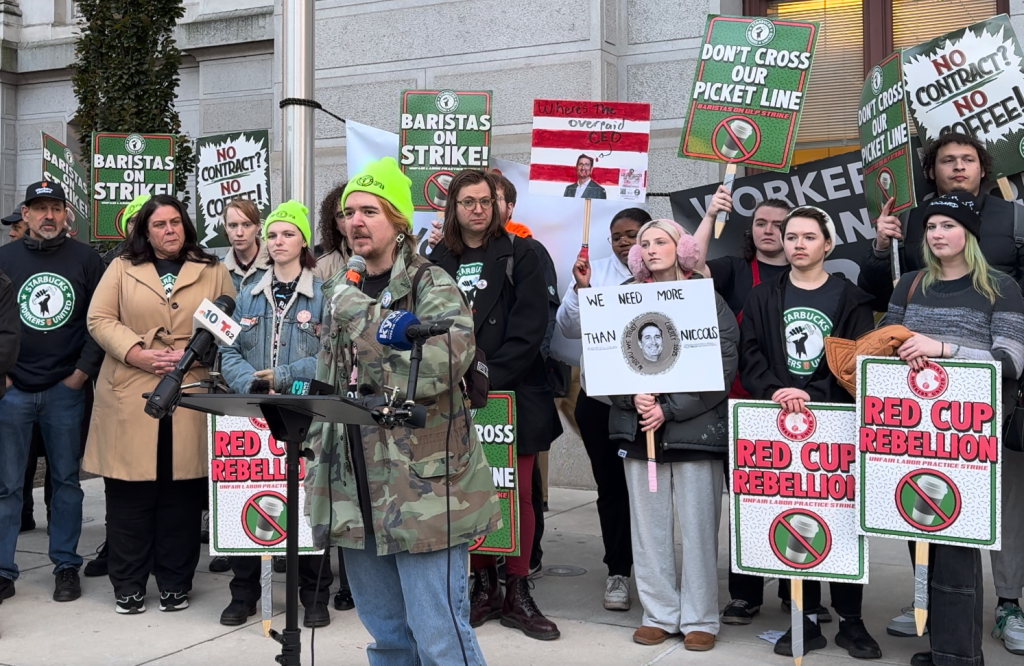
Over 1,000 unionized Starbucks workers in over 40 cities across the US walked off the job on an indefinite Unfair Labor Practice strike on Thursday, Nov. 13. The union, Starbucks Workers United, says more workers at more unionized stores will be joining the picket line during the busy holiday season to pressure Starbucks to return to the bargaining table with proposals that seriously address workers’ ongoing demands regarding better pay and work hours, safe staffing, and resolving the hundreds of Unfair Labor Practice charges that have been filed against the coffee giant. TRNN Editor-in-Chief Maximillian Alvarez reports on the ground from the picket line in Philadelphia, PA.
Credits:
Videography: Maximillian Alvarez
Post-Production: David Hebden, Maximillian Alvarez
Transcript
The following is a rushed transcript and may contain errors. A proofread version will be made available as soon as possible.
Crowd chants:
What do we want? Contract! When do we want it? Now! If we don’t get it? Shut it down! If we don’t get it? Shut it down!
Maximillian Alvarez:
I’m here in Philadelphia, Pennsylvania, just outside City Hall. It’s Thursday, November 13th, around 5:00 PM Eastern time. And earlier today, over a thousand Starbucks workers in over 45 cities around the country walked off the job and went out on an unfair labor practice strike. After last week, a super majority of unionized baristas voted to authorize the strike, demanding that Starbucks come back to the bargaining table with serious proposals to address workers’ ongoing years long concerns about safe staffing, better pay, better work hours, and all manner of unfair labor practices that have been filed against the company since the first store unionized in Buffalo, New