by Maximillian Alvarez | May 4, 2026 | baltimore, Economy and Inequality, May Day, Politics and Movements: US, protest, video
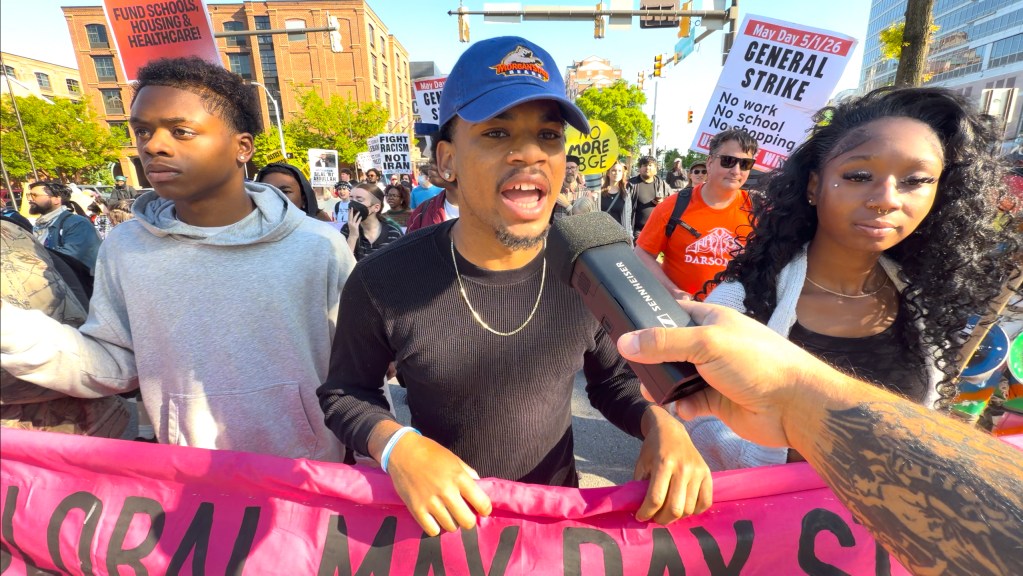
Inspired by January’s mass strike against ICE terror in Minnesota, a vast coalition of labor unions, democratic organizations, and community groups organized protests around the US on Friday, May 1, to coincide with International Workers Day (aka May Day). Organizers called for a one-day “economic blackout” (“no school, no work, no shopping”) in protest of authoritarianism and government policies that put billionaires’ needs above those of workers. TRNN takes you inside the Baltimore, Maryland, May Day march so you can see it and hear directly from protesters yourself.
Additional links/info:
Maximillian Alvarez, Working People / TRNN, “May 1: Unions, community orgs plan nationwide ‘economic blackout’ against billionaires and authoritarianism”
Hamilton Nolan, In These Times, “May Day was a reminder that we make the world run”
Credits:
Videography / Post-Production: Maximillian Alvarez
Transcript
The following is a rushed transcript and may contain errors. It will be updated as soon as possible.
Maximillian Alvarez: This is Maximillian Alvarez for the Real News Network. I’m here in downtown Baltimore and behind me. Around a hundred or more local residents are marching through the streets of downtown on Mayday in solidarity with others around the country who are participating in the Mayday Strong Day of Protests inspired by the anti-ice mass strike that shut down Minneapolis earlier this year. Organizers are calling for a day of no work, no school, no shopping. Here in Baltimore, the demonstration may be on the smaller side, but the spirit is still very lively. I’m about to take you into the heart of the march so you can see it for yourself.
So here in Baltimore, you’re seeing a lot of the signs you’re probably seeing at
by Maximillian Alvarez | May 1, 2026 | Economy and Inequality, labor, Podcast, Politics and Movements: US, Unions, video, Working People
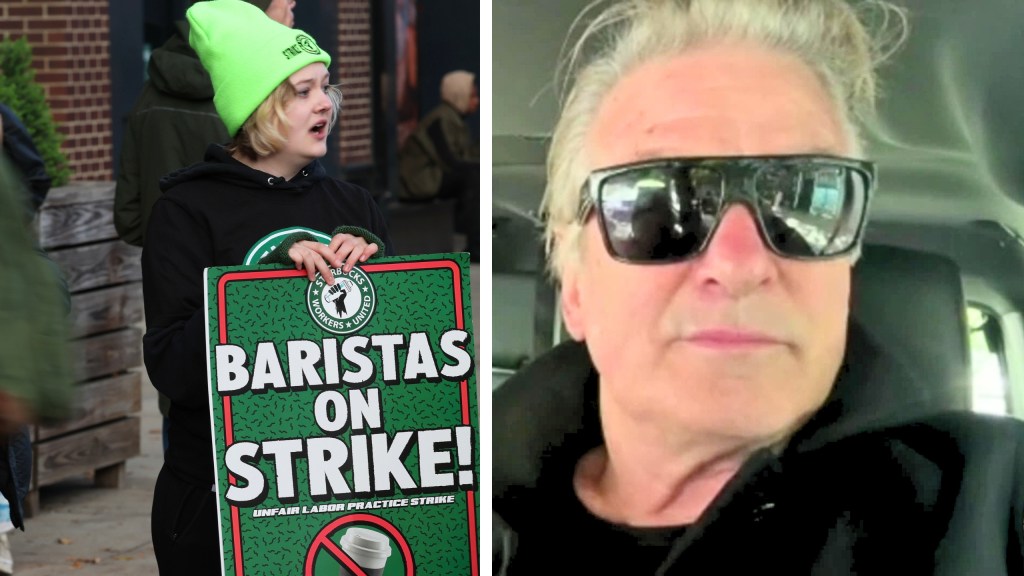
After decades of decline, the organized labor movement in the US has seen a resurgence in rank-and-file militancy over the last decade, with increased strike actions and union drives in industries across the economy. And in the story of this recent revival of labor in America, the movement led by predominantly young baristas to unionize coffee giant Starbucks has played a pivotal role. The new documentary Baristas vs. Billionaires takes viewers on a journey through the last five years of the epic, ongoing struggle to unionize Starbucks, told by some of the workers and organizers at the center of that struggle. TRNN Editor-in-Chief Maximillian Alvarez speaks with director of Baristas vs. Billionaires and Academy Award nominee Mark Mori, and with legendary actor and Academy Award nominee Alec Baldwin, who is a producer on the film.
Additional links/info:
Baristas vs. Billionaires website
Maximillian Alvarez, Working People / TRNN, “‘Starbucks is the largest labor violator in modern history’: Starbucks workers prepare for indefinite national strike”
Maximillian Alvarez, Working People / TRNN, “How union organizing can change your life and the world: A conversation with Jaz Brisack”
Maximillian Alvarez, Working People / TRNN, “Want to unionize your workplace? These worker-organizers have some advice”
Featured Music:
Jules Taylor, Working People Theme Song
Credits:
Studio Production / Post-Production: David Hebden
Audio Post-Production: Jules Taylor
Transcript
MAXIMILLIAN ALVAREZ: Welcome back to The Real News Network. I’m Maximillian Alvarez. In the post-World War heyday of American manufacturing and industrial unionism, when the middle class was exploding, about one in every three workers in this country was part of a union. But today, as working people face a punishing cost of living crisis, an evaporating middle class, and Gilded Age levels of
by Mansa Musa | Apr 27, 2026 | Economy and Inequality, history, Inequality, Politics and Movements: US, Racism, Rattling the Bars, video
2026 marks the 250th anniversary of the American Revolutionary War. While the national mythology behind the “America at 250” celebrations focuses on the 18th-century battle between Patriot and Loyalist elites, what does the story of the American Revolution and the founding of the United States look like through the eyes of enslaved people? In this episode of Rattling the Bars, host Mansa Musa speaks with Professor Justene Hill Edwards, author of Unfree Markets: The Slaves’ Economy and the Rise of Capitalism in South Carolina.
Guests:
Justene Hill Edwards is an associate professor of History in the Corcoran Department of History at the University of Virginia. Her research explores the intersection of African American history, the history of slavery, and the history of American capitalism. She is the author of Unfree Markets: The Slaves’ Economy and the Rise of Capitalism in South Carolina and Savings and Trust: The Rise and Betrayal of the Freedman’s Bank.
Credits:
Producer / Videographer / Editor: Cameron Granadino
Transcript
The following is a rushed transcript and may contain errors. A proofread version will be made available as soon as possible.
Mansa Musa:
This year marks the 250th anniversary of the Revolutionary War, a conflict that we typically frame as a struggle between the colonialists and the British. However, we rarely examine the age of revolution from the perspective of the enslaved and the enslaved has a voice in this matter, as we will see. Join us today as the University of Virginia Professor of History, Justine Hill Edwards, an author of Unfree Market: The Slave Economy and the Rise of Capitalism in South Carolina. And Saviors and Trust. Professor, welcome to Rattling the Bars
by Taya Graham and Stephen Janis | Apr 24, 2026 | elections, ICE, Inequality, Inequality Watch, midterms, Politics and Movements: US, Prisons and Policing, video
Congress members of the Hispanic Caucus speak out on their concerns on ICE and Border Patrol, with their first question being: why is an additional $70 billion needed after the record breaking $140 billion allocated last year from the Big Beautiful Bill? The budget for ICE has already increased by 400% within the past year, so speculation as to how these new funds would be used now leans towards intimidation and interference at the upcoming midterm elections. Inequality Watch reporters Taya Graham and Stephen Janis break down their most recent interviews from these representatives at the nation’s Capitol in Washington, DC.
Credits:
Written by: Stephen Janis
Produced by: Taya Graham, Stephen Janis
Studio / Post-Production: Cameron Granadino
Trancript
The following is a rushed transcript and may contain errors. A proofread version will be made available as soon as possible.
Taya Graham:
Could new funding slated for ICE be used for a midterm election surprise? We’ll break down what might happen on this episode of our Capitol Hill Inequality Watch video React. Hello, my name is Taya Graham and welcome back to our Capitol Hill React show where we watch comment and analyze developments at the nation’s capital and beyond. It’s a show filtered through the prism of inequality and informed by the intellectual context of analyzing the imperative of raw power and exposing how it corrupts a political power that is supposed to serve we, the people. Now, to start the show, I want to introduce my reporting partner, Stephen Janis. Hello, Stephen. How are you?
Stephen Janis:
Hey, Taya, how are you doing? Good to be back here with you talking about power and politics.
Taya Graham:
Excellent. Well, we appreciate
by Mansa Musa and Ruwaida Amer | Apr 20, 2026 | Israel, Palestine, Political Prisoners, Politics and Movements: International, Prisons and Policing, Rattling the Bars, video
Former political prisoner Mahmoud al-Arda was first arrested by Israeli occupation forces in 1992 due to his involvement in the First Intifada and his membership in Islamic Jihad. Since then, for the past three decades, al-Arda has been incarcerated in different Israeli prisons, and he made international headlines in 2021 after leading a daring, successful, but short-lived escape from the maximum-security Gilboa Prison. In this blockbuster episode of Rattling the Bars, host Mansa Musa—a former Black Panther and political prisoner in the US—speaks with al-Arda after he and 2,000 other Palestinian prisoners were finally released from incarceration in Israel in 2025.
Additional links/info:
B’Tselem, Statistics on Palestinians in Israeli Custody
B’Tselem, “Welcome to Hell”: The Israeli Prison System as a Network of Torture Camps (Report)
Mansa Musa, TRNN, “Inside Israel’s Prison Regime”
Ruwaida Amer, Electronic Intifada, “Freedom is the eternal dream”
Aseel Mousa, Middle East Eye, “Jailbreak, freedom, exile: Life of Mahmoud al-Arda, architect of daring Israeli prison escape”
Credits:
Videography: Ruwaida Amer, Cameron Granadino
Producer / Editor: Cameron Granadino
Voiceover: Danny Bou-Maroun
Transcript
The following is a rushed transcript and may contain errors. A proofread version will be made available as soon as possible.Mansa Musa:
For the past two years, the four major US Sunday news shows have almost entirely excluded Palestinian voices from their coverage of Gaza. Airing just one brief interview in that time, according to journalist Adam Johnson. Corporate media’s propaganda war isn’t only about the stories it chooses to show, but even more about the voices and perspective it leaves out. In contrast, the real news is committed to amplifying those voices. In this spirit, we connected with Mahmoud al-Arda , a 50-year-old Palestinian who spent 32 years
by Taya Graham and Stephen Janis | Apr 17, 2026 | AI, Economy and Inequality, Inequality, Inequality Watch, Politics and Movements: US, video
Welcome to Inequality Watch React, where we don’t just talk about inequality, we go straight to the source.
This week, we take you inside the National Press Club, where we spoke with Congressman Ro Khanna about the future of the Democratic Party, economic patriotism, and the growing divide between the powerful and everyone else.
From why Democrats struggle to win, to the unanswered questions surrounding the Epstein files, to whether Silicon Valley is creating a new class of untouchable elites, we break it all down.
Because this isn’t just about politics. It’s about power, and who it protects.
And the big question: can we protect ourselves from its excess and its consequences? Independent journalists Taya Graham and Stephen Janis head down to Capitol Hill to ask these questions. And if you have a question you want us to ask, please leave it in the comments!
Credits:
Written by: Stephen Janis
Produced by: Taya Graham, Stephen Janis
Studio / Post-Production: Cameron Granadino
Transcript
The following is a rushed transcript and may contain errors. A proofread version will be made available as soon as possible.
Taya Graham:
Hello, my name is Taya Graham and welcome to our Inequality Watch React, the show where we discuss not just how this country is ruled by billionaires, but how and why. Reporting that seeks to hold the American aristocracy accountable for the destructive effect unimaginable wealth has had on our politics and on our lives. Now, unlike other YouTubers, we go right to the source to report back to you on America’s historic wealth imbalance, namely our nation’s capital, Washington DC. That’s where my reporting partner and I, hello, Steven.
Stephen Janis:
Hey, how you doing, Taya?
Taya Graham:
We often