

As ebola virus spreads, we see the terrifying effects of Trump dismantling USAID
This article was originally published by Truthout on June 04, 2026. It is shared here under a Creative Commons (CC BY-NC-ND 4.0) license.
In 2018, when the Democratic Republic of the Congo (DRC) experienced a severe Ebola outbreak, more than 30 experts from the Centers for Disease Control and Prevention (CDC), close to 20 disaster-response specialists from the U.S. Agency for International Development (USAID), and 120 additional USAID staff were on the ground attempting to manage the outbreak, according to estimates from Friends of USAID, an advocacy organization mainly made up of ex-USAID staffers. With that level of staffing in 2018, by and large, they succeeded in limiting the extent to which the disease spread.
This year, as a particularly virulent strain of the Ebola virus — the Bundibugyo strain, against which there is no approved vaccine and for which there are no medicinal cures — runs rampant in the Democratic Republic of the Congo, Friends of USAID estimate there is only one CDC staffer on the ground there, along with five additional State Department personnel. There are of course no USAID workers present, since the Trump administration dismantled USAID during the purges led by the so-called “Department of Government Efficiency” (DOGE) in 2025, summarily firing local health care contractors around the world, including in countries with extreme poverty rates such as the Democratic Republic of the Congo.
In addition, since Donald Trump signed an executive order pulling the U.S. out of the World Health Organization in early 2025 — a pullout that was completed in January of this year — CDC experts are no longer allowed to communicate with World Health Organization personnel. And despite
Voters in California city become first in US to approve permanent ban on data centers
This story originally appeared in Common Dreams on June 04, 2026. It is shared here under a Creative Commons (CC BY-NC-ND 3.0) license.
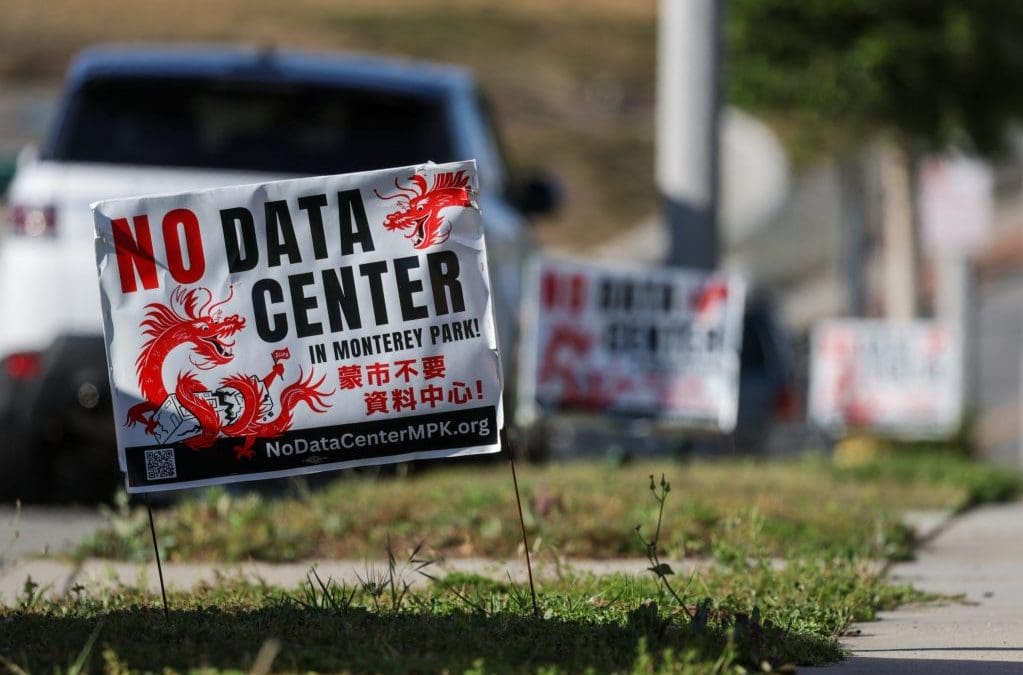
Voters in Monterey Park, California on Tuesday overwhelmingly approved a permanent ban on data centers within city limits, becoming the first city in the US to prohibit the power-hungry facilities via a ballot initiative.
In total, the anti-data center resolution passed with 86% voter support, with only 14% of voters opposed. The resolution’s text said that a ban was necessary to “protect air quality, drinking water resources, and public health” and “prevent impacts to electricity and water rates.”
Steven Kung, a leader of the local initiative, told ABC 7 Eyewitness News that the result was “a landslide victory.”
Kung listed multiple reasons why residents in the city resoundingly rejected building data centers in their community.
“The noise pollution, the air pollution, the rise in the electricity rates,” he said, “the deal just didn’t make sense and it doesn’t make sense for most, if not all, cities data centers go to.”
In an interview with Politico, Monterey Park Mayor Elizabeth Yang predicted that her city would be far from the last to pass data center bans, noting data center projects have spurred protests across the country.
“A lot of the other cities that are facing data center proposals are going to follow suit,” said Yang. “There’s [a] bad reputation across the board, across the country, from other data centers that have been built in neighborhoods.”
Monterey Park city councilmember Jose Sanchez expressed a similar sentiment, telling The Guardian that he hoped his city would become a inspiration to others.
“We hope that other communities will use the model set by residents here in Monterey Park,” said Sanchez, “as inspiration to stop
‘Huge win for the Constitution’ as House finally passes Iran war powers resolution
This story originally appeared in Common Dreams on June 03, 2026. It is shared here under a Creative Commons (CC BY-NC-ND 3.0) license.
Raucous applause erupted in the House of Representatives on Wednesday after US lawmakers passed a war powers resolution aimed at ending Donald Trump’s illegal war of choice against Iran—although skeptics cautioned that the measure will likely have little impact on the actions of a president who has habitually shown utter contempt for the rule of law.
House lawmakers voted 215-208, with 7 legislators not voting, in favor of H.Con.Res.86, introduced in April by Rep. Gregory Meeks (D-NY) and cosponsored by Reps. James Himes (D-Conn.), Adam Smith (D-Wash.), Gabe Amo (D-RI), Maggie Goodlander (D-NH), and Thomas Massie (R-Ky.).
Every Democrat present voted for the resolution, while three Republicans—Reps. Tom Barrett (Mich.), Warren Davidson (Ohio), and Brian Fitzpatrick (Pa.)—broke ranks with their GOP colleagues and joined Massie in voting to approve the measure, which directs Trump to “remove United States armed forces from hostilities with Iran.”
Cheers in the House as the war powers resolution passes pic.twitter.com/nRL3eGm0Zr— Acyn (@Acyn) June 3, 2026
“We are trapped in a war that won’t end because an incompetent president launched it thinking of only his own ego while failing to prepare for the consequences,” Meeks, the ranking member on the House Foreign Affairs Committee, said during floor debate ahead of Wednesday’s vote. “Diplomacy is the only exit from this, not more bombing, not more bluster.”
The War Powers Resolution of 1973—also known as the War Powers Act—requires the president to notify Congress within 48 hours of committing troops to military action and limiting such action to 60 days, with a 30-day withdrawal period, unless lawmakers declare war or issue an

‘Debases the democratic process’: Sotomayor pens scathing dissent as Supreme Court allows racist Alabama map
This story originally appeared in Common Dreams on June 03, 2026. It is shared here under a Creative Commons (CC BY-NC-ND 3.0) license.
The US Supreme Court late Tuesday gave Alabama a green light to use an aggressively gerrymandered congressional map that a lower court said was “tainted by intentional race-based discrimination.”
The unsigned decision, from which the high court’s three liberal justices dissented, enables Alabama’s Republican-dominated government to replace its current congressional map, which has two majority-Black districts, with a map that the US Supreme Court struck down in 2023. That map has just one majority-Black district.
In her dissenting opinion, liberal Justice Sonia Sotomayor wrote that “just as Alabama doubled down on racial discrimination, the court today doubles down on chaos.”
“In addition to being wrong on the merits, the court’s decision inflicts two grave harms on the public,” wrote Sotomayor. “It debases the democratic process by upending Alabama’s entire election in the name of permitting Alabama to discriminate against Black Alabamians. It also corrodes the rule of law by rewarding Alabama’s gamesmanship and outright defiance of court orders.”
The liberal justice noted that in order to switch to the map previously struck down by the high court, Alabama election officials “will have to reassign hundreds of thousands of voters across the state to new congressional districts.”
“Three of Alabama’s counties will be particularly hard hit because they are split across two congressional districts,” Sotomayor noted. “These counties have about 600,000 registered voters between them (roughly 15% of the state’s total number of registered voters).”
Alabama Gov. Kay Ivey, a Republican, postponed US House primary elections in the wake of the Supreme Court’s April decision in Louisiana v. Callais, which severely narrowed the 1965 Voting Rights Act’s protections against racial discrimination and paved

‘Disturbing trend of lawlessness’: UN experts denounce Trump’s coercive brutalization of Cuban people
This story originally appeared in Common Dreams on June 03, 2026. It is shared here under a Creative Commons (CC BY-NC-ND 3.0) license.
A trio of United Nations rights experts on Tuesday demanded that the US government “cease all threats” against Cuba and accused President Donald Trump of furthering a “disturbing trend of lawlessness” with preparations to attack the island nation; a indictment of its former president; and a protracted oil blockade that has left Cubans facing blackouts and a breakdown of their lauded healthcare system.
“Efforts to change the constitutional order of a sovereign state through threats and coercion echo colonial-era practices,” said George Katrougalos, independent expert on the promotion of a democratic international order; Zaina Jallad, special rapporteur on unilateral coercive measures; and Ben Saul, special rapporteur on counterterrorism and human rights.
The experts pointed to Trump’s declaration of what’s become known as the Donroe Doctrine, “asserting US predominance over the Western Hemisphere” through military might, and his repeated comments regarding the possibility of taking over Cuba, whose communist government, Trump has said, has turned the country into a “failing nation.”
“Statements by the US president regarding the ‘honor of taking Cuba’ reflect a deeply concerning strategy of coercion against a sovereign state,” said the experts. “This assertion is not mere rhetoric, but part of a broader strategy involving the long-standing embargo on Cuba, its listing as a state-sponsor of terrorism, the recent fuel blockade, and the imposition of coercive measures on third parties.”
Experts @profbensaul, @gkatr and Zeina Jallad express concern regarding US escalating threats, coercive measures & judicial weaponisation against #Cuba. “Efforts to change the constitutional order of a sovereign State through threats and coercion echo colonial-era practices.” pic.twitter.com/9feklXLRuQ— United Nations Geneva (@UNGeneva) June 3, 2026
In January, Trump issued an executive order centered around