This story originally appeared in Baltimore Beat on Oct. 07, 2025. It is shared here with permission.
Highlandtown sidewalks tell a much different story today than they did a year ago. Shops that once bustled with conversation sit emptier; families who once roamed the streets have now retreated. The day-to-day has become filled with fear under President Donald Trump’s mass deportation push, sending shockwaves through the largely Spanish-speaking neighborhood.
Both noncitizen, long-time U.S. residents L and E (whose full names Baltimore Beat is not using for their safety) are family members who are two sides of the same coin: L was already forced to leave the country; E feels imprisoned in his fear. Every glance from strangers, every passing security officer a reminder of the attention their brown skin draws.
Their parallel lives reflect a community sentiment, where daily rhythms are interrupted by immigration enforcement vans and streets become more desolate with every deportation.
Lucia Islas, a case manager at the Southeast CDC, works with a client at their office in East Baltimore on September 30. Credit: J. M. Giordano.
While L’s fight ended when she was forced to leave the country, E’s continues toward an unknown. L has walked her final moments in the United States, holding the hands of her two young children, and E could not walk beside her. In this moment in history, to get too close would be a risk to his own freedom. His life the last seven months has been characterized by living in the shadows. His heart is still heavy that he could not comfort his loved one in the way he wanted to.
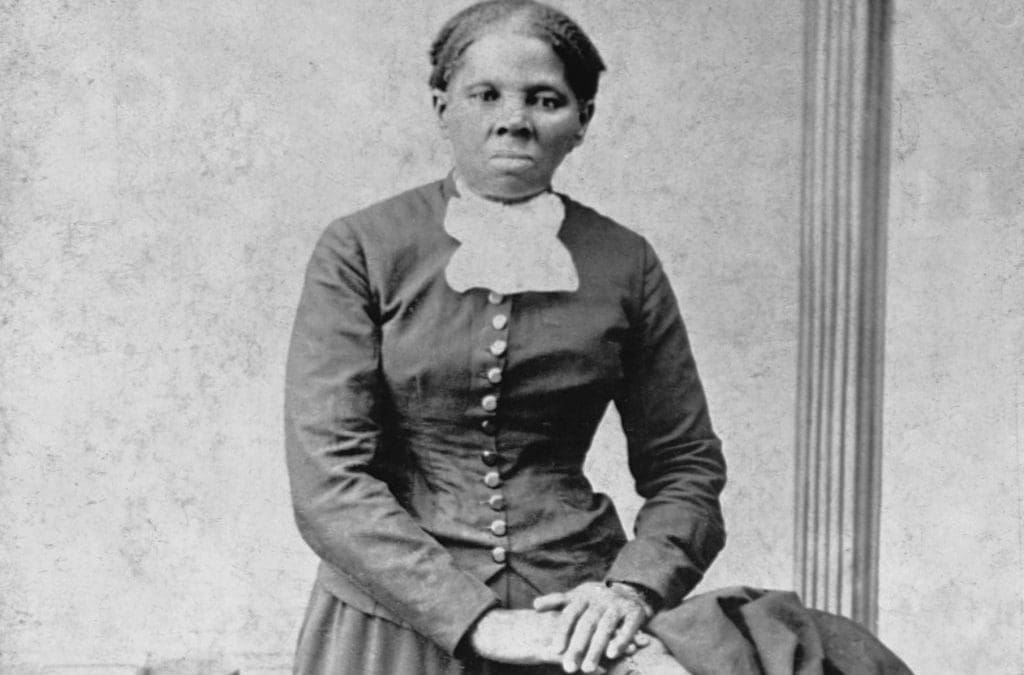
Harriet Tubman is an icon for freedom. She first fled slavery with two brothers on September 17, 1849. By the following year, she was returning to save others. She traveled by night, from safe house to safe house, supported by a network of abolitionists known as the Underground Railroad. Walking north to Pennsylvania—a free state. She would make 13 trips back and forth throughout the 1850s and early 1860s. She rescued roughly 70 people from enslavement. But she didn’t stop there.
This is episode 69 of Stories of Resistance—a podcast produced by The Real News
. Each week, we’ll bring you stories of resistance like this. Inspiration for dark times.
BIG NEWS! This podcast is a finalist for this year’s Signal Awards for best history podcast. It’s a huge honor just to get this far.
And you can help us win. Your vote can make a difference. Anyone can vote.
All you have to do is click on the link. That will take you to a page where you can click on the Stories of Resistance icon. Register your email and you’re all set.
Please consider supporting this podcast and Michael Fox’s reporting on his Patreon account
: patreon.com/mfox
. There you can also see exclusive pictures, video, and interviews.
If you like what you hear, please subscribe, like, share, comment, or leave a review.
And please consider signing up for the Stories of Resistance podcast feed, either in Spotify
, Apple Podcasts
, Spreaker
, or wherever you listen.
Harriet Tubman. There are few more iconic women in the history of the United States. A woman who not only freed herself from slavery, but who returned again, and again, and again to dangerous lands to help free others.
So many others.
Her resistance is legendary, and she is remembered until today.
Harriet Tubman was born in March 1822 on Maryland’s Eastern Shore. Born into slavery. Her grandmother had been stolen from her home in Africa, and sailed on a terror slave ship across the Atlantic to be sold.
Harriet Tubman was born with the name Araminta Ross. She was forced to work as a little girl. She was beaten and whipped, and even suffered a traumatic head injury that would affect her throughout her life. Many brothers and sisters were ripped from her mother’s arms and sold to other families. But she also saw her mother’s resistance when they came for her younger brother. Her mother hid him for a month and promised to fight to keep him from them.
In her early 20s, Araminta Ross married. She changed her name to Harriet Tubman.
In 1849, the patriarch of the estate that owned her died. The descendants planned to sell her and others. To break apart their remaining family. She would not have it.
She fled slavery with two brothers on September 17, 1849. Her brothers changed their minds and convinced her to turn back. But she had soon fled again. This time there was no going back.
She boarded the Underground Railroad, a network of people who helped slaves flee the South. Harriet Tubman traveled by night. She fled from safe house to safe house. Walking north to Pennsylvania, a free state.
The trip was only 90 miles, but on foot., under the darkness of night, it would have taken days or weeks. And she had to be on the lookout for slave catchers who tracked down fugitive slaves and brought them back for ransom.
Finally, Harriet Tubman crossed into Pennsylvania.
“When I found I had crossed that line,” she later said, “I looked at my hands to see if I was the same person. There was such a glory over everything; the sun came like gold through the trees, and over the fields, and I felt like I was in Heaven.”
But her freedom was not enough. Her loved ones were still enslaved. “I was free,” she would say. “and they should be free.”
And they would be.
Harriet Tubman saved money working odd jobs in Philadelphia and New Jersey, and in late 1850 she traveled back into Maryland, to Baltimore, where she helped her niece and her family flee to Philadelphia.
The next year, Harriet returned to Maryland again. This time she saved her younger brother Moses and two other men. In December 1851, she returned again, helping 11 people escape. And again, and again, and again, she returned with the help of so many others and brought out dozens on the road to freedom.
Harriet Tubman was devout, and she found in the Bible inspiration and faith in her struggle to free those who were enslaved.
“I have wrought in the day – you in the night,” abolitionist Frederick Douglass would write of her. “The midnight sky and the silent stars have been the witnesses of your devotion to freedom and of your heroism.”
She would make 13 trips back and forth throughout the 1850s and early 1860s. She rescued roughly 70 people from enslavement. They called her Moses, like the prophet who led the Hebrews from Egypt.
Harriet Tubman would help people flee to Pennsylvania and then to Canada after the Fugitive Slave Act forced law enforcement in the North to help return runaway slaves to the South. But her resistance didn’t stop there. During the Civil War, she worked with the Union army as a cook, a nurse, a scout, and a spy. She helped the North to free hundreds of enslaved people. She was an icon who even later in life would fight for women’s suffrage — the women’s right to vote.
Harriet Tubman died in March 1913. Her life and legacy continue to inspire. Resistance against all odds. Resistance in the face of so much injustice. Carrying people to freedom along the footpaths of the Underground Railroad.
September is Underground Railroad Month in Maryland and other U.S. states. This is the month when both Harriet Tubman and the great abolitionist Frederick Douglass freed themselves from slavery. Their stories and their struggles are as important as ever.
Hi folks, thanks for listening. I’m your host Michael Fox. Two things before I go. First, I’m adding links to some more background information on Harriet Tubman. You can find those in the show notes.
Second, I have incredible news. This podcast, Stories of Resistance, is a finalist for this year’s Signal Awards for best history podcast. It’s a huge honor just to get this far. And you can help us win. Your vote can make a difference.
Anyone can vote. It’s fast and easy. The link is in the show notes. All you have to do is click on the link. That will take you to a page where you can click on the Stories of Resistance icon. Register your email and you’re all set. While you’re there, please also vote for The Real News’s Marc Steiner. He’s in the running for best episode host. I’ll add a link to that as well in the show notes. And if you like what we do, please spread the word and tell a friend.
As always, if you enjoy this podcast, I hope you’ll consider becoming a subscriber on my Patreon. It’s only a few dollars a month. I have a ton of exclusive content there, only available to my supporters. And every supporter really makes a difference.
This is the latest episode of Stories of Resistance, a podcast series produced by The Real News. Each week, I bring you stories of resistance and hope like this. Inspiration for dark times. If you like what you hear, please subscribe, like, share, comment, or leave a review.
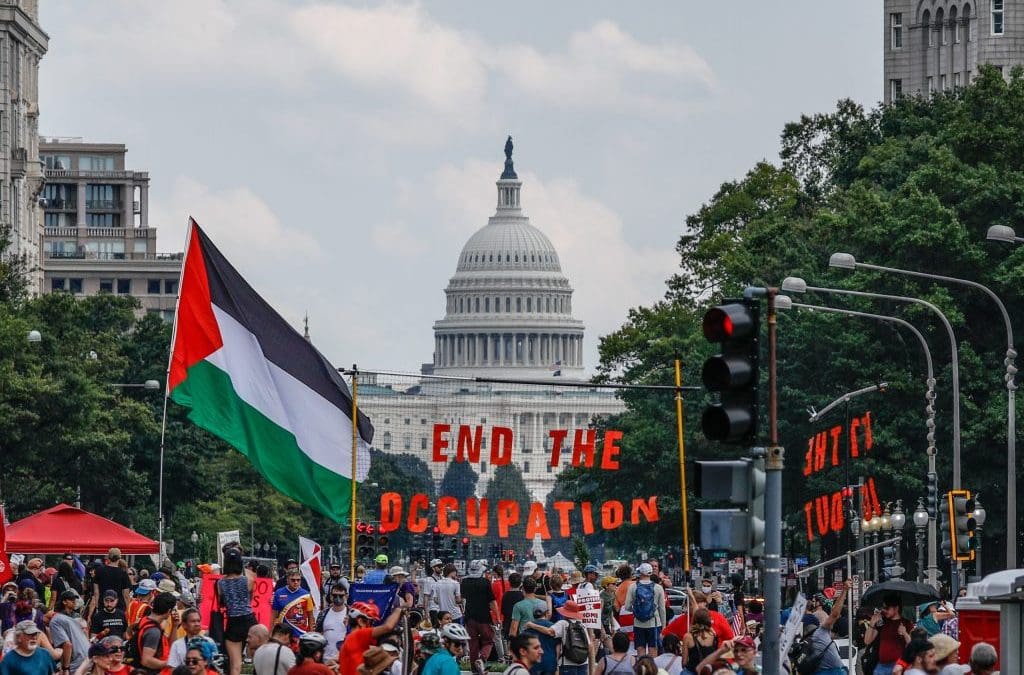
On Saturday, Sept. 6, thousands of local residents, out-of-state supporters, union members, and concerned citizens of all stripes marched through the nation’s capital to protest President Trump’s militarized federal occupation of Washington, DC. The “We are all DC” march was one of the largest protests—if not the largest—to take place in the US capital since the beginning of the second Trump administration. Reporting from Malcolm X Park for TRNN, Rattling the Bars host Mansa Musa and Edge of Sports TV host Dave Zirin give an on-the-ground account of the size, makeup, and significance of Saturday’s protest.
The following is a rushed transcript and may contain errors. A proofread version will be made available as soon as possible.
Mansa Musa:
I am here at Malcolm X Park in Washington, DC with Dave Zirin. Today we are looking at the birth of a mass movement around anti-imperialism, antifascism, anti-capitalism. Talk about what you see today, Dave.
Dave Zirin:
I’m so impressed right now. This is a demonstration to free DC and what we’re seeing out here is that it unites people of across all sorts of ways. You’ve got people here from all backgrounds, you’ve got people here of all ages. Multi-generational protests in this town are actually quite rare. And to see all of this is incredible. Also, incredible union delegations, which I have not seen yet at these demonstrations. That’s a big deal. Also a big deal. They’re masses of buses of here from Baltimore. There are masses of buses of here from New Jersey. There’s a whole Unite here union team from Jersey, like dozens and dozens of people. And what this says to me is that people are not looking at DC as a DC issue. That’s right. Or one, they’re just offering solidarity with us. People are seeing we could be next and DC will either be the first or the last city under Trump’s military occupation.
And we play a role in that by defending DC. So it’s amazing. I mean, this is huge. Right? And look, we can go into demos of dozens of people, 50 people, a hundred people to free dc and this is just over the top. Amazing. And can I just say one last thing? Come on. It is a tribute to the people of Washington DC and the resistance that they have already built because that’s the pole of attraction that’s brought so many people here today. If there was no resistance, if the vibe from DC was nobody cares that we’re now being militarized or we support that we are being militarized. No one would come here to support us. So the fact that we have created a pole of attraction on this is just incredible.
Mansa Musa:
And the fact they got it in Malcolm X Park. But talk about, you mentioned earlier, multi-generational, but talk about the international characteristics of this particular march because they start out saying, they start out saying it’s about free dc right? But then it turned into free people. NS turned to more or less getting around the issues of Palestine, getting around the issues of the immigration law, getting around the issue. What he getting ready to do in Venezuela. Talk about the international characteristics of this movement.
Dave Zirin:
Well, the international aspect of this demonstration and the international aspect of this moment are very real because what is happening overseas is boomeranging onto us back home. Authoritarianism, soldiers, children dying without repercussion, no investigations of things. Decades ago there would’ve been congressional oversight and demonstrations of, look, I’m not naive about how things used to be. I know there’s always been so much rotten in this system, but people have to recognize that it’s been turned up 15 to 20 notches under Trump. We’re talking about the militarization of our cities, and it’s international for a couple of reasons. Let’s start with Latin America. This is a crowd of people who understands that people are fleeing to come to this country. And we used to have a system in this country called asylum. And instead of people being treated as like, give me your tie, your poor, your huddled masses. People are being treated not just like criminals, but people who deserve to be tortured, people who deserve to be sent to South Sudan. How does a family from El Salvador that is starving, coming to this country know a damn lick about South Sudan, know a damn lick about a prison camp in Libya. How are they ever supposed to get home? These are people being disappeared by an international prison system. And that’s one aspect of this international development. It’s solidarity with the people of Latin America and saying, immigrants are welcome here. Another aspect of the internationalism that we’re seeing is a lot of Palestinian flags and banners.
Mansa Musa:
That’s right.
Dave Zirin:
I haven’t heard something yet from the front of the stage about it. And that’s fine if people want to keep a broader united message because on the ground, it’s flags in keffiyehs here. And I think we have to understand that there’s an anti-colonial solidarity. That’s right. That’s very real. And another aspect is that the Palestinian struggle and the movement against the massacres of children taking place in Gaza, the famine and Gaza, that is what animates the young generation to want to hit the streets, to risk arrest, to risk losing their college financial aid. And that is represented here today. That is why the Democratic party can’t even go to a college to campaign anymore because they’re so pro-Israel. And no student anywhere is going to have that even down south, even in the old Jim Crow. I mean, even at the state schools, people are protesting and they can’t have that.