by Maximillian Alvarez | Apr 9, 2026 | Economy, ICE, immigration, Politics and Movements: US, Prisons and Policing, video
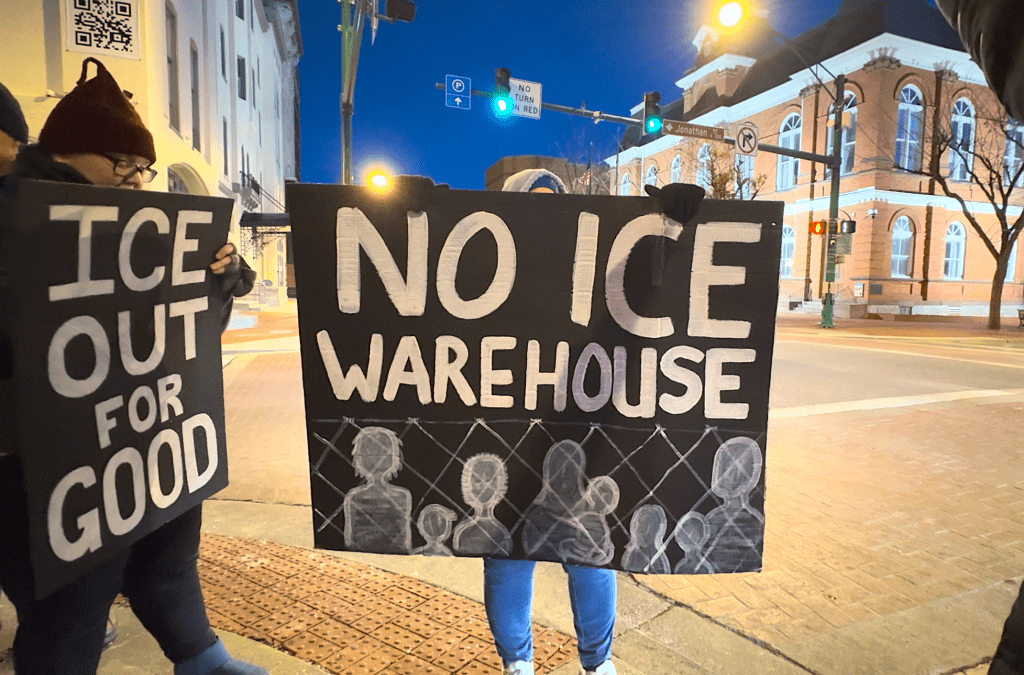
To execute its mass deportation campaign, the Trump administration has big plans for small-town America. In the rural town of Williamsport, Maryland, just next to Hagerstown, the Department of Homeland Security recently purchased a massive shipping warehouse for over $100 million and plans to convert the facility into an immigrant detention center that will hold upwards of 1,500 human beings per day. In this on-the-ground report, TRNN takes you to the site of the proposed ICE detention facility and speaks with local residents who are fighting back and demanding more transparency and accountability from the government.
Additional links/info:
Hagerstown Rapid Response Network website, Facebook page, Bluesky page, and Instagram
Washington County Indivisible website
Project Salt Box Substack, Bluesky page, TikTok, and Instagram
Maximillian Alvarez, TRNN, “The chilling truth behind ICE’s detention warehouses”
Maximillian Alvarez, TRNN, “Meet the data analysts exposing ICE’s plans
ACLU of Maryland, “Community leaders, elected officials, and civil rights organizations challenge DHS’s secret, rushed plan to convert Hagerstown warehouse into mass immigration detention center”
Credits:
Videographer: Maximillian Alvarez
Post-Production: Maximillian Alvarez, Cameron Granadino
Transcript
The following is a rushed transcript and may contain errors. A proofread version will be made available as soon as possible.
Claire Connor:
We are on the outskirts of Hagerstown very close to Williamsport, Maryland, and we are standing in front of a gargantuan warehouse facility that has recently been purchased by DHS for use of detention center.
Laura Spivak:
We were recently informed actually by the Washington Post via some leak documents that an ICE facility was planned for our county. We were not informed by any of our local politicians. We were not informed by the federal government. And the community
Claire Connor:
In light of this has been
by Mansa Musa | Apr 6, 2026 | history, Prisons and Policing, Rattling the Bars, video
When state violence and systemic denial of full citizenship by the state makes true belonging impossible for Black people, Black anarchists have envisioned and fought for a free life beyond the state. In this episode of Rattling the Bars, author William C. Anderson explores the rich, radical tradition of Black anarchism and its connection to prison abolitionist movements.
Guests:
William C. Anderson is a writer and activist from Birmingham, AL. His work has appeared in outlets ranging from The Guardian, MTV, Truthout, British Journal of Photography, to Pitchfork. He is the author of The Nation on No Map: Black Anarchism and Abolition, and co-author of As Black as Resistance: Finding the Conditions for Liberation. He’s also the co-founder of Offshoot Journal and provides creative direction as a producer of the Black Autonomy Podcast.
Credits:
Producer / Videographer / Editor: Cameron Granadino
Transcript
The following is a rushed transcript and may contain errors. A proofread version will be made available as soon as possible.
Mansa Musa:
Welcome to Rattling Bars. I’m your host, Mansa Musa. When you hear the term “anarchy” and “anarchist,” what comes to mind? Joining me today is William C. Anderson, author of The Nation on No Map: Black Anarchism and Abolition, and a columnist for Prism News where he writes the series Another Way Out. Welcome, William. Welcome to Rattling the Bars.
William C. Anderson:
Hey, thanks for having me on.
Mansa Musa:
First start out, could you introduce yourself to our audience and share how some of your background?
William C. Anderson:
Yeah. So my name’s William C. Anderson. I’m a writer, an activist, do some organizing here and there, and a person who’s just generally committed to struggle. I
by Abdaljawad Omar | Apr 3, 2026 | Article, Israel, Opinion, Palestine, Politics and Movements: International, Prisons and Policing, Reprint
This story originally appeared in Mondoweiss on April 02, 2026. It is shared here with permission.
The picture of Israeli National Security Minister Itamar Ben-Gvir jubilantly trying to open a champagne bottle on the Knesset floor over the passing of a death penalty law for Palestinians will be anchored in history as one of those photographs that needs no caption.
It’s the image of a country that has never truly left the colonial moment into which it was born. It didn’t simply inherit British practices, but kept them alive for over 70 years. It now reaches back to retrieve one of the darkest of these practices.
Israel’s new death penalty law, which exclusively targets Palestinians, did not come out of nowhere. It was passed down from a scaffold the British had already built on the same land, testing it on the same people under the same sky. In his study of Britain’s “pacification” of Palestine, Matthew Hughes, a military historian at Brunel University, shows how the military courts established by the British Mandate in November 1937 were built for speed above all else — a terror performed so quickly that no one had time to appeal or look away. Shaykh Farhan al-Sa’di, an elderly Qassamite revolutionary leader and one of the principal field commanders of the 1936 uprising, was captured on a Monday, tried on a Wednesday, and hanged on a Saturday. It’s the same law Israel reintroduced today.
What those courts also reveal is that British execution policy was, from the beginning, applied differently depending on who stood before the judge. Palestinians were hanged for carrying four bullets; Jews received prison sentences for firing weapons. The courts were equal on
by Maximillian Alvarez | Apr 1, 2026 | ICE, Podcast, Politics and Movements: US, Prisons and Policing, Working People
While facing decades-long political efforts to throttle and privatize the United States Postal Service (USPS), and while US Postmaster General David Steiner ominously warns that the USPS will “run out of money” within a year, postal workers continue to deliver the mail and serve communities across the country. But that job has gotten harder, more dangerous, and more complicated in recent years. From increases in targeted violence against letter carriers to the Trump administration’s attacks on mail-in voting, to ICE and Border Patrol agents invading communities on their mail routes, USPS workers are confronting many daily hazards on the job that the public doesn’t see. In this episode, we speak with Connor Mauche, a letter carrier in New York and a shop steward for Branch 3 of the National Association of Letter Carriers, about what it’s like to be a postal worker in America in 2026.
Additional links/info:
National Association of Letter Carriers – Branch 3 website
Ann DeStefano Sutherland, The Revolt of the Good Guys (a documentary about the Great Postal Strike of 1970)
Derek Dolbeare, Labor Notes, “Dispatch: Letter carriers are gearing up for another contract fight”
Sara Braun, The Guardian, “Nearly blind refugee abandoned by US border patrol found dead in Buffalo”
Monique Morrissey, Economic Policy Institute, “Why is President Trump attacking the Postal Service?”
Susan Haigh, AP, “US Postal Service expects to run out of cash in a year without help from Congress, postmaster says”
Featured Music:
Jules Taylor, Working People Theme Song
Credits:
Audio Post-Production: Jules Taylor
Transcript
The following is a rushed transcript and may contain errors. A proofread version will be made available as soon as possible.
Maximillian Alvarez:
Alright. Welcome everyone to Working People, a podcast about
by Marc Becker | Mar 30, 2026 | Article, Ecuador, FBI, Politics and Movements: International, Politics and Movements: US, Prisons and Policing, Reprint
by Maximillian Alvarez | Mar 27, 2026 | Military, Military Industrial Complex, Politics and Movements: International, Politics and Movements: US, Prisons and Policing, video
Earth’s Greatest Enemy, the new blockbuster documentary by independent journalist and filmmaker Abby Martin, is an expansive and terrifying investigation into the existential threat that US empire in general—and the US military specifically—poses to humanity and to our planet. In this panel discussion, recorded after a live screening of Earth’s Greatest Enemy on Jan. 29 at the TRNN studio in Baltimore, Maryland, TRNN Editor-in-Chief Maximillian Alvarez and Dharna Noor, fossil fuels and climate reporter for The Guardian, speak with Abby Martin about how US militarism and imperialism are destroying the planet—and what can be done to stop them.
Guests:
Abby Martin is an independent journalist, filmmaker, and host of The Empire Files. She is the director of the 2019 documentary Gaza Fights for Freedom and the 2026 documentary Earth’s Greatest Enemy.
Dharna Noor is a fossil fuels and climate reporter at The Guardian.
Credits:
Studio Production: David Hebden, Cameron Granadino
Post-Production: Cameron Granadino
Transcript
The following is a rushed transcript and may contain errors. A proofread version will be made available as soon as possible.
Maximillian Alvarez:
Welcome everyone to the Real News Network podcast. I’m Maximillian Alvarez. I’m the editor-in-chief here at The Real News, and it’s so great to have you all with us. Earth’s greatest enemy is the title of a new blockbuster documentary by legendary independent journalist and filmmaker, Abby Martin. It is an expansive, engrossing, and frankly, terrifying investigation into the existential threat that US Empire in general and the US military specifically poses to humanity and to our planet. Recently, right here in the real news studio in downtown Baltimore, we had the honor of hosting the Baltimore premiere of this vital documentary, and