by Eleanor J. Bader | May 2, 2026 | Adjunct Faculty, Connecticut, education, faculty, Higher Education, Interview, labor, Labor Organizing, Maine, Massachusetts, National Labor Relations Board, New Hampshire, New Jersey, New York, NLRB, Pennsylvania, Rhode Island, shared governance, solidarity, Students, Unions, Vermont
When East Coast members of Higher Education Labor United (HELU) got together in January, they set their sights on developing a national plan to improve working conditions for university and college faculty and staff, enhance learning conditions for students, and build lasting partnerships with local communities to promote the common good. Together, they drafted a document called the Amherst…
Source

by Maximillian Alvarez | May 1, 2026 | Economy and Inequality, labor, Podcast, Politics and Movements: US, Unions, video, Working People
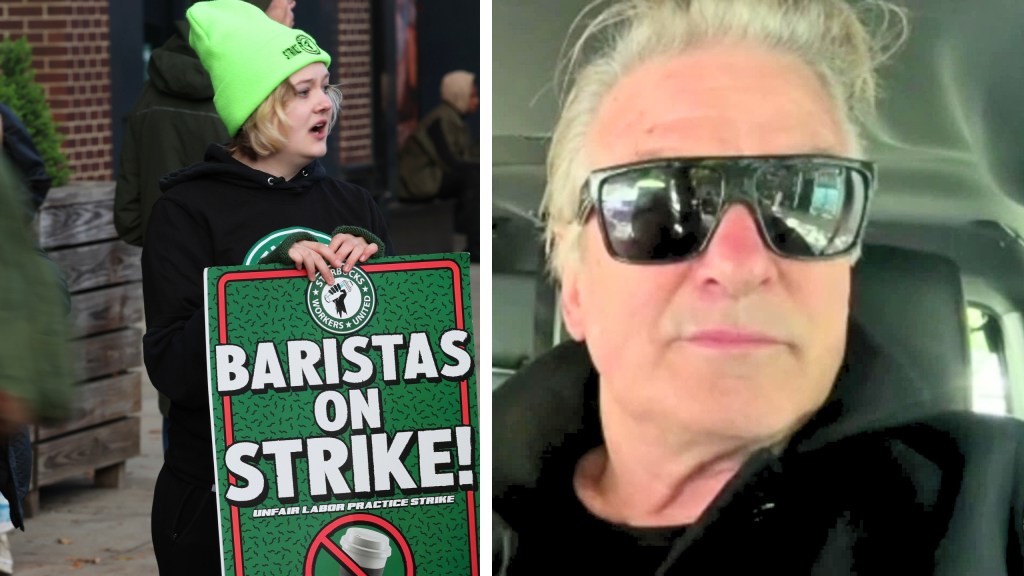
After decades of decline, the organized labor movement in the US has seen a resurgence in rank-and-file militancy over the last decade, with increased strike actions and union drives in industries across the economy. And in the story of this recent revival of labor in America, the movement led by predominantly young baristas to unionize coffee giant Starbucks has played a pivotal role. The new documentary Baristas vs. Billionaires takes viewers on a journey through the last five years of the epic, ongoing struggle to unionize Starbucks, told by some of the workers and organizers at the center of that struggle. TRNN Editor-in-Chief Maximillian Alvarez speaks with director of Baristas vs. Billionaires and Academy Award nominee Mark Mori, and with legendary actor and Academy Award nominee Alec Baldwin, who is a producer on the film.
Additional links/info:
Baristas vs. Billionaires website
Maximillian Alvarez, Working People / TRNN, “‘Starbucks is the largest labor violator in modern history’: Starbucks workers prepare for indefinite national strike”
Maximillian Alvarez, Working People / TRNN, “How union organizing can change your life and the world: A conversation with Jaz Brisack”
Maximillian Alvarez, Working People / TRNN, “Want to unionize your workplace? These worker-organizers have some advice”
Featured Music:
Jules Taylor, Working People Theme Song
Credits:
Studio Production / Post-Production: David Hebden
Audio Post-Production: Jules Taylor
Transcript
MAXIMILLIAN ALVAREZ: Welcome back to The Real News Network. I’m Maximillian Alvarez. In the post-World War heyday of American manufacturing and industrial unionism, when the middle class was exploding, about one in every three workers in this country was part of a union. But today, as working people face a punishing cost of living crisis, an evaporating middle class, and Gilded Age levels of
by Maximillian Alvarez | Apr 29, 2026 | Economy, Economy and Inequality, labor, Podcast, Politics and Movements: US, Unions, Working People
Inspired by January’s mass strike against ICE terror in Minnesota, a vast coalition of labor unions, democratic organizations, and community groups are organizing a nationwide economic blackout on Friday, May 1, International Workers Day. “May Day Strong events are being planned across the US,” Michael Sainato reports at The Guardian, “with organizers calling for ‘no school, no work, no shopping,’ in protest of government policies they say put billionaires’ needs above those of workers.”
In this episode of Working People, we speak with a panel of guests who are all involved in organizing May Day events this week from Philadelphia to Chicago to Iowa. Panelists include: Jana Korn, who currently serves as the chief of staff for the Philadelphia Council AFL-CIO, and also serves on the board of Philadelphia Jobs with Justice; Jeff Kurtz, a retired locomotive engineer and union officer who also served as a state representative in the Iowa House of Representatives; and John Emiliano, a healthcare worker and organizer in Chicago with the Tahanan Center and Tanggol Migrante, a grassroots Filipino migrant defense network.
Additional links/info:
May Day Strong coalition website
Workers Over Billionaires 2026 – Philadelphia Linktree
Workers Over Billionaires 2026 – Chicago details
Lee County (Iowa) Labor Chapter Facebook page and May Day 2026 details
Tahanan Filipino Center Instagram
Tanggol Migrante website
Latino Union of Chicago website
Michael Sainato, The Guardian, “US activists plan May Day economic blackout: ‘No school, no work, no shopping’”
Featured Music:
Jules Taylor, Working People Theme Song
Credits:
Audio Post-Production: Jules Taylor
Transcript
The following is a rushed transcript and may contain errors. A proofread version will be made available as soon as possible.
Maximillian Alvarez:
Alright. Welcome everyone to Working People, a podcast about the lives, jobs,
by Lorah Steichen | Apr 24, 2026 | Article, Economy, Economy and Inequality, labor, Military Industrial Complex, Politics and Movements: US, Reprint, War
This story originally appeared in Jacobin on April 23, 2026. It is shared here with permission.
Amid the United States’ illegal, costly, and broadly unpopular war in Iran, the Trump administration recently asked Congress to approve a record-breaking $1.5 trillion military budget — the largest military spending proposal in US history. The administration claims that record war spending will pay for a “once-in-a-century revival of American industry,” while hawks in Congress argue that the spending spree will “revitalize” the military industrial base by investing in a “skilled, patriotic defense workforce.”
But new research from Transition Security Project suggests that military spending increases are unlikely to translate into broad gains for American workers.
While Pentagon budgets have steadily increased over recent decades, the arms industry has become more consolidated, more automated, and less labor-intensive — upending the idea that the warfare state is an effective economic development strategy for working people, and strengthening the case for a state-led shift toward a civilian industrial base focused on green manufacturing.
Half of the Pentagon budget is funneled to private weapons manufacturers, but higher spending has not produced more jobs. Employment in military industries has fallen significantly since Cold War peaks, from an estimated 3.2 million workers during the 1980s to about 1.1 million in 2020, despite Pentagon budgets growing by roughly 22 percent over the same period. Meanwhile, job quality in the sector has also deteriorated: wages have declined, pensions cut, and unionization collapsed to roughly 10 to 14 percent on average across major military contracting firms, while company revenues from military contracts have grown substantially.
Taken together, these trends challenge a persistent assumption in Washington policymaking that military spending is an effective jobs program for American
by Caitlyn Clark and Lisa Xu | Apr 23, 2026 | Article, Economy, Economy and Inequality, labor, Politics and Movements: US, Reprint, Unions
This story originally appeared in Labor Notes on April 23, 2026. It is shared here with permission.
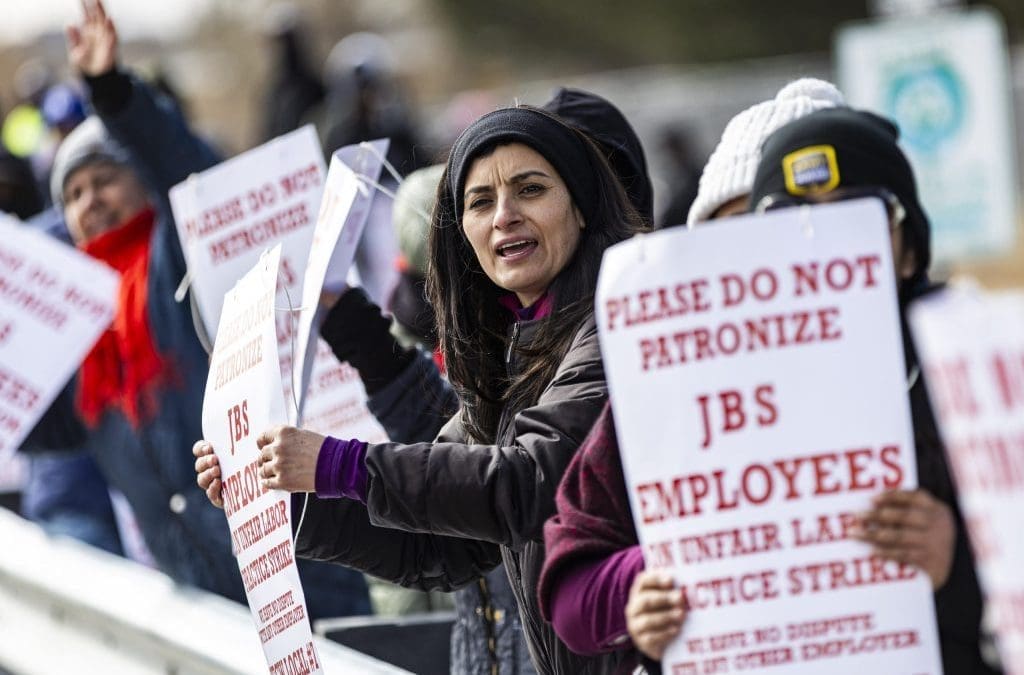
Last month, 3,800 meatpacking workers in UFCW Local 7 in Greeley, Colorado launched the industry’s first major strike in 40 years.
The three-week unfair labor practice strike was the first time workers had ever struck the JBS Greeley beef packing plant, one of the company’s largest. ULP charges against JBS included the illegal termination of a member of the bargaining committee and surveillance and intimidation of workers for participation in union activity.
With 57 languages spoken under one roof, the strike united the plant’s largely immigrant workforce to take on the biggest meatpacking company in the world.
The local had spent nearly a year in negotiations following the contract’s expiration last July. JBS returned to the bargaining table after the strike—and when the dust settled, the company had conceded to almost every demand.
WON PROTECTION
In addition to $1.50 an hour in wage increases over the short two-year agreement, workers won a groundbreaking policy on personal protective equipment, challenging JBS’s previous system of garnishing wages to replace necessary PPE when it was lost, damaged, or stolen. JBS was charging workers up to $1,100 to pay for mesh vests, gloves, arm guards, and knife sharpeners.
“My mesh apron had a hole in it. I had to go two months wearing the same apron,” said Chris Ready, who has worked in the slaughter department at the plant for one year.
“I’ve had my equipment stolen,” Ready said. “I borrowed knives until I had to buy my own… I’ve had to buy two mesh gloves so far, that’s $200. It was annoying, but it
by Jane Slaughter | Apr 13, 2026 | Article, Economy and Inequality, labor, Politics and Movements: US, Reprint, Unions
This story originally appeared in Labor Notes on April 6, 2026. It is shared here with permission.
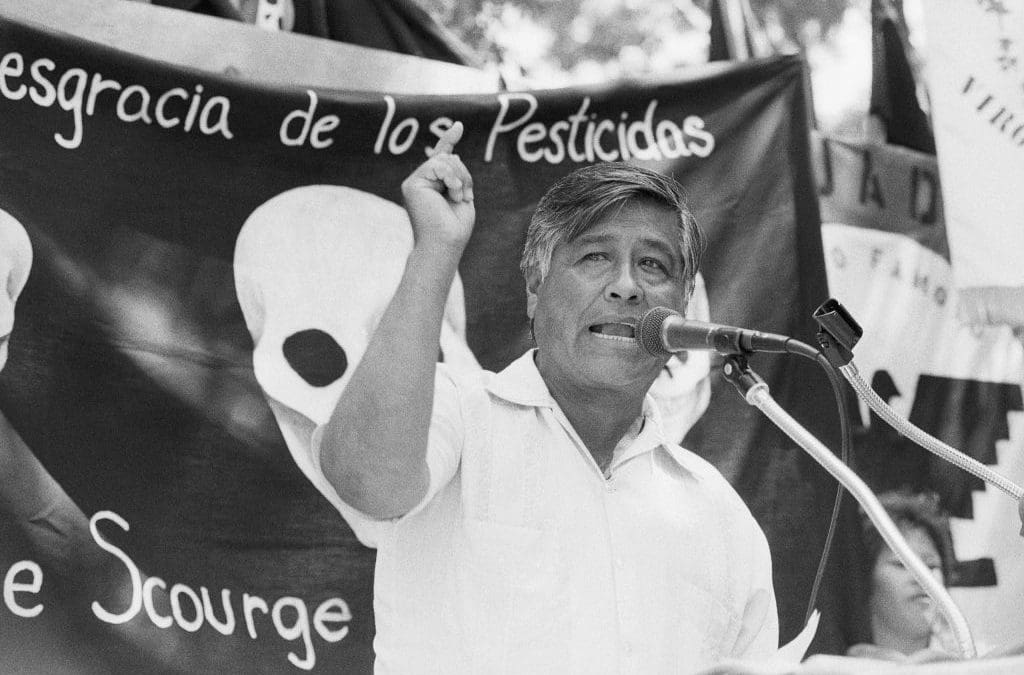
In 2011 Frank Bardacke published an 800-page history of the Farm Workers union: Trampling Out the Vintage: Cesar Chavez and the Two Souls of the United Farm Workers. It opened many eyes to the reasons the UFW became a shadow of its former self.
Bardacke starts the book with an epigraph, a quote from Shakespeare’s Julius Caesar: “O what a fall was there, my countrymen! Then I, and you, and all of us fell down…”
Bardacke was a farmworker in the fields of the Salinas Valley for six seasons in the 1970s. When he decided to write his book years later, he went back to his carpool co-workers, finding them still at work in the fields. In 1994, the union had been thoroughly defeated for nearly 10 years—but his old friends were afraid even to mention its name where the foreman might hear.
I interviewed Frank Bardacke after a New York Times investigation revealed evidence that Chavez had sexually abused young girls who were volunteering with the union, and the allegation that he had also assaulted union co-founder Dolores Huerta. –Jane Slaughter
Jane Slaughter: The revelations about Cesar Chavez as a sexual predator: many people have said they were “surprised but not shocked” or “shocked but not surprised.” How did you react?
Frank Bardacke: The abuse of Ana Murguia was rumored at the time among UFW staff, primarily at the La Paz headquarters. Many of the rumors originated with Ana’s stepmother, Kathy Murguia. But people just didn’t want to hear it. They didn’t want to look into it very deeply because Cesar was one of these