by Maximillian Alvarez | Apr 8, 2026 | Economy, Economy and Inequality, health care, labor, Podcast, Politics and Movements: US, Unions, Working People
Nearly a year after workers voted to authorize a strike, non-union city and commercially contracted security officers in Baltimore, MD, will walk off the job on April 9 in an Unfair Labor Practice strike against their employer, Abacus Corporation. In their yearslong effort to unionize and secure more job security, better pay, accessible healthcare, and safer working conditions, workers at Abacus have reported rampant union busting and violations of their labor rights. In this episode, we speak with Laura Dixon, a veteran security officer and Abacus employee, and Jaimie Contreras, executive vice president of the Service Employees International Union, Local 32BJ.
Additional links/info:
SEIU Local 32BJ website, Facebook page, and Instagram
Katherine Wilson, Baltimore Sun, “Baltimore contract security officers at city properties prepare to strike”
Featured Music:
Jules Taylor, Working People Theme Song
Credits:
Audio Post-Production: Jules Taylor
Transcript
The following is a rushed transcript and may contain errors. A proofread version will be made available as soon as possible.
Maximillian Alvarez:
All right. Welcome everyone to Working People, a podcast about the lives, jobs, dreams, and struggles of the working class today. Working People is a proud member of the Labor Radio Podcast Network and is brought to you in partnership with In These Times Magazine and the Real News Network. This show is produced by Jules Taylor and made possible by the support of listeners like you. My name is Maximillian Alvarez, and today we are going back to the picket line. We’ve got another strike update episode for you guys, and this time we’re talking about a strike that’s happening right here in our hometown of Baltimore. As stated in a press release from the Service Employees International
by Marianne Dhenin | Apr 4, 2026 | health care, Health Care Workers, ICE, immigration, labor, News, Nurses, Unions
After the House of Representatives passed bills to send $10 billion in funding to the Department of Homeland Security in January, the nation’s largest union of registered nurses published a demand that Congress abolish Immigration and Customs Enforcement (ICE). “Nurses demand the removal of immigration enforcement agents from communities, the abolition of ICE, and accountability for this…
Source
by Eleanor J. Bader | Apr 2, 2026 | Article, Economy and Inequality, education, labor, Politics and Movements: US, Reprint, Unions
This article was originally published by Truthout on April 01, 2026. It is shared here under a Creative Commons (CC BY-NC-ND 4.0) license.
Sixty-two years ago, St. John’s University (SJU) in New York City became the site of the first major faculty strike in U.S. history — a year-long conflict that followed the firing of 33 teachers, including three priests, without due process. Now, the struggle over labor conditions has forced the faculty to once again mobilize, a move precipitated by the current college administration’s abrupt announcement that it will no longer recognize two faculty unions or continue negotiations to hash out a new contract.
St. John’s president, Rev. Brian J. Shanley, and Provost and Senior Vice President Simon Geir Møller, told the National Catholic Reporter (NCR) that the move was necessary to give the college “the flexibility required to innovate … and deliver on our promise to our students.”
But faculty members, who had been demanding improved wages and greater transparency in how their share of health insurance premiums are calculated, call it union busting.
And while the university’s administrators did not respond to Truthout’s multiple requests for an interview, they told NCR that the decision rests on a 2020 decision promulgated by the National Labor Relations Board (NLRB). That decision, Bethany College, 369 NLRB No. 98, removed NLRB jurisdiction over most of the 849 religiously affiliated colleges and universities in the country and prompted at least eight predominantly Catholic schools — Bethany and Boston Colleges, and Duquesne, Edward Waters, Loyola Marymount, Marquette, St. Leo and Wilberforce universities — to end union recognition on campus.
Critics see this as part of a general rightward trend in higher education.
“The anti-union arguments that have emerged coincide
by Eleanor J. Bader | Apr 1, 2026 | American Association of University Professors, CBP, Customs and Border Protection, education, Higher Education, labor, National Labor Relations Board, News, NLRB, Union Busting, Unions
Sixty-two years ago, St. John’s University (SJU) in New York City became the site of the first major faculty strike in U.S. history — a year-long conflict that followed the firing of 33 teachers, including three priests, without due process. Now, the struggle over labor conditions has forced the faculty to once again mobilize, a move precipitated by the current college administration’s abrupt…
Source
by Amy Goodman | Apr 1, 2026 | child labor, Colorado, Discrimination, Immigrants, Interview, JBS, labor, Meat Plants, Meatpacking, meatpacking plants, PPE, strike, Unions, Wages, Worker Safety
More than 3,000 meatpacking workers in Greeley, Colorado, have been on strike since mid-March, the first major labor strike in the U.S. meatpacking industry since 1985. Workers at JBS USA, the U.S. subsidiary of Brazilian-based multinational JBS, are protesting unfair and dangerous labor conditions, including low wages, lack of personal protective gear and discrimination against its majority…
Source
by Tina Vasquez | Mar 31, 2026 | Article, labor, Politics and Movements: US, Reprint
This story originally appeared in Prism on March 23, 2026.
Real journalists wrote and edited this (not AI)—independent, community-driven journalism survives because you back it. Donate to sustain Prism’s mission and the humans behind it.
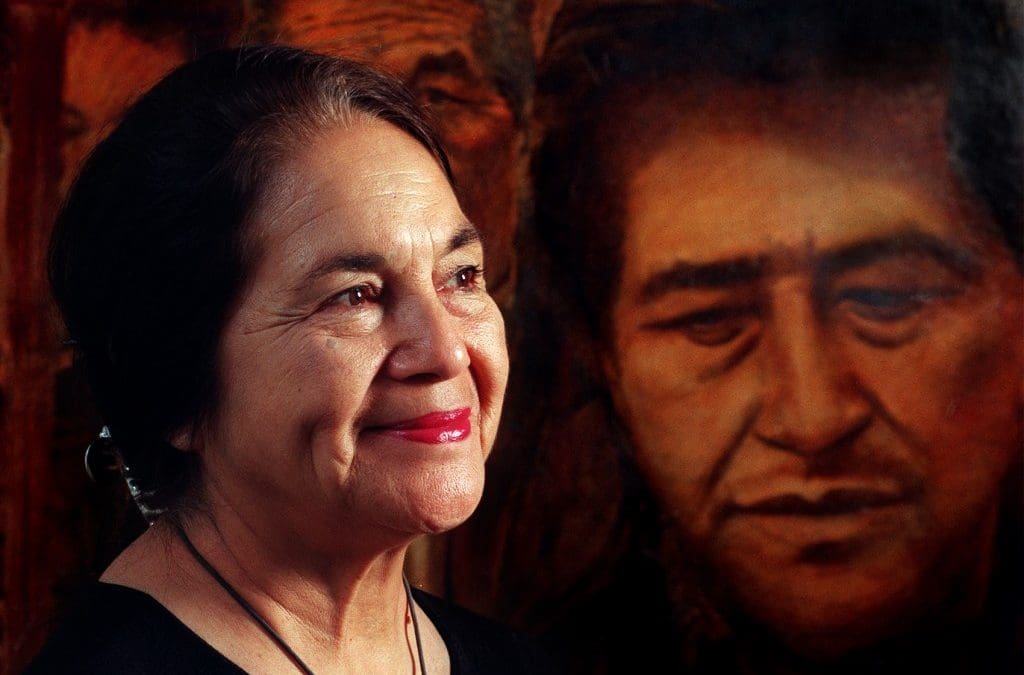
Like many others, I’ve spent the last few days looking at the many iconic photos of Dolores Huerta, the renowned feminist, labor organizer, and powerhouse co-founder of the United Farm Workers (UFW) Union. In one of my favorites taken in Salinas, California, Huerta gently holds a microphone up to her mouth with a slight smile on her face, her other hand in the air commanding the attention of the room.
The photo was taken during a UFW rally in 1970, just a few years after Huerta said she was raped by Chicano civil rights leader and union co-founder, César Chávez. For Latinos nationwide grappling with Huerta’s recent revelation, Chávez’s legacy is forever fragmented: the time before and the time after we learned he was a rapist.
As part of an investigation by The New York Times published March 18, Huerta for the first time publicly disclosed the sexual and emotional abuse she experienced at the hands of her comrade while they were the public faces of the Latino-led farmworker organizing movement. Together, they helped obtain union contracts, higher wages, and more dignified working conditions for farmworkers, in part by organizing a grape boycott. It was also in a secluded grape field where Chávez raped Huerta—a tactic commonly deployed by other rapists against their unsuspecting compañeras in agriculture who toil alongside them.
While Chávez died in 1993 at the age of 66, Huerta, now 95, said she felt forced to keep the abuse a secret for fear no one would believe her, and