
‘These are murders’: Trump killing spree hits at least 185
This story originally appeared in Common Dreams on April 27, 2026. It is shared here under a Creative Commons (CC BY-NC-ND 3.0) license.
The murder spree being conducted by the US government under the direction of President Donald Trump and Secretary of Defense Pete Hegseth climbed to an estimated 185 people on Sunday after the Pentagon announced another bombing of a boat it claims was trafficking illegal narcotics.
“On April 26, at the direction of SOUTHCOM commander Gen. Francis L. Donovan, Joint Task Force Southern Spear conducted a lethal kinetic strike on a vessel operated by Designated Terrorist Organizations,” the US military stated in a social media post. “Intelligence confirmed the vessel was transiting along known narco-trafficking routes in the Eastern Pacific and was engaged in narco-trafficking operations. Three male narco-terrorists were killed during this action. No US military forces were harmed.”
While no specific evidence was provided publicly to back up the claims made by SOUTHCOM about Sunday’s strike, human rights experts and legal scholars have made clear for months that such lethal operations at sea—whether or not those targeted are in fact trafficking drugs—have no justification under international maritime law and that the extrajudicial killings should be seen for what they are: cold-blooded murder.
Footage released by SOUTHCOM showed the moment the vessel was attacked, and those aboard were killed:
On April 26, at the direction of #SOUTHCOM commander Gen. Francis L. Donovan, Joint Task Force Southern Spear conducted a lethal kinetic strike on a vessel operated by Designated Terrorist Organizations. Intelligence confirmed the vessel was transiting along known… pic.twitter.com/br2znnUM1x— U.S. Southern Command (@Southcom) April 27, 2026
In a separate attack on April 24, also carried out by SOUTHCOM, two other individuals were murdered when their boat, filmed stationary in the

War isn’t working for American workers
This story originally appeared in Jacobin on April 23, 2026. It is shared here with permission.
Amid the United States’ illegal, costly, and broadly unpopular war in Iran, the Trump administration recently asked Congress to approve a record-breaking $1.5 trillion military budget — the largest military spending proposal in US history. The administration claims that record war spending will pay for a “once-in-a-century revival of American industry,” while hawks in Congress argue that the spending spree will “revitalize” the military industrial base by investing in a “skilled, patriotic defense workforce.”
But new research from Transition Security Project suggests that military spending increases are unlikely to translate into broad gains for American workers.
While Pentagon budgets have steadily increased over recent decades, the arms industry has become more consolidated, more automated, and less labor-intensive — upending the idea that the warfare state is an effective economic development strategy for working people, and strengthening the case for a state-led shift toward a civilian industrial base focused on green manufacturing.
Half of the Pentagon budget is funneled to private weapons manufacturers, but higher spending has not produced more jobs. Employment in military industries has fallen significantly since Cold War peaks, from an estimated 3.2 million workers during the 1980s to about 1.1 million in 2020, despite Pentagon budgets growing by roughly 22 percent over the same period. Meanwhile, job quality in the sector has also deteriorated: wages have declined, pensions cut, and unionization collapsed to roughly 10 to 14 percent on average across major military contracting firms, while company revenues from military contracts have grown substantially.
Taken together, these trends challenge a persistent assumption in Washington policymaking that military spending is an effective jobs program for American

Israel kills journalist in Lebanon after “hunting” down her and a colleague
This article was originally published by Truthout on April 23, 2026. It is shared here under a Creative Commons (CC BY-NC-ND 4.0) license.
Israeli forces killed journalist Amal Khalil and wounded her colleague, Zeinab Faraj, on Wednesday, firing multiple strikes on the journalists in southern Lebanon in Israel’s latest attack on journalists covering its violence across the region.
Khalil and Faraj were taking cover in a nearby house after an Israeli strike near their car, while they were out reporting on an Israeli strike on another vehicle. While at the house, Khalil reached out to family and Lebanese officials, notifying them of her location, but Israeli forces bombed the house, collapsing it.
Rescuers pulled Faraj from the wreckage, but Israeli forces fired at emergency workers trying to reach Khalil, delaying her rescue, according to Lebanese officials. Khalil’s body was only recovered hours later from the rubble.
Meanwhile, Israeli forces also fired, for a third time, on the ambulance transporting Faraj to the hospital, Lebanese media reported, in an incident described by critics as the Israeli forces “hunting her down.” Faraj underwent surgery at the hospital and was brought to stable condition.
Khalil was a veteran reporter for the Al-Akhbar newspaper. The left-wing journalist was raised under Israeli occupation in the 1980s in southern Lebanon, and was driven by a desire to chronicle daily life in south Lebanon under constant threat of Israeli invasion and bombardment.
“On a personal level, resistance means everything to me,” Khalil said in an interview, translated from Arabic, with The Public Source last year. “Through my work, I have tried to be in solidarity with these people — the people of the land.”
Khalil was also an animal lover, and devoted her free time
After three-week strike, JBS concedes to meatpacking workers
This story originally appeared in Labor Notes on April 23, 2026. It is shared here with permission.
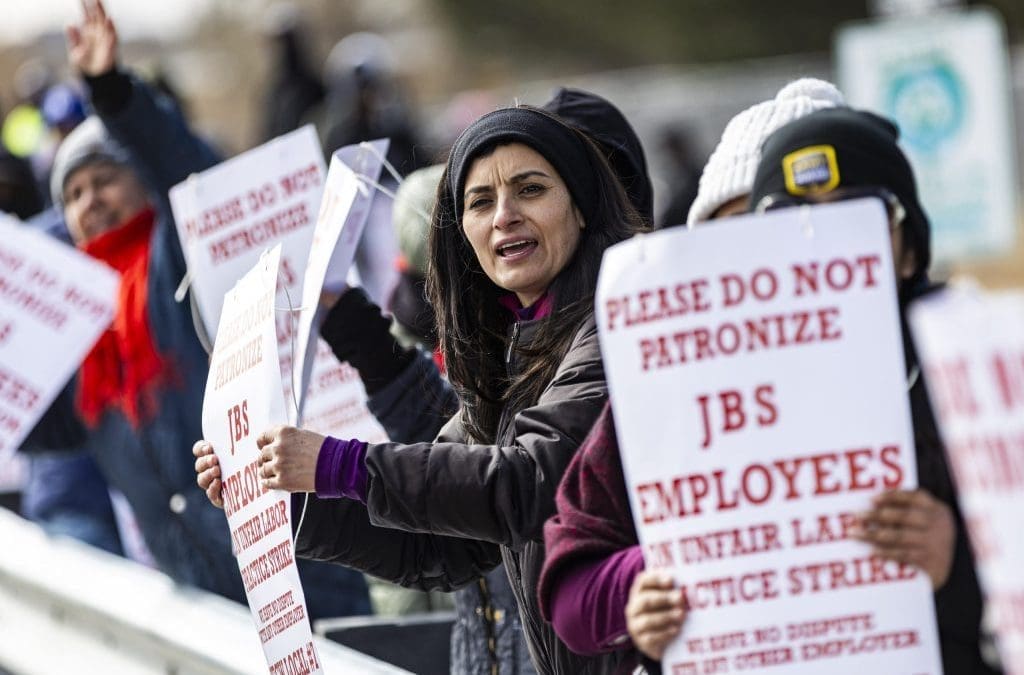
Last month, 3,800 meatpacking workers in UFCW Local 7 in Greeley, Colorado launched the industry’s first major strike in 40 years.
The three-week unfair labor practice strike was the first time workers had ever struck the JBS Greeley beef packing plant, one of the company’s largest. ULP charges against JBS included the illegal termination of a member of the bargaining committee and surveillance and intimidation of workers for participation in union activity.
With 57 languages spoken under one roof, the strike united the plant’s largely immigrant workforce to take on the biggest meatpacking company in the world.
The local had spent nearly a year in negotiations following the contract’s expiration last July. JBS returned to the bargaining table after the strike—and when the dust settled, the company had conceded to almost every demand.
WON PROTECTION
In addition to $1.50 an hour in wage increases over the short two-year agreement, workers won a groundbreaking policy on personal protective equipment, challenging JBS’s previous system of garnishing wages to replace necessary PPE when it was lost, damaged, or stolen. JBS was charging workers up to $1,100 to pay for mesh vests, gloves, arm guards, and knife sharpeners.
“My mesh apron had a hole in it. I had to go two months wearing the same apron,” said Chris Ready, who has worked in the slaughter department at the plant for one year.
“I’ve had my equipment stolen,” Ready said. “I borrowed knives until I had to buy my own… I’ve had to buy two mesh gloves so far, that’s $200. It was annoying, but it