by Tareq S. Hajjaj | May 29, 2026 | Article, Gaza, Israel, Palestine, Politics and Movements: International, Reprint
This story originally appeared in Mondoweiss on May 29, 2026. It is shared here with permission.
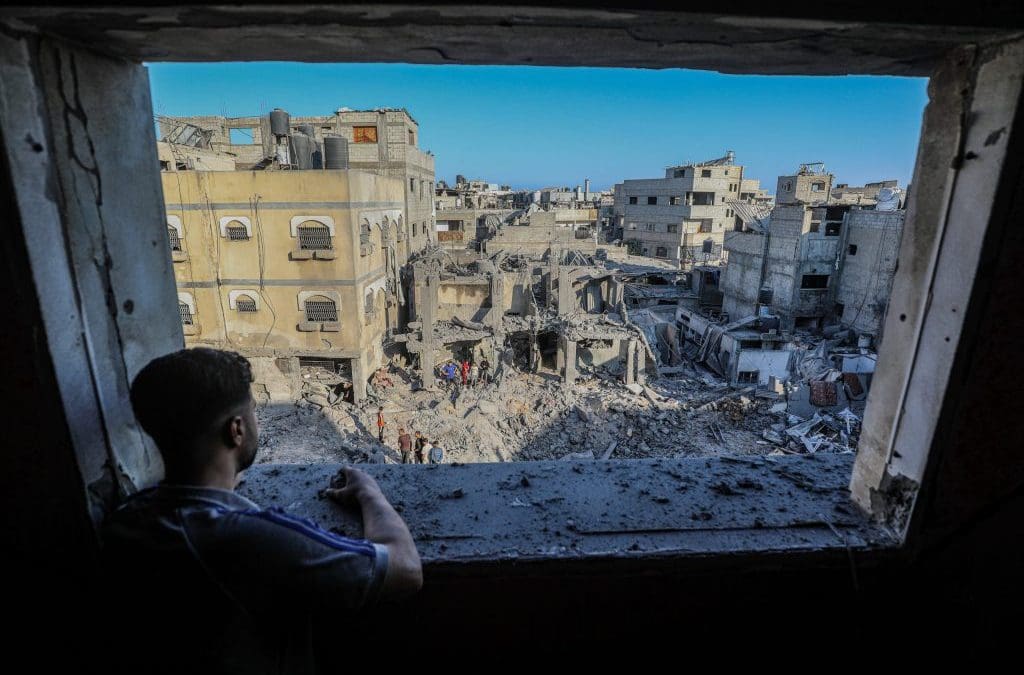
On May 24, Karam Ismael, 43, received a phone call from someone who identified himself as an Israeli army officer. The caller delivered one message: evacuate your home in 20 minutes before we bomb it. At first, he thought it was another scare tactic, similar to the messages the Israeli army used to send during incursions into neighborhoods. It was one of several calls made to residents of Nuseirat refugee camp in central Gaza, with a warning that covered residential blocks near al-Quds Supermarket and a local UNRWA clinic. The area included dozens of homes that had not previously been bombed throughout the past two years.
Four minutes after receiving his first call, Ismael’s phone rang again. The officer told him they had 10 minutes left, ordering him to evacuate immediately and to notify his neighbors. This time, he took the threat seriously and fled with his neighbors, leaving his belongings behind.
After half an hour, quadcopter drones appeared and hovered above the residential block, followed by the fighter jets. The entire block was leveled.
This was not the first such incident in recent weeks in which the Israeli army warned entire residential areas to evacuate and then bombed their homes. The Israeli army has been following a new pattern during the ceasefire: targeting residential blocks that had not experienced a ground invasion and had not been bombed during the war, remaining intact and still sheltering their owners. Over the past week, the army appears to have escalated this approach by specifically targeting residential blocks that had previously remained
by Shireen Akram-Boshar | May 28, 2026 | Article, ICE, immigration, Politics and Movements: US, Prisons and Policing, Reprint
This article was originally published by Truthout on May 26, 2026. It is shared here under a Creative Commons (CC BY-NC-ND 4.0) license.
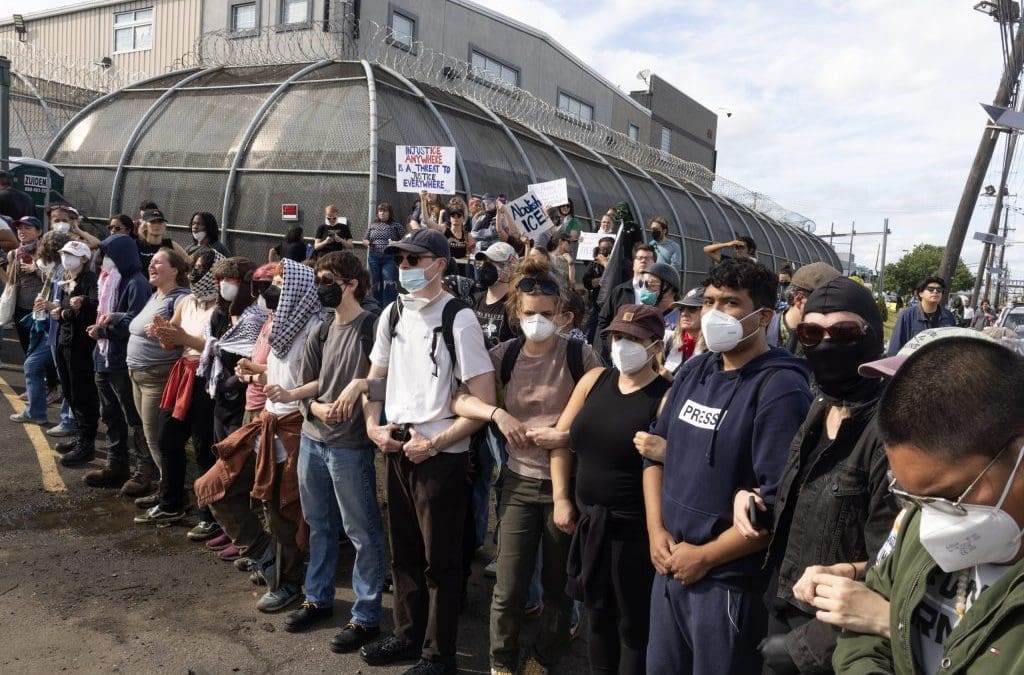
Protests erupted on Sunday night outside of the Delaney Hall immigrant jail in Newark, New Jersey, when Immigration and Customs Enforcement (ICE) moved to transfer a strike leader from the jail.
Some 300 detainees launched a hunger and labor strike on Friday in protest of the conditions at the ICE jail. On Sunday, activists and family members learned that the jail was preparing to move Martin Soto, one of the detainees who had announced the strike.
Gabriela Soto, Martin’s wife, saw ICE agents loading Martin into a van, and ran to block the van that held her husband from leaving the site. Other demonstrators joined in blocking the van from leaving the facility, and forced it back to the detention facility. Protestors formed a blockade for hours to prevent Martin Soto from being moved out of the site.
“Free Martin!” the protestors chanted. “Free them all!”
Later, around 1 am on Monday, ICE agents began to move a caravan of vehicles out of the facility, and protestors again attempted to block the vehicles from leaving. ICE agents then shoved aside protestors, pushing them against the sidewalk and against cars, and pepper sprayed at least one protestor.
A Department of Homeland Security (DHS) spokesperson announced on Monday that after “ICE successfully dispersed approximately 70 agitators” it succeeded in transferring Martin to another facility.
Since the start of the hunger strike, family members and supporters have gathered outside of the detention center. Among others, a 10-year-old child spoke about her father, who is currently being imprisoned in the
by William C. Anderson | May 26, 2026 | Article, Democratic Party, Fascism, Politics and Movements: US, Reprint
This story originally appeared in Prism on April 28, 2026.
“The ‘mosaic’ will be built on the principles of seeking to recruit from both the most oppressed segments and from among the most selfless. … The mosaic must immediately begin a dialogue toward building a consensus—as soon as possible—about how to best further coordinate our collective efforts.” –Russell Maroon Shoatz
“Freedom is indivisible, or it is nothing at all besides sloganeering and temporary, short-sighted, and short-lived advancement for a few. Freedom is indivisible, and either we are working for freedom, or you are working for the sake of your self-interests and I am working for mine.” –June Jordan
Oftentimes, powerlessness and despair lead people to turn on one another. Far too many who are scared to fight the crisis will fight their neighbor instead. The history of conquest, colonization, and capitalism is filled with examples. Like clockwork, we can always identify those who are confused, stuck, and deluded by their inability to determine where to direct their fury. In the face of vast oppression, instead of aiming for the head of their tormenters and ruling tyrants, these types blame those next to them. It’s a common reality where poverty flourishes, conflict simmers to a boiling point, and where rigid ideologues preach. In the face of fascism, there are plenty among us in the U.S. who seem doubtful about our collective power. There will need to be some level of understanding in order to overcome. Instead of a call for resentment-filled “unity” or traditional fronts, we can look to what former Black Panther, Black Liberation Army member, and political prisoner Russell Maroon Shoatz called