

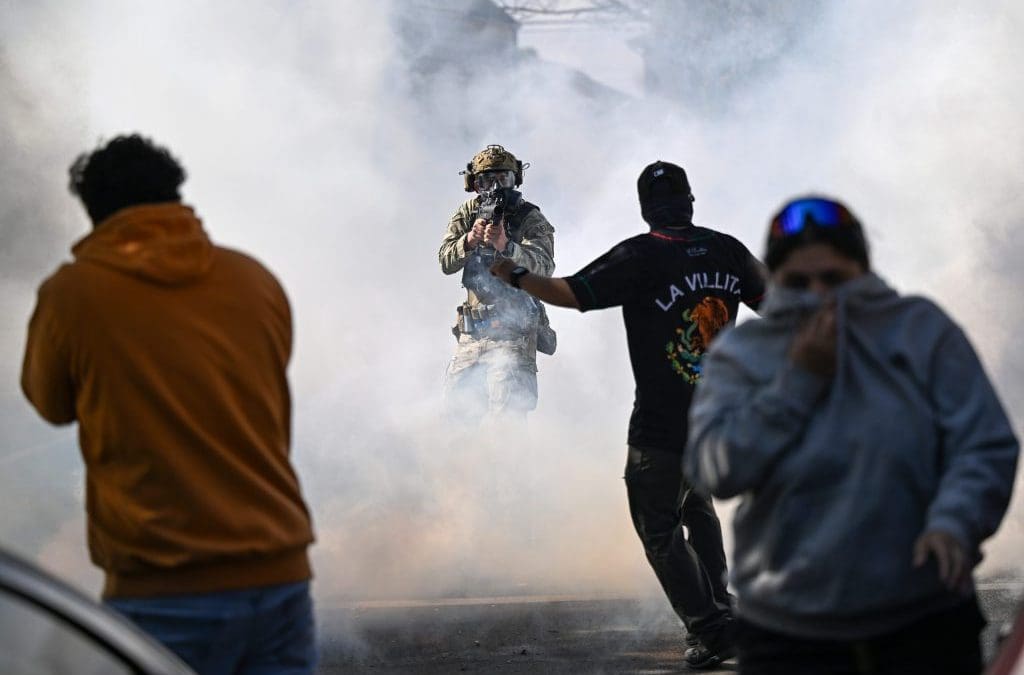
‘No Kings’ protests set to sweep US even as Trump increases attacks on activists
This story was originally published on Truthout on Oct. 15, 2025. It is shared here under a Creative Commons (CC BY-NC-ND 4.0) license.
Wearing a high-visibility vest that said “Press,” award-winning journalist Mario Guevara was arrested in June by local law enforcement while livestreaming a “No Kings” protest against President Donald Trump in Georgia. While the charges against him were eventually dropped, Guevara was handed over to Immigrations and Customs Enforcement (ICE) despite being authorized to live and work in the United States. The Trump administration railroaded Guevara through the courts until October 3, when they deported him to El Salvador, a country he fled 20 years ago in fear for his life.
The targeting of Guevara has been widely regarded as an attack on press freedom — and a punishment for dissent. It’s also likely top of mind for some as people across the country prepare for the next round of “No Kings” protests this week. Experts say that the recent string of moves from the Trump administration is meant to criminalize political opposition and further put activists on edge — but they also urge people to stay engaged. Trump’s claims about a surge in anti-fascist political violence are false, and people across the country are developing clever ways to resist, even as the president attempts to sow mayhem in cities led by Democrats.
“Coupled with a legal concern about the very troubling expansion of an authoritarian state, it’s never going to be my legal advice to let an authoritarian do an authoritarianism,” Matthew Kellegrew, an attorney with the Civil Liberties Defense Center, told Truthout. “You can look out your window and see what Trump is saying
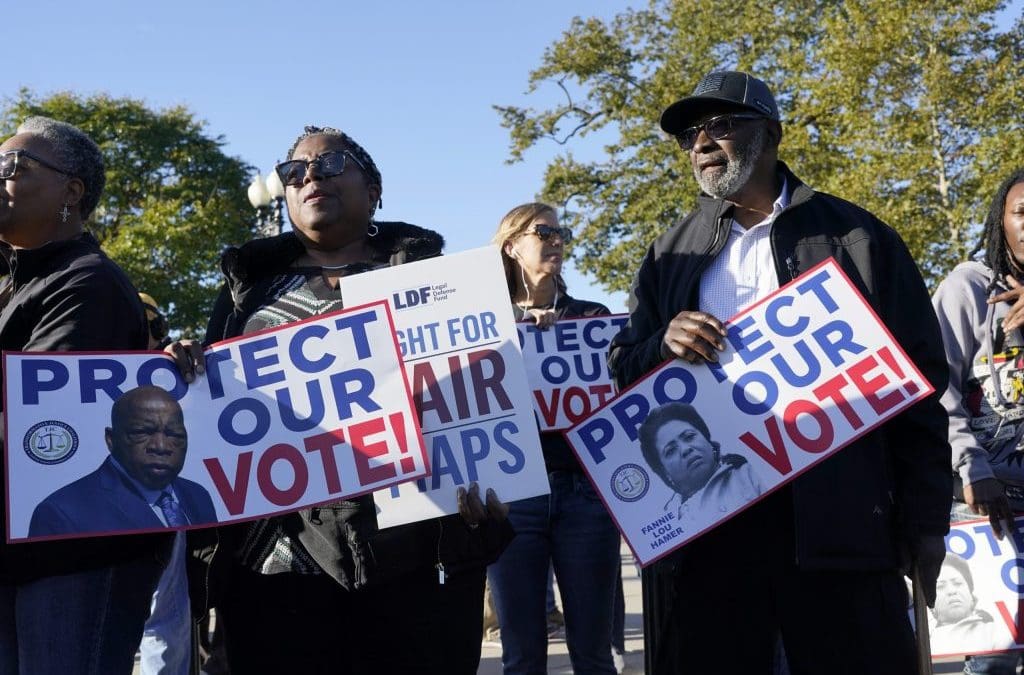
Case before Supreme Court could destroy Voting Rights Act and cement GOP control of House ‘for at least a generation’
This story originally appeared in Common Dreams on Oct. 15, 2025. It is shared here under a Creative Commons (CC BY-NC-ND 3.0) license.
The US Supreme Court will rehear a case on Wednesday that could strike a death blow to the Voting Rights Act and, in the process, virtually guarantee that Republicans hang on to power in the 2026 midterm elections and well into the future.
At issue in the case, Louisiana v. Callais, is Section 2 of the VRA, which outlaws racially discriminatory redistricting. Max Flugrath, communications director for the voting rights group Fair Fight Action, wrote for Slate that “by taking the unusual step of reopening arguments, legal experts believe, the court’s far-right majority may have telegraphed its intent to dismantle Section 2.”
“If it falls, the impact will reverberate far beyond Louisiana, reshaping political power across the entire country,” he said.
According to a report from Fair Fight and Black Voters Matter, if Section 2 is dismantled, it would guarantee Republicans an additional 19 safe seats in the US House of Representatives, and as many as 27 when combined with the GOP’s Trump-led push for mid-decade gerrymandering.
“It’s enough to cement one-party control of the US House for at least a generation,” according to the report.
The origins of the case itself are highly unusual. It began typically enough, with a conservative Fifth Circuit Court affirming a lower court’s ruling that the congressional maps drawn by the state GOP in 2022 constituted an illegal racial gerrymander. Despite Black residents making up roughly a third of Louisiana’s population, many of them were crammed into a single district, while the other five in the state remained majority white.
After the court ruling, Republican Gov. Jeff Landry convened

Siding with Trump, Facebook suspends Chicago community group issuing ICE alerts
This story originally appeared in Common Dreams on Oct. 15, 2025. It is shared here under a Creative Commons (CC BY-NC-ND 3.0) license.
Chicago residents in recent weeks have found numerous ways to resist the Trump administration’s deployment of hundreds of federal agents in its increasingly violent “Operation Midway Blitz” anti-immigration campaign—with thousands of people marching to demand armed officers leave the city, some physically intervening in arrests, and community members volunteering to patrol their neighborhoods to warn the public when agents are nearby.
But the alliance between Big Tech and the Trump administration on Tuesday interfered with efforts by more than 80,000 Chicagoland residents to show solidarity with immigrants and people of color, as Facebook suspended a community group where people have been tipping off their neighbors when they see US Immigration and Customs Enforcement (ICE) and other federal agents in public areas.
Days after far-right activist and conspiracy theorist Laura Loomer, who has gained considerable influence in the White House despite holding no formal government position, spoke out against a group called ICE Sighting-Chicagoland, Facebook parent company Meta suspended the group to stop its 84,000 members from sharing information about impending ICE raids and enforcement actions.
Loomer wrote on the social media platform X on Sunday that “Big Tech executives” such as Meta CEO Mark Zuckerberg should “use this as an opportunity to be in compliance and to support President [Donald] Trump’s immigration policies, but they aren’t.”
She said the presence of the community group was evidence of Zuckerberg’s “leftist subversion of Trump and his policies.”
Two days later, US Attorney General Pam Bondi announced that action had been taken to stop Chicago area residents from discussing the deployment of federal agents.
“Today, following outreach from the [Department of

Now that a Gaza ceasefire has been reached, will Trump force Israel to end the genocide?
This story originally appeared in Mondoweiss on Oct. 10, 2025. It is shared here with permission.
As the genocide in Gaza began its third year, there was some hope — one can’t really call it optimism — that the end might finally be in sight. Wednesday evening, the United States announced that Hamas and other Palestinian factions had accepted the initial parts of U.S. President Donald Trump’s 20-Point Plan. Specifically, they accepted the exchange of hostages and the first redeployment of Israeli military forces, along with an end to Israel’s offensive actions.
Yet, while Palestinians, especially in Gaza, celebrate, hope is tempered with the experience of two years of temporary pauses, which were just limited downscales of Israel’s violence, after which the slaughter returned with even greater ferocity than before.
Trump’s “20-Point Plan” has some potential for truly ending the genocide. But that potential is limited by its vagueness and its dependence on the United States to apply and maintain pressure on Israel.
Trump’s plan and motivations
Trump’s plan explicitly disregards the rights of the Palestinian people. It establishes foreign rule over an ostensibly Palestinian technocratic administrative apparatus but requires that current Palestinian representatives — in this case, Hamas, a body that has never been, nor ever claimed to be, representative of the entire Palestinian nation — agree to that foreign rule. Vague allusions to the possibility that there might one day be a path to a mythical Palestinian state do little to mitigate this reality.
Ironically, and despite the fact that Hamas has already made it clear that they have neither the authority nor the willingness to agree to such a thing, this demand might be the very reason the

Indiscriminate ICE arrests have left Baltimore’s immigrant communities in a constant state of fear and anxiety
This story originally appeared in Baltimore Beat on Oct. 07, 2025. It is shared here with permission.
Highlandtown sidewalks tell a much different story today than they did a year ago. Shops that once bustled with conversation sit emptier; families who once roamed the streets have now retreated. The day-to-day has become filled with fear under President Donald Trump’s mass deportation push, sending shockwaves through the largely Spanish-speaking neighborhood.
Both noncitizen, long-time U.S. residents L and E (whose full names Baltimore Beat is not using for their safety) are family members who are two sides of the same coin: L was already forced to leave the country; E feels imprisoned in his fear. Every glance from strangers, every passing security officer a reminder of the attention their brown skin draws.
Their parallel lives reflect a community sentiment, where daily rhythms are interrupted by immigration enforcement vans and streets become more desolate with every deportation.
Lucia Islas, a case manager at the Southeast CDC, works with a client at their office in East Baltimore on September 30. Credit: J. M. Giordano.
While L’s fight ended when she was forced to leave the country, E’s continues toward an unknown. L has walked her final moments in the United States, holding the hands of her two young children, and E could not walk beside her. In this moment in history, to get too close would be a risk to his own freedom. His life the last seven months has been characterized by living in the shadows. His heart is still heavy that he could not comfort his loved one in the way he wanted to.
L, 32, came to the