

US builds up air power reminiscent of Iraq invasion as Trump mulls Iran attacks
This story was originally published on Truthout on Feb. 19, 2026. It is shared here under a Creative Commons (CC BY-NC-ND 4.0) license.
The U.S. is rapidly building up its military force in the Middle East, amassing an amount of air power reminiscent of the 2003 invasion of Iraq, as President Donald Trump mulls attacks on Iran without seeking congressional approval.
Top administration officials reported that the White House has been told that the U.S. is ready to strike Iran as soon as this weekend, CBS News reports, with other news outlets confirming.
On Thursday, at opening remarks for his “Board of Peace” event, Trump said that “you’re going to be finding out probably over the next 10 days” whether the U.S. will attack Iran. He once again threatened Iran to negotiate a deal with the U.S. on its nuclear program, or else “bad things will happen.”
Reports find that the military is, indeed, prepared for a significant operation. Air and sea trackers have shown an enormous amount of firepower being amassed in the region, with the Wall Street Journal comparing the amount of air power concentrated there to the build-up before the 2003 Iraq invasion.
Trump has not yet made the final decision on whether to strike, outlets have reported. Israel, which has long urged the U.S. to initiate war with Iran, may participate in potential attacks.
Trump does not have the statutory authority to unilaterally launch a war with Iran. Representatives Ro Khanna (D-California) and Thomas Massie (R-Kentucky) have said that they are planning to force a vote on a War Powers Resolution next week in hopes of preventing strikes.
“Like the votes before the Iraq war, this could be one of the most consequential votes in the history of Congress. Are we going to

‘A big f*ck you to big tech’: New Jersey residents defeat AI data center
This story originally appeared in Common Dreams on Feb. 19, 2026. It is shared here under a Creative Commons (CC BY-NC-ND 3.0) license.
The New Brunswick, New Jersey City Council voted Wednesday to cancel plans to construct an artificial intelligence data center and instead build a new public park where the 27,000-square foot facility would have gone.
Artificial intelligence data centers—which house the servers and other infrastructure needed to train and power AI models—have major environmental and climate impacts, as they consume massive amounts of electricity and water, as well as rare earth metals and other resources.
According to New Brunswick Patch, hundreds of people packed into Wednesday evening’s city hall meeting to voice concerns that the proposed data center would send their electricity and water bills skyrocketing, and that the facility would harm the environment.
“Many people did not want this in their neighborhood,” New Brunswick NAACP president Bruce Morgan said during the council meeting. “We don’t want these kinds of centers that’s going to take resources from the community.”
The site of the nixed data center, 100 Jersey Avenue, is already slated for development including 600 new apartments—10% of which will be affordable housing units—and warehouses for startups and other small businesses. Now, thanks to Wednesday’s vote, a park is on the agenda too.
“This is great news, no data center,” New Brunswick resident Anne Norris told Patch.
“My kids went through the public school system; we didn’t pay for lunch because we have so many families under the poverty line,” Norris said before taking aim at what she said was the dearth of affordable housing approved for the site.
“Given the economic status of the people who live in New Brunswick, I don’t think 10% is really sufficient,” she contended.
A
‘The tankers just keep coming’: US military movements spike fears of imminent attack on Iran
This story originally appeared in Common Dreams on Feb. 18, 2026. It is shared here under a Creative Commons (CC BY-NC-ND 3.0) license.
As an adviser to President Donald Trump told Axios that “I think there is 90% chance we see kinetic action” against Iran in the next few weeks following nuclear talks in Switzerland, US military movement on Wednesday fueled fears of an imminent attack on the Middle Eastern country.
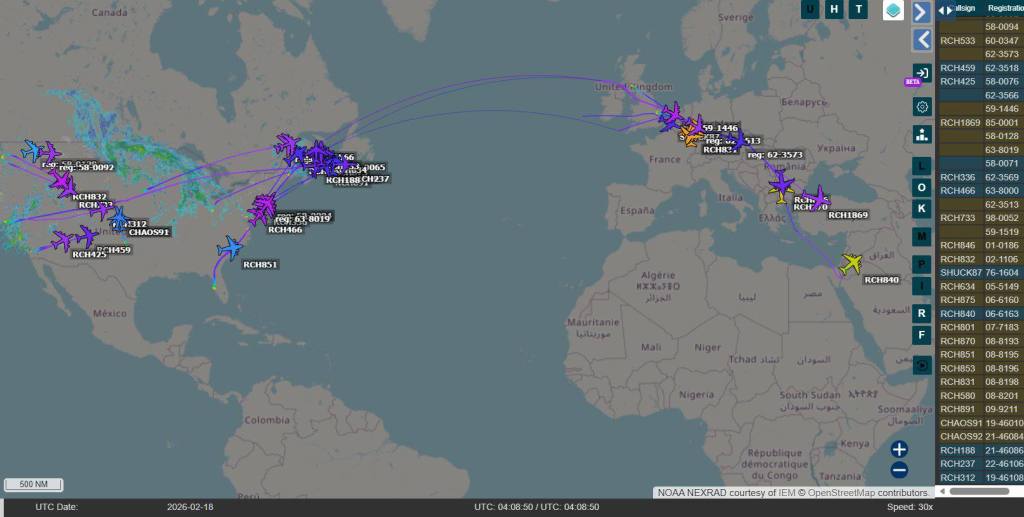
Multiple open-source intelligence accounts on social media shared images of what OSINTdefender called “one of the busiest days for the US Air Force in Europe that I have seen in recent history, with close to a dozen KC-135R/T Stratotankers airborne across the Mediterranean and off the coast of Spain, while a steady line of C-17A Globemaster IIIs can be seen heading towards and returning from bases in the Middle East.”
Sharing a similar image showing North America, Europe, and the top of Africa, intelligence analyst Oliver Alexander declared on X that “the tankers just keep coming.”
Greek economist and Progressive International co-founder Yanis Varoufakis responded to that post with a clear message directed at Trump—who notably abandoned the United States’ previous nuclear deal with Iran during his first term.
“Looks like an imminent US strike is in train as US tanker planes are heading eastwards. HANDS OFF IRAN Mr. TRUMP,” he said. “And to the rest of us: Let’s do whatever it takes to oppose another war crime—this time against the Iranian people.”
Also spotlighting the US military movements on Wednesday, progressive US political commentator and talk show host Kyle Kulinski nodded to Trump’s deadly invasion of Venezuela last month to abduct Venezuelan President Nicolás Maduro and hand over the South American country’s nationalized oil industry to his US campaign donors.
A US attack on Iran by “imperialist warmonger Trump” would be “another illegal and offensive war

This Tennessee prison is leaving LGBTQ people unhoused behind bars
This story was originally published on Truthout on Feb. 16, 2026. It is shared here under a Creative Commons (CC BY-NC-ND 4.0) license.
In the United States, it is possible to be unhoused even inside a prison. At the South Central Correctional Center in Tennessee, people sleep in doorways, closets, or even in the showers. “Anywhere that’s pretty much off camera,” said Bishop, a man imprisoned in the facility who chose not to use his last name out of fear of retaliation.
Atticus, another man in the prison, told Truthout he knows at least a couple people living within the prison “who are actually homeless on a more permanent basis, people bouncing around from place to place.” These folks have no bed to sleep in at night, and no place to leave their belongings.
Sources imprisoned at South Central described a different sort of housing crisis, one that takes place inside the walls of the institution that is charged with providing for them. The prison is run by CoreCivic, and, like other CoreCivic prisons in Tennessee, has been the subject of recent investigations because of the rampant violence and extortion that gang members in the prison perpetrate on newer or unaffiliated people. LGBTQ+ people in the prison say this violence often targets them specifically.
Conditions at South Central are just one example of the broader problem that LGBTQ+ people face inside prisons, particularly around housing issues. Although prisons claim to take seriously the safety of the people they confine — CoreCivic’s website highlights that they operate “safe facilities” — the people inside tell a very different story.
Instead, people inside are organizing to protect themselves. Bishop and Atticus are both part of
Peter Thiel is unleashing a neocolonial billionaire fantasy in Honduras
This story was originally published on Truthout on Feb. 16, 2026. It is shared here under a Creative Commons (CC BY-NC-ND 4.0) license.
In April 2025, Peter Thiel’s Palantir made headlines after documents were released detailing its partnership with Immigration and Customs Enforcement (ICE) to create ImmigrationOS, a massive database of information gathered from a variety of sources including the IRS, in order to surveil, detain, and deport immigrants. Thiel is not new to spearheading endeavors that aim to dehumanize and attack people of color. In fact, the tech mogul is one of the billionaires leading our modern-day version of tech neocolonialism, the new-yet-old imperial monster that colonizes land, extracts resources, exploits natives, and is happy to profit off of their suffering.
As a Honduran immigrant myself, I would know.
In 2009, Honduras found itself in turmoil after a military coup destabilized the country leading to unprecedented levels of violence and repression. Taking a page out of the “shock doctrine” playbook, the elite political actors behind the coup (including narco-dictator Juan Orlando Hernández, now pardoned by Donald Trump after being sentenced to 45 years in prison for drug trafficking and weapons charges) watered down environmental protections on Honduran land and approved illegal contracts to sell Indigenous and protected land to the highest bidder.
Among other corrupt dealings and land grabs, the government approved a law that enabled the creation of Peter Thiel’s Zones for Employment and Economic Development (ZEDEs). ZEDEs derive from the idea of “charter cities.” Proposed by former World Bank executive and economist Paul Romer, these proposed cities are enclaves within lower-income nations that “promote economic growth” through privatization and the disposal of national regulations, while gifting major tax