Why US veterans are sailing to Gaza with the Global Sumud Flotilla

Why US veterans are sailing to Gaza with the Global Sumud Flotilla

The Global Sumud Flotilla sets sail from Barcelona towards Gaza, in Barcelona, Spain, on August 31, 2025. Hundreds gather at Moll de la Fusta to bid farewell to the flotilla, with dozens of boats and thousands of supporters wearing kufiyas (Palestinian scarves) and waving flags. Photo by Lorena Sopena/NurPhoto via Getty Images

After multiple voyages by the Gaza Freedom Flotilla have been prevented from reaching Gaza’s shores by Israel’s military, a massive fleet of freedom flotillas are currently sailing towards Gaza to deliver life-saving humanitarian aid to Palestinians in the midst of genocide. The Global Sumud Flotilla “brings together a diverse coalition of international participants, including those involved in previous land and sea efforts like the Maghreb Sumud Flotilla, Freedom Flotilla Coalition, and Global Movement to Gaza.” Including over 50 vessels, delegations from at least 44 countries, and activists, organizers, and people of conscience from around the world, the Global Sumud Flotilla is the largest maritime mission in history to break Israel’s blockade of the Gaza Strip. TRNN Editor-in-Chief Maximillian Alvarez speaks with Zue Jernstedt and Zuleyka Morales Rivera, two US military veterans and members of About Face: Veterans Against the War, who are sailing with the Global Sumud Flotilla.

Additional links/info:

Credits:

  • Studio Production: Cameron Granadino
  • Post-Production: David Hebden
Transcript

The following is a rushed transcript and may contain errors. A proofread version will be made available as soon as possible.

Maximillian Alvarez:

After multiple voyages by the Gaza, freedom Flotilla have been prevented from reaching Gaza shores by Israel’s military, a massive fleet of freedom. Flotillas are currently sailing towards Gaza as we speak their mission to break Israel’s blockade and deliver lifesaving humanitarian aid to Palestinians in the midst of a genocide. This is the largest maritime mission in history to break Israel’s blockade of the Gaza Strip. The Global Saud Flotilla includes small and large vessels, delegations from 45 countries, and activists organiz and people of conscience from around the world. From Greta Thunberg to Man Mandela Nelson Mandela’s grandson. And we are recording on Monday, September 8th. The Global Saud Flotilla is currently docked at the Port of Tice and will be departing on Wednesday en route to Gaza. And joining us on The Real News today from uni are two American military veterans and members of the group about face veterans against the war who are sailing with the global Saud Flotilla. Zue Jernstedt is a US Army veteran, and Zuleyka Morales Rivera is a US Marine veteran and they join us now. Thank you both so much for joining us on the Real News Network. I really appreciate it.

Zuleyka Morales Rivera:

Thank you for having us.

Maximillian Alvarez:

Well, firstly, we’ve been seeing a lot of the videos and photos of this massive fleet of flotillas sailing towards Gaza, but I wanted to ask you both if you could tell us what it actually looks and feels like to be there right now, who is taking part in this? Just give our viewers an on the ground view of this historic effort.

Zue Jernstedt:

Yeah, well, it’s actually pretty crazy because we’re in these very tiny sailboats. This is a humanitarian mission. This is not a military mission. So we’re on these very tiny sailboats with people from all over the world who are just regular people sailing across a giant sea. So when we’re in these boats, it’s actually, we feel quite small and we’re just all stuffed in these tiny boats. And then we’ll look across the vast sea and just see all these little sailboats dotted around us, all flying Palestinian flags. So it feels so surreal to be on a giant ocean with all these tiny little boats bobbing around all with Palestinian flags. And it feels like we’re very separate almost at times. And then we can see the solidarity online and the people in Gaza who are talking about waiting for us, the actions back home of people saying they’re with us, and we realize how big it actually is from being seasick alone in our boat too, being connected with everyone around the world.

Zuleyka Morales Rivera:

Yeah, it feels very surreal. I think it’s one of those moments where you don’t realize just how big it is until months have passed and it finally sinks in and you’re like, wow, I can’t believe that this is actually happening or this actually is happening.

Maximillian Alvarez:

And I guess just on that note, what was the reception like in uni when you guys got there?

Zue Jernstedt:

Well, actually we got here a bit later than everyone else. When the first boats came in, the streets were so crowded that people couldn’t get through, and there was just parties and dancing and singing, and yeah, it was completely crushed with people supporting. We didn’t get until very, very late last night. So by that time, everyone was sleeping and we were just happy to get to the hotel.

Zuleyka Morales Rivera:

Even as we were sailing in maybe six hours out from actually arriving in Tunis, there’s a boat of civilians that came up to our boat and just started screaming Free Palestine. Free Palestine, and stopped by each boat and just kept saying, thank you, free Palestine. So the solidarity that we feel in this movement is pretty incredible.

Maximillian Alvarez:

Wow. Yeah. What does that feel like?

Zuleyka Morales Rivera:

It’s unlike anything that we’ve ever experienced before because it’s on such a large scale globally, 44 countries that are sailing to Gaza. To be part of that is something that I’ve never felt before.

Maximillian Alvarez:

Yeah, I can only imagine. And I wanted to ask as individual American military veterans and as a group representing about face against the War, because there’s a contingent of you sailing towards Gaza now, I wanted to ask if you could tell us more about why you all decided to join the global Saud Flotilla?

Zue Jernstedt:

Yeah, so actually most of the people on the boat are about face members. Most of us are also veteran for peace members. We’re all pretty much all anti-imperialist activists because we believe that the struggle in Palestine is interconnected with anti imperialism. But I joined personally because my Palestinian American friend who I met in the West Bank last year while doing protective presence, asked me if I knew any boat people, any captains or anything, and I said no. And then they said, Hey, there’s a veterans boat. And I said, sign me up here. Absolutely. I want to be a part of this. And then sent the information to other people. And about face

Zuleyka Morales Rivera:

Mine is somewhat similar. I actually took part in the march to Gaza that took place in June and we weren’t able to get very far. But it really opened my eyes to the layers of systemic oppression that is not only against the Palestinian people, but against a lot of the global south and the people of the world. And so I had a comrade that was also in the March to Gaza that called me and asked me, they’re doing another Flotilla and it’s going to be dozens of boats. Would you like to go? And immediately I said, of course we have to make it to Gaga.

Maximillian Alvarez:

Is there anything about your identities as veterans, as people who took the oaths that you took and have gone through, what you’ve gone through? Is there anything about being a veteran of the US military that made you feel even more compelled to speak out about this?

Zue Jernstedt:

Yeah, absolutely. I’m someone who served in Afghanistan in 2009, and I feel like it’s my duty now to stand up against imperialism because I was a foot soldier of imperialism. I spread pain and violence through the world, upholding this American ideal and resource stealing. So I feel like I also now have to stand against it now that I see what’s going on, now that I have privilege in America for being a veteran, that it’s very important for us to say, Hey, no, we see what’s happening. We won’t take part anymore. We can change the narrative. We don’t have to follow orders. We don’t have to be these people. We don’t have to march to their tune. We are the people, we have the power.

Zuleyka Morales Rivera:

For me, I joined the Marine Corps straight out of Puerto Rico. I was born in Puerto Rico, the oldest colony in the world, and I wasn’t aware of the oppression and the second class citizen that we had. And as I opened my eyes when I got out of the military, I realized these systems are designed to be put against us and we have to do something. So it’s intertwined in our everyday lives and just had to do something about it.

Maximillian Alvarez:

Well, I spoke to Chris Smalls when he was on board the Last Freedom Flotilla, and we had that conversation about a day or so before the Flotilla was captured, and Chris himself was separated, beaten, and detained by Israeli forces. And Chris knew that he was putting his safety and possibly even his life at risk for this cause. And I know that everyone on this mission is fully aware of those risks as well. But I wanted to ask, what are you expecting the response from Israel to be like, we’ve never seen a fleet like this before, but we’ve seen how Israel has responded to individual missions before. So how are y’all prepared for the different range of outcomes here, including the possibility of violence and hostility from the Israeli military?

Zue Jernstedt:

Well, I just want to start with the violence and hostility from the Israeli military will be nothing compared to what the people of Gaza and the people in the West Bank face every day. So for us, it’s not, yeah, it means so much that they’re going through this that does not worry us. It’s nothing compared to what they’ve been facing for the last 700 days and since 1948 and before. So that isn’t our main concern. Our main concern is what are they going to do? Because they do not follow humanitarian law. They do not follow the Geneva Convention. They do not follow the ICC. They do not follow the IHL. So we are completely unsure. They’re a rogue state. They’re a complete wild card. So we are making all these scenarios up of what we could do in each way, but we really cannot say because they do not follow the laws and they’re inhumane and they are committing a genocide against the Palestinian people.

Zuleyka Morales Rivera:

And based off what we’ve witnessed and the slaughter that’s been going on in Gaza for over 700 days, we can honestly expect anything from them because that’s just how they are. Nobody sets limits on them. So we go over scenarios on a regular basis. Daily we have meetings, we talk about what if this happens or what if this happens or what would you do if you see this happen to another person? How do we remain calm? How do we deal with situations like that, which we most likely aren’t really prepared for, but we’re preparing as much as we can.

Maximillian Alvarez:

Just the very fact of this fleet existing. It really is a testament to the age old organizing principle that there is strength in numbers, and we’re even hearing about ways that others who are not on those ships are preparing to aid your effort, including the Italian dock workers who are saying that they will shut down the ports if you all are harmed. So it sounds like, and please do tell us if there’s more in that vein that folks should know about, but it does sound like the strength in numbers principle is being applied in its full force here from the amount of ships sailing towards Gaza to the amount of support around the world to protect those ships.

Zue Jernstedt:

Yeah, absolutely. The people are waking up and we are aware of American imperialism now. We are aware of billionaires controlling resources, and the people are waking up to say no more. This is multinational. We are coming together to say, it doesn’t matter how much money you have, you don’t have the numbers that we have. And the people of the world stand for humanity. The people of the world stand for Palestine. The people of the world stand for Congo. The people of the world stand for Sudan. The people of the world stand for Puerto Rico. We’re not going to take it laying down anymore, and we are all going to join up. And everyone can do their little part. You don’t have to be on a flotilla. You can do things in your everyday life that will subvert what they’re doing and show them that they don’t have the power of us over us and we can make changes.

Zuleyka Morales Rivera:

And I think that’s the difference with this movement is that it’s so big. Maybe we don’t realize it because we’re on a small ship, but it’s so big that I feel like this time people actually can feel like they can be in solidarity with us, even if it’s just sharing or sharing the voices in Gaza or sharing a post or speaking about it with their families or joining the discourse, or even the smallest little bit of effort that is put towards standing in solidarity with the people of Gaza and the Palestinian people all around the world is very different than the movements in the past.

Maximillian Alvarez:

Well, and on that note, I mean that hits very deeply, and I just wanted to make my own appeal to anyone watching this that please share the dozens of documentary reports that we’ve been publishing from Gaza itself, from the West Bank, our reporter in Gaza, ruida Amer, a brilliant documentary filmmaker, is starving, her family is dying. We are talking to her every day. I beg you, if you’ve been watching those documentaries, just know that the person behind them is dying like everyone else in Gaza. And that is where this urgency to do something is coming from. On my podcast Working People last week, which we published here in The Real News, I interviewed two Palestinians in Gaza talking about the horrific circumstances that they are living through and trying to survive in. This is as real as it gets. That is why this massive fleet is sailing towards Gaza this week. And so I wanted to end on that note because I know I have to let you both go. You’ve got a long week ahead of you. But while I still have you, I wanted to ask if you had any final messages about what you all and the rest of the Flotilla Coalition are advising people to do to help, and if you had any final messages to the world that you want to share here before we let you go?

Zue Jernstedt:

Oh, yes, absolutely. I mean, the biggest thing is what you were just saying of Center the Voices and Gaza Center, the voices on the West Bank, sure, we have this Flotilla, it’s a big media thing, but where’s the media for Gaza? Where’s the media for the West Bank? Those are the people who are going through it, are suffering under it. Those are the people you need to be listening to. One thing I would like to say is 26,000 people tried to get on the Flotilla and we didn’t have the room, but there’s other organizations that you can work with in solidarity with the Palestinian people. I was in the West Bank with ISM, the International Solidarity Movement. They need people in the West Bank. They’re undergoing right now some horrific, horrific ethnic cleansing, where they’re destroying the olive trees. They’re shooting people. They need observers from around the world to be there to keep them from doing these crimes without having anyone international to intervene. Like, please, please, there’s more ways of solidarity than just the flotilla.

Zuleyka Morales Rivera:

And I think it’s just important to realize that in our thousands, in our millions, we’re all Palestinians. And I really mean that We can’t look away from the suffering of Palestinian children. We can’t look away from the suffering of Gaza that has been going on for so long. It is one fight. It’s one fight, and it’s a fight of the whole world. And the more of us that there are, the better.

Original

‘It’s terror’: Global Sumud Flotilla bound for Gaza bombed

‘It’s terror’: Global Sumud Flotilla bound for Gaza bombed

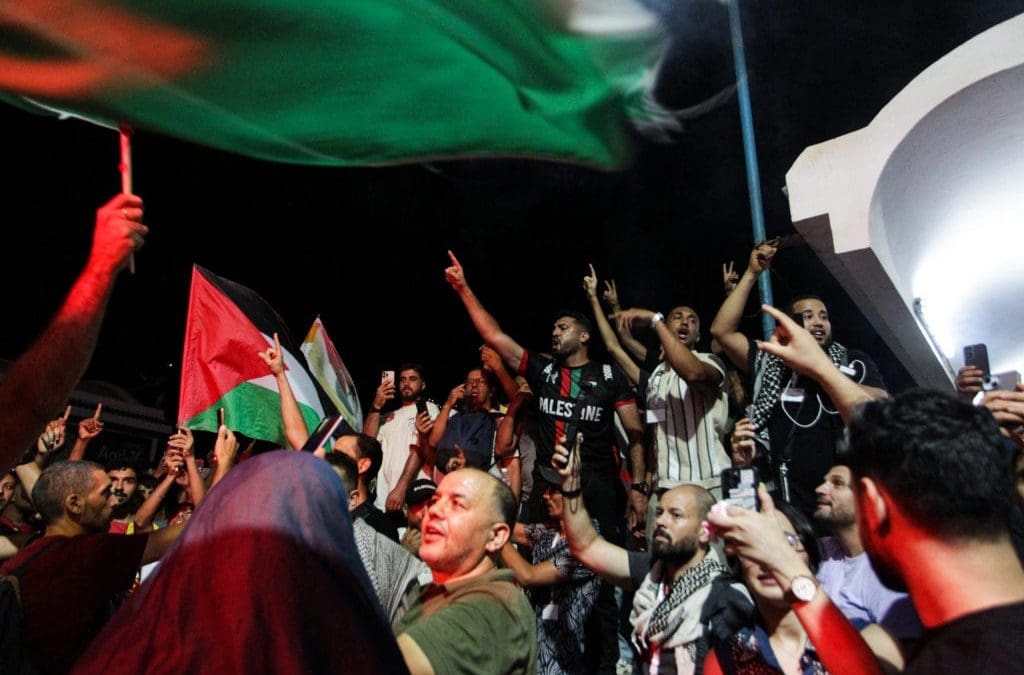
Tunisian protesters shout anti-Israeli slogans and wave Palestinian flags at the Port of Sidi Bou Said near Tunis on September 9, 2025, after the organisers of a Gaza-bound flotilla carrying humanitarian aid and pro-Palestinian activists said late on September 8 that one of their boats was hit by a suspected UAV but Tunisian authorities said
Common Dreams Logo

This story originally appeared in Common Dreams on Sep. 09, 2025 . It is shared here under a  Creative Commons (CC BY-NC-ND 3.0) license.

Pro-Palestinian protesters gathered  at the Port of Sidi Bou Said in Tunis, Tunisia early Tuesday morning after the international group organizing a humanitarian aid mission to Gaza  said one of its boats had been struck by what was believed to be a drone.

The Global Sumud Flotilla said one of the main vessels of its fleet of 50 boats was struck while it was anchored in the harbor. The boat was carrying the group’s steering committee, which includes climate leader Greta Thunberg , human rights activist Yasemin Acar, and Brazilian organizer Thiago Ávila.

Footage taken from a boat docked near the “Family Boat” showed the moment an object appeared to drop onto the vessel, triggering an explosion.

The Global Sumud Flotilla said  no one was injured in the apparent attack and said that “acts of aggression aimed at intimidating and derailing our mission will not deter us.”

“Our peaceful mission to break the siege on Gaza and stand in solidarity with its people continues with determination and resolve,” said the group in a statement.

Political commentator Brian Allen posted another video taken aboard the Family Boat.

The flotilla is the latest fleet of boats headed for Gaza to deliver humanitarian aid and break the siege Israel  has imposed since October 2023 as it has relentlessly attacked the exclave, killing more than 64,000 Palestinians so far, and said it is planning  a complete takeover of Gaza.

Nearly 400 people, including at least 140 children, have died of starvation caused by Israel’s near-total blockade on humanitarian aid. More than 1,000 people have been killed while trying to access food, including at hubs set up by the privatized, US- and Israel-backed Gaza Humanitarian Foundation. The Integrated Food Security Phase Classification said  in late July that parts of Gaza are facing famine, with one in three people going days without consuming any food.

Israel has stopped several aid boats from reaching Gaza in recent months, including the Madleen and the Handala , and detained organizers. The Conscience , another boat operated by the Gaza Freedom Flotilla, was reportedly bombed by Israel in May off the coast of Malta, forcing organizers to turn back.

Israeli National Security Minister Itamar Ben-Gvir has threatened  to designate humanitarian aid organizers trying to reach Gaza by boat as “terrorists” and to detain them.

On Tuesday, Francesca Albanese , the United Nations special rapporteur on the occupied Palestinian territories, said the reports of a drone attack have to be verified but noted Israel’s “history” of attacking aid vessels bound for Gaza.

Tunisian officials have said  the vessel was not attacked by a drone and blamed the fire that broke out on a cigarette butt or lighter.

“There is no other state protecting this boat other than Tunisia creating a safe port,” said Albanese. “The question is, if it’s confirmed that this is a drone attack, it will be an assault, an aggression against Tunisia and against Tunisian sovereignty.”

“We cannot keep on tolerating this,” she added, “and normalizing the illegal.”

Original

Trump and Silicon Valley’s plan to rule the world with AI weapons

Trump and Silicon Valley’s plan to rule the world with AI weapons

US President Donald Trump and First Lady Melania Trump host tech leaders, including Facebook founder Mark Zuckerberg (L) and Microsoft founder Bill Gates (R) for a dinner in the State Dining Room of the White House in Washington, DC, on September 4, 2025. Photo by SAUL LOEB/AFP via Getty Images

The unnerving alliance between Big Tech and the second Trump administration goes much deeper than many in the public realize. What factors are motivating President Trump and Silicon Valley’s monumental investments in “artificial intelligence” infrastructure and the expanded integration of “AI” into military and governmental operating systems? What is their endgame? What will their vision of an AI future mean for the rest of us? In his new investigative series Military AI Watch, produced in partnership with Project Censored, award-winning science reporter Peter Byrne explores “how Silicon Valley, corporate media, the Department of Defense, the banking industry, and scientific institutions all intersect in the effort to militarize AI.” In this episode of The Marc Steiner Show, Marc speaks with Byrne and TRNN Editor-in-Chief Maximillian Alvarez about “AI” today and the techno-dystopian future on the horizon.

Guest:

  • Peter Byrne  is an award-winning investigative reporter and science writer based in Northern California. He specializes in reporting on physics, nuclear warfare, medical research, local and national politics, corporate and governmental corruption, and, now, the weaponization of artificial intelligence. Byrne’s work has been published in Scientific American, New Scientist, Quanta, Wired, Mother Jones, SF Weekly, CounterPunch, The Edge, Project Censored, and other publications. Byrne has published books and chapters on multiple universes and the history of quantum physics with Oxford University Press, Princeton University Press, and Springer.

Additional resources:

Credits:

  • Producer: Rosette Sewali
  • Studio Production: David Hebden
  • Audio Post-Production: Stephen Frank
Transcript

The following is a rushed transcript and may contain errors. A proofread version will be made available as soon as possible.

Marc Steiner:

Welcome to the Marc Steiner Show here on The Real News. I’m Marc Steiner. It’s great to have you all with us. Now, we’ve all heard about artificial intelligence. Sometimes it’s just taken for granted as part of the modern landscape and our films and literature can seem ominous and dangerous, but in reality it can be both. But what happens when artificial intelligence is weaponized by the military, by our government, which occurs when right-wing tech giants control this industry in a time when the right controls our government. But I guess today’s Peter Byrne, he’s taken on this question. He’s an award-winning national and international investigative journalist and wrote an in-depth series for Project Censored, exploring every possible aspect. And in this conversation I’m joined in the studio by our editor-in-chief and colleague and dear friend Max Alvarez, making sure I don’t screw up. No, I’m just kidding. He’s here because we both are really intensely interested in this topic. And Peter, I want to welcome you. Thank you so much for joining us here today.

Peter Byrne:

Oh, thanks for having me. Glad to be here.

Marc Steiner:

So where do we even begin? I mean, reading this series you did. I figured we could do a five part conversation for this whole series, but let’s take a step back for a moment. When people hear that word, artificial intelligence, people have real more comprehension about the depth of it, what it means. So talk a bit about what that means, first of all, and what made you jump into this?

Peter Byrne:

Well, artificial intelligence, so called is probably one of the cleverest and inherently evil terms ever to emerge out of the military, industrial, academic complex as it were. It was coined in the 1950s at a conference at Dartmouth University where a bunch of cyber Ians who were early computer scientists got together to talk about the future of what we now call artificial intelligence. They called it computation and cybernetics. So anyway, they came up with this term artificial intelligence, which has stuck ever since. And in my newest story called Into the Uncanny Valley human AI war machines. I started by quoting David Hume, the philosopher from the 1757. He says There is a universal tendency among mankind to think of all things as being like themselves and to transfer to every object, the qualities they are familiarly acquainted with. We find human faces in the moon, armies in the clouds, and if not corrected by experience and reflection, our natural tendency leads us to ascribe malice or goodwill to everything that hurts or pleases us.

And to put things in context, I follow that with a quote from a military AI scholar. There is such a thing, the subject of military AI is not well covered at all in the mainstream media or even the alternative press. It is a function basically of trade journals which are pumping it up and our military AI watch at Project Censored, which is why I’m working there because it’s actually quite censored in the mainstream. Anyway, this military AI scholar referenced hues remarkable insight, which I think is applicable to using the word like intelligence for computation. And he said, AI technology is already being infused into military machines designed to look and act like humans. Anthropomorphic terms like ethical, intelligent, and responsible in the context of machines can lead to false tropes, implying that inanimate AI agents are more capable of moral reasoning, compassion, empathy, and mercy, and thus might act more ethically in humanly in warfare than humans.

And that’s the claim that is being made by Silicon Valley, which is just battening off this vast cornucopia of funding that’s being generated for a technology that is actually failing in many ways, which is that ais can replace, usis will be kinder and gentler than us, and by the way, we can also program them to kill our enemies at speeds faster than we can contemplate ourselves. There’s a whole school of thought that super intelligent ais are going to take over and exterminate human beings. That’s a conjecture. I don’t really go into that in my reporting. I’m consuming more with the here and now. And the dangers of the here and now are plenty because the present day is horrible enough in terms of one, how artificially intelligent so-called weapons systems are being used right now in Gaza as Israeli Palestinian Journal of 9 7 9 has exposed and has gotten pretty good coverage over the last few months.

The Israeli armies are using Microsoft and Oracle and probably open AI and other products to target people and to then kill them with so-called smart bombs. But one of the problems of course is, well, there’s two problems. One that they’re doing it at all using the databases that they’ve been putting together for years because they’ve been surveilling everybody in Gaza for decades. But two, there’s still obvious false positives. I mean, every time they want to kill some alleged Hamas leader, they end up blowing up a whole block full of children and people going about their daily business trying to find food among a starving genocide situation. So the Americans are not only complicit in the genocide itself, but in the technology of it because it’s Silicon Valley that is making it possible. And that’s only one application. We see military and intelligence applications of it everywhere from license plate monitoring to ice, try to figure out where to go to apprehend families of so-called undocumented people.

And of course the media gets all excited. The New York Times is just like the biggest blowjob of all on ai. I mean those guys are Silicon Valley’s just always astonishing them by the miraculous stuff that they can do. So my series goes into the tech of it because I am a science writer, but I’m also an investigative reporter. So it goes into the financing of it a lot. The first story, one ring to rule them all goes, starts out a long piece. It’s like 7,000 words. It goes into Palantir and Andre, these companies founded by Peter Thiel who’s a,

Marc Steiner:

Lemme stop you for one second. Want to back up a minute what you just said here. I think it’s really important for people to understand as we dive into what this technology is doing and is capable of doing, is the names you’re throwing out, who they are, what they are, what is Planete, who are these companies and the relationship that Teal and others have with this, the cross a spectrum of Democrat and Republican. And I think that because we’re on the edge of something really can redefine things in our society. So let’s step back for a minute and really define some of these terms. Who are these companies and describe them?

Peter Byrne:

Back in 2003, this venture capitalist named Peter Thiel, T-H-I-E-L, who had made a few million dollars in PayPal along with Elon Musk and Reid Hoffman and a bunch of other people who became oligarchs AI oligarchs. He founded this company called Palantir with investment from the CIA’s investment arm, which is called in Q Tel. A lot of people don’t know that the CIA actually has been pumping hundreds of millions of dollars into Silicon Valley AI weapons programs for a long time

Marc Steiner:

Or that the CIA actually has those investments that they have that kind of money. People don’t realize that either.

Peter Byrne:

No, I mean they also don’t realize that the Army has the Defense Innovation Unit, which is doing the same thing for the Army. With the advent of the Trump regime, the second day after his inauguration, he gathered all these oligarchs, Sam Altman and Larry Ellison and the guy from SoftBank into the White House, and also we’re going to put 500 billion into data centers. So this huge bubble of AI has been created. Now how did we get there? So let’s go back. Like you suggested 2003, Palantir has created, what it is is a very good software application for finding patterns in large databases. One of the first customers was a national security agency, was scoops up vast amounts of data every day and has it’s impossible to monitor it in real time. So Pound Share’s product is able to sit on top of vast amounts of data and locate where is the people wearing kafis today or where were they two years ago?

It doesn’t do much more than that, but that’s a lot from the intelligence agencies. And in order to weaponize this capability further, teal started another company called Andre, which manufactures the hardware that can use the Palantir type location software to go and find people and blow them up. Both Palantir and Andre were private companies. They were named after Tropes and Tolkiens Lord of the Rings. And there were EDRi still private. Palantir was private for 20 years. And what his business model was, which I expose in the first part of my series, is it was always running at a loss. It was always spending more money than it had, which had a real benefit for it because then it could tell the IRS that it wasn’t making any money and it didn’t have to pay any taxes. These guys hate to pay taxes more than anything in the world.

They contemplate having floating islands in the ocean so they don’t have to pay taxes. They get behind a guy like Trump who doesn’t want billionaires to pay taxes. So they would run out of loss and they were going to go back to their investors and get more money. And then when they went public a few years ago, we were able to using SEC filings, look into some of the machinations that they were doing financially. The short story of the long story is that now with the advent of the Trump regime, it’s finally making money and it hadn’t been making money before. Let

Marc Steiner:

Stop you for a second. So what do you mean? Why are they making money now? And did one before I shortly. What does that mean?

Peter Byrne:

Because they’re stuffing Palantir and Andre with contracts almost every day. They get a new contract, they’ve got billions and billions of contracts. Andre, which I point out in my first story in the series, has been getting all these contracts from the Department of Defense build as serving small business administration contracts. It’s not a small business. The reason they do that is because when you get a small business contract, you don’t have to go through all the procurement documentation and auditing that Lockheed would have to go through. Not that matters that much because the Pentagon can’t be audited, never has been audited. So at any rate, this is now on steroids. I mean, the reason that Zuckerberg and Tim Cook from Apple and the rest of ’em have been flocking to bend the need to Trump is because the government is throwing hundreds of billions of dollars at them, including in this so-called Golden Dome anti-ballistic missile program, which is scientifically and technologically a shival. If it cannot work, it cannot work. But they don’t care because what people need to realize not only about Silicon Valley, but about what’s going on with the Counter Revolution led by the Trump regime is these people have no ideology. They have no actual goal except enriching themselves in concentrating capital more and more and more, and that’s what they’re about.

Maximillian Alvarez:

I want to kind of tug at that thread a little more, right, because we’ve got two concrete horrifying examples that have already come up in the conversation so far, and I want to take advantage of Peter’s expertise and all the deep research he’s done. But for our listeners right now, I wanted to bring in both how AI and big tech are deeply embedded in the ongoing genocide of Palestinians and Gaza and ethnic cleansing of Palestinians in the West Bank right here, right now. And I also want to look at how the new Trump administration is leaning into big tech, actually not leaning in, like going as Peter said, full bore

Into partnerships with big tech. I want us to sort of unpack what they’re doing, how they’re doing it and why, what the end game is for them. But to kind of quickly go back to Israel and Palestine, this is connected to a story that we just reported on. I flew out to Seattle, Washington and I was one of the only journalists on the ground at Microsoft’s headquarters in Redmond, Washington when current and former tech workers at Microsoft community supporters, people with the no Azure for Apartheid coalition have been waging really risky, dangerous, brave, and crucial acts of resistance in the heart of Microsoft in direct opposition to Microsoft’s complicity with Israel’s genocide of Palestinians. And this was really exposed in an explosive investigation by The Guardian and the Israeli Palestinian publication plus 9 7 2 magazine and the Hebrew Language Outlet local call, and I’m going to quote from their August report here, which we’ll link to in the show notes, but the authors write One afternoon in late 2021, Microsoft’s chief executive Satya Nadella met with the commander of Israel’s military surveillance agency unit 8,200 on the Spy Chief’s agenda, moving vast amounts of top secret intelligence material into the US company’s cloud meeting at Microsoft’s headquarters near Seattle, a former chicken farm termed high-tech campus.

The Spy Master Yossi Sadel won nala’s support for a plan that would grant unit 8,200 access to a customized and segregated area within Microsoft’s Azure cloud platform. Armed with Azure’s near limitless storage capacity, unit 8,200 began building a powerful new mass surveillance tool, a sweeping, an intrusive system that collects and stores recordings of millions of mobile phone calls made each day by Palestinians and Gaza and the West Bank. According to three unit, 8,200 sources, the cloud-based storage platform has facilitated the preparation of deadly airstrikes and has shaped military operations in Gaza and the West Bank files suggest that by July of this year, 11,500 terabytes of Israeli military data equivalent to approximately 200 million hours of audio was held in Microsoft’s Azure servers in the Netherlands while a smaller proportion was stored in Ireland. Now again, people can go to the real news to look at our coverage of the Microsoft workers current and former who are putting their jobs safety on the line to oppose this however they can.

Microsoft is the most complicit digital arms manufacturer in Israel’s genocide of Palestine, Reen Ott, a current Microsoft worker and no Azure for apartheid organizer told me. And then Julius Sean, a software engineer at Microsoft also told me it really, really disgusted me to know that my work truly is in some part condemning children to death and I could no longer live with that. So with all that upfront, I wanted to turn things back to Peter and asked Peter if we could use these two again horrifying examples of big text complicity with Israel’s war on Palestine and the marriage between the current Trump administration and Silicon Valley or Surveillance Valley as you refer to it in your report. Let’s use these as kind of two critical examples to unpack some of the really critical takeaway points that come from your reporting here.

Peter Byrne:

Well, Gaza is the ground zero right now. It’s a laboratory for testing these weapons and it’s not just Microsoft. Amazon web services is implicated just as much as Oracle and all of the biggies. When you were reading from plus nine, seven two’s incredible reporting, you referenced the cloud. And when people think of the cloud, this is another marketing thing like artificial intelligence, right? It’s the smart as us. The cloud is up there, it’s like floating up there. No, it’s data centers that are being built just like at a pace that is astonishing. We talked about Stargate, where Trump had these guys in the Oval office and said they would put 500 billion into these data centers. They are death on the environment. They suck up vast amounts of water to keep the chips cool, and they use vast amounts of electricity, which is why Amazon and the rest of ’em are trying to build them in deserts because building these data centers is really capital intensive and places like OpenAI, which is basically just a division of Microsoft these days, they don’t have the money to build the data center.

So they have to go into debt, they have to borrow money from M SoftBank, which is this semi fraudulent organization based in Japan, which has been in a lot of trouble, but which is at the center of everything because it’s been sucking up to the Trump and his crypto moves. So we have these data centers that are being built and one of my articles about the data centers I talk about, yeah, those are going to be actual ground zero in a nuclear war or even in a conventional war because the wars that use autonomous weapons and AI control systems are actually all taking place inside the data centers inside the chips. So you don’t need to just attack a plane or a ship, you could just go blow up the data center and those things will be mean entering around like lost spot. So you’ve got the data centers and then you’ve got, as one of my other articles called AI battlespace, weaponizing the 5G Internet of Things.

You’ve got what the military calls the military internet of things, and this goes back to Amazon and Alexa and all of these devices like your refrigerator now, which has a chip in it that utilize the 5G electromagnetic infrastructure that is now being implemented worldwide. I quote from Rand reports and military documents showing how the military is now planning to use the 5G devices in households in Europe to guide its AI weapons systems in the event of a war with Russia. They’re actually, depending on all these little devices that we think are making our lives easier to make military operations happen in places where there’s so much jamming going on because that’s a whole nother story. It’s easy to jam the electromagnetic spectrum and to mess up the AI’s capability of communicating each other, but if they can just switch from communicating through satellite constellations to communicating through the Alexas in people’s houses or their refrigerators and smart toasters, which they actually can do, you don’t have to give them permission to do it, they can override it, then that’s how they plan to fight these future wars.

Now I want to make two points. One is the internet of things and all the sensors that they have and the satellites, I mean we’re talking about millions of devices all over the world that are supposedly sending information into some kind of centralized point in the military industrial apparatus from which they can control everything, and that is their plan. They have what is called a joint all awareness domain command and control system, which they envision as a kind of pane of glass where they can see the entire global battle space as they call it, and they can wage wars big and small, including nuclear wars at light speed, all basically operated by eyes with little or no human input. This is their wet dream. This is their vision because it’s costing a trillion dollars to implement. Now, the good news from the point of view of the actual humans is that it probably won’t happen for several reasons.

One, the military typically the Army has its contractors. The Air Force has, its the navies has its, and it’s the same thing going on with Silicon Valley. They each have their own favorite. I think it’s the Army likes Amazon and the Air Force likes Oracle, I think, but they have, they’re signing their own definite contracts with each of these big Silicon Valley oligarchical companies to make this great big joint all awareness domain and control system. But it’ll be proprietary only to that army or that Navy or that air force. And they don’t interconnect, they don’t talk to each other. So there’s no way that the president or the civilian who’s supposed to be giving all the commands, it is going to be able to look at a central point and go, oh, we’ve got a little battle going on in Bosnia. Let’s hope it doesn’t.

Our resources need to go there, but we have resources in Pakistan and we’re fighting a war with China in Taiwan. There’s no way that there’s any kind of centralized decision making can happen because these things can’t talk to each other. But even more fundamentally, they’re all based on large language models, the so-called chats, and the chats hallucinate all the time. This is an inescapable feature. They confabulate because they’re predictive mechanisms, they have no sense of truth. All they can do is to look at their training data, which is usually about selected by the military forces. They select the training data that they want them to train on. They don’t talk to about peace or diplomacy or arms limitations or anything like that. And I go into a lot of that in my articles. So you’ve got these chats that are advising military commanders in theory and in many cases will actually be issuing tactical orders that can’t tell truth from falsehood.

Now, a lot of people in the Pentagon are horrified by this. You’re weird Christian Dash crypto fascist leader, Pete Heg and Trump’s AI czar who was also one of the PayPal mafia guys. Their concern, as I said earlier on in our talk today is money. They don’t care if his shit works or not, but in order to get the money out of Congress and the American people, they have to go, oh, China’s going to beat us in the AI race and then they’re going to dominate us and we’ll all be speaking Chinese, blah, blah, blah, drumbeat going on day after day. We have to get ready for a war with China. Well, this is no joke because every time they want to go to war, remember Iraq and Afghanistan, I mean it just goes back on and on and on. They start the drumbeat. Our way of life is being threatened by this is an existential issue. So they’re throwing all this money into a technology that the science itself shows is incapable of accomplishing what they say it can’t accomplish. It’s one of the largest fraudulent speculative bubbles in human history and it can only harm us in ways that we can’t even yet imagine.

Marc Steiner:

So just to push that a little bit further, I mean two of the things I gleaned out of the work you’ve done and thinking about this over the last few days is that if you take the two examples of ice and how the technology’s being used by ice at this moment to go after immigrants coming to this country, and if you look at what is going on in Israel, Palestine and Gaza, that these are both testing grounds because what they’re doing at this moment in those two fronts that I’m talking about, they’re using this AI to kind of further their goals. It’s a test they’re working on implementing this and building on it to create a structure that doesn’t exist now, but doesn’t mean it could not exist. And when you take that with the corporate world that is helping to fund and push this and the right wing push across the world, especially in our own country, what I glean from this is the Amish potential inside of our future with all this.

Peter Byrne:

I’m complete a chord with you on that in the sense that yes, it is a test. Palestine is famously a laboratory, but right now in the United States, they’re testing Palantir and ail are both totally embedded with ice. They have billions of dollars in contracts right now to do what it is. When I say that it doesn’t work technologically, it doesn’t work as they bill it. For example, they say, well, we’ll be able to tell the difference between a peasant holding a rake and a rifle from our satellite based ai. No, that’s not true. I mean, we know that there are limitations on that. Now the idea that large language models, which is just one type of artificial intelligence, which we should be clear about is the latest iteration. There are other types of artificial intelligence. I want you to actually much better at doing this type of computational analysis than large language models, which are crippled by their hallucinatory problem.

They’ve also run out of data to train them on. They used up a whole internet. They sucked up Reddit and Wikipedia and the common crawl, just a lot of internet garbage. They didn’t get into university data banks or corporate data banks or even military data banks. I mean, those are all things that can be fine tuned into them, but the foundational models are all trained on just internet slop. So that’s one of the reasons that they hallucinate, but they run out of data. They need massive amounts of data to make their probabilistic neural nets work, and there’s a lot of papers that are coming out, they call it at the ceiling, they hit the ceiling and they’re not going to get any better at what they do.

Marc Steiner:

What do you mean? What do you mean they’re not going to get any better? Why do you say that?

Peter Byrne:

Their problem is it’s garbage in, garbage out. It’s the training data, but like I mentioned before in Gaza, if it was doing what they said it would do, it would be able to say, okay, commander so-and-so of hummus is in this apartment, and we can go there and either arrest him or pinpoint a small explosive and blow up his apartment. But no, they blow up the whole block, right? Because they don’t actually know if he’s there or not. The claims that are being made by the chats are probabilistic. They’re not factual. They’re saying there’s a chance that so-and-so is there or whatever.

Maximillian Alvarez:

I want hover on that just really quick. I was

Peter Byrne:

About say

Maximillian Alvarez:

Go ahead. Yeah, I mean further unpack this for our listeners, right? Because I think help make Peter’s point about the limits of what this technology is going to be able to do. It’s worth, like I said, hovering as we are right now on what it is currently being used for and the results of that. So between Gaza and the West Bank, let’s not forget that a lot of these surveillance efforts that have been turned on Gaza started in the West Bank and a lot of the data that has been just stored from surveilling entire populations of Palestinians. To Peter’s point, the general who kickstarted all of this in Israel got fired because that shit didn’t predict or stop October 7th, and that was the main thing that got him ousted. But what it is being used for as Peter was just saying, is to compile hundreds of millions of hours of phone calls, texts from, I’ve seen pictures of these data like collectors and surveillance scrapers that are set up in settlements in the West Bank that are just there to surveil and collect all of the communications data of Palestinians in those areas.

What we can sort of extrude from that is that right now with the different kinds of technologies that we are currently calling ai, we have tracking and surveillance capabilities. That’s one of the key use cases that is being pushed from Microsoft to the ID to the Trump administration. So you can scrape vast amounts of social media accounts for any language that is deemed to be supporting terrorist organizations or what have you, right? You have massive data processing capacities and ostensible pattern location capabilities. To Peter’s point, you feed massive amounts of data into these large language learning models for the purpose of being able to identify patterns that like the human eye and brain couldn’t, but that is distinct from the predictive and decision-making capacities that they are trying to sell from the IDF saying, we have all this data, we haveis going through it to locate patterns and we’re going to use AI to basically tell us who to target to kill.

Peter Byrne:

Let me interject with this, and I’m in agreement with what you’re saying In Gaza, there’s no counterforce that can jam the ability of the IDF to utilize the electromagnetic spectrum for all of the military intelligence uses that it does, but the Achilles heel of AI driven warfare and autonomous weapons is the electromagnetic index spectrum. The case in point being in the Ukraine where you do have powers that can jam the electromagnetic index spectrum and the Ukraine, there’s like 10,000 drones a day going in each direction and only a handful of them get through because both sides are jamming. The other side’s capabilities to guide their weapons. They’re frying the insides of the weapons with microwave direct devices, and so both sides have resorted to sending out drones that extrude miles of very thin fiber optic cable that can’t be jammed. It goes to where a soldier operator has a device to guide the drone into its target.

Most of the drones that are actually hitting targets these days are guided by fiber optic cables, and then they rely on the phenomenon of large numbers. If you send out a thousand drones, maybe six of ’em hit. So then you can claim that you’re doing well that day militarily, but you just sent out 900 whatever drones they didn’t hit, right? The thing is that Gaza, which is the laboratory, nobody’s jamming the Israelis, but what they’re doing there won’t work in other places where you have powers that can actually do the jamming and the GAZA’S can’t trick. The large language models that the Israelis are training are using, which are trained on data by poisoning Rand to the Department of Defense, and everybody else that knows about this are freaking out about how easy it is to hack the training data that large language models are using.

Just think about it, they scoop up trillions and trillions of bytes from the internet. So you have your little website, whether you’re North Korea or with anonymous or something, and you put some data poisoning code that gets scooped up. Then just for an example, if you changed two pixels on a stop sign, a large language model might think it’s an elephant. That’s a famous example. So the people with the technological capacity to poison and disrupt and hack these systems, which they are doing, render them pretty ineffective. I mean, I actually have a subscription to Jane’s, which is the trade magazine for all the weapons freaks

And time after time when they’re writing about AI battle equipment. It’s the jamming that’s the problem. It’s the poisoning. That’s the problem. I go into this a lot and my articles, so when I say that it is got a ceiling on training and it’s also got a ceiling on operational capacities given technologies that we have so far, pretty much I would predict that in a major war between the United States and China, which we used autonomous weapons, the unintended consequences would be just amazing because nothing will work the way that they think it can work, and they have no capacity to view the overall battle space. As I mentioned, they don’t have this joint all awareness domain capacity, and it’s not just me saying this, this is a government accountability office. I linked to reports by federal auditors saying exactly what I’m telling you.

Maximillian Alvarez:

I think that really helps clarify for me, Peter’s point about the entire promise of Silicon Valley of what this tech is going to mean for warfare and national defense in the 21st century is bunk because so much of the learning and data processing that goes into this can be jammed from the start and thus the processing and prediction are going to be flawed. So you’re not going to have these pinpointed targets of military leaders who are killed by an autonomously controlled weapon. That’s what they’re pitching. That’s not what they’re going to get, especially with any major nation that is going to war in the 21st century like China or the us. However, I want to kind of circle back to what it will and is being used for, especially when it’s turned on its own citizens, right? We’re talking about, I mean, this was what I think we’re going to keep learning for years and months, what Elon Musk’s team at Doge, what public data was fed into these language models without our consent, but that is now being used to track surveil and target undocumented or political dissidents who have attended protests. Everyone’s trying to implement this stuff to the point of denying medical claims using ai. So I wanted to sort of circle back there, Peter and ask, with all the ceiling that you talk about in terms of its military and intelligence capacities, let’s talk about how it’s already being used even with those problems you talked about to surveil and punish working people.

Peter Byrne:

I’m not sure that the AI products, the Palantir is put in place. It’s helping ice all that much because they seem to be cruising the streets, looking for people that have brown skin and maybe are walking out of a factory and then attacking them. And since people are undocumented and they’re not in that many databases necessarily, I’m not sure that the plan to be able to just identify millions of unwanted immigrants via data is working out that well for them. Mostly they seem to be trolling to get it. Now, when I say that this stuff doesn’t work as it’s flawed to be working, it doesn’t mean that it doesn’t have tremendous harm and that it doesn’t work in some ways. For example, I got a whole story a couple of weeks ago here on how AI has been inserted into the nuclear command and control system.

It’s actually, this is happening. The chats are being inserted into the so-called NC three, which is the nuclear command and control system, and war games and experiments and everything else show that because of their training, the chats almost always launch nuclear weapons in any type of conflict because that’s the bias that they’re trained on because they’re trained by the military and the military is biased to actually go to war, and the corporations are biased to go to war too. How you make money. I mean, Lockheed figured out long ago, we need to have wars in order to keep our stockholders happy, and Peter Thiel has figured out the same thing. So putting it into the nuclear command and control system is like an act of insanity, but how much more insane is it than we actually have a nuclear command and control system to start with, and that we have these weapons that we’re not even trying to control anymore. We’ve abandoned the start. We’ve abandoned all anti-ballistic missile treaties. We’re headed towards what the United States is now advocating, which is the ability to fight limited nuclear wars, which is what Henry Kissinger was advocating back in the 1950s and was famously shot down, but now it’s back because the tech, we have smaller bombs, so they think they can fight these wars and not end up with nuclear winner and devastation and stuff like that.

I think that everybody’s got PTSD and basic mental instabilities in the world now. I mean, not only because we’ve evolved technologically passed our homeowner capacities to process information, but because we’re all staring into these fricking phones being told what to do every day and we’re being fed just this steady diet of spectacle. And so the horror here is that a lot of people think one, that it’s okay, what’s going on in Gaza, and two, that we should go to a war with China and three that Trump’s doing a good job or that Biden was doing a good job. He was just as equally evil, and so how do we reorient ourselves culturally and politically in this vast morass of misinformation and disinformation that is targeting us? And that’s where ais are really good. Is it targeting you individually with misinformation which somebody is paying them to do?

However, the good news is there’s a bunch of reports came out in the past couple of weeks showing that businesses that bought in and drank the Kool-Aid and fired a bunch of people and replaced them with AI are now hiring people back because things aren’t working very well, because like I said before, they hallucinate. You don’t want your customer service AI to go, Hey, fuck you buddy. I think your wife’s a bitch. I mean, they can say stuff like that. They really can. And so the companies are running away from it right now, which is super interesting. I think we’re looking at another AI winner. The bubble’s going to collapse this year. I would predict, I would bet money on it. And that doesn’t mean that the next technological iteration building on the neural net configuration that we have now won’t be more capable of doing this or that. We don’t know. It’s all conjecture, right? But symbolic ai, which was the kind that came before the large language models, is actually much more accurate and rules-based as it were, than the predictive models, which basically have no rules.

Marc Steiner:

I just kind of push back a little. Everything I’ve read in all the pieces you wrote and other things I’ve been looking at, we’re in kind of very beginning stages of this technology and all of it may not work at this moment. That’s exactly what they’re doing in Gaza. That’s exactly what they’re doing in ice. That’s exactly what they’re doing in other situations is testing out these models. How does it work? Where does it fail? How do we make it stronger? And when you’re doing this in encountered with very right-wing governments like our own in this country and with the technology companies that are allied with that politically, this is to me just the beginning. We don’t know where they’re, this is going to go. We don’t know where we’re going to take it, where they’re going to take it. And everything I’m watching at this moment are like dry runs. Is this going to work? How do we make it work and how do we make it better so it does work.

Maximillian Alvarez:

And to even add one more horrifying detail to that, I think what we’re all also acknowledging is the fascistic reality that we will base life or death situations on the hallucinations of an unaccountable technology in the hands of the rich and powerful. So when AI is being used to track surveil process data from Palestinians and target Hamas fighters, and it results in women and children being blown up, that’s as horrifying as the technology because the technology doesn’t work as it is, as if the technology did, right? I mean,

Peter Byrne:

Let me interject here. I’m not saying that it doesn’t work. I’m saying that it doesn’t do what is being sold as doing, which is to be discriminatory and obey the international humanitarian laws of war and things like that. I mean, we have to recognize that ai, artificial intelligence has actually been embedded in the military systems of the United States and the other Western industrial countries for like 70 years. I mean ever since the bomb sites in World War ii in the B seventeens, those were artificial intelligence, the origins of it. So we’ve been computerizing our military apparatus forever. This is just the newest iteration of it. And yes, it is being tested. The testing process itself is horrible in every ways. If you want to glimpse the future that Silicon Valley is aiming towards, look at what’s going on with the Uyghurs in China, their entire 2 million strong society, it seems to can be completely monitored by devices set up by the Chinese government that in conjunction with Apple and Microsoft and Oracle and the rest of Silicon Valley, they would like total control.

Just like Leonard Cohen said, they want absolute control over every living soul. But that doesn’t mean they’re going to get it because people need to say, I’m not going to go anymore with this. I’m going to put down my phone or not going to use the chat. I mean, using the chat is an environmental crime every time you do it, but not only that, they’re using the information that you feed the chat to train more chats. So it does bad things and it is limited, and it will just keep doing bad things as it struggles to keep making profits because that’s the main goal of the war machine. This guy, Antoine Buske wrote this. B-O-U-S-Q-E-T wrote this great book called The Scientific Way of Warfare some years ago, which goes into starting with the Greeks, how technology and science have implicated warfare and developments of warfare up into the present day. So this isn’t new. Using ai so-called in warfare is not new. It’s just getting a lot more attention right now, and that may be a good thing. Maybe people will get sick of it and turn against it.

Marc Steiner:

So I think that one of the things after reading all the pieces you wrote and want to read more and get into this even deeper, is what the response is. What should our response be? How do you control it? How do you control them? How do you go up against the powers of techno business across this country and across the globe? It is a battleground for the future of democracy. It’s a battleground for what happens to our society because what they can’t do now, they will figure out a way to do it. And if I’m as old as I am, I may not be here, but my kids will be here, my grandkids will be here, my great grandkids will be here. And so I think it’s something that people really need to understand what’s happening to us, what they’re doing, what we face, and then how do we respond to it.

Maximillian Alvarez:

Well, and I want to just hop in with three little points there, and then I want to give Peter the last word, please on that really important question. But just taking from our own reporting here at the Real News, we’ve already seen that every step of the way there is resistance, and there are critical sites of resistance where working people are the ones fighting back either because their conscience is telling them they have to or because their circumstances leave them no other choice but to fight. So I interviewed folks in Texas who are living across the street from these Bitcoin mining data centers that just popped up in their neighborhoods, and now the sound pollution from those is giving people heart problems and they’re bleeding from their ears. And so you have these coalitions of apolitical people, liberal people, deep red, conservative people who are all being kind of pushed together because these data centers are, as Peter said, just so there’re such big resource hogs, they’re taking all of the water.

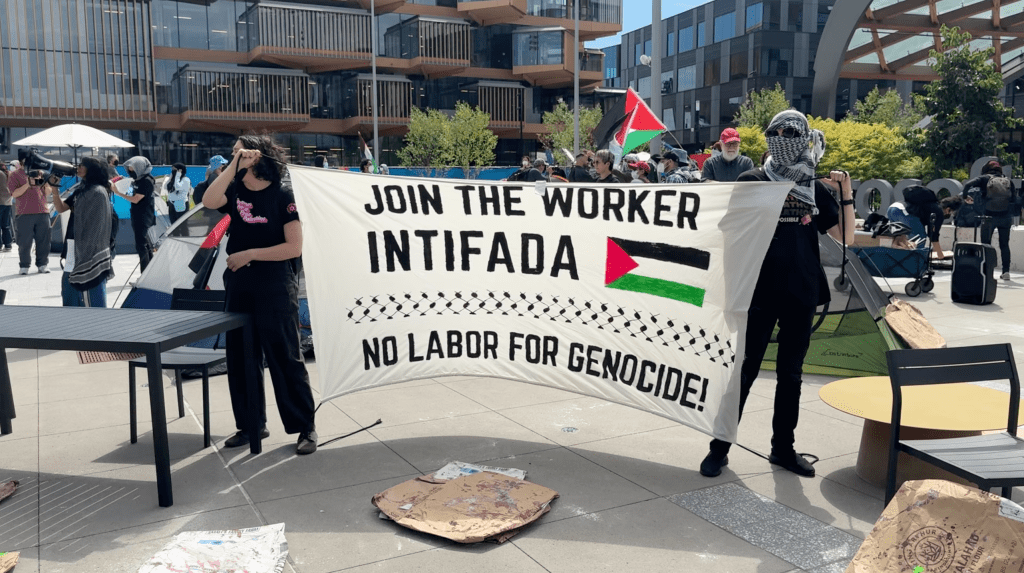
They are polluters sound wise and otherwise, and people don’t want to live near them and they don’t want to give all these resources away to these big tech companies that aren’t even providing jobs for those communities or any benefits that people can see. Seeing grassroots resistance around the data centers from Memphis to Texas to Mexico, that’s really critical. I mentioned the Microsoft workers and tech workers in general who have a vital role to play. They are the rank and file workers on board the Death Star in a lot of ways. And they know that the workers I talked to know that, and they are speaking up. They are disrupting business as usual. They’re using their knowledge to convince people of what we’re trying to kind of unpack here in this conversation. But the Microsoft are explicitly calling for a worker Intifada. They’re saying We need tech workers across the sector, not just in the US, to mobilize resistance against what the executives and shareholders are pushing these companies to do, including surveil and Target and kill Palestinians and our own people here in the United States.

So you have those two critical sites of resistance. And the last one I just throw in is that other workers who don’t work in tech also have a critical role to play. And we saw that coming to a head during the Hollywood strikes last year, particularly the writers strike one of the major, I mean, but this was also an issue for SAG AFT and the screen actors because they were fighting the company executives who are trying to push for AI to replace those workers. They want to create movies that are written by ai, maybe checked by one human. They want to replace background actors with AI generated ones. They want to use dead actors likenesses to recreate new performances. So this is coming, it’s seeping into all areas of life, which means that yes, it’s horrifying, but at the same time it creates more stakeholders in the fight against it. And I think that we’re seeing that from residents living near the data centers to workers in tech to workers whose jobs and livelihoods are being threatened by tech. And with that, I’m going to shut up and let our guest, Peter have the last word.

Peter Byrne:

Yeah, I’m in unity with what you’re saying. I think as people are more and more recognize that they’re locally impacted by the AI infrastructure, whether it’s data centers or losing jobs or getting bad medical information from their chat, whatever, that people will look for answers now. Yeah, general strike would be a good idea. I mean, if people stopped using Amazon for a week, that would change everything, which is why Amazon is actually, its profit center is now a military contracting. It’s not the Amazon store, but if people stopped using it, that would probably bring it to its knees. What we have to do, I think in this country is to look beyond the binary political thinking that we’ve been brainwashed to think it’s got to be either Democrats or Republicans. The Democrats are just as implicated in all of this as the Republicans. I mean, the Biden administration was going in the same route that the Trump is on ai.

There’s really no difference in what happened in the transition and the Tweedle D and Tweedle dumb two sides of the same coin kind of politics that we’ve been imprisoning ourselves with here for decades, if not centuries, doesn’t have a solution. There’s no way the Democrats are going to stop Trump from running for a third term or whatever he wants to do. So it’s going to take a mass movement and people just have to stop looking at their phones and stop thinking that they can communicate everything on signal and be immune from being attacked themselves and to actually start talking to one another face to face-to-face. I mean, look at us. I’d love to be in a room with you guys, but we’re here like a thousand miles, 3000 miles apart. And no doubt, the NSA has scooped up every word we said in some large language model is making an analysis of it.

Fortunately, it would be largely untrue. So I don’t know what’s going to happen next. I mean, mark, you and I are basically the same generation. We came up through the 1960s and all that, and people were mobilized by the depredations of the Vietnam War and by our encouragement of the Black Panther Party for self-defense and things like that, what do we have now? Black Lives Matter turned into some fricking nonprofit, self-aggrandizing hell, in terms of how it took on its next step. It didn’t really need a next step. It was great at mobilizing people as a phenomena, but once it became institutionalized, it became easy to attack. And so most things, movements that become institutionalized, become corrupted one way or another. So I don’t know. I have a 23-year-old son who’s a college senior, and for some reason I don’t understand, he wants to be an investigative reporter. So I think we need more people out there doing that and communicating. Then let’s see what happens. Because we’re not in control. The fucking war machine is in control, but it can’t do it without our blood.

Marc Steiner:

Well, this is just the tip of the iceberg that we’ve done here. First of all, I want to thank Peter Burn. Just we’re going to link to the piece you put together. It’s really important to read. I think there’s a great deal more to glean out of it and to talk about and to expand this conversation, which I think is critical. And

Maximillian Alvarez:

Shout out to our colleagues at Project Censored for all the great work that they’re doing.

Marc Steiner:

Absolutely. And to my dear friend, colleague and editor-in-chief, we had the Real News, Max Alvarez for being here on the Mark Steiner show as well in this conversation. And we’re going to look at this more and in greater, deeper ways because I think what Peter Byrne has shown us in his series is the real danger that we face and what we have to do to stand up to it, to save the future for our children, grandchildren, and everybody else on this planet. So thank you all for being here on the Mark Steiner show. Peter, thank you for doing the work you’re doing. And folks, let us know what you think. Just write to me at market the real news.com. I’ll get right back to you, and we’re going to expand this conversation and get it out there. So thank you both, all of everybody. Thank you,

Peter Byrne:

Onward. Thank you.

Original

September 11: Remembering the resistance to Pinochet’s Chile

September 11: Remembering the resistance to Pinochet’s Chile

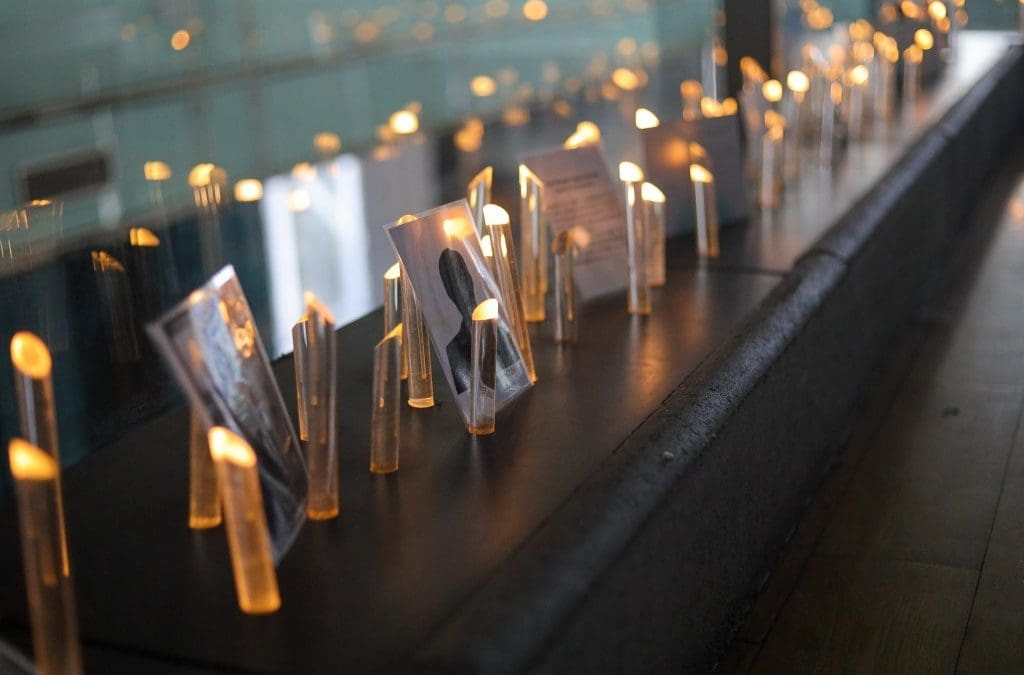
Pictures and lights are displayed as tiny candles in an art installation in the Museum of Memory and Human Rights in Santiago, Chile, in late 2024. Photo by Michael Fox.

On September 11, 1973, tanks rumbled over the streets of Santiago, Chile. Planes bombed La Moneda, the presidential palace, as US-backed General Augusto Pinochet overthrew the democratically elected President Salvador Allende.

It was a dark, dark moment in Chile’s history. Pinochet would unleash a bloody regime that would grip power until 1990. During his rule, thousands were rounded up, detained, tortured, and executed.

But there was resistance.

In this special bonus episode of Stories of Resistance, we showcase four different vignettes of people standing up to the evil in which Pinochet enveloped the country in the early 1970s, and the fight for truth, justice, and memory that continues until today.

These stories have been published at different times in this podcast series over the last year. Here are links to the individual stories. They were all researched and reported by journalist and host Michael Fox.

Episode 1 – The Last Words of Victor Jara
Episode 33 – Liquor Store Resistance
Episode 38 – The Women of Calama
Episode 62 – Chile’s Bulnes Bridge

This is the latest episode of Stories of Resistance —a podcast produced by The Real News . Each week, we’ll bring you stories of resistance like this. Inspiration for dark times.

You can check out exclusive pictures of Bulnes Bridge and the mural painting session there late last year here on Michael Fox’s Patreon .

Please consider supporting this podcast and Michael Fox’s reporting on his Patreon account : patreon.com/ mfox . There you can also see exclusive pictures, video, and interviews. 

If you like what you hear, please subscribe, like, share, comment, or leave a review. 

And please consider signing up for the Stories of Resistance podcast feed, either in Spotify , Apple Podcasts , Spreaker , or wherever you listen.

Written and produced by Michael Fox .

Transcript

Michael Fox, Narrator: September 11th is a hard anniversary, but an important one. Not just of planes flying into towers, and devastation, destruction, lives lost in New York, but also of September 11, 1973. Santiago, Chile. Tanks on the streets. Planes bombing La Moneda, the presidential palace. The overthrow of President Salvador Allende by US-backed General Augusto Pinochet.

Pinochet would unleash a bloody regime that would grip power until 1990, 17 years later. During his rule, thousands were rounded up, detained, tortured, and executed. But there was resistance.

If you are a fan of this show, you have heard stories of people standing up to the US-backed Pinochet regime. Today, in this special episode marking the September 11th coup, I’m bringing them all back in one place. Four vignettes of people standing up to the evil that Pinochet enveloped the country with in the early 1970s, and the fight for truth, justice, and memory that continues until today.

I’ll play these stories back to back. Thanks for listening.

[Episode 1 – The Last Words of Victor Jara]

Hope does not die. 

But it can fade until it’s transformed and reborn.

This is what happened that overcast winter day, when it was trampled by the soldiers in uniform. Run over by the tanks. Gunned down by the machine guns. Overcome by the whining turbines of the planes that descended on the city.

Chile’s democratically elected president Salvador Allende promised to fight. 

“I will not resign,” he told the country in his final address, as bombs fell.

Allende was one of thousands of victims killed or rounded up.

Sports stadiums converted into detention, torture, and execution centers.

This is where Victor Jara was taken.

His songs were the soundtrack of Allende’s revolution. His… the voice of hope.

He was crammed alongside thousands others into the Estadio Chile.

There he was beaten. Starved. Tortured. 

But amid the suffering and chaos, Victor Jara found a paper and pencil. 

He wrote his last words. A poem titled “Estadio Chile.””

He writes words of truth. Of pain and suffering. But also the resolve to live and relive.

The blood of the companion President

Is stronger than bombs and the shrapnel.

And our fist will fight again.

How badly I sing

when I have to sing in terror.

Terror like the one I live, terror like the one I die.

To see myself among so, so many moments of infinity

in which silence and the screams are the goals of this song.

What I have never seen, what I have felt and what I feel

will birth another moment.

Victor Jara was killed hours later. 

His poem was found, copied, and smuggled out. Its lines have far outlived the tragedy that was the US-backed September 11, 1973, Chilean coup.

Today, the Chile Stadium is renamed Victor Jara Stadium. 

Colorful murals of Victor Jara adorn the walls out front. Inside, near the rafters, is a small museum in honor of the iconic singer.

Down in the seats, a single printed copy of Victor Jara’s last poem is taped to the front of a row of worn green wooden bleachers.

One simple black and white page, reminding visitors of the horrors that happened here…

The resolve to fight and live on. 

And the hope that would not die.

[Episode 33 – Liquor Store Resistance]

The year is 1973.

Santiago, Chile.

Ana Maria’s father runs a liquor store just down the street from their house. Every night when he goes to lock up, pairs of feet follow him. Feet in tired shoes. Nervous feet. Wanted feet. Feet on the run. 

He guides them into the basement of his shop and maybe rolls out a blanket or two. They lie, alongside cases of the Chilean beer Escudo, or Shield, and hope that it will protect them. Sometimes they even try a bottle. They whisper to each other in the darkness. They develop plans. They talk of fighting. Or fleeing the country. Or they reminisce of better times. Times only just past. 

They sleep beside the Escudo… under the watchful eye of rows of Chilean Pisco, Cabernet Sauvignon, or Syrah.

They have restless, agitated dreams. Dreams they cannot run from. Dark dreams that descended on Chile in September, 1973, and enveloped the country in a thick grey fog. A fog that will not go away. A fog that plucked people from off the street and removed them, never to be seen again. 

But these feet are survivors.

In the morning, Ana Maria’s father comes to open the shop. He brings food. A large bowl of cazuela. Bread. Sandwiches. His wife cooks.

“I’m famished,” he tells her every morning. “So hungry.” It’s hard to tell if she knows why.

The feet eat quickly and quietly. Then they lace their shoes, grab their bag and slide out the back door into the empty street.

Thrushes and sparrows dart from tree to tree, singing their early morning song. The sun hasn’t yet crested the Andes. 

The feet walk quickly. Determined. They have no other choice. They have to… before the fog descends again. Sometimes, in 1973 Chile, it’s hard to tell which is worse, the bad dreams or the reality.

[Episode 38 – The Women of Calama]

For nearly 20 years, the women of Calama traveled into the desert each day to search for their loved ones.

Monday through Sunday, sun-up to sundown, they scoured the harsh desert earth with strainers and rakes.

Searching and hoping. 

The crunch of the ground beneath their feet. The harsh wind whipping at their clothes. The hot sun on their faces.

“For us there was no wind, there was no cold, there was no heat, there was no hunger,” Violeta Berríos says.

Her partner, Mario Argüelles Toro, was a taxi driver and a local leader in the Socialist Party. It was his death sentence. 

Mario Argüelles Toro was detained and tortured just weeks after the September 1973 coup d’état by Chilean General Augusto Pinochet.

On October 19, 1973, Mario was taken from prison, executed, and disappeared alongside 25 others for their support for the former democratically elected President Salvador Allende.

Executed during what they called the Chilean army’s “Caravan of Death.”

The men’s partners and mothers responded, transforming their sadness into action. 

They founded the Group of Family Members of the Politically Executed and Disappeared Detainees of Calama.

They took to the desert, scratching at it each day, demanding that it reveal its secrets.

And after years, finally, it did.

In 1990, in a place called Quebrada del Buitre, or Vultures Gorge, on the edge of a hillside overlooking the expansive Atacama desert, the women found fragments of bones and pieces of teeth.

This was the location their loved ones had laid buried for 17 years. But most of their bodies were no longer there. 

Just as the women were getting closer, General Augusto Pinochet had ordered their remains dug up, removed and buried someplace else. An evil scavenger hunt, in which the rules are rigged and the dice are staked.

Between 1990 and 2003, the women would find the partial remains of 21 of the victims.

Today, a memorial lives on a hillside just off highway 23, heading east out of Calama. 

This was once barren desert for miles, but it now lies beneath a sea of wind turbines. The sun burns overhead. The wind threatens to knock you over.

The memorial is in the shape of a circle. Almost like a small amphitheater, with stairs leading down. In the middle is a patch of dry Atacama earth. Rocks and small marble stones are laid there in the shape of a cross. Pink and red flowers have been placed throughout. Pink concrete columns rise into the air. Each of them bears a name inscribed on a little plaque. The name of each of those who was detained, tortured, executed and disappeared here in the Atacama desert.

This is the location of the mass grave, where the women of Calama finally found the fragments of bones that proved their loved ones had been here.

Behind the memorial is a crater in the ground, where the grave was opened, and where they exhumed what they could. Rocks, in piles or in tiny circles, mark the locations where parts of their loved ones were found.

The memorial is a sentinel in the desert. A beacon of memory. Memory of lives lost. Of the horror and the pain of the past. But also the memory of the women’s determination. Their hope and struggle. Their resistance in the desert…

The women are still searching for and demanding justice.

[Episode 62 – Chile’s Bulnes Bridge] 

Aquiles Cordova adopted a bridge. 

It is not a pretty bridge. Four lanes of busy traffic rush across Puente Bulnes during most hours. To the North, it buttresses against two overpasses that lead to a bustling highway. Below it, run the milky grey waters of the Mapocho River, after passing through downtown Santiago. Chile. 

Trash and discarded clothes catch against the rocky shoreline or the concrete legs of the bridge. They flap in the current. It reminds Aquiles of a past that no one wants to remember, but which everyone must. 

On special days, Aquiles Cordova holds memorials. 

Once a month, he leads cleanup brigades. 

Every so often, he invites muralists to come. They paint the walls. Huge life-sized pictures of faces and figures. Names and phrases like “Never Again”.

50 years ago. In another time, this bridge was a favorite execution site for the military and police of Chilean dictator Augusto Pinochet. 

Hundreds were shot and pushed over the bridge into the rushing waters below, in the early months of the Pinochet dictatorship.

Today, Aquiles Cordova will not let it be forgotten — ever. 

For him, it’s personal. The day after the September 11th coup, 1973, a young Aquiles Cordova found himself on the edge of Puente Bulnes, staring down the barrel of a gun. A young soldier on the other side, shouting orders. 

Aquiles’s life flashed before his eyes. He saw it all: birth to present. Like a movie real on high speed.

And then… he was allowed to go. He was one of the lucky ones.

Aquiles Cordova has grey hair now. 

He will never forget. 

He won’t let anyone else forget, either.

###

Hi folks, thanks for listening. I’m your host Michael Fox.

Today’s episode was a little different. I hope you enjoyed it.

If you like what you heard, I hope you’ll stay on the lookout for my upcoming second season of Under the Shadow. I dive deep into Plan Condor, the South American dictatorships of the 1970s and the role of the United States. I’ve been working on it for the last year. Of course, Pinochet’s Chile is front and center. You can watch for it in the first half of 2026.

As always, if you like what you hear and enjoy this podcast, please consider becoming a subscriber on my Patreon. It’s only a few dollars a month. I have a ton of exclusive content there, only available to my supporters. And every supporter really makes a difference.

This is the latest episode of Stories of Resistance, a podcast series produced by The Real News. Each week, I bring you stories of resistance and hope like this. Inspiration for dark times. If you like what you hear, please subscribe, like, share, comment, or leave a review.

Thanks for listening. See you next time.

Original

The biggest labor story in the US right now is happening at Microsoft

The biggest labor story in the US right now is happening at Microsoft

Members of the No Azure for Apartheid coalition, including current and former tech workers at Microsoft and community allies, occupy the main courtyard on Microsoft’s East Campus on Aug. 19, 2025. Two coalition members hold a banner that says, “Join the Worker Intifada: No Labor for Genocide!” Photo by Maximillian Alvarez/TRNN.

Current and former tech workers with the No Azure for Apartheid coalition continue to disrupt business as usual at Microsoft’s global headquarters in solidarity with Palestinians facing a genocide, and in protest of Microsoft’s contracts with the Israeli military to provide tech that Israel uses to surveil, kill, and retroactively justify the killing of Palestinians. In this episode of Working People, which is a critical follow-up to our last episode, we speak with a panel of five tech workers and No Azure for Apartheid coalition members who have all been fired by Microsoft in the past year in response to their protest actions: Anna Hattle, Joe Lopez, Hossam Nasr, Nisreen Jaradat, and Riki. Even after losing their jobs, however, these workers have vowed not to stop organizing and protesting until Microsoft meets their demands to “fully and perpetually divests from Israel’s economy of occupation, apartheid, and genocide.”

Additional links/info:

Featured Music:

  • Jules Taylor, “Working People” Theme Song

Credits:

  • Audio Post-Production: Jules Taylor
Transcript

The following is a rushed transcript and may contain errors. A proofread version will be made available as soon as possible.

Maximillian Alvarez:

Alright. Welcome everyone to Working People, a podcast about the lives, jobs, dreams, and struggles of the working class today. Working People is a proud member of the Labor Radio Podcast Network and is brought to you in partnership within these Times Magazine and the Real News Network. This show is produced by Jules Taylor and made possible by the support of listeners like you. My name is Maximillian Alvarez and today we are returning to the front lines of what is probably the most important and most sorely undercovered labor struggle happening in the country right now. As you guys know from our last episode and my coverage for the Real News Network, current and former tech workers have been rebelling at one of the biggest and most powerful tech companies in the world putting their jobs, livelihoods, and even their bodies on the line to disrupt business as usual at Microsoft.

Members of the No Azure for Apartheid Coalition have been taking bold and escalating protest actions in solidarity with Palestinians facing a genocide and in protest of Microsoft’s contracts with the Israeli military to provide tech that Israel uses to surveil, kill and retroactively justify the killing of Palestinians and Gaza and the West Bank. In our last episode, you heard audio of speeches, chance and exclusive interviews that I recorded when I was on the ground in Redmond, Washington on August 19th and 20th, where current and former tech workers along with community supporters set up an encampment in the East Campus Plaza of Microsoft’s global headquarters establishing a liberated zone and renaming the plaza. The martyred Palestinian Children’s Plaza Police violently dismantled the encampment on August 20th and arrested 20 members of the no Azure for Apartheid Coalition. Now, local reports initially said that there were 18 arrests, but the coalition publicly clarified that 20 people were arrested.

Then on August 26th when I was already back here in Baltimore, coalition members were back at Microsoft HQ as the coalition posted on the day of their action. Just now, current and former tech workers from Microsoft, Google, Oracle and more have been successfully able to occupy the office of Brad Smith, Microsoft Vice Chairman and President to protest Microsoft’s indispensable role empowering the genocide in Gaza and the mass surveillance of Palestinians. They are presenting their demands to the executives at their place of work as a direct escalation to show that worker pressure has reached a tipping. Point four, Microsoft employees were fired for participating in that sit-in a company spokesperson said in a statement that the firings were quote, due to serious violations of established company policies and our code of conduct, including participating in recent onsite demonstrations that created significant safety concerns for our employees we wish to emphasize.

Again, the statement continued that such conduct is entirely unacceptable and stands in direct opposition to our company values and policies. Now in a news conference after the sit-in, Brad Smith himself spoke about the protests. He even mentioned the no Azure for Apartheid coalition by name, and he addressed the bombshell reports from The Guardian and 9 7 2 Magazine exposing Israel’s use of Microsoft Azure Cloud services to store recordings of millions of mobile phone calls and texts by Palestinians and Gaza in the West Bank. We’re committed to ensuring that our human rights principles and our contractual terms of service are upheld in the Middle East. Smith said at that news conference and he stressed that the company is investigating the revelations from the Guardian report. We are working every day to get to the bottom of what is going on and we will Now, we’ve actually linked to the full press conference video in the show notes for this episode, so you can go watch it for yourself.

But in today’s episode, which is a critical follow-up to our last episode, you’re going to hear directly from a panel of five tech workers who are part of the know Azure for Apartheid Coalition and who have all been fired by Microsoft in the past year. Some were fired after the recent encampment and sit-in, others were fired earlier in the year. But as you’ll hear in our conversation, they do not regrets standing up for Palestinians and for speaking out against big tech’s complicity in their genocide and in Israel’s apartheid system. Even if doing so costs them the jobs that they’ve worked their whole lives to get. And they have vowed not to stop until Microsoft meets their demands to quote fully and perpetually divest from Israel’s economy of occupation, apartheid and genocide. So here we go. This is part two of our deep dive into the tech worker revolt for Palestine at Microsoft.

Anna Hattle:

My name is Anna Hattle. I worked at Microsoft for five years before getting fired recently after being arrested both at the encampments and at the sit-in and Brad Smith’s office.

Joe Lopez:

My name is Joe Lopez or Jose. I worked at Microsoft for around four years before getting fired, after disrupting Sanya Nadal’s keynote speech at Microsoft Build this year.

Hossam Nasr:

Hi, I’m Hossam Nasr. I’m a fired Microsoft worker and an organizer with no Azure for apartheid. I was fired last year in October after organizing a visual for the Palestinians work called Reza on Microsoft’s campus, and I was one of the first organizers with no Azure for apartheid, and I was recently arrested twice over the past couple of weeks, once at the encampment on Microsoft’s campus. And lastly, during the sit-in in Brad Smith’s office,

Nisreen Jaradat:

My name is Nisreen Jaradat. I worked with Microsoft for nearly seven years before being fired for participating in the Liberation Zone encampments and the rally that we did outside during the Brad Smith’s office. And I’m also an organizer with no Azure for Apartheid. Hey,

Riki:

I’m Riki. I’m an organizer with the much for apartheid. I was also fired a couple weeks ago for participating in the sit-in at Brad Smith’s office where we had seven of us arrested. But yeah, excited to be here.

Maximillian Alvarez:

Well, Anna, Joe, Hassan, Rine, Ricky, it’s really an honor to be on this call with you all and my heart’s very heavy just hearing all of these intros and I imagine our listeners are feeling the same because you have all been putting your bodies, your livelihoods, your everything on the line for this cause. And I saw that firsthand when I was there covering the encampment that y’all put up on Microsoft’s campus on August 19th and 20th. But I just wanted to really start by impressing upon folks listening that this is as real as it gets. And we are here talking to folks who, as you heard, have been fired because of the actions that they have taken to try to stop a genocide and to try to stop their employers complicity in that genocide. And you’re going to hear more from them about why they took that step and what has happened since I left Redmond and this struggle continued where the struggle goes from here and what listeners like you can do to help our brothers, sisters and siblings who are being slaughtered across the world in Palestine.

And you guys also recently heard my interview with two Palestinians in Gaza about what they’re going through right now. So that’s what I mean when I say this is as real as it gets. And I am truly grateful to all of you for being here, and I really want to make the most of the time that we have together. So I’m going to keep my portions here short so that folks can hear directly from y’all. So let’s go around the table and have each of y’all tell us a bit more about yourself and how and why you got involved in the no Azure for Apartheid Coalition and this effort to get Microsoft to end its complicity in the genocide and contracts with Israel and take us through the preparations to the encampment and to the days of the encampment itself.

Anna Hattle:

Sure. As far as how I got involved in the campaign, I want to say that coming out of school I had a lot of convictions and thoughts about the world and so on and so forth that I didn’t know what to do with those and I was searching for ways to act on the things that I’d learned. And I think when I came into my job at Microsoft, I was always looking for that. And then when the genocide began, I think all of us and so many people everywhere knew that we had to figure out some way to try to answer the call for Palestine. And when I learned, I think a little over a year ago that there was actually something related to the position that I have at Microsoft and something that was related to something that I felt that I could do something about, I felt like I immediately needed to jump on that.

And I think at that time I didn’t really realize the depth of Microsoft’s complicity. I just thought this is about Palestine, this is something that it’s about Microsoft, so I have context and I can make a contribution I need to join. And I think the campaign quickly educated me on how deeply entrenched Microsoft is in the occupation and genocide. And from there it became something that became so clear that it was worth putting energy into. Yeah, I think the thing that has also been really inspiring for me is connecting with so many other Microsoft workers who feel so strongly about this and working to build collective power around that and then exercise that power to pressure Microsoft. And this is my first time experiencing labor organizing in this way and feeling honestly just in my life, a sense of agency about being able to create the impact that is needed. So I’m really proud of what the campaign and the workers have been able to do together. The encampment that happened in the sit-in are just a testament to the creativity, the hard work, the dedication of so many people and so many of whom are not visible with us right now, but contributed to hopefully something that a tech company like this has never seen before.

Joe Lopez:

Yeah, I will echo that. I think that this is a really special campaign and there’s a lot of people working really hard to try and put an end to this genocide from all many different avenues. But I think Microsoft definitely is very complicit in the ways that they support is real with their technology. And so it’s a really important target for us to attack right now. I would say I’m probably the newest member of No Azure for Apartheid on this call right now. I had been paying attention to the ongoing genocide in Gaza for a while, but not really fully understanding how the company that I worked for was complicit as well. But after seeing Vanya and Al disrupt the 50th anniversary celebration for Microsoft in April, it really forced me to take a closer look and see how entrenched Microsoft really is in the technological backbone that’s being used to surveil Palestinians and to power the Israeli war machine.

And so that kind of set me on the path of knowing that I wanted to leave the company, but also feeling inspired to do something on my way out. And so I reached out to Noah through Instagram actually and just let them know that I wanted to leave Microsoft and if there was a way that I could make an impact on my way out, I wanted to do it. And that’s how I ended up getting involved and eventually disrupting the keynote speech by CEO Satya Nella on May 19th. And since then I’ve still been organizing. I was fired after that, but I participated in the encampments a couple of weeks ago and also to sit-in and I think it’s really important to send a message to Microsoft that they can try and suppress their workers. They can try and fire us and try and shut down our speech, but we’re not going to leave and we’re not going to stop taking action until they decide to actually take an action to end their complicity.

Hossam Nasr:

I think for me, I was born and raised in Egypt and I came here for college. I organized a little bit in my college years before starting my first job at college, which was at Microsoft. I worked there for three years before I was fired. And I think especially being Arab Muslim immigrant, I think a lot of the time you are taught, I was taught to sort of keep my head down, don’t ruffle any feathers, don’t speak out, just lay low, rise up in the ranks and wait until you have more power and more privilege to actually speak up. And I think that I always pushed back against that framing. I’m not here saying that I bought into that, but I did think that there was a balance in my view at the time. I thought that there was a balance between using the privilege and the voice that I did have in this particular moment, and between also trying to somehow stay under the radar and so that I can rise up in the ranks and whatnot.

I think that balance and that calculation for me completely ended on October 7th, 2023 and the start of the genocide that really shook my worldview and that shook my life personally and witnessing the extreme levels of depravity of the genocide and seeing it so clear and contrasting that with the levels gaslighting that I was seeing from every facet of my life, from my school to my employer, to my elected officials, every single facet of my life in this country was just hell bent on convincing me that Palestinian life has no value and I refuse to accept that. So for me, I think it became a thing of I threw that calculation out the window and I refused to abide by that. So I was like, I’m not going to withhold any ounce of privilege or voice. I have to speak up about Palestine and I don’t care about the repercussions.

So I think quickly I tried to do that in every opportunity I saw in the streets here in Seattle or at work. And I was motivated to do that at work because the first thing that I saw when I logged on to Outlook on the first business day after October seven was an email from my leadership saying, we stand with Israel and a big banner with an Israeli flag that says, donate to Israel. And again, no mention of Palestinian people, no mention of the occupation, no mention of any of that. And again, that really angered me. And I started to, I think at first I started to just work within what the so-called proper channels and sending emails to my leadership and talking to my managers and asking questions and all of that. And I think very, very quickly I realized that that’s at that end and that’s not really going to affect any real change.

And quickly, I think I had the conviction that it is the way to affect change is to have external pressure. It’s to not appeal to the humanity of these executives, but to apply pressure on them and that we need to be organized. That was one of the main things that I learned from this genocide in general, is that we are not outnumbered. We are out organized. So it was very important for me that I don’t do something that is just as an individual thing or an individual action of rage, but rather to build an infrastructure, an organization, a community that is bigger than the sum of its parts. And I think quickly I met other workers at Microsoft who felt similarly. And that group, we became organized under the banner of No Tech for Apartheid, which is this campaign that was started by former and current Google and Amazon workers to protest Project Nimbus, the 1.2 billion contract between Google, Amazon, and the Israeli government.

So we were inspired by them and wanted to kind of replicate that campaign for Microsoft. We organized under their banner for a few months starting with our main focus was just understanding Microsoft’s ties to Israel. And our first action was actually releasing that research in the report that we titled Marriage Made in Hell, a play on a quote by Benjamin Netanyahu actually who described Microsoft’s and Israel’s relationship as a marriage made in heaven. So after that, I think that we launched officially no Azure for apartheid as our campaign. We honed in on our demands after we understood more Microsoft’s simplicity and we started doing more actions to again apply pressure on the company. We launched the petition. And I think for me, I was never intentionally trying to get fired, but I realized that eventually that was going to happen as a consequence of my activism, and I was prepared to pay that price.

I didn’t expect that to happen because of a visual of all things, but that’s what ended up being. And I think after that, that was a galvanizing moment for me to again, make sure that this does not have the intended effect that they had, which is to sort of scare people or dissuade them from joining the campaign. I wanted to have the opposite effect. So again, I made sure to invest in the campaign even more to make sure that people feel actually more empowered to join the campaign after that and to not be disempowered by the repression. And I think after that, we, thankfully, our numbers grew even more. Our signatures grew even more and we started having more creative actions to apply pressure in different ways. We started doing these conference disruptions, disrupting keynotes, disrupting the 50th anniversary both on Microsoft campus and in the Seattle State Town Hall.

And I think after a period of that, I think there was kind of leading to your question about the encampments. I think for me and a lot of us in the campaign, there was a moment where it felt like we need to escalate even more and we need to bring the movement to the seat of power to the throne of Microsoft executives at their offices, at their homes. And we took inspiration from the student movement. We were really inspired by the student in Tado and how that galvanized the entire Palestine movement around them and how that really created a moment of deep crisis for not just the universities but for the entire ruling elite that are causing this genocide to persist for so long. And we took inspiration from that and we said that if the students were able to create that level of crisis, if they were able to galvanize the movement in that way, is it time for the labor contingent to do the same? Is it time for our labor organizing rise to rise to the occasion in that way and carry forward the mental of the struggle? So that was really our inspiration behind the encampments and why we set them up in the Marr Palestinian Children’s Plaza, which formerly known as the East Campus Plaza. And unfortunately we were violently swept, but it was unfortunately to be expected given the pattern of behavior we’ve seen from Microsoft.

Nisreen Jaradat:

I joined Microsoft in 2018 and I very much had rose colored glasses at the time. I really believed in Microsoft’s mission and all of that. And I think kind of an awakening moment for me was in 2021, I recall signing a petition that called for a human rights review of Israeli contracts and stuff, and basically nothing happening with that. And then later on we learned that Satya’s response to that was to meet with the head of unit 8 2 0 0 a few months later and approved the mass theft of all Palestinian communications in a 10 minute meeting. And she called an incredibly powerful brand moment. And then after that, there were a lot of things that I was trying to do just on my own very much within the so-called proper channels, so raising HR tickets and going to the legal team and there’s stuff by myself which fizzled out.

And then when this genocide started, I tried to do the same and it was very pretty clear that I wasn’t going to get anywhere. So when I heard that there was this group that was organizing, it’s like, great, I can’t do it on my own. Nobody can do this on their own. I was like, why don’t I join? And it was one of the best decisions of my life to join because I really learned that not only is our labor power, but our collective action is power and we keep each other safe, and it’s been just amazing organizing with this community, and when I started organizing, I wasn’t intending to get fired. There’s a lot of work that people do in the background, critical work for the campaign, which I was doing a lot of. I think that kind of changed for me after Microsoft built and I saw the way that Microsoft was responding to protests that people were getting brutalized and pepper sprayed and just I violently dragged out of sessions for our peaceful disruption.

Also, when Microsoft also decided to respond to that by banning the words Palestine genocide and apartheid, it was clear that they were cracking down on all forms of Palestinian or pro-Palestinian speech, and it became very important for me to respond to that because I wasn’t going to be told that I can’t say the name of my whole Land Palestine and I wasn’t going to be told that I can’t answer this call or that we can’t call a genocide. A genocide and apartheid apartheid. So very trivially bypassed the email restriction and I sent a mass email, which is the exact thing they were trying to prevent, and instantly got suspended for that for about six weeks, and then I came back, they reinstated me and I joined the encampments and a rally outside of Brett Smith’s office where we delivered the petition. When we delivered the petition, we carried a scroll that was 18 feet long.

It had the names of 2000 workers. Microsoft at the time was trying to say that workers were not representative of the liberation zone encampments. That was a complete lie. It was representative of the workers. It was literally an attempt at erasure of Palestinian and pro-Palestinian voices to say that we didn’t count as workers. And so we came and workers gave speeches, including me, I was still a worker at the time, and we delivered the petition scroll with the names of 2000 Microsoft workers who were also calling for Microsoft to divest from genocide and Microsoft security responded by specifically targeting the protesters who were carrying scroll and tore that scroll. Thankfully, they didn’t succeed in carrying the complete scroll, but that is how they responded. They literally violently responded to a piece of paper, so you can just imagine how they treat actual protestors. It was very, very important to me to take part in these encampments and in this rally, even though I knew from the pattern that Microsoft has that being fired was a likely outcome, I thought it was very important because every single moment is the right moment to escalate. There’s no time to wait and say Palestine somebody else’s problem. The time to escalate is right now. My only regret is that I didn’t do something like that sooner.

Riki:

Yeah, I can go into my story of coming into noaa. I graduated from college in 2023 and I had done an internship at Microsoft. I thought of them as one of these evil big tech companies by the least evil of those. I think a lot of people who are in my shoes share that sentiment or that thought that there’s Google and Amazon, they don’t really care anymore that they’re evil. They’re fine with people knowing that. And Microsoft is kind of like, oh, we help hospitals or something.

Maximillian Alvarez:

Jeff Bezos is gone full bond villain, whereas you still got the Microsoft sweater vest aesthetic.

Riki:

Yeah, yeah. It’s very much like, oh, we’re a company that really helps the world. We help people. I think I’ve definitely learned through this campaign that that is a very calculated kind of PR facade that they have been building, especially over the past few years. But I started Microsoft 2023 and then so I have been working there or I was working there for about two years in Azure storage, which is basically the cloud computing. If you want to store some kind of media on Microsoft servers, that’s where that would happen. I actually didn’t know too much about no for apartheid before joining. I actually was just going to lunch on East campus and stumbled into the vigil last November, and I think I had heard about No Tech for Apartheid, which is largely focused on Amazon and Google. I had seen No for Apartheid show up on Instagram, I think, but I didn’t know too much about the campaign, and I ran into the visual there and I was like, it’s like that there’s some protest happening here.

Microsoft and I learned that it was worker led and that they’re trying to bring in workers, and so I joined the campaign through that. I think over the past time that I’ve been with Noah, it’s been very energizing to see how effective we, we’ve moved together and what an awesome kind of organization. This isn’t just like Microsoft is a company of 300,000 workers and one of the highest valued companies in the world, and we are in comparison a small but very mighty group of people who have kind of backed Microsoft into a corner in the present moment. So I’m very proud of being this part of this campaign, and I think we’ve had over this past almost a year that I’ve been a part of this campaign, we’ve had this series of all these different actions. We had the conference disruptions, we had disruptions of the 50th anniversary things or events that Microsoft was trying to put on.

Basically we’ve just been shitting all over Microsoft’s parade every time they try and have one, and I think it’s really cool to see the impact of, they desperately don’t want people to look at what we’re trying to bring to light. And every time they do that, we recent the narrative, I remember after Build, I think a lot of the media sentiment surrounding build was largely focused on the protests, and that was a huge win for our campaign. I think up until this point, I’ve been not helping with the backend operations of the campaign and helping be someone documenting these events and not someone who’s a visible face of this campaign up until the Brad Smith sit in. That was the right time for me to become one of this group of these fired workers, these arrested workers. I think that was, I don’t regret that at all, and I feel like that was the right time for me to play those cards and for me to really step up for Palestine.

I don’t personally have too many ties to Palestine. I certainly have more now after being part of this movement. Currently it’s the center of all the power structures that are trying to oppress a lot of that centers on Palestine, and I think just over the past two years I’ve kind of seen, we’ve taken off the cover and I can kind of see a lot of the wiring underneath all this ways in which the economy of genocide and war pr hearing that is going on as a result and all this propaganda that happens. So that’s kind of why I’m here. Just as someone who cares about the world and wants to see a world in which not only Palestine is free, but all of us are free, I

Maximillian Alvarez:

Think that’s beautifully and powerfully put, and I myself as a journalist, trying to get people to care about this and stop this and to fight for life and humanity and fight against this just inhumane, genocidal slaughter in which all of our souls are being sucked down the drain. What kind of world, what kind of people are we going to be after turning to our children and saying, we allowed this to happen? That’s the kind of thing that I’m sure we’ve all been thinking about over the course of this horrific genocide in Gaza. I am always trying to get folks to just care about that on its own. He’s like, these are human beings. That should be enough for you. Women, children, men, older people, like everyone. This is just life being obliterated. That should be enough for you. But if somehow that’s not enough, then you should care about it for your own fucking sake.

Pardon my French, because now here we are back in the Imperial core and that boomerang’s coming to whip us in the ass ice is going to have access to Israel’s surveillance technology that they’re going to be spying on us with. Do you care about it? Now I’m getting heated, but you could tell from all of us here, me especially that this is the urgency that we’re talking about. This is the urgency that we’re trying to cover at the Real News. Whether it’s students camping out on their campuses, whether it’s tech workers, like taking this brave step to occupy the literal campus of one of the biggest companies in the world, to get that message across and to get others to join that struggle. All of it is important. And all of it is as we’re speaking right now, there is a whole bunch of flotillas like sailing towards Gaza.

That urgency, I think is deeply felt in our listeners and folks around the world, and the more intense that action becomes, it feels like the more intense the reaction from the powers that be is. And so I wanted to, this is by way of getting us to this second portion here where I wanted to kind of talk about that. I wanted to talk about the effect of the actions y’all have been taking, the effect of the organizing you’ve been doing, both in terms of expanding the coalition, making this message more broadly felt understood, impossible to ignore, but also the empire strikes back effect of you losing your jobs of, I mean, I was there holding a camera like 10 feet from Hassam. There were like 10 cops on him, basically hog tying him and then carrying him out while he’s shouting Free Palestine. I saw one of the no Azure for apartheid coalition members get shot at point blank range with a pepper ball gun.

I’m talking two feet away from them, but I didn’t see what happened afterwards. I showed our audience at the Real News. I showed people on YouTube. This is what I saw, but then my perspective kind of went another way while some of y’all were carried off to the police station. I was there with Ms. Reen and interviewed her before she and coalition members left together, and then a goddamn drone was following me back to my car for the next four blocks. Right. I mean, so people have seen my side, but I wanted to ask if y’all could talk about more like, yeah, help us fill in this story on the effects side, what are you hearing from coworkers at Microsoft, other tech workers outside of Microsoft, the reaction and response from Microsoft and the police? How is it impacting you and your life?

Anna Hattle:

Thanks. Yeah, there’s so much to talk about in terms of impact. So I’ll try to summarize asbestos I can. But I think to start with the encampment itself, I think one thing that people were surprised by is honestly the positive reactions that we were getting from workers. Even workers who were scared of what was happening, who were maybe too scared to ever participate or step inside the encampment, for example. But people who were mouthing the chance back to us, people who would put a shy thumbs up as they were walking by people who were taking flyers that were explaining why the encampment was created. And I think that even the campaign is kind of shocked by the underlying, I think support, of course there’s lots of Zionists and lots of opposition, but I think that there’s a sense that undergirding all of that, there is popular support for what we’re doing.

And as far as the company response, I think that these escalations and in particular the ones that we’re talking about now, these most recent ones have built on this series of increased escalations over the past several months, which they’ve already been responding to in force. So for example, I think in May when we sent them the petition with 2000 worker signatures demanding that they cut ties, they that day put out their weak statement where they admitted to additional complicity in the genocide. And so we’ve been seeing already that they have seen this campaign as a force to be reckoned with, but I think now they’re truly in what feels like crisis mode. And I think that this is kind of part of what we anticipated is that there would be a huge amount of repression to onion and preparation and escalation as they’re scrambling to see what we do next.

And I think we saw over the campus overall that there was an increase in security, and especially after the sit-in and the occupation, there are parts of the campus that are now locked down and now people are not able to get in buildings that they aren’t specifically assigned to. And I think that the energy that we’re getting from them is that they’re doing everything they can to stop something like this happening. Again, I’ll maybe let other people speak to this more, but immediately after the sit-in in Brad Smith’s office, he held a press conference, like an impromptu press conference in that same office to talk about what we did and to naming the campaign and trying to disavow what we were doing and making statements that were obviously and verifiably false about what we did, what we were there to do. And so I think that at this point it feels like they are scrambling and also doing work to potentially create a runway for themselves to make actually some progress on meeting certain demands We’ve seen in the past that they’re kind of setting themselves up for a potential divestment action. And so I want to let other folks talk about that a little bit. But yeah, overall I think we are really, I think, happy to see the kind of impact that this has been having. I

Joe Lopez:

Got 50 to a hundred messages on LinkedIn after I did my disruption and sent my email of people from within Microsoft saying, I didn’t know that this was going on. I didn’t know that the company I worked for had these deep ties with the Israeli military. Thank you for doing something and thank you for speaking up and I’m going to look into this. And I know that alone just made it worth it knowing that I lost my job, but I also got people to pay attention. And I think, I know people are scared to act in a public way, but there’s no smallest amount of impact that you can have. Even just signing a petition or taking a pledge that you’re not going to allow your work to support the apartheid regime. Those things matter and they add up. And so just seeing all the workers within Microsoft the way that they’re touched by what we’re doing, it means a lot. And yeah, that’s allow others to speak, but that’s impacted me a lot

Hossam Nasr:

Ultimately having been with the campaign basically sit since hounding, I’ve seen how every single time we do something, Microsoft’s response has always been just to respond with brute force. And as we have escalated our campaign, so has their force and their repression escalated as well. But make no mistake, that’s been their toolbox from the beginning. When we first launched our petition in May of 2024, the first thing they did within a day of publishing that petition was actually try to take down the links, the internal links that we had, that petition when we had the visual. Again, the most simple action that we could think of on campus, I bet now they wish we’d only do visuals now, but back then they fired two of us for organizing that visual. And when we had people in the campaign or work with the campaign to send mass emails in protest or as announcing the resignation, again, the response was to just completely ban the use of the words Palestine visa genocide in any internal email going out from anybody to anyone, even if it’s an email to yourself, which was crazy.

And I think we’ve seen the same thing happen in response to conference protests. They again responded with just insanely militarizing their conference spaces, adding a huge amount of security and even armed retired police and responding with pepper spray to our protests during their latest conference, their biggest conference in May of this year, Microsoft build. And that was no different this time either. And I think this time again, we’ve seen since this was our biggest escalation so far, it was their biggest escalation of their force as well. They responded with extreme force pretty quickly. Like you said, one of our comrades during the encampment was shot with pepper balls seven times in the back with point playing range. Some of us were dragged and tackled and completely unnecessary and unjustified use of force on behalf of the police that Microsoft, again invited to campus against a peaceful encampment against a peaceful group of their workers and former workers who are protesting their complicity and genocide. And I think that’s been coupled also with the repression. It doesn’t just take this form of hard violence, but also takes the form of surveillance and intimidation, weaponizing HR investigations, which has happened to me a lot of the time before I was, I didn’t back down, so they had to fire me. I think that’s happened to a lot of people on this call as well before they were also fired.

Your experience with the drone, that’s been also an experience that we’ve seen more recently on campus. They literally, the drone, when four of us decided to go tabling the Friday after the sit-in at Brad’s office, we were literally just four people on public property trying to table, and they called at least that I saw two police cars, a police van. They sent the drones, they brought out the head of security. They are panicking, and I’m sure you’ve heard they’ve even tried to get the FPI involved and named me specifically by name and communication with the FPI. But I think ultimately the point is, I think when you are at the crosshairs of these imperial forces, you’re doing something right. When you are getting under the skin of these powerful war criminals so badly, you’re doing something right. And when you have the police and even the FBI and Microsoft security weaponized against you in this way, you’re doing something right.

So this has not deterred us. And if anything, I think it’s made us stronger and it simply just doesn’t work. I think the simplest proof of that is that we came back less than a week after our encampment was violently dispersed and we occupied the president’s office and all the people who were arrested during the encampment were also there at the sit-in and were arrested again. And that’s a message that we need to emphasize and we continue to emphasize every single time we can to Microsoft that again, the repression and the violence and that brute force tactic simply does not work. And the only way to stop our movement, the only way to make these to end this crisis that they have created with their own actions is to end their complicity in the genocide. That is the real crisis. That is the real moral test of our time, and that is ultimately the only thing that’s going to make people not show up and not escalate every single time.

Nisreen Jaradat:

I think Microsoft knows that they’re in trouble. I think that Microsoft is scared of their workers discovering and fully understanding that they’ve been misled into abetting a genocide and working for a digital arms manufacturer that is masquerading as a tech company. And I think that that’s why Microsoft responds the way it does with brute force with trying to silence any sort of even vague criticism of its dealings with the Israeli occupation forces forces. And I think that our success is really showing and the fact that they’re clearly scrambling right now. As Anna mentioned, Brett Smith in his press conference said a lot of statements that didn’t even make sense that were wrong while answering his court summons by the way, and the jumping from narrative to narrative that didn’t make any sense. Well, this isn’t worker led, but then firing four workers and tearing the scroll of 2000 signatures, calling the community members who risked so much protesting outside agitators when they’re the ones who live in gated communities surrounded by boats. So it really shows how much they’re scrambling right now, and I think it’s becoming more obvious that the only way to get out of this crisis is to divest from genocide.

Riki:

Yeah, I think like Msre said, Microsoft is kind of backed into a corner right now more so than they’ve ever been from our actions and our continual organizing, the basically unrelenting pressure that we’re trying to put on them both from inside the company and from without. I think we’re in the strongest position we’ve ever been in to negotiate with Microsoft. I think there’s going to be a lot of ’em trying to give us very insufficient wins to try and get us off their tail, just basically symbolic victories. But it all comes back to getting that divestment. I think for me, just as someone who was arrested who was fired, I’ve been doing fine. I also got a lot of mostly positive LinkedIn messages. Some people were just hating for no reason basically.

So yeah, I think it’s important for people who are in positions of privilege like we were to and who are a part of these willingly or not part of these structures that enable this genocide, that enable this current economy of war profiteering. It’s important for us to make those stands and to make our own sacrifices to basically for the people who are not fortunate enough to be able to have a choice in that. So that’s very much what I’ve been thinking about recently where I stand. I’m really hoping that I other worker movements follow in some of our footsteps and the footsteps of students who have sacrificed a lot as well in making these kind of principles and also strategic kind of sacrifices to enable our collective goals.

Maximillian Alvarez:

That’s a perfect sort of segue to this kind of final round here. And I know we only have a few minutes left before I got to let you all go, but I really want to go back around the table and ask y’all to just any final messages that you have for folks out there listening, like the folks who are in unions, folks who are not in unions, folks who work in tech, folks who work outside of tech. I mean all manner of working people listen to this show. And so I want to end with you guys sort of giving final messages about where things go from here for the no Azure for Apartheid coalition, for the no tech, for Apartheid movement, and for what y’all have called the worker in. So that’s what I want us to focus on in this final round. And I guess by way of getting there, I just wanted to kind of share a thought that was kind of welling up in me as I’ve been listening to all of you talk, and it struck me at some point that we could have all grown up together.

I mean, we could have all gone to college together. We’re not that far apart. And to work at a place like Microsoft, I imagine you guys had to bust your asses your whole lives to get there. And you like my immigrant family, they look at me in the degrees that I have as the pride of our family. And I guess what I’m trying to say is I can really deeply understand, but also really only imagine what it must be like to be willing to sacrifice that or put that on the line, the job that you’d worked your entire life to get to for a cause that you believe in so deeply and to put your bodies and all that work, your livelihood, your security, everything like that on the line. As workers, I don’t want that to be lost on people. I feel like so many, after doing hundreds and hundreds of interviews with so many different kinds of working folks over the years, I feel like most of the time the point of those conversations is to get people to see their own value and their worth as human beings, their power as workers.

But you guys are kind of in a different position where it’s like you’re paid according to how valuable you and your work is, and you are using that as way to fight back against a genocide. And that feels, again, really significant and something that I think everyone in the labor world should really take notice of. And really anyone who’s in the labor movement should care about this struggle, frankly. With all that from me, I just wanted to toss it back to y’all and ask again, let’s take this back down to the worker level and you as workers and listeners as working people hearing this, what do you want to leave folks with about where we go from here and any messages to them listening about what they should do to be part of this movement or how they can use their power as workers to fight for life and justice and light?

Anna Hattle:

Thanks, max, to your point, I think after getting fired and after with so many other people facing the reality of state violence and repression, I have so many people reaching out to me expressing care and expressing, I think also what you said, which is that is a huge sacrifice to make. And I think that my initial reaction in my heart is just that I appreciate that care so much, and what I want people to know is I think it would be the greatest honor in my life to give up something so small if it’s in service of this cause it’s such a small price to pay if it can advance even a millimeter, the liberation of Palestine or an end to the genocide. And so of all of the things that I’ve tried to accomplish in my life, I think fighting for this is more of an honor than anything else.

And so I know that I have a certain amount of privileges potentially in my life that might make that true, and not everyone feels that they can or are willing to pay that price. And I would encourage people to think about that if that’s really true. But also even if you’re not there and you can’t do that or you don’t have to be there in order to organize, in order to build collective power and in order to make an impact. And I think that’s something that I really want more people to know both at Microsoft and just elsewhere because there’s so much repression of labor organizing everywhere. Their whole goal is to scare everyone and to feel like they’re threatening your livelihoods and so that you don’t take hold of your power and do something with it. And so there, even if you’re scared and even if you’re not ready or willing to risk those things, there’s so many things you can do.

You just have to get started and you just have to connect to the movement and make steps to plug in. And I think to your point, one of our goals is one, of course to bring more people into the campaign and the movement, Microsoft workers and beyond. And it’s great to also have community support for the things we’re trying to do, whether it’s answering calls to boycott Microsoft or sign petitions or just show the executives that there is huge public pressure in addition to the pressure that workers are exerting on them, but also to all workers. Hopefully we can continue to be in dialogue and inspire each other about creative ways to exert that pressure. And knowing that we’re in a context where, particularly at Microsoft, I think it’s a notoriously kind of anti-union environment. There’s so many anti-union environments in this climate, but making something that as Hasam said before, is greater than the, some of its parts is difficult, but not impossible as you might imagine. And so if we continue to inspire each other and figure out new ways to exert that pressure and to escalate, I think that overall there’s so much potential for unions, for the labor movement, for people at composite companies and entities everywhere to exert that pressure. We know that’s where our power is. And if we were all already organized and all ready to exert that pressure, maybe we wouldn’t have to be here right now. So maybe we’re not there yet, but now’s the time.

Joe Lopez:

Yeah, that’s really well said. And just to add on, I think a lot of people right now, especially in the us, are feeling a sense of frustration. I know at the beginning of this year that really peaked for me with the current administration taking power and I felt so powerless, didn’t really do anything about it. But I hope if one thing people take away from this, our demonstrations and what we’ve achieved so far, I hope it’s that you do have power no matter where you are, every worker across the us, across the globe, you can contribute in some way. And I was not a huge activist before. I had always paid attention to global and US news, but taking ownership of my actions and actually contributing to this movement in some way has been a huge emotional outlet for me. Honestly, I feel like I’m taking back the power that’s been taken away from us over the years. And so if you work in the us, I’m sure the company that you work for has some complicity. If you pay tax dollars in the US, your government has some complicity in this genocide. So take a look at the BDS list of complicit companies, investigate your employer may be contributing to genocide and talk to your coworkers about it and see what you can do, follow our example, and I’m sure you can achieve something amazing.

Hossam Nasr:

Yeah, I think first of all, just thank you for everything that you said, max. And I think to answer your first part of your question, I think like you said, the action that the actions that we took over the past couple of weeks with the encampment and then with the sitin marked a significant escalation in our campaign and our tactics. And that was an intentional, and it was to send a message, and it was also a call to other workers to, like you said, to join the worker in Alda, to take the mental of the revolution of the struggle that the students had carried last year that have really created that deep crisis within the ruling elite. That really was the moment that we came closest as a movement to bring the empire to its sneeze, to force and enter this genocide and to enter the complicity in apartheid.

And I think the reason why, there’s many reasons why we can talk about that forever, but I think part of the reason why this movement was so effective is because it’s really struck at the heart and at the core of the elites, right? There was a reason that it was Columbia. There was a reason that it was Harvard and Stanford and those really elite colleges that made the headlines and then ultimately had the most repression. And I think, like I said, ultimately once you really start to challenge empire, you will face the wrath of the empire. And that is a sign of your success actually. We expect repression to come and we stand undeterred by its prospect, even as someone who is an immigrant in this country, in this climate. But ultimately, I think the message I want to send to every person, every person of conscience, every worker, is that I think, like Anna said, a lot of people say, that’s a big sacrifice.

This is your livelihood, et cetera. I think that is actually a very cheap price to pay. It’s a very, very cheap sacrifice. I don’t think it even rises to the level of the word sacrifice when it’s compared to the meal sacrifices that are being forced upon the Palestinian people in Za every single day. And it’s especially the case when I want everyone to sit with this. We are not mere observers of this genocide. We are all active participants, whether we like it or not, through your labor, through your tax dollars, through simply being part of this country, you are enabling this genocide in one way or the other. Your tax dollars are funding it, your labor is enabling it in one way or the other. So that comes with a moral duty. Honestly. We live in this empire and we enjoy its fruits. The quality of life I have here is probably a lot higher than I would have if I was back home in Egypt.

That is because of I am enjoying the fruits of this global empire. And that comes with a responsibility. And I think that people really need to sit with that and the implications of that and not sort of honestly wave their hands and say, there’s nothing I can do. Because the other thing I want everyone to recognize is that you are not powerless. You have power. Your labor is your power. Your voice is your power. Your body in some cases is your power. And we have a responsibility to use that privilege whenever we have the chance. And I think that the last thing I’ll say is we cannot let fear of repression or retaliation cripple us. For me personally, during the visual in October, 2024, this was a very different time. The campaign was at a different place. We were much smaller in number. That was probably the first thing we ever did on Microsoft’s campus.

And I had no idea at the time that it would lead to my firing. I had no idea before Trump had even gotten elected, that the prospect of the deportation for me would be somewhat of a more real possibility than a theoretical one. But still, I think in that visual, I said a lot of the time I’m asked, are you not scared of being fired? Are you not scared of being arrested? Are you not scared of being deported? And my answer is always, are you not scared? Are you not scared of being complicit in this genocide? Are you not scared of being silent in the face of the Holocaust of our time? Are you not scared of what you will tell your children and grandchildren when they ask you, what were you doing when the genocide imp was happening? So again, I want to leave people with that, and I want them to really to sit with before thinking about the cost of speaking up, think about the cost of not speaking up and think about what will you think of yourself 10 years from now, 20 years from now, when everyone will have been against this?

Nisreen Jaradat:

Wherever you are in the world, it’s both your moral right and your moral responsibility to stand up against the abatement of genocide. And something that I heard a lot from people in this campaign was the sentence we keep each other safe. And throughout my time with this campaign, that’s really, really proved to be true. And it’s something that I really learned. And I agree that it is a cheap excuse and there are things you can do that are not as risky. And like I said, I contributed to some of the critical work for the campaign in the background for a full year before I made the act choice to be more visible. There’s always things that people can do, and there’s always community, and there’s always people that will support you and stand up for you. So my advice would just be to get organized. And we can’t just keep saying, oh, this is going to be somebody else’s problem. Oh, I can’t risk it. There’s always something that you can do.

Riki:

Yeah, I think pretty much what everyone was saying, I would echo, I think the powers that be want us to feel hopeless, to be distracted by other things, to ignore what’s going on, to not realize our own potentials. And I think it is important that we find whatever way we can to contribute. And certainly Noag for Project has been an amazing outlet for that. And I think there’s so many other outlets for that that exist in other places, in that it’s there if you go search for it. And that it’s also important to not do these things alone as well, because with community that helps you build that stamina to keep and to fight against this hopelessness and to be with others that empower you. I think that’s all really important. I think there’s sometimes this idea of there will be someone who will come out of the woodwork and save us all, and I don’t think that’s true. All these movements of the past have been collective and certainly there have been more visible faces in those movements, but we are all kind of drops of water in basically if you imagine a dam, we are all drops of water and eventually there will be enough water to where the dam will break and we will break through and I think I see the cracks forming now on the dam, which is something that’s very galvanizing for me, but it’s something that we have to keep working on.

Hossam Nasr:

Follow at no Azure for apartheids on all social media and sign the petition at no azure for apartheid.com. There’s also ways there on the website if you’re a Microsoft worker to join the campaign or you can fill out the form at noa oaa.cc/join. And if you’re a Microsoft worker, you can also sign the pledge to pledge to not do any work or service, any support for tickets that come from the Israeli military or companies that are working with Israeli military.

Maximillian Alvarez:

All right, gang. That’s going to wrap things up for us this week. I want to thank our guests, Anna Hattle, Joe Lopez, Hossam Nasr, Nisreen Jaradat, and Riki, all fired Microsoft Workers, all members of the know Azure for Apartheid Coalition. And of course, I want to thank you all for listening and I want to thank you for caring. We’ll see y’all back here next week for another episode of Working People and if you can’t wait that long, then go explore all the great work that we’re doing at the Real News Network where we do grassroots journalism that lifts up the voices and stories from the front lines of struggle. Sign up for the real new newsletter so you never miss a story. And help us do more work like this by going to the real news.com/donate and becoming a supporter today. I promise you we really need it and it really makes a difference. I’m Maximillian Alvarez. Take care of yourselves. Take care of each other. Solidarity forever.

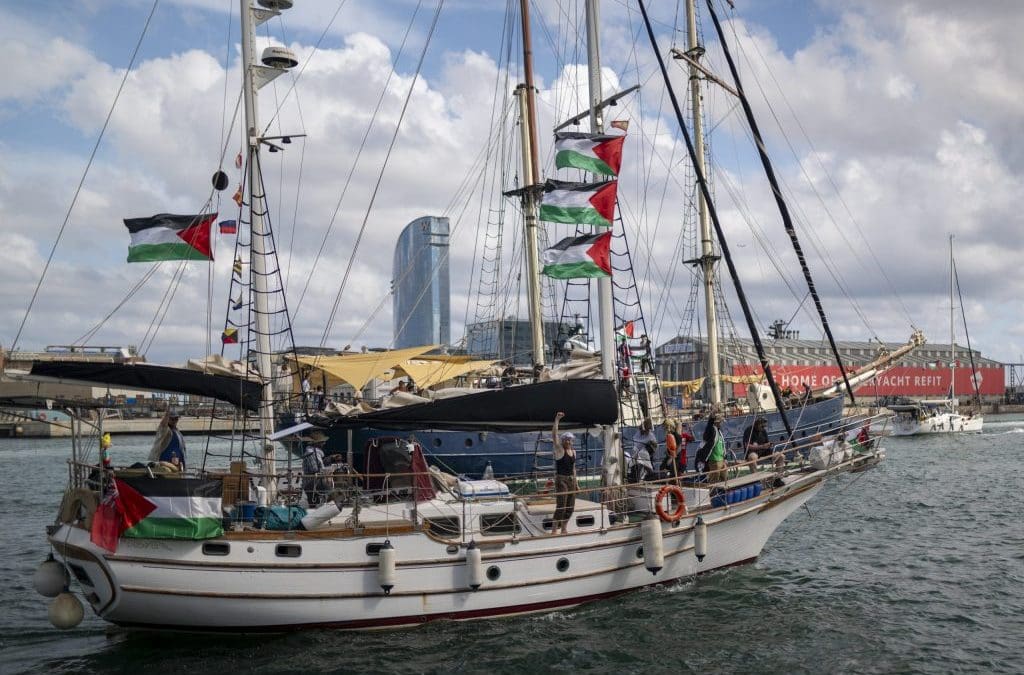
Original

‘Great day’ for Brazil as coup plotter Bolsonaro convicted, sentenced to 27 years

‘Great day’ for Brazil as coup plotter Bolsonaro convicted, sentenced to 27 years

Former Brazilian President Jair Bolsonaro speaks to members of the media in Belo Horizonte, Minas Gerais state, Brazil, on June 30, 2023. Photo by DOUGLAS MAGNO/AFP via Getty Images
Common Dreams Logo

This story originally appeared in Common Dreams on Sep. 11, 2025 . It is shared here under a  Creative Commons (CC BY-NC-ND 3.0) license.

Former Brazilian President Jair Bolsonaro  was sentenced to over 27 years behind bars Thursday after four of five Supreme Court justices on a panel voted to convict the far-right leader and seven associates of plotting a military coup and assassination of current President Luiz Inácio Lula da Silva and other officials.

“This criminal case is almost a meeting between Brazil and its past, its present, and its future,” said Justice Cármen Lúcia Antunes Rocha, on Thursday cast the third and decisive vote to convict the former president and seven co-plotters, referring in part to the two decades of US-backed  military dictatorship, during which Bolsonaro served as an army paratrooper.

Lúcia joined Justices Flávio Dino, Cristiano Zanin, and Alexandre de Moraes—who, along with Lula and Brazilian Vice President Geraldo Alckmin were targeted for assassination by the plotters—in voting to convict the defendants of attempting to subvert Lula’s victory  in the 2022 presidential election.

The defendants—who in addition to Bolsonaro include army generals and former Defense Ministers Walter Braga Netto and Paulo Sérgio Nogueira de Oliveira; former Institutional Security Minister Augusto Heleno Ribiero; admiral and former Navy Commander Almir Garnier Santos; former Justice Minister Anderson Torres; and former presidential adviser Márcio Mirando—were found guilty of crimes including attempting a coup, involvement in an armed criminal organization, attempting the violent abolition of democratic rule of law, and aggravated damage of the state’s assets.

Lt. Col. Mauro Cid, a former Bolsonaro aide who turned state’s witness, was sentenced  Thursday to two years of confinement under open conditions, the most lenient form of carceral punishment in the Brazilian justice system.

“The government wanted to remain in power by simply ignoring democracy—and that is what constitutes a coup d’état,” Moraes said ahead of his vote on Tuesday. “The leader of the criminal group made it clear—publicly and in his own words—that he would never accept defeat at the ballot, a democratic loss in the elections, and that he would never abide by the will of the people.”

Bolsonaro was sentenced to 27 years, 3 months in prison, with penalties for the other convicted defendants still uncertain as of Thursday evening. Bolsonaro, who is 70 years old, denies any wrongdoing. He is currently under house arrest and could remain there until after exhausting the appeals process. He is already banned  from running for any office until 2030 due to his abuse of power related to baseless claims of electoral fraud.

Justice Luiz Fux voted Thursday to absolve Bolsonaro, asserting that there was “absolutely no proof” that the former president took part in or was even aware of the coup and assassination plot.

However, Lúcia argued that there was copious evidence indicating that Bolsonaro and his accomplices acted “with the purpose of eroding democracy and institutions.”

“They acted to hijack the soul of the republic,” she said. “The case files show a coordinated criminal enterprise by the defendants, who adopted the methods of a digital militia to attack the judiciary, the electoral system, and the electronic voting machines.”

The landmark verdict came amid acute political polarization in Latin America’s biggest democracy and threats from the office of US President Donald Trump  to unleash American “military might” in defense of the “Trump of the Tropics,” as Bolsonaro is often called. The Trump administration has already slapped 50% tariffs  on Brazilian imports and has sanctioned  Moraes.

US Secretary of State Marco Rubio responded to Thursday’s developments by vowing on social media that “the United States will respond accordingly to this witch hunt.”

Like Trump in 2020, Bolsonaro made many baseless allegations that his loss in the 2022 election was due to fraud, fueling lies and conspiracy theories that led to the January 8, 2023 mob attacks  on government buildings. Around 1,500 Bolsonaro supporters were arrested  in the days following the storming of Congress and the presidential offices.

While many right-wing Brazilians were outraged by the convictions, leftist lawmakers and others applauded what Lula’s Workers’ Party (PT) called  “a historic moment for Brazil.”

Brazilian Secretary of Institutional Affairs Gleisi Hoffmann (PT) said  on social media, “The conviction of Jair Bolsonaro and his accomplices by the Federal Supreme Court expresses the vigor of democracy and national sovereignty.”

“They were convicted in due legal process, based on compelling evidence of the crimes they committed,” she continued. “It is a historic, unprecedented decision so that they may never again dare to attack the rule of law and the will of the people expressed at the ballot box.”

“It is also the proud response of Brazil’s judiciary to the economic sanctions and absurd coercion of the Donald Trump government, in conspiracy with the traitors to the homeland in the service of Bolsonaro,” Hoffmann added. “Today… Brazil told the world that crimes against democracy are intolerable. And they are unforgivable.”

Federal Deputy Talíria Petrone (Socialism and Liberty-Rio de Janeiro) called  Thursday “the greatest day ever,” while former colleague Jean Wyllys also hailed  this “great day.”

Erika Hilton, a Socialism and Liberty federal deputy representing São Paulo, taunted Bolsonaro with the prospect of a lengthy stay at a notorious maximum security penitentiary.

Federal Deputy Benedita da Silva (PT-Rio de Janeiro) said  on social media that “democratic Brazil is proud and celebrating the firm decision” of the high court, “whose members suffered countless threats, including death threats, from the conspirators against the democratic rule of law.”

Referring to the United States, da Silva praised the justices, who “did not bow to the threats to our sovereignty from the greatest external power.”“Now we have to defeat the amnesty coup of the convicted plotters that they are still trying to pass,” she added, a reference to efforts by the right-wing Congress to pass clemency legislation for Bolsonaro. “No amnesty!”

Original