by Julie O’Donoghue | May 3, 2026 | Donald Trump, elections, Gerrymandering, Louisiana, News, Redistricting, Voting
Early voting for the May 16 election began Saturday with confusion over whether all the races listed on the ballot are still taking place. Even motivated voters who showed up within the first few hours said they weren’t quite sure whether the U.S. House elections were still happening. “I went ahead and voted for who I wanted to vote for. If they don’t count it, that’s their problem,”…
Source
by Sasha Abramsky | May 3, 2026 | Alaska, California, elections, Eric Swalwell, Gubernatorial elections, Louisiana, Maine, Op-Ed, primaries, Ranked Choice Voting, Republicans, Runoff Election, Runoff Elections, Washington D.C., Washington State
With just weeks until California voters cast ballots for the next governor in the primary, five candidates are clustered atop the polling, each with at least 10 percent but less than 20 percent support among the electorate. A sixth candidate, San Jose Mayor Matt Mahan, is at 5 percent and has been gaining visibility in recent weeks. More than a quarter of the electorate has yet to make up its mind.
Source
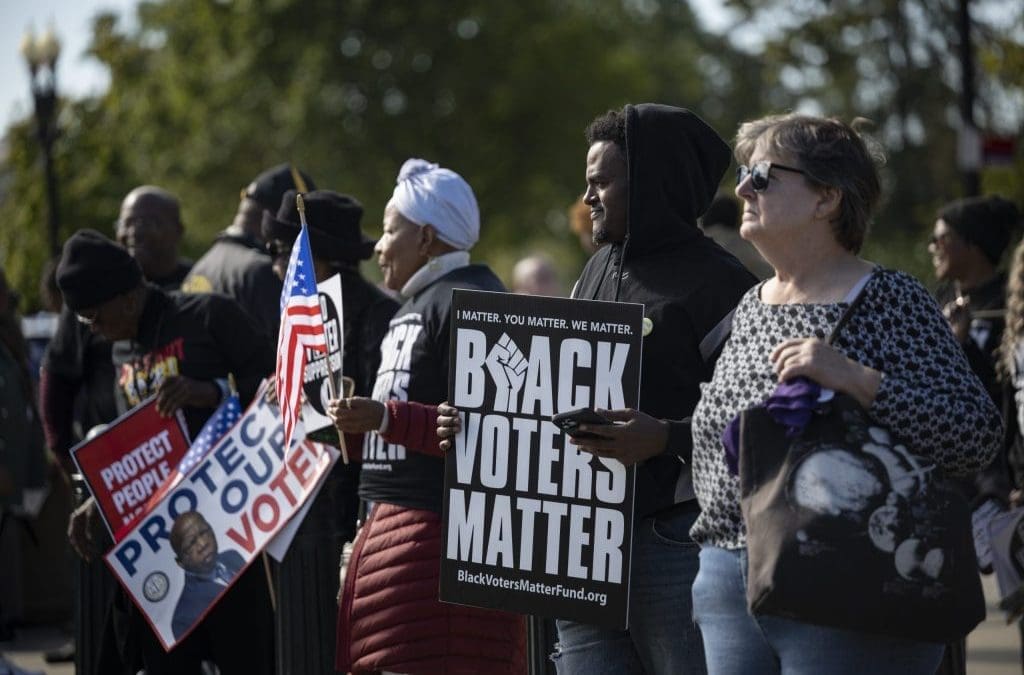
by Amy Goodman | May 1, 2026 | black voters, elections, Gerrymandering, Interview, Supreme Court, Voter Suppression, Voting Rights Act
The U.S. Supreme Court has effectively gutted Section 2 of the Voting Rights Act, the last remaining major provision of the landmark 1965 law that was a crowning achievement of the civil rights movement. In a 6-3 decision along partisan lines, a majority of justices ruled Wednesday that Louisiana must redraw a congressional map that was designed to create a second majority-Black district in…
Source

by Brett Wilkins | Apr 29, 2026 | Article, elections, midterms, Politics and Movements: US, Racial Justice, Reprint, Voting Rights
This story originally appeared in Common Dreams on April 29, 2026. It is shared here under a Creative Commons (CC BY-NC-ND 3.0) license.
The US Supreme Court ruled Wednesday that Louisiana must redraw its 2024 congressional map—which created a second majority-Black district to mitigate persistent barriers to equal representation—in a decision that further guts the already tattered Voting Rights Act.
The justices ruled 6-3 along ideological lines in Louisiana v. Callais that the state’s map is “an unconstitutional racial gerrymander,” effectively voiding the last remaining provision of Section 2 of the 1965 Voting Rights Act (VRA), which allows voters of color to challenge racially discriminatory electoral maps in court.
The case centers on the redrawing of Louisiana’s six congressional districts to better reflect the population of a state in which one-third of the people are Black, as Section 2 states that minority voters should have the same chance as others to elect candidates of their choice.
Civil and voting rights advocates challenged Louisiana’s Republican-drawn and racially rigged congressional map. In 2022, a federal judge agreed that the map likely violated Section 2, and the 5th US Circuit Court of Appeals upheld that ruling, ordering Louisiana to draw a new map by January 2024.
Louisiana complied. But a group of non-Black voters challenged the new map, claiming it was a racially rigged creation that violated the 14th Amendment. The Trump administration supported the challengers, arguing that Black voters had no right to a second majority-minority district.
The Supreme Court’s right-wing justices—three of whom were nominated by Trump—agreed in Wednesday’s decision.
“Allowing race to play any part in government decision-making represents a departure from the constitutional rule that applies in almost every other context,” Justice Samuel Alito wrote for the right-wing majority. “Compliance with Section 2 thus could not justify
by Eleanor Klibanoff | Apr 28, 2026 | Congressional Map, Donald Trump, elections, Gerrymandering, GOP, News, Supreme Court, Texas
Texas’ newly redrawn congressional map is officially cleared for use, after the U.S. Supreme Court formally overturned a lower court’s ruling Monday. In November, the high court allowed the map to be used temporarily. Monday’s ruling maintains that status quo permanently, ensuring the new lines will be used for the 2026 midterms and going forward. The ruling ends the lengthy legal battle over…
Source
by Taya Graham and Stephen Janis | Apr 24, 2026 | elections, ICE, Inequality, Inequality Watch, midterms, Politics and Movements: US, Prisons and Policing, video
Congress members of the Hispanic Caucus speak out on their concerns on ICE and Border Patrol, with their first question being: why is an additional $70 billion needed after the record breaking $140 billion allocated last year from the Big Beautiful Bill? The budget for ICE has already increased by 400% within the past year, so speculation as to how these new funds would be used now leans towards intimidation and interference at the upcoming midterm elections. Inequality Watch reporters Taya Graham and Stephen Janis break down their most recent interviews from these representatives at the nation’s Capitol in Washington, DC.
Credits:
Written by: Stephen Janis
Produced by: Taya Graham, Stephen Janis
Studio / Post-Production: Cameron Granadino
Trancript
The following is a rushed transcript and may contain errors. A proofread version will be made available as soon as possible.
Taya Graham:
Could new funding slated for ICE be used for a midterm election surprise? We’ll break down what might happen on this episode of our Capitol Hill Inequality Watch video React. Hello, my name is Taya Graham and welcome back to our Capitol Hill React show where we watch comment and analyze developments at the nation’s capital and beyond. It’s a show filtered through the prism of inequality and informed by the intellectual context of analyzing the imperative of raw power and exposing how it corrupts a political power that is supposed to serve we, the people. Now, to start the show, I want to introduce my reporting partner, Stephen Janis. Hello, Stephen. How are you?
Stephen Janis:
Hey, Taya, how are you doing? Good to be back here with you talking about power and politics.
Taya Graham:
Excellent. Well, we appreciate