by Lorah Steichen | Apr 24, 2026 | Article, Economy, Economy and Inequality, labor, Military Industrial Complex, Politics and Movements: US, Reprint, War
This story originally appeared in Jacobin on April 23, 2026. It is shared here with permission.
Amid the United States’ illegal, costly, and broadly unpopular war in Iran, the Trump administration recently asked Congress to approve a record-breaking $1.5 trillion military budget — the largest military spending proposal in US history. The administration claims that record war spending will pay for a “once-in-a-century revival of American industry,” while hawks in Congress argue that the spending spree will “revitalize” the military industrial base by investing in a “skilled, patriotic defense workforce.”
But new research from Transition Security Project suggests that military spending increases are unlikely to translate into broad gains for American workers.
While Pentagon budgets have steadily increased over recent decades, the arms industry has become more consolidated, more automated, and less labor-intensive — upending the idea that the warfare state is an effective economic development strategy for working people, and strengthening the case for a state-led shift toward a civilian industrial base focused on green manufacturing.
Half of the Pentagon budget is funneled to private weapons manufacturers, but higher spending has not produced more jobs. Employment in military industries has fallen significantly since Cold War peaks, from an estimated 3.2 million workers during the 1980s to about 1.1 million in 2020, despite Pentagon budgets growing by roughly 22 percent over the same period. Meanwhile, job quality in the sector has also deteriorated: wages have declined, pensions cut, and unionization collapsed to roughly 10 to 14 percent on average across major military contracting firms, while company revenues from military contracts have grown substantially.
Taken together, these trends challenge a persistent assumption in Washington policymaking that military spending is an effective jobs program for American
by Caitlyn Clark and Lisa Xu | Apr 23, 2026 | Article, Economy, Economy and Inequality, labor, Politics and Movements: US, Reprint, Unions
This story originally appeared in Labor Notes on April 23, 2026. It is shared here with permission.
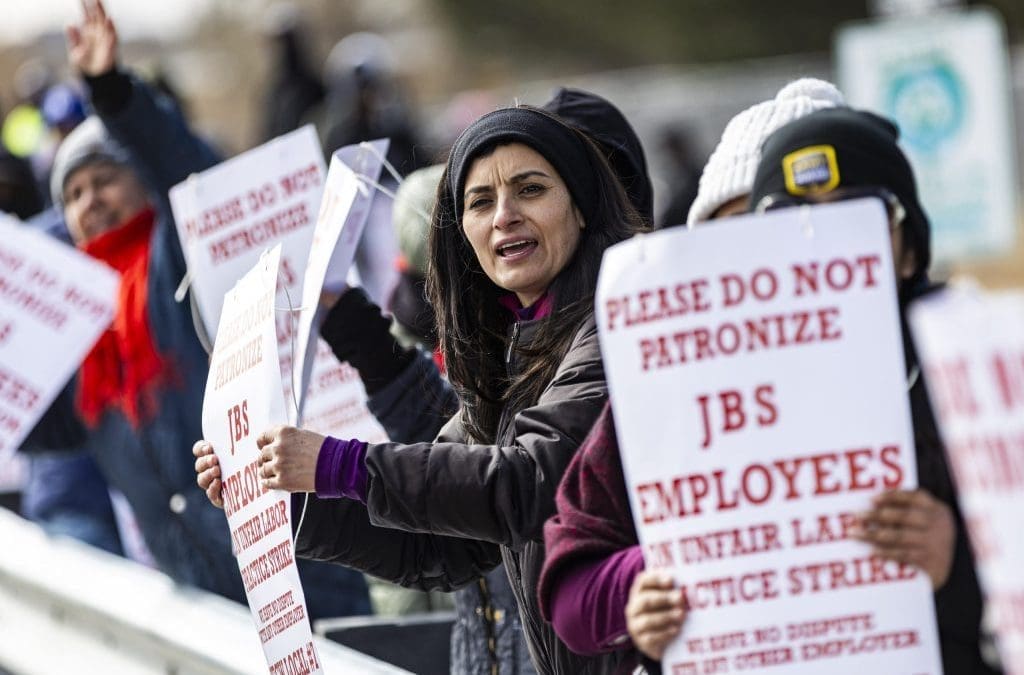
Last month, 3,800 meatpacking workers in UFCW Local 7 in Greeley, Colorado launched the industry’s first major strike in 40 years.
The three-week unfair labor practice strike was the first time workers had ever struck the JBS Greeley beef packing plant, one of the company’s largest. ULP charges against JBS included the illegal termination of a member of the bargaining committee and surveillance and intimidation of workers for participation in union activity.
With 57 languages spoken under one roof, the strike united the plant’s largely immigrant workforce to take on the biggest meatpacking company in the world.
The local had spent nearly a year in negotiations following the contract’s expiration last July. JBS returned to the bargaining table after the strike—and when the dust settled, the company had conceded to almost every demand.
WON PROTECTION
In addition to $1.50 an hour in wage increases over the short two-year agreement, workers won a groundbreaking policy on personal protective equipment, challenging JBS’s previous system of garnishing wages to replace necessary PPE when it was lost, damaged, or stolen. JBS was charging workers up to $1,100 to pay for mesh vests, gloves, arm guards, and knife sharpeners.
“My mesh apron had a hole in it. I had to go two months wearing the same apron,” said Chris Ready, who has worked in the slaughter department at the plant for one year.
“I’ve had my equipment stolen,” Ready said. “I borrowed knives until I had to buy my own… I’ve had to buy two mesh gloves so far, that’s $200. It was annoying, but it
by Nermeen Shaikh | Apr 23, 2026 | Economy, food systems, global economy, Interview, Iran, Strait of Hormuz, War, world hunger
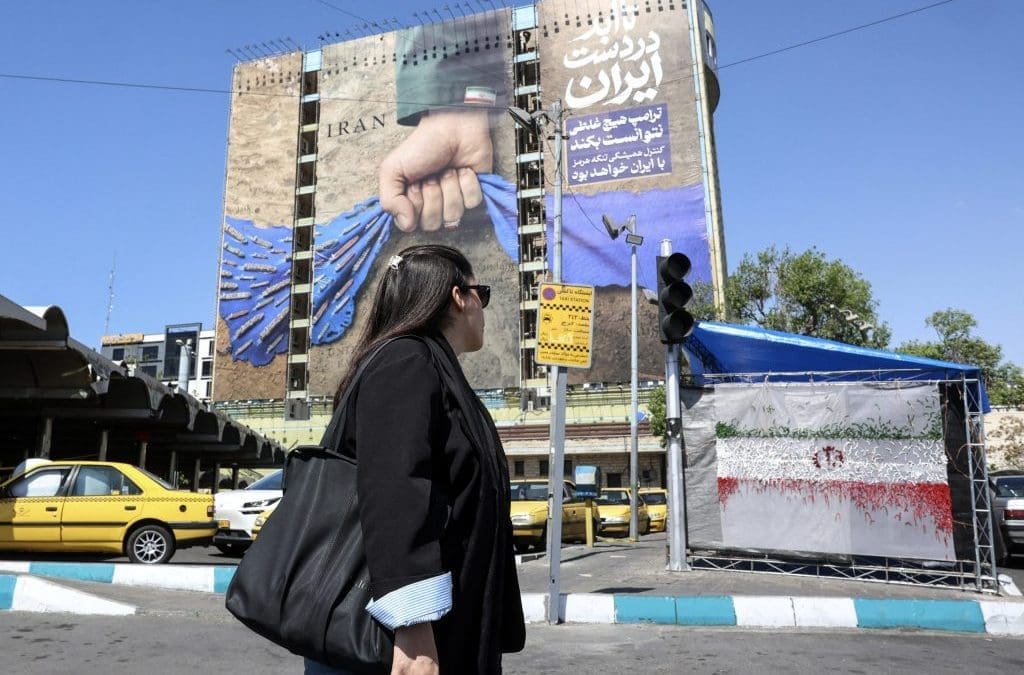
The U.S.-Israeli war on Iran and the closure of the Strait of Hormuz have raised fuel costs and caused shortages of key fertilizers around the world, wreaking havoc on the agricultural industry. Adam Hanieh, director of the SOAS Middle East Institute at the University of London, says the effects could be felt for a long time, particularly in the Global South. “About a third of the world’s…
Source
by Steve Benen | Apr 22, 2026 | Economy, Maddowblog, News, Politics
It’s hardly a secret that public concerns about inflation, affordability and the cost of living are a major concern for much of the country, so it’s important for Donald Trump to at least try to understand the issue at a basic level. So far, the president hasn’t even cleared a low bar.
KERNEN: By the time Biden left, inflation was down to about 3%–TRUMP: No it wasn’t. It was down to 5%. And the reason it was down was because I had won the election and it started falling after I won the election and I started getting prices down from right after November 5— Aaron Rupar (@atrupar.com) 2026-04-21T13:00:43.699Z
During his latest appearance on CNBC’s “Squawk Box,” host Joe Kernen, widely recognized as a conservative voice, noted that the inflation rate “was down to about where it is now, about 3%,” by the time Joe Biden’s term came to an end. Before the host could even get to his question, Trump interrupted.
“No, it wasn’t,” the president insisted. “It was down to 5%.”
Trump went on to argue, “And the reason it was down was because I had won the election, and it started falling after I won the election, and I started getting prices down from right after Nov. 5.”
Fortunately, none of this is subjective. We’re talking about knowable and specific details. It’s very easy to check and see whether the president was right or whether he was clueless.
Take a wild guess where I’m going with this.
As the global economy started recovering in earnest in the wake of the pandemic, inflation roared in every advanced economy on the planet. Unfortunately, the United States
by Derek Seidman | Apr 20, 2026 | AI, Article, Economy, Economy and Inequality, Politics and Movements: US, Reprint
This article was originally published by Truthout on April 19, 2026. It is shared here under a Creative Commons (CC BY-NC-ND 4.0) license.
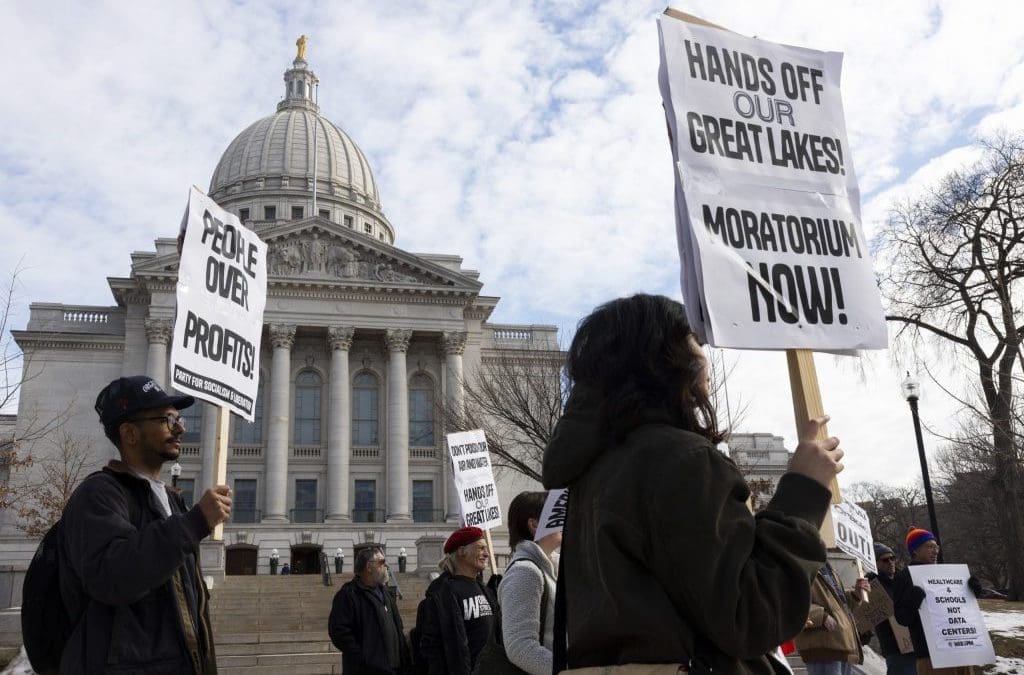
The prolific construction of massive data centers that house the physical computing power for artificial intelligence (AI) is galvanizing resistance in localities across the United States. Communities are fighting back against the billionaire tech and financial power behind these projects and their numerous harms, from their noise and pollution to their hyperconsumption of water and electricity.
Truthout has been covering the corporate interests behind the data center boom and local resistance to data centers. In this roundtable, we brought together representatives from three campaigns across the U.S. to share their experiences and lessons from taking on data centers and AI infrastructure in their areas.
KeShaun Pearson is the leader of Memphis Community Against Pollution (MCAP), based in Memphis, Tennessee, which is focused on fighting for environmental and climate justice in the predominantly Black community of southwest Memphis that’s most impacted by the concentrated pollution from nearby toxic release facilities. MCAP is currently campaigning against Elon Musk’s polluting xAI Colossus supercomputer. Tricia Boehlke is an organizer with No Data Center in DeForest, which recently succeeded in halting a proposed data center that was pushed by a private equity-owned company in a small town outside of Madison, Wisconsin. Lee Ziesche organizes with the Tucson Democratic Socialists of America and the No Desert Data Center Coalition, which has been taking on Project Blue, a huge data center proposed in the Tucson, Arizona, area. The campaign against Project Blue won a victory when Amazon recently pulled out of the project, but its developers are again trying to advance it.
This roundtable has been lightly edited for length and clarity.
Derek
by Brett Wilkins | Apr 17, 2026 | Article, Economy, Economy and Inequality, Iran, Oil, Politics and Movements: International, Politics and Movements: US, Reprint, Trump, War