by Alexis Goldstein | Dec 3, 2025 | Article, baltimore, Economy and Inequality, New York, Politics and Movements: US, Reprint
This story was originally published on Truthout on Dec. 01, 2025. It is shared here under a Creative Commons (CC BY-NC-ND 4.0) license.
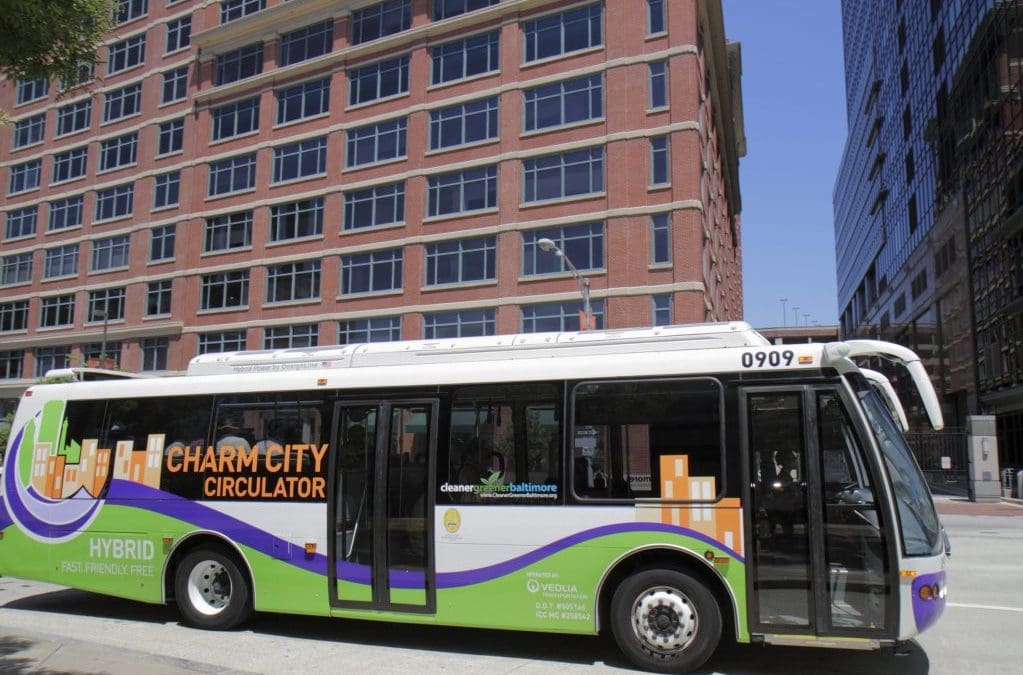
During the COVID-19 pandemic and its associated economic downturn, many people couldn’t pay their transportation costs, and often didn’t. In New York City in 2021, some 21 percent of bus riders did not pay the fare, a figure that grew to 48 percent in 2024. Some local governments, including New York City, responded with reduced or free fare programs. From 2023 to 2024, New York’s Metropolitan Transit Authority (MTA) ran a zero-fare bus pilot that served around 43,000 riders. The pilot, championed by then-assembly member Zohran Mamdani, offered free trips on one bus in each borough.
To expand this small pilot to universal zero-fare buses throughout New York City is a tall task, with a total 2024 bus ridership of 409 million and 6,300 buses. As mayor-elect Mamdani and his administration look to grow zero-fare buses in New York, they have a stellar example just a few hours south of New York, in Maryland.
The largest free bus program in Maryland by ridership is in Montgomery County, a suburb north of Washington, D.C.
Montgomery County first made its “Ride On” buses free to all riders under 18 in 2019. Then on June 29, 2025, it made all of its buses fare-free for all passengers. The system has a fleet of nearly 400 buses, 80 routes, and provided 19.2 million rides in the 2025 fiscal year. In the three months since free fares were instituted, ridership has increased by 5.4 percent. Phil McLaughlin, General Manager of Transit Services for Montgomery County Department of Transportation (MCDOT), said an estimated 1 percent to 2 percent of
by Julia Conley | Dec 2, 2025 | Article, immigration, Politics and Movements: US, Prisons and Policing, Racial Justice, Reprint
This story originally appeared in Common Dreams on Dec. 02, 2025. It is shared here under a Creative Commons (CC BY-NC-ND 3.0) license.
As the Trump administration intensifies a push to hire what officials call “deportation judges,” eight judges were fired Monday from the New York City immigration court that’s become the epicenter for anti-immigrant enforcement in the city.
The National Association of Immigration Judges, the union that represents judges who handle immigration cases, confirmed to the New York Times that the eight officials had been dismissed in what one recently fired judge described as a “Monday afternoon massacre.”
“The court has been basically eviscerated,” said former Judge Olivia Cassin, who presided over another immigration court in New York City until being fired in November, told the Times.
Trump, the arch enemy of due process and the rule of law, has gutted the immigration court by firing so many experienced and respected immigration judges like Olivia Cassin and Ameina Khan. Trump Administration Fires 8 Immigration Judges in New York https://t.co/o7l46Y19kg…— Cyrus Mehta (@cyrusmehta) December 2, 2025
The judges who were dismissed Monday had worked at the immigration court at 26 Federal Plaza, where the city’s US Immigration and Customs Enforcement (ICE) offices are also located.
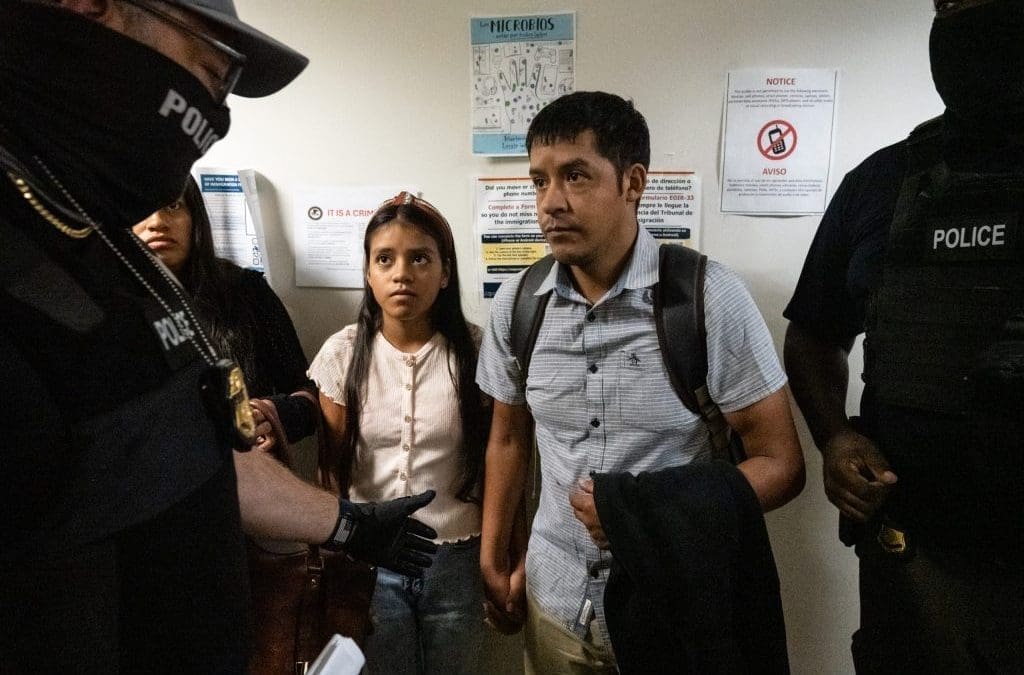
The building has been the scene of harrowing ICE arrests in recent months, with an agent throwing an asylum-seeker to the ground in September as she pleaded with him not to detain her husband, and masked officers arresting NYC Comptroller Brad Lander in June when he tried to offer assistance to an immigrant.
The immigration court at 26 Federal Plaza employs 34 judges. Nearly 100 immigration judges have now been fired across the US this year.
Among those dismissed on Monday was Judge Amiena A. Khan, who served as the assistant chief
by Brad Reed | Dec 1, 2025 | Article, Economy, Economy and Inequality, Inequality, Reprint
by Kori Skillman | Nov 24, 2025 | Article, baltimore, ICE, Politics and Movements: US, Prisons and Policing, Reprint
This story originally appeared in Baltimore Beat on Aug. 25, 2025. It is shared here with permission.
Immigration officials in Maryland are skirting scrutiny after a federal judge threw out a lawsuit challenging conditions inside Baltimore’s downtown ICE holding facility and lawmakers were initially denied entry to investigate reports of inhumane conditions.
Despite being allowed a one-hour visit into the holding facility in the George H. Fallon Federal Building weeks after they were first denied access, Maryland’s congressional members said they were left with more questions than answers about how detained people were being treated.
While lawmakers have focused the national spotlight on conditions in Baltimore’s downtown ICE holding facility, attorneys from the Amica Center for Immigration Rights — a nonprofit organization providing legal and social services to immigrants seeking status in the U.S. — filed a class-action suit in early May arguing that inhumane conditions were widespread among people detained there.
A late July hearing would have considered suspending use of the facility while the full case played out, but Maryland U.S. District Judge Julie Rubin denied the class certification and sent lawyers back to the drawing board.
“The hearing would have confirmed what we have known… which is that the conditions there are absolutely impermissible under the law and under the Constitution,” said Amelia Dagen, lead litigator in the class action suit. “There is a special weight to hearing it from people who have experienced those and endured those conditions.”
The lawsuit represents two immigrant women who were held in a freezing, windowless room without access to basic hygiene or medical care. The lawsuit had the support of Maryland Attorney General Anthony G. Brown, who wrote in a brief
by Lara Witt, Prism and Maya Schenwar, Truthout | Nov 20, 2025 | Article, Economy and Inequality, Politics and Movements: US, Reprint, The Cultural Front
This story was originally published on Truthout on Nov. 19, 2025. It is shared here under a Creative Commons (CC BY-NC-ND 4.0) license.
On Nov. 3, Condé Nast announced that it was folding Teen Vogue into Vogue, thus laying off most of Teen Vogue’s staff. Most devastatingly, the layoffs primarily affected their Black, brown, trans, and queer workers and the publication’s entire political desk, which had provided readers with rigorous and accurate reporting on systems of oppression, the policies they took shape as, and the progressive and left movements pushing back against them, thanks to a small team of dedicated editors and reporters. Teen Vogue was an outlier in the Vogue-sphere and a rarity in mainstream media. The racial and gender diversity of Teen Vogue’s workers reached beyond representational politics; it was also present in how they covered the news. It pushed as close as you could get to movement journalism within the mainstream sphere, right up to the boundary where advertisers might get nervous.
Teen Vogue is a major loss for many young (and adult!) readers. But this is just the latest in corporate and mainstream media consolidations and closures for the sake of maximizing profits. The 1996 Telecommunications Act ushered in an era of deregulation and paved the way for mergers and acquisitions. Because of those consolidations, the large majority of for-profit news media are now owned by just six conglomerates. What we are witnessing today, however, can and should more accurately be described as media capitulating to President Donald Trump’s racist and authoritarian agenda or at the very least, newsroom leaders finding an opportunity to stop pretending that they
by Jaclynn Ashly | Nov 19, 2025 | Article, Iraq, Politics and Movements: International
Content warning: The video included in this story contains graphic footage of victims of the Haditha massacre.
Khaled Salman Raseef remembers being jolted awake by a loud explosion near his home on the morning of November 19, 2005—exactly two decades ago today.
In Haditha, a once-peaceful Iraqi city along the Euphrates River, such sounds had become routine. The close-knit neighborhoods had been transformed into a war zone after the U.S. invasion and the fall of Saddam Hussein more than two years earlier. Insurgent groups, including Al Qaeda, had taken root here to fight American forces.
A view of Haditha, Iraq, situated along the banks of the Euphrates River. The city’s strategic position near the Haditha Dam made it a key site during the U.S. occupation and ensuing insurgency—conditions that set the stage for the 2005 massacre. Photo by Jaclynn Ashly.
The Euphrates River runs alongside Haditha, long considered the city’s lifeblood. Its proximity to the massive Haditha Dam has made the area strategically vital—drawing a heavy U.S. military presence after the U.S. invasion in 2003. Photo by Jaclynn Ashly.
By then, Raseef and his neighbors had a routine for when an improvised explosive device (IED) exploded and U.S. raids followed. They hid the elderly, women, and children in a back room, while the men opened the doors and tried to speak calmly. Whatever happened—whether troops burst in with assault rifles raised or smashed furniture—the rule was always the same: stay polite, Raseef says, speaking in his home in Haditha.
“Usually, about an hour after an explosion, everything goes back to normal,” the 51-year-old lawyer explains. “But that day was unlike any other.”
Khaled Salman Raseef at his