by Fallon Gallagher | Sep 15, 2026 | News
The Department of Justice is asking a federal appeals court to overturn a consequential ruling that resulted in the dismissal of criminal cases against former FBI Director James Comey and New York Attorney General Letitia James.
The Fourth Circuit Court of Appeals will hear arguments Tuesday in the government’s bid to reverse a federal judge’s ruling that found the prosecutor who secured the indictments — former Interim U.S. Attorney Lindsey Halligan — had been unlawfully appointed. That finding prompted U.S. District Judge Cameron Currie to toss out both criminal cases last November. The cases were dismissed without prejudice, though, meaning the DOJ could potentially revive them in the future.
Currie ruled that Halligan, a former Trump aide with no prosecutorial experience, had been unlawfully appointed to her position as Interim U.S. Attorney for the Eastern District of Virginia. That ruling invalidated the two indictments, both of which she sought and signed by herself.
Halligan was appointed by then-Attorney General Pam Bondi after Erik Siebert, the prosecutor who had been leading the office, resigned amid pressure to secure an indictment against Comey and James.
Siebert had also been appointed and was serving in the role without Senate confirmation. Federal law allows U.S. Attorneys to serve for a period of 120 days without Senate confirmation. Currie, however, found that law does not allow successive interim appointments.
The government argues Halligan was appointed lawfully and that she should be reinstated and the indictments should be restored.
Lawyers for Comey and James have both urged the appellate court to uphold Currie’s ruling, concurring that Halligan was unlawfully appointed and dismissal of their cases was the proper solution.
“The Supreme Court has

by Jessica Corbett | Sep 15, 2026 | Article, midterms, Politics and Movements: US, Reprint, Voting Rights
This story originally appeared in Common Dreams on Aug. 25, 2026. It is shared here under a Creative Commons (CC BY-NC-ND 3.0) license.
Democratic leaders and a “pro-voter” coalition on Tuesday announced separate actions to combat President Donald Trump’s attack on voting by mail after the US Supreme Court’s right-wing majority delivered a “painful setback” for critics who argue the Republican’s executive order is unconstitutional.
The president’s March order directed the US Department of Homeland Security to compile lists of citizens eligible to vote, states to provide voter information to the federal government, and the United States Postal Service to craft new regulations for absentee ballots—for which the USPS published a final rule last Friday, less than three months away from the midterm elections.
The nation’s top court said in a 6-3 decision on Monday that Democrat-led states had not demonstrated sufficient standing to challenge the president’s order and paused a lower court injunction blocking its implementation. The attorneys general in that case, Trump v. California, vowed to keep fighting back, and as of Tuesday evening, others already are.
The chairs of the Democratic National Committee (DNC) and Democratic Governors Association, US Senate and House minority leaders, and heads of the party’s campaign committee for each chamber of Congress on Tuesday announced the filing of a new motion for a preliminary injunction.
“Today, we are taking strong, joint legal action to stop Trump’s unlawful attempt to restrict mail-in voting through the Postal Service,” said DNC Chair Ken Martin, Kentucky Gov. Andy Beshear, Sen. Chuck Schumer (NY), Rep. Hakeem Jeffries (NY), Sen. Kirsten Gillibrand (NY), and Rep. Suzan DelBene (Wash.) in a joint statement.
“Yesterday’s Supreme Court ruling did not say that Trump’s executive order attacking voting rights is constitutional,” they stressed. Rather than ruling on the merits of the challenge, the majority of justices simply said
by Chris Walker | Sep 15, 2026 | 2026 Elections, 2026 Republican Convention, Donald Trump, J.D. Vance, midterms, News, Polls, Ted Cruz
The second night of the Republican midterm convention in Dallas, Texas, this week featured racist remarks from speakers and a call for violence against Democrats from an audience member — before concluding with President Donald Trump demanding a loyalty oath from viewers. At one point, while arguing why voters should back Republicans in the midterms, Vice President JD Vance objected to the…
Source
by Akayla Gardner | Sep 15, 2026 | News
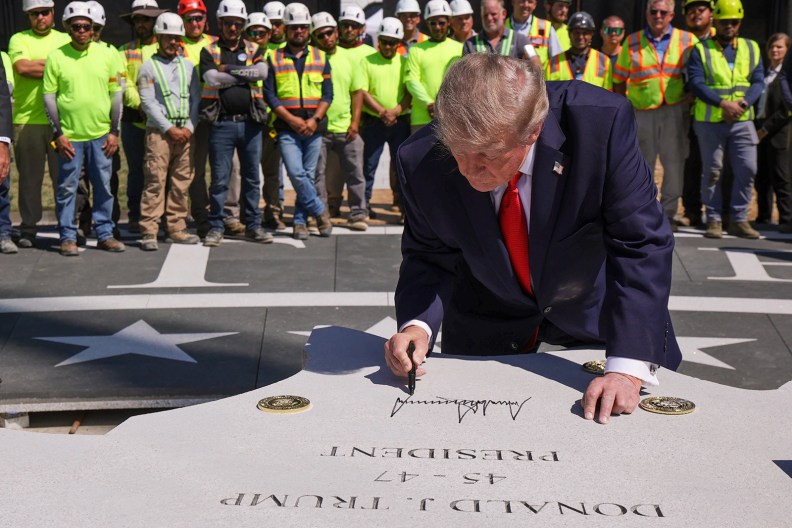
The Kennedy Center’s presidential-appointed leadership says the institution is nearly out of money. President Donald Trump has offered to raise what it needs. On Tuesday, his appointees to the board will be asked to approve what a draft resolution says he requires in return: “appropriate recognition” of his role — which is to say, his name on the front of the building. Trustees have 10 inscriptions to choose from.
He has spent a year and a half remaking the nation’s capital in his image.
The columns have been refinished. Gold cherubs from the Mar-a-Lago ballroom sit above the Oval Office doors. The West Wing has been redesigned with an 18th-century-flare for European aesthetics and gold accents. Lafayette Square is being replanted with 47 maple trees, a nod to his ordinal spot among presidents. The Rose Garden lawn has been paved over. The community golf course is being rebuilt to championship standard. The East Wing has been torn down for a ballroom. On the South Lawn, a granite helipad was poured, judged unsatisfactory, torn out and poured again.
His name went up outside the Institute of Peace, which his administration had gutted a year earlier. House Republicans have introduced a bill to put his name on Dulles International Airport. And, Trump has reportedly pressed privately to put it on the Washington Commanders’ new stadium.
Last month, the president gave reporters a tour of the new granite helipad on the South Lawn, which was redone after complaints about how it was leveled on the ground. “I’m a real good developer, and, frankly, it used to make me sick to look at how horrible the condition [of
by Taya Graham and Stephen Janis | Sep 15, 2026 | Democratic Party, Democrats, Inequality, Inequality Watch, midterms, Politics and Movements: US, video
David Sirota explains how consultants profit from massive television-ad purchases, how billionaire-funded super PACs influence the candidates and policies voters are offered, and how the language of “moderation” and “electability” is used to undermine progressive and populist challengers.We examine the consequences of legalized political corruption: Washington’s silence on America’s healthcare crisis, the widening gulf between voters and their representatives, and the 50-year campaign to transform elections into auctions while concentrating power in the presidency.David Sirota is the founder of the investigative news organization The Lever, a former speechwriter for Bernie Sanders, an Oscar-nominated co-creator of the story for the movie Don’t Look Up, and the producer of the podcast series Master Plan.
Additional links/info:
David Sirota and Jared Jacang Maher’s co-authored book, Master Plan: The Hidden Plot to Legalize Corruption in America
The Lever’s website, Instagram, and podcast series, Master plan
Credits:
Production: Stephen Janis, Taya Graham
Written by: Stephen Janis
Studio Production: Cameron Granadino
Post-Production: Stephen Janis, David Hebden
Transcript
The following is a rushed transcript and may contain errors. It will be updated as soon as possible.
Taya Graham:
Hello, my name is Taya Graham and welcome to the Inequality Watch Report, a show that examines government policy and action through the lens of extreme economic inequality, the existential issue of our time. Today, we’re going to discuss a topic that defines who holds power in America and how they keep it despite growing voter dissatisfaction amid a historic wealth imbalance. It’s a story of money, access, and self-enrichment that is at the root of the bad policies and broken institutions we all struggle with daily. And it’s an issue that transcends the nominal state of play in this country