How Democrats set the stage for Trump’s assault on free speech

How Democrats set the stage for Trump’s assault on free speech

LOS ANGELES, CALIFORNIA - FEBRUARY 01: Jimmy Kimmel speaks onstage during the 67th GRAMMY Awards Pre-GRAMMY Gala & GRAMMY Salute to Industry Icons Honoring Jody Gerson on February 01, 2025 in Los Angeles, California. Photo by Johnny Nunez/Getty Images for The Recording Academy

By pressuring broadcast giant ABC to suspend Jimmy Kimmel’s late-night show—a decision that ABC reversed this week—the Trump administration has taken its assault on the First Amendment to new heights over the past week. Kimmel’s show is back on the air for now, but the whole debacle has revealed just how vulnerable free speech in America is to political and corporate authoritarianism. This is a crisis, and both Democrats and Republicans have set the stage for it. “As corporate media accelerate their censorship of comedians and journalists,” renowned media analyst Jeff Cohen writes, “we must realize that we got to this dire situation because of old-fashioned, bipartisan corruption in Washington, DC.” In this episode of The Marc Steiner Show, Marc speaks with Cohen about how the consolidation of corporate control over the media, mixed with a ravenously censorious Trump administration, has left free speech in America hanging by a thread.

Guest:

Additional resources:

Credits:

  • Producer: Rosette Sewali
  • Studio Production: David Hebden
  • Audio Post-Production: Stephen Frank
Transcript

The following is a rushed transcript and may contain errors. A proofread version will be made available as soon as possible.

Marc Steiner:

Welcome to the Marc Steiner Show here in The Real News. I’m Marc Steiner. It’s great to have you all with us. Our democracy is under attack and one of the underpinnings of a free society is a free and independent press. Right now, 90% of our media is controlled by just six corporations, and when those in media do their job and confront power, they’re attacked by their corporate owners and by the right wing. We’re in control of the White House. Trump said in response to the firing of Jimmy Kimmel, congratulations to a, b, C for finally having the courage to do what had to be done.

And while Jimmy Kimmel may be back on many stations controlled by right-wing conglomerates like Nexstar, which controls over 200 stations, reaching 220 million people will not carry Kimmel. This monopolistic control of our media is a canary in the coal mine. And to unravel we face, we’re joined today by Jeff Cohen, founder of the Media Watchdog Group, Fairness and Accuracy in Reporting, and co-founder of RootsAction.org. He’s a retired journalism professor at the college and author of Cable News Confidential: My Misadventures in Corporate Media. Jeff, it’s good to have you with us. I really appreciate you taking the time here.

Jeff Cohen:

Great to be with you

Marc Steiner:

And a propitious moment as well. I mean, we could talk about, as we will, the state of media in America today and where we are, but the Kimmel episode was really a frightening in the beginning, but enlightening and how this is unfolding talk. I really want to hear, start off with your kind of analysis of where that is, why this bloody thing happened in the first place and why it’s turned around the way it turned around.

Jeff Cohen:

Yeah, it’s been a long time coming. We’d almost have to talk about the decades of the federal government, both parties, Congress and the White House, allowing the media, placing the media in the hands of fewer and fewer ever larger conglomerates. That’s the beginning. And then these conglomerates, when they want to merge even bigger, they need to get federal approval. So if there’s too many employees that are interfering or making things difficult with them, for them, with whoever the government is, I experienced this as you know, Marc, I was at MSNBC in the run up to the Invasion of Iraq in 2003.

Marc Steiner:

I remember.

Jeff Cohen:

And we were muzzled by management and then terminated three weeks before the invasion and all the internal memos leaked out. Why? Because of what we were trying to question, ask journalistic questions about the invasion. So it’s been happening decade after decade, but it’s never been worse than now because the conglomerates are bigger than they ever were. And we have the Trump team. So you have all of these companies doing somersaults to please Trump, especially if they have merger business before the Federal Communications Commission. The reason that Colbert was terminated, many of us believe is because Paramount needed to merge with Skydance. When that happened, the boss of Paramount, Sherry Redstone became $2 billion richer than the day before the merger, and the merger could not go through until 60 Minutes had been squeezed. The executive producer 60 minutes left in protest, as did his boss, and they were still holding out.

That’s when I suspected they’re waiting for something to be done to either Colbert on CBS, which Paramount owns or comedy the Daily Show on Comedy Central. So now we come to Kimmel, and it’s the same thing. Disney had merger business before the Federal Communications Commission. Disney already owns Hulu, the streaming service, and they wanted to get fubu, and that needs federal approval. It’s currently at the Justice Department, Trump’s Justice Department. And then perhaps even more important than Disney’s collaboration with Trump in suspending, Kimmel was two big television groups. One is the right wing Sinclair Broadcast Group, which is as Trumpian as any media company in our country and the other, and they own or operate nearly 200 television stations. And nexstar owns even more TV stations. And both of them after the FCC threatened to go after a B, C affiliates carrying Kimmel. That’s also unprecedented. Those two companies said were preempting Kimmel and that put pressure on Disney and then Disney folded. But what it has to be understood about both Nexstar and Sinclair Broadcast Group, their government created conglomerates prior to the 1996 Telecommunications Act that was pushed through by Democratic President Bill Clinton, hand in hand with Republican Speaker of the House, Newt Gingrich.

You could only own 12 TV stations in the whole country. You couldn’t own 200 like Nexar and Sinclair owned. So that brings us up today. They’re going to bring Kimmel back this week according to Disney, but Nexstar and have said, no, he’s not coming back on our stations. I heard from someone in Washington DC they won’t be able to watch Kimmel’s return because of who owns the Washington DC ABC affiliates and nearly somewhere between 25 and 30% of ABC affiliates will not be carrying Kimmel on his return.

Marc Steiner:

It’s so convoluted, but also very dangerous. I’m going to take a step back for just a minute. People may not, who are watching and listening to us now may not be aware of what happened in 1996 and how that allowed all this to unfold and why the Democrats team built Republicans to allow it to happen, why Clinton allowed it to happen to kind of take this massive media world we have in our country owned by many different people across the country, local stations, doing it in local ways. Why that changed? Well, what was the dynamic in 1996 that allowed that to happen and exactly what did happen so people understand really what we’re facing?

Jeff Cohen:

Yeah, it’s really important. When we, for decades, one individual or company could only own in the whole country, seven television and 7:00 AM radio and seven FM radio, and you couldn’t own two in one market. When Reagan took over Fowler, his FCC chair got it changed. So it was 12, 12, 12. That’s how it stood until the point you want me to talk about, which is 1996 when there was this corrupt law written by the telecommunications and media company lobbyists that sort of divided up the media pie among fewer companies that were allowed to get bigger because the caps were relaxed. So instead of being able to own 12 TV stations, now you could own hundreds. And so Sinclair Broadcast Group only owned 12 in 1996, and they’re completely Trumpian, totally right wing. They’ve been right wing since they intervened. I remember in the 2004 presidential election

Marc Steiner:

Running

Jeff Cohen:

A smear documentary attacking Kerry two weeks before the election of Kerry and George W. Bush in 2004. So those companies, thanks to the Telecommunications Act of 1996, they now own or operate around 200 stations. That was illegal in 1995. You could only own 12 nationwide. So other things that happened, Murdoch, because of the 1996 bill, he was able to build his Fox Empire Clear Channel, a right wing radio company out of Texas, closely allied with George W. Bush. Prior to the Telecommunications Act, they owned 50 radio stations. Within two years, they owned about 1200 radio stations. Again, this was written by lobbyists Fair, the media watch group that I founded, we were protesting, we were trying to get journalists to even cover this 1996 telecommunications act, which was the biggest change in media since the 1930s, and you couldn’t get coverage. I remember the Consumer Federation of America was so concerned about how little attention this very dangerous corporate media bill was getting. They went to CNN and said, Hey, we’ve raised the money for a 32nd ad to warn the public, and CNN wouldn’t sell them the 32nd ad time

Marc Steiner:

Would not sell them the ad,

Jeff Cohen:

Right? So it was horrific at the time. I was able back then to write stuff in the Baltimore Sun actually

Marc Steiner:

About

Jeff Cohen:

How dangerous this bill was. And we’ve now seen the implications both parties back then. This is before Citizens United Corporations couldn’t give to politicians, but they could give to party organizations. That was what was called soft money. And the big media companies were giving big dollars to the Democratic party organizations and the Republican party organizations. And it passed the Senate, the Telecommunications Act of 1996, 81 to 18. And I remember talking shortly after it passed with Senator Paul Simon, not the singer, the senator from Illinois,

And Paul Simon was the only journalist in the Senate. He had been a newspaper publisher in Illinois, and he said, it’s one of the proudest votes I’ve ever cast was to vote no on this horrible bill giving all of our media information power to fewer and fewer big companies. So the 1996 Act, when I say to people, don’t just blame Trump. If you’re blaming presidents for the censorship that’s going on, whether it’s journalists, whether it’s Colbert, whether it’s Kimmel, also you have to blame President Bill Clinton, a Democrat because of the role he played in pushing this corrupt legislation. And again, Democrats were getting big money from the media companies as well as Republicans.

Marc Steiner:

That period I remember, well, I was on public radio with my show and we covered this. It was almost like was deafening the silence of the opposition to what we saw unfold. And I think so especially what you’ve been writing lately is we are reaping what was sowed then. And I think that this is, as I said earlier, we’re on a very dangerous precipice with corporate control of everything we see, read and hear, and a very right, right-wing government in power in our country. And I don’t think people really understand the clear danger

Jeff Cohen:

That

Marc Steiner:

This poses for us.

Jeff Cohen:

And remember, when these companies want to get even bigger, they need federal approval. And that means Trump and Trump’s basically told every federal agency, you work for me. So the Federal Communications Commission used to be somewhat independent. Now it’s headed by a Trump bite. He wrote part of Project 2025,

He wrote the part of it on the media, and that’s Brendan Carr. He’s maybe even more ferociously right wing than Trump. And so these companies, Nexar, which already owns or operates 200 television stations, and they won’t be running Kimmel, when Kimmel comes back, they want to merge with a company called TEGNA Media. And instead of just reaching 39% of US households, which is what the cap is now, they want it changed to 80%. And Brendan Carr at the FCC has basically said he would do that. So the FCC has to approve the Nexar merger. They need to approve that. The Justice Department will have to, is now investigating the merger Disney wants, where they will take over FUBU to go along with their Hulu. And it’s also the internet tycoons. I mean the billionaires control the media, and you had all of them sitting in the front row of the Trump inauguration. That was unprecedented. Marc, you and I go back a few decades, but for young viewers,

We have to let them know how abnormal all of this is. That instead of in the front row being US Senators who’ve been in office for 20, 30 years, it was the tech moguls. It was Zuckerberg, it was Bezos, it was Elon Musk. Bezos owns the Washington Post. He’s demanded that the opinion page only have free market propaganda. You can’t be critical of corporate capitalism on the Washington Post. People have had to resign their political cartoonists, their award winner. Ann, tell Nate, she had to resign recently over comments about Charlie Kirk that were accurate just quoting what Kirk stands for

Marc Steiner:

Said what actually said. Right?

Jeff Cohen:

Yes. She got fired. The Global Opinions editor and African-American woman, Karen Atia. So the censorship is worse than ever. It’s happening because the media are concentrating in the hands of a few. People always say, well, at least Colbert can go until May. I’ll be shocked if he survives till May Kimmel’s contract. He’s coming back, but he’s coming back limping because those huge station groups aren’t carrying it. At least not now. And I saw a great quote from the head of Nexstar or from their pr, they’re not going to bring Kimmel back to their, I think they have more than 30 ABC affiliates because approval is pending. They want to see if Kimmel will be fostering an environment of respectful dialogue. Now, I guess that means they can’t cover anything that comes out of the mouth of Trump. He’s usually so abusive and name calling, but Kimmel, they want to be more obedient.

So yeah, it’s utterly dangerous that the billionaires and these conglomerates have been having so much handed, so much media power. All they care about is profit maximization. They don’t care about journalism. They don’t care about the right to dissent. A, B, C News is a shrinking part of the Disney conglomerate. They don’t care about news or journalism. Paramount Skydance because they got rid of, or they’ve terminated Colbert as of May. That merger went through with Paramount that owns Comedy Central and CBS merging with Skydance, which is Larry Ellison’s money. He’s the 81-year-old billionaire who founded Oracle. His son David is the CEO of Skydance. They’ve already announced they’re going to move CBS news to the right. They’re going to make sure there’s no bias, nothing that will offend Trump. People have already left CBS news because of this. It’s going to get worse. And there was an amazing column by a former Wall Street banker who’s now a publisher in the New York Times a couple days ago.

And he said, Larry Ellison, the 81-year-old billionaire who’s now perhaps the billionaire most closely allied with Trump since Trump had his falling out with Musk, this guy is now the behind Paramount Skydance, which owns CBS Comedy Central and so much more. He’s going to get a majority stake. He’s part of this consortium taking over TikTok, and there’s evidence that Larry Ellison wants to take over Warner Brothers discovery, which owns HBO CNN. So we’re in, and again, if Trump gets what he wants out of these conglomerates, he’s going to approve these mergers that would not have been able to be approved years or decades ago.

Marc Steiner:

So one of the things I was thinking about reading all this and leading up to this conversation, but also just covering this because of the years I’ve been doing this work in media, is that this reminds me of the period of the trusts that ran America in the late 1890s, early 19 hundreds before Teddy Roosevelt broke them up. All you can say about Teddy Roosevelt, you can say about him, but he broke up the trusts, he went after

Jeff Cohen:

Them,

Marc Steiner:

He didn’t back down. So where do you think that political force today to take this on?

Jeff Cohen:

Well, what’s fascinating is when you do polls of the public, whether it’s right wing people, left wing people, everyone thinks there’s too much corporate power and too much corporate. It’s just not debatable that the masses want these things broken up. You can do polls on this. Are the insurance companies too big? Is big pharma too big? So you bring up the key point that the reason the media have been able to be put in the hands of such a few companies is antitrust law quit being enforced.

The Federal Communications Commission kept changing its rules to loosen ownership caps. And I mean, think about antitrust, one of the most important cases in the area of media and information when governments still enforced antitrust law that as you say, came about at the turn of the 20th century with a Republican president, Teddy Roosevelt in 1948, the Justice Department in a suit initiated under Franklin Roosevelt’s government that was continued under Harry Truman’s government. They said to the big movie studios, the case is called United States versus Paramount, the movie studios, you want to own movie studios. You shouldn’t be able to own the where you produce the content. You shouldn’t be able to own the movie theaters that are at the end delivery point of the product or the content. Classic vertical monopoly

Marc Steiner:

Was

Jeff Cohen:

Not allowed. And they had to sell off their theaters. And it allowed independent movies to sometimes be shown in theaters because there was no longer this vertical monopoly. That was 1948, beginning in the eighties with Reagan continuing with Clinton in the nineties. And Bush and Obama. They don’t enforce antitrust law. And what was interesting is one of Biden’s best appointments of all was the head of the Federal Trade Commission, Lena Kahn. And she was really a break on some of these mergers. And you had big democratic donors like Kamala Harris’s big donor, Reed Hoffman was demanding month after month. They’ve got to get rid of Lena Khan at the Federal Trade Commission

Because she was obstructing these ridiculous mergers that all would’ve been illegal 10, 20, 50 years ago. And if Kamala Harris had been elected and Kahn was probably going to go. So that’s the problem you bring up antitrust. We used to have rules that made the economy more competitive and allowed smaller outlets, smaller companies, including smaller media companies to compete. That’s a bygone era, and it’s not a natural process that the media were handed over to a few companies. It’s utterly corrupt. These companies were funding both parties, usually done behind closed doors. As you know, the 1996 Telecommunications Act, the biggest change in media law for 60 years was hardly discussed in mainstream media.

Marc Steiner:

Nobody covered it. I mean, in that period, I forced a conversation on Capitol Hill with our Maryland Congressman about that bill, because you saw the handwriting on the wall. You knew what it was going to mean. So I just wonder, in all the ways of looking where our media is at this moment, how do you see the political opposition organizing to stop it? Or does it exist?

Jeff Cohen:

Well, the fascinating thing is most of the people getting censored are not as famous or big as Jimmy Kimmel, but when he got suspended, it was an uprising. There were demonstrations in the streets. There were all these online petitions. There was let’s boycott Disney, boycott Hulu, 400 of the biggest names in Hollywood all signed an ACLU petition protesting the FCC, putting pressure to get Kimmel suspended. So that’s the good news is people know how to organize on behalf of freedom of speech, the right to dissent. But a broader answer to your question is independent media. That’s the key. I’ve supported The Real News Network since day one. If you know about The Real News Network, and most Americans do not.

Marc Steiner:

Right

Jeff Cohen:

Fund it, tell your neighbors and friends and relatives about it, independent news outlets are doing the serious journalistic work and having the serious debates that are not happening in mainstream media. And so if you’re an activist who cares about these big issues, whether it’s labor rights, environmental rights, environmental justice, anti-racism, you’ve got to also be, if you’re an activist on any of those issues, your second issue should be media activism. And if you’re a media activist, that means you resist censorship wherever you see it, and you use your own email, your own social media, your own word of mouth to promote The Real News Network, to support these places that are doing the real digging and having the voices. I can’t get on mainstream media anymore. I was banned in 2003. They

Marc Steiner:

Won’t have you.

Jeff Cohen:

I mean, with Phil Donahue, I saw what media censorship was up close. And so I’m a big believer in independent media. The independent media is strong, but it needs activist to promote it because The Real News Network doesn’t exactly have a big ad budget.

Marc Steiner:

It does not. I think one of the things in terms of what you’re laying out for people to hear is that most Americans, I think at this point don’t understand the danger we’re in with this kind of right wing authoritarian power in Washington dc. The destruction of our independent media, the monopolies taking place over our media and what we hear and learn. I mean, this is a moment where I think that people have to, the most we can do is to make people understand what we face. Our democracy is under threat. Our media independence is under threat. One of the things about America that made it blossom was freedom of the press. People speaking their minds and presses in the newspapers being owned locally by people in the community.

Jeff Cohen:

You’ve said it. I mean, we were the original democracy. It was always imperfect, always was racist.

Marc Steiner:

But

Jeff Cohen:

We went to Tocqueville, a French nobleman, traveling all around the us. He’s just amazed. Everyone’s reading newspapers. He came from Europe where it was all monarchs. And I’ve marveled as recently as a few weeks ago, that we’re a country where you can have Jimmy Kimmel and Colbert criticizing, ridiculing the president night after night with millions of people watching. But again, that seems to be a thing of the past. Even the comedians are going to have to go independent. Colbert. If he wants to do something, he’ll be doing it online. Probably Kim will, John Stewart, they’re all making plans for a post conglomerate. I mean, we have these great comics that have kept many of us sane through the Trump era, but they’re all employed by conglomerates. Paramount employs Colbert and John Stewart and the team at Comedy Central at the Daily Show, Warner Brothers Discovery, which may have a new right wing owner.

Soon they employ one of the great investigative journalists of our day, the comedian John Oliver Comcast. And Trump’s been threatening Comcast. Comcast is the employer of Seth Meyers and Jimmy Fallon on NBC. Now, most people, if we had media literacy in the schools, kids would be taught, oh, okay, here are the companies that own the media and information system, but we don’t have media literacy in our schools. So yeah, it’s very dangerous. The comedians have been a breath of fresh air. I’ve always said that you can learn more from a 10 minute monologue from Kimmel or John Oliver or Colbert than from watching like a month of news on those very same channels. The journalists have always been, this is why fair.org exists. And by the way, a good way to fight for media against censorship is with fair.org. But the reason we exist is because of this censorship that has gone on, and you can resist it together as a group, and it’s more effective. I am telling people the worst thing you can do in a period like this where Trump is collaborating with conglomerates to squeeze dissenting voices, the worst thing you can do is sit at home alone. You’ve got to join organizations. You need to become a sustainer of the Real News Network. You have to join fair fair.org. I’m also with Roots Action and Activism Group that fights this censorship roots action.org. When you’d start joining with other people.

That personal despair I think can be eroded because we’re taking action and we’re doing it with other like-minded people.

Marc Steiner:

What you’re saying is really critical. Everything you’ve been writing about it, I think is very critical. But what you’re saying at this moment in our conversation is critical because it’s, we’re not done yet. And I can remember in 19, I am dating myself here. I can remember in 1968 when we convened a national media in Washington DC of alternative media, but not just alternative media of media people, of small newspapers across America who came in to start talking about what we have to do to organize, to not allow then the corporate media from owning everything. And I think we’re at that moment.

Jeff Cohen:

Yeah, and we’re at that. I think it’s the most dangerous moment since the height of the Joe McCarthy era

Of Blacklist, where so many journalists were purged. Edward Murrow didn’t even defend some of the journalists that got purged from CBS News. Journalists across the country were purged. Academics were purged. Union leaders were purged. A number of unions were almost smashed during that era. And today, one of the most outrageous things that’s happened in the last week or two is the University of California President has taken the names of 160 professors, students and staff, and turn them over for investigation to Trump on the basis that maybe they engaged in antisemitism. We know a lot of these people on the list are Jewish. It’s a hoax, as we know from the encampments, protesting the Gaza genocide. And my daughter is one of them.

So many of the protesters are Jewish, but they use this charade, this hoax that they’re antisemitic when they protest the University of California being invested with Israel in killing Palestinian civilians. So they’ve turned over a list. It’s like if you’re talking about echoes of the McCarthy era, when a university is turning over a list and the people on the list don’t know what they did, they’ve been notified. They’re on the list, they have no clue why they’re on the list. Many of them are Jewish. They are not antisemitic. So yes, it’s a dangerous time, but we still have independent media. And if you put together the audience of the Real News Network and Democracy Now, and Common Dreams and Truth Dig and Truth Out and Counter Punch, and the Young Turks salon.com, I mean, you’ve got millions of people every day are getting independent news from non-corporate, non conglomerated sources. That’s new. Now, there’s obviously tens of millions that don’t know about these independent sources, but the fact that so many millions of people are getting the news every hour. This didn’t happen in the sixties. In the sixties and early seventies, which was a boom in independent media, which had underground newspapers and liberation news service. But it basically reached a youth demographic,

And it was once a week, aside from Pacifica Radio, it was once a week with the internet. We have these independent outlets that are giving you the real scoop, as you guys say, the Real News on an hourly and daily basis. And we didn’t have that in the late sixties, early seventies when the underground press, the alternative media boomed.

Marc Steiner:

Well, I really do appreciate this conversation, and I do want to have more of these conversations with you and others, and we have to keep this fire burning, and you keep your fire burning and keep putting yourself out there.

Jeff Cohen:

Thanks. And we have to be optimistic. I know The Real News Network emphasizes taking action, not just learning the news.

Marc Steiner:

That’s right. That’s

Jeff Cohen:

Right. That’s the key.

Marc Steiner:

That’s the key.

Jeff Cohen:

Thanks, Marc.

Marc Steiner:

Once again, thank you so much.

Jeff Cohen:

Thank you.

Marc Steiner:

We’ll stay in touch once again. Let me thank Jeff Cohen for joining us today. And thanks to David Hebden for not only running the program, but editing today’s program and producer Rosette Sewali for making it all work behind the scenes and everyone here through the news for making this show possible. So please let me know what you thought about what you heard today and what you’d like us to cover. Just write to me at mss@therealnews.com, and I’ll get right back to you. Once again, thank you to Jeff Cohen for joining us today and for the valuable work he does for all of us. So for the crew here at The Real News, I’m Marc Steiner. Stay involved. Keep listening, and take care.

Original

‘We are all DC’: Massive protests rock US capital in defiance of Trump

‘We are all DC’: Massive protests rock US capital in defiance of Trump

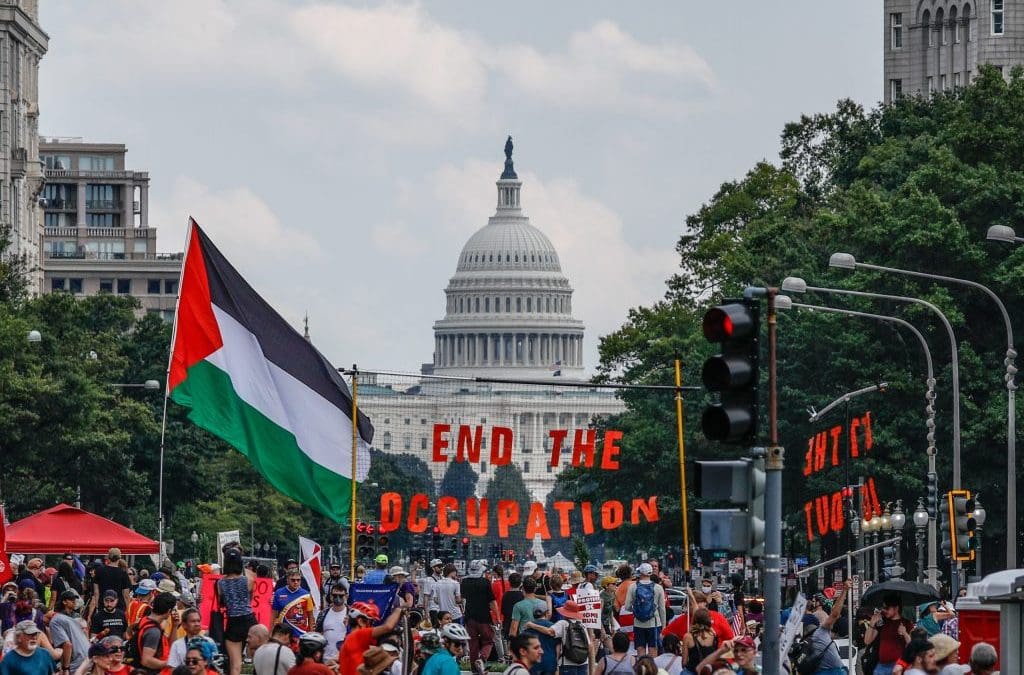
Protesters gathered in the nation's capital on September 6, 2025, to raise their voices against the federal government's efforts to increase control over the city's police department. The demonstration, titled

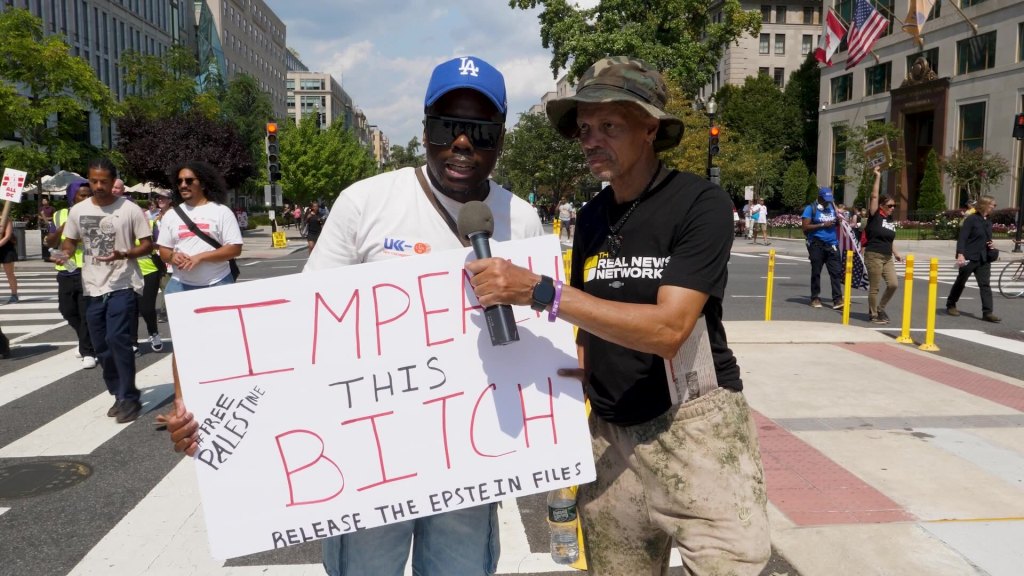
On Saturday, Sept. 6, thousands of local residents, out-of-state supporters, union members, and concerned citizens of all stripes marched through the nation’s capital to protest President Trump’s militarized federal occupation of Washington, DC. The “We are all DC” march was one of the largest protests—if not the largest—to take place in the US capital since the beginning of the second Trump administration. Reporting from Malcolm X Park for TRNN, Rattling the Bars host Mansa Musa and Edge of Sports TV host Dave Zirin give an on-the-ground account of the size, makeup, and significance of Saturday’s protest.

Credits:

  • Producer / Videographer / Post-Production: Cameron Granadino
Transcript

The following is a rushed transcript and may contain errors. A proofread version will be made available as soon as possible.

Mansa Musa:

I am here at Malcolm X Park in Washington, DC with Dave Zirin. Today we are looking at the birth of a mass movement around anti-imperialism, antifascism, anti-capitalism. Talk about what you see today, Dave.

Dave Zirin:

I’m so impressed right now. This is a demonstration to free DC and what we’re seeing out here is that it unites people of across all sorts of ways. You’ve got people here from all backgrounds, you’ve got people here of all ages. Multi-generational protests in this town are actually quite rare. And to see all of this is incredible. Also, incredible union delegations, which I have not seen yet at these demonstrations. That’s a big deal. Also a big deal. They’re masses of buses of here from Baltimore. There are masses of buses of here from New Jersey. There’s a whole Unite here union team from Jersey, like dozens and dozens of people. And what this says to me is that people are not looking at DC as a DC issue. That’s right. Or one, they’re just offering solidarity with us. People are seeing we could be next and DC will either be the first or the last city under Trump’s military occupation.

And we play a role in that by defending DC. So it’s amazing. I mean, this is huge. Right? And look, we can go into demos of dozens of people, 50 people, a hundred people to free dc and this is just over the top. Amazing. And can I just say one last thing? Come on. It is a tribute to the people of Washington DC and the resistance that they have already built because that’s the pole of attraction that’s brought so many people here today. If there was no resistance, if the vibe from DC was nobody cares that we’re now being militarized or we support that we are being militarized. No one would come here to support us. So the fact that we have created a pole of attraction on this is just incredible.

Mansa Musa:

And the fact they got it in Malcolm X Park. But talk about, you mentioned earlier, multi-generational, but talk about the international characteristics of this particular march because they start out saying, they start out saying it’s about free dc right? But then it turned into free people. NS turned to more or less getting around the issues of Palestine, getting around the issues of the immigration law, getting around the issue. What he getting ready to do in Venezuela. Talk about the international characteristics of this movement.

Dave Zirin:

Well, the international aspect of this demonstration and the international aspect of this moment are very real because what is happening overseas is boomeranging onto us back home. Authoritarianism, soldiers, children dying without repercussion, no investigations of things. Decades ago there would’ve been congressional oversight and demonstrations of, look, I’m not naive about how things used to be. I know there’s always been so much rotten in this system, but people have to recognize that it’s been turned up 15 to 20 notches under Trump. We’re talking about the militarization of our cities, and it’s international for a couple of reasons. Let’s start with Latin America. This is a crowd of people who understands that people are fleeing to come to this country. And we used to have a system in this country called asylum. And instead of people being treated as like, give me your tie, your poor, your huddled masses. People are being treated not just like criminals, but people who deserve to be tortured, people who deserve to be sent to South Sudan. How does a family from El Salvador that is starving, coming to this country know a damn lick about South Sudan, know a damn lick about a prison camp in Libya. How are they ever supposed to get home? These are people being disappeared by an international prison system. And that’s one aspect of this international development. It’s solidarity with the people of Latin America and saying, immigrants are welcome here. Another aspect of the internationalism that we’re seeing is a lot of Palestinian flags and banners.

Mansa Musa:

That’s right.

Dave Zirin:

I haven’t heard something yet from the front of the stage about it. And that’s fine if people want to keep a broader united message because on the ground, it’s flags in keffiyehs here. And I think we have to understand that there’s an anti-colonial solidarity. That’s right. That’s very real. And another aspect is that the Palestinian struggle and the movement against the massacres of children taking place in Gaza, the famine and Gaza, that is what animates the young generation to want to hit the streets, to risk arrest, to risk losing their college financial aid. And that is represented here today. That is why the Democratic party can’t even go to a college to campaign anymore because they’re so pro-Israel. And no student anywhere is going to have that even down south, even in the old Jim Crow. I mean, even at the state schools, people are protesting and they can’t have that.

Original

Trump and Silicon Valley’s plan to rule the world with AI weapons

Trump and Silicon Valley’s plan to rule the world with AI weapons

US President Donald Trump and First Lady Melania Trump host tech leaders, including Facebook founder Mark Zuckerberg (L) and Microsoft founder Bill Gates (R) for a dinner in the State Dining Room of the White House in Washington, DC, on September 4, 2025. Photo by SAUL LOEB/AFP via Getty Images

The unnerving alliance between Big Tech and the second Trump administration goes much deeper than many in the public realize. What factors are motivating President Trump and Silicon Valley’s monumental investments in “artificial intelligence” infrastructure and the expanded integration of “AI” into military and governmental operating systems? What is their endgame? What will their vision of an AI future mean for the rest of us? In his new investigative series Military AI Watch, produced in partnership with Project Censored, award-winning science reporter Peter Byrne explores “how Silicon Valley, corporate media, the Department of Defense, the banking industry, and scientific institutions all intersect in the effort to militarize AI.” In this episode of The Marc Steiner Show, Marc speaks with Byrne and TRNN Editor-in-Chief Maximillian Alvarez about “AI” today and the techno-dystopian future on the horizon.

Guest:

  • Peter Byrne  is an award-winning investigative reporter and science writer based in Northern California. He specializes in reporting on physics, nuclear warfare, medical research, local and national politics, corporate and governmental corruption, and, now, the weaponization of artificial intelligence. Byrne’s work has been published in Scientific American, New Scientist, Quanta, Wired, Mother Jones, SF Weekly, CounterPunch, The Edge, Project Censored, and other publications. Byrne has published books and chapters on multiple universes and the history of quantum physics with Oxford University Press, Princeton University Press, and Springer.

Additional resources:

Credits:

  • Producer: Rosette Sewali
  • Studio Production: David Hebden
  • Audio Post-Production: Stephen Frank
Transcript

The following is a rushed transcript and may contain errors. A proofread version will be made available as soon as possible.

Marc Steiner:

Welcome to the Marc Steiner Show here on The Real News. I’m Marc Steiner. It’s great to have you all with us. Now, we’ve all heard about artificial intelligence. Sometimes it’s just taken for granted as part of the modern landscape and our films and literature can seem ominous and dangerous, but in reality it can be both. But what happens when artificial intelligence is weaponized by the military, by our government, which occurs when right-wing tech giants control this industry in a time when the right controls our government. But I guess today’s Peter Byrne, he’s taken on this question. He’s an award-winning national and international investigative journalist and wrote an in-depth series for Project Censored, exploring every possible aspect. And in this conversation I’m joined in the studio by our editor-in-chief and colleague and dear friend Max Alvarez, making sure I don’t screw up. No, I’m just kidding. He’s here because we both are really intensely interested in this topic. And Peter, I want to welcome you. Thank you so much for joining us here today.

Peter Byrne:

Oh, thanks for having me. Glad to be here.

Marc Steiner:

So where do we even begin? I mean, reading this series you did. I figured we could do a five part conversation for this whole series, but let’s take a step back for a moment. When people hear that word, artificial intelligence, people have real more comprehension about the depth of it, what it means. So talk a bit about what that means, first of all, and what made you jump into this?

Peter Byrne:

Well, artificial intelligence, so called is probably one of the cleverest and inherently evil terms ever to emerge out of the military, industrial, academic complex as it were. It was coined in the 1950s at a conference at Dartmouth University where a bunch of cyber Ians who were early computer scientists got together to talk about the future of what we now call artificial intelligence. They called it computation and cybernetics. So anyway, they came up with this term artificial intelligence, which has stuck ever since. And in my newest story called Into the Uncanny Valley human AI war machines. I started by quoting David Hume, the philosopher from the 1757. He says There is a universal tendency among mankind to think of all things as being like themselves and to transfer to every object, the qualities they are familiarly acquainted with. We find human faces in the moon, armies in the clouds, and if not corrected by experience and reflection, our natural tendency leads us to ascribe malice or goodwill to everything that hurts or pleases us.

And to put things in context, I follow that with a quote from a military AI scholar. There is such a thing, the subject of military AI is not well covered at all in the mainstream media or even the alternative press. It is a function basically of trade journals which are pumping it up and our military AI watch at Project Censored, which is why I’m working there because it’s actually quite censored in the mainstream. Anyway, this military AI scholar referenced hues remarkable insight, which I think is applicable to using the word like intelligence for computation. And he said, AI technology is already being infused into military machines designed to look and act like humans. Anthropomorphic terms like ethical, intelligent, and responsible in the context of machines can lead to false tropes, implying that inanimate AI agents are more capable of moral reasoning, compassion, empathy, and mercy, and thus might act more ethically in humanly in warfare than humans.

And that’s the claim that is being made by Silicon Valley, which is just battening off this vast cornucopia of funding that’s being generated for a technology that is actually failing in many ways, which is that ais can replace, usis will be kinder and gentler than us, and by the way, we can also program them to kill our enemies at speeds faster than we can contemplate ourselves. There’s a whole school of thought that super intelligent ais are going to take over and exterminate human beings. That’s a conjecture. I don’t really go into that in my reporting. I’m consuming more with the here and now. And the dangers of the here and now are plenty because the present day is horrible enough in terms of one, how artificially intelligent so-called weapons systems are being used right now in Gaza as Israeli Palestinian Journal of 9 7 9 has exposed and has gotten pretty good coverage over the last few months.

The Israeli armies are using Microsoft and Oracle and probably open AI and other products to target people and to then kill them with so-called smart bombs. But one of the problems of course is, well, there’s two problems. One that they’re doing it at all using the databases that they’ve been putting together for years because they’ve been surveilling everybody in Gaza for decades. But two, there’s still obvious false positives. I mean, every time they want to kill some alleged Hamas leader, they end up blowing up a whole block full of children and people going about their daily business trying to find food among a starving genocide situation. So the Americans are not only complicit in the genocide itself, but in the technology of it because it’s Silicon Valley that is making it possible. And that’s only one application. We see military and intelligence applications of it everywhere from license plate monitoring to ice, try to figure out where to go to apprehend families of so-called undocumented people.

And of course the media gets all excited. The New York Times is just like the biggest blowjob of all on ai. I mean those guys are Silicon Valley’s just always astonishing them by the miraculous stuff that they can do. So my series goes into the tech of it because I am a science writer, but I’m also an investigative reporter. So it goes into the financing of it a lot. The first story, one ring to rule them all goes, starts out a long piece. It’s like 7,000 words. It goes into Palantir and Andre, these companies founded by Peter Thiel who’s a,

Marc Steiner:

Lemme stop you for one second. Want to back up a minute what you just said here. I think it’s really important for people to understand as we dive into what this technology is doing and is capable of doing, is the names you’re throwing out, who they are, what they are, what is Planete, who are these companies and the relationship that Teal and others have with this, the cross a spectrum of Democrat and Republican. And I think that because we’re on the edge of something really can redefine things in our society. So let’s step back for a minute and really define some of these terms. Who are these companies and describe them?

Peter Byrne:

Back in 2003, this venture capitalist named Peter Thiel, T-H-I-E-L, who had made a few million dollars in PayPal along with Elon Musk and Reid Hoffman and a bunch of other people who became oligarchs AI oligarchs. He founded this company called Palantir with investment from the CIA’s investment arm, which is called in Q Tel. A lot of people don’t know that the CIA actually has been pumping hundreds of millions of dollars into Silicon Valley AI weapons programs for a long time

Marc Steiner:

Or that the CIA actually has those investments that they have that kind of money. People don’t realize that either.

Peter Byrne:

No, I mean they also don’t realize that the Army has the Defense Innovation Unit, which is doing the same thing for the Army. With the advent of the Trump regime, the second day after his inauguration, he gathered all these oligarchs, Sam Altman and Larry Ellison and the guy from SoftBank into the White House, and also we’re going to put 500 billion into data centers. So this huge bubble of AI has been created. Now how did we get there? So let’s go back. Like you suggested 2003, Palantir has created, what it is is a very good software application for finding patterns in large databases. One of the first customers was a national security agency, was scoops up vast amounts of data every day and has it’s impossible to monitor it in real time. So Pound Share’s product is able to sit on top of vast amounts of data and locate where is the people wearing kafis today or where were they two years ago?

It doesn’t do much more than that, but that’s a lot from the intelligence agencies. And in order to weaponize this capability further, teal started another company called Andre, which manufactures the hardware that can use the Palantir type location software to go and find people and blow them up. Both Palantir and Andre were private companies. They were named after Tropes and Tolkiens Lord of the Rings. And there were EDRi still private. Palantir was private for 20 years. And what his business model was, which I expose in the first part of my series, is it was always running at a loss. It was always spending more money than it had, which had a real benefit for it because then it could tell the IRS that it wasn’t making any money and it didn’t have to pay any taxes. These guys hate to pay taxes more than anything in the world.

They contemplate having floating islands in the ocean so they don’t have to pay taxes. They get behind a guy like Trump who doesn’t want billionaires to pay taxes. So they would run out of loss and they were going to go back to their investors and get more money. And then when they went public a few years ago, we were able to using SEC filings, look into some of the machinations that they were doing financially. The short story of the long story is that now with the advent of the Trump regime, it’s finally making money and it hadn’t been making money before. Let

Marc Steiner:

Stop you for a second. So what do you mean? Why are they making money now? And did one before I shortly. What does that mean?

Peter Byrne:

Because they’re stuffing Palantir and Andre with contracts almost every day. They get a new contract, they’ve got billions and billions of contracts. Andre, which I point out in my first story in the series, has been getting all these contracts from the Department of Defense build as serving small business administration contracts. It’s not a small business. The reason they do that is because when you get a small business contract, you don’t have to go through all the procurement documentation and auditing that Lockheed would have to go through. Not that matters that much because the Pentagon can’t be audited, never has been audited. So at any rate, this is now on steroids. I mean, the reason that Zuckerberg and Tim Cook from Apple and the rest of ’em have been flocking to bend the need to Trump is because the government is throwing hundreds of billions of dollars at them, including in this so-called Golden Dome anti-ballistic missile program, which is scientifically and technologically a shival. If it cannot work, it cannot work. But they don’t care because what people need to realize not only about Silicon Valley, but about what’s going on with the Counter Revolution led by the Trump regime is these people have no ideology. They have no actual goal except enriching themselves in concentrating capital more and more and more, and that’s what they’re about.

Maximillian Alvarez:

I want to kind of tug at that thread a little more, right, because we’ve got two concrete horrifying examples that have already come up in the conversation so far, and I want to take advantage of Peter’s expertise and all the deep research he’s done. But for our listeners right now, I wanted to bring in both how AI and big tech are deeply embedded in the ongoing genocide of Palestinians and Gaza and ethnic cleansing of Palestinians in the West Bank right here, right now. And I also want to look at how the new Trump administration is leaning into big tech, actually not leaning in, like going as Peter said, full bore

Into partnerships with big tech. I want us to sort of unpack what they’re doing, how they’re doing it and why, what the end game is for them. But to kind of quickly go back to Israel and Palestine, this is connected to a story that we just reported on. I flew out to Seattle, Washington and I was one of the only journalists on the ground at Microsoft’s headquarters in Redmond, Washington when current and former tech workers at Microsoft community supporters, people with the no Azure for Apartheid coalition have been waging really risky, dangerous, brave, and crucial acts of resistance in the heart of Microsoft in direct opposition to Microsoft’s complicity with Israel’s genocide of Palestinians. And this was really exposed in an explosive investigation by The Guardian and the Israeli Palestinian publication plus 9 7 2 magazine and the Hebrew Language Outlet local call, and I’m going to quote from their August report here, which we’ll link to in the show notes, but the authors write One afternoon in late 2021, Microsoft’s chief executive Satya Nadella met with the commander of Israel’s military surveillance agency unit 8,200 on the Spy Chief’s agenda, moving vast amounts of top secret intelligence material into the US company’s cloud meeting at Microsoft’s headquarters near Seattle, a former chicken farm termed high-tech campus.

The Spy Master Yossi Sadel won nala’s support for a plan that would grant unit 8,200 access to a customized and segregated area within Microsoft’s Azure cloud platform. Armed with Azure’s near limitless storage capacity, unit 8,200 began building a powerful new mass surveillance tool, a sweeping, an intrusive system that collects and stores recordings of millions of mobile phone calls made each day by Palestinians and Gaza and the West Bank. According to three unit, 8,200 sources, the cloud-based storage platform has facilitated the preparation of deadly airstrikes and has shaped military operations in Gaza and the West Bank files suggest that by July of this year, 11,500 terabytes of Israeli military data equivalent to approximately 200 million hours of audio was held in Microsoft’s Azure servers in the Netherlands while a smaller proportion was stored in Ireland. Now again, people can go to the real news to look at our coverage of the Microsoft workers current and former who are putting their jobs safety on the line to oppose this however they can.

Microsoft is the most complicit digital arms manufacturer in Israel’s genocide of Palestine, Reen Ott, a current Microsoft worker and no Azure for apartheid organizer told me. And then Julius Sean, a software engineer at Microsoft also told me it really, really disgusted me to know that my work truly is in some part condemning children to death and I could no longer live with that. So with all that upfront, I wanted to turn things back to Peter and asked Peter if we could use these two again horrifying examples of big text complicity with Israel’s war on Palestine and the marriage between the current Trump administration and Silicon Valley or Surveillance Valley as you refer to it in your report. Let’s use these as kind of two critical examples to unpack some of the really critical takeaway points that come from your reporting here.

Peter Byrne:

Well, Gaza is the ground zero right now. It’s a laboratory for testing these weapons and it’s not just Microsoft. Amazon web services is implicated just as much as Oracle and all of the biggies. When you were reading from plus nine, seven two’s incredible reporting, you referenced the cloud. And when people think of the cloud, this is another marketing thing like artificial intelligence, right? It’s the smart as us. The cloud is up there, it’s like floating up there. No, it’s data centers that are being built just like at a pace that is astonishing. We talked about Stargate, where Trump had these guys in the Oval office and said they would put 500 billion into these data centers. They are death on the environment. They suck up vast amounts of water to keep the chips cool, and they use vast amounts of electricity, which is why Amazon and the rest of ’em are trying to build them in deserts because building these data centers is really capital intensive and places like OpenAI, which is basically just a division of Microsoft these days, they don’t have the money to build the data center.

So they have to go into debt, they have to borrow money from M SoftBank, which is this semi fraudulent organization based in Japan, which has been in a lot of trouble, but which is at the center of everything because it’s been sucking up to the Trump and his crypto moves. So we have these data centers that are being built and one of my articles about the data centers I talk about, yeah, those are going to be actual ground zero in a nuclear war or even in a conventional war because the wars that use autonomous weapons and AI control systems are actually all taking place inside the data centers inside the chips. So you don’t need to just attack a plane or a ship, you could just go blow up the data center and those things will be mean entering around like lost spot. So you’ve got the data centers and then you’ve got, as one of my other articles called AI battlespace, weaponizing the 5G Internet of Things.

You’ve got what the military calls the military internet of things, and this goes back to Amazon and Alexa and all of these devices like your refrigerator now, which has a chip in it that utilize the 5G electromagnetic infrastructure that is now being implemented worldwide. I quote from Rand reports and military documents showing how the military is now planning to use the 5G devices in households in Europe to guide its AI weapons systems in the event of a war with Russia. They’re actually, depending on all these little devices that we think are making our lives easier to make military operations happen in places where there’s so much jamming going on because that’s a whole nother story. It’s easy to jam the electromagnetic spectrum and to mess up the AI’s capability of communicating each other, but if they can just switch from communicating through satellite constellations to communicating through the Alexas in people’s houses or their refrigerators and smart toasters, which they actually can do, you don’t have to give them permission to do it, they can override it, then that’s how they plan to fight these future wars.

Now I want to make two points. One is the internet of things and all the sensors that they have and the satellites, I mean we’re talking about millions of devices all over the world that are supposedly sending information into some kind of centralized point in the military industrial apparatus from which they can control everything, and that is their plan. They have what is called a joint all awareness domain command and control system, which they envision as a kind of pane of glass where they can see the entire global battle space as they call it, and they can wage wars big and small, including nuclear wars at light speed, all basically operated by eyes with little or no human input. This is their wet dream. This is their vision because it’s costing a trillion dollars to implement. Now, the good news from the point of view of the actual humans is that it probably won’t happen for several reasons.

One, the military typically the Army has its contractors. The Air Force has, its the navies has its, and it’s the same thing going on with Silicon Valley. They each have their own favorite. I think it’s the Army likes Amazon and the Air Force likes Oracle, I think, but they have, they’re signing their own definite contracts with each of these big Silicon Valley oligarchical companies to make this great big joint all awareness domain and control system. But it’ll be proprietary only to that army or that Navy or that air force. And they don’t interconnect, they don’t talk to each other. So there’s no way that the president or the civilian who’s supposed to be giving all the commands, it is going to be able to look at a central point and go, oh, we’ve got a little battle going on in Bosnia. Let’s hope it doesn’t.

Our resources need to go there, but we have resources in Pakistan and we’re fighting a war with China in Taiwan. There’s no way that there’s any kind of centralized decision making can happen because these things can’t talk to each other. But even more fundamentally, they’re all based on large language models, the so-called chats, and the chats hallucinate all the time. This is an inescapable feature. They confabulate because they’re predictive mechanisms, they have no sense of truth. All they can do is to look at their training data, which is usually about selected by the military forces. They select the training data that they want them to train on. They don’t talk to about peace or diplomacy or arms limitations or anything like that. And I go into a lot of that in my articles. So you’ve got these chats that are advising military commanders in theory and in many cases will actually be issuing tactical orders that can’t tell truth from falsehood.

Now, a lot of people in the Pentagon are horrified by this. You’re weird Christian Dash crypto fascist leader, Pete Heg and Trump’s AI czar who was also one of the PayPal mafia guys. Their concern, as I said earlier on in our talk today is money. They don’t care if his shit works or not, but in order to get the money out of Congress and the American people, they have to go, oh, China’s going to beat us in the AI race and then they’re going to dominate us and we’ll all be speaking Chinese, blah, blah, blah, drumbeat going on day after day. We have to get ready for a war with China. Well, this is no joke because every time they want to go to war, remember Iraq and Afghanistan, I mean it just goes back on and on and on. They start the drumbeat. Our way of life is being threatened by this is an existential issue. So they’re throwing all this money into a technology that the science itself shows is incapable of accomplishing what they say it can’t accomplish. It’s one of the largest fraudulent speculative bubbles in human history and it can only harm us in ways that we can’t even yet imagine.

Marc Steiner:

So just to push that a little bit further, I mean two of the things I gleaned out of the work you’ve done and thinking about this over the last few days is that if you take the two examples of ice and how the technology’s being used by ice at this moment to go after immigrants coming to this country, and if you look at what is going on in Israel, Palestine and Gaza, that these are both testing grounds because what they’re doing at this moment in those two fronts that I’m talking about, they’re using this AI to kind of further their goals. It’s a test they’re working on implementing this and building on it to create a structure that doesn’t exist now, but doesn’t mean it could not exist. And when you take that with the corporate world that is helping to fund and push this and the right wing push across the world, especially in our own country, what I glean from this is the Amish potential inside of our future with all this.

Peter Byrne:

I’m complete a chord with you on that in the sense that yes, it is a test. Palestine is famously a laboratory, but right now in the United States, they’re testing Palantir and ail are both totally embedded with ice. They have billions of dollars in contracts right now to do what it is. When I say that it doesn’t work technologically, it doesn’t work as they bill it. For example, they say, well, we’ll be able to tell the difference between a peasant holding a rake and a rifle from our satellite based ai. No, that’s not true. I mean, we know that there are limitations on that. Now the idea that large language models, which is just one type of artificial intelligence, which we should be clear about is the latest iteration. There are other types of artificial intelligence. I want you to actually much better at doing this type of computational analysis than large language models, which are crippled by their hallucinatory problem.

They’ve also run out of data to train them on. They used up a whole internet. They sucked up Reddit and Wikipedia and the common crawl, just a lot of internet garbage. They didn’t get into university data banks or corporate data banks or even military data banks. I mean, those are all things that can be fine tuned into them, but the foundational models are all trained on just internet slop. So that’s one of the reasons that they hallucinate, but they run out of data. They need massive amounts of data to make their probabilistic neural nets work, and there’s a lot of papers that are coming out, they call it at the ceiling, they hit the ceiling and they’re not going to get any better at what they do.

Marc Steiner:

What do you mean? What do you mean they’re not going to get any better? Why do you say that?

Peter Byrne:

Their problem is it’s garbage in, garbage out. It’s the training data, but like I mentioned before in Gaza, if it was doing what they said it would do, it would be able to say, okay, commander so-and-so of hummus is in this apartment, and we can go there and either arrest him or pinpoint a small explosive and blow up his apartment. But no, they blow up the whole block, right? Because they don’t actually know if he’s there or not. The claims that are being made by the chats are probabilistic. They’re not factual. They’re saying there’s a chance that so-and-so is there or whatever.

Maximillian Alvarez:

I want hover on that just really quick. I was

Peter Byrne:

About say

Maximillian Alvarez:

Go ahead. Yeah, I mean further unpack this for our listeners, right? Because I think help make Peter’s point about the limits of what this technology is going to be able to do. It’s worth, like I said, hovering as we are right now on what it is currently being used for and the results of that. So between Gaza and the West Bank, let’s not forget that a lot of these surveillance efforts that have been turned on Gaza started in the West Bank and a lot of the data that has been just stored from surveilling entire populations of Palestinians. To Peter’s point, the general who kickstarted all of this in Israel got fired because that shit didn’t predict or stop October 7th, and that was the main thing that got him ousted. But what it is being used for as Peter was just saying, is to compile hundreds of millions of hours of phone calls, texts from, I’ve seen pictures of these data like collectors and surveillance scrapers that are set up in settlements in the West Bank that are just there to surveil and collect all of the communications data of Palestinians in those areas.

What we can sort of extrude from that is that right now with the different kinds of technologies that we are currently calling ai, we have tracking and surveillance capabilities. That’s one of the key use cases that is being pushed from Microsoft to the ID to the Trump administration. So you can scrape vast amounts of social media accounts for any language that is deemed to be supporting terrorist organizations or what have you, right? You have massive data processing capacities and ostensible pattern location capabilities. To Peter’s point, you feed massive amounts of data into these large language learning models for the purpose of being able to identify patterns that like the human eye and brain couldn’t, but that is distinct from the predictive and decision-making capacities that they are trying to sell from the IDF saying, we have all this data, we haveis going through it to locate patterns and we’re going to use AI to basically tell us who to target to kill.

Peter Byrne:

Let me interject with this, and I’m in agreement with what you’re saying In Gaza, there’s no counterforce that can jam the ability of the IDF to utilize the electromagnetic spectrum for all of the military intelligence uses that it does, but the Achilles heel of AI driven warfare and autonomous weapons is the electromagnetic index spectrum. The case in point being in the Ukraine where you do have powers that can jam the electromagnetic index spectrum and the Ukraine, there’s like 10,000 drones a day going in each direction and only a handful of them get through because both sides are jamming. The other side’s capabilities to guide their weapons. They’re frying the insides of the weapons with microwave direct devices, and so both sides have resorted to sending out drones that extrude miles of very thin fiber optic cable that can’t be jammed. It goes to where a soldier operator has a device to guide the drone into its target.

Most of the drones that are actually hitting targets these days are guided by fiber optic cables, and then they rely on the phenomenon of large numbers. If you send out a thousand drones, maybe six of ’em hit. So then you can claim that you’re doing well that day militarily, but you just sent out 900 whatever drones they didn’t hit, right? The thing is that Gaza, which is the laboratory, nobody’s jamming the Israelis, but what they’re doing there won’t work in other places where you have powers that can actually do the jamming and the GAZA’S can’t trick. The large language models that the Israelis are training are using, which are trained on data by poisoning Rand to the Department of Defense, and everybody else that knows about this are freaking out about how easy it is to hack the training data that large language models are using.

Just think about it, they scoop up trillions and trillions of bytes from the internet. So you have your little website, whether you’re North Korea or with anonymous or something, and you put some data poisoning code that gets scooped up. Then just for an example, if you changed two pixels on a stop sign, a large language model might think it’s an elephant. That’s a famous example. So the people with the technological capacity to poison and disrupt and hack these systems, which they are doing, render them pretty ineffective. I mean, I actually have a subscription to Jane’s, which is the trade magazine for all the weapons freaks

And time after time when they’re writing about AI battle equipment. It’s the jamming that’s the problem. It’s the poisoning. That’s the problem. I go into this a lot and my articles, so when I say that it is got a ceiling on training and it’s also got a ceiling on operational capacities given technologies that we have so far, pretty much I would predict that in a major war between the United States and China, which we used autonomous weapons, the unintended consequences would be just amazing because nothing will work the way that they think it can work, and they have no capacity to view the overall battle space. As I mentioned, they don’t have this joint all awareness domain capacity, and it’s not just me saying this, this is a government accountability office. I linked to reports by federal auditors saying exactly what I’m telling you.

Maximillian Alvarez:

I think that really helps clarify for me, Peter’s point about the entire promise of Silicon Valley of what this tech is going to mean for warfare and national defense in the 21st century is bunk because so much of the learning and data processing that goes into this can be jammed from the start and thus the processing and prediction are going to be flawed. So you’re not going to have these pinpointed targets of military leaders who are killed by an autonomously controlled weapon. That’s what they’re pitching. That’s not what they’re going to get, especially with any major nation that is going to war in the 21st century like China or the us. However, I want to kind of circle back to what it will and is being used for, especially when it’s turned on its own citizens, right? We’re talking about, I mean, this was what I think we’re going to keep learning for years and months, what Elon Musk’s team at Doge, what public data was fed into these language models without our consent, but that is now being used to track surveil and target undocumented or political dissidents who have attended protests. Everyone’s trying to implement this stuff to the point of denying medical claims using ai. So I wanted to sort of circle back there, Peter and ask, with all the ceiling that you talk about in terms of its military and intelligence capacities, let’s talk about how it’s already being used even with those problems you talked about to surveil and punish working people.

Peter Byrne:

I’m not sure that the AI products, the Palantir is put in place. It’s helping ice all that much because they seem to be cruising the streets, looking for people that have brown skin and maybe are walking out of a factory and then attacking them. And since people are undocumented and they’re not in that many databases necessarily, I’m not sure that the plan to be able to just identify millions of unwanted immigrants via data is working out that well for them. Mostly they seem to be trolling to get it. Now, when I say that this stuff doesn’t work as it’s flawed to be working, it doesn’t mean that it doesn’t have tremendous harm and that it doesn’t work in some ways. For example, I got a whole story a couple of weeks ago here on how AI has been inserted into the nuclear command and control system.

It’s actually, this is happening. The chats are being inserted into the so-called NC three, which is the nuclear command and control system, and war games and experiments and everything else show that because of their training, the chats almost always launch nuclear weapons in any type of conflict because that’s the bias that they’re trained on because they’re trained by the military and the military is biased to actually go to war, and the corporations are biased to go to war too. How you make money. I mean, Lockheed figured out long ago, we need to have wars in order to keep our stockholders happy, and Peter Thiel has figured out the same thing. So putting it into the nuclear command and control system is like an act of insanity, but how much more insane is it than we actually have a nuclear command and control system to start with, and that we have these weapons that we’re not even trying to control anymore. We’ve abandoned the start. We’ve abandoned all anti-ballistic missile treaties. We’re headed towards what the United States is now advocating, which is the ability to fight limited nuclear wars, which is what Henry Kissinger was advocating back in the 1950s and was famously shot down, but now it’s back because the tech, we have smaller bombs, so they think they can fight these wars and not end up with nuclear winner and devastation and stuff like that.

I think that everybody’s got PTSD and basic mental instabilities in the world now. I mean, not only because we’ve evolved technologically passed our homeowner capacities to process information, but because we’re all staring into these fricking phones being told what to do every day and we’re being fed just this steady diet of spectacle. And so the horror here is that a lot of people think one, that it’s okay, what’s going on in Gaza, and two, that we should go to a war with China and three that Trump’s doing a good job or that Biden was doing a good job. He was just as equally evil, and so how do we reorient ourselves culturally and politically in this vast morass of misinformation and disinformation that is targeting us? And that’s where ais are really good. Is it targeting you individually with misinformation which somebody is paying them to do?

However, the good news is there’s a bunch of reports came out in the past couple of weeks showing that businesses that bought in and drank the Kool-Aid and fired a bunch of people and replaced them with AI are now hiring people back because things aren’t working very well, because like I said before, they hallucinate. You don’t want your customer service AI to go, Hey, fuck you buddy. I think your wife’s a bitch. I mean, they can say stuff like that. They really can. And so the companies are running away from it right now, which is super interesting. I think we’re looking at another AI winner. The bubble’s going to collapse this year. I would predict, I would bet money on it. And that doesn’t mean that the next technological iteration building on the neural net configuration that we have now won’t be more capable of doing this or that. We don’t know. It’s all conjecture, right? But symbolic ai, which was the kind that came before the large language models, is actually much more accurate and rules-based as it were, than the predictive models, which basically have no rules.

Marc Steiner:

I just kind of push back a little. Everything I’ve read in all the pieces you wrote and other things I’ve been looking at, we’re in kind of very beginning stages of this technology and all of it may not work at this moment. That’s exactly what they’re doing in Gaza. That’s exactly what they’re doing in ice. That’s exactly what they’re doing in other situations is testing out these models. How does it work? Where does it fail? How do we make it stronger? And when you’re doing this in encountered with very right-wing governments like our own in this country and with the technology companies that are allied with that politically, this is to me just the beginning. We don’t know where they’re, this is going to go. We don’t know where we’re going to take it, where they’re going to take it. And everything I’m watching at this moment are like dry runs. Is this going to work? How do we make it work and how do we make it better so it does work.

Maximillian Alvarez:

And to even add one more horrifying detail to that, I think what we’re all also acknowledging is the fascistic reality that we will base life or death situations on the hallucinations of an unaccountable technology in the hands of the rich and powerful. So when AI is being used to track surveil process data from Palestinians and target Hamas fighters, and it results in women and children being blown up, that’s as horrifying as the technology because the technology doesn’t work as it is, as if the technology did, right? I mean,

Peter Byrne:

Let me interject here. I’m not saying that it doesn’t work. I’m saying that it doesn’t do what is being sold as doing, which is to be discriminatory and obey the international humanitarian laws of war and things like that. I mean, we have to recognize that ai, artificial intelligence has actually been embedded in the military systems of the United States and the other Western industrial countries for like 70 years. I mean ever since the bomb sites in World War ii in the B seventeens, those were artificial intelligence, the origins of it. So we’ve been computerizing our military apparatus forever. This is just the newest iteration of it. And yes, it is being tested. The testing process itself is horrible in every ways. If you want to glimpse the future that Silicon Valley is aiming towards, look at what’s going on with the Uyghurs in China, their entire 2 million strong society, it seems to can be completely monitored by devices set up by the Chinese government that in conjunction with Apple and Microsoft and Oracle and the rest of Silicon Valley, they would like total control.

Just like Leonard Cohen said, they want absolute control over every living soul. But that doesn’t mean they’re going to get it because people need to say, I’m not going to go anymore with this. I’m going to put down my phone or not going to use the chat. I mean, using the chat is an environmental crime every time you do it, but not only that, they’re using the information that you feed the chat to train more chats. So it does bad things and it is limited, and it will just keep doing bad things as it struggles to keep making profits because that’s the main goal of the war machine. This guy, Antoine Buske wrote this. B-O-U-S-Q-E-T wrote this great book called The Scientific Way of Warfare some years ago, which goes into starting with the Greeks, how technology and science have implicated warfare and developments of warfare up into the present day. So this isn’t new. Using ai so-called in warfare is not new. It’s just getting a lot more attention right now, and that may be a good thing. Maybe people will get sick of it and turn against it.

Marc Steiner:

So I think that one of the things after reading all the pieces you wrote and want to read more and get into this even deeper, is what the response is. What should our response be? How do you control it? How do you control them? How do you go up against the powers of techno business across this country and across the globe? It is a battleground for the future of democracy. It’s a battleground for what happens to our society because what they can’t do now, they will figure out a way to do it. And if I’m as old as I am, I may not be here, but my kids will be here, my grandkids will be here, my great grandkids will be here. And so I think it’s something that people really need to understand what’s happening to us, what they’re doing, what we face, and then how do we respond to it.

Maximillian Alvarez:

Well, and I want to just hop in with three little points there, and then I want to give Peter the last word, please on that really important question. But just taking from our own reporting here at the Real News, we’ve already seen that every step of the way there is resistance, and there are critical sites of resistance where working people are the ones fighting back either because their conscience is telling them they have to or because their circumstances leave them no other choice but to fight. So I interviewed folks in Texas who are living across the street from these Bitcoin mining data centers that just popped up in their neighborhoods, and now the sound pollution from those is giving people heart problems and they’re bleeding from their ears. And so you have these coalitions of apolitical people, liberal people, deep red, conservative people who are all being kind of pushed together because these data centers are, as Peter said, just so there’re such big resource hogs, they’re taking all of the water.

They are polluters sound wise and otherwise, and people don’t want to live near them and they don’t want to give all these resources away to these big tech companies that aren’t even providing jobs for those communities or any benefits that people can see. Seeing grassroots resistance around the data centers from Memphis to Texas to Mexico, that’s really critical. I mentioned the Microsoft workers and tech workers in general who have a vital role to play. They are the rank and file workers on board the Death Star in a lot of ways. And they know that the workers I talked to know that, and they are speaking up. They are disrupting business as usual. They’re using their knowledge to convince people of what we’re trying to kind of unpack here in this conversation. But the Microsoft are explicitly calling for a worker Intifada. They’re saying We need tech workers across the sector, not just in the US, to mobilize resistance against what the executives and shareholders are pushing these companies to do, including surveil and Target and kill Palestinians and our own people here in the United States.

So you have those two critical sites of resistance. And the last one I just throw in is that other workers who don’t work in tech also have a critical role to play. And we saw that coming to a head during the Hollywood strikes last year, particularly the writers strike one of the major, I mean, but this was also an issue for SAG AFT and the screen actors because they were fighting the company executives who are trying to push for AI to replace those workers. They want to create movies that are written by ai, maybe checked by one human. They want to replace background actors with AI generated ones. They want to use dead actors likenesses to recreate new performances. So this is coming, it’s seeping into all areas of life, which means that yes, it’s horrifying, but at the same time it creates more stakeholders in the fight against it. And I think that we’re seeing that from residents living near the data centers to workers in tech to workers whose jobs and livelihoods are being threatened by tech. And with that, I’m going to shut up and let our guest, Peter have the last word.

Peter Byrne:

Yeah, I’m in unity with what you’re saying. I think as people are more and more recognize that they’re locally impacted by the AI infrastructure, whether it’s data centers or losing jobs or getting bad medical information from their chat, whatever, that people will look for answers now. Yeah, general strike would be a good idea. I mean, if people stopped using Amazon for a week, that would change everything, which is why Amazon is actually, its profit center is now a military contracting. It’s not the Amazon store, but if people stopped using it, that would probably bring it to its knees. What we have to do, I think in this country is to look beyond the binary political thinking that we’ve been brainwashed to think it’s got to be either Democrats or Republicans. The Democrats are just as implicated in all of this as the Republicans. I mean, the Biden administration was going in the same route that the Trump is on ai.

There’s really no difference in what happened in the transition and the Tweedle D and Tweedle dumb two sides of the same coin kind of politics that we’ve been imprisoning ourselves with here for decades, if not centuries, doesn’t have a solution. There’s no way the Democrats are going to stop Trump from running for a third term or whatever he wants to do. So it’s going to take a mass movement and people just have to stop looking at their phones and stop thinking that they can communicate everything on signal and be immune from being attacked themselves and to actually start talking to one another face to face-to-face. I mean, look at us. I’d love to be in a room with you guys, but we’re here like a thousand miles, 3000 miles apart. And no doubt, the NSA has scooped up every word we said in some large language model is making an analysis of it.

Fortunately, it would be largely untrue. So I don’t know what’s going to happen next. I mean, mark, you and I are basically the same generation. We came up through the 1960s and all that, and people were mobilized by the depredations of the Vietnam War and by our encouragement of the Black Panther Party for self-defense and things like that, what do we have now? Black Lives Matter turned into some fricking nonprofit, self-aggrandizing hell, in terms of how it took on its next step. It didn’t really need a next step. It was great at mobilizing people as a phenomena, but once it became institutionalized, it became easy to attack. And so most things, movements that become institutionalized, become corrupted one way or another. So I don’t know. I have a 23-year-old son who’s a college senior, and for some reason I don’t understand, he wants to be an investigative reporter. So I think we need more people out there doing that and communicating. Then let’s see what happens. Because we’re not in control. The fucking war machine is in control, but it can’t do it without our blood.

Marc Steiner:

Well, this is just the tip of the iceberg that we’ve done here. First of all, I want to thank Peter Burn. Just we’re going to link to the piece you put together. It’s really important to read. I think there’s a great deal more to glean out of it and to talk about and to expand this conversation, which I think is critical. And

Maximillian Alvarez:

Shout out to our colleagues at Project Censored for all the great work that they’re doing.

Marc Steiner:

Absolutely. And to my dear friend, colleague and editor-in-chief, we had the Real News, Max Alvarez for being here on the Mark Steiner show as well in this conversation. And we’re going to look at this more and in greater, deeper ways because I think what Peter Byrne has shown us in his series is the real danger that we face and what we have to do to stand up to it, to save the future for our children, grandchildren, and everybody else on this planet. So thank you all for being here on the Mark Steiner show. Peter, thank you for doing the work you’re doing. And folks, let us know what you think. Just write to me at market the real news.com. I’ll get right back to you, and we’re going to expand this conversation and get it out there. So thank you both, all of everybody. Thank you,

Peter Byrne:

Onward. Thank you.

Original

‘We want DC to be free!’ Voices from the ‘We are all DC’ march

‘We want DC to be free!’ Voices from the ‘We are all DC’ march

TRNN's Mansa Musa (right) speaks with an unnamed protestor and

The “We are all DC” march on Saturday, Sept. 6, was one of the largest protests—if not the largest—to take place in the US capital since the beginning of the second Trump administration. Thousands of local residents, out-of-state supporters, union members, and others marched through the streets of Washington, DC, to demand an end to President Trump’s militarized federal occupation of DC. But the march also brought together a cross-section of concerned citizens protesting the Trump administration’s attacks on immigrants, US support for Israel’s genocide in Gaza, and more. Reporting on the ground for TRNN, Rattling the Bars host Mansa Musa speaks with a range of organizers and attendees at Saturday’s march.

Additional links/info:

Credits:

  • Producer / Videographer / Post-Production: Cameron Granadino
Transcript

The following is a rushed transcript and may contain errors. A proofread version will be made available as soon as possible.

Mansa Musa:

We at Meridian Park, also known as Malcolm X Park, where we are recovering the rally from free dc, a coalition group of all organizations in the District of Columbia that’s coming together to call for the freedom of dc. What do freedom of DC mean? It means they saying that in the federal occupation, but it means more than that. It means statehood, it means the right to self-determination. As you can see, a lot of people have come out here today to be a part of this process. What you going to see today is a textbook and organizing 1 0 1. What do you think about this movement today?

Alfonso:

Well, I think it’s very popular. There’s a lot of people, it’s across generations, across all walks of life. So I’m really hopeful.

Mansa Musa:

Right. And in terms of the connection between the DC federal occupation and what we seeing going on in Occupy Palestine, is it a connection?

Alfonso:

Well, I guess there is a connection, but it’s much worse and much more serious what’s going on in Gaza.

Mansa Musa:

And I agree 100%. Right, it’s more serious. But do you think that in terms of your presence here and the fact that I walked around, I see a lot of Palestinian flags. I see a lot of, I get out of Gaza free Palestine, so it’s obviously international, it’s obviously international connection. People are looking at from respect that none of us are free until

Alfonso:

All of us are free. Absolutely. I think we have a lot of things to protest against. So I think it’s a good moment to gather and ask for all of those things. Right.

Lydia Walther-Rodriguez:

We’re here today with over a hundred CASA members, over a dozen organizations with one simple ask to stop the militarized occupation in DC

Mansa Musa:

They using the law to say that if you are committed a crime and you are an immigrant, then they hold you to the outcome of your crime to determine whether or not they’re going to deport you. But they rounding people up saying that under the pretense they commit the crime. What do you think? Really the story is behind why they rounded?

Lydia Walther-Rodriguez:

We are seeing a time that is unprecedented to us, but a time that has repeated itself over and over again under this administration. We have seen the constitutional crisis of the injustice of this president not respecting due process. We saw it in Quin Ab Garcia’s case, and we continue to see it every time they detain our immigrant communities here in DC and Baltimore, all across the country, folks are being detained and targeted and there there’s a PR machine saying they’re criminals. But the reality is that they see black and brown people and they have already targeted us as criminals and are taking away our due process. It’s happening to, it’s happening to immigrants, it’s happening to black Baltimoreans, and it’s going to happen to all of us if we don’t put a stop to this right now.

Mansa Musa:

And I like that. I like that articulation because I want you to unpack this right here. Alright. As you said, they rounding up people under the prescience of being criminals. Do you think that the fact that they’re using their lack of citizenship status to ignore their rights as human beings,

Lydia Walther-Rodriguez:

We know there’s no dignity and there hasn’t been dignity in this country for people of color, for black Americans, for immigrants, for anybody who does not meet the white supremacist agenda, they’re just trying to use the laws that were created against us. But we have the Constitution that clearly states that we have due process and in violation of due process is where we will resist, we will fight back and we will not allow these normalized racial biases to continue to silence the voices of the struggle. And for everybody who can hear my voice, it’s going to happen in you two if you don’t rise up and stand up.

Mansa Musa:

That’s right. And we remember in time in history was called Dr. Scott decision and Dred Scott, the Supreme Court, said that Dred Scott did not have no rights that the United States was bound to respect because he was considered one third of a human being and looked like they resurrected the Dred Scott decision in terms of rounding up people, not just Latin Americans, Latinos, Hispanic, anybody that can fit the narrative. You got the last word on this

Lydia Walther-Rodriguez:

Dred Scott decision never left us. Our people have continued to suffer as black, indigenous, Latina queer. And now this system is showing its face. Are you listening? Are you seeing it because we’re seeing it through every single kidnap that’s happening every single day in the streets of DC and countrywide? This is not a phenomenon that started here, but the US occupation intervention has been piloted in Central and South America. And it has shown to us that imperialism continues and its tactics will continue on in this country too.

Susan:

There have been people we’ve talked to, there’s a whole bus from Unite here, it’s come from Philadelphia, people from New Jersey, Vermont, Florida. So I think people understand the threat. This means not just for people in DC and for the country, and I guess particularly from Pennsylvania, people from DC every election go out and canvas and do things we don’t have people to vote for. So I kind of feel like it’s paying back and appreciative of that.

Sarah:

There’s 60 of us here from Vermont because we want DC to be free. This invasion is terrible.

Mansa Musa:

Why do y’all feel like y’all had to come down here though?

Sarah:

Because if Trump does it here, he’s going to do it in the next city, in the next city, in the next city. And this is not a dictatorship. And just because most of the people in DC voted against him, he’s now pissed and he’s taking it out on them. That is not right. This is not a dictatorship. This is a country where we all vote. And if he doesn’t, people don’t like what he’s doing, they’ll vote him out and bye-bye Mr. Trump. We’re here to support the people in dc

Gelly:

We have basically changed our rhythm from focusing on climate change legislation and getting elected officials in that are for a green New deal. And we’ve shifted completely to trying to combat the administration and the oligarchy and occupation that’s happening because we can’t get anything done with them in office.

Mansa Musa:

So you think it’s a connection between climate change, immigration and free dc?

Gelly:

Absolutely. And there’s a connection between climate change and the oligarchy that’s happening right now in our government.

Mansa Musa:

Okay. So what you think about the demonstration today?

Gelly:

I think the demonstration today is beautiful. I see a lot of people out here focused on different things. We’ve got immigrants, we’ve got climate people, just everyday Americans who want to be free and don’t want to have an occupation in our streets.

Mansa Musa:

This definitely is a people’s movement?

Gelly:

Absolutely. Yeah. This is for the people, by the people.

Mansa Musa:

It’s all about the revolution…

Joe:

This is Bernie Sanders’ group, our revolution group. And why are y’all here? Well, we’re here because the country’s been taken over by a group of fascists.

Mansa Musa:

This is Malcolm X Park. At one point in time you had African Liberation Day. They rally around. They rally around here. But more importantly, the most salient demonstration and rallying point was the war in Vietnam. And it all started with small groups. And then every day

Joe:

I was in all of them

Mansa Musa:

Nationally, you see nationwide, worldwide. So you got defund genocide, free Palestine.

Lisa:

Well, I think our giving military aid to Israel is just perpetrating these attacks on Gaza and giving them the means to commit genocide and cause this starvation, this hunger problem over there. And what’s really upsetting is people are trying to get the aid we’re sending and they’re getting shot down. And I find that quite upsetting. It’s an atrocity,

Joe:

It’s a major war crime and genocide. The whole world knows it. But the good thing, except for Trump and his administration,

Jane:

A members of Congress including a lot of Democrats in Congress who won’t vote to cut off the aid.

Mansa Musa:

Why is occupation a crime?

Pomelo:

Oh, occupation is just a violation of everybody’s dignity and justice. It’s an complete abuse of power. Everything that’s happening in Palestine is going to be happening in the states and DC is the test case for what’s going to happen across the country. So it’s all intersectional. It’s being tested on Palestine. The technologies they’ve been used on Palestine ICE are now using here on DC and people are across the street. So we’re just got to protest it all.

Mansa Musa:

What do you think about today’s demonstration?

Pomelo:

It’s fantastic. I mean, obviously people have to be protesting every day in their lives, not just in one protest that we get to go on a Saturday. Everybody can do actions all day every day. But it’s amazing to be in masses of people and know that you’re not alone.

Mike:

Human rights belong to everybody. When people start taking people off the street claiming they’re illegal, they’re not only hurting that person, they’re hurting the family that they provide for, which can be a large family in the community as a whole. Even if they’re not legal citizens of the United States, they still pay taxes. They still belong here. We are the melting pot of America. Isn’t that correct? We have a statue in New York Harbor that is meant for exactly that.

Mansa Musa:

Most people just won’t be treated as human beings.

Mike:

That’s correct. Why can’t everybody just be treated like human beings? There’s a lot of people out there that are intimidated of large groups of people or people they don’t know or understand instead of loving them.

Mansa Musa:

Why are you here today?

Yuri:

Well, I’m an immigrant and I don’t feel like we are being treated fairly. We are here to work, to be part of America and support the American dream, and that way that we’re being treated is just unfair. So I’m here to protest.

Mansa Musa:

Bottom line. You here to do the same thing his father did, came here to find a place to live and get living conditions and you’re no different. You’re not an immigrant. You’re a human being.

Yuri:

Thank you. I appreciate that.

Mansa Musa:

Yeah. Talk about your sign.

“Freedom Fighter”:

My sign indicates today that our president can go into the White House, he could exercise his writer free speech. I’m doing the same. I’m keeping it in plain text English. Let’s impeach this bitch. What’s happening in our world is not okay. What’s happening in Palestine is not okay. And we as a people have come together today to stand for justice, for unity and to take back our streets. I think that this is what DC is. It is collective unity. It’s love, it’s peace, and it’s coming together on the streets and letting our voices be heard. So this is what this represents and this is beautiful.

Mansa Musa:

And talk about what you think the takeaway going to be today. For most people,

“Freedom Fighter”:

The takeaway for most people today is going to say, listen, we are here. We’re loud. We’re in color. We’re letting our voices be heard. And enough is enough, right? We’re in the streets. We love dc, this is our home. And we won’t let it just go willingly and teach this bitch.

Medea Benjamin:

I think this one is great because it brings together so many key issues. You have the issue of ice, get ice out of our city. You have groups like Casa representing immigrants and the signs saying immigrants are welcome here. Then you have the issue of the militarization of our city, which is wrapped around the whole issue of free DC and statehood for dc. And then we have the issue of Palestine. That occupation is a crime from DC to Palestine. So it’s all connected. It’s a large march. It’s very militant and I think it’s great.

Mansa Musa:

And I dub this as organized in 1 0 1 because we seen initially the call was for free dc, but then it takes on the international and national character. How do you think This’s going to play out in the long run?

Medea Benjamin:

Well, I think in the long run, the only way to deal with any of these issues, whether it’s ice or the oppression of DC by the Trump administration or Palestine, is united front. And this is an example of United Front. It’s got to get much bigger and we’ve got to really strengthen all of those connections. But this is a great example.

Mansa Musa:

This remind me of the war in Vietnam. When we had the marches against the war in Vietnam, it started out microscopic, but then it got to a point where it became international, where every Saturday, every Sunday, every day throughout the week, you see masses demonstration. So this is characteristic of that. Do you not agree?

Medea Benjamin:

Absolutely. And I think that’s the way we have to do, it’s great to be marching on a Saturday, but we really need to be out in the streets on a Monday, Tuesday, Wednesday, Thursday, Friday when we say no business as usual. So I’m looking forward to that because until now there’s been small groupings of these individual issues. For example, I’m in Congress all the time and you see the free DC people in Congress, you see us, the Palestine people, you see the immigrant rights people, but they’re not together. So if we joined up during the week as well as on the weekend, I think there’s so much power in that.

Ryan Harvey:

Well, I think it’s important for folks. We came down, we had five buses come down from Baltimore, organize that with in partnership with unions and grassroots groups. I saw a busload of folks from Vermont. I think it’s really important for folks to take some national action right now and stand up because DC’s a test case. DC’s the city where he’s testing out how far he can push it. And I think Trump’s making real authoritarian moves right now. And I think it’s really important for people to be out here, not just for us and for the people in our cities, but also for members of the National Guard and members of the US military. They need to be asking themselves if they’re not already serious questions right now about what they’re doing, what they’re being asked to do, what their rights are, and do they have the willingness to stand on the right side of this.

Mansa Musa:

And we was down here, one of the marches that they had, and it was about 60 people today. It looked like we estimating more close to 3000. But in terms of the coalition building, what’d you think about that?

Ryan Harvey:

I mean, I would say this looks to me like it’s at least 10,000. I mean, how far we’re stretching the White House right now, but no, look, I mean we’ve been building coalitions I would say in a pretty unprecedented way for the last couple of years. And I think what’s been happening, especially with the unity now between some of the labor unions and grassroots organizations, especially black led grassroots organizations in DC, I think is critical. I think the labor movement needs to be pushed in a better direction in terms of how they show up on the streets. And I think that a lot of folks need to be reaching out to the unions and working with the unions and organizing unions as well. So I think there’s a gap that we’ve been suffering from, I would say, since McCarthy in this country. And I think we’re starting to undo some of that. And I think it’s really good to see.

Mansa Musa:

And this remind me of the war in Vietnam, how to protest, start with the war in Vietnam. And it always ended up in DC where people come together in hundreds of thousands to protest. And I think this is the star that would you agree?

Ryan Harvey:

Absolutely. And Vietnam was a common enemy. I think there’s a misconception about the sixties that it was all about Vietnam. You go to a Vietnam War protest, there’s the black power movement, there’s the Puerto Rican Liberation Movement, the gay liberation movement, leftists, socialists, et cetera. The feminist movement. We’re in a moment like that and folks need to understand. And I think we are understanding that when you have these common struggles, that’s where a lot of problems get solved. That’s where a lot of forms of bigotry disappear when you confront that this person is fighting just like I am for something better for themselves and for the world.

Johnny Silvercloud:

It looks pretty amazing, man. It was like a whole lot more folks than I thought.

Mansa Musa:

Yeah. Have you been at the previous ones?

Johnny Silvercloud:

Yeah, a few of them. I was bit injured, so I couldn’t be in the ones early August. But I make my way to be out here. Now you’re talking to Johnny Silver Cloud, the premier photographer, videographer of Washington DC as far as street journalism goes.

Mansa Musa:

But talk about this movement and talk about the characteristics of it. Have you been noticing that they got people from all over the country?

Johnny Silvercloud:

Oh yeah. Especially as a military veteran, a lot of folks center around where we’re camped out at. We’ll find numerous folks coming from Mississippi, Georgia, California, Vermont, Maine. It’s pretty amazing. There’s probably a couple of days that I’ve missed. I don’t have overhead sight of every day, but these summer come out, there’s, there’s folks that are native to dc, native of the DMV. There’s a difference. And also folks from across the United States. It’s pretty amazing. Alright, one more thing. Alright. So we as Washington dc, especially US military veterans, we are not against the National Guard. We’re not against the troops, we’re against their presence. We are against their usage. Their usage. Because we’re not mad at the pieces on the chess board. We’re mad at the hand on the pieces.

Mansa Musa:

Okay. You mad at the people that’s moving the pieces?

Johnny Silvercloud:

Exactly.

Craig Williams:

I’m Craig Williams. I do a jazz program on Thursday mornings. Morning brew, classic jazz edition.

Mansa Musa:

Yeah, I listen to Morning Brew.

Craig Williams:

Oh good, good. And I’m also here in the streets representing the justice side of our radio station.

Mansa Musa:

What you think about this day’s demonstration?

Craig Williams:

I think it’s great that we finally have a really big event and turnout from everywhere.

Mansa Musa:

Look, when you look up we way down, we are in the middle of it and they way down the road. Talk about being alternative radio and attack on media. How is WPFW fighting back?

Craig Williams:

So we have not had corporation for funding, public broadcasting for over a decade. So they can’t take money away from us that they haven’t been given us. On the other hand, our Pacifica network was specifically mentioned in Project 2025 and the FCC is watching. So we have to be careful about everything we do, everything we say, everything we play, and it isn’t fun.

Mansa Musa:

Is freedom of speech under attack?

Craig Williams:

Absolutely. Absolutely.

Mansa Musa:

Why you wearing that at this time?

Unnamed Protestor 1:

Because it’s about solidarity. It’s about all the people who are experiencing hate and oppression banding together and not being divided.

Mansa Musa:

And you got to say a reminder, this is not normal. Why is this not normal?

Unnamed Protestor 1:

We do not need the National Guard in our streets. Our streets are safe. I feel more unsafe from the National Guard than I do from the people of dc.

Mansa Musa:

And what do you think about today’s demonstration, the turnout?

Unnamed Protestor 1:

I’m really happy about it because the last demonstration I went to was much smaller and I think that everybody should be in the streets. Everybody, when one person civil rights are taken away, all of our civil rights are at risk.

Thomas:

It’s a great turnout. Multicultural religious organizations in the forefront. And many people who are native and live in DC are here as well as people from around the region.

Mansa Musa:

Right. I noticed that it’s a cross section of people representation, the unions transgender, L-B-G-T-Q, the Palestinians. But talk about free DC because I see you have free dc. Talk about what it means when you say free dc.

Thomas:

If you notice the term free DC is more than taxation without representation is more than home rule. It’s actually the deliberation of people exercising their own right to liberty. So free DC means a lot. Those people who made our home, it means that we get to run our lives, we get to run our government. It’s not run from the outside even by a person like Trump.

Mansa Musa:

And I’m glad you qualify that. I was thinking the same thing when you say free DC and then you put the limitation on it, statehood that don’t mean that you free right now we got home rule. And do you think home rule represent freedom?

Thomas:

No. Home rule examples of what’s going on right now. Home rule show you that it’s not freedom. It’s so many exemptions and so many rights that can be taken away simply by the presidential authority.

Mansa Musa:

Talk about if you have a view on they saying the mayor capitulated to Trump going with the occupation. Talk about that, if you got a view.

Thomas:

The mayor plays within the lines. She’s not a rebellious person. She plays within the rules that are given to her. So she’s trying to make the best that she can. But the mayor, I thought was a friend of mine, but I can see her days coming to an end.

Mansa Musa:

Yeah, I think so too because right now most citizens in the District of Columbia don’t like this occupation. Just the other day, they locked out kids from Union Station. They didn’t let ’em at a certain time when the curfew kicked in, they said that they could not go use the subway in public transportation, the National Guard. And then the mayor turned around and say that we are happy that these people are here.

Keya Chatterjee:

We’re out here also in front of the Wilson building. So I want to say something also to Mayor Bowser. Mayor Bowser, your constituents call on you to stop cooperating with this administration. Do not make their work easier or convenient. We do not welcome indefinite coordination. Do we welcome that? No. And the vast majority of our constituents do not want this. Local leaders oppose what is happening right now. And we need you not to enable it.

Erin McCleary:

Mariel Bowser. Yeah, we need some leadership right now. We don’t need conciliatory, appeasement. It gets us nowhere. First rule against fascism is Yeah, don’t bend the knee.

Mansa Musa:

Don’t bend.

Erin McCleary:

Don’t bend.

Mansa Musa:

I thought she was for statehood. I thought she was for a home rule. I thought all her actions she say is in defense of these things.

Erin McCleary:

I mean, actions speak louder than words. And she talks to Pam Bundy every day. I am disappointed. I’m let down. I’m afraid.

Mansa Musa:

Oh, is it more or is it more like Pam Bundy? Tell her what to do every day.

Erin McCleary:

I mean, either way. Does she have to be an earpiece for Pam Bundy?

Mansa Musa:

No.

Erin McCleary:

Come on.

Mansa Musa:

What you think about today’s demonstration?

Erin McCleary:

Huge turnout. Very inspiring. We’re united. We’re united.

Mansa Musa:

She’s coming about there.

Erin McCleary:

She’s going to what?

Mansa Musa:

Bows. She’s coming about

Erin McCleary:

There. Oh, for

Mansa Musa:

Sure.

Erin McCleary:

She’s done. She’s done.

Mansa Musa:

She’s done.

Erin McCleary:

She’s done. Bye-bye. Bowser.

Mansa Musa:

Talk about the orange man. Why you got the orange man?

Maisy:

I wanted to bring some fun to the march because we are so fed up. We’re so filled with anger. So now it’s kind of like nice to put a little fun in it.

Mansa Musa:

And fun is definitely, this is like you got good trouble and you got good fun.

Maisy:

Yep. Good trouble.

Keya Chatterjee:

So fascists like this president lose their power. When people like us start using our power, we’re going to use our power as workers and we’re going to use our power as community members. So we need to use every single tool we have to make this administration’s attacks on us. Difficult and costly every day. Everywhere. And that is how we will win.

Mansa Musa:

Talk about what you see today, Paul.

Paul Coates:

I see people. I see people and I’m energized by ’em. I’m energized by the young folks. I’m energized by the older folks who are out here like me, but very, very energized by people and from all different veins. All right. Different interests are united here. Beautiful.

Mansa Musa:

And we just talked to a woman from Vermont and she say, and we got people from Vermont. We got people representing the Palestinians. We got people representing in apartheid DC and we got people talking about don’t occupy Baltimore. So it’s a cross section throughout the world.

Should the unions be more proactive?

Steven:

The unions should be much more active. Trump’s taken away bargaining rights from a million people and every union should be out and some unions are, but a bunch of unions have somehow convinced themselves that they’ll sort of sit this out and be okay and they’re wrong. Everybody needs to be out.

Mansa Musa:

Yeah, because come for one ain’t going to come for everybody.

Steven:

That’s exactly right. But what is good is UNITE HERE, SEIU 32BJ, a bunch of unions are here today, but it’s unions who should be on the front lines in fighting fascism.

Mansa Musa:

And Paul, what about the representation of black people? You think more black people should be represented? I mean, we don’t turn out, we’re not turning out. And the one that’s most threatened

Paul Coates:

In this city, I don’t know about most threatening this city, but I know when black folks are ready to turn out, they’ll turn out. Right now, I’m very happy to see white folks out here and so many white folks out here. It actually makes me feel good and it enlivens me. I don’t think we have to worry about black folks coming out. I don’t. Folks are ready to jump in the street. They’ll jump in the street and unfortunately they may come out with a little different, a little different. So I’m glad to see it going. It’s going okay.

Sue Blair:

We’re union workers. We stick up for rights, workers’ rights. We are based out of Atlantic City, but unite here is all over the country. Local 54 is very powerful. Our president, Donna DiCaprio, she’s awesome. She likes to stick up for workers’ rights. And when this all went down, we have about 150 TPS workers in Atlantic City and we came down here to March. They’re trying to take away their temporary protective status. So we came down here to march and do the rally.

Mansa Musa:

How important do you think it is for the union to be represented in marches like this?

Sue Blair:

Very important. It’s very important for workers’ rights. We stick up for all workers’ rights, but being that my mom was never a citizen and to stick up for the dreamers and they have their children here and for them to be deported and it’s just horrible. They have rights. They’ve been paying taxes for decades now, and now they’re trying to make them leave the country. It’s just not right.

Mansa Musa:

We’re in the midst of a march in DC Freedom. We marched from Malcolm X Park to down to Freedom Square. But what you see behind me is where they barricaded the front of the White House. This was one of the major tour attraction, and now they got petitions up where you can’t walk through that section no more. Just last week you could. Today you can’t. Here today, gone tomorrow.

Keya Chatterjee:

This is not just about the next election. Their end game is to silence, dissent and prevent a transfer of power. Why do we have Democrats voting for that? They’re bullying you and you are being bullied into attacking dc. So some of the people who have the most tools right now are members of Congress and we need Congress to do their part. And this president’s racist and white nationalist occupation of dc, right? They have the power to do that. We need this Congress to get ice out of DC and get the entire federal Gestapo outside of dc. We heard from our black youth today what that is doing. Do we want them out?

Juliette Bethea:

All I have to say is we must resist this. And today is encouraging to see folks out who aren’t going to deal with this. So we just have to resist. Are you a native Washington? Well, I’ve lived here since 1967. I wasn’t born here, but I’ve payed a lot of taxes

Mansa Musa:

You’re a Washingtonian. You remember the Civil Rights Act? You remember summer jobs, all that stuff. Right. So what you think about the state of DC right now? What’s going on with the state of DC right now?

Juliette Bethea:

Well, it’s really distressing. It’s an outrage because I was here when we were fighting for home rule, and even when we were fighting for representation on the school board and then mayor and then, so to see the pendulums would go, this far is really distressing and I have no other option but to resist it in many ways.

Mansa Musa:

And this is a good indication of the people’s attitude about what they feel. I didn’t participate in a number of rallies, but this is the largest and the most You think about that, the cross-sectional aspect of this.

Juliette Bethea:

Well, we have people from all over the country. I’ve been talking with people from Chicago, from Atlantic City, from New York. So people realize what this means and the ramifications of this. It’s not just about controlling dc, it’s this march towards authoritarian, which we have to resist.

Mansa Musa:

As you can see, we’re wrapping up our day of rally and demonstration for freedom. They say free dc. But as we talk to people, they say it’s bigger than that. It’s bigger than free in dc. It’s about people’s right to humanity and to be treated as human beings. We had a cross section of people here today. We had unions, we had the Palestinian representatives, we had people come all the way from Guam. We had people come from every city, major city in the United States, Chicago, New York, Philadelphia, Atlanta Union representatives, and more importantly, we had grassroots elements come here around organizing to eternity as they see it today from the Trump administration. So it is not about free dc, it’s about freedom. Our right to have freedom. Stay tuned.

Original

4 Reasons why Trump is afraid of Zohran Mamdani

4 Reasons why Trump is afraid of Zohran Mamdani

New York City Mayoral Candidate Zohran Mamdani speaks during a rally at Lou Gehrig Plaza on September 02, 2025 in the South Bronx in New York City. Photo by Michael M. Santiago/Getty Images

Donald Trump is putting his thumb on the scale of the New York mayoral race. Reports suggest he’s floated an ambassadorship to current Mayor Eric Adams and even had back-channel conversations with former Governor Andrew Cuomo, who’s now eyeing an independent run.

Credits:

  • Written by: Stephen Janis
  • Studio: David Hebden
  • Post-Production: Stephen Janis
Transcript

The following is a rushed transcript and may contain errors. A proofread version will be made available as soon as possible.

Taya Graham:

Okay. I have one simple question for you. Could it be that Donald Trump, president of the United States might be afraid of Zoman Mond, a New York State assemblyman and mayor candidate? Well, we will answer that question on this. Our latest installment of the Inequality Report react, and we’ve got a video you won’t want to miss. Okay. It has been a whirlwind since Rah Ami was the surprise, Victor of the New York mayoral primary. The self-described Democratic socialist beat, the establishment favorite former New York governor, Andrew Cuomo. But of course, since then it has been knives out for manami. The mainstream media, democratic elites and nervous real estate billionaires have been targeting him from every single angle, including with propaganda millions in super PAC donations and personal attacks on a man who did nothing more than win an election while the Democratic party sinks deeper into the abyss. Imagine that. But now since none of the attacks have worked, the most unlikely of political alliances has recently emerged. And Steven, you’re not going to believe it,

Stephen Janis :

Tell you when I heard it, I didn’t believe it. I know you’re going to say it, but I still don’t freaking believe it, to be honest with you. It was shocking.

Taya Graham:

I know. It shocked me too. I mean, all he did was win, which is honestly quite unusual for Democrats these

Stephen Janis :

Days at this point. Absolutely.

Taya Graham:

But instead of embracing his success, the pushback from Democrats has gone even further and has become even more bizarre. Democrats seem so upset the mond of one, they’ve taken the idea that politics creates strange bedfellows and turned it into a king size bed of crazy. Okay, you ready for this?

Stephen Janis :

Yeah, I’m ready.

Taya Graham:

Okay. According to reporting by the New York Times and Politico, Donald Trump is weighing in on whether to insert himself into the upcoming November, New York mayoral election, specifically to beat ami. But what’s really shocking is who he called to form the alliance to beat the upstart candidate. Wait for it. None other than Andrew Cuomo himself. That’s right. The New York Times reported that Trump and Cuomo talked on the phone about strategies to beat Mond in the fall, although Cuomo actually denies that this call happened. But still, Cuomo is your typical corporate Democrat who appears to be okay with working with Trump, provided he wins. And just to put an exclamation point on the fact that Manami is living rent free in Trump’s head and why this potential alliance is possible at all, let’s take a look at the clip where he talks about manami in not so glowing terms. Stephen, let’s watch and then we come back. Let’s talk about what he’s really saying.

Donald Trump:

Total lunatic. I don’t know what she’s on. She’s all jumping up and down. I’ve never seen anything like it talking about supporting the communist mayor. And he’s not a socialist. He’s a communist. Okay. This is not a socialist mayor. This is a communist. If you look at any of his policies and go back six months, you don’t have to go back further than that. So they want to put a communist in New York. Now, the good news is we have a lot of power over that because we’re the ones with the money. We send the money, we don’t send the money. It’s up to the house. A lot of power in the White House.

Taya Graham:

That was intense.

Stephen Janis :

Yeah, that was very, very intense. That was like, wow, he seems really upset.

Taya Graham:

So before we get into why Trump might possibly be scared of Manami, why don’t you help me break this video down?

Stephen Janis :

Well, I think what’s interesting about it is they talk about the Trump derangement syndrome, and this is like Momani or derangement syndrome. I mean to call him a communist. What? I’m sorry. Free public transit is communist. I’m sorry. Having affordable housing is communist. I mean, he’s going to extremes. Usually he just calls him left wing nut jobs or right left wing radicals. Now he’s using the C word. Right?

Taya Graham:

Right. He really did bring out the C word. The C word. Like you said, I’ve heard him say left wing lunatics or left wing nut jobs, but communist is actually a new one. What’s going on here, Steven? Why does he seem to be almost desperate to make sure Mond doesn’t win?

Stephen Janis :

I think Ami, and we’ll talk about this really specifically hits on some points and breaks from the democratic neoliberal incrementalists elitist playbook that hires consultants at billions of dollars but doesn’t connect with the people. I think he hits on that and I think Trump realizes that, and that’s why he’s scared

Taya Graham:

Steven. That is the perfect place to drill down into the four reasons Donald Trump might possibly be scared of. Zorah Mond. Okay. Number one, he is not a neoliberal corporatist, typical incrementalist Democrat. Steven, talk to me about it.

Stephen Janis :

Okay. Tell, there’s one word I’m going to use here to describe why this is an important concept to understand of why Trump years won the healthcare. Healthcare.

Taya Graham:

Yes.

Stephen Janis :

Okay. So we watched this 1.5 billion fiasco where the Democrats lost to Trump, and one thing they did not do was ever mention healthcare, one of the most important issues to the American people and an issue that they won on in 2018. A month after that election, you have this tragic murder of the United Healthcare, Brian Thompson. And then the public comes out and all they’re talking about is how much they hate the healthcare system in this country. And Democrats didn’t talk about it, I think because a lot of their money comes from healthcare companies. So they were boxed in. The one thing where they could have beaten Trump or at least made a difference or a difference in the court of public opinion was healthcare. And they didn’t even touch it. And that’s why these corporate centers candidates fail consistently.

Taya Graham:

Okay. I really like where you’re going here because I think you’re pointing out something that just does not get enough discussion. I remember when we talked to Professor Richard Wolf about the economic history of this country. One of the things he pointed out that really stuck with me was that during the Cold War, the reason the tax code and unionization and other working class policies persisted in the fifties and sixties and even partially into the seventies, was because the elites of this country were fighting with the Soviet Union. He told us they felt like they had to provide a better life for the broad majority of people in order to win the ideological battle that democracy and capitalism were better than communism. But he then told us that at the end of the Cold War, equality unionization and the other things that made working class life better just vanished. And the elites started hoarding wealth. That’s when we get into the nineties neoliberalism and what we call the age of the corporate Democrat. And of course the topic of our show wealth inequality and political division. But history aside, Steven, why does Mond not being a corporatist make Trump afraid of Mond?

Stephen Janis :

Well, you talk about the kind of shift and the Democrats in that same period of time that Wolf was talking about were aligned with the working class because they were trying to lift up the working class and create a large middle class. And then the nineties they got corporatized totally. They got taken over by political money and they became less and less able to align their interests with the working class interests. I mean, working class people want real change to their lives. They don’t want more tax breaks for corporations or more tax breaks for people in power. They want something that’s going to materially change their life. And Manami was promising that. And he’s breaking from that past or that tradition of the nineties that started with the corporatist incrementalist Democrats. And that’s why it scares Trump because he knows that democratic playbook is a failure.

It’s a failure for the working class and the working class, high school educated voters that Democrats just can’t connect to anymore. Trump knows that the most dangerous thing is for the Democrats who abandon that playbook and look, tell we have big structural problems, not incremental problems, not problems you can address around the edges, like our disastrous healthcare system like the unaffordable housing. They are big problems. It takes bold ideas, not just saying, Hey, we’re going to pass a little legislation and move it incrementally forward. It takes bold, progressive thinking. And Trump knows, as long as the Democrats stick to the playbook where they don’t address the broad structural problems, he knows he’s good and he knows the Republican party is good, they can just point to failure. And that’s what happens when you try to approach these huge structural issues with incrementalism. It

Taya Graham:

Doesn’t work. Absolutely. And to be perfectly honest, our constituents, our fellow voters, they don’t trust it anymore. They want change and they want it now. Okay, and now let’s go to number two. The second reason that Trump might be scared of Mond, he’s not a kandis. Now, Steven, on a previous show we showed a CNN anchor giving Mond’s opponent, Andrew Cuomo, the opportunity to spout propaganda and to try to discredit his opponent. Lemme just play a really short clip of this before we talk about it.

Kasie Hunt:

Do you think your opponent, would a Mayor Momani help or hurt the morale of the NYPD?

Andrew Cuomo :

Well, look, if you look at his prior statements, I think it would definitely hurt. Literally, he has said he was part of this defund the police movement. He has said that the police are a threat to public safety, that they are racists, that he would dismantle the police department.

Taya Graham:

Okay. Now I get Kagan that is a good card to play against Soran, but why do you think it concerns that Mond is not doubling down on policing? I mean, Trump is using the National Guard to allegedly fight crime in blue cities that he has categorized as hell holes. And just as a little side note, we both went to interview the National Guard in DC with I would say minimal results. But the point is Trump is trotting out the old playbook that Democrats are soft on crime. But why does Mondavi’s promise to use social programs and community intervention programs scare him?

Stephen Janis :

Well, the thing is that what we have learned in blue cities and reporters who have covered this closely is that policing doesn’t work. I mean, policing might be one part or one component of trying to fight crime, but if you don’t double down on social programs, which is what a lot of cities have done that have been successful, you’re not going to lower crimes. So what Trump actually does is he exploits this idea, this lack of vision in the Democratic party. Because really, truthfully, as you not taan, you’re going to talk about the Democrats really tripled down on policing in Baltimore until they didn’t. And it’s an important thing because Trump has ’em there. They pick the wrong policy and then he throws it back in their face. If Manami says, Hey, I’m going to invest in social programs to reduce crime, he’s got a more winning formula. And it also cancels out the whole idea that you’re either for or against police.

Taya Graham:

Steven, I’m so glad you mentioned Baltimore because I have personally lived through all the different strategies they’ve tried with the Baltimore City Police Department. And just for the record, we have had historic drops in crime while our police department has also had historic drops in staffing. I mean, there’s some estimates that say our department is short between 500 to a thousand officers, which is literally a third of the force. Strangely enough, crime has dropped precipitously. But to your point, the Democrats have wrongly back policing. I mean, it’s just so ironic. I mean, here in Baltimore we had zero tolerance policing that led to a hundred thousand people arrested every year for nearly a decade and crime. And in particular, the homicide rate didn’t go down until they stopped doing that. So honestly, the Democrats look bad both ways. And so as long as they keep on trying to out police Trump, I think they’re going to look pretty bad.

Stephen Janis :

So it’s pretty

Taya Graham:

Smart from Adam not to fall into that trap.

Stephen Janis :

Yeah, well, that’s the thing. It is a trap. It is a trap because you have two sort of visions, right? What can the Democrats say in opposition of Trump’s idea of putting National Guard, bringing in all sorts of law enforcement? They can’t say anything because they’ve embraced the same sort of tactics with unconstitutional and authoritarian policing that we wrote about in democratic cities. But if you come with a different playbook and you say, you know what? Policing is fine, but really what’s important is improving people’s lives, having social programs, having a community-based approach to violence, then you have a different vision. And that’s the problem. Trump’s vision. Trump’s idea is to exploit the Democrats for picking the wrong policy and he could just double down on it doesn’t matter. But if you have a different vision, a contrast, which is what Manami has in his campaign, then you can fight it out.

Then you have something to say. If you don’t have that contrast, you just end up looking feeble and weak. And let me say this too, as you pointed out, the idea that Democrats picked policing to solve complex social problems, hurt this city, hurt the people of the city, as Professor Lester Spencer said from Johns Hopkins University, we wrote about this, it basically minimized the efficacy of the most progressive parts of this country. So really the are going to be the Democrats were like 15 years ago. Oh my God, we have to look like we’re tough on crime. We have to embrace policing. But what scares Trump is that if Moham says, you know what? I don’t even think policing is the answer to this question, then you have a different vision and a competing vision that people can pick from. And Trump does not want that.

Taya Graham:

Okay. Reason number three. Okay, Steven, I think number three is kind of interesting and intriguing, and we’re going to call it the Medicare fallacy.

Stephen Janis :

Why

Taya Graham:

Don’t you explain what that is and why that might scare Trump about Mond

Stephen Janis :

Teya? It’s a really simple idea. The Medicare fallacy is a way of proving that neoliberalism doesn’t work. And by doing so, it shows that the underlying assumptions in neoliberalism that the market is always the best solution is wrong. So if you look at private healthcare versus Medicare, private healthcare spends between 2012 and 20% on overhead. Medicare spends 2%. So think about that. What’s more efficient? The market-based solution that plays 12 to 20%, or Medicare, which is 2%. So everyone’s always saying, when bomb with the grocery stores, you can’t do that. Government can’t do anything. Well, well, the Medicare fallacy shows that, yeah, government can do something really well deliver healthcare efficiently to millions and millions of elderly Americans. And so what Manami is trying to say here and why that scares Trump is like, no, Medicare is more efficient, so security is more efficient. We’re not going to give our 4 0 1 Ks over to private equity. He’s going to interrupt the whole idea that government should be profitable, or the only way government can solve problems is by monetizing them. And I think that’s why we call it the Medicare fallacy. You just look at Medicare and it’s much more efficient, much more cost effective,

Taya Graham:

And

Stephen Janis :

Benefits more people. So I think by him embracing some of these ideas that aren’t exactly Medicare, but ancillary to that is something that Trump fears because if Democrats start making government work, that’s really going to be a problem for the Republicans.

Taya Graham:

Steven, I think you touched on something so important there, because fundamentally the message that we’re getting from the Republican party is that government can’t do anything right? Which is sort of ironic that that would be coming from people who are in government, but I’ve seen government get things right and I’ve seen them get them right effectively. I get water, I get electricity, I have roads I can drive on. I have a public library I can go to. I get mail. There are things the government can do, and it doesn’t necessarily have to be a for-profit, which I think explains why it might be worthy to consider whether or not AMI should have the city investing into a grocery store. It’s

Stephen Janis :

A good

Taya Graham:

Question. Just the idea people have just been vicious about it, saying it’s impossible.

Stephen Janis :

Yeah, no, I mean, this is one of the ideas he’s been attacked on the most is his idea that you can’t run a grocery store. But I think it’s oversimplification. I think what he’s trying to say is we have a complex social problem. People can’t afford to live. How are we going to attack it? Maybe we’ll try a grocery store, maybe it won’t work, but maybe in the process we’ll learn something about how government can work. And the other thing too is that the Democrats always put themselves in defending bad institutions. Instead of saying, we can reform this. A lot of institutions have been corrupted by this idea, a lot of government institutions by the idea that they should serve profit and they should be neoliberal and market-based solutions that make business money but don’t serve the people. If the Democrats would turn around and say, you know what? The main metric we have in governance is how well it serves the people, and we’re going to reform any institution that doesn’t meet that goal, then they’re in better shape right now. They just look like they’re defending waste, fraud and abuse and whatever they say. And that’s because they have embraced neoliberalism and as you were saying, public private partnerships and things like that.

Taya Graham:

Reason number four, okay. Now the fourth reason that I see Trump might be afraid of ami. I mean, it almost sounds silly when I say it, but it actually might be one of the most important. Okay, here it goes. People like him. I know it sounds strange, but the truth is he is charismatic. People connect to him, and he seems authentic to him, at least based on our reporting. And I actually have firsthand experience with this because I’ve covered, actually you were there with me.

Stephen Janis :

I was there,

Taya Graham:

The Republican National Convention. And when I was there, I literally, literally saw people crying when Trump would appear. I mean, it kind of felt like a religious gathering. But when Chuck Schumer goes up to the podium, if people are crying, it’s probably from disappointment because he is one of the key members of the Democratic leadership that has refused to fight back against Republicans during the government funding showdown earlier this year. But I know from talking to people that, except for Bernie Sanders or a OC, and now ami, the ability to connect with the voters is often underestimated and an undervalued skill by Democrats. I mean, let’s think about it. They spent 1.5 billion,

Stephen Janis :

Billion

Taya Graham:

With a B last November, and they lost. And now they’re paying consultants again, the same ones to figure out how to talk to voters. And this is something that Madami seems to naturally understand given his win. But why don’t they get it, Steven? I mean, Dems, okay, let me talk like the kids Dems don’t seem to value the Riz. No,

Stephen Janis :

No, they don’t. They don’t really get that. It’s really funny because I was at the same Republican convention you’re at, as you mentioned, and I was just amazed at how people were connected to Trump in that audience. They felt like it was visceral. They had some deep bond with this man, which I’m a reporter so I can’t express my opinion, but was somewhat mystifying to me given some of the things he had said, and they were just completely enthralled. But every time the Democrats have a candidate that emerges that can have the same sort of connection with their side of the voters or even voters beyond their side, they tend to attack him because I think in a lot of ways it attacks the underlying political economy of the Democrats, which is a consultant class who can take a mediocre sort of play by the rules.

Remember we talked about this, get in line Democrats, which we had the get in line Democratic party where no candidate can jump the line like Trump did for the Republicans. They have to get in line. So they take the assembly line of neoliberal Democrats and say, I’ll make you popular. Just don’t say these words. I’ll make you popular as you point out before, I’ll spend $20 million. We’ll do focus groups with young men and we’ll tell you what to say. I mean, of course they’re going to come out and be bland and not be interesting and not be authentic. And of course they’re going to get outmatched because they’re so circumspect, because there’s been so much money trying to turn them into automatons that when Trump says something crazy, they don’t even know how to respond because there’s no there. And I think the candidates that capture people’s imagination have something other than political consciousness. They have some understanding of what people are really going through some way to connect and be empathetic and not sound totally superficial. So the Democrats just reject them because the entire business economy of being a Democrat is sort of bound in this idea of having you get in line the next candidate, the next one we formulated, rather than someone like Manami, it comes out nowhere and wins it, and then no, look, they’re apoplectic. So I think that’s part of it.

Taya Graham:

What’s even funnier, and maybe it’s sad, not funny, but I’m sure you’ve heard about this democratic think tank called Third Way that put out a list of words Democrats are not supposed to use. Can I give you an example?

Stephen Janis :

Yeah. Okay.

Taya Graham:

It’s kind of like seminar speak, organizer jargon, therapy speak words like safe space triggered, words like that. So when they have to have a conversation like that, they’re having some difficulties.

Stephen Janis :

They have a really perverse od deak, wait, did I say that

Taya Graham:

Right? Yeah. Siro deak

Stephen Janis :

Kind of thing going on here where they’re paying people millions of dollars to tell them what to come out of their mouth because they don’t know what to say. But that’s such, to me, such a bad sort of omen for Democrats as politicians. If a politician doesn’t innately know how to respond to a situation, if a politician doesn’t know what to say in a moment or how to connect with a person who could be a skeptical voter or a person, they’re not immediately aligned with, there’s no amount of money you can spend to cover that up. There’s no amount of training or no amount of lists of words that is going to make a Democrat an effective communicator. It’s innate, it’s natural, but it also comes from people jumping the line. Let’s remember that Obama jumped the freaking fucking line he was not supposed to run. Right? He’s a senator. They’re all like, he’s only been a senator for two years. He jumped the line. He won because he understood he was a political talent, and they’ve got to look for talent, not just people who check a box. And that’s what it sounds like. It sounds like the consulting class. Check a couple of boxes. They need talent.

Taya Graham:

Okay. Steven, I think this really speaks to what you were talking about, about those focus groups, because Democrats are limiting candidates controlling their words while Trump says whatever comes to mind, regardless of how offensive some folks might find it. I mean, how is that supposed to work? I mean, just imagine a candidate trying to be natural and trying to connect to people while being worried about saying a particular set of words. Meanwhile, president Trump can shoot from the hip and say literally everything. And it’s not because the rules are different, it’s because he knows his audience and he connects with them. And there are a lot of people who just don’t like that and don’t like him, and they’re going to get angry with me for even mentioning it. But a candidate has to have a way with connecting with people. Absolutely. It’s so important. I mean, people may not want to accept that Trump has a way of connecting with his base, but you can’t deny it. So a candidate has to have a way of connecting that has nothing to do with focus groups or consultants or paid advertising. And the fact that Mond came out of nowhere says something about the importance of charisma. And there is not a focus group or list or consultant that can conjure that if a candidate doesn’t intrinsically have

Stephen Janis :

It. So true. So

Taya Graham:

True. I’m sure Republicans are laughing as Democrats twist and turn and try to address their historic unpopularity with consultants rather than embracing a candidate. People actually like

Stephen Janis :

That is so Taya. No, but that is exactly what I was trying to say, that you said so much better than I

Taya Graham:

Do. Oh, no,

Stephen Janis :

You are so right. Thank you for saying that. I just hope they listen to you, but I don’t know if they will.

Taya Graham:

I don’t know mean there are a lot of young folks, and I’ve heard this from them, they feel like it’s a gerontocracy.

Stephen Janis :

Oh my God. Yeah. And I think Ali is an expression of that, what, 32, 31 years old. He is a very young man. And I think the average age in the Senate, the medium age is like 64.

Taya Graham:

I wouldn’t be surprised if it was higher, but I’ll take your word for it.

Stephen Janis :

It was something like that. I was real. I was just, was astounded. It’s like an assisted living facility. But it is. And I mean, come on, the Democrats have to get younger. Look, I’m an old man, but I want to see a viable two party system in here. And if they don’t recover in some way, the Republicans are going to rule this country for a very long time.

Taya Graham:

And that doesn’t lead to a healthy democracy having only one party rule.

Stephen Janis :

Right? Right. So we’ll see if the Democrats will actually listen to what Te Graham said today, which I think should be the Bible going forward, but we’ll just have to see because I don’t know if it’s going to

Taya Graham:

Happen. Well, we are available as consultants to write you up our own playbook. No you’re not. I’m just teasing. Okay, Steven, we reviewed the four reasons Trump might be afraid of Mond. And the question is now will the Democrats agree to embrace him?

My

Name is Taya Graham. This is my colleague Steven. Janis, we’re your inequality watchdog and we’re reporting for you.

Original

Fighting for the democracy we’ve never had

Fighting for the democracy we’ve never had

The dome of the U.S. Capitol building is seen beyond an upside-down U.S. flag during an anti-Trump protest at Union Station in Washington, D.C. on September 2, 2025. Photo by BRYAN DOZIER/Middle East Images/AFP via Getty Images

Not just in the United States, but around the world, authoritarianism is rising and people’s faith in the concept of “democracy” is collapsing. “In the absence of clarity from its defenders and amid the failures of our putatively democratic institutions,” Osita Nwanevu writes in his new book, The Right of the People, “democracy has become a specious and suspicious platitude, equally useful to marketers and would-be dictators—a hollow idea for a hollow, unserious time.” How did we get here? And what will it take to revive working people’s faith in democracy, not just as a philosophical ideal, but as a real, practiced force that will improve their lives? In this podcast, recorded at Red Emma’s Cooperative Bookstore and Cafe  in Baltimore on August 12, 2025, TRNN Editor-in-Chief Maximillian Alvarez and Chris Lehmann, DC Bureau Chief for The Nation, speak with Nwanevu about his new book and the fight to reclaim democracy in an age of rising authoritarianism.

Guest:

  • Osita Nwanevu  is a contributing editor at The New Republic, a columnist at The Guardian, and the Democratic Institutions fellow at the Roosevelt Institute. He is a former staff writer at The New Republic, The New Yorker, and Slate, and his work has also appeared in The New York Times, The New York Review of Books, The Nation, Harper’s Magazine, Columbia Journalism Review, In These Times, and Gawker. He lives in Baltimore, Maryland.

Additional resources:

Credits:

  • Studio Production: Maximillian Alvarez
  • Audio Post-Production: David Hebden
Transcript

The following is a rushed transcript and may contain errors. A proofread version will be made available as soon as possible.

John Duda:

My name is John Duda. I’m one of the worker owners here at Red Emma’s. We are a 20 plus year old radical worker owned bookstore, restaurant, social center, and we’re excited to see you all in the dog days of August and the waning days of the American Republic. We are tonight joined by a wonderful panel chief. Among them is AED Nueva, who is here to launch this amazing book, which I’ve been looking forward to for a long time. I think really grateful to be launching this book. It’s kind of a nerve wracking book because part of it is a catalog of everything that’s wrong with the system that sometimes we call democracy, but as he shows, really isn’t, I got to admit, it woke me up in a fit at one in the morning. So if I seem a little incoherent, it’s because this book caused me to lose sleep.

But as I finished it this morning in my sleep deprived days, it actually, there was something relaxing about it because once you accept that we’ve actually never really had a democracy in America and that it’s going to take generations to build it, it actually, given what we’re seeing today, given all of the shit, all of the backsliding, we know that we’re not losing something that we were actually had, we’re being set back in a struggle that’s a lot longer and has always been a lot longer than just the machinations of the current fascist regime. But to help us work through this today, we also have some amazing panelists with us. We have another good friend of the cooperative here, max Alvarez, editor-in-chief of the Real News Network. And then for the first time we have Chris Lehmann, who is a, I want to say legendary editor, a fantastic run at the head of the Bathler, an incredible generational run at the head of the New Republic, and now the bureau chief for DC for the nation. So excited to have these folks here tonight to talk to us about democracy or lack thereof. Please join me in giving them all a warm welcome.

Chris Lehmann:

Well, thank you all for coming out again in a hot August night or late afternoon. As John said, I’m Chris Lehmann and both Max and I will be enjoying the great opportunity to engage with Oida on these really urgent questions raised in his book, which are not, as John alluded to by any means, sort of academic or theoretical for us at this moment. I drove up from the newly anointed garrison state of Washington to be here today. And that experience just covering Trump’s surreal and fascist racist press conference yesterday was a good sort of distillation of a lot of what O CDA argues in this book, which is to say there is this kind of capital R resistance narrative about the Trump moment being a moment of profound backsliding where we have betrayed our faith and trust with the democratic ideal. In reality, it’s been an accelerationist moment.

It’s harnessing all of the very potent and not even dormant, but latent, I guess you could say, anti-democratic energies in the American political system. And so the challenge going forward in wrestling with this moment is that we are the sort of inheritors of an oligarchic system that uses a very loose rhetoric of democracy, largely to defend status quo arrangements. And to sort of get to the bottom of this morass, you actually need to return to certain basic first principles of what happens to one person, one vote when again, in places like Washington, there is no congressional representation. There is no ability to pass laws or a budget without congressional interference. What does it mean to say that Trump is an existential threat to democracy when the US is exporting a genocidal war in Israel? None of this actually works out at a basic level of logic. And the great virtue of O’S book is he began sort of unpacking the mythology we’ve used to avoid talking about substantive democracy in this moment. So with that all in view, I will toss over to Max.

Maximillian Alvarez:

Well, I just want to say before we get real deep into Osita’s incredible book, what an honor it is for Oita and I to be sitting with Chris who, without whom, I don’t know, I won’t speak for Osita. I mean, I’m sure he would’ve found a way, but I would not be where I am without Chris. And that is true of many of us that you read and see in left and independent media like both as the leader of a news network. Again, it’s never lost on me that I wouldn’t be here had Chris not believed in me in my writing 10 years ago. And also when I look for role models, I have very few, and you may not know it, but as far as like guys who have stuck by their principles and been chewed up, turned out, spit out, and somehow kept coming back and leading different newsrooms to improve, this is the guy that has managed to make a career the right way. So let’s give it up for Chris.

Chris Lehmann:

I think we should all also have a moment of silence for Max because anyone in the position of adopting me as a role model isn’t desperate straight. But thank you.

Maximillian Alvarez:

It was very, and Chris in ota, I just could not be proud of you brother for getting this book out. And I know it was a real slog, but it feels like it’s coming at the right moment when we need it most. And I really appreciate you for that. And like Chris was saying, we were all watching what’s going on in dc. I mean Donald Trump is Federalizing DC police calling in the National Guard. I was just back home reporting in Southern California where he did the same. And I came into reading ADA’s book with one of my favorite book titles from Sister Astor Taylor, another shout out, another Baffler contributor. She has one of the best book titles of all time that’s always swimming around in my head. Democracy may not exist but will miss it when it’s gone. So I’m coming into reading o’s book with that in my head and my head’s on fire with everything in o’s book.

And then I’m watching what’s unfolding over the last 24 hours. And I know we don’t live in a functional democracy in the way that any of us were taught to believe it, but I know when I’m seeing these images that I’m watching the death of something. And so I wanted that to sort of be the springboard for us to talk about and introduce your book Oda, what can your book, what does it give us and people like us who are feeling that same way to help understand what we’re seeing and help know to do what to do next. And let’s use that as a springboard for a larger introduction to what the book is.

Osita Nwanevu:

Sure thing. Thank you for that introduction. You’ve been a real supporter of me throughout the entire process of writing this, and I could not be more grateful, Chris. I could be here for the next hour talking about how grateful I am to you for hiring me at the New Republic. But everything that Max said was absolutely correct. You’ve been truly a real model. If that means bad things for me in the future, I don’t care. It is a fact. It’s true. And I’ll always be grateful. And while we’re doing Thanks Red Emmas, I’ve been really proud to be a part of this community for some years now. It’s not just a great gathering place and a point of community for Baltimore, but it is a place that instantiates every single day, the democratic values that I talk about in this book and inspiration to cooperatives in the city and around the country. And I would not have imagined starting this tour anywhere else but right here. So thank you for that as well.

What I think we’re staring down with the Trump administration, I think is fascism. You can continue to debate that point academically if you’d like to, but when I see people being whisked off the street and put into unmarked vans for expressing opinion, that’s really calling of all I need to know personally. And when you talk about something dying, what is the thing that we’re all kind of feeling? What is the collapse we’re all trying to interpret? I think that what’s collapsed is our kind of faith in the system broadly understood. These institutions that I think all of us are taught, or most of us are taught in school, were designed to prevent the rise of somebody like Donald Trump have not only failed to do that, but as I argue in this book actually helped him come to power the Democratic Party, which I think people might’ve hoped would be an effective bulwark against the radical right against Trump’s fascist movement.

I think its messaging has failed. I think its political approach and strategy has failed. I think even us on the left as much as energy and as much sweat as we’ve put into organizing the last 10, 15 years especially, we’re still a lot of work cut out for us in terms of building a true left majority in this country. And I think the people are kind of taking in all of that and wondering what the next steps are, where do we go from here from this point of collapse? And my book is a humble effort at constructing something that I think might be useful vision moving forward, which is taking democracy seriously, not just as a by word, not just as a cliche, but as a really, really deep system of ideals that I think has animated a lot of people on the left for a long time.

But that conception democracy has not been that prevailing understanding of democracy within mainstream politics. And I’m trying to, I think, bring people who are concerned about Donald Trump concerned about this moment, concerned about authoritarianism into a more ambitious and frankly more radical understanding of what democracy can and should mean for us and to get to a truly democratic America. I think that we have to take a critical look at our existing structures, existing systems, not just in our politics, but within our economy. And that’s what the book in a nutshell is fundamentally about and trying to do.

Chris Lehmann:

Yeah, and actually to put in a plug for my current home publication, the nation is running an excerpt from O’S book about economic democracy that goes live Thursday. So if you want, I mean you should obviously buy it here tonight, but you can send the link to your friends and that I think might be a good place to start the project of engaging with what a democracy worth preserving looks like in this country. And you talk about the first order failure, and I felt this all during the Kamala campaign in 2024, where it was a central theme of the campaign that Donald Trump is an urgent threat to democracy. We have to protect our democracy. And at the same time, there were genuine economic ills and inflation wasn’t under control. And the Trump campaign was able to cynically exploit that and cynically do these absurd gimmicks like suspending taxes on tips, suspending interest payments on auto loans, and Trump even dressed up like a McDonald’s worker to sort of drive home this idea that we are the party of the working class, the forgotten Americans.

And of course, when fast forward, whatever it is, 10 months, and the CBO report just came out on the combined effect of both the quote, big beautiful bill and Trump’s tariffs, and literally every decile of the American income spectrum is going to be paying more. So we don’t have to at Red Ams of all places. We don’t have to belabor this point except to say how is it that the Democrats in particular have become so flatfooted on what had historically been they were the party of workers, and how is it that the Republicans have found it so easy in the broader conditions that we all work and pay our bills under to present themselves effectively as that?

Osita Nwanevu:

Yeah, I mean, as I say in the introduction of the book, which is written after the election, a publisher did not like that they wanted an introduction well before, but there in the introduction of the book, I think that people in this last election felt that they’re being asked to make this binary choice. On the one hand, you can vote to save and protect democracy, which is this kind of that your civics teacher told you was important in sixth grade or something, or you can vote on the basis of your own economic self-interest. You’re paying too much for your groceries, you’re paying too much in your rent, you dunno how you’re going to pay your mortgage, et cetera, et cetera, et cetera. I think people saw themselves as having to make this choice between this ideal that Donald Trump was violating and their own material interest, which they, I think mistakenly believed many voters mistakenly believed that Donald Trump would be able to improve their material law. And that is not a way, first of all, that’s, it’s not a very compelling way to sell a democracy.

If it’s justice, abstraction, justice kind of academic thing that has no connection with your own lived material situation, you’re going to lose that fight to people making other kinds of appeals unless you can sell democracy. And I think truthfully argue for democracy as something can actually materially empower us and improve our standing in the economy, Democrats did not do this. And I don’t think it can be a surprise that for many of the critical constituencies that they needed to win in this election, people chose differently. The Gallup did a poll earlier last year where they found, I think 70 something percent of the American people, 74% it might’ve been, who were dissatisfied with the way American democracy was functioning. That’s not an environment where you want to come in as the people representing the status quo, representing the defense of institutions. You have to speak to that institutional cynicism.

And most Americans are not taking political science classes and they don’t know what senate mal apportionment is and all that, but they do, I think correctly feel that Washington is not set up to work democratically in their interests. They do know even if they don’t have the numbers, that the wealthy corporations get their way more often than not in Washington dc. And so I think people saw that and they saw this kind of defensive our democracy instead of themselves, well, hell, this democracy of ours has never really worked for me. And as a matter of fact, to the extent that you’re telling me that Donald Trump is going to disrupt and destroy those institutions, I might want that to happen. I might vote for him for that reason. And so I think a way to talk about democracy that is more compelling and I think more robust and full is one where you say to people, there’s something about democracy in the system of ideals that actually empowers you materially.

It’s not just about the right to vote. As important as that is, it’s not just about denying or rejecting efforts to overturn the election in 2020. It’s important as that was, but it is a system, it’s a set of ideas, a set of values that will actually improve your own material situation, material standing and ability to live the life that you want. And that’s a conception I’m kind of arguing for in this book, but I think that that can only come if you take a step back, go back to the drawing board and think kind of ambitiously and from first principles, but what democracy even means to begin with. For me, the definition that I came to after reading many dusty and dry books that I don’t know that you should read yourself work for you in a lot of political science or whatever definition I’ve come to that feels most simple to me is democracy is a system in which the govern, the people who are themselves subject to government are the ones who are doing the governing.

It’s not a system that lets some higher authority, arbitrary king or sort of rulers rule over you. You yourself have the power to govern or in Lincoln’s construction government of buy. And for the people, I think there are a lot of technical reasons I get into why that system is better than other alternatives ruled by the few in some guys or another, whether that’s a monarchy and oligarchy. But the thing that I think is increasingly compelling to me is a justification for democracy is this almost spiritual intuition that we, each and every one of us are entitled to a measure of control over the conditions that shape our lives that in this brief time we’re around, it is wrong for us to live as victims of arbitrary circumstance. It is wrong for us to live under in enthrall to hierarchies of people who happen to be born while you’re in more powerful than that.

So there’s something about that and spending our time dominated in that way that is unjust. And so democracy offers us a means to exercise some agency in the time that we have to exercise agency. And if you think about democracy at that level, it becomes very, very clear and obvious, at least to me. And I think a lot of political scientists who aren’t even leftists actually, that’s not just a system of ideals that tells you that you deserve the right to vote and go to the ballot box every couple of years, but that’s a system that says something about what you’re entitled to in the economy and at work

We spend about a third of our lives at work. The decisions that are made at the top of corporations we work for often affect us more directly, intimately and immediately than decisions made in Washington DC or City Hall. And we have very little democratic agency in the economy and at work at all. How can it be the case that somebody who works at Amazon, and I think this is true, this should be true, can go to the polls every two to four years and vote on the basis of what they think are foreign policy should be with respect to Russia or Iran, but has no place in their life where they get to say, this is how I think Amazon should be run as a worker who’s actually at that business generating that business, making what they do possible except for voting within a political system that is also dominated by their bosses at Amazon. That is a democratic problem, a democratic question, and you only come to understand that as a democratic problem if you take a sufficiently ambitious and first principles grounded view of what democracy is about in the first place.

Maximillian Alvarez:

I want to hover real quick on the relationship between democracy and material abundance or having one’s materials needs met, right? Because when you were saying that, a light kind of went on for me and it struck me that the 2024 election was in a way, a sort of bizarro reflection of the post nine 11 moment. And I’ll explain what I mean. Chris and OTA know this, and if anyone’s listened to my show, they know this, but I grew up deeply conservative in that era. I was in high school when nine 11 happened, and I didn’t know shit about shit, but I was with the majority of Americans fully on board, my family and I with this notion that we were going to go spread democracy around the rest of the world that we were going, we were invading Iraq, we were invading Afghanistan somehow in the name of democracy.

Again, not really knowing what democracy meant like Osda is showing, but having the gall to support such an effort because at that time we were middle class and it felt like the economy was doing okay for a lot of us. And when we talked about living in a democracy, let alone having the right to go out and spread democracy and invade other countries to do so again, something felt right there, not because I knew that the system was working, but because as a subject of that system, it felt like the bargain was still being kept and then all of that was effectively broken with the crash, the recession, and it’s just kept breaking ever since. And I think more and more of us have found ourselves falling into that meat grinder over the years, and then fast forward to 2024 where we’re making kind of the same sort of appeals from the Democratic party that we got to defend democracy, the faith bottomed out, and I was like, well, I don’t live in one because I, everything sucks and everything’s worse for my family. And so I think that that is kind of one of the ways that the false connection to democracy maintains when a relative degree of material wealth is available to people, and when that craters, the absence of democracy, real democracy becomes all the more apparent. And so I wanted to ask, what are the kind of tangible examples that people can grasp onto and that you examine in this book where we actually are practicing more democratic control over the conditions of our lives?

Osita Nwanevu:

Well, I think we’re sitting in one place like that. As I said at the beginning, I mean, worker cooperatives are, I think the fullest instantiation of economic democracy, places where workers themselves are running the business, own the business, manage the business, and are making democratic decisions about how things should be run. It’s a small sector in the United States right now, but I think it is a model for the kinds economy that we might aspire to have someday. So you come to places like Redx and you can see that this is not just a kind of pipe dream. This is not just a kind of abstract theory. The businesses can work like this in span. They have this company called the Mongan Corporation System of cooperatives that is actually very, very serious. They manufacture industrial products. There was a profile that Nick Romeo of the New Yorker did a couple of years ago about the business where they said, look, when you look at the kind of patents that they’ve been able to do and the kind of things that they built, it’s very possible that items sitting within a couple of feet of you right now was manufactured by the Mon Dragon Corporation in Spain, the system of cooperatives.

I think that that matters. I think there’s ways you can talk about this economic stuff that makes it seem like it’s so far away and so distant and so impossible to reach for it. I don’t think that has to be true. I think that having visions for the economy are important, and there are all kinds of other economic policies that I talk about in this book too, that have some elements that we’re already kind of seeing at work in the United States today. So I’ve been doing some reporting on worker standards boards, for instance, these panels in different industries around the country, cities and states have set these up where worker representatives and representatives from a particular sector, particular industry and state representatives come together to make decisions on basic working agreements. People see this as a step towards sectoral bargaining, which is common in Europe, a system where instead of firm by firm by firm or workplace by workplace, you need organizing.

You have these agreements that govern an entire sector of workers, and it’s not so hard to get people covered when it comes to their basic wages and working conditions. You’re not doing this kind of whack-a-mole approach to labor organizing. I think that in Europe you have kind of intersecting model of labor power where you have those traditional unions, you have sectoral bargaining, you have co determination, which always also talk about in the book where workers are representative on corporate boards and can vote in corporate decisions at that level. You have ideas like Bernie Sanders offered in 2020 for inclusive ownership funds. This is what John was talking about. They did this polling at the Democracy Collaborative, I believe it was years ago, where Americans were asked, what if we had a policy where companies of a certain size were required to give over, let’s say 20% of their shares to a fund that would be owned and controlled by workers that would pay them out dividends and that would give them voting rights.

In my recollection, and John probably remembers this even better than I do, American supported this idea up to 50% ownership of the company. Why is that? I think that people didn’t understand that proposal as this kind of crazy radical leftist thing. They said, hell, I work for this company. I do what I make it. What does possible. I’m entitled to something more than just my pay. I have a voice that ought to be heard in the basic decisions that are being made here. So I think all of these things are part of an economic agenda that is democratic and it feels, I think, novel in the American context, and it might be exciting to people who want to hear new ideas about addressing our economic situation addressing economic inequality. I think these are also ideas that would build democratic power in a way that would help us in our politics. Let’s say you’re not a leftist like I am, but you’re somebody who’s really, really concerned about tribalism or polarization and isolation. All these things you hear about in the Atlantic Magazine.

One great way to build community amongst people to get them to talk across difference are structures for labor power, whether that’s a union or some other kind of formal organization at work that brings you together with your fellow workers to hash out disagreements, make compromises, make arguments, practice these political skills that ideally we’d be doing more to practice than just trialing ’em out every two to four years in an election. If that was something you were doing on a regular basis, I think that would down to the benefit of our political cohesion as a society. So yeah, I mean, I think that all of these things intersect and interact as a democratic agenda, and it’s a fully conception of democracy again than what we’re used to hearing from our politicians, and I think that makes it rather exciting.

Chris Lehmann:

Yeah, absolutely. Though, naturally the question arises, you’ve sort of sketched out what should be on paper, a very simple program, right? There is tremendous polled support for workplace democracy. There’s tremendous suspicion of corporate oligarchy. There’s this, as we’ve been talking about, a deep drive to challenge the system and the status quo. And so why isn’t this translating into a mass left politics and more specifically, inevitably, I have to ask, why is Democratic party so utterly fucking clueless about

Osita Nwanevu:

This? Yeah, I mean, we could be here all night trying to delve into that question. I don’t know that I have the skills. I’m not a psychiatrist. I don’t know what exactly is going on there. I think there’s a confluence of different things. I think money matters, the fact that they’re being paid by corporations to avoid some of this agenda and some of this talk. I think complacency matters, chair cracy matters. There’s all kinds of cascading influences.

Chris Lehmann:

Not to interrupt, but I think there’s also a credibility problem when you have repeated elections where you say, look, there’s an existential crisis facing our democracy. And as we’ve seen in the last six months of the second Trump administration, Democrats have ruled over on Trump’s appointees. They voted for the Lake and Riley Act, the atrocious demagogic immigration bill. They voted to support the genius Act, which is like, that is the opposite of a small democratic political economy agenda if you’re enabling crypto Barrs and de regulating

Osita Nwanevu:

Banks. That’s, but to go to the other parts of my book, I think that there are also structural things we can point to here. So it matters, I think, for the contours of our politics that a resident of Wyoming has about 67 times representation of residents of California in the United States Senate.

Chris Lehmann:

But Liz Cheney supported Kamala. I’m kidding.

Osita Nwanevu:

Well, this is important to

Chris Lehmann:

Point out

Osita Nwanevu:

Liz Cheney. I believe that she, in all sincerity is offended by Donald Trump attempt to overturn the 2020 election probably genuinely offended by the January 6th attacks. Does Liz Cheney believe that a resident of Los Angeles should have as much power in our political system as one of our constituents in Wyoming? No, she doesn’t believe that. No, there’s not a single person who probably

Chris Lehmann:

Couldn’t afford to

Osita Nwanevu:

Who believes that,

But you welcome her into your political coalition out of an insufficiently serious understanding of what democracy means. It should mean more than just opposing people stealing elections. It’s like a very minimal kind of baseline thing. That’s fine. I think that’s great. But I think another minimal hurdle you should meet is believing in political equality that no matter who you are, no matter what the color of your skin is, no matter where you happen to live, you come into our political system, into the political process in equal standing with other people in your polity. That’s a baseline, I think, ground level democratic principle. And once you take that seriously as simple and as common sensical as it sounds, our existing political system is totally untenable in very basic ways. You talk about Washington dc, Washington DC is a city of about 700,000 people. More people, in fact, in Wyoming is an entire state that does not have full voting representation in Congress. They have a single non-voting delegate, Eleanor Holmes Norton, who cannot vote in the final passage of legislation that matters. You don’t even have to read this book to understand that that’s a democratic problem in 1978, I think more Americans should know this, that Congress actually passed in a bipartisan basis a constitutional amendment that would’ve given DC to senators

And the requisite number of representatives bipartisan Strom Thurmond voted for this, right? If you’re opposed to DC having full representation in Congress, you are to the right of Strom Thurmond’s on this question. It went to the states failed in the States as a constitutional amendment. Why? Because I think people understood

Speaker 5:

Benefit, right?

Osita Nwanevu:

I think that there was a racial question, a racial issue, should we have a majority black city empowered federally in this way? Republicans increasingly outside of Washington, were being pulled to the right, and I think opposed statehood or opposed, this was not statehood, but opposed fully voting rights for DC on that basis. And that’s where the movement for statehood emerges in the 1980s. This is a basic problem there. 4 million Americans for whom this is true, Puerto Rico has most of them. I say in this book that we should offer the Puerto Ricans a choice. Do you want independence or do you want to join this wheezing, jalopy known as the United States. And so it worked towards who carry better system. I think that should be left up to them, but the status quo is not tenable. And I think in very basic democratic ways,

Maximillian Alvarez:

I mean this is a basic ass point, but I think it really should be said that it can’t be underestimated how much damage to the concept of democracy. It has done that one of our two parties calls themselves the Democrats

And they suck so much. And that association with the word, with the name, with the people, with the process, it accrues over time. And that was true when I was a conservative. That was true when I was a lefty nut job over and over again. My disappointment with the democratic party tends to correlate with my lack of faith. That democracy as such is working. And I hear that from a lot of the folks that I talk to, and I think o’s really pushing us to take seriously how we use that term. And I think we should even broaden that to other terms on the left. One that I think about a lot is the leftist knee jerk, good faith tendency to champion community when so few of us actually know what that word means or feel. Any real genuine sense of community. I’ll be honest, I don’t have a big community. My family lives in California. I work all the time. I know people through work. I don’t have a big community. And so

Chris Lehmann:

He has cats.

Maximillian Alvarez:

Yeah, I got cats, my wife and I, we got our cats. But that’s all to say that when I hear people say community to me without it resonating in any sort of meaningful deep way, it cheapens the term to the point where I stopped caring so much about it. And we should care about what community we shouldn’t cheapen it. And same thing with democracy. We don’t give up on it because the term has been so laden with all this crap. But if we’re going to defend it, we need to be really clear about what it means and how it can help improve our lives and save our world from going to total shit. So more democracy equals better outcomes for working people. Let’s take unions as an example. Walk us through Oce a how unions are one of the few institutions, but not the only, where that makes more sense for people.

Osita Nwanevu:

Yeah, I mean, the unions are a straightforward instantiation of economic democracy. They’re formed either by literal election or by majority consensus. And on that basis, they organized the behalf of workers and give them the voice they would not otherwise have in their workplace. And that gave workers in a time when unions were more powerful in this country. In the fifties, there were about a third of the workforce was unionized that were down into workers material benefit. I think it’s been estimated that about a quarter of the decline in inequality between the 1930s and the 1960s is attributable to union membership. Some of the rise, a good proportion of the rise in the equality since unions have declines since the 1970s is attributable to the decline of unions. So it really mattered to deliver people better wages, better working conditions, but also made them, again, agents in their own life.

You don’t have to just take whatever boss tells you. You have an institution, you have advocates that work on your behalf. You can come together with your fellow workers and organize and do something together. That’s a level of agency that really matters. In Washington DC, they were representatives of working class people. Right now we have a lobbying scene in DC that’s obviously dominated by major corporations and business interests. Unions. Were one of the few institutions that would go to Washington and really fight for legislation on the benefit of working class people, instrumental in putting together the new deal and the great society agendas in their absence. That power is eroded, and I think we see the consequences all over our politics and all over our economy. So these worlds are intertwined. And when I started writing this book, I started writing this book in 2021.

I was getting into these economic arguments and I was like, you know what? This makes sense to me, but I’m not sure it’s clear enough to people that these conversations had to be had in tandem. And I wish there was a way to sort of more easily and simply convey that fast forward to this year where literally the wealthiest human being on earth, because he donated $260 million to Donald Trump’s campaign is awarded with a position in government where he fires thousands of federal workers, ends programs, restructure the executive branch to his liking because he just has the money. I could not have constructed a caricature. I know

Chris Lehmann:

Right

Osita Nwanevu:

Of our political situation with respect to economic inequality than what Elon Musk did and we’ll continue to do in policy. I mean, he was going over, I think it was in Wisconsin, this election where he was literally offering people million dollar checks if they could prove that they voted in this state. You can’t make this. It was almost too convenient. For me, this matters. We’re heading into a world where we’re going to have the first in our society, the ancients, whether it was Greece or Rome, these people took seriously the risks that concentrations of wealth would pose to political institutions in a way that we don’t. I think we’re operating this fantasy land where you can make as much money as you want and create as much economic power as you want, and political system will just keep chugging along in a way that makes sense. It’s not how it’s worked. When I was up the New Yorker briefly, I covered the Amazon HQ two process where cities were offering tax incentives and to rename themselves and do this and that in the hopes of getting the city to choose them as their headquarters processes that were shielded, blocked away from the public. People didn’t know what was going through these incentive packages. I think we can expect more and more of our politics even below level of Washington DC to look like that.

Again, these are basic democratic questions that I don’t think we could ignore. I don’t think we can sort of shun to the side. I think very well-meaning people who are political reformers will talk a lot about Citizens United campaign finance reform, lobbying reform. But you’ll read these books and they’ll be all they say about the economy as though if we just pass the right laws,

Chris Lehmann:

Right

Osita Nwanevu:

We will fully insulate our system from the influence of the wealthy. Well, one of the reasons why we can’t pass those laws is because the wealthy influence the system to prevent us from passing ’em.

But the impact of economic inequality is so much more diffuse than people handing each other checks for their campaigns. People who serve as politicians to a large extent are millionaires in this country. They send their children to the same schools as the corporate leaders. They are interacting in the same social circles. Meanwhile, those of us who try to make independent decisions as voters are getting our information from a corporate media that is profit driven depends on advertising for major corporations that influences coverage in all kinds of ways. There’s this paper that was done a couple of years ago on economic coverage, economic reporting that found, well, the metrics that we use to convey to people how well the economy is doing. Things like the Dow Jones Industrial Average, GDP numbers, I’ll tell you a macro story about what the United States is doing economically, how it’s doing economically, but those metrics often don’t have a direct relationship to how ordinary people are feeling. There are figures like corporate earnings, those numbers, they make sense as indicators for wealthy people, and that skews our perception of how the economy is actually functioning. So in all of these kinds of ways, inequality and concentrations of wealth, consciousness of power affect our politics in ways that you can’t just legislate away or you can’t just do away with overturning students to united. You have to really deal with inequality on its own terms as an economic question. And that’s what I think part of the economic portions of this book are trying to get us to think through.

Chris Lehmann:

One question that occurred to me as I was reading the book and occurs to me more broadly as I deal with the insanity of our public life is, and you don’t address this directly, but I’m just curious what you might think. I often find myself in a very, I don’t know, furtive and guilty way feeling almost nostalgic for the Cold War, not in the way that Max was describing of yeah, America first, blah, blah, blah, but it exerted a lot of discipline on these same elites. The idea that there was a serious ideological rival for global hegemony meant that maybe we did have to do something about racism just if only for appearance’s sake, and maybe we do have to make sure that union or that workers have job security and pensions. And so part of me thinks that absent that sort of disciplinary function, the ID of the American right has run wild. And I don’t think it’s a coincidence that the America first part of the Trump movement is so prominent because it is a rejection of that Cold War order through and through. Anyway, I just wanted to get your

Osita Nwanevu:

Yeah, I mean I do think about this a good deal. It’s not really in the book, but when it comes to things like the Trump tariff policies and our entire orientation towards China, I think that people are trying to reconstruct a Cold War arrangement, substitute the Soviet Union for the Chinese now, and it’s leading to a lot of, I think economic delusion. Again, the thing that made, whether it was a union, whether it was a job at a steel mill or an auto plant good back in the day, they sort of romanticized times of old was not the fact that there was something magical about working the steel plant that makes that a good job…

Chris Lehmann:

A union

Osita Nwanevu:

Unions. You had labor unions that fought for better wages, working conditions that extracted those from employers. This idea that if you, in our battle for world dominance with China hike up tariffs enough, a Ford plant is going to start sprouting up in somebody’s backyard with ready to, it is insane. It’s insane. So I think you’re right in the sense that on issues like racial inequality for instance, there was a drive to show up the Soviets by dealing with racial segregation, and that might’ve been useful to a certain extent, but I also think people don’t need to be told. There are also a lot of negative aspects that competition, and I think that that’s kind of replicating itself now with the ways that we talk about China. It feels to me like we are engaging with that battle and that sort of fight for global supremacy in a way that is intended to sideline the issue of labor justice and labor equality.

Chris Lehmann:

Yeah, I think that’s key.

Osita Nwanevu:

It’s the chinese’s fault that we have bad jobs now and you need to bring the steel plants back. It can’t be the case. You can just organize service workers. That’s not a thing. You need people making cars because that is automatically a good job. Nevermind the fact in the places we have people making cars in this country now today in the South. Those are not good paying jobs. People are losing their arms and legs. They have very few labor rights.

Chris Lehmann:

They’re a right to work state.

Osita Nwanevu:

Exactly. So again, how do we talk about this in a way that resonates with a broad swath of the American electorate and this broad swath even within the Democratic party? I think one way to sort of reductively capture the project of this book is that I’m trying to look at the person who I think is rightfully outraged by the authoritarianism of Donald Trump and the authoritarianism of this moment and all that he’s done, that it’s bad and say to them, well, if you care about authoritarianism as you should, there is this other whole sphere of our lives where we are functionally living with authoritarian structures and living with less power than we ought to. And that is the economy.

And if you are passionate as you should be about protecting democratic values, instantiating making good on the promise of American democracy, that is an obligation. That means you should also take seriously how little power workers now have in our economy. And if you repair that, you’ll actually do a whole lot, not just to improve their material lives, but to prevent the continuing drive authoritarianism on the right. I think that these projects have to be united. It is an effort to get somebody who watches M-S-N-B-C to care about labor rights. I think that’s the most protective framing of this project possible. We’re working on it. We’re working on it. We’ll see if it happens. But I think that democracy is a very powerful idea in this way. Even if you’re not somebody who self-consciously considers themselves on the left, people have good feelings about the concept of democracy. They want to feel that they are working for democracy towards democracy, at least on the democratic party side. If we can sort of pull people in that way to our economic project and economic values, I dunno, I think it’s worth a shot.

Maximillian Alvarez:

I think you’re right, man. And I wanted to sort of maybe transition us by way of getting us to the q and a portion. We really want to hear what you guys think. I was wondering if we could sort of end on that note of how important it is to see democracy as something that we all do and not just a thing we all have, and that’s supposed to do things in our name. And trying to think of where people can practice that doing and in so doing, become more hungry for more democracy because they see the benefits of a system where their democratic input improves the functioning of their lives. And so of course, everywhere I go, I’m telling people, join a union. Start a union. If your union sucks democratically, retake that union and make it better. Right? I mean because not just because I believe that every worker deserves a union and should have a union and that bosses should not have the authoritarian dictatorial power over our lives that they do in this country.

But because when I see and hear stories from working people who have had that experience, the small democratic experience of making something happen as a group, not always getting your way, but being satisfied with majoritarian consensus because it’s the best for all. And it’s not the end all be all, but there’s a process for improving things like having a say, having one’s voice heard, feeling like one’s voice deserves to be heard in the first place. When I see working people who have never experienced that before in or outside of the workplace, and they get a taste of it, they become a different version of themselves and they become a more powerful version of themselves. We all need to become those more powerful versions of ourselves if we’re going to start going on the offensive and reclaiming the terrains of life that have been democratized, exploited, and taken over by the rich. I wanted to ask, where else can people practice that in the smallest of ways, even in their own damn apartment buildings, but where and how can people get that taste for real democracy and build on that momentum?

Osita Nwanevu:

Well, I mean, I think red Emma’s people know that these spaces as well, I think you’re right to mention apartments, people doing tenant organizing, interact with people in these ways, bring people together in similar ways. There are other kinds of organizing you can do, whether it’s mutual aid, whatever, but it’s that same basic feeling. How do we give people agency that they don’t presently feel that they have? And again, if democracy has experienced this way is not just this thing that somebody’s telling you about on tv. It’s not just this kind of abstraction about voting in a system you don’t really believe in, but it is the way that you got your last raise. It’s the way that you addressed a working condition that sucked something at worked that was bothering you. I think that you become more committed to it as a system of ideals.

And I think that actually makes you more prepared to say, this person in our politics who’s an authoritarian, that’s a system of values that I don’t like. I can see the impact of that on my life in my own personal life, the way having a structure function that way. And I’ve seen by contrast what democracy can do in a very real material way because it’s embodied my economic wellbeing. And so I’m prepared to reject even political authoritarianism on those grounds rounds. So anywhere people can work to bring folks who are disempowered together in realization of their own agency to change things that is practicing democracy and the more concrete way. One of the things I point out in the book is, look, this is a long-term project, especially at the federal level of very gradual generational reform. I think we should abolish the Senate. Is that going to happen tomorrow in the next 10 years?

No, it’s like 2100 maybe. I dunno. But at the state and local level, your access to reforms is actually much, much greater. State constitutions are much easier to amend. In fact, people have input all kinds of policy items, progressive policy items within state constitutions, on education, on environmental policy. I think that can be one place where you actually build up labor rights. You have to deal with the preemption of federal labor law and how the interacts with state law. I’m not going to bore you, but there are things we can do, I think even within government, the state and local level to try to build up worker of power and to democratize our existing state and local political institutions as well. So that’s something else to try. But yeah, anywhere where you are actively working to bring people together to change their conditions and telling them that they don’t have to accept the way things are, they don’t have to accept being under the thumb of some boss or some higher up person that doesn’t respect them. Anytime you’re telling them to challenge that system, you’re participating in a very meaningful way in democracy.

Chris Lehmann:

I think we should probably open the floor to other questions.

Maximillian Alvarez:

Well, let’s give it up Osita real quick. Everybody. Okay. Now we’ll open up for questions.

Audience Member 1:

Thank you. I was struck by what you said earlier about sectoral organizing, and I had a two-part question. One, do you think there are structural issues the way our system is set up with the federal and state level to doing that in this country slash the size of the country? I’m curious if there are other countries of this size in the world that do sectoral organizing and if that size of the country limits the possibilities or makes it more difficult to implement. But the other side of that question too is do you see AI as a threat to all of these things that you’re discussing today? And how do we combat that?

Osita Nwanevu:

Yeah, we could be here for another two hours on ai. I have a lot of very heated thoughts about all that’s happening. I don’t know. I don’t even know if I want to get into it. I do see it as a threat to labor rights and the agency of workers. We’re seeing workers already replaced by these being replaced by these systems as somebody who believes that writing and art are creative labor. The fact that we have these systems built upon the stolen work of writers, illustrators, photographers, artists of all kinds without any compensation that matters as a labor issue to me. And it’s striking that nobody in politics, nobody in Washington really seems to take that seriously. But even beyond that, we’re already dealing with AI’s impact on the workforce. And actually we’ve had a couple of interesting conversations with some people about whether AI specifically might be a way to kind of test out sectoral bargaining.

If we can create agreements within workers of a particular sector, clerical workers, for instance, in a given city or state where you’re bringing together companies, you’re bringing together workers, bringing together representatives from government to hash out basic guidelines on how AI should be used. That can be kind of proof of concept for how sectoral bargaining might work in future. So I think they’re actually intersecting conversations. But as far as sectoral bargaining broadly considered is concerned. It’s more common in Europe. We’re a very large country that makes everything kind of difficult and hard. But you could have regional sectoral agreements. All companies in a given industry within this part of the country have a sectoral master agreement so on makes it maybe a little bit more manageable to run and to govern. But I think that the existing NLRB framework for labor organizing just does not work.

We should pass the PRO Act. We should make it easier to reform. Traditional unions, obviously in all kinds of ways people talk about all the time, but the process of going HoCo from firm to firm workplace by workplace is going to be so difficult. It’s just difficult to imagine getting up to a reasonable amount of unionization through that process. You need something larger. One way to bring workers all together and by the thousands across lots of workplaces together under the same agreements. And that’s what the promise of sectoral bargaining is. We have these panels that I talked about that are examples of how this could work out. We have a fast food council in California. I did some reporting on Colorado’s standards board for direct care workers industries that are particularly hard to organize traditional unions within, or especially promising for sectoral bargaining. So I think we should look to that, but I also think we should be even more ambitious than the Europeans in certain respects in thinking about how they could be democratically structured. What if you could vote for your worker representatives on the board? There’s an electoral process where you choose people you think are going to be the best people to represent your fellow workers on the sectoral panel if there’s a kind of sectoral Congress or something like that. I think that’s actually an exciting democratic way of making them even more ambitious than they are in current proposals. And I think that’s worth exploring.

Maximillian Alvarez:

Yes. And I want to just throw two quick examples out there for the non-labor folks. So on the sectoral bargaining, why should we consider it, right? Because the system we got now, like Osita said, we ain’t winning. We keep losing. Union density keeps going down. And even the unions that we do have are so vastly outmatched by the sectoral collaboration of the ruling class that we’re fighting against. The railroads are a perfect example. I mean, the corporate consolidation and Wall Street ification of the railroads has been happening for decades to the point where over the past 40 years, we went from over 30 different rail companies to four that own it’s a cartel. They don’t compete with each other. And now Union Pacific and Norfolk Southern are about to merge again and they’re going to be three. And these companies that operate as a cartel are going up against in bargaining like 13 different rail craft unions, which is insane because you got rail workers at all different points of the industry, but they’re bargaining in their own little different sector and sides of the rail industry.

And of course you see the value of that because the needs of someone who’s working in the rail yard fixing broken trains are different from someone who’s going out to fix track or someone in the dispatch office or someone who’s driving those trains, of course. But again, the unions, the less unified that they are and the more scattered and the less just manpower like numbers that they have, the less power that they’re going to have to contend with these fucking companies. So that’s just one example among many in which even with the unions that we’ve got, we are so far outmatched to the monsters that we’re facing that we got to be thinking big. And one other way to think big that like OTA said, goes beyond the NLRB model of organizing is thinking of ways that you can harness the power of communities to act like unions.

And they don’t have to just be labor unions. I mean, step up, Louisiana is doing this with dollar stores like the one across the fucking street. They get dollar store workers, customers like church members in the neighborhood who all start showing up to protest the fact that there are only two workers in those horribly understaffed and stores. So you get stakeholders to show up for each other and build a collective voice focused at a singular problem. Another really great example of this is the Immokalee Coalition of farm workers in Florida who don’t have sectoral bargaining, but what they have done is use people, power workers and their supporters to put pressure on companies like Wendy’s and grocery stores to voluntarily sign labor community standards. And they say, if you don’t abide by these standards and treat your workers according to these standards, we’re going to boycott your ass. Right? I mean, so there are ways that we can harness sectoral leverage without needing the long-term process of formalization, but we’re not going to get there unless we practice democracy every step of the way.

John Duda:

I’m going to go over there.

Audience Member 2:

Hi. Thank you so much for this fantastic talk. I had a quick question. I am 100% on board with this idea of strengthening political democracy. I’m also 100% on board with the idea of building and strengthening economic democracy. I’m not yet convinced of the connective tissue between the two. And I guess my question is in the places where we have, where the people have the strongest political representation, don’t you talk about Wyoming having 60 to one political representation over people in California. They’re the most hostile there to these ideas of labor rights. These are right to work states, et cetera. And then on the flip side, if you look at the places where some of the places where we have the strongest economic democracy unions, especially a lot of our public sector unions, we saw recently some political backsliding toward Trump and authoritarianism. So why do we think that strengthening one or the other will benefit the opposite? Why wouldn’t they just continue to undermine the other? Why is there a relationship?

Osita Nwanevu:

Well, they’re going to undermine the other if people don’t perceive the connection themselves. I mean, I think that people in Wyoming are not well-served by living in the right to work environment, labor environment as well-represented as they are in our politics. If they use that representation to vote for politicians that abrogate labor rights, they’re going to suffer. They’re going to suffer economically. I dunno that they’re, from my perspective, just because they’re well represented, it doesn’t mean that they’re acting democratically in their own interests. And you have to make the argument to them that these things are connected. And I think that they are, again, we have a political system that is dominated in very, very obvious ways by major corporations. The wealthy, you don’t get the just outcomes and sensible outcomes when it comes to policymaking. We want, unless we deal with that problem. Political scientists have been very troubled by this for a long time.

Students as united, et cetera, et cetera, et cetera, they are connected. Again, when unions were stronger, they were one of the few institutions that you would had in Washington DC that were not trade associations, that were not lobbyists for major corporations that were there to represent people who would otherwise not be well represented institutionally within the system. I think that we have suffered with the decline of unions in that respect, as ordinary, as ordinary workers. There have been a study that I talk about in the book where even the words that are used on the floor of Congress to describe the economic situation and the concerns that people talk about in their floor speeches, there’s been a meaningful shift in that given the decline in labor power in the United States, people are talking less and less about worker rights, minimum wage and so on, and talking more and more about narrow issues of direct appeal to major corporations and corporate shareholders. So these worlds are linked and intertwined. Voters might not perceive that, and if they don’t perceive that they’re going to maybe vote for their own democratic representation as people in Wyoming or a small state at the expense of their own economic empowerment or vice versa. I mean, unions traditional. You can talk all day probably about the problems with traditional unions and teamsters and et cetera, et cetera, et cetera.

Maximillian Alvarez:

But I’ll give my answer off the air. I want to make sure people can ask Osita their questions.

Osita Nwanevu:

But yeah, by no means true that just because you’re in a union, you believe in a progressive economic or social gender, an agenda that ought to be as economic progressive as it could be. But I do think that they’re a good starting place. I think that you’re better off or we are better off with unions as a potential place where you can build that politics than we are without ’em. And I think that history shows that, but that’s not going to mean that every trade union is going to have the right positions or agree with me on everything, if that makes sense.

Chris Lehmann:

Yeah. I think,

Maximillian Alvarez:

Oh, please, Chris, go.

Chris Lehmann:

Oh, no, I was just going to, just feeding back. Sorry. I was going to note that for instance, patco, the Air Traffic Controllers Union that was famously broken in 1982 by Reagan endorsed Reagan.

So that’s a sort of capsule portrait of what I think Sean Duffy could be court in or his membership is already suffering. And I think the other sort of relevant data point goes back to the Democrats, and we are in many ways living through the consequences of the Democrats embrace of free trade. In the nineties, when the Clinton administration made a very deliberate calculation to embrace nafta, to embrace the WTO and the savvy Beltway wisdom at that time was, what are workers going to do? Vote Republican? And they do. And now 30 odd years later, we have the answer. So I think this is not just again, to beat up on the Democrats, which I’m always happy to do, but to point out that there are real consequences when you divorce yourself from a core constituency like that. And the political consequences in this case were protracted. It took a good long time and it took the 2008 calamity, I think, to really surface it. But this is why I’m basically seconding oida that unions imperfect as they are, they’re often corrupt, they’re often self-dealing. They exist, and they are a voice that potentially that carries more democratic potential than big pharma or big oil or big maga.

Maximillian Alvarez:

Yeah, God damnit, you could make a real argument that in fact, the continual collapse of our democracy or what remained of it has coincided with the collapse of organized workers having more of a say in their lives, Allah unions. And with that, as unions have declined for the past 40 years, inequality has skyrocketed, right? I mean, Reed Hamilton Nolan’s book for a deeper dive on that. But that doesn’t mean, like you said, unions are perfect. It just means without those where else do you have the ability to tell a boss that, no, you got to pay me more. No, you can’t force me to work in those shitty conditions. And in fact, when unions were at their strongest, they were at the tip of the spear of social issues. When the Cuyahoga River was catching fire every year, the UAW was leading the charge against the companies that were polluting that river.

But then when you started getting globalization, the eighties, the neoliberal turn, when auto companies had a much bigger threat to make to say, we’re going to close this plant and go to the south, or we’re going to go across to Mexico, suddenly unions stop talking about social issues, and they only focus on their healthcare and their pay and benefits. So it’s been a long process and unions have contributed to their own decline. And the one thing that I would say that really makes the argument for OCE a’s book is that the most energy that I’m finding from labor right now is coming from people who believe in the principle that more democracy equals better outcomes. The UAW, their old leadership has been sitting in prison because they were so goddamn corrupt, and the union members led a democratic uprising to elect a new progressive slate and get President Sean feign in there who led the standup strike at the big three before. At the same time, the UAW workers rebelled against their previous international union leadership when they were 10,000 workers were on strike at John Deere, and the union leadership was saying, Hey, you guys should accept this shitty contract. They voted it down twice and stayed on strike and got a much better contract

Chris Lehmann:

I’m from the hometown of John Deere. So represent,

Maximillian Alvarez:

Just like we’re saying with the Democrats in democracy, there are so many people who have their handprints on the enshittification of the institutions that we actually need to save ourselves right now. So we can’t rely on those shitty people to lead those institutions. We got to take ’em over. We got to have a democratic, rebellious overtaking of the organs, institutions, and mechanisms of power building that have just eroded in front of our eyes over the last few decades. That’s whether it’s unions or something else, we got to be the ones to really inject it with that rank and file democratic input and accountability to make them into something that can actually fight

Osita Nwanevu:

To make a technical nerd point. Again, the Europeans have kind of figured a lot of this stuff out. I hate, I feel like very few Americans are persuaded by the idea that we should be Sweden. And so I hesitate

To argue on that basis. But look, in Europe, you have a whole labor infrastructure. You have traditional unions, you have works councils, you have co determination, you have sectoral bargaining. They all kind of intersect with each other and give workers different kinds of powers at different levels of organization, whether the results of that, they have better social mobility than we do. Workers have paid leave as crazy as that, that it’s required. I mean, it’s a different environment, and I think we told ourselves so often in this country that the way that things are, as far as the labor economy is concerned, are the way things have to be. If we want economic growth, we want people to innovate and so on. I just don’t think that that is true. I think we’re falling behind some of our peers with very different labor arrangements, and I think that’s all the more reason why we should again, build a real understanding that there needs to be a democratic reform to our economy that builds up worker power in different kinds of ways, both traditional unions and other forms of organization. If you want to read about this more in depth, Sharon Block at Harvard University has had this project called the Clean Slate for Worker Power. That’s like a full kind of platform that I drew upon substantially for this book, and it talked about how these different aspects of labor economy can intersect in a better system.

Chris Lehmann:

I also just feel like we should note that in the Momani campaign in New York right now, we are sort of seeing a proof of concept underway for the argument of your book, broadening the idea of democracy to include core economic relations and reintroducing, however, I don’t know how it’s going to work, but worker power sort of at the foundation of the Democratic Party in New York, which that’s a big ask because that is the city most dominated by wealth in this country. So I think it bears watching. I’m cautiously optimistic. I mean, I actually think a socialist is going to win in New York, which is, it feels weird to say those words out loud.

John Duda:

Anyone? So I had a question, actually, we’ll go back over there. I wanted to ask a question about roughly American exceptionalism in your book, and I’ll ask it three ways. I’ll try and keep it really schematic. Sure.

So first, there’s a lot of dysfunction in American democracy, but we see that dysfunction mirrored in a lot of other liberal democracies. We see the same weakening center. We see the same kind of tentative surges towards a left populism, and then we see the same sort of really scary rise of authoritarianism, whether it’s Bicon or Erdogan or a F day. There are things happening that are similar even in systems that are very different procedurally from the dysfunction that you really track very well in this book. That’s the first schematic. Second schematic is over the same time period that we’ve seen the neoliberal decay stagnation of the US roughly from the mid seventies, we’ve seen a place make tremendous strides for ordinary working people. China, in just in sheer material terms for hundreds and hundreds of millions of people. That has very, you could say a lot about China, but one thing you probably can’t say about China is that it’s oriented and focused around democracy.

The third thing is carbon democracy globally. The question of democracy in the 21st century, to me, seems to be something that would actually transcend the boundaries of the nation state, right? That if we actually had a democratic world order that was addressing the problem in front of us, it would be one in which we had actual democratic power that could strain our actions here in the United States in our planet, wrecking mode of imperial existence. So those are kind of three angles towards this, and I know it’s a big vague question, but I’m just kind of curious. If we are talking about a multi-generational process of rebuilding democracy, why should we stop at a democracy that ends at the American border?

Osita Nwanevu:

I don’t know that we should. I do think that the project of global democracy, if you believe in that project, is going to be hard to accomplish if the United States remains a kind of authoritarian fascist state. Things don’t go well here if things don’t go well here. I think it’s hard for any kind of liberation to succeed across the globe. And so you kind of have to improve this situation somewhat. That’s just what I happen to believe as far as the reality. And you’re right, I pointed out that we’ve seen the rise of authoritarianism in all kinds of countries, including countries in Europe with better political systems, better labor environment than I describe.

All of the reasons that have contributed to that are not just structural reasons. There are things like tech. They’re fueling the rise of authoritarians abroad. But even in comparing our situation to, let’s say France, for instance, Marine Lapin did not launch an attack on the French legislature that happened here. The kinds of violence that we see amongst Republican politicians. I think that Daniel, what’s his name? Steven Tyranny of the Minority, this book by Steven Ziot and Daniel Levitsky from a couple of years ago. They point out that even to the extent that we see far right parties rising all over the world right now, the Republican Party as is distinctively violent character that we’ve seen play out under Donald Trump. And so I think things are worse here, and I think things are worse partially as a function of the unique aspects of our political system.

What was your second point? The second point before carbon democracy, China. China, I make a point of saying early in this book that the case for democracy is not just a matter of looking at GDP statistics, right? If that’s the case, then the fact, as you say, that China, which is an authoritarian country, it’s not democratic country, has done well by metrics of economic growth that undermines your argument. You have to appeal to things that are deeper and more elemental. I think that the reasons why we should care about democracy have something to do with, again, this almost spiritual commitment that I think people on the left should have to the dignity and value of every person. And I think that’s one reason why we should care about labor rights. I think we would be better if people in China had more labor rights than they do now.

So yeah, I am not here saying that the only way that you get to economic growth is through a democratic system. I think people at the Economist make that argument all the time, but I don’t think it happens to be true. I think that we repeal their democracy for other reasons, and if we instantiate democracy more fully, I think we come to a better society than the Chinese have at present, even as many strides as they’ve made in improving people’s economic standing. But go back to, I think the third thing was the carbon democracy question, which is the global democracy question of how do we deal with the fact that to create a more just world, we need to impose limits of some kind on the American economic system, given how destructive it’s should we move towards global democracy? Again, I think that’s a noble worthy goal, but I think there are things that we can do in this country to improve the situation.

We don’t have to wait for world government in order to prove our law and prove our standing. I think that we can do a lot within the context of the American politics and should to pull us in the right direction in the interest, maybe someday some broad horizon, a hundred years for 200 years, however long it’s going to be. It’s creating a democracy that transcends borders. I don’t think that we’re there yet. I don’t think that we’re especially close. And I think one of the reason why we’re not especially close is that the United States remains as the most powerful country in the world, richest country in the world, still deeply, deeply inequitable in ways that the international communities had to confront, and that we have a responsibility to try to fix the interest of all mankind.

John Duda:

Cool. I’m going to go back here

Jaisal Noor:

So I have more of a statement than a question. Just kidding. I’m just kidding. Just kidding. So there’s an opportunity right now in terms of talking to our neighbors and organizing Police force has been federalized. We’re talking about Baltimore next and my neighborhood. There’s already been 200 people that have signed up as part of an ice alert network. People have been going to door to door, and obviously this is all sort of motivated from Trump to this response is motivated by fear, but people are now thinking about what they can do to sort of build something different, just on a very basic level, talking to neighbors that might not have paid attention before or not felt they could have done anything. Take part in the democratic space as you were talking about. So yeah, so how do we have these conversations? What do we need to prove or what’s the case we need to make to expand that? Not in defensive way, but I’ve been thinking a third of people in Baltimore go hungry any given night, there’s very basic material conditions that are not being met. So how do we actually fight for something deeper and realer than

Osita Nwanevu:

How do you make that struggle resonate with more people, I guess is what

Jaisal Noor:

You’re saying? That’s the question.

Osita Nwanevu:

Yeah. I have been in the last couple of months to, I think one of the big anti-Trump protests. It was not a no King’s protest. It was on no King’s Day, but for whatever reason, they decided not to do an in dc. I think it was because there was this parade that was happening on that particular day. And so I went to a protest that was run by refused fascism because it was the only game in town. You had this incredible mix of baba Vian people and normy libs that I don’t think you normally see. But it was striking to me that as people came up to talk about why they were there, you still have people come up and say, with all the sincerity in their heart, I am here because Donald Trump is violating the US Constitution. I swore oath to defend the constitution, defend the existing political order. Donald Trump is aggregating it, and I think that we should oppose him on that basis, people who I think meant really well.

But this book is about thinking about democracy again in a way that is much broader and more ambitious and deeper than that. It’s about getting people to think about democracy as a kind of elemental first order commitment. I really wish people go into those protests and said, I’m here because Donald Trump is violating our rights as human beings to democratic agency. And I think it’s only when you get people to thinking in that register away from the political norms they’ve grown up with, that you then plug them into these other sites of struggle on the basis of human rights and basic human entitlements that has to change. And that’s why it’s so important for me to talk about democracy in that kind of language, not purely as a kind of project of institutional reform, but something that shapes our existence as human beings. I think if you get people talking about democracy in that way, you do get people who are trouble by Donald Trump to go in and participate in mutual aid projects, to do other kinds of organizing, to protect people from ice more readily, because they understand this is not just a restorative project to bring back old political norms, but building a new country and building a new world that will require us to forge new alliances and take special care and paid special attention to people who’ve been struggling in our society for a long time before Donald Trump was even a political figure.

So that’s a long-winded way of saying that. I think that the way you get more people involved in those struggles is to speak about democracy in a way that pulls them out of the modalities of ordinary politics, if that makes sense.

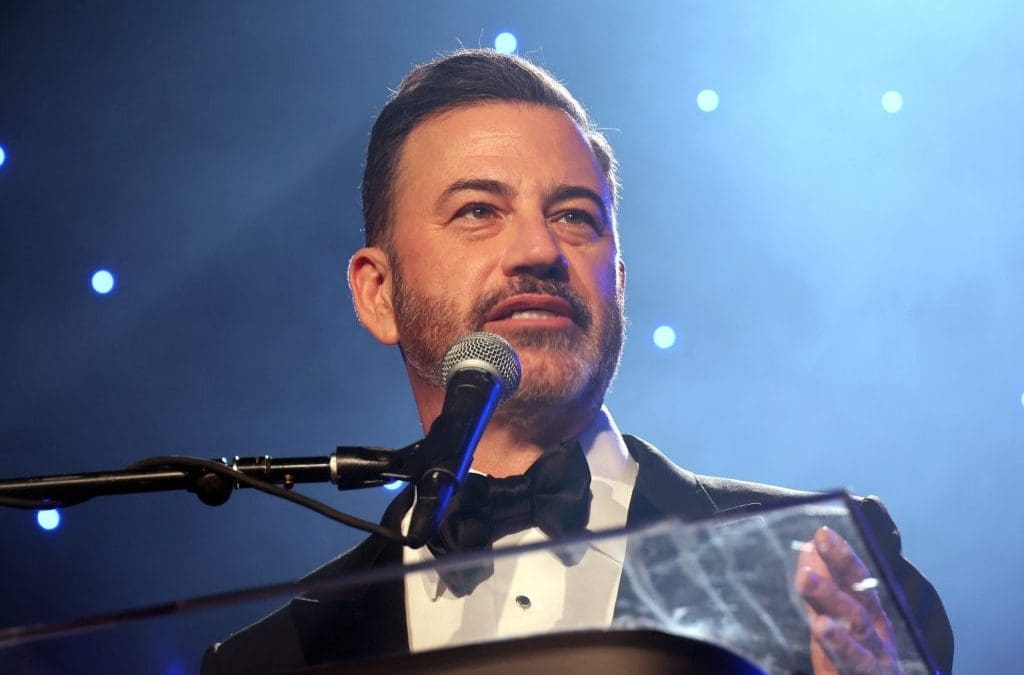
Original