by Jake Johnson | May 11, 2026 | Article, cuba, Iran, Politics and Movements: International, Politics and Movements: US, Reprint, Venezuela, War
This story originally appeared in Common Dreams on May 11, 2026. It is shared here under a Creative Commons (CC BY-NC-ND 3.0) license.
US surveillance and reconnaissance flights off the coast of Cuba have surged in recent months as President Donald Trump has issued increasingly belligerent threats to seize the island nation by force.
CNN reported Sunday that the US Navy and Air Force have conducted more than two dozen surveillance flights—mostly of them near Havana and Santiago de Cuba, the country’s largest cities—since early February, after the Trump administration invaded Venezuela and kidnapped its president. The outlet noted that “similar patterns, in which ramped-up rhetoric by the Trump administration coincided with an uptick in publicly visible surveillance flights, occurred in the lead-up to US military operations in both Venezuela and Iran.”
“The flights are notable not only for their proximity to the coast, which puts them well within range of gathering intelligence, but for the suddenness of their appearance—prior to February, such publicly visible flights were exceedingly rare in this area—and for their timing,” CNN reported.
CNN published its story days after US Secretary of State Marco Rubio announced new sanctions targeting a conglomerate operated by Cuba’s military and a natural resources firm, intensifying the United States’ decades-long economic war against the island nation.
“Our people already know the cruelty behind the actions of the US government and the viciousness with which it is capable of attacking us,” Cuban President Miguel Díaz-Canel said in response to the sanctions. “They understand, just as the rest of the world does, that this is a unilateral aggression against a nation and a population whose sole ambition is to live in peace, masters of their own destiny and free from the pernicious interference of US imperialism.”
In a New York Times op-ed on Monday, US Reps. Pramila
by Brad Reed | May 11, 2026 | AI, Article, Economy, Economy and Inequality, Inequality, Politics and Movements: US, Reprint
This story originally appeared in Common Dreams on May 08, 2026. It is shared here under a Creative Commons (CC BY-NC-ND 3.0) license.
A top state utilities regulator is calling foul on an effort to shift the power cost of out-of-state artificial intelligence data centers onto Maryland residents.
Maryland’s Office of People’s Counsel on Thursday filed a complaint with the Federal Energy Regulatory Commission (FERC) against electric grid operator PJM Interconnection objecting to plans that it said would force residents in the state to pay $1.6 billion in data center-driven transmission costs over the next decade.
The complaint states that the transmission cost allocation methodology PJM is using “broadly socializes” the cost of increased power demands that is being driven by AI data centers.
“That result is unjust and unreasonable and violates the cost causation principles that have long governed transmission cost allocation and that this commission has repeatedly affirmed,” the complaint says. “PJM’s tariff imposes these costs on Maryland electric customers even though Maryland customers do not meaningfully cause nor benefit from those investments.”
The Office of People’s Counsel pointed to the massive number of data centers built in neighboring Virginia as a primary culprit for added strain on the electric grid.
“Amidst national data center growth, Virginia stands as the epicenter,” the complaint says. “Virginia is the largest data center market in the world… As of December 2024, data centers represented 3.6 GW of demand… reflecting, since 2013, a 660% increase in megawatt-hour consumption.”
This explosive growth in energy demand is only expected to intensify over the next several years, the complaint continues, noting that “PJM projects 32 GW of peak load growth across its territory by 2030, of which approximately 30 GW
by Jake Johnson | May 8, 2026 | Article, elections, midterms, Politics and Movements: US, Racial Justice, Reprint, Voting Rights
This story originally appeared in Common Dreams on May 07, 2026. It is shared here under a Creative Commons (CC BY-NC-ND 3.0) license.
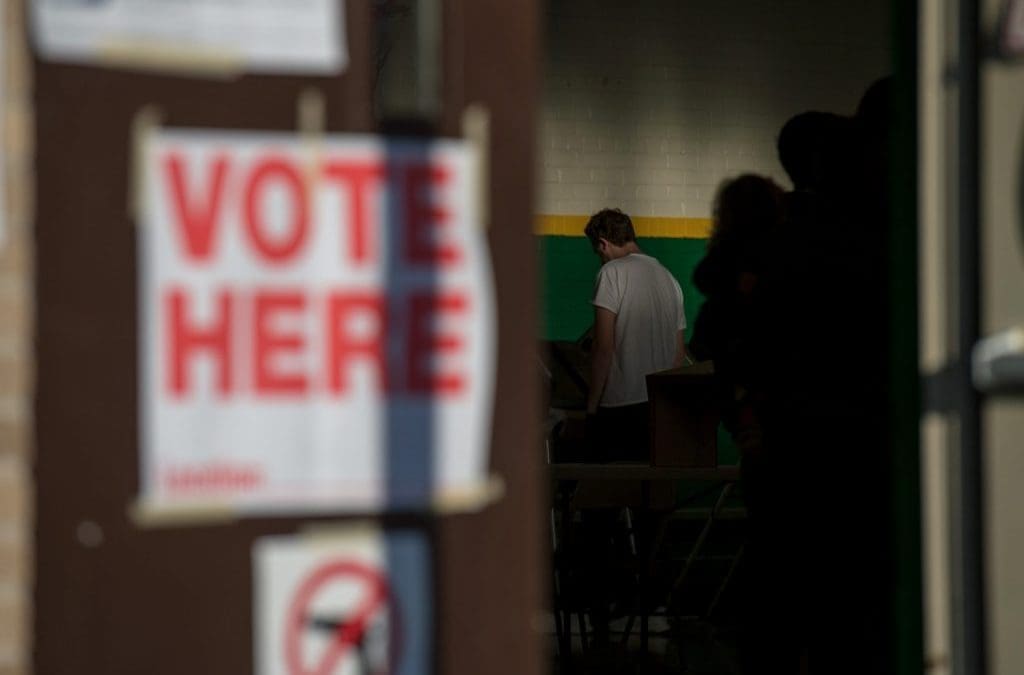
Republicans in the Tennessee House of Representatives voted during a special session on Thursday to adopt a new congressional map that would carve up the state’s lone majority-Black district, a move that came amid raucous protests from angry residents and Democratic lawmakers.
The special session was called by GOP Gov. Bill Lee at the behest of President Donald Trump, whose aggressive gerrymandering push across the country was supercharged by the US Supreme Court’s decision last week gutting the 1965 Voting Rights Act’s protections against racial discrimination. One Tennessee Republican—state Rep. Todd Warner (R-92)—walked into the House chamber for Thursday’s vote wearing a Trump 2024 flag as a cape.
The Tennessee House approved the new congressional map, which would likely draw the only Democrat in Tennessee’s US congressional delegation out of his seat, by a party-line vote of 64 to 25. Following the vote, The Tennessean reported that “Democrats linked arms and walked out of the room. Seconds later, the chamber adjourned.”
Shouts of rage flooded the Tennessee House chamber after the map passed, and protesters booed and jeered Republican lawmakers as they exited.
⚡️ WATCH — JUST NOW — 99% white Tennessee House Republicans pass a racist 9-0 map stripping majority Black Memphis of congressional representation pic.twitter.com/OYwTWZK2i1— The Tennessee Holler (@TheTNHoller) May 7, 2026
House passage of the map came after lawmakers voted to repeal a 1972 ban on mid-decade redistricting after limited debate, clearing the way for approval of the new district lines, which are expected to draw US Rep. Steve Cohen (D-Tenn.)—the only Democrat in Tennessee’s congressional delegation—out of his seat.
The Tennessee Senate is expected to approve
by Sharon Zhang | May 7, 2026 | Article, Iran, Israel, Politics and Movements: International, Politics and Movements: US, Reprint, War
by Stephen Prager | May 6, 2026 | Article, Economy and Inequality, Inequality, Iran, Oil, Politics and Movements: International, Politics and Movements: US, Reprint, War
by Julia Conley | May 5, 2026 | Article, elections, midterms, Politics and Movements: US, Racial Justice, Reprint, Voting Rights
This story originally appeared in Common Dreams on May 05, 2026. It is shared here under a Creative Commons (CC BY-NC-ND 3.0) license.
Warning that the US Supreme Court’s right-wing majority was appearing to give its approval of Louisiana’s decision to suspend federal primary elections in the state following the court’s ruling on the state’s congressional map last week, Justice Ketanji Brown Jackson on Monday evening was the lone dissenter as the court agreed to immediately finalize the ruling instead of waiting the customary 32 days.
By expediting the ruling, suggested Jackson, the court was taking an obviously political stance in support of efforts to ensure Louisiana Republicans can quickly redraw the state’s congressional map to yield more electoral wins for the GOP.
“The court’s decision to buck our usual practice,” wrote Jackson, “is tantamount to an approval of Louisiana’s rush to pause the ongoing election in order to pass a new map.”
Ordinarily, the court would wait 32 days to transmit an opinion to the lower courts, giving the losing party time to request that the justices reconsider the case.
In a brief, unsigned opinion Monday evening, the court said that the Black voters who had defended the state’s 2024 congressional map at the center of Louisiana v. Callais had “not expressed any intent to ask this court to reconsider its judgment.”
In Louisiana v. Callais last week, the court ruled along ideological lines that the 2024 map—which was drawn to better represent the population of Louisiana, where one-third of residents are Black—was an unconstitutional racial gerrymander. The ruling effectively struck down the last remaining provision of Section 2 of the Voting Rights Act, which held that voters of color can challenge racially discriminatory electoral maps.
The map that was struck down ensured there were two majority-minority districts in