‘A soul-sucking, desolate hell’: How I survived America’s most secretive supermax prison

‘A soul-sucking, desolate hell’: How I survived America’s most secretive supermax prison

Eric King is a father, poet, activist, and anarchist who was imprisoned in 2014 for acts of solidarity with the Ferguson, MO, uprising in the wake of the police killing of Michael Brown. While locked up, King endured years of documented physical and psychological torture, spending the last 18 months of his sentence in the ADX supermax prison in Florence, Colorado. In this episode of Rattling the Bars, host Mansa Musa speaks with King about how he survived his incarceration “with heart and soul intact,” and about King’s new book, A Clean Hell: Anarchy and Abolition in America’s Most Notorious Dungeon, in which he “opens the doors of America’s most secretive prison and lets the reader step into the cell to experience all the horrors the Federal Bureau of Prisons tries to keep hidden underground.”

Guest:

Eric King is an anarchist who was imprisoned in 2014 for acts of solidarity with the Ferguson, Missouri, uprising. While in federal custody King was indicted for a self-defense incident at FCI-Florence. King took it to trial and is one of the few people to ever win such a case at a federal trial. After his legal victory, King was sent to the federal supermax ADX, where he spent most of his final two years of his prison bid. During his time in prison King coedited the political prisoner anthology Rattling the Cages: Oral Histories of North American Political Prisoners. King survived years of documented physical and psychological torture and made it out of prison with heart and soul intact. He is an activist, antifascist, and loving father and husband who lives in Denver, CO.

Additional links/info:

Eric King, PM Press, A

Original

Trump’s loophole for mass-jailing immigrants: The US Marshals

Trump’s loophole for mass-jailing immigrants: The US Marshals

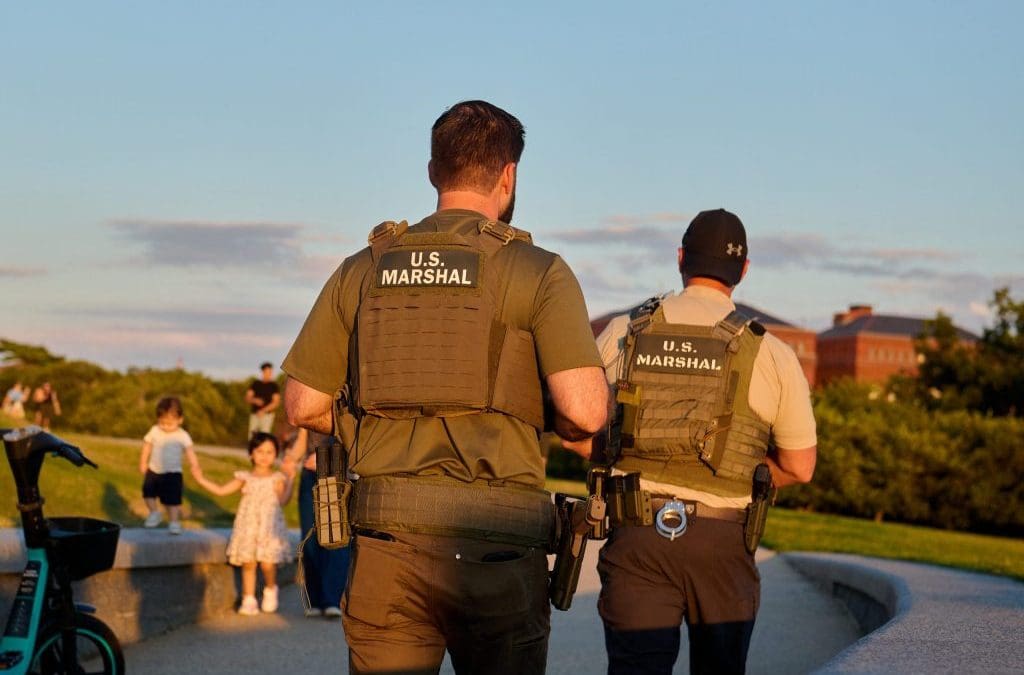
US Marshals patrol The National Mall in Washington D.C. on orders from Pres. Donald Trump, Aug. 25, 2025. Photo by DOMINIC GWINN/Middle East Images/AFP via Getty Images

There are two primary federal agencies tasked with immigration detention: ICE, which is well known, and the US Marshal Service. Under the Trump administration, the US Marshals have dramatically increased their role in detaining and incarcerating undocumented immigrants, using their federal power to override restrictions on immigrant detention in local jails around the country. In this episode of Rattling the Bars, host Mansa Musa speaks with Wanda Bertram, communications strategist for the Prison Policy Initiative, about how the Trump administration is weaponizing legal loopholes and the US Marshal Service to execute the mass incarceration of immigrants.

Guest:

Additional links/info:

Credits:

  • Producer / Videographer / Post-Production: Cameron Granadino
Transcript

The following is a rushed transcript and may contain errors. A proofread version will be made available as soon as possible.

Mansa Musa:

Welcome to the edition of Rattling the Bars. I’m your host, Mansa Musa. We’ve been hearing terms like deportation, immigration, arrest, ice, the federal marshals. When we hear these terms, we hear ’em relative to people. People that’s undocumented in this country under the pretense that they’re committed a crime in this country, that they’re being arrested. But the reality is they’re being rounded up. They’re being rounded up like slaves was rounded up. They’re being rounded up like the Japanese was being rounded up and placed in tournament camps. Joining me today is Wanda Bertram, communication strategist with the Prison Policy Initiative at one of the most reliable research hubs for Data on Incarceration. A recent report by the Prison Policy Initiative titled Hiding in Plain Sight Revealed how local jails are central to Trump’s deportation. Wanda, welcome to Rallying the Bars.

Wanda Bertram:

I’m happy to be here. Thanks for having me.

Mansa Musa:

And so let’s start here. Explain to our audience the loophole that the Trump administration is using to bypass city and county sanctuary policies. Unpack that for our audience.

Wanda Bertram:

So I think the place to start is that there are two main federal agencies that are tasked with immigration detention, and one of them is ice, which most people have heard of Immigration and Customs Enforcement. And then the other one, which is a little bit less well known is called the US Marshall Service. And the Marshall Service does things that are not immigration too. They’re generally speaking, the federal agency that handles pretrial detention. And in our report, one of the things we did was we gave an estimate of how many people are in ICE detention and US Marshals detention because a lot of people don’t think about the US Marshals. Right. And then one of the other things we did was we pointed out this loophole that you mentioned and what we call the loophole is just the fact that lots of local jails, including many that have said, we are not going to cooperate with ice,

Have contracts with the US Marshals to house, to detain immigrants who are under the jurisdiction of that agency. And actually, ICE can also piggyback off those US marshals contracts. So whether someone is under the jurisdiction of the US Marshals, and I can explain the difference between that and ice, whether someone is under the jurisdiction of the US Marshals or with ice, hundreds of local jails across the country are making room for those detainees to be held. So there are thousands and thousands of detainees who are being held in local jails that are run by sheriffs that the people left.

Mansa Musa:

Right. Okay. So in terms of the difference between ICE and the Federal marshals, because I think we was talking off camera, when you think of a person being detained by the Federal Marshals, we’re thinking about actually a crime has actually been committed a crime in form of like a gun violation of a federal statute violate of federal criminal code, violate of federal law. I’m in possession of large quantities of drugs. I’m doing counterfeit, I’m in possession of weapons. I think they had in Baltimore City, they had passed this law saying that anyone court, in order to get control over what they dubbed as a serious possession of guns in the city, they created this law where they say that anyone arrested with a gun in Baltimore, they federalized it. So they called it, I’m trying to think if they had a term that they was using. But everybody that got caught with federal guns got caught with guns during that time was arrested and put under Federal Marshall jurisdiction. At that time, I was in Supermax in Baltimore City and they took a whole section and specifically design it for that. So talk about that. Talk about the difference between the two and why it’s important that people understand that.

Wanda Bertram:

Yeah, I’m really glad you brought that up. The US Marshals, like you’re saying, when I think of the US Marshals, I think about people being charged with gun related crimes, with drug related crimes. Sometimes with federal violent offenses, the federal government has a wide latitude to choose to prosecute certain cases. And once they bring someone under their jurisdiction, or if they arrest someone, obviously they can also bring people who are under state or local jurisdiction into their jurisdiction through these state and local agreements. So the long and short of it is if you are charged with a federal crime, you are under the US Marshal’s jurisdiction. The rub here is that there, there’s been an increase in several thousand people since Trump took office in January who were under US Marshals, who were booked into US Marshalls jurisdiction for immigration related crimes. And what is an immigration crime? Come on. That can be as simple as just being undocumented illegal entry or illegal reentry. I think most people think, okay, if you’re under US Marshalls’ jurisdiction, you must have committed some horrible crime. But there’s a lot of people there who are just undocumented and their cases are becoming criminalized.

Mansa Musa:

And I was talking to one of the staff members here and I was telling that, and this is my thinking, right, the criminal element that will be under the Federal Marshals, they be like, in their mind they like, hurry up, hurry up and get me out. Send me to wherever you want to send me at so I can hurry up and get back in the country. A person that’s a person that’s committed immigration crime or whatever these terms they’re using, these people know the threat that they represent is, I’m a threat because I’m working hard, I’m paying taxes. But talk about how local jails specifically playing Trumps mass deportation program, both in terms of scale and conservation and immigration arrest, and you spoke on it earlier about how many people being arrested and being detained, but talk about how it’s planned out.

Wanda Bertram:

We know. So we estimate that on any given day, currently there’s about 83,000 people, immigrants being held for ice. And the US Marshals, I can break down how we got to that number, but of those, we know that about 10,000, a little over 10,000 people are being held in local jails for ice. We unfortunately can’t tell how many people are being held in local jails for the Marshall who just don’t have that granular data. But we actually, I will say one more thing. I’ll throw out one more statistic, which is that between January and May of this year, the number of people held for immigration reasons grew more in local jails than it did in privately run detention centers. I’m throwing this out there just to say that jails play an essential role in housing immigrants for these agencies.

I think a lot of people think about ICE as having tons of detention centers, its own detention centers around the country. And it’s true, there are several, but these agencies depend on local facilities that can hold people temporarily or for a longer time after they’re arrested. In fact, in 26 states, jails provide the sole detention capacity to ice US marshals. So a lot of people think, okay, sure. This is going on in Texas, it’s going on in Florida with alligator Alcatraz. It’s not happening where I live. You might be wrong. It might be happening where you live. A lot of jails caught up in this.

Mansa Musa:

Right? And that right there, the impact, talk about the impact that have on the population because I know if I’m a state and I’m outsourcing or I’m contracting with the federal government, I’m contracting with ICE to provide so many bids for immigration or a section for immigration, then how does that play out in terms of the way that particular detention center function overall? Because now I have to allocate staff, I have to allocate extra money, I have to allocate. And in terms of what they’re entitled to versus what people that’s is entitled to have Y, is it a problem with that or from your investigation and your study, have you seen this being problematic?

Wanda Bertram:

Well, I think we need to start talking about the money. That’s the reason that ICE and the Marshals, or excuse me, that’s the reason that local jails have these agreements in the first place. Jails are keen to bring in money from the federal government that they get in exchange for housing people, and they get somewhere anywhere between 50 and a hundred dollars per person. So it’s thousands of dollars that come in just every month for a local jail. And importantly, we have very little transparency into what that money is used

Mansa Musa:

For.

Wanda Bertram:

But some jails have been open about saying, we are using this to pay our staff. We’re using it to cover costs of the jail.

It ties into a very toxic pattern that we’ve seen over the last couple of decades, which is that counties will build, actually, they will build bigger jails anticipating that they’ll be able to allocate some of their new jail space to renting to the federal government or to their state prison system. And where there’s two ways that this all goes wrong, one is that oftentimes these jails are already understaffed. They don’t have the staff to care for their own populations, much less an additional influx of immigrants or people held by the US Marshal for any reason. And then the second thing, the second way this goes haywire is that these populations, these populations that come in from the feds, they flux, right? They come and go. And when those populations, when that source of revenue dries up for the jail,

Mansa Musa:

They’re

Wanda Bertram:

Going to need to justify the existence of such a large facility in other ways, and that’s going to lead to more local incarceration. We like to say that if you build it, they will fill it. And when counties build bigger jails anticipating renting beds to ICE or the Feds in some other capacity, they find a way to fill those beds, whether it’s with federal detainees or their own community members.

Mansa Musa:

And then in some states like California, Massachusetts, New York and Illinois have laws that restrict local law enforcement from collaborating with ice. But that’s like when you do a comparison versus the amount of money that y’all talked about how this past great, beautiful nightmare of a bill that they passed, they allocated a lot of money to ICE and a lot of money to the federal government. So how do you see the pushback, or what can states do to eliminate this nightmare? Because as you said, at the end game, the end game, the state going to be holding the bag and the end game, they’re going to have to come with some way to fill themselves, and that’s going to be at the expense of the citizens of their particular state or county. Talk about that.

Wanda Bertram:

Yeah. One thing in the report that we really hammer on is that communities have, in so far as communities are providing some of the backbone of detention. They also have the power to be a real thorn in the side of the Trump administration by resisting that. Like you pointed out, some states and several counties have instituted sanctuary city policies, and often that means, or sanctuary state policies, and that limits the jail’s. Collaborations of ICE communities also need to cancel their contracts at the US Marshals, because as I said, at the top, ICE can piggyback off of the US marshals. They can put people in jails through a US Marshals contract, and those often go overlooked. Again, the marshals are not an agency most people think about. So that’s a step that counties have been able to take to several years. They can do it now and they should do it now.

I think the other thing is on a longer timeframe, being critical of your local government, when they talk about building a new and bigger jail, just to throw something out there, this is not related to immigration at all, but about 80% of people in local jails are their pretrial. Now, this is another thing that Trump has been trying to attack is bail reform. But when counties are facing overcrowded or understaffed jails and they have these large pretrial populations, one thing that most places most counties have not tried is decarceration, right? Pursuing bail reform, pursuing cashless bail as a way of decreasing their jail populations. Instead, what many counties will do is they will try to build a bigger jail thinking it’s going to solve the problem.

And sometimes that’s what gets counties into this pickle with the federal government is they build this big new jail, and then they have a big tab to cover. And it’s very helpful if the federal government comes in and says, well, we can offset some of your costs. You just have to house some people for us. So I mean, definitely to anyone listening who’s wondering, what can I do in my community? I definitely would say being critical, being skeptical of any plans to expand your county jail and show up to city council meetings about that. Be a sticky wheel, because that’s how this happens. That’s how it starts.

Mansa Musa:

Okay. And thank you wa tell our audience how they can stay in touch with you or stay aware of some of the work that you’re doing with Prison Policy Initiative as we close out.

Wanda Bertram:

Well, no. I mean, first, thank you so much for having me. I think it’s great to be able to come on and talk about this stuff. Our website is www prison policy.org. We have a newsletter. If you sign up for that, you’ll get everything that we publish. It’s about a once a week newsletter. We also have social media. If you go to basically whatever social media you’re on, we’re at slash prison policy.

Mansa Musa:

Thank you. And as we close out, we thank you and appreciate all the work that y’all are doing at Prison Policy Initiative. And we want to tell our audience, remind our audiences that we deal with evidence, and it’s based on the statistics that the Prison Policy Initiative has offered us, that you can fact check ’em to get a clear understanding. But what we do know is this here, we know that people are being rounded up. We know that agencies that supposed to protect, serve and protect people’s rights are being used to help aid and assist in rounding people up. We know that people are being housed in astronomical numbers, in inhumane environments for one reason and one reason only. All because they’re undocumented in this country. They haven’t committed no crimes. To the extent that’s being perpetuated by the Trump administration, they’re here, they’re undocumented, and the most crime that they committed is driving without license or picking tomatoes. We ask that you continue to support real news and rallying bars. We ask that you continue to evaluate this information. We ask that you weigh in on what you think about this information, but more importantly, we ask that you make a decision on what you think should be done and do that. Thank you.

Original

‘We are all DC’: Massive protests rock US capital in defiance of Trump

‘We are all DC’: Massive protests rock US capital in defiance of Trump

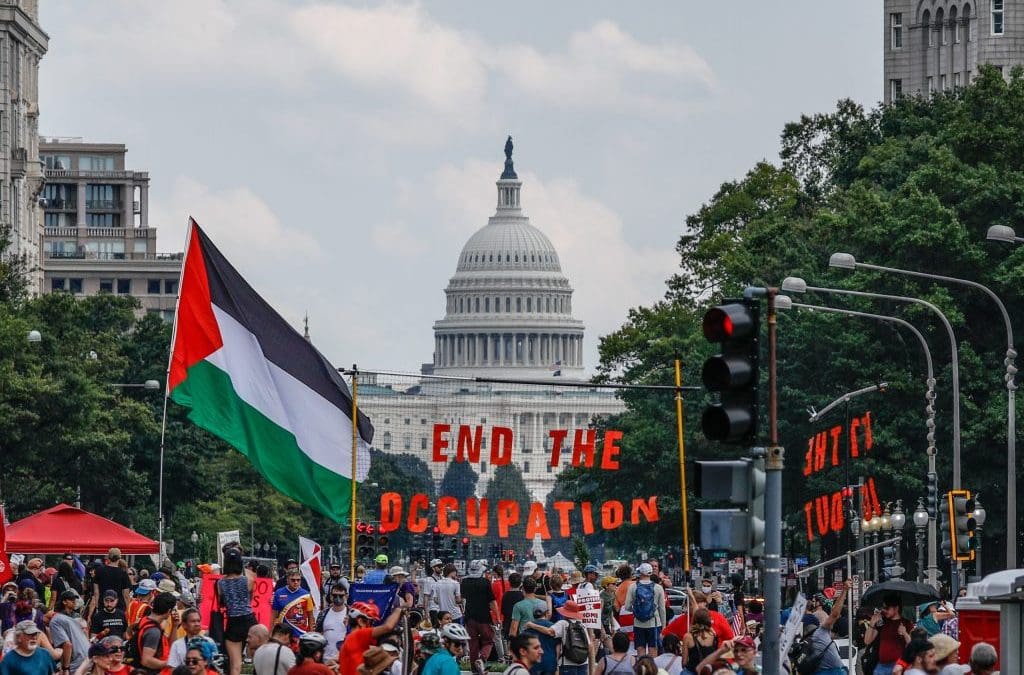
Protesters gathered in the nation's capital on September 6, 2025, to raise their voices against the federal government's efforts to increase control over the city's police department. The demonstration, titled

On Saturday, Sept. 6, thousands of local residents, out-of-state supporters, union members, and concerned citizens of all stripes marched through the nation’s capital to protest President Trump’s militarized federal occupation of Washington, DC. The “We are all DC” march was one of the largest protests—if not the largest—to take place in the US capital since the beginning of the second Trump administration. Reporting from Malcolm X Park for TRNN, Rattling the Bars host Mansa Musa and Edge of Sports TV host Dave Zirin give an on-the-ground account of the size, makeup, and significance of Saturday’s protest.

Credits:

  • Producer / Videographer / Post-Production: Cameron Granadino
Transcript

The following is a rushed transcript and may contain errors. A proofread version will be made available as soon as possible.

Mansa Musa:

I am here at Malcolm X Park in Washington, DC with Dave Zirin. Today we are looking at the birth of a mass movement around anti-imperialism, antifascism, anti-capitalism. Talk about what you see today, Dave.

Dave Zirin:

I’m so impressed right now. This is a demonstration to free DC and what we’re seeing out here is that it unites people of across all sorts of ways. You’ve got people here from all backgrounds, you’ve got people here of all ages. Multi-generational protests in this town are actually quite rare. And to see all of this is incredible. Also, incredible union delegations, which I have not seen yet at these demonstrations. That’s a big deal. Also a big deal. They’re masses of buses of here from Baltimore. There are masses of buses of here from New Jersey. There’s a whole Unite here union team from Jersey, like dozens and dozens of people. And what this says to me is that people are not looking at DC as a DC issue. That’s right. Or one, they’re just offering solidarity with us. People are seeing we could be next and DC will either be the first or the last city under Trump’s military occupation.

And we play a role in that by defending DC. So it’s amazing. I mean, this is huge. Right? And look, we can go into demos of dozens of people, 50 people, a hundred people to free dc and this is just over the top. Amazing. And can I just say one last thing? Come on. It is a tribute to the people of Washington DC and the resistance that they have already built because that’s the pole of attraction that’s brought so many people here today. If there was no resistance, if the vibe from DC was nobody cares that we’re now being militarized or we support that we are being militarized. No one would come here to support us. So the fact that we have created a pole of attraction on this is just incredible.

Mansa Musa:

And the fact they got it in Malcolm X Park. But talk about, you mentioned earlier, multi-generational, but talk about the international characteristics of this particular march because they start out saying, they start out saying it’s about free dc right? But then it turned into free people. NS turned to more or less getting around the issues of Palestine, getting around the issues of the immigration law, getting around the issue. What he getting ready to do in Venezuela. Talk about the international characteristics of this movement.

Dave Zirin:

Well, the international aspect of this demonstration and the international aspect of this moment are very real because what is happening overseas is boomeranging onto us back home. Authoritarianism, soldiers, children dying without repercussion, no investigations of things. Decades ago there would’ve been congressional oversight and demonstrations of, look, I’m not naive about how things used to be. I know there’s always been so much rotten in this system, but people have to recognize that it’s been turned up 15 to 20 notches under Trump. We’re talking about the militarization of our cities, and it’s international for a couple of reasons. Let’s start with Latin America. This is a crowd of people who understands that people are fleeing to come to this country. And we used to have a system in this country called asylum. And instead of people being treated as like, give me your tie, your poor, your huddled masses. People are being treated not just like criminals, but people who deserve to be tortured, people who deserve to be sent to South Sudan. How does a family from El Salvador that is starving, coming to this country know a damn lick about South Sudan, know a damn lick about a prison camp in Libya. How are they ever supposed to get home? These are people being disappeared by an international prison system. And that’s one aspect of this international development. It’s solidarity with the people of Latin America and saying, immigrants are welcome here. Another aspect of the internationalism that we’re seeing is a lot of Palestinian flags and banners.

Mansa Musa:

That’s right.

Dave Zirin:

I haven’t heard something yet from the front of the stage about it. And that’s fine if people want to keep a broader united message because on the ground, it’s flags in keffiyehs here. And I think we have to understand that there’s an anti-colonial solidarity. That’s right. That’s very real. And another aspect is that the Palestinian struggle and the movement against the massacres of children taking place in Gaza, the famine and Gaza, that is what animates the young generation to want to hit the streets, to risk arrest, to risk losing their college financial aid. And that is represented here today. That is why the Democratic party can’t even go to a college to campaign anymore because they’re so pro-Israel. And no student anywhere is going to have that even down south, even in the old Jim Crow. I mean, even at the state schools, people are protesting and they can’t have that.

Original

‘We want DC to be free!’ Voices from the ‘We are all DC’ march

‘We want DC to be free!’ Voices from the ‘We are all DC’ march

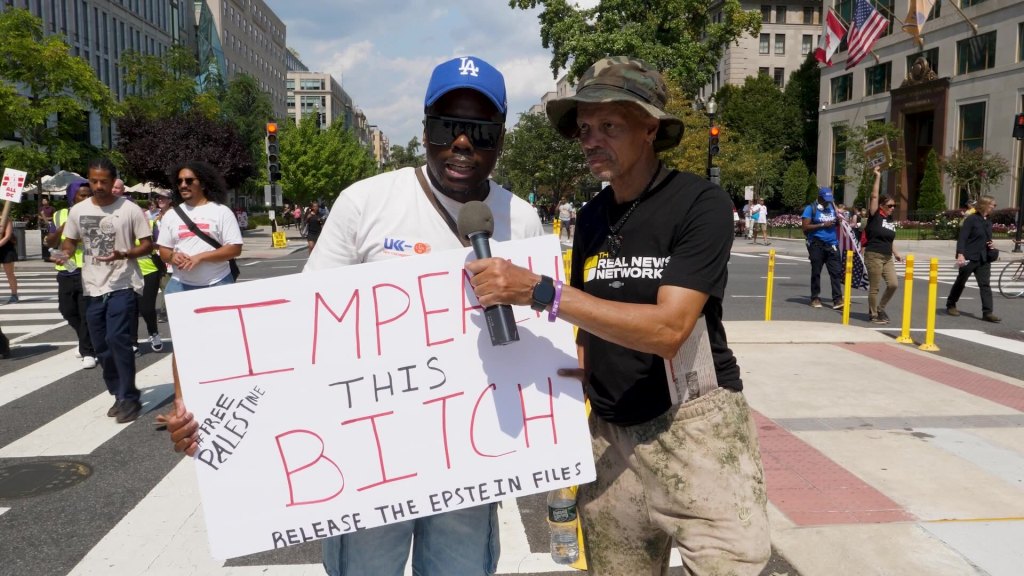
TRNN's Mansa Musa (right) speaks with an unnamed protestor and

The “We are all DC” march on Saturday, Sept. 6, was one of the largest protests—if not the largest—to take place in the US capital since the beginning of the second Trump administration. Thousands of local residents, out-of-state supporters, union members, and others marched through the streets of Washington, DC, to demand an end to President Trump’s militarized federal occupation of DC. But the march also brought together a cross-section of concerned citizens protesting the Trump administration’s attacks on immigrants, US support for Israel’s genocide in Gaza, and more. Reporting on the ground for TRNN, Rattling the Bars host Mansa Musa speaks with a range of organizers and attendees at Saturday’s march.

Additional links/info:

Credits:

  • Producer / Videographer / Post-Production: Cameron Granadino
Transcript

The following is a rushed transcript and may contain errors. A proofread version will be made available as soon as possible.

Mansa Musa:

We at Meridian Park, also known as Malcolm X Park, where we are recovering the rally from free dc, a coalition group of all organizations in the District of Columbia that’s coming together to call for the freedom of dc. What do freedom of DC mean? It means they saying that in the federal occupation, but it means more than that. It means statehood, it means the right to self-determination. As you can see, a lot of people have come out here today to be a part of this process. What you going to see today is a textbook and organizing 1 0 1. What do you think about this movement today?

Alfonso:

Well, I think it’s very popular. There’s a lot of people, it’s across generations, across all walks of life. So I’m really hopeful.

Mansa Musa:

Right. And in terms of the connection between the DC federal occupation and what we seeing going on in Occupy Palestine, is it a connection?

Alfonso:

Well, I guess there is a connection, but it’s much worse and much more serious what’s going on in Gaza.

Mansa Musa:

And I agree 100%. Right, it’s more serious. But do you think that in terms of your presence here and the fact that I walked around, I see a lot of Palestinian flags. I see a lot of, I get out of Gaza free Palestine, so it’s obviously international, it’s obviously international connection. People are looking at from respect that none of us are free until

Alfonso:

All of us are free. Absolutely. I think we have a lot of things to protest against. So I think it’s a good moment to gather and ask for all of those things. Right.

Lydia Walther-Rodriguez:

We’re here today with over a hundred CASA members, over a dozen organizations with one simple ask to stop the militarized occupation in DC

Mansa Musa:

They using the law to say that if you are committed a crime and you are an immigrant, then they hold you to the outcome of your crime to determine whether or not they’re going to deport you. But they rounding people up saying that under the pretense they commit the crime. What do you think? Really the story is behind why they rounded?

Lydia Walther-Rodriguez:

We are seeing a time that is unprecedented to us, but a time that has repeated itself over and over again under this administration. We have seen the constitutional crisis of the injustice of this president not respecting due process. We saw it in Quin Ab Garcia’s case, and we continue to see it every time they detain our immigrant communities here in DC and Baltimore, all across the country, folks are being detained and targeted and there there’s a PR machine saying they’re criminals. But the reality is that they see black and brown people and they have already targeted us as criminals and are taking away our due process. It’s happening to, it’s happening to immigrants, it’s happening to black Baltimoreans, and it’s going to happen to all of us if we don’t put a stop to this right now.

Mansa Musa:

And I like that. I like that articulation because I want you to unpack this right here. Alright. As you said, they rounding up people under the prescience of being criminals. Do you think that the fact that they’re using their lack of citizenship status to ignore their rights as human beings,

Lydia Walther-Rodriguez:

We know there’s no dignity and there hasn’t been dignity in this country for people of color, for black Americans, for immigrants, for anybody who does not meet the white supremacist agenda, they’re just trying to use the laws that were created against us. But we have the Constitution that clearly states that we have due process and in violation of due process is where we will resist, we will fight back and we will not allow these normalized racial biases to continue to silence the voices of the struggle. And for everybody who can hear my voice, it’s going to happen in you two if you don’t rise up and stand up.

Mansa Musa:

That’s right. And we remember in time in history was called Dr. Scott decision and Dred Scott, the Supreme Court, said that Dred Scott did not have no rights that the United States was bound to respect because he was considered one third of a human being and looked like they resurrected the Dred Scott decision in terms of rounding up people, not just Latin Americans, Latinos, Hispanic, anybody that can fit the narrative. You got the last word on this

Lydia Walther-Rodriguez:

Dred Scott decision never left us. Our people have continued to suffer as black, indigenous, Latina queer. And now this system is showing its face. Are you listening? Are you seeing it because we’re seeing it through every single kidnap that’s happening every single day in the streets of DC and countrywide? This is not a phenomenon that started here, but the US occupation intervention has been piloted in Central and South America. And it has shown to us that imperialism continues and its tactics will continue on in this country too.

Susan:

There have been people we’ve talked to, there’s a whole bus from Unite here, it’s come from Philadelphia, people from New Jersey, Vermont, Florida. So I think people understand the threat. This means not just for people in DC and for the country, and I guess particularly from Pennsylvania, people from DC every election go out and canvas and do things we don’t have people to vote for. So I kind of feel like it’s paying back and appreciative of that.

Sarah:

There’s 60 of us here from Vermont because we want DC to be free. This invasion is terrible.

Mansa Musa:

Why do y’all feel like y’all had to come down here though?

Sarah:

Because if Trump does it here, he’s going to do it in the next city, in the next city, in the next city. And this is not a dictatorship. And just because most of the people in DC voted against him, he’s now pissed and he’s taking it out on them. That is not right. This is not a dictatorship. This is a country where we all vote. And if he doesn’t, people don’t like what he’s doing, they’ll vote him out and bye-bye Mr. Trump. We’re here to support the people in dc

Gelly:

We have basically changed our rhythm from focusing on climate change legislation and getting elected officials in that are for a green New deal. And we’ve shifted completely to trying to combat the administration and the oligarchy and occupation that’s happening because we can’t get anything done with them in office.

Mansa Musa:

So you think it’s a connection between climate change, immigration and free dc?

Gelly:

Absolutely. And there’s a connection between climate change and the oligarchy that’s happening right now in our government.

Mansa Musa:

Okay. So what you think about the demonstration today?

Gelly:

I think the demonstration today is beautiful. I see a lot of people out here focused on different things. We’ve got immigrants, we’ve got climate people, just everyday Americans who want to be free and don’t want to have an occupation in our streets.

Mansa Musa:

This definitely is a people’s movement?

Gelly:

Absolutely. Yeah. This is for the people, by the people.

Mansa Musa:

It’s all about the revolution…

Joe:

This is Bernie Sanders’ group, our revolution group. And why are y’all here? Well, we’re here because the country’s been taken over by a group of fascists.

Mansa Musa:

This is Malcolm X Park. At one point in time you had African Liberation Day. They rally around. They rally around here. But more importantly, the most salient demonstration and rallying point was the war in Vietnam. And it all started with small groups. And then every day

Joe:

I was in all of them

Mansa Musa:

Nationally, you see nationwide, worldwide. So you got defund genocide, free Palestine.

Lisa:

Well, I think our giving military aid to Israel is just perpetrating these attacks on Gaza and giving them the means to commit genocide and cause this starvation, this hunger problem over there. And what’s really upsetting is people are trying to get the aid we’re sending and they’re getting shot down. And I find that quite upsetting. It’s an atrocity,

Joe:

It’s a major war crime and genocide. The whole world knows it. But the good thing, except for Trump and his administration,

Jane:

A members of Congress including a lot of Democrats in Congress who won’t vote to cut off the aid.

Mansa Musa:

Why is occupation a crime?

Pomelo:

Oh, occupation is just a violation of everybody’s dignity and justice. It’s an complete abuse of power. Everything that’s happening in Palestine is going to be happening in the states and DC is the test case for what’s going to happen across the country. So it’s all intersectional. It’s being tested on Palestine. The technologies they’ve been used on Palestine ICE are now using here on DC and people are across the street. So we’re just got to protest it all.

Mansa Musa:

What do you think about today’s demonstration?

Pomelo:

It’s fantastic. I mean, obviously people have to be protesting every day in their lives, not just in one protest that we get to go on a Saturday. Everybody can do actions all day every day. But it’s amazing to be in masses of people and know that you’re not alone.

Mike:

Human rights belong to everybody. When people start taking people off the street claiming they’re illegal, they’re not only hurting that person, they’re hurting the family that they provide for, which can be a large family in the community as a whole. Even if they’re not legal citizens of the United States, they still pay taxes. They still belong here. We are the melting pot of America. Isn’t that correct? We have a statue in New York Harbor that is meant for exactly that.

Mansa Musa:

Most people just won’t be treated as human beings.

Mike:

That’s correct. Why can’t everybody just be treated like human beings? There’s a lot of people out there that are intimidated of large groups of people or people they don’t know or understand instead of loving them.

Mansa Musa:

Why are you here today?

Yuri:

Well, I’m an immigrant and I don’t feel like we are being treated fairly. We are here to work, to be part of America and support the American dream, and that way that we’re being treated is just unfair. So I’m here to protest.

Mansa Musa:

Bottom line. You here to do the same thing his father did, came here to find a place to live and get living conditions and you’re no different. You’re not an immigrant. You’re a human being.

Yuri:

Thank you. I appreciate that.

Mansa Musa:

Yeah. Talk about your sign.

“Freedom Fighter”:

My sign indicates today that our president can go into the White House, he could exercise his writer free speech. I’m doing the same. I’m keeping it in plain text English. Let’s impeach this bitch. What’s happening in our world is not okay. What’s happening in Palestine is not okay. And we as a people have come together today to stand for justice, for unity and to take back our streets. I think that this is what DC is. It is collective unity. It’s love, it’s peace, and it’s coming together on the streets and letting our voices be heard. So this is what this represents and this is beautiful.

Mansa Musa:

And talk about what you think the takeaway going to be today. For most people,

“Freedom Fighter”:

The takeaway for most people today is going to say, listen, we are here. We’re loud. We’re in color. We’re letting our voices be heard. And enough is enough, right? We’re in the streets. We love dc, this is our home. And we won’t let it just go willingly and teach this bitch.

Medea Benjamin:

I think this one is great because it brings together so many key issues. You have the issue of ice, get ice out of our city. You have groups like Casa representing immigrants and the signs saying immigrants are welcome here. Then you have the issue of the militarization of our city, which is wrapped around the whole issue of free DC and statehood for dc. And then we have the issue of Palestine. That occupation is a crime from DC to Palestine. So it’s all connected. It’s a large march. It’s very militant and I think it’s great.

Mansa Musa:

And I dub this as organized in 1 0 1 because we seen initially the call was for free dc, but then it takes on the international and national character. How do you think This’s going to play out in the long run?

Medea Benjamin:

Well, I think in the long run, the only way to deal with any of these issues, whether it’s ice or the oppression of DC by the Trump administration or Palestine, is united front. And this is an example of United Front. It’s got to get much bigger and we’ve got to really strengthen all of those connections. But this is a great example.

Mansa Musa:

This remind me of the war in Vietnam. When we had the marches against the war in Vietnam, it started out microscopic, but then it got to a point where it became international, where every Saturday, every Sunday, every day throughout the week, you see masses demonstration. So this is characteristic of that. Do you not agree?

Medea Benjamin:

Absolutely. And I think that’s the way we have to do, it’s great to be marching on a Saturday, but we really need to be out in the streets on a Monday, Tuesday, Wednesday, Thursday, Friday when we say no business as usual. So I’m looking forward to that because until now there’s been small groupings of these individual issues. For example, I’m in Congress all the time and you see the free DC people in Congress, you see us, the Palestine people, you see the immigrant rights people, but they’re not together. So if we joined up during the week as well as on the weekend, I think there’s so much power in that.

Ryan Harvey:

Well, I think it’s important for folks. We came down, we had five buses come down from Baltimore, organize that with in partnership with unions and grassroots groups. I saw a busload of folks from Vermont. I think it’s really important for folks to take some national action right now and stand up because DC’s a test case. DC’s the city where he’s testing out how far he can push it. And I think Trump’s making real authoritarian moves right now. And I think it’s really important for people to be out here, not just for us and for the people in our cities, but also for members of the National Guard and members of the US military. They need to be asking themselves if they’re not already serious questions right now about what they’re doing, what they’re being asked to do, what their rights are, and do they have the willingness to stand on the right side of this.

Mansa Musa:

And we was down here, one of the marches that they had, and it was about 60 people today. It looked like we estimating more close to 3000. But in terms of the coalition building, what’d you think about that?

Ryan Harvey:

I mean, I would say this looks to me like it’s at least 10,000. I mean, how far we’re stretching the White House right now, but no, look, I mean we’ve been building coalitions I would say in a pretty unprecedented way for the last couple of years. And I think what’s been happening, especially with the unity now between some of the labor unions and grassroots organizations, especially black led grassroots organizations in DC, I think is critical. I think the labor movement needs to be pushed in a better direction in terms of how they show up on the streets. And I think that a lot of folks need to be reaching out to the unions and working with the unions and organizing unions as well. So I think there’s a gap that we’ve been suffering from, I would say, since McCarthy in this country. And I think we’re starting to undo some of that. And I think it’s really good to see.

Mansa Musa:

And this remind me of the war in Vietnam, how to protest, start with the war in Vietnam. And it always ended up in DC where people come together in hundreds of thousands to protest. And I think this is the star that would you agree?

Ryan Harvey:

Absolutely. And Vietnam was a common enemy. I think there’s a misconception about the sixties that it was all about Vietnam. You go to a Vietnam War protest, there’s the black power movement, there’s the Puerto Rican Liberation Movement, the gay liberation movement, leftists, socialists, et cetera. The feminist movement. We’re in a moment like that and folks need to understand. And I think we are understanding that when you have these common struggles, that’s where a lot of problems get solved. That’s where a lot of forms of bigotry disappear when you confront that this person is fighting just like I am for something better for themselves and for the world.

Johnny Silvercloud:

It looks pretty amazing, man. It was like a whole lot more folks than I thought.

Mansa Musa:

Yeah. Have you been at the previous ones?

Johnny Silvercloud:

Yeah, a few of them. I was bit injured, so I couldn’t be in the ones early August. But I make my way to be out here. Now you’re talking to Johnny Silver Cloud, the premier photographer, videographer of Washington DC as far as street journalism goes.

Mansa Musa:

But talk about this movement and talk about the characteristics of it. Have you been noticing that they got people from all over the country?

Johnny Silvercloud:

Oh yeah. Especially as a military veteran, a lot of folks center around where we’re camped out at. We’ll find numerous folks coming from Mississippi, Georgia, California, Vermont, Maine. It’s pretty amazing. There’s probably a couple of days that I’ve missed. I don’t have overhead sight of every day, but these summer come out, there’s, there’s folks that are native to dc, native of the DMV. There’s a difference. And also folks from across the United States. It’s pretty amazing. Alright, one more thing. Alright. So we as Washington dc, especially US military veterans, we are not against the National Guard. We’re not against the troops, we’re against their presence. We are against their usage. Their usage. Because we’re not mad at the pieces on the chess board. We’re mad at the hand on the pieces.

Mansa Musa:

Okay. You mad at the people that’s moving the pieces?

Johnny Silvercloud:

Exactly.

Craig Williams:

I’m Craig Williams. I do a jazz program on Thursday mornings. Morning brew, classic jazz edition.

Mansa Musa:

Yeah, I listen to Morning Brew.

Craig Williams:

Oh good, good. And I’m also here in the streets representing the justice side of our radio station.

Mansa Musa:

What you think about this day’s demonstration?

Craig Williams:

I think it’s great that we finally have a really big event and turnout from everywhere.

Mansa Musa:

Look, when you look up we way down, we are in the middle of it and they way down the road. Talk about being alternative radio and attack on media. How is WPFW fighting back?

Craig Williams:

So we have not had corporation for funding, public broadcasting for over a decade. So they can’t take money away from us that they haven’t been given us. On the other hand, our Pacifica network was specifically mentioned in Project 2025 and the FCC is watching. So we have to be careful about everything we do, everything we say, everything we play, and it isn’t fun.

Mansa Musa:

Is freedom of speech under attack?

Craig Williams:

Absolutely. Absolutely.

Mansa Musa:

Why you wearing that at this time?

Unnamed Protestor 1:

Because it’s about solidarity. It’s about all the people who are experiencing hate and oppression banding together and not being divided.

Mansa Musa:

And you got to say a reminder, this is not normal. Why is this not normal?

Unnamed Protestor 1:

We do not need the National Guard in our streets. Our streets are safe. I feel more unsafe from the National Guard than I do from the people of dc.

Mansa Musa:

And what do you think about today’s demonstration, the turnout?

Unnamed Protestor 1:

I’m really happy about it because the last demonstration I went to was much smaller and I think that everybody should be in the streets. Everybody, when one person civil rights are taken away, all of our civil rights are at risk.

Thomas:

It’s a great turnout. Multicultural religious organizations in the forefront. And many people who are native and live in DC are here as well as people from around the region.

Mansa Musa:

Right. I noticed that it’s a cross section of people representation, the unions transgender, L-B-G-T-Q, the Palestinians. But talk about free DC because I see you have free dc. Talk about what it means when you say free dc.

Thomas:

If you notice the term free DC is more than taxation without representation is more than home rule. It’s actually the deliberation of people exercising their own right to liberty. So free DC means a lot. Those people who made our home, it means that we get to run our lives, we get to run our government. It’s not run from the outside even by a person like Trump.

Mansa Musa:

And I’m glad you qualify that. I was thinking the same thing when you say free DC and then you put the limitation on it, statehood that don’t mean that you free right now we got home rule. And do you think home rule represent freedom?

Thomas:

No. Home rule examples of what’s going on right now. Home rule show you that it’s not freedom. It’s so many exemptions and so many rights that can be taken away simply by the presidential authority.

Mansa Musa:

Talk about if you have a view on they saying the mayor capitulated to Trump going with the occupation. Talk about that, if you got a view.

Thomas:

The mayor plays within the lines. She’s not a rebellious person. She plays within the rules that are given to her. So she’s trying to make the best that she can. But the mayor, I thought was a friend of mine, but I can see her days coming to an end.

Mansa Musa:

Yeah, I think so too because right now most citizens in the District of Columbia don’t like this occupation. Just the other day, they locked out kids from Union Station. They didn’t let ’em at a certain time when the curfew kicked in, they said that they could not go use the subway in public transportation, the National Guard. And then the mayor turned around and say that we are happy that these people are here.

Keya Chatterjee:

We’re out here also in front of the Wilson building. So I want to say something also to Mayor Bowser. Mayor Bowser, your constituents call on you to stop cooperating with this administration. Do not make their work easier or convenient. We do not welcome indefinite coordination. Do we welcome that? No. And the vast majority of our constituents do not want this. Local leaders oppose what is happening right now. And we need you not to enable it.

Erin McCleary:

Mariel Bowser. Yeah, we need some leadership right now. We don’t need conciliatory, appeasement. It gets us nowhere. First rule against fascism is Yeah, don’t bend the knee.

Mansa Musa:

Don’t bend.

Erin McCleary:

Don’t bend.

Mansa Musa:

I thought she was for statehood. I thought she was for a home rule. I thought all her actions she say is in defense of these things.

Erin McCleary:

I mean, actions speak louder than words. And she talks to Pam Bundy every day. I am disappointed. I’m let down. I’m afraid.

Mansa Musa:

Oh, is it more or is it more like Pam Bundy? Tell her what to do every day.

Erin McCleary:

I mean, either way. Does she have to be an earpiece for Pam Bundy?

Mansa Musa:

No.

Erin McCleary:

Come on.

Mansa Musa:

What you think about today’s demonstration?

Erin McCleary:

Huge turnout. Very inspiring. We’re united. We’re united.

Mansa Musa:

She’s coming about there.

Erin McCleary:

She’s going to what?

Mansa Musa:

Bows. She’s coming about

Erin McCleary:

There. Oh, for

Mansa Musa:

Sure.

Erin McCleary:

She’s done. She’s done.

Mansa Musa:

She’s done.

Erin McCleary:

She’s done. Bye-bye. Bowser.

Mansa Musa:

Talk about the orange man. Why you got the orange man?

Maisy:

I wanted to bring some fun to the march because we are so fed up. We’re so filled with anger. So now it’s kind of like nice to put a little fun in it.

Mansa Musa:

And fun is definitely, this is like you got good trouble and you got good fun.

Maisy:

Yep. Good trouble.

Keya Chatterjee:

So fascists like this president lose their power. When people like us start using our power, we’re going to use our power as workers and we’re going to use our power as community members. So we need to use every single tool we have to make this administration’s attacks on us. Difficult and costly every day. Everywhere. And that is how we will win.

Mansa Musa:

Talk about what you see today, Paul.

Paul Coates:

I see people. I see people and I’m energized by ’em. I’m energized by the young folks. I’m energized by the older folks who are out here like me, but very, very energized by people and from all different veins. All right. Different interests are united here. Beautiful.

Mansa Musa:

And we just talked to a woman from Vermont and she say, and we got people from Vermont. We got people representing the Palestinians. We got people representing in apartheid DC and we got people talking about don’t occupy Baltimore. So it’s a cross section throughout the world.

Should the unions be more proactive?

Steven:

The unions should be much more active. Trump’s taken away bargaining rights from a million people and every union should be out and some unions are, but a bunch of unions have somehow convinced themselves that they’ll sort of sit this out and be okay and they’re wrong. Everybody needs to be out.

Mansa Musa:

Yeah, because come for one ain’t going to come for everybody.

Steven:

That’s exactly right. But what is good is UNITE HERE, SEIU 32BJ, a bunch of unions are here today, but it’s unions who should be on the front lines in fighting fascism.

Mansa Musa:

And Paul, what about the representation of black people? You think more black people should be represented? I mean, we don’t turn out, we’re not turning out. And the one that’s most threatened

Paul Coates:

In this city, I don’t know about most threatening this city, but I know when black folks are ready to turn out, they’ll turn out. Right now, I’m very happy to see white folks out here and so many white folks out here. It actually makes me feel good and it enlivens me. I don’t think we have to worry about black folks coming out. I don’t. Folks are ready to jump in the street. They’ll jump in the street and unfortunately they may come out with a little different, a little different. So I’m glad to see it going. It’s going okay.

Sue Blair:

We’re union workers. We stick up for rights, workers’ rights. We are based out of Atlantic City, but unite here is all over the country. Local 54 is very powerful. Our president, Donna DiCaprio, she’s awesome. She likes to stick up for workers’ rights. And when this all went down, we have about 150 TPS workers in Atlantic City and we came down here to March. They’re trying to take away their temporary protective status. So we came down here to march and do the rally.

Mansa Musa:

How important do you think it is for the union to be represented in marches like this?

Sue Blair:

Very important. It’s very important for workers’ rights. We stick up for all workers’ rights, but being that my mom was never a citizen and to stick up for the dreamers and they have their children here and for them to be deported and it’s just horrible. They have rights. They’ve been paying taxes for decades now, and now they’re trying to make them leave the country. It’s just not right.

Mansa Musa:

We’re in the midst of a march in DC Freedom. We marched from Malcolm X Park to down to Freedom Square. But what you see behind me is where they barricaded the front of the White House. This was one of the major tour attraction, and now they got petitions up where you can’t walk through that section no more. Just last week you could. Today you can’t. Here today, gone tomorrow.

Keya Chatterjee:

This is not just about the next election. Their end game is to silence, dissent and prevent a transfer of power. Why do we have Democrats voting for that? They’re bullying you and you are being bullied into attacking dc. So some of the people who have the most tools right now are members of Congress and we need Congress to do their part. And this president’s racist and white nationalist occupation of dc, right? They have the power to do that. We need this Congress to get ice out of DC and get the entire federal Gestapo outside of dc. We heard from our black youth today what that is doing. Do we want them out?

Juliette Bethea:

All I have to say is we must resist this. And today is encouraging to see folks out who aren’t going to deal with this. So we just have to resist. Are you a native Washington? Well, I’ve lived here since 1967. I wasn’t born here, but I’ve payed a lot of taxes

Mansa Musa:

You’re a Washingtonian. You remember the Civil Rights Act? You remember summer jobs, all that stuff. Right. So what you think about the state of DC right now? What’s going on with the state of DC right now?

Juliette Bethea:

Well, it’s really distressing. It’s an outrage because I was here when we were fighting for home rule, and even when we were fighting for representation on the school board and then mayor and then, so to see the pendulums would go, this far is really distressing and I have no other option but to resist it in many ways.

Mansa Musa:

And this is a good indication of the people’s attitude about what they feel. I didn’t participate in a number of rallies, but this is the largest and the most You think about that, the cross-sectional aspect of this.

Juliette Bethea:

Well, we have people from all over the country. I’ve been talking with people from Chicago, from Atlantic City, from New York. So people realize what this means and the ramifications of this. It’s not just about controlling dc, it’s this march towards authoritarian, which we have to resist.

Mansa Musa:

As you can see, we’re wrapping up our day of rally and demonstration for freedom. They say free dc. But as we talk to people, they say it’s bigger than that. It’s bigger than free in dc. It’s about people’s right to humanity and to be treated as human beings. We had a cross section of people here today. We had unions, we had the Palestinian representatives, we had people come all the way from Guam. We had people come from every city, major city in the United States, Chicago, New York, Philadelphia, Atlanta Union representatives, and more importantly, we had grassroots elements come here around organizing to eternity as they see it today from the Trump administration. So it is not about free dc, it’s about freedom. Our right to have freedom. Stay tuned.


Original

Trump’s incarceration nation: ‘Alligator Alcatraz’ is just the beginning

Trump’s incarceration nation: ‘Alligator Alcatraz’ is just the beginning

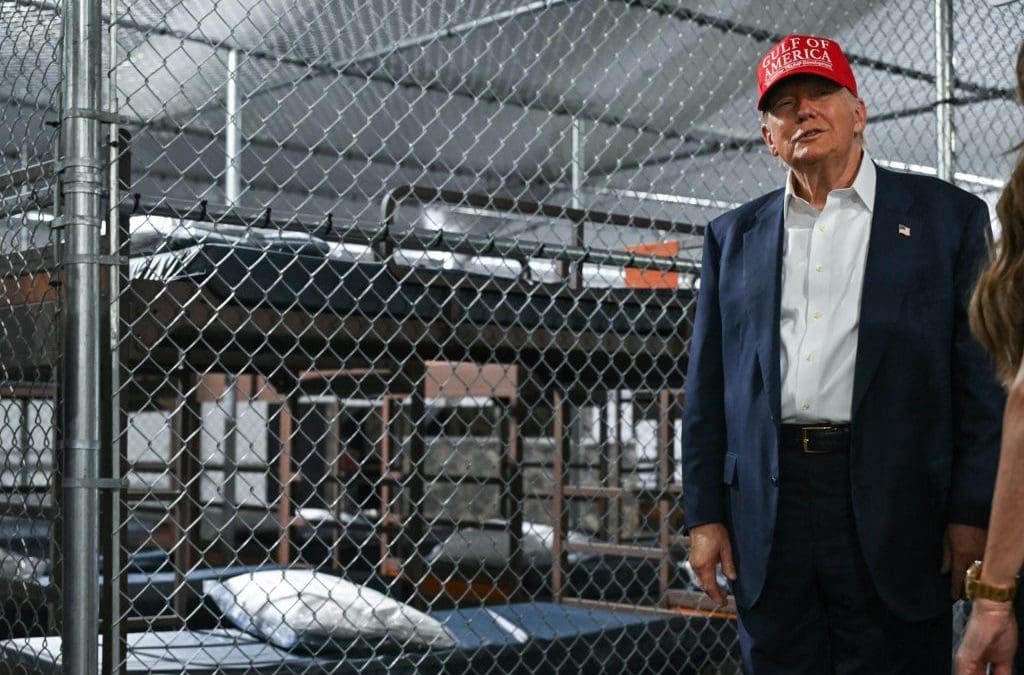
US President President Donald Trump tours a migrant detention center, dubbed

The 11th Circuit Court of Appeals has halted the imminent closure of the infamous “Alligator Alcatraz” detention camp in Florida; now, the future of the facility, and the people incarcerated within it, remains in limbo. “But no matter the future of Alligator Alcatraz, the Trump administration is turning it into a model for expanding detention capacity across the country,” Shannon Heffernan and Beth Schwartzapfel report at The Marshall Project. “Similar large-scale facilities, opened in collaboration with state governments, are already in the works. These projects mark the first time that states have gotten this involved in large-scale immigration detention.” In this episode of Rattling the Bars, host Mansa Musa speaks with Heffernan about how the Trump administration, in collaboration with state governments, is expanding the US system of mass incarceration to unprecedented levels.

Guest:

  • Shannon Heffernan  is a staff writer at The Marshall Project whose work focuses on prisons and jails across the US, as well as sexual and gender-based violence, immigration and mental health, and how arts and culture shape (and are shaped by) crime and punishment.

Additional links/info:

Credits:

  • Producer / Videographer / Post-Production: Cameron Granadino
Transcript

The following is a rushed transcript and may contain errors. A proofread version will be made available as soon as possible.

Mansa Musa:

Welcome to this edition of Rattling the Bars. I’m your host, Mansa Musa. Today we’re talking about detention centers, zombie prisons, and alligator Alcatraz. Joining me today is Shannon Heffernan, an award-winning reporter and fiction writer whose works focused on prisons and jails across the United States. Her recent reporting include two major pieces. The next alligator Alcatraz could be in your state, which looks at the controversial ICE Detention Project in Florida and zombie prisons about how ICE is bringing shuttered facilities back to life. Shannon, welcome to Rallying the Bars.

Shannon Heffernan:

Thank you so much for having me. I’m happy to be here.

Mansa Musa:

Let’s start with the next alligator. Alcatraz could be in your state. Okay. So construction on Alligator Alcatraz was stopped because a lawsuit was filed saying it had a environmental detriment, and so it was stopped. Based on that, walk us through how that came about and what’s going on with that now.

Shannon Heffernan:

Sure. So a couple of groups, some environmental groups as well as some indigenous tribes. Our a indigenous tribe bought a lawsuit against Alligator Alcatraz because of environmental concerns. They essentially said, this is a federal facility, it should follow federal laws, and it’s not done the proper environmental review. Originally, a court did halt that. However, very recently an appeals court has lifted the halt on alligator Alcatraz, so it moves forward. All of this is going to continue to play out in courts. We don’t know where it will land for alligator Alcatraz, but I do believe that this all has implications beyond what’s happening in Florida for states across the country. And no matter what happens at Alligator Alcatraz, I think it gives us some insight into the strategies that the federal government wants to use to increase immigration detention across the United States.

Mansa Musa:

In terms of the conditions in alligator Alcaraz, I recall reading some things where one is beyond the environmental aspect of it, the impact it has on environment, but the impact it has on human, human beings, people that’s being detained in there. And I seen a picture of how it’s designed and the way it’s designed is designed like with multiple bunks and cages and tents. In your report and in your gathering your information, what can you say about the conditions of alligator ture?

Shannon Heffernan:

Yeah, there’s been some pretty big complaints about the human conditions there. You’ve had people complaining about food not being edible. You’ve had people complain about their access to legal representation. You’ve also had people complaining about how difficult it is to even find if somebody is incarcerated at alligator Alcatraz. They weren’t showing up in the federal system. They also weren’t showing up in the state system. So it was hard to locate folks. It became this kind of black hole. The federal government has denied some of those claims in terms of how bad the living conditions are, but there have been multiple reports from people who are incarcerated there as well as civil rights lawyers representing their case,

Mansa Musa:

Talk about the law that gives them the right to detain people, and if you can juxtapose that against what is actually taking place now.

Shannon Heffernan:

Yeah, so I think this is a really important point that I heard from legal scholars I’ve been speaking to about immigration detention. Technically, immigration detention is not supposed to be punishment. It is different in that way from what you see in the criminal system, at least in terms of the law. That said, you see these places not only having troubling conditions like you’ve mentioned, but being given these names that raise the specter of them being frightening places. Alligator Alcatraz, you now see that they want to send people to Angola, a place that has a long history of problems and lots of associations with abusive treatment or the so-called speedway slammer in Indiana. So I think that it seems to be clear that officials are really raising the spectra of these places, being places you don’t want to go, that would be punitive. So I do think there’s that gap between what you hear legal scholars saying immigration detention should be, and then actually how it plays out and what it does.

Mansa Musa:

And you mentioned speedway slammer, and then the fact that AIN going is known for its plantation style facilities, but more importantly, we had the opportunity to talk to some people relative to crop dusting and when they come around and crop dust, whether or not it has an effect on going into the cell blocks. And so in terms of your investigation, how do you see that playing out? Because you mentioned earlier that this what we see now taking place in alligator Alcatraz is ominous a whisk to come down the pipe in terms. Talk about that.

Shannon Heffernan:

So I mean, I think that there’s a couple of things to consider. I mean, I think generally there’s the issue of detention increasing across the United States and what that means for conditions. But specifically what I meant when I talked about that is there’s a strategy that the federal government is now using to specifically get state governments involved in alligator Alcatraz. As I said, this is a state run facility. You see what’s happening in Indiana, in Nebraska with the so-called corn husker clink with Angola and Louisiana, that there are these collaborations with states to do that. And so why would that matter? Why would that matter? Right. Well, when it’s fuzzy who’s in control, a lot of the experts I spoke to about this says that makes accountability much harder. It sets up conditions that are really ripe for abuse, and we already know that there have been problems with conditions and immigration detentions for a long time, and I think what folks are arguing is this just creates a really fertile ground for that to happen even more and an even more extreme way. The collaboration with states, I think also could potentially free up resources for the federal government to do this even more other places. You’ve had the DHS secretary, Christie Noam saying that this strategy of working with states is actually becoming her preferred method instead of working with private prisons. And why is that? Because she says she thinks it’s cheaper, she thinks it’s more efficient. Instead of having to sign long-term contracts, she can sign these shorter term contracts.

She didn’t say this now, but this is me, at least she hasn’t said it that I’m aware of. It also would give her access to a workforce that might not otherwise be available because it comes from the state or buildings that might not otherwise be available because their own bar state. So if the United States government really wants to up the number of people who they’re detaining and then eventually deporting, which they’ve said that is their goal, collaborating with states on this level is something that can help them do that. I think it’s really important to note that this is unprecedented. Local governments have played a role and immigration detention in the past. For example, local jails rent out their beds to ice, but you haven’t really seen it on this scale. We’re talking about massive, massive facilities that are supposedly under the state’s control, although I think that there’s some complications and nuance there about how much they’re under the state versus the federal control.

So this is something we’ve not really seen at this scale before in the United States and is definitely worth paying attention to. I also think it speaks to a larger idea that I think we really need to be wrestling with and thinking about, which is how our country’s history of mass incarceration is actually deeply tied to what you see happening with immigration right now. These facilities are available and built because the United States has a long history of incarcerating large numbers of people. When you saw criminal justice reforms in the last decade, some of those facilities began to be shut down, either because places were shrinking, their prison population changes to parole or sentencing, or because the facilities were simply deemed too terrible, too harsh of places to put humans into. But after those facilities closed, the buildings weren’t destroyed and now you’re seeing them reanimate it for use by immigration detention.

And I think that’s really important to notice because in the same way that they’re being moved from the criminal system to the immigration system right now, once this system is built, once the system is fortified, you can see it being deployed against other populations. Once the infrastructure is there, there are financial incentives to keep them going. So when we see immigration detention getting bigger and bigger, I think there’s a question of like, well, what does that mean for the next decade in the United States? I think it’s something, it’s going to be a legacy that is likely to continue beyond just this present moment.

Mansa Musa:

Do immigrants people that’s locked up under the Immigration Nationalization Act, do they have constitutional rights? Do they have the protection under the eighth amendment, the cruel, unused upon the 14th due process, 14th amendment due process? Do they have these rights of once they’re locked up, do they have the same rights that United States citizen had or are they just put detained and then when they determine where they’re going to send ’em, they pack ’em up and fly ’em to wherever state or country they want to take ’em to?

Shannon Heffernan:

So there are standards that are supposed to be met in these detention centers. I think the question is, regardless of what the standards are, if you don’t have oversight, then it doesn’t matter. If you don’t have enforcement, then it doesn’t matter. And we’ve seen a real decimation of the systems that have historically provided oversight in these facilities. If you can’t prove what’s happening inside, it becomes really difficult to hold those systems accountable. And in addition to some of the groups that were supposed to watch dog detention centers shrinking or ending, you also have lawyers less able to access their clients in these facilities, which means the word is getting out less about what’s happening there. So I think it’s a real challenge and it’ll become an increasing challenge to make sure that what’s happening inside these detention centers is meeting basic humanitarian standards.

Mansa Musa:

And I think that based on everything that’s being done, and I did 48 years in prison before I got out, and I did, and I served time in some antiquated elaborated involvements, but I’m looking at what’s going on here. These ain’t no detention. These are basically concentration camps. They’re holding them, pinning, sending them somewhere else, but they’re holding them under the most inhumane conditions known to man at this time. But let’s talk about how the next article you wrote was Zombie Prison. I want to shift there, and you made very astute observation on this. What we’re seeing now is how their practice is in terms of how they establish this prison industrial complex, the infrastructure, how they mapping it out in terms of finding places, putting people, finding places, putting people, finding places, putting people, talk about the zombie prison, how ice detention is raising troubled facilities from the dead.

Shannon Heffernan:

Yeah, so we’ve seen a number of facilities that used to be prisons and got closed down reopening now as ice detention centers. And I think that’s important because in some cases these facilities closed for a reason. Either the infrastructure is in poor shape or the staff there were treating people poorly, for example. And now I think the real question is how are they going to ensure that’s not repeated for immigrants? I also think that that really illustrates the question of detention’s not supposed to be punishment.

Then why are places that were prisons able to handle these populations? Why are they equipped? Why are the places that we’re going to send these folks? As you know from your understanding of prisons, a lot of these facilities are in fairly remote locations. They’re hard to get medical care too. They’re hard to get translators to, they’re hard to get legal help to. So just by the geographic location, you’re already setting up a real challenge in terms of people getting what they need. I want to go back to something you said before, which is you were talking about the poor conditions in these places before they deport people. I think there’s a real connection between the conditions and deportations themselves. We’ve spoken to immigrants who are inside some of these facilities who want to stay in the United States and who may even have credible legal paths to staying in the United States, but they’re choosing to leave.

They’re choosing deportation over those legal battles because they are so disturbed by the conditions that they’re experiencing that they want to leave and they want to get out. So the conditions have, in the same way that you have people talk about people confessing to crimes that they maybe do not commit because they want to get out of jail, right? Because bail’s not available to them. The conditions are so terrible. I would say this is sort of analogous to that. People who may have credible claims to stay in the United States choosing to leave anyways because the conditions are so abysmal that they don’t feel like they can stay there safely.

Mansa Musa:

Talk about where we stand in terms of advocacy, what we have to do or what people need to do, what people need to understand about fighting back. Because I think Angela Davis say, if they come for me in the morning, they’ll come for you night. So the coming is coming. It’s just a matter of how they change the narrative on how they identify why a person or class of people fit up under the statute to say that you are a danger to the security of the United States, therefore you can be detained as an illegal immigrant even though you are a United States. Talk about the pushback, how we fight back or how to fight back.

Shannon Heffernan:

As you alluded to the so-called big, beautiful Bill gave a huge infusion of cash into immigration detention and deportation. So I suspect we’re going to continue to see efforts to grow this machinery from the federal government. I think one big challenge that advocates and activists are up against is historically under other administrations, immigration, detention and deportation was also a problem. This has gone across both parties. It’s not just unique to the Trump administration, but one thing that I think was really different is some other administrations would be shamed into action when there were reports of bad humanitarian treatment. They didn’t want that to be what it appeared to be on the outside. They wanted to appear friendly and nice. So if activists or advocates or the media showed bad conditions, there would be some thought that that would result in an action because they didn’t want to be perceived that way. But I think we’re under an administration now where that specter of it being terrible, that specter of it being cruel is something that they’re less afraid of. I mean, you have them naming these facilities, things like alligator, Raz,

Which have a connotation of the conditions themselves being poor. So if you’ve relied on a strategy in the past that if you expose harm, if you expose things being terrible, that’s going to result in action, I think that’s a strategy that you’re going to see work a little differently now under the current administration, and it’s going to require different ways of operating for activists and advocates. I think another challenge is just moving at a really, really quick speed. How quickly the administration has been able to get these places up and running is really quite astounding. Now, I say all that with those challenges. I do think it’s also important to note that this has gotten a lot of attention. You have seen a lot of activists and advocates being motivated towards action. So people are in motion across the United States resisting this and showing

Mansa Musa:

Up. And I think another problem that we are confronted with as we moved in opposition, you hit on it the speed at which they’re doing it, but in every regard in terms of the amount of money they put into it and the countries that they looking at putting money into these countries, telling them like El Salvador was the test case and say, I’m going to give you money to house these prisons. I’m going to give you money. And came out and said, yeah, I’m with this. Whatever you want to send, however you want to send. Now they talking about going to different African countries or other third world countries to pay them to take people. Talk about going forward, how do we look at it from the legal landscape? Because right now, as it stands right now, it seems, and I raised this earlier, it seems like the courts don’t have jurisdiction over the treatment aspect of it that’s being litigated. It is cruel and unusual punishment. It’s inhumane. So is it a United Nation thing or is what? Talk about that. This is mind boggling. I know our audience would probably saying the same thing if this was done to United States prisoners, at some point in time the court going to intervene because we got constitutional rights to be treated a certain way. But when it comes to a person that’s they done dub illegal immigrant, a non-citizen to that non citizenship mean I can treat you like inhuman and with impunity.

Shannon Heffernan:

So there are legal challenges that have been brought and will play out in the courts, and I suspect that will continue. I think one of the things you really have to think about when you’re talking about these legal challenges is the law is created by humans and the law is enforced by people in power. And what the law means is decided by courts, and as you’ve seen some of these cases work their way up, you will see the courts siding with where their political affiliations are. I mean, courts aren’t supposed to do that, but there’s a range in what judges can decide. So we know what the Supreme Court looks like right now as these cases reached that the question is regardless of how the law has been interpreted in the past, what is the law itself capable of doing right now? In the same way that I talked about the specter of cruelty being a little bit differently, I also think the specter of what the law will and won’t do is something that’s really in flux right now under the current administration. So I think that’s something that definitely is worth paying attention to.

Mansa Musa:

And as we close out, tell our audience how they can stay on top of your reporting because it’s definitely impactful in terms of really focusing on the issues and informing people about what is the real news versus fake news. So talk, how can our audience stay intact?

Shannon Heffernan:

Sure. So you can read my work@themarshallproject.org. I’m also on Blue Sky, and we would love to hear from all of you about what you’re seeing on the ground and what kinds of recording you think we need to continue to do. We are especially interested in looking at ways that the criminal justice system overlaps with the immigration system because we think that’s going to be really key going forward.

Mansa Musa:

Alright, thank you. And as you said earlier, I just want to close on this point. So we ask that as you look at this information that Shannon put out, we ask that you follow her lead in terms of letting them know some of the things that are going on with your views on these things, what you witnessing.

But more importantly, we ask that you take a critical look at what’s going on in this country because it’s not a matter of what I like someone or don’t like someone, it’s a matter of whether or not a person should be treated as a human being. This is about treating people as human beings. It’s not about treating people as animals because they’re not United States citizens. This is about treating people as human beings, what the Statue of Liberty says, the Statue of Liberty right now would be taking the mass off and running down the water. As you see what’s going on in this country, we ask that you continue to support the real news and rally the bar. We ask that you look at this information, give your views on it, critique it, and let us know what you think. And we’ll definitely echo your voice because we don’t give you a voice. We just turn the volume up on your voice.

Original

‘We’ve got four public prisons and one private prison closed’: CA abolitionist coalition takes on the prison-industrial complex

‘We’ve got four public prisons and one private prison closed’: CA abolitionist coalition takes on the prison-industrial complex

After years of pressure from community members and a coalition of over 80 organizations, the California Department of Corrections and Rehabilitation has announced plans to close the infamous California Rehabilitation Center in Norco, CA, by the fall of 2026. But organizers say this is just the beginning—they are fighting to close more prisons in California and prevent the government from re-opening shuttered facilities for immigrant detention. In this episode of Rattling the Bars, host Mansa Musa speaks with Woods Ervin of the grassroots organization Critical Resistance about California’s prison system and the growing abolitionist movement working to dismantle it.

Guest:

  • Woods Ervin is the National Co-Director of Campaigns and Projects at Critical Resistance, a national grassroots organization seeking to build an international movement to end the prison-industrial complex.

Additional links/info:

Credits:
Producer / Videographer / Post-Production: Cameron Granadino

Transcript

The following is a rushed transcript and may contain errors. A proofread version will be made available as soon as possible.

Mansa Musa:

Welcome to this edition of Rattling the Bars. I’m your host, Mansa Musa. Today we are discussing California’s prison system and the abolition movement working to dismantle it. Joining me today is Woods Ervin. She’s the National Co-Director for Campaigns and Projects at Critical Resistance, an organization founded in the mid 1990s with the mission of ending the use of prisons and police. Woods, thank you so much for joining me today.

Woods Ervin:

Thank you so much for having me today, Mansa. I appreciate it.

Mansa Musa:

Recently the California Department of Correction and Rehabilitation announced that the California Rehabilitation Center or CRC in Norco will close in the fall of 2026. Now, CIC is known for the most inhumane conditions as it relate to road infested unsafe drinking water, severe overcrowding, stifling heat and violence at the hands of the staff. Can you walk us through how this came about and were there any unlikely alliances that emerged in the fight to close prisons that people might learn from when building coalitions?

Woods Ervin:

Thank you so much. So that’s a really great question. So just to take us back a little bit to 2020, Critical Resistance joined a campaign, a coalition that was leading a campaign to close 10 prisons by 2025, feeling ambitious, it was 20. And the coalition is actually in an alliance. The California is United for Responsible Budget.

And at the time around 2020, we heard from the legislative analyst office, which is a bipartisan research office within the California state infrastructure that at the very least five prisons could close without impacting the imprison population. Just with all of the work that we’ve been doing to get people out of prison over the last decade, the population had gotten to that point. So we launched this campaign and had moved a few prisons towards closure, but we were focusing on the person who had the decision making power ultimately, which was Governor Newsom. And he was just making choices around whatever prison he saw fit to close, I think in relationship to or talking to CDCR, but not necessarily to us. And so even though we knew that Gut Newsom does have the final say in whether or not our prison closes, we also thought that everyday people should also get a say in how dollars are spent.

So we decided to engage in a site fight just to sort of test our power, our ability to be able to name a prison and then have that prison get shut down. So when we first started the campaign, it was based in what we called the People’s Plan for Prison Closure, which was a research project that Curb did back in 2019 or 2028 where they interviewed hundreds of imprison people across the state. What were the prisons that were most toxic? And given everything you listed initially, clearly CRC Norco was one of the prisons at the top of that list. So we pulled 10 prisons and we were just like between people inside wanting the prison to close. And we had heard that there were pushes from the city council and the mayor to close the prison as well. And we thought that might be good conditions for trying out focusing on CRC Norco to get it to close.

So we did the sort of, I think some of the usual things around grassroots organizing where we, and agitated our base of supporters to send the governor letters for closure or advocating for closure. We did also engage in mobilizations to CRC Norco as direct action and also we organized with interfaith movements. So a bunch of churches from across the state that would mobilize to Norco, they did a pilgrimage of the direct action as well to show their opposition to Norco support for people inside and the desire for it to close. But we didn’t want to stop there. We did some organizing outside of the prison, which looked like what we call parking lot outreach days. So with the goal of organizing the families of people

Mansa Musa:

And not to cut you off and that was onsite at the institutions. When you say pa, alright, go ahead. That’s

Woods Ervin:

Every weekend when folks would visit their family members inside we would have a table with food and water and iceman outside. And so the goal was to one, just generally support family members of people who were in CRC Norco and then also to let them know about the campaign to encourage them to join if they were interested in doing so. And we were hoping to also then set the groundwork so that if we did win the closure of CRC Norco, then we would be prepared to mobilize with family members on that. Right,

Mansa Musa:

Right. And you just described organizing 1 0 1 in terms of going where the people are because as you said, y’all got this strategy to close it. But now we looking at conditions that shifted in this country in the interim of what you just said, the mentality has shifted. Now we have the raise on people, rounding people up, ice rate rounding people up because they’re now United States citizens. So we see that. How are y’all looking at alright, the close of these prisons and not allowing them to become a repurposed for federal detention and ice? Is that a part of y’all plan? Because Governor Gavin Newsome signed AB 1 37 to prevent ICE from acquiring closed facilities. Has this legislation been effective in stopping the federal government from taking over sites like FCI, Dublin and Chaco Walla Valley State Prison?

Woods Ervin:

Right on. So we’re definitely excited to have been able to push for AB 1 37 to get passed and that to include some of the language that would allow for prisons that we get closed to not be able to be sold to the federal government. Just like you were saying, 2020 when we started the campaign, it was a different moment when we knew in the fall of last year when Trump got elected and was spouting all the anti-immigrant rhetoric that we needed to get ahead of the issue with prisons being converted to detention centers. So the legislation AB 1 37 currently says that the state has to name a building as excess to fall into the status of not being sold. And while that is one step forward, that does then bring about a lot of challenges in terms of it’s implemented, right? So what the prisons you were speaking to Chuck Wall Valley State Prison is not currently named as excess. So we’re organizing our base to send letters to the governor to move it into that category. But we’re also thinking about this next legislative cycle. How do we figure out ways to either strengthen the legislation via amendment or if there are ways administratively to figure out some supporting the interpretation of the legislation to a little bit one more automatic, it shouldn’t be that we have to fight for every prison that we get closed to then get named as excess so that we don’t have to worry about it getting sold.

And two, so that it’s just broader. So it covers as many of the facilities that get closed as possible. Unfortunately with a case of something like FCI Dublin, which was a federal facility, so it was already federally owned. So AB 1 37 doesn’t cover it, right? Federal property. So there’s no need to exchange hands in terms of ownership,

Mansa Musa:

But there’s always the question, when a prison closed, does it actually mean the conservation, are people being released or are they simply being transferred to another jail or prison? And in that regard, we are looking at the impact of the closure. Talk about the impact of closure when y’all made y’all analysis, how y’all tracking that?

Woods Ervin:

Yes, I can definitely speak to that. So how we’re approaching this is rooted in the answer to your first question because some of our grassroots organizing was not just with people on the outside, it was also on people with people on the inside,

Mansa Musa:

Right?

Woods Ervin:

Okay. We organized with people on the inside about if we were successful in getting Norco name for closure, what would they want to see? How would they want us to approach it? And so really at the top of their desire was for us to move for releases and not transfers. So already a lot of us just wanted to get clarity on we want what’s the highest bar, but then if we don’t have the juice or the capacity to get CR to get our prison system to release everybody what then? And so even though we’ve been continuing to push for releases, not transfers, we’re also realistic about where is there some room beyond that? So what we’ve been trying to do is then also to have, if they are going to be transferring people to try and mitigate the harm as much as possible. So what we’ve looked at is we’ve been trying to push for our process for our prison system to assess eligibility for release and create reentry plans, push for autonomy and choice in the transfer process.

So we know that especially when thinking about programs like programming for folks inside, we’re trying to, there’s a penal code 2030 3.7 in California that should allow for people in prison to choose to be able to continue programming at their next facility. But that will require that the facility that they move to have that program program, right? So we’re pushing for in accordance with law people should be moved to a prison, continue to program and also other things like people should have adequate prep time and in planning and advance the transfer and clearly everything else maintain adequate levels of medical assistant food stocks and space to avoid overcrowding. And so those are some of the things that we are pushing for as part of our ultimate goals release is not

Mansa Musa:

Transferred.

Woods Ervin:

If they’re not going to fully comply with that, we have other demands in addition to that.

Mansa Musa:

I like the strategy because it’s interconnected. You close the prison and you create a transitory environment, then that means that okay, I go from maximum security to medium security to minimum security to pre-release if that’s a system that exists in California. But ultimately I don’t stay in one secure environment. My behavior is now allow me to be able to progress through the system. Whereas though before I’m just, I need a plantation, I need numbers. One of the numbers that need to be on the plantation versus ain’t no more plantations. So we close them. That mean we got to do something with the people and I like that strategy. So that’s all power to the people in that regard. Another factor here is that we had did a story on North Carolina and we found in our study, in our investigation that a lot of prisons in environments where if you got fires, floods when it rains and they don’t have a contingency plan for preparation to move people into a safer environment or close the prison and then have the people move to a more secure environment or process them out. Can you speak to that?

Woods Ervin:

That’s exactly right. I think we saw this back in I think 20 21, 20 22 during the fires, the fire, right? Exactly. In Susanville and we were pushing a closed California correctional center at the time. And at the time, just like CIC Norco, California Correctional Center did not have an emergency plan even though the fire was heading directly towards them. And so we literally had to intervene because family members were calling us and they didn’t know what was going to happen to their loved ones. So because the prison system didn’t have an emergency plan, a contingency plan for that, we were like not only do we need to manage the outside advocates, we have managed this situation when CDCI has all this money to do that, but then also this prison needs to close immediately. Right? Right,

Mansa Musa:

Exactly.

Woods Ervin:

That was a blatant and clear example of the inability for them to keep people inside safe.

Mansa Musa:

It’s only because of the advocacy of families and people much like y’all cells that bring this to national attention. That makes it an issue that has to be dealt with in a more humane manner. Fine. Let’s touch on the broad economic picture. California is basically facing a deficit now. I was looking at how much money in the 20 24, 20 25 fiscal year. They estimated 18.1 billion for that fiscal year. Alright. Talk about perhaps repurposing the facilities. Will it help strengthen the state economy, especially given the outgoing hostility from the Trump administration? So we find ourselves in a situation where you close in prison. Okay. How was this closing and repurposing those facility help strengthen the state’s economy? What’s the economic impact?

Woods Ervin:

I love that question. I let you ask the question. So essentially there are a couple of things. So there is the fact that there’ll be less wasteful spending. So prior to the closure of CRC Norco, California spent 250 million on repairs as we said earlier is in terrible condition. So 250 million on repairing CRC Norco that in a way that wasn’t effective given the state of the prison,

Mansa Musa:

Right? Right, exactly.

Woods Ervin:

We want to stop our prison system, our state from pouring the state’s resources into these dilapidated prisons that need to be closed and have our folks released. So that’s like baseline, right? So also as a result of this continuing trend downward of the population, so the population reductions that have been happening inside of prison, the legislative analyst office shows that California is in a position to close five more prisons and that would save 1.5 billion annual, yeah,

Mansa Musa:

1.5 billion

Woods Ervin:

Foreseeable future. And that can be put towards the deficit, but if as it currently stands, but it can also support some of the gaps in Medi-Cal food services

And other programs, housing exactly. That are being slashed in this moment. There’s also this really interesting opportunity. So as I was saying earlier, the prison system CDCI has no plan whether it be for emergencies or for the prison closure. So what did we do? We came up with a plan and we were like, here’s an example of what we could be doing with as part of prison closures. So we are pushing for the state to not only close prisons permanently and not reopen or sell them, but then to try and transform the conditions of the prison. So that could be tear it down, use it for something else

Like detoxify the land, give it back to the local communities, right? Give it back to put it into a program for reparations or back to this communities we’ve been working with. So that’s one example of what we could do. We’ve been working with an organization called Designing Justice, designing Spaces that does redesigns for prison facilities that could be turned into lots of other things that are generative for the local economy. And clearly from the funds that gets saved from the prison being closed that would’ve gone to that prison, could go back into the general fund at the state level, but then be set aside for the county to make decisions about their local economy and youth. Norco is a particular case. That county is relatively wealthy and conservative, so they actually don’t need the money to do what they want to do with the prison after it shuts down. So what we’re advocating for in that instance is, or instances like these and in general is that the money that would go to that, there’s money that could go to counties, but there’s also the money that should go to the counties. So there’s the counties that the prison is located in, but then there’s counties where the majority of imprison people come from like LA County and there should be more resources going to where the people who are locked up the most come from,

Mansa Musa:

You can divide that like you say, it is equity, economic equity because you can divide that money up in two places where it can be served the most in terms of advancement of humanity. And that’s a good strategy to counter what the Trump administration is doing. They throwing a lot of money to the states and it’s not being regulated. I’ll give you 1.9 billion or I’ll give you like 1.5 million and you just do this right here for me. And whatever happens in terms of being regulated, if you knock somebody’s brains out, if you put people in thumb locks, it don’t really matter to me as long as you contain that population that I wanted to put in that space for closing first, we want to thank you for coming to the real news and rallying the bars. Tell us about going forward, what you want our listeners and our viewers to be on the lookout for coming out with the critical resistance space.

Woods Ervin:

Yeah, I mean, thanks again so much for having me. And the fight continues. We’ve got four public prisons and one private prison closed. As I said earlier, we’re still going to keep trying to make sure that those prisons that we close don’t get turned into something we don’t want them to get turned into that the money goes where it needs to go. And then we still have five to six additional prisons that we want to get named for closure. And according to legislative analyst office, even though there’s been, as you were saying, the landscape has shifted and there’s more of a sort of tough on crime approach that is gaining popularity in moment, there is still room to close many more prisons in California and just given the amount of people that we’ve been able to get out and that we could potentially still get out and so we’re going to, are going to keep fighting. It would be amazing if we got the 10 prisons, the rest of the name this year. But I definitely think that even if they don’t get named this year, we’re going to fight until we reach our goal.

Mansa Musa:

And I want to close with the immortal words of Bob Marley, get up, stand up. Stand up for your rights. Get up. Stand up. Don’t give up the fight. And I see from what I’m seeing in California, George Jackson say, when the doors open, the real dragon will come out. Well the real dragon is out in the form of critical resistance in the form of curb. The real dragon has come out and make no mistake about y’all are actually showing the nation, when we say abolition, what that look like in terms of the full colony of it. Not just shutting the prison doors but ensuring that the people that’s in prison have a transition. The states and the counties. Well, the counties where the prisons, I have an opportunity to transition from relying on slave labor to looking at expanding your imagination, imagining some other than making money off of people’s sweat and browe.

Woods Ervin:

Thank you so much Mansa for having me. Thank you for being those very big kind words.

Original