by Mansa Musa | Dec 22, 2025 | holidays, Prison Industrial Complex, Prisons and Policing, Rattling the Bars, video
For incarcerated people and their families, the holidays are the most painful time of year. In this episode of Rattling the Bars, host Mansa Musa and TRNN Editor-in-Chief Maximillian Alvarez speak frankly about what it’s like to be locked up during the holidays, why inmate suicides, violence, and depression spike this time of year, and about the life-saving and society-improving steps we can take this holiday season to help prisoners maintain contact with the outside world.
Content Warning: Discussion of suicide and depression.
Producer / Videographer / Post-Production: Cameron Granadino
Transcript
The following is a rushed transcript and may contain errors. A proofread version will be made available as soon as possible.
Mansa Musa:
Welcome to Rattling the Bars. I’m your host, Mansa Musa.
Maximillian Alvarez:
And I’m Maximillian Alvarez, editor-in-chief of the Real News Network. As we reach the end of an impossibly long year, all of us here at the Real News want to wish you and yours a happy holiday season. Whether you celebrate or not, we hope that this time of year at least provides some time and space for you to rest and to be with the ones that you love. But of course, as we do every single year here, we also want to take this moment to remind y’all and to remind ourselves that there are so many people in this country right now who will not be able to be with their loved ones this year. The nearly two million human beings who are locked up in the United States of America right now. The tens of thousands of immigrants who have been sitting and rotting in ice detention, the vast
by Mansa Musa | Dec 8, 2025 | Prison Industrial Complex, prison reform, Prisons and Policing, Rattling the Bars, video
Fifty years into the era of mass incarceration, states like Arkansas, Montana, California, and Colorado are pushing to build new prisons and expand immigrant detention. In this episode of Rattling the Bars, host Mansa Musa talks with Nicole Porter of The Sentencing Project about how federal and state governments are doubling down on new prison construction and ICE contracts to expand the prison-industrial complex, what sets the US criminal justice system apart from other countries around the world, and how organizers are fighting for real prison population reductions instead of more cages.
Guest:
Nicole D. Porter, named a “New Civil Rights Leader” by Essence Magazine for her work to challenge mass incarceration, manages The Sentencing Project’s state and local advocacy efforts on sentencing reform, voting rights, and confronting racial disparities in the criminal legal system. Since joining The Sentencing Project in 2009, Porter’s advocacy and findings have supported criminal legal reforms in several states including Kentucky, Maryland Missouri, California, Texas and the District of Columbia. Porter’s areas of expertise include research and grassroots support around challenging racial disparities, felony disenfranchisement, in addition to prison closures and prison reuse. Her research has been cited in several major media outlets including Salon and the Washington Post, and she has appeared in the New York Times, Washington Post, and on National Public Radio and MSNBC.
Additional links/info:
The Sentencing Project website, Facebook page, and Instagram
Lisa Armstrong, Essence, “The new Civil Rights leaders”
Credits:
Producer / Videographer / Post-Production: Cameron Granadino
Transcript
The following is a rushed transcript and may contain errors. A proofread version will be made available as soon as possible.
Mansa Musa:
Welcome to this edition of Rattling the Bars. I’m your host, Mansa Musa. Today we have with us Nicole Porter.
by Mansa Musa | Nov 17, 2025 | Politics and Movements: US, Prison Industrial Complex, prison reform, Prisons and Policing, Rattling the Bars, video
The Alabama prison system functions like a modern-day plantation: overcrowded, understaffed prisons like Bullock Correctional Facility run on forced labor, violence, and deliberate neglect. In this episode of Rattling the Bars, host Mansa Musa speaks with journalist Matthew Vernon Whalan about his book Bullock: Chronicles of Deprivation and Despair in an American Prison, and about the systematic corruption and inhumane horrors endured daily by incarcerated people in Alabama.
Guest:
Matthew Vernon Whalan is a writer and oral historian living in New England. He is the author of the book Bullock: Chronicles of Deprivation and Despair in an American Prison, and his work has appeared in Counterpunch Magazine, Alabama Political Reporter, Scheer Post, Jacobin, Eunoia Review, New York Journal of Books, The Brattleboro Reformer, and elsewhere. He runs the publication Hard Times Reviewer.
Credits:
Producer / Videographer / Post-Production: Cameron Granadino
Transcript
The following is a rushed transcript and may contain errors. A proofread version will be made available as soon as possible.
Mansa Musa:
Welcome to this edition of Rattling Bars. I’m your host, Mansa Musa. In this country, we have the right to life, liberty, and the pursuit of happiness according to the Constitution. But in this country also, we have legalized slavery under the 13th Amendment. To understand what legalized slavery is, institutionalized slavery is, all you have to do is look to Alabama and the Alabama prison system. The prison industrial complex in Alabama is one of the most notorious systems in this country, I would even venture to say in the world. Join me today is Matthew Whalan. Matthew wrote a book called Bullock: Chronicles of Deprivation and Despair in an American Prison. Thank you for joining us today, Matthew.
Matthew Whalan:
Thank you for having me.
Mansa Musa:
Alright,
by Mansa Musa | Nov 10, 2025 | Politics and Movements: US, Prison Industrial Complex, Prisons and Policing, Racial Justice, Rattling the Bars, The Cultural Front, video
Rattling the Bars host Mansa Musa explores how a one-woman play, The Peculiar Patriot, reveals the human cost of mass incarceration and the enduring ties between slavery and the prison system. The artist behind the play, Liza Jessie Peterson, has worked with incarcerated youth for decades, bringing their stories to the stage and to national audiences. Performed in more than 35 US prisons and filmed at Louisiana’s Angola Prison—once a plantation, now a maximum-security facility—the play became the basis of the documentary, Angola: Do You Hear Us? (Paramount Plus / Amazon Prime). As the fight for abolition and prison reform gains momentum, this story reminds us that art is not decoration—it’s a tool for awakening, organizing, and freedom.
Producer / Videographer / Post-Production: Cameron Granadino
Transcript
Mansa Musa: Welcome to this edition of Rattling the Bars. I’m your host, Mansa Musa. In African tradition, we have what is known as the griot. The griot is a storyteller, but more importantly, the griot is one that translate our oral history into telling events, activities, and monumental accomplishments of African people. Today we have a griot, but more importantly, we have a revolutionary griot. We have a woman that has been inspired to take and tell the stories of African people that’s under the 13th Amendment, but more importantly to educate people about the humanity of these people that we call prisoners and to give them a space so their voices can be heard and the value can be turned up. Liza Jessie Peterson is an activist and actress, playwright, poet, author, and youth advocate who has worked steadfast with incarcerated populations for more than two decades. Her
by Mansa Musa | Nov 3, 2025 | Politics and Movements: US, Prison Industrial Complex, prison reform, Prisons and Policing, Rattling the Bars, video
From chronic overcrowding and inmate deaths to systematic abuse and lawbreaking by corrections officers, prison conditions in the state of Alabama have reached a crisis point. And yet, state leaders continue to push an “Alabama solution” that involves building more mega-prisons and expanding qualified immunity for officers. In this episode of Rattling the Bars, host Mansa Musa speaks with Dakarai Larriett, a Democratic candidate for US Senate in Alabama, about about the true cost of Alabama’s carceral crisis and his vision for an alternative vision of criminal justice.
Guest:
Dakarai Larriett is a community leader, entrepreneur, and Democratic candidate for US Senate in Alabama
Credits:
Producer / Videographer / Post-Production: Cameron Granadino
Transcript
The following is a rushed transcript and may contain errors. A proofread version will be made available as soon as possible.
Mansa Musa:
Welcome to this edition of Rattling the Bars. I’m your host Mansa Musa. We’ve been hitting hard on covering what’s going on down in Sweet Home, Alabama. We’ve been intentional about giving people a voice or turn the volume up on their voice about what they should be done in Alabama. What is the Alabama solution? This term came out of a documentary where prison system in Alabama was being highlighted, and when they confronted the governor with some of the realities of the abuse that was taking place in the Alabama prison system in general, and the fact that the United States Attorney General had issued a mandate that the conditions in Alabama were so horrendous that they had to do something about it, the governor respond was this is not a Justice Department solution. This is not the Justice Department responsible correcting.
by D Watkins | Oct 30, 2025 | Article, baltimore, Prison Industrial Complex, prison reform, Prisons and Policing, Reprint, The Cultural Front
This story originally appeared in Baltimore Beat on Oct. 28, 2025. It is shared here with permission.
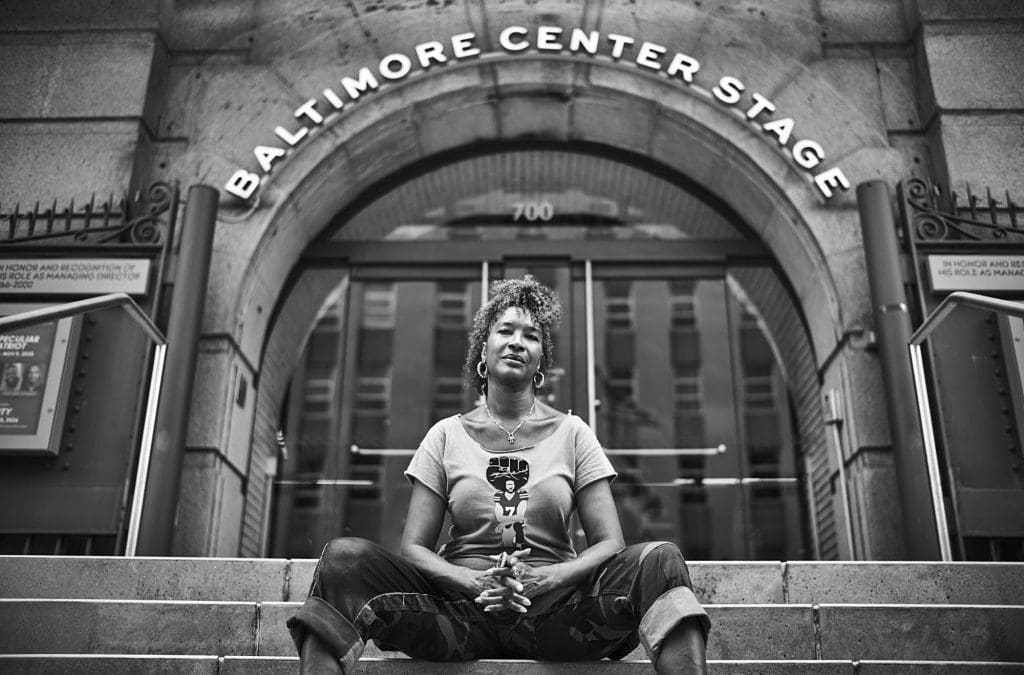
Poet, actor, and playwright Liza Jessie Peterson is bringing her one-woman play “The Peculiar Patriot” to Baltimore Center Stage. The Philly native believes it’s the right place and the right time for this story.
“There’s an energy here that just feels familiar, like home,” Peterson said. “I love bringing this piece here because I know that it’s a Black Mecca. The play speaks to our people in a real way. I’m excited to see how Baltimore is going to receive it.”
“The Peculiar Patriot” taps into the deep humanity that exists within the confines of mass incarceration. In it, Peterson portrays Betsy Laquanda Ross, who regularly visits her incarcerated best friend Joanne. The play takes place over a series of wild conversations between the women. Ross keeps her friend updated about what’s happening in the neighborhood, her own life, and in the outside world. The play is inspired by the 20 years Peterson spent working with teens at New York’s notorious Rikers Island.
Liza Jessie Peterson Credit: Devin Allen.
At Rikers, Peterson served as a poetry and GED teacher, program counselor, and re-entry specialist. Her time at Rikers not only taught her about the evils of the prison industrial complex, and the great capacity all people have for change — but it served as a creative catalyst. Out of it came a memoir, “All Day,” which Peterson published in 2017. She also wrote monologues that later evolved into this play.Peterson originally intended to debut the play off-Broadway, but like many Black artists who dare to aim mirrors at